Udayalakshmi D et al. Int. Journal of Engineering Research and Applications www.ijera.com
ISSN : 2248-9622, Vol. 5, Issue 4, ( Part -5) April 2015, pp.06-09
www.ijera.com 6 | P a g e
Design & Simulation of single frequency Rectangular Patch
Antenna by Using HFSS
Udayalakshmi D1
, Anuradha O2
, Alekhya K3
, S Nagakishore Bhavanam4
1, 2, 3
UG Students, Acharya Nagarjuna University, Guntur, Andhra Pradesh, India
4
Asst. Professor, Acharya Nagarjuna University, Guntur, India
ABSTRACT
An enhanced but simple single band Rectangular patch antenna is presented. This compact micro strip antenna is
obtained by inserting small coaxial feed in a Rectangular patch antenna. The antenna has been designed and
simulated on an RTduroid substrate with dielectric constant of 2.2 and thickness of 3.2mm.The design is
analysed by finite element method based HFSS simulator software (version 13.0).The simulated return loss
obtained is -31.4402db at 2.4GHZ respectively. Therfore this antenna is applicable for SHF band applications.
Keywords– Frequency, Gain, HFSS, Patch Antenna, Return Loss, Substrate, SHF
I. INTRODUCTION
In recent years there is a need for more compact
antennas due to rapid decrease in size of personal
communication devices. As communication devices
become smaller due to greater integration of
electronics, the antenna becomes a significantly
larger part of the overall package volume. This
results in a demand for similar reductions in antenna
size. In addition to this, low profile antenna designs
are also important for fixed wireless application. The
microstrip antennas used in a wide range of
applications from communication systems to satellite
and biomedical applications.
In order to simplify analysis and performance
prediction, the patch is generally
square,rectangular,circular, triangular, elliptical or
some other common shape .The rectangular
microstrip patch antenna is the widely used of all the
types of microstrip antennas that are present .The
substrate material, dimension of antenna, feeding
technique will determines the performance of
microstrip antenna. Among different feeding
techniques, coaxial fed technique is used for the
design of rectangular microstrip patch antenna at
2.4GHz.The substrate material mainly used for
design technique is Rogers RT duroid 5880(tm) with
𝜖r=2.2.The software tool HFSS is used because it is a
high performance full wave electromagnetic (EM)
field simulator for arbitrary 3D volumetric passive
device modeling.It integrates simulation,
visualization, solid modelling, and automation in
an easy to learn environment where solutions to your
3D EM problems are quickly and accurate obtained.
II. FEEDING TECHNIQUES
Different methods are available to feed
microstrip patch antennas. These methods can be
contacting and non-contacting methods. There are
many feed techniques but the four most popular
feeding techniques used are microstrip line, coaxial
probe (both contacting schemes), aperture coupling
and proximity coupling (both non-contacting
schemes).
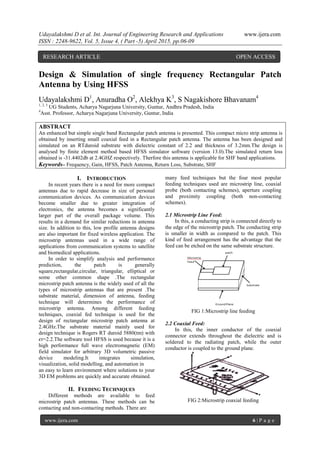
2.1 Microstrip Line Feed:
In this, a conducting strip is connected directly to
the edge of the microstrip patch. The conducting strip
is smaller in width as compared to the patch. This
kind of feed arrangement has the advantage that the
feed can be etched on the same substrate structure.
FIG 1:Microstrip line feeding
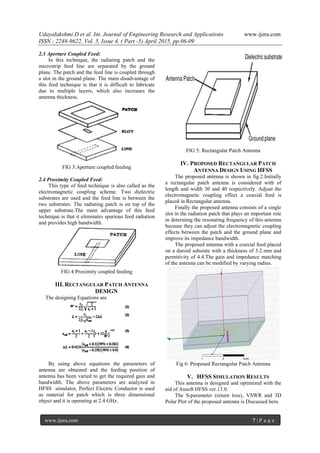
2.2 Coaxial Feed:
In this, the inner conductor of the coaxial
connector extends throughout the dielectric and is
soldered to the radiating patch, while the outer
conductor is coupled to the ground plane.
FIG 2:Microstrip coaxial feeding
RESEARCH ARTICLE OPEN ACCESS
Udayalakshmi D et al. Int. Journal of Engineering Research and Applications www.ijera.com
ISSN : 2248-9622, Vol. 5, Issue 4, ( Part -5) April 2015, pp.06-09
www.ijera.com 7 | P a g e
2.3 Aperture Coupled Feed:
In this technique, the radiating patch and the
microstrip feed line are separated by the ground
plane. The patch and the feed line is coupled through
a slot in the ground plane. The main disadvantage of
this feed technique is that it is difficult to fabricate
due to multiple layers, which also increases the
antenna thickness.
FIG 3:Aperture coupled feeding
2.4 Proximity Coupled Feed:
This type of feed technique is also called as the
electromagnetic coupling scheme. Two dielectric
substrates are used and the feed line is between the
two substrates. The radiating patch is on top of the
upper substrate.The main advantage of this feed
technique is that it eliminates spurious feed radiation
and provides high bandwidth.
FIG 4:Proximity coupled feeding
III. RECTANGULAR PATCH ANTENNA
DESIGN
The designing Equations are
By using above equations the parameters of
antenna are obtained and the feeding position of
antenna has been varied to get the required gain and
bandwidth. The above parameters are analyzed in
HFSS simulator, Perfect Electric Conductor is used
as material for patch which is three dimensional
object and it is operating at 2.4 GHz.
FIG 5: Rectangular Patch Antenna
IV. PROPOSED RECTANGULAR PATCH
ANTENNA DESIGN USING HFSS
The proposed antenna is shown in fig.2.Initially
a rectangular patch antenna is considered with of
length and width 30 and 40 respectively. Adjust the
electromagnetic coupling effect a coaxial feed is
placed in Rectangular antenna.
Finally the proposed antenna consists of a single
slot in the radiation patch that plays an important role
in determing the resonating frequency of this antenna
because they can adjust the electromagnetic coupling
effects between the patch and the ground plane and
improve its impedance bandwidth.
The proposed antenna with a coaxial feed placed
on a duroid subsrate with a thickness of 3.2.mm and
permitivity of 4.4.The gain and impedance matching
of the antenna can be modified by varying radius.
Fig 6: Proposed Rectangular Patch Antenna
V. HFSS SIMULATION RESULTS
This antenna is designed and optimized with the
aid of Ansoft HFSS ver.13.0.
The S-parameter (return loss), VSWR and 3D
Polar Plot of the proposed antenna is Discussed here.
Udayalakshmi D et al. Int. Journal of Engineering Research and Applications www.ijera.com
ISSN : 2248-9622, Vol. 5, Issue 4, ( Part -5) April 2015, pp.06-09
www.ijera.com 8 | P a g e
5.1 Return Loss
The Rectangular Patch antenna has return loss of
-31.4402 db at 2.4 GHz.
FIG 7: Return Loss
5.2 VSWR
The parameter VSWR is a measure that
numerically describes how well the antenna is
impedance matched to the radio or transmission line
it is connected to.VSWR must be less than 2.For this
antenna the VSWR reading is 0.4655.
FIG 8: VSWR
5.3 3D Polar Plot
FIG 9: 3D Polar plot
From polar plot it is clear that the radiations is
along Z direction.
VI. CONCLUSION
A single band Rectangular patch antenna is
presented in this letter. This antenna has a simple
structure which is easy to be integrated in miniature
devices. Results show that the frequency bandwidth
covers 0.0513GHZ with return loss of -31.4402db
where measured and simulate results are in good
agreement. Measured results show good impedance
matching. From above it is clear that the antenna will
work good in SHF band for satellite and Mobile
applications.
Acknowledgements
We are very greatful to Dr. P. Siddaiah ,
Principal of ANUCET for their support and
encouragement to write this paper. I am also thankful
to my friend K.Manideep for his support.
REFERENCES
[1] S Nagakishore Bhavanam, P Siddaiah,
Vasujadevi M “Printed Microstrip Compact
Antenna With Slots in Ground Plane And
Patch Using HFSS” in International Journal
of Engineering Research and Sports Science
, Vol.1, Issue.2, Feb 2014, pp.19-24.
[2] Vasujadevi M, P Siddaiah, S Nagakishore
Bhavanam,”Rectangular Patch Antena Aray
Design at 13GHz frequency Using HFSS”
in IEEE International Conference on
Computational Intelligence and Computing
Research. 978-1-4799-3972-5/14/$31.00,
Dec 2014, pp.43-46
[3] M Sekhar, S Nagakishore Bhavanam, P
Siddaiah, “Triple Frequency Circular Patch
Antenna”, in IEEE International Conference
on Computational Intelligence and
Computing Research. 978-1-4799-3972-
5/14/$31.00, Dec 2014, pp.1231-1233.
[4] H. Choi, S. Choi, H. Cha, “Structural health
monitoring system base On strain gauge
enabled wireless sensor nodes,” 5th
International Conference on Networked
Sensing Systems (INSS 2008), vol. 2(4),
Jun.2008, pp. 211–214.
[5] Gohil, J.V.; Bhatia, D., "Design of 2×1
circularly polarized microstrip patch
antenna array for 5.8 GHz ISM band
applications," Engineering (NUiCONE),
2012 Nirma University International
Conference in Ahmadabad, IEEE Publisher
on,pp.1-4,6-8 Dec. 2012.
[6] K. L.Wong, C. L. Tang, and H. T. Chen,
“Acompact meandered circular microstrip
antenna with shorting pin,” Microwave Opt.
Technol. Lett. 15,147–149, June 20, 1997.
Udayalakshmi D et al. Int. Journal of Engineering Research and Applications www.ijera.com
ISSN : 2248-9622, Vol. 5, Issue 4, ( Part -5) April 2015, pp.06-09
www.ijera.com 9 | P a g e
[7] Mittra, R., Li, Y. and Yoo, K “A
comparative study of directivity
enhancement of microstrip patch antennas
with using three different superstrates”
Microwave Optical Technology Letter,
volume 52,issue 2, 327–331, Feb 2010.
[8] T. Durga Prasad, K. V. Satya Kumar,
V.Santosh Kumar “Comparisons of Circular
and Rectangular Microstrip Patch,”
AntennasVol 02, Issue 04; July 2011.
[9] Richards, W.F. (1988) Microstrip Antennas.
Theory, Application and Design. Van
Reinhold Co., New York.

Design & Simulation of single frequency Rectangular Patch Antenna by Using HFSS

  • 1.
    Udayalakshmi D etal. Int. Journal of Engineering Research and Applications www.ijera.com ISSN : 2248-9622, Vol. 5, Issue 4, ( Part -5) April 2015, pp.06-09 www.ijera.com 6 | P a g e Design & Simulation of single frequency Rectangular Patch Antenna by Using HFSS Udayalakshmi D1 , Anuradha O2 , Alekhya K3 , S Nagakishore Bhavanam4 1, 2, 3 UG Students, Acharya Nagarjuna University, Guntur, Andhra Pradesh, India 4 Asst. Professor, Acharya Nagarjuna University, Guntur, India ABSTRACT An enhanced but simple single band Rectangular patch antenna is presented. This compact micro strip antenna is obtained by inserting small coaxial feed in a Rectangular patch antenna. The antenna has been designed and simulated on an RTduroid substrate with dielectric constant of 2.2 and thickness of 3.2mm.The design is analysed by finite element method based HFSS simulator software (version 13.0).The simulated return loss obtained is -31.4402db at 2.4GHZ respectively. Therfore this antenna is applicable for SHF band applications. Keywords– Frequency, Gain, HFSS, Patch Antenna, Return Loss, Substrate, SHF I. INTRODUCTION In recent years there is a need for more compact antennas due to rapid decrease in size of personal communication devices. As communication devices become smaller due to greater integration of electronics, the antenna becomes a significantly larger part of the overall package volume. This results in a demand for similar reductions in antenna size. In addition to this, low profile antenna designs are also important for fixed wireless application. The microstrip antennas used in a wide range of applications from communication systems to satellite and biomedical applications. In order to simplify analysis and performance prediction, the patch is generally square,rectangular,circular, triangular, elliptical or some other common shape .The rectangular microstrip patch antenna is the widely used of all the types of microstrip antennas that are present .The substrate material, dimension of antenna, feeding technique will determines the performance of microstrip antenna. Among different feeding techniques, coaxial fed technique is used for the design of rectangular microstrip patch antenna at 2.4GHz.The substrate material mainly used for design technique is Rogers RT duroid 5880(tm) with 𝜖r=2.2.The software tool HFSS is used because it is a high performance full wave electromagnetic (EM) field simulator for arbitrary 3D volumetric passive device modeling.It integrates simulation, visualization, solid modelling, and automation in an easy to learn environment where solutions to your 3D EM problems are quickly and accurate obtained. II. FEEDING TECHNIQUES Different methods are available to feed microstrip patch antennas. These methods can be contacting and non-contacting methods. There are many feed techniques but the four most popular feeding techniques used are microstrip line, coaxial probe (both contacting schemes), aperture coupling and proximity coupling (both non-contacting schemes). 2.1 Microstrip Line Feed: In this, a conducting strip is connected directly to the edge of the microstrip patch. The conducting strip is smaller in width as compared to the patch. This kind of feed arrangement has the advantage that the feed can be etched on the same substrate structure. FIG 1:Microstrip line feeding 2.2 Coaxial Feed: In this, the inner conductor of the coaxial connector extends throughout the dielectric and is soldered to the radiating patch, while the outer conductor is coupled to the ground plane. FIG 2:Microstrip coaxial feeding RESEARCH ARTICLE OPEN ACCESS
  • 2.
    Udayalakshmi D etal. Int. Journal of Engineering Research and Applications www.ijera.com ISSN : 2248-9622, Vol. 5, Issue 4, ( Part -5) April 2015, pp.06-09 www.ijera.com 7 | P a g e 2.3 Aperture Coupled Feed: In this technique, the radiating patch and the microstrip feed line are separated by the ground plane. The patch and the feed line is coupled through a slot in the ground plane. The main disadvantage of this feed technique is that it is difficult to fabricate due to multiple layers, which also increases the antenna thickness. FIG 3:Aperture coupled feeding 2.4 Proximity Coupled Feed: This type of feed technique is also called as the electromagnetic coupling scheme. Two dielectric substrates are used and the feed line is between the two substrates. The radiating patch is on top of the upper substrate.The main advantage of this feed technique is that it eliminates spurious feed radiation and provides high bandwidth. FIG 4:Proximity coupled feeding III. RECTANGULAR PATCH ANTENNA DESIGN The designing Equations are By using above equations the parameters of antenna are obtained and the feeding position of antenna has been varied to get the required gain and bandwidth. The above parameters are analyzed in HFSS simulator, Perfect Electric Conductor is used as material for patch which is three dimensional object and it is operating at 2.4 GHz. FIG 5: Rectangular Patch Antenna IV. PROPOSED RECTANGULAR PATCH ANTENNA DESIGN USING HFSS The proposed antenna is shown in fig.2.Initially a rectangular patch antenna is considered with of length and width 30 and 40 respectively. Adjust the electromagnetic coupling effect a coaxial feed is placed in Rectangular antenna. Finally the proposed antenna consists of a single slot in the radiation patch that plays an important role in determing the resonating frequency of this antenna because they can adjust the electromagnetic coupling effects between the patch and the ground plane and improve its impedance bandwidth. The proposed antenna with a coaxial feed placed on a duroid subsrate with a thickness of 3.2.mm and permitivity of 4.4.The gain and impedance matching of the antenna can be modified by varying radius. Fig 6: Proposed Rectangular Patch Antenna V. HFSS SIMULATION RESULTS This antenna is designed and optimized with the aid of Ansoft HFSS ver.13.0. The S-parameter (return loss), VSWR and 3D Polar Plot of the proposed antenna is Discussed here.
  • 3.
    Udayalakshmi D etal. Int. Journal of Engineering Research and Applications www.ijera.com ISSN : 2248-9622, Vol. 5, Issue 4, ( Part -5) April 2015, pp.06-09 www.ijera.com 8 | P a g e 5.1 Return Loss The Rectangular Patch antenna has return loss of -31.4402 db at 2.4 GHz. FIG 7: Return Loss 5.2 VSWR The parameter VSWR is a measure that numerically describes how well the antenna is impedance matched to the radio or transmission line it is connected to.VSWR must be less than 2.For this antenna the VSWR reading is 0.4655. FIG 8: VSWR 5.3 3D Polar Plot FIG 9: 3D Polar plot From polar plot it is clear that the radiations is along Z direction. VI. CONCLUSION A single band Rectangular patch antenna is presented in this letter. This antenna has a simple structure which is easy to be integrated in miniature devices. Results show that the frequency bandwidth covers 0.0513GHZ with return loss of -31.4402db where measured and simulate results are in good agreement. Measured results show good impedance matching. From above it is clear that the antenna will work good in SHF band for satellite and Mobile applications. Acknowledgements We are very greatful to Dr. P. Siddaiah , Principal of ANUCET for their support and encouragement to write this paper. I am also thankful to my friend K.Manideep for his support. REFERENCES [1] S Nagakishore Bhavanam, P Siddaiah, Vasujadevi M “Printed Microstrip Compact Antenna With Slots in Ground Plane And Patch Using HFSS” in International Journal of Engineering Research and Sports Science , Vol.1, Issue.2, Feb 2014, pp.19-24. [2] Vasujadevi M, P Siddaiah, S Nagakishore Bhavanam,”Rectangular Patch Antena Aray Design at 13GHz frequency Using HFSS” in IEEE International Conference on Computational Intelligence and Computing Research. 978-1-4799-3972-5/14/$31.00, Dec 2014, pp.43-46 [3] M Sekhar, S Nagakishore Bhavanam, P Siddaiah, “Triple Frequency Circular Patch Antenna”, in IEEE International Conference on Computational Intelligence and Computing Research. 978-1-4799-3972- 5/14/$31.00, Dec 2014, pp.1231-1233. [4] H. Choi, S. Choi, H. Cha, “Structural health monitoring system base On strain gauge enabled wireless sensor nodes,” 5th International Conference on Networked Sensing Systems (INSS 2008), vol. 2(4), Jun.2008, pp. 211–214. [5] Gohil, J.V.; Bhatia, D., "Design of 2×1 circularly polarized microstrip patch antenna array for 5.8 GHz ISM band applications," Engineering (NUiCONE), 2012 Nirma University International Conference in Ahmadabad, IEEE Publisher on,pp.1-4,6-8 Dec. 2012. [6] K. L.Wong, C. L. Tang, and H. T. Chen, “Acompact meandered circular microstrip antenna with shorting pin,” Microwave Opt. Technol. Lett. 15,147–149, June 20, 1997.
  • 4.
    Udayalakshmi D etal. Int. Journal of Engineering Research and Applications www.ijera.com ISSN : 2248-9622, Vol. 5, Issue 4, ( Part -5) April 2015, pp.06-09 www.ijera.com 9 | P a g e [7] Mittra, R., Li, Y. and Yoo, K “A comparative study of directivity enhancement of microstrip patch antennas with using three different superstrates” Microwave Optical Technology Letter, volume 52,issue 2, 327–331, Feb 2010. [8] T. Durga Prasad, K. V. Satya Kumar, V.Santosh Kumar “Comparisons of Circular and Rectangular Microstrip Patch,” AntennasVol 02, Issue 04; July 2011. [9] Richards, W.F. (1988) Microstrip Antennas. Theory, Application and Design. Van Reinhold Co., New York.