© Robert W. Heath Jr. (2015)
Millimeter wave as the future of 5G
Robert W. Heath Jr., PhD, PE
Cullen Trust Endowed Professor
Wireless Networking and Communications Group
Department of Electrical and Computer Engineering
The University of Texas at Austin
www.profheath.org
© Robert W. Heath Jr. (2015)
2
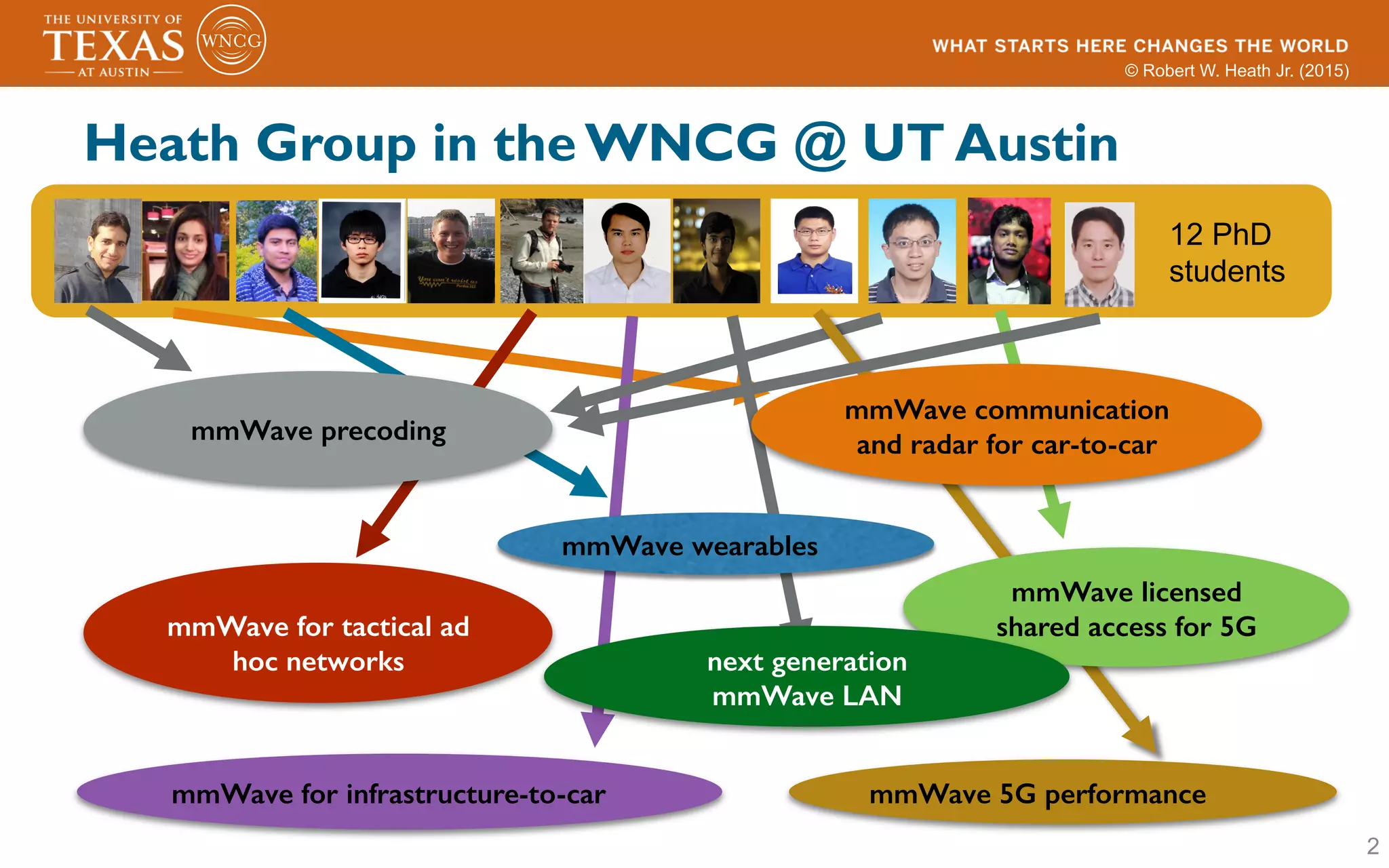
Heath Group in the WNCG @ UT Austin
12 PhD
students
mmWave precoding!
mmWave for tactical ad!
hoc networks!
mmWave communication
and radar for car-to-car!
mmWave licensed
shared access for 5G!
mmWave for infrastructure-to-car!
mmWave wearables!
next generation!
mmWave LAN!
mmWave 5G performance!
© Robert W. Heath Jr. (2015)
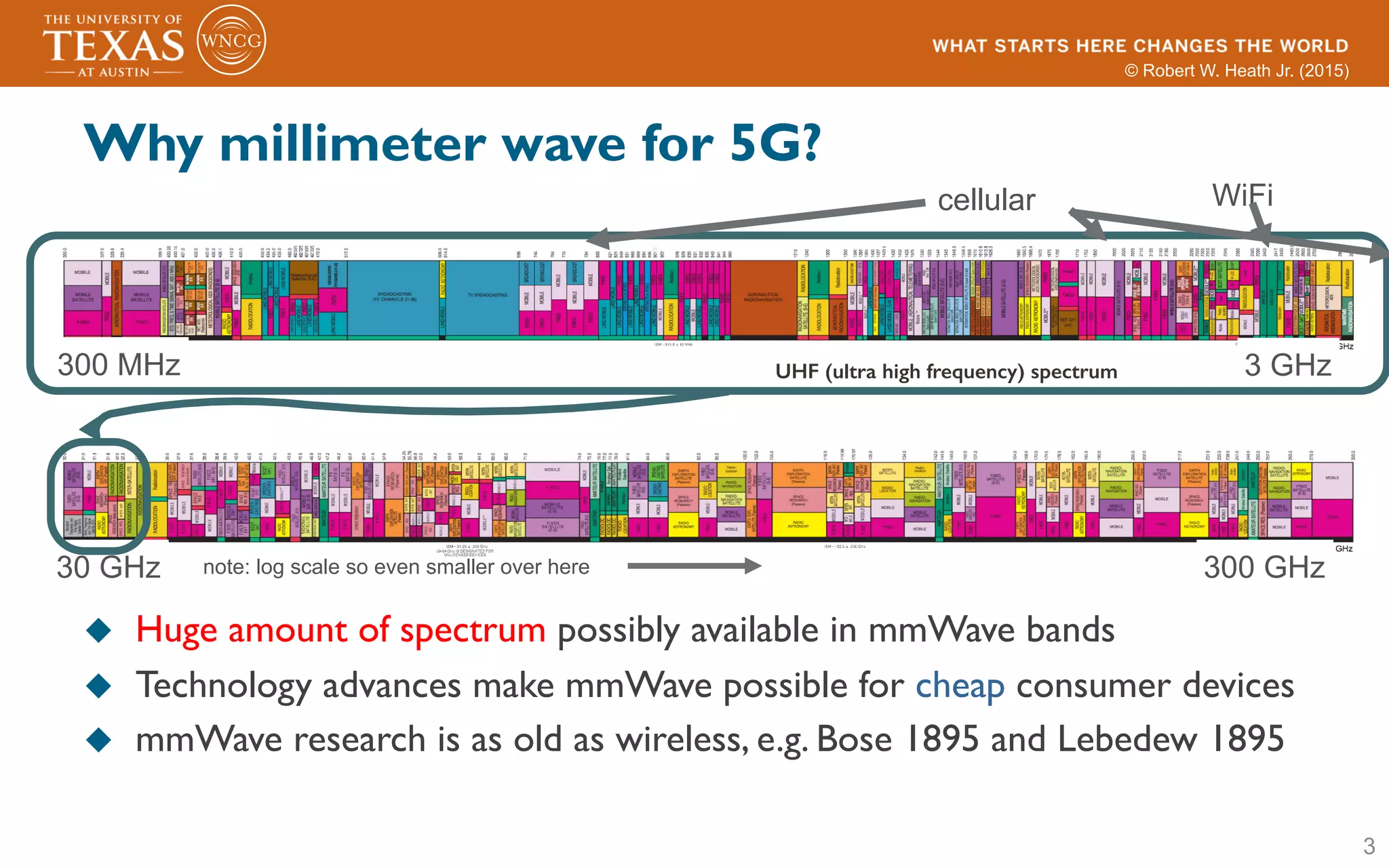
Why millimeter wave for 5G?
u  Huge amount of spectrum possibly available in mmWave bands
u  Technology advances make mmWave possible for cheap consumer devices
u  mmWave research is as old as wireless, e.g. Bose 1895 and Lebedew 1895
3
300 MHz 3 GHz
30 GHz 300 GHz
cellular WiFi
note: log scale so even smaller over here
UHF (ultra high frequency) spectrum!
© Robert W. Heath Jr. (2015)
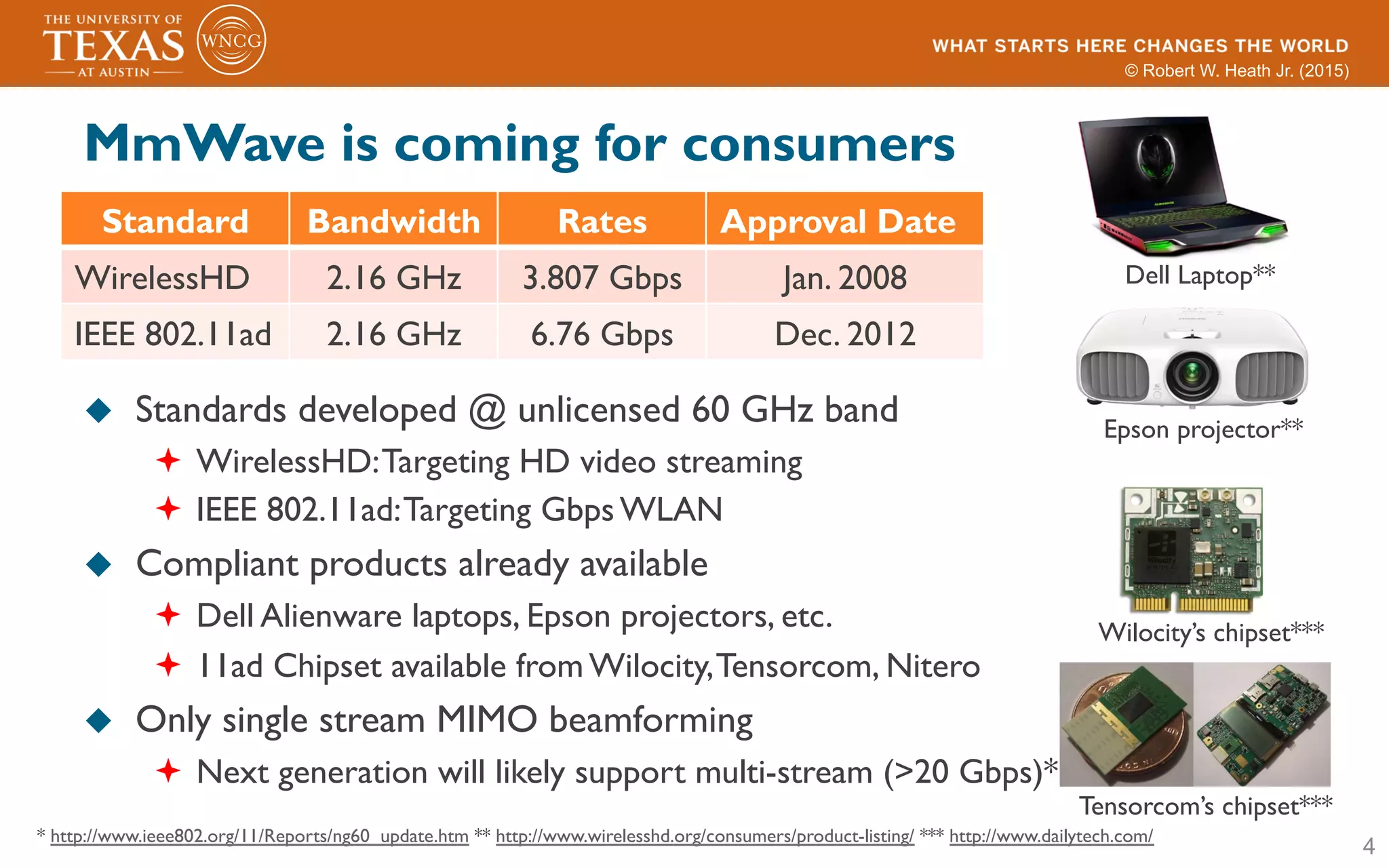
MmWave is coming for consumers
u  Standards developed @ unlicensed 60 GHz band
ª  WirelessHD:Targeting HD video streaming
ª  IEEE 802.11ad:Targeting Gbps WLAN
u  Compliant products already available
ª  Dell Alienware laptops, Epson projectors, etc.
ª  11ad Chipset available from Wilocity,Tensorcom, Nitero
u  Only single stream MIMO beamforming
ª  Next generation will likely support multi-stream (>20 Gbps)*
4
Standard Bandwidth Rates Approval Date
WirelessHD 2.16 GHz 3.807 Gbps Jan. 2008
IEEE 802.11ad 2.16 GHz 6.76 Gbps Dec. 2012
Wilocity’s chipset***
Tensorcom’s chipset***
* http://www.ieee802.org/11/Reports/ng60_update.htm ** http://www.wirelesshd.org/consumers/product-listing/ *** http://www.dailytech.com/
Epson projector**
Dell Laptop**
© Robert W. Heath Jr. (2015)
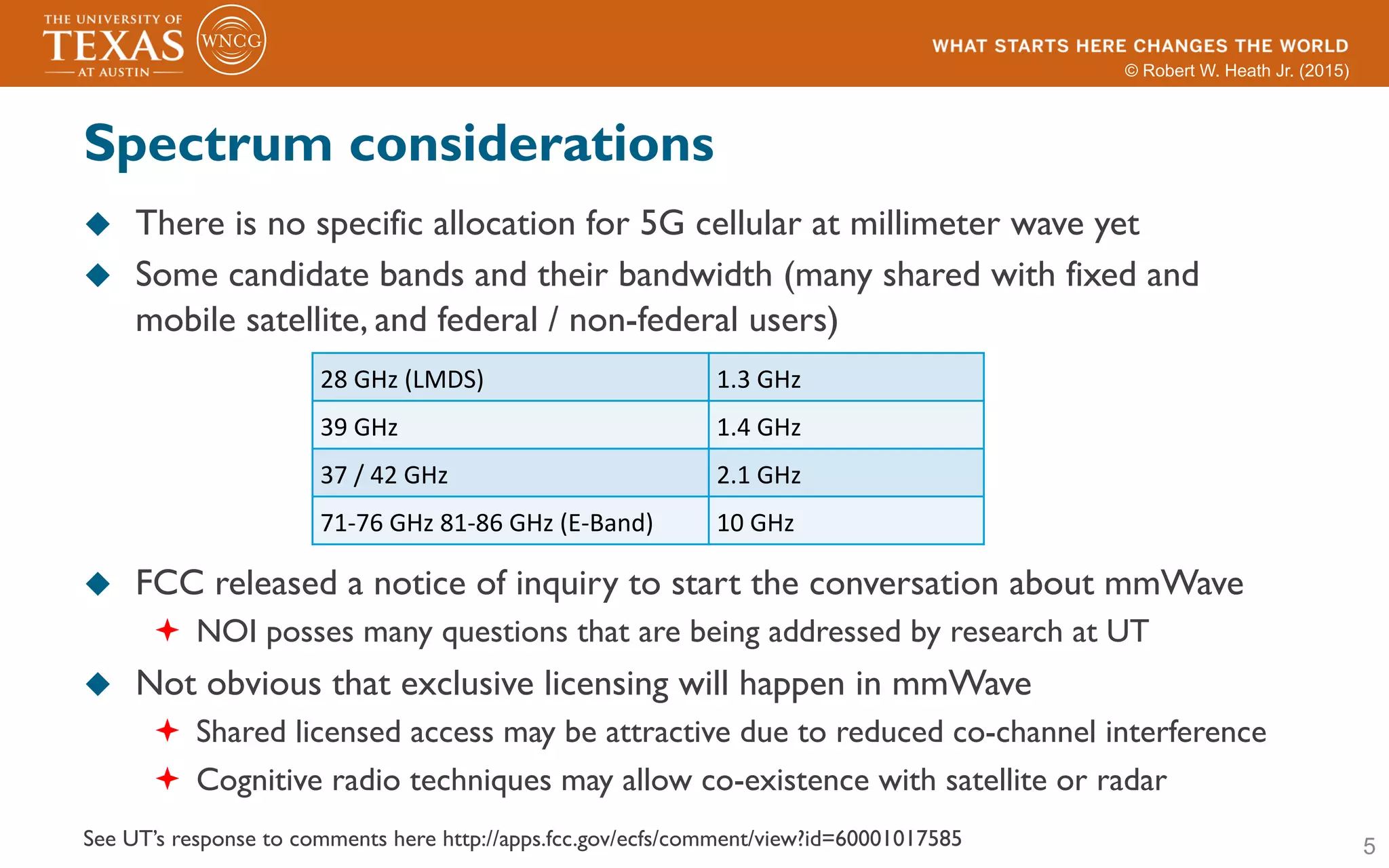
Spectrum considerations
u  There is no specific allocation for 5G cellular at millimeter wave yet
u  Some candidate bands and their bandwidth (many shared with fixed and
mobile satellite, and federal / non-federal users)
u  FCC released a notice of inquiry to start the conversation about mmWave
ª  NOI posses many questions that are being addressed by research at UT
u  Not obvious that exclusive licensing will happen in mmWave
ª  Shared licensed access may be attractive due to reduced co-channel interference
ª  Cognitive radio techniques may allow co-existence with satellite or radar
5See UT’s response to comments here http://apps.fcc.gov/ecfs/comment/view?id=60001017585
28	
  GHz	
  (LMDS) 1.3	
  GHz
39	
  GHz 1.4	
  GHz
37	
  /	
  42	
  GHz 2.1	
  GHz
71-­‐76	
  GHz	
  81-­‐86	
  GHz	
  (E-­‐Band) 10	
  GHz
© Robert W. Heath Jr. (2015)
6
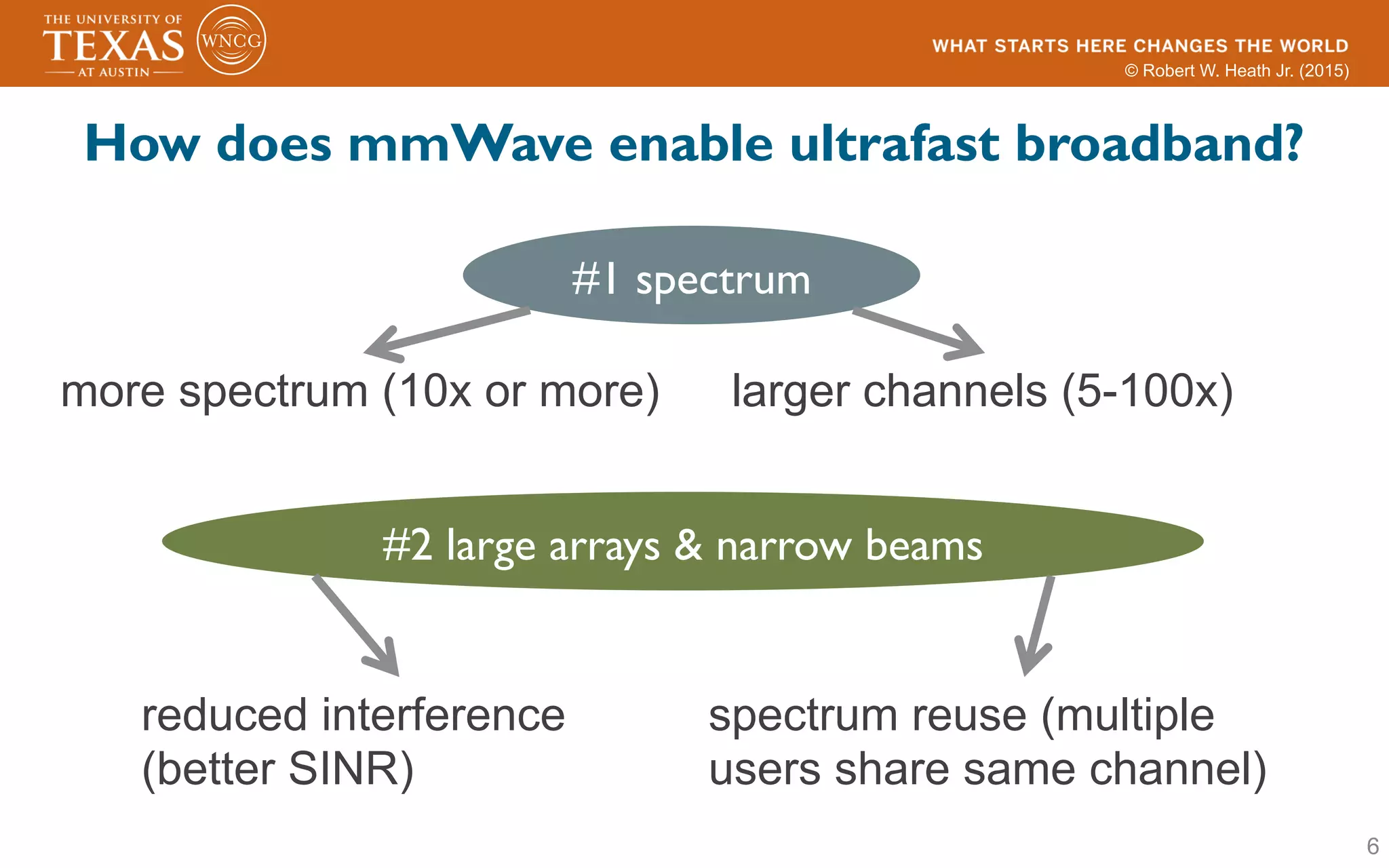
How does mmWave enable ultrafast broadband?
#1 spectrum
more spectrum (10x or more) larger channels (5-100x)
#2 large arrays & narrow beams
reduced interference
(better SINR)
spectrum reuse (multiple
users share same channel)
© Robert W. Heath Jr. (2015)
7
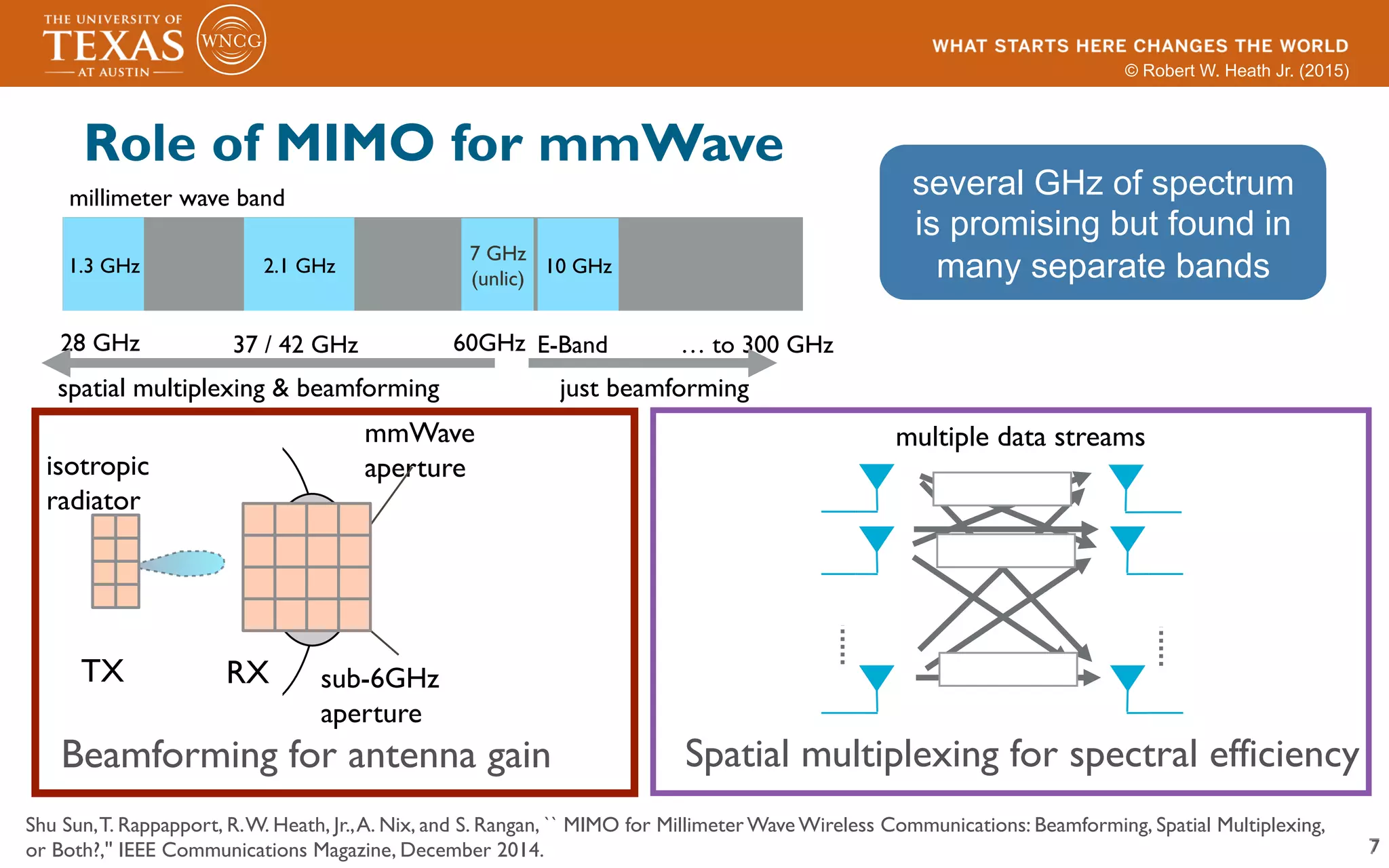
Role of MIMO for mmWave
sub-6GHz
aperture
mmWave
aperture
TX RX
isotropic
radiator
Beamforming for antenna gain
7
… to 300 GHz
1.3 GHz 2.1 GHz
28 GHz 37 / 42 GHz
10 GHz
E-Band
7 GHz
(unlic)
60GHz
millimeter wave band
Shu Sun,T. Rappapport, R.W. Heath, Jr.,A. Nix, and S. Rangan, `` MIMO for Millimeter Wave Wireless Communications: Beamforming, Spatial Multiplexing,
or Both?,'' IEEE Communications Magazine, December 2014.
just beamformingspatial multiplexing & beamforming
Spatial multiplexing for spectral efficiency
multiple data streams
several GHz of spectrum
is promising but found in
many separate bands
© Robert W. Heath Jr. (2015)
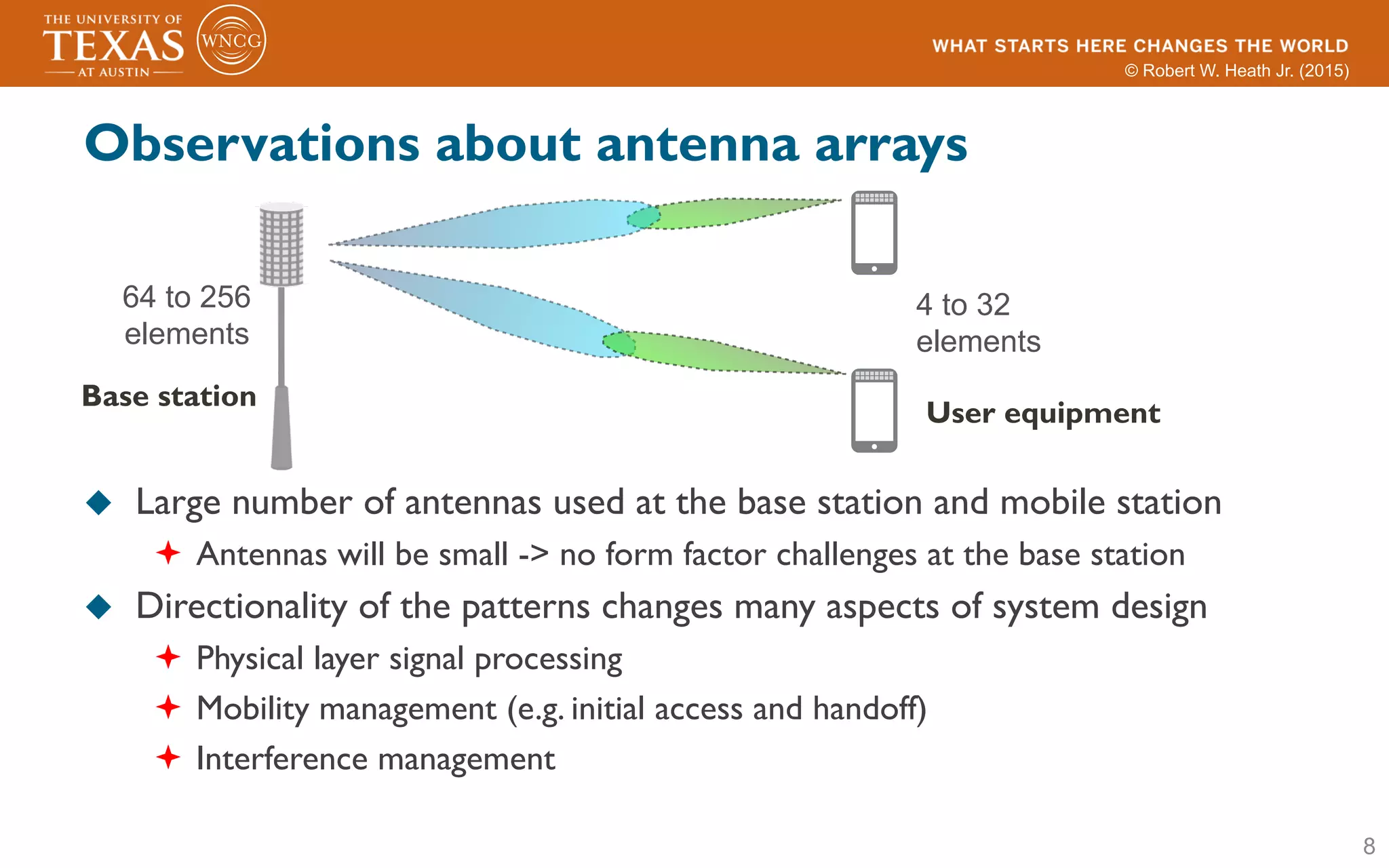
Observations about antenna arrays
u  Large number of antennas used at the base station and mobile station
ª  Antennas will be small -> no form factor challenges at the base station
u  Directionality of the patterns changes many aspects of system design
ª  Physical layer signal processing
ª  Mobility management (e.g. initial access and handoff)
ª  Interference management
8
User equipment
Base station
64 to 256
elements
4 to 32
elements
© Robert W. Heath Jr. (2015)
9
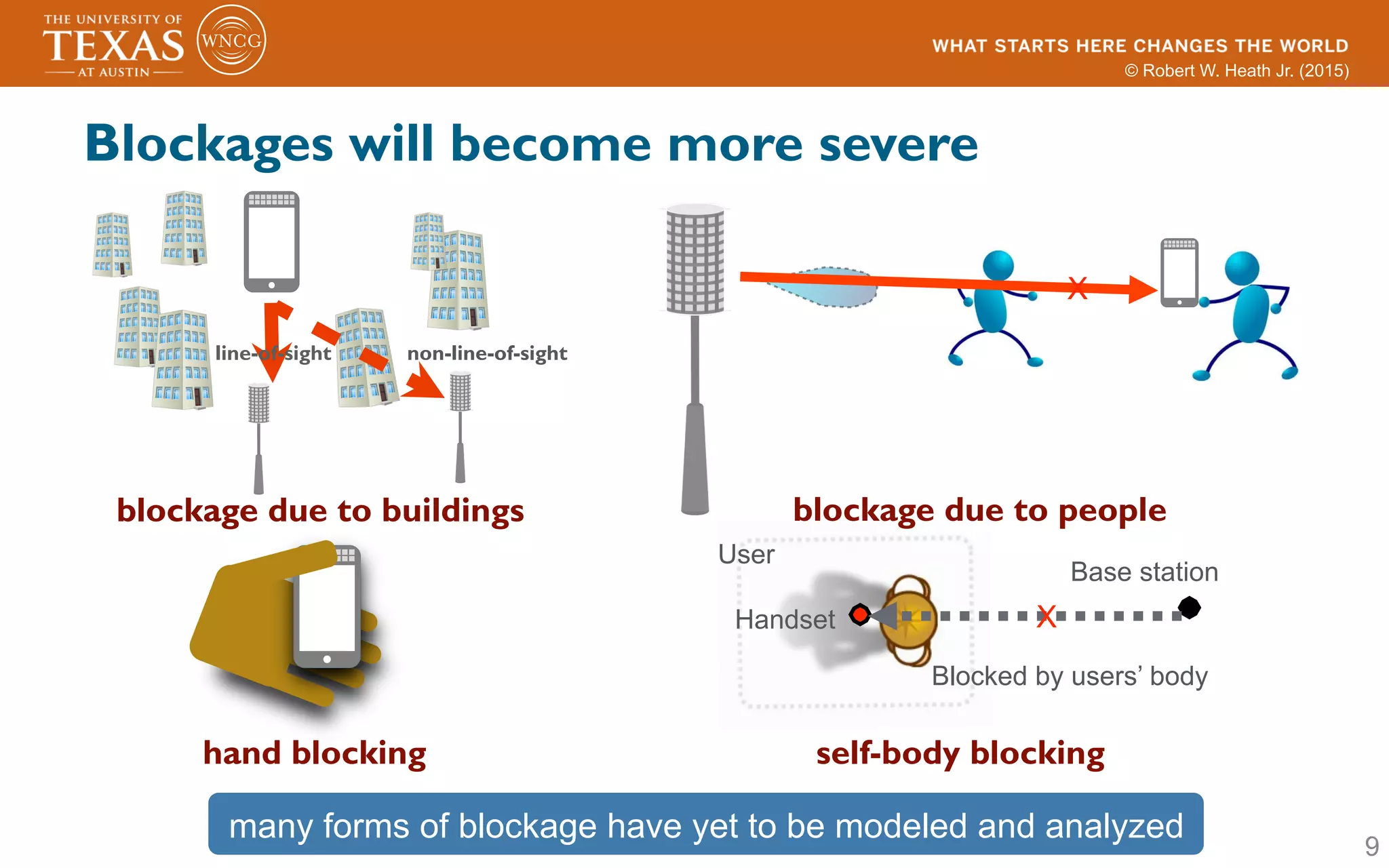
Blockages will become more severe
Base station
Handset
Blocked by users’ body
X
User
self-body blocking
X
blockage due to people
hand blocking
blockage due to buildings
line-of-sight non-line-of-sight
many forms of blockage have yet to be modeled and analyzed
© Robert W. Heath Jr. (2015)
Observations about blockage
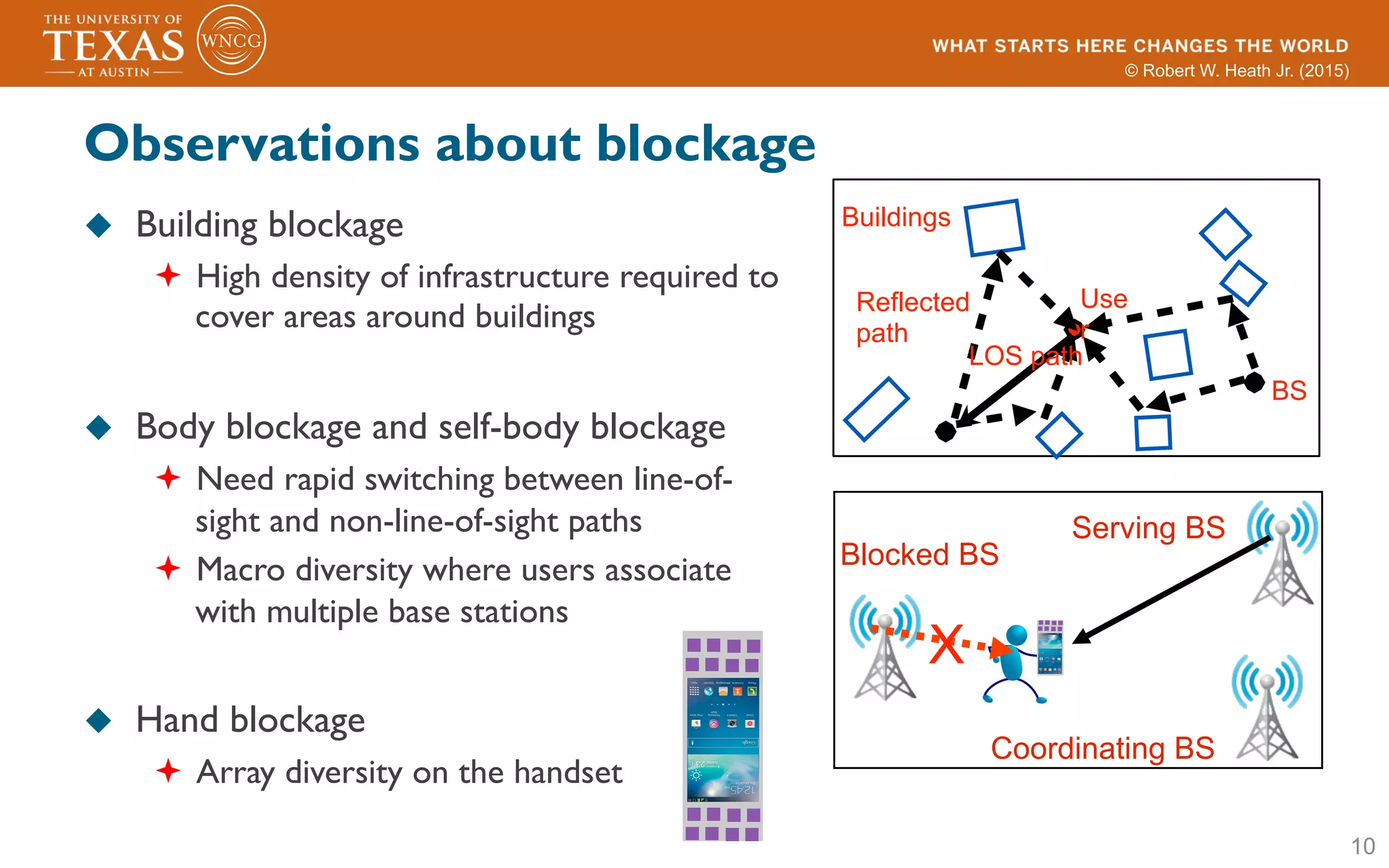
u  Building blockage
ª  High density of infrastructure required to
cover areas around buildings
u  Body blockage and self-body blockage
ª  Need rapid switching between line-of-
sight and non-line-of-sight paths
ª  Macro diversity where users associate
with multiple base stations
u  Hand blockage
ª  Array diversity on the handset
10
BS
Use
r
LOS path
Reflected
path
Buildings
Serving BS
Blocked BS
X
Coordinating BS
© Robert W. Heath Jr. (2015)
11
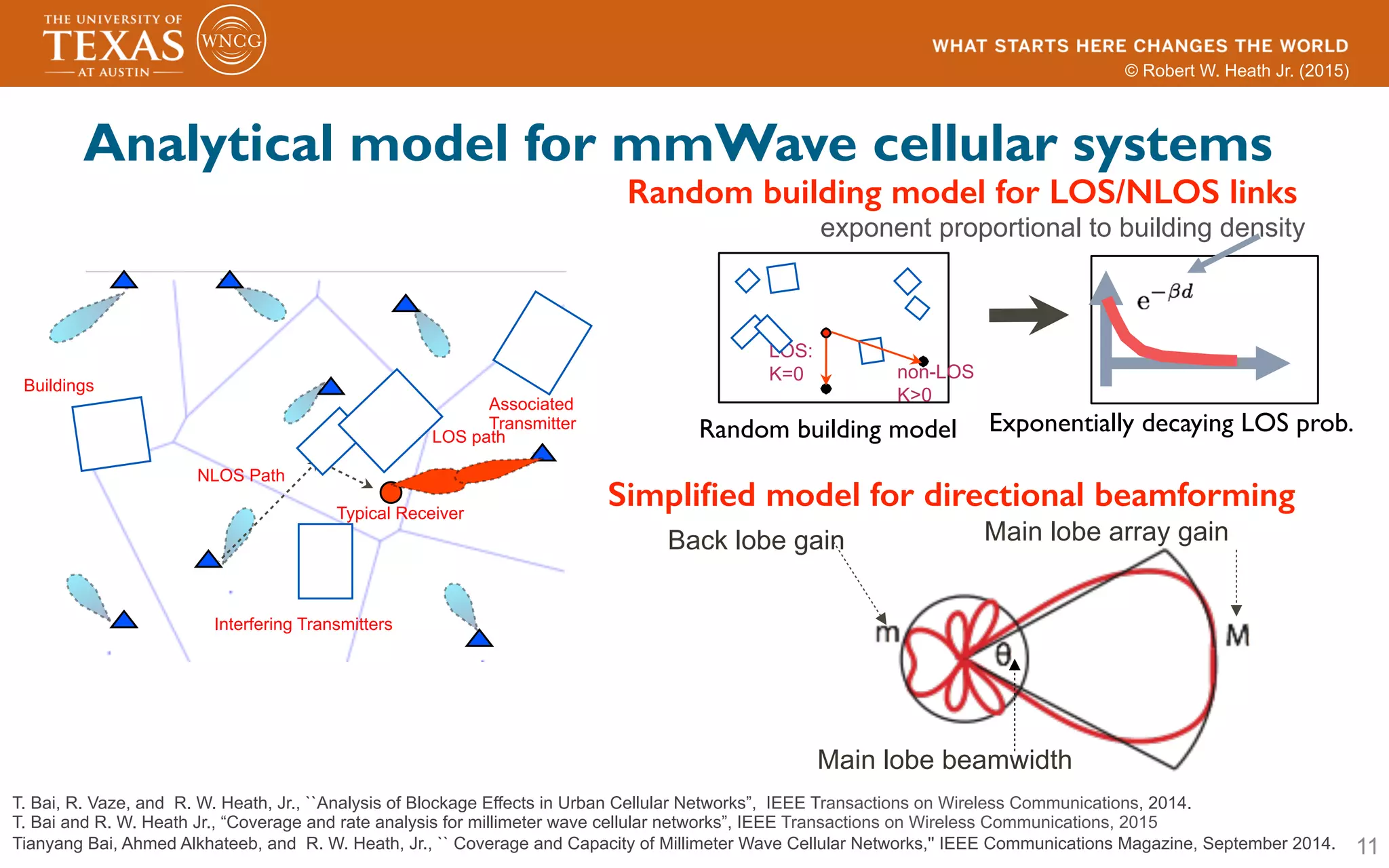
Analytical model for mmWave cellular systems
T. Bai, R. Vaze, and R. W. Heath, Jr., ``Analysis of Blockage Effects in Urban Cellular Networks”, IEEE Transactions on Wireless Communications, 2014.
T. Bai and R. W. Heath Jr., “Coverage and rate analysis for millimeter wave cellular networks”, IEEE Transactions on Wireless Communications, 2015
Tianyang Bai, Ahmed Alkhateeb, and R. W. Heath, Jr., `` Coverage and Capacity of Millimeter Wave Cellular Networks,'' IEEE Communications Magazine, September 2014.
Interfering Transmitters
Associated
Transmitter
Buildings
Typical Receiver
NLOS Path
LOS path
Simplified model for directional beamforming!
Main lobe beamwidth
Main lobe array gainBack lobe gain
Random building model for LOS/NLOS links !
Random building model
LOS:
K=0 non-LOS
K>0
exponent proportional to building density
Exponentially decaying LOS prob.
© Robert W. Heath Jr. (2015)
12
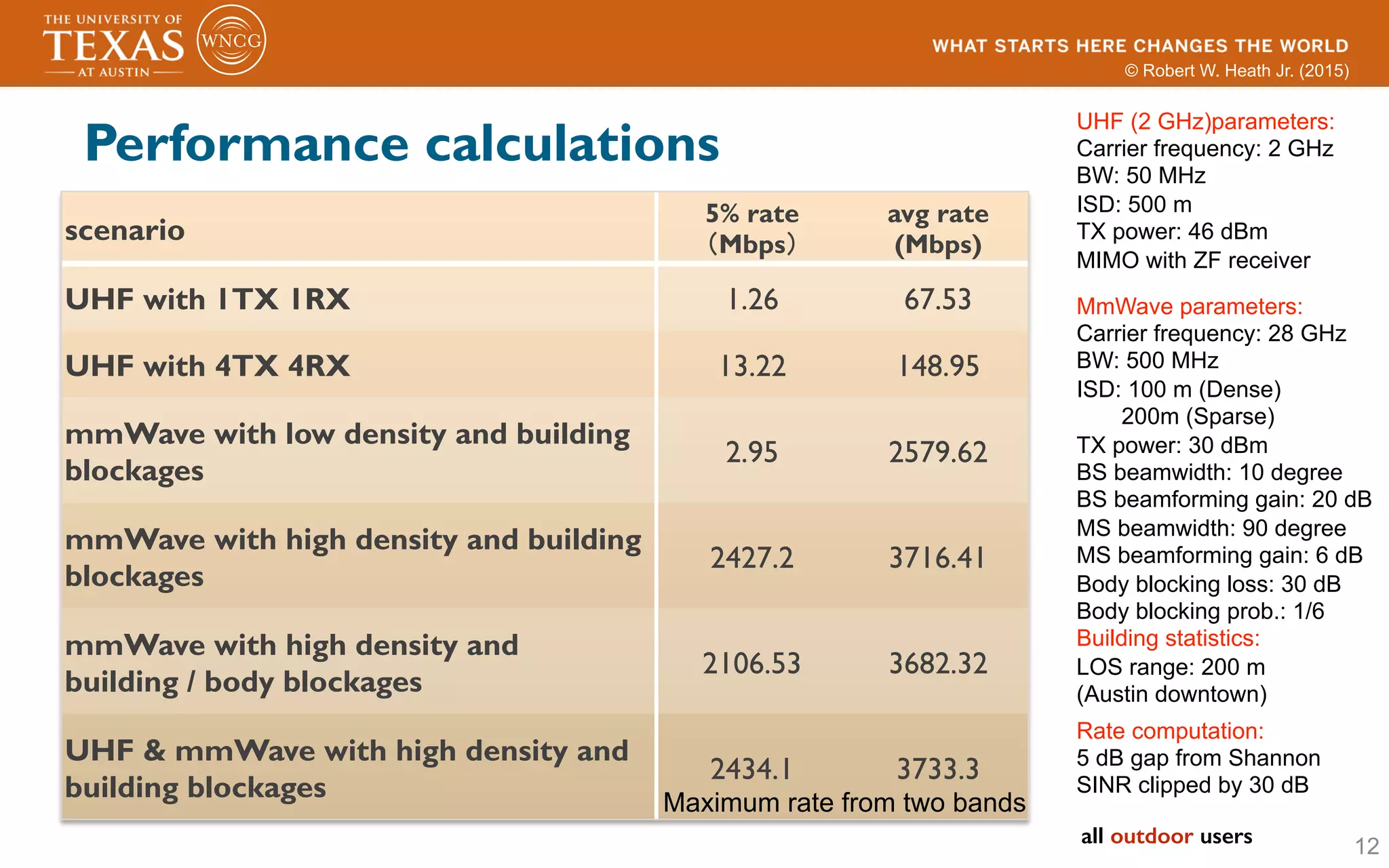
Performance calculations
scenario
5% rate
(Mbps)
avg rate
(Mbps)
UHF with 1TX 1RX 1.26 67.53
UHF with 4TX 4RX 13.22 148.95
mmWave with low density and building
blockages
2.95 2579.62
mmWave with high density and building
blockages
2427.2 3716.41
mmWave with high density and
building / body blockages
2106.53 3682.32
UHF & mmWave with high density and
building blockages
2434.1 3733.3
UHF (2 GHz)parameters:
Carrier frequency: 2 GHz
BW: 50 MHz
ISD: 500 m
TX power: 46 dBm
MIMO with ZF receiver
MmWave parameters:
Carrier frequency: 28 GHz
BW: 500 MHz
ISD: 100 m (Dense)
200m (Sparse)
TX power: 30 dBm
BS beamwidth: 10 degree
BS beamforming gain: 20 dB
MS beamwidth: 90 degree
MS beamforming gain: 6 dB
Body blocking loss: 30 dB
Body blocking prob.: 1/6
Building statistics:
LOS range: 200 m
(Austin downtown)
Rate computation:
5 dB gap from Shannon
SINR clipped by 30 dB
Maximum rate from two bands
all outdoor users!
© Robert W. Heath Jr. (2015)
13
Conclusion
Buildings Femtocell
Microwave Macro BS
mmWave D2D
Indoor user
mmWave BS
Control signals
Multiple-BS access for
fewer handovers and
high rate
Wireless
backhaul
Data center
LOS links
Non-line-of-sight
(NLOS) link
[1] Tianyang Bai,Ahmed Alkhateeb, and R.W. Heath, Jr., `` Coverage and Capacity of Millimeter Wave Cellular Networks,''
IEEE Communications Magazine, September 2014.
[2] Ahmed Alkhateeb, Jianhua Mo, N. González Prelcic and R.W. Heath, Jr., `` MIMO Precoding and Combining Solutions
for Millimeter Wave Systems,'' IEEE Communications Magazine, December 2014.
[3] Shu Sun,T. Rappapport, R.W. Heath, Jr.,A. Nix, and S. Rangan, `` MIMO for Millimeter Wave Wireless Communications:
Beamforming, Spatial Multiplexing, or Both?,'' IEEE Communications Magazine, December 2014.
[4] T. S. Rappaport, R.W. Heath, Jr. , J. N. Murdock, R. C. Daniels, Millimeter Wave Wireless Communications, Pearson, 2014
https://www.youtube.com/watch?v=BQ45FuGpFQ0
mmWave will impact every aspect of cellular communication

Millimeter wave as the future of 5g

  • 1.
    © Robert W.Heath Jr. (2015) Millimeter wave as the future of 5G Robert W. Heath Jr., PhD, PE Cullen Trust Endowed Professor Wireless Networking and Communications Group Department of Electrical and Computer Engineering The University of Texas at Austin www.profheath.org
  • 2.
    © Robert W.Heath Jr. (2015) 2 Heath Group in the WNCG @ UT Austin 12 PhD students mmWave precoding! mmWave for tactical ad! hoc networks! mmWave communication and radar for car-to-car! mmWave licensed shared access for 5G! mmWave for infrastructure-to-car! mmWave wearables! next generation! mmWave LAN! mmWave 5G performance!
  • 3.
    © Robert W.Heath Jr. (2015) Why millimeter wave for 5G? u  Huge amount of spectrum possibly available in mmWave bands u  Technology advances make mmWave possible for cheap consumer devices u  mmWave research is as old as wireless, e.g. Bose 1895 and Lebedew 1895 3 300 MHz 3 GHz 30 GHz 300 GHz cellular WiFi note: log scale so even smaller over here UHF (ultra high frequency) spectrum!
  • 4.
    © Robert W.Heath Jr. (2015) MmWave is coming for consumers u  Standards developed @ unlicensed 60 GHz band ª  WirelessHD:Targeting HD video streaming ª  IEEE 802.11ad:Targeting Gbps WLAN u  Compliant products already available ª  Dell Alienware laptops, Epson projectors, etc. ª  11ad Chipset available from Wilocity,Tensorcom, Nitero u  Only single stream MIMO beamforming ª  Next generation will likely support multi-stream (>20 Gbps)* 4 Standard Bandwidth Rates Approval Date WirelessHD 2.16 GHz 3.807 Gbps Jan. 2008 IEEE 802.11ad 2.16 GHz 6.76 Gbps Dec. 2012 Wilocity’s chipset*** Tensorcom’s chipset*** * http://www.ieee802.org/11/Reports/ng60_update.htm ** http://www.wirelesshd.org/consumers/product-listing/ *** http://www.dailytech.com/ Epson projector** Dell Laptop**
  • 5.
    © Robert W.Heath Jr. (2015) Spectrum considerations u  There is no specific allocation for 5G cellular at millimeter wave yet u  Some candidate bands and their bandwidth (many shared with fixed and mobile satellite, and federal / non-federal users) u  FCC released a notice of inquiry to start the conversation about mmWave ª  NOI posses many questions that are being addressed by research at UT u  Not obvious that exclusive licensing will happen in mmWave ª  Shared licensed access may be attractive due to reduced co-channel interference ª  Cognitive radio techniques may allow co-existence with satellite or radar 5See UT’s response to comments here http://apps.fcc.gov/ecfs/comment/view?id=60001017585 28  GHz  (LMDS) 1.3  GHz 39  GHz 1.4  GHz 37  /  42  GHz 2.1  GHz 71-­‐76  GHz  81-­‐86  GHz  (E-­‐Band) 10  GHz
  • 6.
    © Robert W.Heath Jr. (2015) 6 How does mmWave enable ultrafast broadband? #1 spectrum more spectrum (10x or more) larger channels (5-100x) #2 large arrays & narrow beams reduced interference (better SINR) spectrum reuse (multiple users share same channel)
  • 7.
    © Robert W.Heath Jr. (2015) 7 Role of MIMO for mmWave sub-6GHz aperture mmWave aperture TX RX isotropic radiator Beamforming for antenna gain 7 … to 300 GHz 1.3 GHz 2.1 GHz 28 GHz 37 / 42 GHz 10 GHz E-Band 7 GHz (unlic) 60GHz millimeter wave band Shu Sun,T. Rappapport, R.W. Heath, Jr.,A. Nix, and S. Rangan, `` MIMO for Millimeter Wave Wireless Communications: Beamforming, Spatial Multiplexing, or Both?,'' IEEE Communications Magazine, December 2014. just beamformingspatial multiplexing & beamforming Spatial multiplexing for spectral efficiency multiple data streams several GHz of spectrum is promising but found in many separate bands
  • 8.
    © Robert W.Heath Jr. (2015) Observations about antenna arrays u  Large number of antennas used at the base station and mobile station ª  Antennas will be small -> no form factor challenges at the base station u  Directionality of the patterns changes many aspects of system design ª  Physical layer signal processing ª  Mobility management (e.g. initial access and handoff) ª  Interference management 8 User equipment Base station 64 to 256 elements 4 to 32 elements
  • 9.
    © Robert W.Heath Jr. (2015) 9 Blockages will become more severe Base station Handset Blocked by users’ body X User self-body blocking X blockage due to people hand blocking blockage due to buildings line-of-sight non-line-of-sight many forms of blockage have yet to be modeled and analyzed
  • 10.
    © Robert W.Heath Jr. (2015) Observations about blockage u  Building blockage ª  High density of infrastructure required to cover areas around buildings u  Body blockage and self-body blockage ª  Need rapid switching between line-of- sight and non-line-of-sight paths ª  Macro diversity where users associate with multiple base stations u  Hand blockage ª  Array diversity on the handset 10 BS Use r LOS path Reflected path Buildings Serving BS Blocked BS X Coordinating BS
  • 11.
    © Robert W.Heath Jr. (2015) 11 Analytical model for mmWave cellular systems T. Bai, R. Vaze, and R. W. Heath, Jr., ``Analysis of Blockage Effects in Urban Cellular Networks”, IEEE Transactions on Wireless Communications, 2014. T. Bai and R. W. Heath Jr., “Coverage and rate analysis for millimeter wave cellular networks”, IEEE Transactions on Wireless Communications, 2015 Tianyang Bai, Ahmed Alkhateeb, and R. W. Heath, Jr., `` Coverage and Capacity of Millimeter Wave Cellular Networks,'' IEEE Communications Magazine, September 2014. Interfering Transmitters Associated Transmitter Buildings Typical Receiver NLOS Path LOS path Simplified model for directional beamforming! Main lobe beamwidth Main lobe array gainBack lobe gain Random building model for LOS/NLOS links ! Random building model LOS: K=0 non-LOS K>0 exponent proportional to building density Exponentially decaying LOS prob.
  • 12.
    © Robert W.Heath Jr. (2015) 12 Performance calculations scenario 5% rate (Mbps) avg rate (Mbps) UHF with 1TX 1RX 1.26 67.53 UHF with 4TX 4RX 13.22 148.95 mmWave with low density and building blockages 2.95 2579.62 mmWave with high density and building blockages 2427.2 3716.41 mmWave with high density and building / body blockages 2106.53 3682.32 UHF & mmWave with high density and building blockages 2434.1 3733.3 UHF (2 GHz)parameters: Carrier frequency: 2 GHz BW: 50 MHz ISD: 500 m TX power: 46 dBm MIMO with ZF receiver MmWave parameters: Carrier frequency: 28 GHz BW: 500 MHz ISD: 100 m (Dense) 200m (Sparse) TX power: 30 dBm BS beamwidth: 10 degree BS beamforming gain: 20 dB MS beamwidth: 90 degree MS beamforming gain: 6 dB Body blocking loss: 30 dB Body blocking prob.: 1/6 Building statistics: LOS range: 200 m (Austin downtown) Rate computation: 5 dB gap from Shannon SINR clipped by 30 dB Maximum rate from two bands all outdoor users!
  • 13.
    © Robert W.Heath Jr. (2015) 13 Conclusion Buildings Femtocell Microwave Macro BS mmWave D2D Indoor user mmWave BS Control signals Multiple-BS access for fewer handovers and high rate Wireless backhaul Data center LOS links Non-line-of-sight (NLOS) link [1] Tianyang Bai,Ahmed Alkhateeb, and R.W. Heath, Jr., `` Coverage and Capacity of Millimeter Wave Cellular Networks,'' IEEE Communications Magazine, September 2014. [2] Ahmed Alkhateeb, Jianhua Mo, N. González Prelcic and R.W. Heath, Jr., `` MIMO Precoding and Combining Solutions for Millimeter Wave Systems,'' IEEE Communications Magazine, December 2014. [3] Shu Sun,T. Rappapport, R.W. Heath, Jr.,A. Nix, and S. Rangan, `` MIMO for Millimeter Wave Wireless Communications: Beamforming, Spatial Multiplexing, or Both?,'' IEEE Communications Magazine, December 2014. [4] T. S. Rappaport, R.W. Heath, Jr. , J. N. Murdock, R. C. Daniels, Millimeter Wave Wireless Communications, Pearson, 2014 https://www.youtube.com/watch?v=BQ45FuGpFQ0 mmWave will impact every aspect of cellular communication