MICROTEACHING
Prof. (Dr.) Virendra Singh Choudhary
OBJECTIVES
• Definition of microteaching
• Characteristics of microteaching
• Principles of microteaching
• Advantages of microteaching
• Disadvantages of microteaching
• Microteaching cycle
• Microteaching flow chart
• Steps of microteaching
• Phases of microteaching
• Role of supervisor in microteaching
INTRODUCTION
Microteaching is one of the most important
developments in the field of teaching
practice.it is originated in Standford university
in 1963.
Microteaching is a clinical teaching
programme which is organised to explore the
trainee to an organised curriculum of miniature
teaching encounters, moving from the less
complex to the more complex.
MICROTEACHING
Definition
Acc. To Bush, Microteaching is a teacher
education technique which allows teachers to
apply clearly defined teaching skills to
carefully prepared lessons in a planned series
of five to ten minutes encounter with a small
group of real students , often with an
opportunity to observe the result on video tape
.
CONT…
•Acc. To Allen , A scaled down
teaching encounter in class size
and class time. The number of
students is from 5-10 and the
duration of period ranges from 5-20
min.
CHARACTERSTICS OF
MICROTEACHING
1.MICRO-ELEMENTS –Microteaching
reduces the complexity of the teaching
situation in terms of ;
 number of students to be taught
 duration of lesson subject matter to be
taught
 it reduces the teaching skills and size of
the topic .it is focused on micro-events.
CONT……
2.TEACHING SKILLS AND TEACHING
PROCESS –
a. PRE-INSTRUCTIONAL SKILLS
 These includes writing of instructional objectives
.
 Sequencing and organizing knowledge to be
presented in order to achieve specific
objectives.
 Appropriate content.
 Proper organisation .
 Selection of proper audio-visual aids.
CONT….
b. INSTRUCTIONAL SKILLS
 Skills of introducing a lesson.
 Skills of explaining and illustrating
 Reinforcement.
 Probing question.
 Reinforcing pupil participation .
 Diagnosing learners difficulties.
CONT……..
C. POST-INSTRUCTIONAL SKILLS
 Skills of writing test items .
 Interpreting pupils performance in a test .
d. FEEDBACK
 Oral feedback by the supervisor observation
schedules filled in by the peer group
participation in the micro lesson ,audio and
videotape recording.
CONT…..
3. SAFE PRACTICE GROUND
 Teaching is performed under
simulated conditions with a small
group , the trainee is on a safe
practice ground.
PRINCIPLES OF MICROTEACHIG
1.ENFORCEMENT
2. PRACTICE AND DRILL
3. CONTINUITY-microteaching is a continuous
process, teaching-feedback –re-teaching –
feedback
4. MICROSCOPIC SUPERVISION
ADVANTAGES OF MICROTEACHING
 To perfect their performance and
improve it to a superior level.
 Teaching skills are learnt in a real
practice situation .
 Focuses on sharpening and
developing of specific teaching skills
and eliminating errors.
CONT…
Microteaching is very effective in
modifying teaching behaviour .
It provides a safe practice ground
for the student teachers.
Microteaching provides increased
control of the practice teaching
lesson.
CONT….
 Provides for repeated practice .
Increases the self-confidence of the student
teacher.
 Provides accurate and powerful feedback on
the performance of the student teachers by
oral feedback by the supervisor observation
schedules filled in by the peer group , audio
and videotape recording.
DISADVANTAGES OF
MICROTEACHING
Microteaching is skill oriented
rather than content-oriented.
Microteaching has a very narrow
scope.
 Highly time consuming .
 Requires more skills.
cont,….
Real life situations are quite
different.
Conduct under controlled
environment.
It does not apply to skills like
decision-making ,preparation of
audio visual resources, maintaining
student records etc.
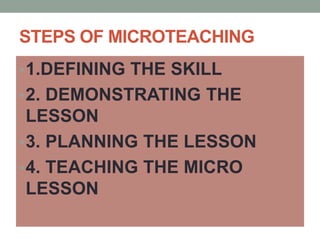
STEPS OF MICROTEACHING
•1.DEFINING THE SKILL
•2. DEMONSTRATING THE
LESSON
•3. PLANNING THE LESSON
•4. TEACHING THE MICRO
LESSON
CONT…
• 5.DISCUSSION ON THE LESSON
DELIVERED
• 6. REPLANNING THE LESSON
• 7.RE-TEACHING THE LESSON
• 8. REDISCUSSION OR RE-FEEDBACK
• 9.RE-PEATING THE CYCLE
CONT….
•MICROTEACHING
CYCLE
CONT….
•MICROTEACHING
FLOW CHART
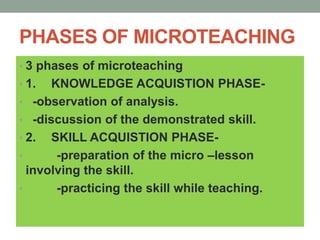
PHASES OF MICROTEACHING
• 3 phases of microteaching
• 1. KNOWLEDGE ACQUISTION PHASE-
• -observation of analysis.
• -discussion of the demonstrated skill.
• 2. SKILL ACQUISTION PHASE-
• -preparation of the micro –lesson
involving the skill.
• -practicing the skill while teaching.
CONT…
•TRANSFER PHASE –
• - evaluating performance
leading to feedback.
• - replan , reteach and transfer
of skill to actual class teaching in
macro sessions.
ROLE OF SUPERVISOR
• • Supervisor will help the teacher
trainee to develop component skills of
teaching to both the theory underlying
skills and the practical conditions of the
classroom.
• • Provides continuous consultation
and helps the teacher trainee skills
learnt in microteaching setting to the
actual classroom.
CONT…
• • Demonstrates the teaching skill which
has to be developed in the teacher trainee.
• • Prepares a special schedule of micro-
teaching lessons in the practicing schools.
• • Evaluates the trainees class and fills
the rating questionnaries schedule and
gives feedback.
• • Supervisor should act as a role model
for teacher trainee.
SUMMARIZATION
• • Definition of microteaching
• • Characteristics of microteaching
• • Principles of microteaching
• • Advantages of microteaching
• • Disadvantages of microteaching
• • Microteaching cycle
• • Microteaching flow chart
• • Steps of microteaching
• • Phases of microteaching
• • Role of supervisor in microteaching
RECAPTULISATION
•
•Define microteaching ?
•Advantages of microteaching ?
•Steps of microteaching ?
•Role of supervisor in
microteaching ?
REFERENCES
• Sudha R , “Nursing education , principles &
concepts,” published by jaypee, edition -1st,pp- 102-
104
• Neeraja K.P , “Textbook of communication &
education technology for nurses,” edition – 1st , pp-
269-275
• Sankaranarayanan B & Sindhu B, “ Learning &
teaching nursing ,” published by jaypee , edition -4th ,
pp- 132-134
• Raj Bhaskara , “ textbook of nursing education”,
pulished by EMMESS Medical, edition -1st ,pp- 162-
170
MICROTEACHING a method of Improving the Teaching

MICROTEACHING a method of Improving the Teaching

  • 1.
  • 2.
    OBJECTIVES • Definition ofmicroteaching • Characteristics of microteaching • Principles of microteaching • Advantages of microteaching • Disadvantages of microteaching • Microteaching cycle • Microteaching flow chart • Steps of microteaching • Phases of microteaching • Role of supervisor in microteaching
  • 3.
    INTRODUCTION Microteaching is oneof the most important developments in the field of teaching practice.it is originated in Standford university in 1963. Microteaching is a clinical teaching programme which is organised to explore the trainee to an organised curriculum of miniature teaching encounters, moving from the less complex to the more complex.
  • 4.
    MICROTEACHING Definition Acc. To Bush,Microteaching is a teacher education technique which allows teachers to apply clearly defined teaching skills to carefully prepared lessons in a planned series of five to ten minutes encounter with a small group of real students , often with an opportunity to observe the result on video tape .
  • 5.
    CONT… •Acc. To Allen, A scaled down teaching encounter in class size and class time. The number of students is from 5-10 and the duration of period ranges from 5-20 min.
  • 6.
    CHARACTERSTICS OF MICROTEACHING 1.MICRO-ELEMENTS –Microteaching reducesthe complexity of the teaching situation in terms of ;  number of students to be taught  duration of lesson subject matter to be taught  it reduces the teaching skills and size of the topic .it is focused on micro-events.
  • 7.
    CONT…… 2.TEACHING SKILLS ANDTEACHING PROCESS – a. PRE-INSTRUCTIONAL SKILLS  These includes writing of instructional objectives .  Sequencing and organizing knowledge to be presented in order to achieve specific objectives.  Appropriate content.  Proper organisation .  Selection of proper audio-visual aids.
  • 8.
    CONT…. b. INSTRUCTIONAL SKILLS Skills of introducing a lesson.  Skills of explaining and illustrating  Reinforcement.  Probing question.  Reinforcing pupil participation .  Diagnosing learners difficulties.
  • 9.
    CONT…….. C. POST-INSTRUCTIONAL SKILLS Skills of writing test items .  Interpreting pupils performance in a test . d. FEEDBACK  Oral feedback by the supervisor observation schedules filled in by the peer group participation in the micro lesson ,audio and videotape recording.
  • 10.
    CONT….. 3. SAFE PRACTICEGROUND  Teaching is performed under simulated conditions with a small group , the trainee is on a safe practice ground.
  • 11.
    PRINCIPLES OF MICROTEACHIG 1.ENFORCEMENT 2.PRACTICE AND DRILL 3. CONTINUITY-microteaching is a continuous process, teaching-feedback –re-teaching – feedback 4. MICROSCOPIC SUPERVISION
  • 12.
    ADVANTAGES OF MICROTEACHING To perfect their performance and improve it to a superior level.  Teaching skills are learnt in a real practice situation .  Focuses on sharpening and developing of specific teaching skills and eliminating errors.
  • 13.
    CONT… Microteaching is veryeffective in modifying teaching behaviour . It provides a safe practice ground for the student teachers. Microteaching provides increased control of the practice teaching lesson.
  • 14.
    CONT….  Provides forrepeated practice . Increases the self-confidence of the student teacher.  Provides accurate and powerful feedback on the performance of the student teachers by oral feedback by the supervisor observation schedules filled in by the peer group , audio and videotape recording.
  • 15.
    DISADVANTAGES OF MICROTEACHING Microteaching isskill oriented rather than content-oriented. Microteaching has a very narrow scope.  Highly time consuming .  Requires more skills.
  • 16.
    cont,…. Real life situationsare quite different. Conduct under controlled environment. It does not apply to skills like decision-making ,preparation of audio visual resources, maintaining student records etc.
  • 17.
    STEPS OF MICROTEACHING •1.DEFININGTHE SKILL •2. DEMONSTRATING THE LESSON •3. PLANNING THE LESSON •4. TEACHING THE MICRO LESSON
  • 18.
    CONT… • 5.DISCUSSION ONTHE LESSON DELIVERED • 6. REPLANNING THE LESSON • 7.RE-TEACHING THE LESSON • 8. REDISCUSSION OR RE-FEEDBACK • 9.RE-PEATING THE CYCLE
  • 19.
  • 20.
  • 21.
    PHASES OF MICROTEACHING •3 phases of microteaching • 1. KNOWLEDGE ACQUISTION PHASE- • -observation of analysis. • -discussion of the demonstrated skill. • 2. SKILL ACQUISTION PHASE- • -preparation of the micro –lesson involving the skill. • -practicing the skill while teaching.
  • 22.
    CONT… •TRANSFER PHASE – •- evaluating performance leading to feedback. • - replan , reteach and transfer of skill to actual class teaching in macro sessions.
  • 23.
    ROLE OF SUPERVISOR •• Supervisor will help the teacher trainee to develop component skills of teaching to both the theory underlying skills and the practical conditions of the classroom. • • Provides continuous consultation and helps the teacher trainee skills learnt in microteaching setting to the actual classroom.
  • 24.
    CONT… • • Demonstratesthe teaching skill which has to be developed in the teacher trainee. • • Prepares a special schedule of micro- teaching lessons in the practicing schools. • • Evaluates the trainees class and fills the rating questionnaries schedule and gives feedback. • • Supervisor should act as a role model for teacher trainee.
  • 25.
    SUMMARIZATION • • Definitionof microteaching • • Characteristics of microteaching • • Principles of microteaching • • Advantages of microteaching • • Disadvantages of microteaching • • Microteaching cycle • • Microteaching flow chart • • Steps of microteaching • • Phases of microteaching • • Role of supervisor in microteaching
  • 26.
    RECAPTULISATION • •Define microteaching ? •Advantagesof microteaching ? •Steps of microteaching ? •Role of supervisor in microteaching ?
  • 27.
    REFERENCES • Sudha R, “Nursing education , principles & concepts,” published by jaypee, edition -1st,pp- 102- 104 • Neeraja K.P , “Textbook of communication & education technology for nurses,” edition – 1st , pp- 269-275 • Sankaranarayanan B & Sindhu B, “ Learning & teaching nursing ,” published by jaypee , edition -4th , pp- 132-134 • Raj Bhaskara , “ textbook of nursing education”, pulished by EMMESS Medical, edition -1st ,pp- 162- 170