PRESENTED BY: SAIMA HABEEB
MSC.(N) 1st year
MICROTEACHING
Scaled down teaching used by a
student teacher in a controlled
condition of a teacher in order to
attain proficiency in a particular
teaching skill is called micro
teaching.
What is micro-teaching?
DEFINITION
According to Bush
“micro-teaching is a teacher education
technique which allows teachers to apply
clearly defined teaching skills to carefully
prepared lessons in a planned series of five
to ten minutes encounter with a small group
of real students, often with an opportunity
to observe the result on video tape.”
OBJECTIVES OF MICROTEACHING
To learn and assimilate new teaching skills
under control conditions.
To gain confidence in teaching and mastering
a no of teaching skills on a small group of
pupils.
To gain maximum advantage with little time,
money and material.
CHARACTERISTICS OF MICRO-
TEACHING
Micro element
 Number of students to be taught.
 Duration of lesson.
 Subject matter
 The number of instructional objectives
 It is focused on micro events.
 It is highly individualized training
 provides feedback for trainees‘
performances.
TEACHING SKILLS AND
TEACHING STRATEGIES
Pre-instructional skills.
Instructional skills:
Post-instructional skills:
Pre-instructional skills.
These include writing of
instructional objectives.
Sequencing and organizing knowledge
to be presented in order to achieve
specific objectives.
Appropriate content.
Selection of proper audio-visual
aids.
Instructional skills
Skills of introducing a lesson.
Skills of explaining and illustrating.
Skill of stimulus variation.
Skill of probing questions.
Skill of reinforcement.
Diagnosing pupils‘
difficulties.
Post-instructional skills:
Skills of writing test items
Interpreting pupil's performance in
a test.
Planning remedial measures.
BASIC PRINCIPLES OF MICRO-TEACHING
Enforcement.
Practice and drill.
Continuity.
Microscopic supervision
MICRO-TEACHING cycle
Defining a Specific skill
Demonstration of the skill
Micro-Lesson Plans
Teaching a small group
Feedback
Re-planning, Re-teaching and
Re-evaluation
MERITS OF MICRO-TEACHING
Helps student teachers to acquire hard-to-attain
teaching skills
student teachers can attain proficiency in teaching
skills in a phased manner.
Provision of immediate feedback makes micro-
teaching more interesting and reliable.
It is a student centered method.
As gadgets like video camera and tape recorders
are used, it exemplifies the effective use of
technology in the field of education.
DEMERITS OF MICRO-TEACHING
Time consuming
Too narrow/ restricted
Technique keeps trainees away from
classroom problem.
Require more time for planning.
More research is needed to ascertain its
usefulness in other teaching situations.
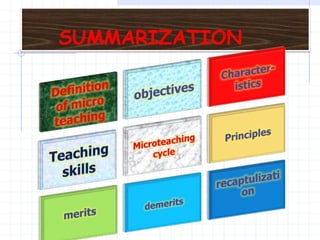
SUMMARIZATION
REFERENCES
Sankaranarayan B, “Learning And
Teaching Nursing” Publisher Brainfill
Mangalore Page: 158-162
BT Basavanthappa, (2003) “Nursing
Education” Jaypee Brothers, Medical
Publisher, First edition Page: 409-413
Neeraja KP, “Textbook of Nursing
Education” First edition, “Jaypee
Brothers Medical Publisher” Page: 289-
294.
Accessed from googles websites.
RECAPTUALIZATION
Secret
19
Present Teacher Expected Teacher
20
THANKING YOU

Micro msc ist year

  • 1.
    PRESENTED BY: SAIMAHABEEB MSC.(N) 1st year
  • 2.
  • 3.
    Scaled down teachingused by a student teacher in a controlled condition of a teacher in order to attain proficiency in a particular teaching skill is called micro teaching. What is micro-teaching?
  • 4.
    DEFINITION According to Bush “micro-teachingis a teacher education technique which allows teachers to apply clearly defined teaching skills to carefully prepared lessons in a planned series of five to ten minutes encounter with a small group of real students, often with an opportunity to observe the result on video tape.”
  • 5.
    OBJECTIVES OF MICROTEACHING Tolearn and assimilate new teaching skills under control conditions. To gain confidence in teaching and mastering a no of teaching skills on a small group of pupils. To gain maximum advantage with little time, money and material.
  • 6.
    CHARACTERISTICS OF MICRO- TEACHING Microelement  Number of students to be taught.  Duration of lesson.  Subject matter  The number of instructional objectives  It is focused on micro events.  It is highly individualized training  provides feedback for trainees‘ performances.
  • 7.
    TEACHING SKILLS AND TEACHINGSTRATEGIES Pre-instructional skills. Instructional skills: Post-instructional skills:
  • 8.
    Pre-instructional skills. These includewriting of instructional objectives. Sequencing and organizing knowledge to be presented in order to achieve specific objectives. Appropriate content. Selection of proper audio-visual aids.
  • 9.
    Instructional skills Skills ofintroducing a lesson. Skills of explaining and illustrating. Skill of stimulus variation. Skill of probing questions. Skill of reinforcement. Diagnosing pupils‘ difficulties.
  • 10.
    Post-instructional skills: Skills ofwriting test items Interpreting pupil's performance in a test. Planning remedial measures.
  • 11.
    BASIC PRINCIPLES OFMICRO-TEACHING Enforcement. Practice and drill. Continuity. Microscopic supervision
  • 12.
    MICRO-TEACHING cycle Defining aSpecific skill Demonstration of the skill Micro-Lesson Plans Teaching a small group Feedback Re-planning, Re-teaching and Re-evaluation
  • 13.
    MERITS OF MICRO-TEACHING Helpsstudent teachers to acquire hard-to-attain teaching skills student teachers can attain proficiency in teaching skills in a phased manner. Provision of immediate feedback makes micro- teaching more interesting and reliable. It is a student centered method. As gadgets like video camera and tape recorders are used, it exemplifies the effective use of technology in the field of education.
  • 14.
    DEMERITS OF MICRO-TEACHING Timeconsuming Too narrow/ restricted Technique keeps trainees away from classroom problem. Require more time for planning. More research is needed to ascertain its usefulness in other teaching situations.
  • 15.
  • 17.
    REFERENCES Sankaranarayan B, “LearningAnd Teaching Nursing” Publisher Brainfill Mangalore Page: 158-162 BT Basavanthappa, (2003) “Nursing Education” Jaypee Brothers, Medical Publisher, First edition Page: 409-413 Neeraja KP, “Textbook of Nursing Education” First edition, “Jaypee Brothers Medical Publisher” Page: 289- 294. Accessed from googles websites.
  • 18.
  • 19.
  • 20.
  • 21.