MICROTEACHING
Mrs.Priyanka Chaudhary
Assistant Lecturer
SINPS, Lucknow.
Teaching of a small unit of content
to the small group of students (6-10
number) in a small amount of time
(10-15 min.)
To train inexperience student-
teachers for acquiring teaching skills.
To improve the skills of experience
teachers.
Microteaching
"A system of controlled practice
that makes it possible to concentrate
on specific teaching behavior and to
practice teaching under controlled
condition". Allen and Eve (1968).
Definition
Principles of micro-teaching
Enforcement.
Practice and drill.
Continuity.
Microscopic supervision
Evaluation
CHARACTERISTICS OF MICRO-TEACHING:
1.Micro Element :
Micro-teaching reduces the complexity of the
teaching situation in terms of.
Number of students to be taught.
Duration of lesson.
Subject matter to be taught to enable the
trainee to concentrate on a particular
teaching skill at a time.
The number of instructional objectives and
the content is kept low.
It reduces the teaching skill and size of the
topic, it is focused on micro events.
It is highly individualized training device to
prepare effective teachers and provides
feedback for trainees' performances.
Micro analysis of the teaching process
consist of analyzing the minute details of
teaching.
2. Teaching skills and teaching
strategies :
a. Pre-instructional skills.
These include writing of instructional
objectives.
Sequencing and organizing knowledge to be
presented in order to achieve specific
objectives.
Appropriate content.
Proper organization.
Selection of proper audio-visual aids.
b. Instructional skills :
Skills of introducing a lesson.
Skills of explaining and illustrating.
Reinforcement
Probing questions.
Reinforcing pupil participation.
Diagnosing pupils' difficulties
C. Post-instructional skills :
Skills of writing test items
Interpreting pupil's performance in a
test.
Planning remedial measures.
D. Feedback:
Safe Practice ground
The Teaching Models
Defining a Specific skill
Demonstration of the skill
Micro-Lesson Plans
Teaching a small group
Feedback
Re-planning, Re-teaching and Re-
evaluation
Steps of Micro-Teaching
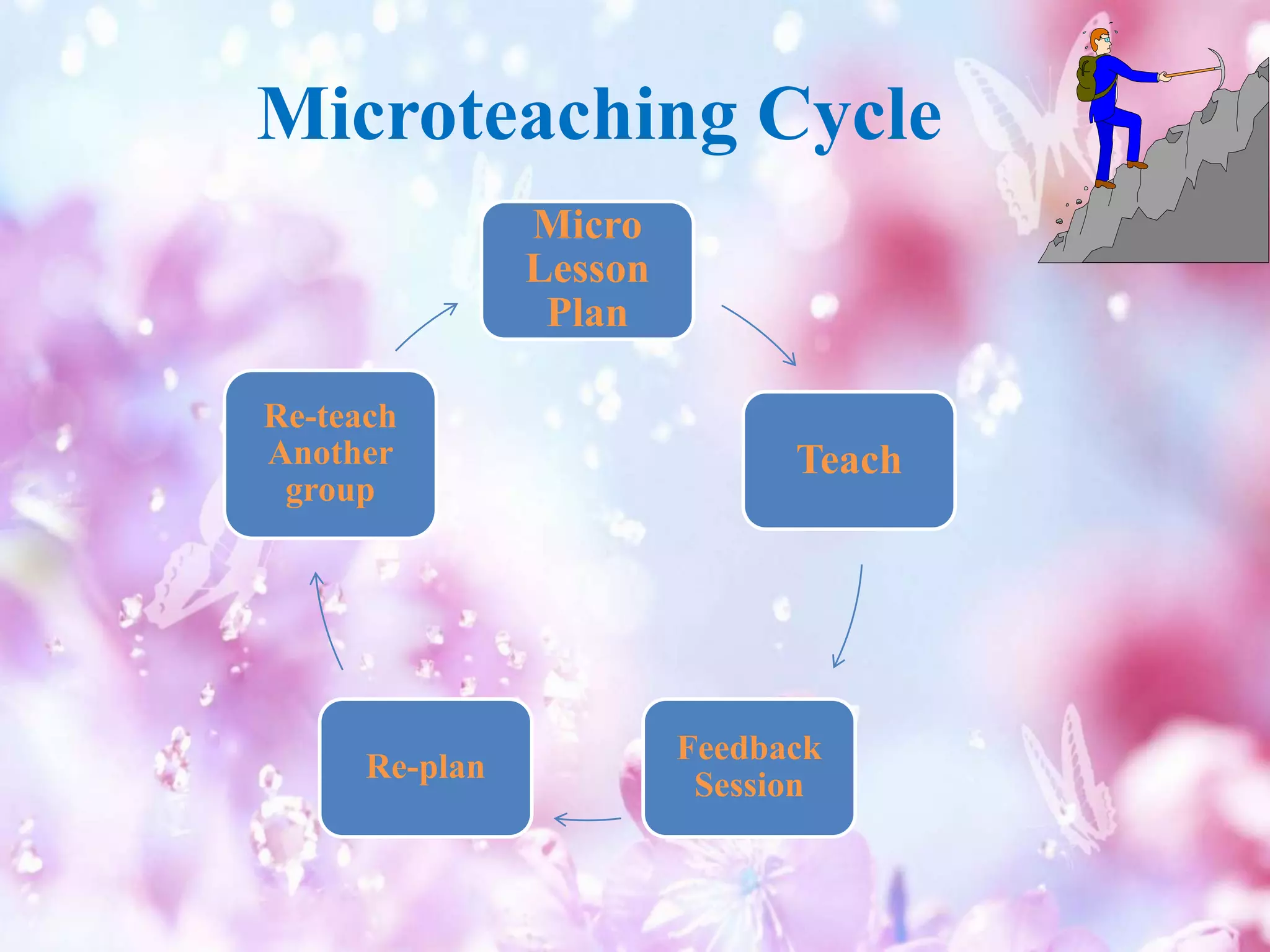
Microteaching Cycle
Micro
Lesson
Plan
Teach
Feedback
Session
Re-plan
Re-teach
Another
group
PHASES OF MICRO-TEACHING
1.KNOWLEDGE ACQUISITION PHASE
OBSERVE
DEMONSTRATION SKILL
ANALYSIS AND DISCUSS
DEMONSTRATION
2.SKILL ACQUISITION PHASE
PREPARE
MICRO
LESSON
PRACTICE SKILL EVALUATE
PERFORMANCE
3.TRANSFER PHASE
YRANSFER TO ACTUAL TEACHING SITUATION
Helps student teachers to acquire hard-to-attain
teaching skills by providing a real situation for
practicing skills.
Since micro-teaching focuses on a particular
skill at a time, student teachers can attain
proficiency in teaching skills in a phased manner.
Provision of immediate feedback makes micro-
teaching more interesting and reliable.
Since main role is played by the student teacher,
it is regarded as a student centered method.
Merits of Micro-Teaching
Time consuming
Produces homogenized standard
robots with set smiles and
procedures
It is said to be (wrongly) a form of
play acting in unnatural
surroundings and it is feared
that the acquired skills may not
be internalized.
Demerits of Micro-Teaching
Micro Teaching (education)

Micro Teaching (education)

  • 1.
  • 2.
    Teaching of asmall unit of content to the small group of students (6-10 number) in a small amount of time (10-15 min.) To train inexperience student- teachers for acquiring teaching skills. To improve the skills of experience teachers. Microteaching
  • 3.
    "A system ofcontrolled practice that makes it possible to concentrate on specific teaching behavior and to practice teaching under controlled condition". Allen and Eve (1968). Definition
  • 4.
    Principles of micro-teaching Enforcement. Practiceand drill. Continuity. Microscopic supervision Evaluation
  • 5.
    CHARACTERISTICS OF MICRO-TEACHING: 1.MicroElement : Micro-teaching reduces the complexity of the teaching situation in terms of. Number of students to be taught. Duration of lesson. Subject matter to be taught to enable the trainee to concentrate on a particular teaching skill at a time. The number of instructional objectives and the content is kept low.
  • 6.
    It reduces theteaching skill and size of the topic, it is focused on micro events. It is highly individualized training device to prepare effective teachers and provides feedback for trainees' performances. Micro analysis of the teaching process consist of analyzing the minute details of teaching.
  • 7.
    2. Teaching skillsand teaching strategies : a. Pre-instructional skills. These include writing of instructional objectives. Sequencing and organizing knowledge to be presented in order to achieve specific objectives. Appropriate content. Proper organization. Selection of proper audio-visual aids.
  • 8.
    b. Instructional skills: Skills of introducing a lesson. Skills of explaining and illustrating. Reinforcement Probing questions. Reinforcing pupil participation. Diagnosing pupils' difficulties
  • 9.
    C. Post-instructional skills: Skills of writing test items Interpreting pupil's performance in a test. Planning remedial measures. D. Feedback: Safe Practice ground The Teaching Models
  • 10.
    Defining a Specificskill Demonstration of the skill Micro-Lesson Plans Teaching a small group Feedback Re-planning, Re-teaching and Re- evaluation Steps of Micro-Teaching
  • 11.
  • 12.
    PHASES OF MICRO-TEACHING 1.KNOWLEDGEACQUISITION PHASE OBSERVE DEMONSTRATION SKILL ANALYSIS AND DISCUSS DEMONSTRATION 2.SKILL ACQUISITION PHASE PREPARE MICRO LESSON PRACTICE SKILL EVALUATE PERFORMANCE 3.TRANSFER PHASE YRANSFER TO ACTUAL TEACHING SITUATION
  • 13.
    Helps student teachersto acquire hard-to-attain teaching skills by providing a real situation for practicing skills. Since micro-teaching focuses on a particular skill at a time, student teachers can attain proficiency in teaching skills in a phased manner. Provision of immediate feedback makes micro- teaching more interesting and reliable. Since main role is played by the student teacher, it is regarded as a student centered method. Merits of Micro-Teaching
  • 14.
    Time consuming Produces homogenizedstandard robots with set smiles and procedures It is said to be (wrongly) a form of play acting in unnatural surroundings and it is feared that the acquired skills may not be internalized. Demerits of Micro-Teaching