

Learning Objective
Definition.
An instructional objective is a statement that
will describe what the learner that will be able to do after
completing the instruction(course)
Method of stating learning objective
 An instructional process becomes successful when a well
organized list of instructional objectives is prepared .
Learning objectives in the teaching learning
Process can be divided into two types .
1) General instructional objectives.
2) Specific learning objectives.
Criteria for stating the General
learning objectives
1. Each general objectives should be stated as
an intended learning.
2. Statement of each general objectives should begin with
a verb.
3. Only one learning outcome should be included in each
general objectives.
4. Each general objectives should be stated at the proper.
Cont……
5. Statement of general objectives should be free of
course content.
6. Overlapping of the objectives should be avoided .
Criteria for stating specific learning
objectives
 The following steps helps to state specific learning
objectives.
1. Each specific learning objectives must be supported by
a representative sample of specific objectives.
2. Each specific learning objectives must begin with an
action verb.
Cont…..
3. Specific learning objectives must be related to the
general objectives.
4. Adequate number of learning objectives should be
enlisted .
5. Statement of specific learning objectives should be free
from course content.
Stating clear course objectives b/c:
 Objectives guide the content materials and the teaching
method .
 You can use objectives to make sure you reach your
goals.
 Student will understand exceptions
 Assessment and grading is based on the objectives.
Purpose of instructional objectives
1. To provide direction for the instructional process by
clearly stating the intend learning outcomes.
2. To convey instruction intend to pupils parents and
educational organization.
3. To provide a basis for evaluating pupil learning by
describing the performance to be measured.
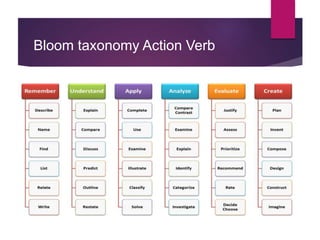
Bloom taxonomy Action Verb
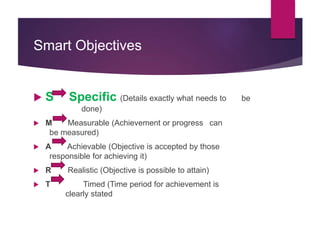
Smart Objectives
 S Specific (Details exactly what needs to be
done)
 M Measurable (Achievement or progress can
be measured)
 A Achievable (Objective is accepted by those
responsible for achieving it)
 R Realistic (Objective is possible to attain)
 T Timed (Time period for achievement is
clearly stated
Method of stating learning objectives outcomes

Method of stating learning objectives outcomes

  • 3.
    Learning Objective Definition. An instructionalobjective is a statement that will describe what the learner that will be able to do after completing the instruction(course)
  • 4.
    Method of statinglearning objective  An instructional process becomes successful when a well organized list of instructional objectives is prepared . Learning objectives in the teaching learning Process can be divided into two types . 1) General instructional objectives. 2) Specific learning objectives.
  • 5.
    Criteria for statingthe General learning objectives 1. Each general objectives should be stated as an intended learning. 2. Statement of each general objectives should begin with a verb. 3. Only one learning outcome should be included in each general objectives. 4. Each general objectives should be stated at the proper.
  • 6.
    Cont…… 5. Statement ofgeneral objectives should be free of course content. 6. Overlapping of the objectives should be avoided .
  • 7.
    Criteria for statingspecific learning objectives  The following steps helps to state specific learning objectives. 1. Each specific learning objectives must be supported by a representative sample of specific objectives. 2. Each specific learning objectives must begin with an action verb.
  • 8.
    Cont….. 3. Specific learningobjectives must be related to the general objectives. 4. Adequate number of learning objectives should be enlisted . 5. Statement of specific learning objectives should be free from course content.
  • 9.
    Stating clear courseobjectives b/c:  Objectives guide the content materials and the teaching method .  You can use objectives to make sure you reach your goals.  Student will understand exceptions  Assessment and grading is based on the objectives.
  • 10.
    Purpose of instructionalobjectives 1. To provide direction for the instructional process by clearly stating the intend learning outcomes. 2. To convey instruction intend to pupils parents and educational organization. 3. To provide a basis for evaluating pupil learning by describing the performance to be measured.
  • 11.
  • 12.
    Smart Objectives  SSpecific (Details exactly what needs to be done)  M Measurable (Achievement or progress can be measured)  A Achievable (Objective is accepted by those responsible for achieving it)  R Realistic (Objective is possible to attain)  T Timed (Time period for achievement is clearly stated