Micro Capsules / Micro Spheres:
Types, preparation and evaluation
Presented By:
Ms. Prajakta Sawant
First Year M.Pharm (Roll No. 5)
(Dept. of Pharmaceutics)
Sub: Molecular Pharmaceutics
(Sem-II)
Alard College Of Pharmacy, Pune.
Under the Guidance of:
Mr. Shivraj Mane
Prof. of Pharmaceutics
(Dept. of Pharmaceutics)
Sub: Molecular Pharmaceutics
(Sem-II)
Alard College Of Pharmacy, Pune.
1 7 June 2021
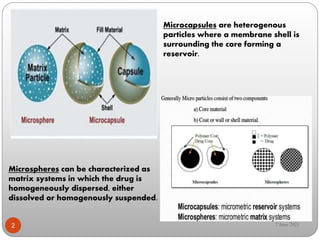
Microcapsules are heterogenous
particles where a membrane shell is
surrounding the core forming a
reservoir.
Microspheres can be characterized as
matrix systems in which the drug is
homogeneously dispersed, either
dissolved or homogenously suspended.
2 7 June 2021
INTRODUCTION
 Microspheres are solid spherical particles ranging in size from 1-
1000µm.
 They are spherical free flowing particles consisting of proteins or
synthetic polymers.
 The microspheres are free flowing powders consisting of proteins or
synthetic polymers, which are biodegradable in nature.
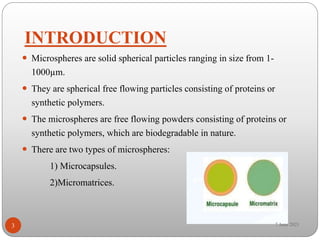
 There are two types of microspheres:
1) Microcapsules.
2)Micromatrices.
3 7 June 2021
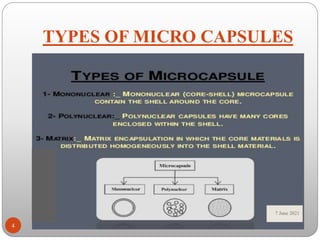
TYPES OF MICRO CAPSULES
4
7 June 2021
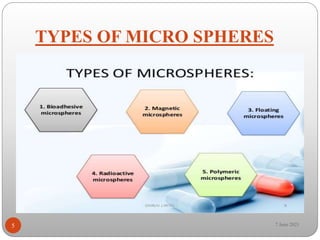
TYPES OF MICRO SPHERES
5 7 June 2021
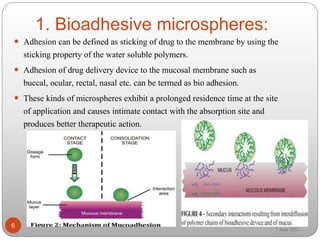
1. Bioadhesive microspheres:
 Adhesion can be defined as sticking of drug to the membrane by using the
sticking property of the water soluble polymers.
 Adhesion of drug delivery device to the mucosal membrane such as
buccal, ocular, rectal, nasal etc. can be termed as bio adhesion.
 These kinds of microspheres exhibit a prolonged residence time at the site
of application and causes intimate contact with the absorption site and
produces better therapeutic action.
6
7 June 2021
2. Magnetic microspheres:
 This kind of delivery system is very much important which localizes the
drug to the disease site.
 Magnetic carriers receive magnetic responses to a magnetic field from
incorporated materials that are used for magnetic microspheres like
chitosan, dextran etc.
a.Therapeutic magnetic microspheres, used to deliver
chemotherapeutic agent to liver tumor. Drugs like proteins and peptides
can also be targeted through this system.
b.Diagnostic microspheres, used for imaging liver metastases and
also can be used to distinguish bowel loops from other abdominal
structures by forming nano size particles supramagnetic iron oxides.
7 7 June 2021
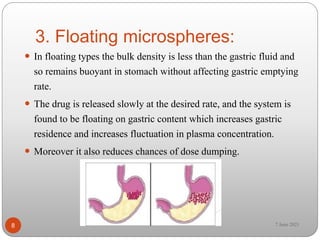
3. Floating microspheres:
 In floating types the bulk density is less than the gastric fluid and
so remains buoyant in stomach without affecting gastric emptying
rate.
 The drug is released slowly at the desired rate, and the system is
found to be floating on gastric content which increases gastric
residence and increases fluctuation in plasma concentration.
 Moreover it also reduces chances of dose dumping.
8 7 June 2021
4. Radioactive microspheres:
 In Radio embolization therapy, microspheres sized 10-30 nm are of
larger than the diameter of the capillaries and gets tapped in first
capillary bed when they come across.
 They are injected in the arteries that leads them to tumor of interest
so all these conditions of radioactive microspheres deliver high
radiation dose to the targeted areas without damaging the normal
surrounding tissues.
9 7 June 2021
 There are various types of polymers used for preparation of
microspheres.
 e.g.:-
 Albumin microspheres
 Gelatin microspheres
 Starch microspheres
 Dextran microspheres
 Carrageenan microspheres
 Alginate microspheres
 Poly (alkyl cyanoacrylate ) microspheres etc.,
5. Polymeric microspheres:
10 7 June 2021
 MATERIALS USED:-
 Microspheres usually used are polymers.
 They are classified into two types:
1. Synthetic polymeric microspheres:
 Synthetic polymeric microspheres are widely used in clinical application,
moreover that also used as bulking agent, fillers, embolic particles, drug
delivery vehicles etc.
 Main disadvantage of these kind of microspheres are that they tend to migrate
away from injection site and lead to potential risk, embolism and further organ
damage.
 Synthetic polymers are divided into two types.:
a) Non-biodegradable polymers:- Poly methyl methacrylate (PMMA),
Acrolein, Glycidyl methacrylate, Epoxy polymers.
b) Biodegradable polymers:-Lactides, Glycolides & their co polymers, Poly
alkyl cyanoacrylates, Poly anhydrides.
11 7 June 2021
2. Natural Polymers
 Natural polymers such as starch are used with the concept that they are
biodegradable, biocompatible, and also bio adhesive in nature.
 Biodegradable polymers prolongs the residence time when in contact with
mucous membrane due to its high degree of swelling property with
aqueous medium , which results in gel formation.
 The rate and extent of drug release is controlled by concentration of
polymer and the release pattern is in a sustained manner.
 Natural polymers are obtained from different sources like proteins,
carbohydrates and chemically modified carbohydrates
o Proteins: Albumin, Gelatin, Collagen
o Carbohydrates: Agarose, Carrageenan, Chitosan, Starch
o Chemically modified carbohydrates: Poly dextran, Poly starch
12 7 June 2021
13 7 June 2021
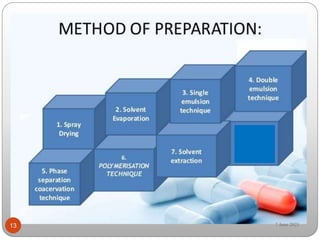
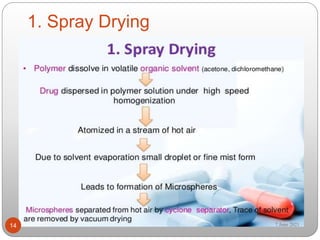
1. Spray Drying
14 7 June 2021
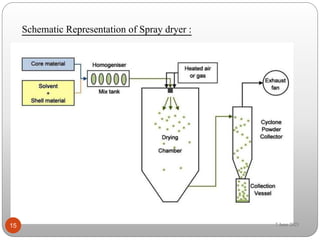
Schematic Representation of Spray dryer :
15 7 June 2021
2. SOLVENT EVAPORATION:
 The microcapsule coating is dispersed in a volatile solvent which is immiscible
with the liquid manufacturing vehicle phase.
 A core material to be microencapsulated is dissolved or dispersed in the coating
polymer solution.
 With agitation the core material mixture is dispersed in the liquid manufacturing
vehicle phase to obtain the appropriate size microcapsule.
 The mixture is then heated, if necessary to evaporate the solvent for the polymer
of the core material which is disperse in the polymer solution, hence the polymer
shrinks around the core.
 If the core material is dissolved in the coating polymer solution, matrix – type
microcapsules are formed.
 The core materials may be either water soluble or water insoluble materials.
 Solvent evaporation involves the formation of an emulsion between polymer
solution and an immiscible continuous phase whether aqueous (o/w) or non-
aqueous.
16 7 June 2021
3. Single emulsion technique
 The micro particulate carriers of natural polymers are dissolved or
dispersed in aqueous medium followed by dispersion in non-aqueous
medium like oil.
 In the next step, the cross linking of the dispersed globule is carried
out.
 The cross linking can be achieved either by means of heat or by using
the chemical cross linkers and then subjected to centrifugation,
washing, separation.
 The nature of the surfactants used to stabilize the emulsion phases can
greatly influence the size distribution, surface morphology, drug
loading, drug release, and bio performance of the final multiparticulate
product.
17 7 June 2021
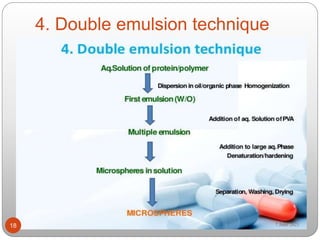
4. Double emulsion technique
18 7 June 2021
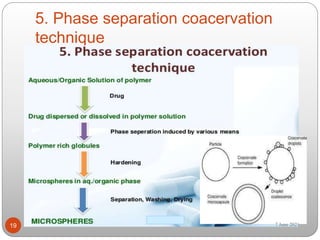
5. Phase separation coacervation
technique
19 7 June 2021
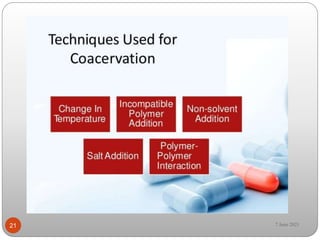
20 7 June 2021
21 7 June 2021
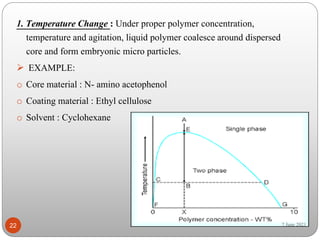
1. Temperature Change : Under proper polymer concentration,
temperature and agitation, liquid polymer coalesce around dispersed
core and form embryonic micro particles.
 EXAMPLE:
o Core material : N- amino acetophenol
o Coating material : Ethyl cellulose
o Solvent : Cyclohexane
22 7 June 2021
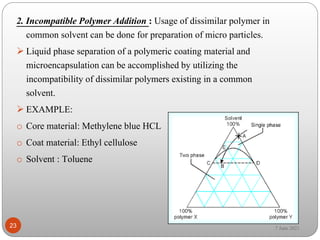
2. Incompatible Polymer Addition : Usage of dissimilar polymer in
common solvent can be done for preparation of micro particles.
 Liquid phase separation of a polymeric coating material and
microencapsulation can be accomplished by utilizing the
incompatibility of dissimilar polymers existing in a common
solvent.
 EXAMPLE:
o Core material: Methylene blue HCL
o Coat material: Ethyl cellulose
o Solvent : Toluene
23 7 June 2021
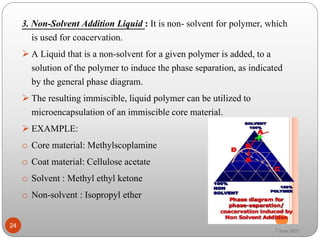
3. Non-Solvent Addition Liquid : It is non- solvent for polymer, which
is used for coacervation.
 A Liquid that is a non-solvent for a given polymer is added, to a
solution of the polymer to induce the phase separation, as indicated
by the general phase diagram.
 The resulting immiscible, liquid polymer can be utilized to
microencapsulation of an immiscible core material.
 EXAMPLE:
o Core material: Methylscoplamine
o Coat material: Cellulose acetate
o Solvent : Methyl ethyl ketone
o Non-solvent : Isopropyl ether
24
7 June 2021
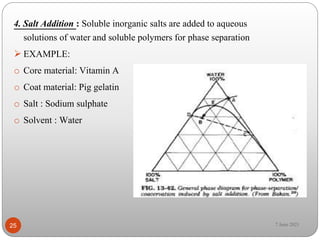
4. Salt Addition : Soluble inorganic salts are added to aqueous
solutions of water and soluble polymers for phase separation
 EXAMPLE:
o Core material: Vitamin A
o Coat material: Pig gelatin
o Salt : Sodium sulphate
o Solvent : Water
25 7 June 2021
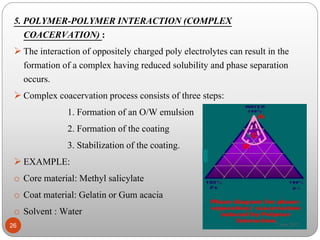
5. POLYMER-POLYMER INTERACTION (COMPLEX
COACERVATION) :
 The interaction of oppositely charged poly electrolytes can result in the
formation of a complex having reduced solubility and phase separation
occurs.
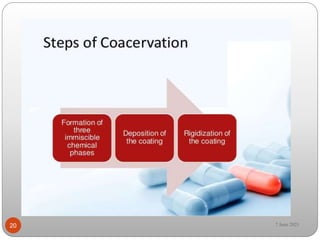
 Complex coacervation process consists of three steps:
1. Formation of an O/W emulsion
2. Formation of the coating
3. Stabilization of the coating.
 EXAMPLE:
o Core material: Methyl salicylate
o Coat material: Gelatin or Gum acacia
o Solvent : Water
26 7 June 2021
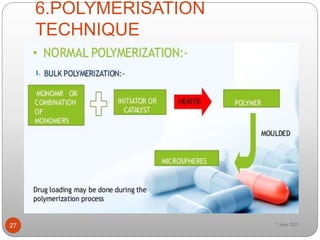
6.POLYMERISATION
TECHNIQUE
1.
27 7 June 2021
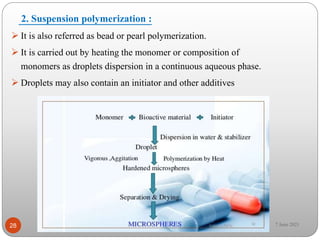
2. Suspension polymerization :
 It is also referred as bead or pearl polymerization.
 It is carried out by heating the monomer or composition of
monomers as droplets dispersion in a continuous aqueous phase.
 Droplets may also contain an initiator and other additives
28 7 June 2021
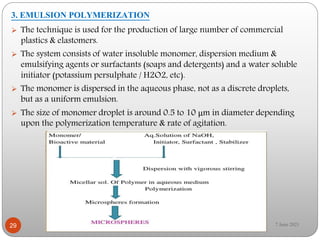
3. EMULSION POLYMERIZATION
 The technique is used for the production of large number of commercial
plastics & elastomers.
 The system consists of water insoluble monomer, dispersion medium &
emulsifying agents or surfactants (soaps and detergents) and a water soluble
initiator (potassium persulphate / H2O2, etc).
 The monomer is dispersed in the aqueous phase, not as a discrete droplets,
but as a uniform emulsion.
 The size of monomer droplet is around 0.5 to 10 μm in diameter depending
upon the polymerization temperature & rate of agitation.
29 7 June 2021
• INTERFACIAL POLYMERIZATION:-
 Interfacial polymerization essentially precedes involving reaction of
various monomers at the interface between the two immiscible
liquid phases to form a film of polymer that essentially envelops the
dispersed phase.
 The monomers present in either phases diffuse rapidly and
polymerize rapidly at the interface.
 Monomer droplet, the formed carrier is of capsular (reservoir)type.
30 7 June 2021
7. Solvent extraction
 Solvent extraction method is used for manufacturing of microparticles,
involves removal of the organic phase by extraction of non aqueous
solvent.
 This method involves water miscible organic solvents like isopropanol .
 Organic phase can be removed by extraction with water.
 This process decreases the hardening time for the microspheres.
 .One variation of the process involves direct incorporation of the drug or
protein to polymer organic solution.
 Rate of solvent removal by extraction method depends on the temperature
of water, ratio of emulsion volume to the water and solubility profile of
polymer.
31 7 June 2021
EVALUATION OF
MICROSPHERES
 1. Particle size and shape : The most widely used procedures to
visualize microparticles are conventional light microscopy (LM) and
scanning electron microscopy (SEM).
 2. Electron spectroscopy for chemical analysis: The surface chemistry
of the microspheres can be determined using the electron spectroscopy
for chemical analysis (ESCA).
 3. Density determination: The density of the microspheres can be
measured by using a multi volume pycnometer.
 4. Isoelectric point: The micro electrophoresis is used to measure the
electrophoretic mobility of microspheres from which the isoelectric
point can be determined.
32 7 June 2021
 5. Angle of contact: The angle of contact is measured to determine the
wetting property of a micro particulate carrier.
 6. In vitro methods: Release studies for different type of microspheres
are carried out by using different suitable dissolution media, mostly by
rotating paddle apparatus (USP / BP).
 7. Drug entrapment efficiency: Drug entrapment efficiency can be
calculated using following equation ;
% Entrapment = Actual content/Theoretical content x 100.
 8. Swelling index : The swelling index of the microsphere was
calculated by using the formula ;
Swelling index= (mass of swollen microspheres - mass of dry
microspheres/mass of dried microspheres) 100.
33 7 June 2021
REFERENCES :
https://www.slideshare.net/DivyaThakur17/microspheres-67311278
Assessed Date: 01/06/2021
https://www.slideshare.net/DhruvPatel50/microspheres-92768481
Assessed Date: 01/06/2021
https://www.slideshare.net/Santachem/polymerization-techniques
Assessed Date: 01/06/2021
https://www.slideshare.net/pravinchinchole/microsphere-amp-
microcapsules Assessed Date: 01/06/2021
https://www.slideshare.net/AnuragPandey60/microencapsulation-
58921360 Assessed Date: 01/06/2021
https://www.slideshare.net/TejaswiniNaredla/coacervationphase-
separation-technique-in-micro-encapsulation Assessed Date: 01/06/2021
34 7 June 2021
35 7 June 2021

Micro Capsules / Micro Spheres

  • 1.
    Micro Capsules /Micro Spheres: Types, preparation and evaluation Presented By: Ms. Prajakta Sawant First Year M.Pharm (Roll No. 5) (Dept. of Pharmaceutics) Sub: Molecular Pharmaceutics (Sem-II) Alard College Of Pharmacy, Pune. Under the Guidance of: Mr. Shivraj Mane Prof. of Pharmaceutics (Dept. of Pharmaceutics) Sub: Molecular Pharmaceutics (Sem-II) Alard College Of Pharmacy, Pune. 1 7 June 2021
  • 2.
    Microcapsules are heterogenous particleswhere a membrane shell is surrounding the core forming a reservoir. Microspheres can be characterized as matrix systems in which the drug is homogeneously dispersed, either dissolved or homogenously suspended. 2 7 June 2021
  • 3.
    INTRODUCTION  Microspheres aresolid spherical particles ranging in size from 1- 1000µm.  They are spherical free flowing particles consisting of proteins or synthetic polymers.  The microspheres are free flowing powders consisting of proteins or synthetic polymers, which are biodegradable in nature.  There are two types of microspheres: 1) Microcapsules. 2)Micromatrices. 3 7 June 2021
  • 4.
    TYPES OF MICROCAPSULES 4 7 June 2021
  • 5.
    TYPES OF MICROSPHERES 5 7 June 2021
  • 6.
    1. Bioadhesive microspheres: Adhesion can be defined as sticking of drug to the membrane by using the sticking property of the water soluble polymers.  Adhesion of drug delivery device to the mucosal membrane such as buccal, ocular, rectal, nasal etc. can be termed as bio adhesion.  These kinds of microspheres exhibit a prolonged residence time at the site of application and causes intimate contact with the absorption site and produces better therapeutic action. 6 7 June 2021
  • 7.
    2. Magnetic microspheres: This kind of delivery system is very much important which localizes the drug to the disease site.  Magnetic carriers receive magnetic responses to a magnetic field from incorporated materials that are used for magnetic microspheres like chitosan, dextran etc. a.Therapeutic magnetic microspheres, used to deliver chemotherapeutic agent to liver tumor. Drugs like proteins and peptides can also be targeted through this system. b.Diagnostic microspheres, used for imaging liver metastases and also can be used to distinguish bowel loops from other abdominal structures by forming nano size particles supramagnetic iron oxides. 7 7 June 2021
  • 8.
    3. Floating microspheres: In floating types the bulk density is less than the gastric fluid and so remains buoyant in stomach without affecting gastric emptying rate.  The drug is released slowly at the desired rate, and the system is found to be floating on gastric content which increases gastric residence and increases fluctuation in plasma concentration.  Moreover it also reduces chances of dose dumping. 8 7 June 2021
  • 9.
    4. Radioactive microspheres: In Radio embolization therapy, microspheres sized 10-30 nm are of larger than the diameter of the capillaries and gets tapped in first capillary bed when they come across.  They are injected in the arteries that leads them to tumor of interest so all these conditions of radioactive microspheres deliver high radiation dose to the targeted areas without damaging the normal surrounding tissues. 9 7 June 2021
  • 10.
     There arevarious types of polymers used for preparation of microspheres.  e.g.:-  Albumin microspheres  Gelatin microspheres  Starch microspheres  Dextran microspheres  Carrageenan microspheres  Alginate microspheres  Poly (alkyl cyanoacrylate ) microspheres etc., 5. Polymeric microspheres: 10 7 June 2021
  • 11.
     MATERIALS USED:- Microspheres usually used are polymers.  They are classified into two types: 1. Synthetic polymeric microspheres:  Synthetic polymeric microspheres are widely used in clinical application, moreover that also used as bulking agent, fillers, embolic particles, drug delivery vehicles etc.  Main disadvantage of these kind of microspheres are that they tend to migrate away from injection site and lead to potential risk, embolism and further organ damage.  Synthetic polymers are divided into two types.: a) Non-biodegradable polymers:- Poly methyl methacrylate (PMMA), Acrolein, Glycidyl methacrylate, Epoxy polymers. b) Biodegradable polymers:-Lactides, Glycolides & their co polymers, Poly alkyl cyanoacrylates, Poly anhydrides. 11 7 June 2021
  • 12.
    2. Natural Polymers Natural polymers such as starch are used with the concept that they are biodegradable, biocompatible, and also bio adhesive in nature.  Biodegradable polymers prolongs the residence time when in contact with mucous membrane due to its high degree of swelling property with aqueous medium , which results in gel formation.  The rate and extent of drug release is controlled by concentration of polymer and the release pattern is in a sustained manner.  Natural polymers are obtained from different sources like proteins, carbohydrates and chemically modified carbohydrates o Proteins: Albumin, Gelatin, Collagen o Carbohydrates: Agarose, Carrageenan, Chitosan, Starch o Chemically modified carbohydrates: Poly dextran, Poly starch 12 7 June 2021
  • 13.
  • 14.
    1. Spray Drying 147 June 2021
  • 15.
    Schematic Representation ofSpray dryer : 15 7 June 2021
  • 16.
    2. SOLVENT EVAPORATION: The microcapsule coating is dispersed in a volatile solvent which is immiscible with the liquid manufacturing vehicle phase.  A core material to be microencapsulated is dissolved or dispersed in the coating polymer solution.  With agitation the core material mixture is dispersed in the liquid manufacturing vehicle phase to obtain the appropriate size microcapsule.  The mixture is then heated, if necessary to evaporate the solvent for the polymer of the core material which is disperse in the polymer solution, hence the polymer shrinks around the core.  If the core material is dissolved in the coating polymer solution, matrix – type microcapsules are formed.  The core materials may be either water soluble or water insoluble materials.  Solvent evaporation involves the formation of an emulsion between polymer solution and an immiscible continuous phase whether aqueous (o/w) or non- aqueous. 16 7 June 2021
  • 17.
    3. Single emulsiontechnique  The micro particulate carriers of natural polymers are dissolved or dispersed in aqueous medium followed by dispersion in non-aqueous medium like oil.  In the next step, the cross linking of the dispersed globule is carried out.  The cross linking can be achieved either by means of heat or by using the chemical cross linkers and then subjected to centrifugation, washing, separation.  The nature of the surfactants used to stabilize the emulsion phases can greatly influence the size distribution, surface morphology, drug loading, drug release, and bio performance of the final multiparticulate product. 17 7 June 2021
  • 18.
    4. Double emulsiontechnique 18 7 June 2021
  • 19.
    5. Phase separationcoacervation technique 19 7 June 2021
  • 20.
  • 21.
  • 22.
    1. Temperature Change: Under proper polymer concentration, temperature and agitation, liquid polymer coalesce around dispersed core and form embryonic micro particles.  EXAMPLE: o Core material : N- amino acetophenol o Coating material : Ethyl cellulose o Solvent : Cyclohexane 22 7 June 2021
  • 23.
    2. Incompatible PolymerAddition : Usage of dissimilar polymer in common solvent can be done for preparation of micro particles.  Liquid phase separation of a polymeric coating material and microencapsulation can be accomplished by utilizing the incompatibility of dissimilar polymers existing in a common solvent.  EXAMPLE: o Core material: Methylene blue HCL o Coat material: Ethyl cellulose o Solvent : Toluene 23 7 June 2021
  • 24.
    3. Non-Solvent AdditionLiquid : It is non- solvent for polymer, which is used for coacervation.  A Liquid that is a non-solvent for a given polymer is added, to a solution of the polymer to induce the phase separation, as indicated by the general phase diagram.  The resulting immiscible, liquid polymer can be utilized to microencapsulation of an immiscible core material.  EXAMPLE: o Core material: Methylscoplamine o Coat material: Cellulose acetate o Solvent : Methyl ethyl ketone o Non-solvent : Isopropyl ether 24 7 June 2021
  • 25.
    4. Salt Addition: Soluble inorganic salts are added to aqueous solutions of water and soluble polymers for phase separation  EXAMPLE: o Core material: Vitamin A o Coat material: Pig gelatin o Salt : Sodium sulphate o Solvent : Water 25 7 June 2021
  • 26.
    5. POLYMER-POLYMER INTERACTION(COMPLEX COACERVATION) :  The interaction of oppositely charged poly electrolytes can result in the formation of a complex having reduced solubility and phase separation occurs.  Complex coacervation process consists of three steps: 1. Formation of an O/W emulsion 2. Formation of the coating 3. Stabilization of the coating.  EXAMPLE: o Core material: Methyl salicylate o Coat material: Gelatin or Gum acacia o Solvent : Water 26 7 June 2021
  • 27.
  • 28.
    2. Suspension polymerization:  It is also referred as bead or pearl polymerization.  It is carried out by heating the monomer or composition of monomers as droplets dispersion in a continuous aqueous phase.  Droplets may also contain an initiator and other additives 28 7 June 2021
  • 29.
    3. EMULSION POLYMERIZATION The technique is used for the production of large number of commercial plastics & elastomers.  The system consists of water insoluble monomer, dispersion medium & emulsifying agents or surfactants (soaps and detergents) and a water soluble initiator (potassium persulphate / H2O2, etc).  The monomer is dispersed in the aqueous phase, not as a discrete droplets, but as a uniform emulsion.  The size of monomer droplet is around 0.5 to 10 μm in diameter depending upon the polymerization temperature & rate of agitation. 29 7 June 2021
  • 30.
    • INTERFACIAL POLYMERIZATION:- Interfacial polymerization essentially precedes involving reaction of various monomers at the interface between the two immiscible liquid phases to form a film of polymer that essentially envelops the dispersed phase.  The monomers present in either phases diffuse rapidly and polymerize rapidly at the interface.  Monomer droplet, the formed carrier is of capsular (reservoir)type. 30 7 June 2021
  • 31.
    7. Solvent extraction Solvent extraction method is used for manufacturing of microparticles, involves removal of the organic phase by extraction of non aqueous solvent.  This method involves water miscible organic solvents like isopropanol .  Organic phase can be removed by extraction with water.  This process decreases the hardening time for the microspheres.  .One variation of the process involves direct incorporation of the drug or protein to polymer organic solution.  Rate of solvent removal by extraction method depends on the temperature of water, ratio of emulsion volume to the water and solubility profile of polymer. 31 7 June 2021
  • 32.
    EVALUATION OF MICROSPHERES  1.Particle size and shape : The most widely used procedures to visualize microparticles are conventional light microscopy (LM) and scanning electron microscopy (SEM).  2. Electron spectroscopy for chemical analysis: The surface chemistry of the microspheres can be determined using the electron spectroscopy for chemical analysis (ESCA).  3. Density determination: The density of the microspheres can be measured by using a multi volume pycnometer.  4. Isoelectric point: The micro electrophoresis is used to measure the electrophoretic mobility of microspheres from which the isoelectric point can be determined. 32 7 June 2021
  • 33.
     5. Angleof contact: The angle of contact is measured to determine the wetting property of a micro particulate carrier.  6. In vitro methods: Release studies for different type of microspheres are carried out by using different suitable dissolution media, mostly by rotating paddle apparatus (USP / BP).  7. Drug entrapment efficiency: Drug entrapment efficiency can be calculated using following equation ; % Entrapment = Actual content/Theoretical content x 100.  8. Swelling index : The swelling index of the microsphere was calculated by using the formula ; Swelling index= (mass of swollen microspheres - mass of dry microspheres/mass of dried microspheres) 100. 33 7 June 2021
  • 34.
    REFERENCES : https://www.slideshare.net/DivyaThakur17/microspheres-67311278 Assessed Date:01/06/2021 https://www.slideshare.net/DhruvPatel50/microspheres-92768481 Assessed Date: 01/06/2021 https://www.slideshare.net/Santachem/polymerization-techniques Assessed Date: 01/06/2021 https://www.slideshare.net/pravinchinchole/microsphere-amp- microcapsules Assessed Date: 01/06/2021 https://www.slideshare.net/AnuragPandey60/microencapsulation- 58921360 Assessed Date: 01/06/2021 https://www.slideshare.net/TejaswiniNaredla/coacervationphase- separation-technique-in-micro-encapsulation Assessed Date: 01/06/2021 34 7 June 2021
  • 35.