A PRESENTATION ON
IMPLANTABLE DRUG DELIVERY
SYSTEM
Prepared by
Sourav Kar
7th Sem, Div-II
B.Pharm
Roll No-1427704097
Mentor: Dr. Gopa Roy Biswas
NSHM Institute Of
Pharmaceutical Technology
INTRODUCTION
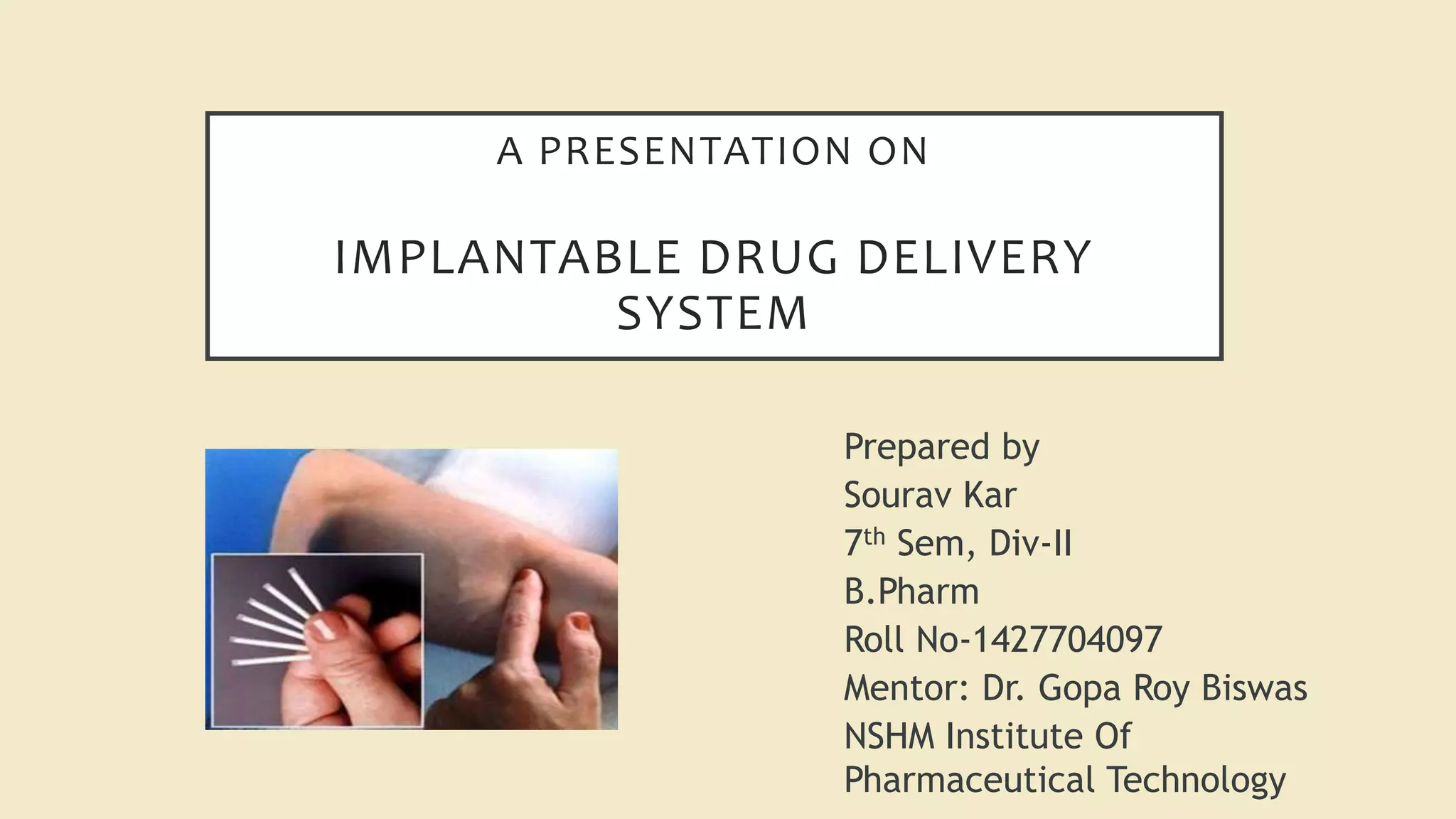
 Implants are small sterile solid masses consisting of a highly purified drug made by
compression or molding or extrusion.
 Implants are intended for implantation in the body ( subcutaneous or intramuscular tissue) by
a minor surgical incision or injected through a large bore needle.
 Implants are developed with a view to provide continuous release of drug into the bloodstream
over long period of time without the repeated insertion of needles.
 Well suited for the drug delivery requirements of insulin, steroids, chemotherapeutics,
antibiotics, analgesics, total parenteral nutrition and heparin.
2
ADVANTAGES
 Controlled drug delivery for
a long time period.
 Improved patient compliance.
 Targeted drug delivery.
 Bypasses first pass
metabolism.
 Decreased side effects.
 Improved stability of drugs.
 Improve bioavailability of
drugs.
DISADVANTAGES
 Surgery is needed for large
implants (Painful).
 Therapy cannot be simply
discontinued.
 Reactions between host &
implant.
 Inadequate release of API.
3
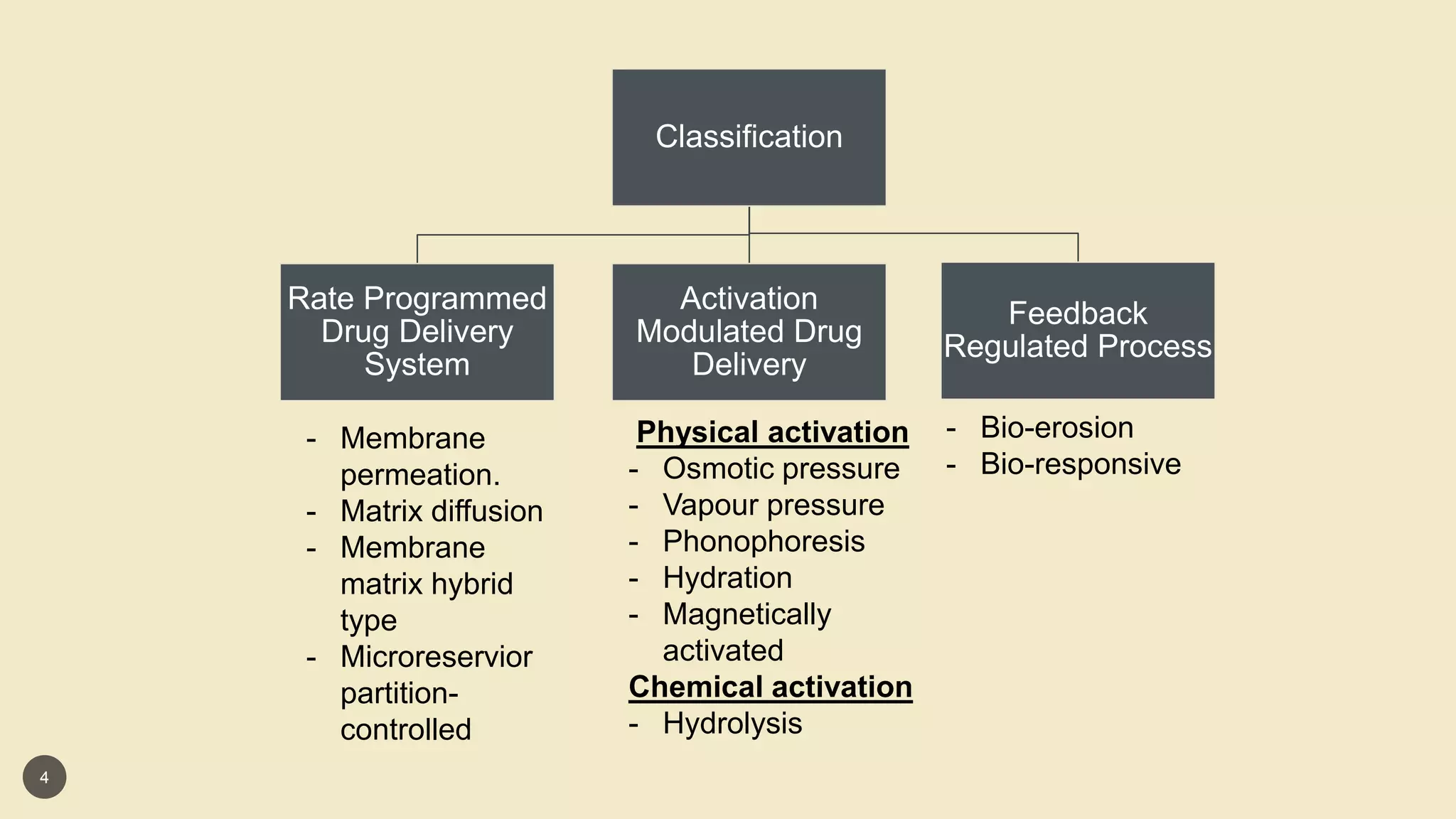
Classification
Rate Programmed
Drug Delivery
System
Activation
Modulated Drug
Delivery
Feedback
Regulated Process
- Membrane
permeation.
- Matrix diffusion
- Membrane
matrix hybrid
type
- Microreservior
partition-
controlled
Physical activation
- Osmotic pressure
- Vapour pressure
- Phonophoresis
- Hydration
- Magnetically
activated
Chemical activation
- Hydrolysis
- Bio-erosion
- Bio-responsive
4
A) RATE PROGRAMMED DRUG DELIVERY SYSTEM
o Diffusion of the drug contributes to the drug release process.
o Release of the drug from the device is pre-programmed at a specific rate profile.
1. Polymer Membrane Permeation Controlled Drug Delivery
• Drug formulation is encapsulated within a compartment that is enclosed by a rate controlling
polymeric membrane.
• Drug reservoir : solid particle/dispersion of solid particles in a liquid or solid dispersion medium.
• Polymer membrane: nonporous/microporous/semipermeable.
Example:
• Norplant subdermal implant.
• Ocusert system.
5
A) RATE PROGRAMMED DRUG DELIVERY SYSTEM
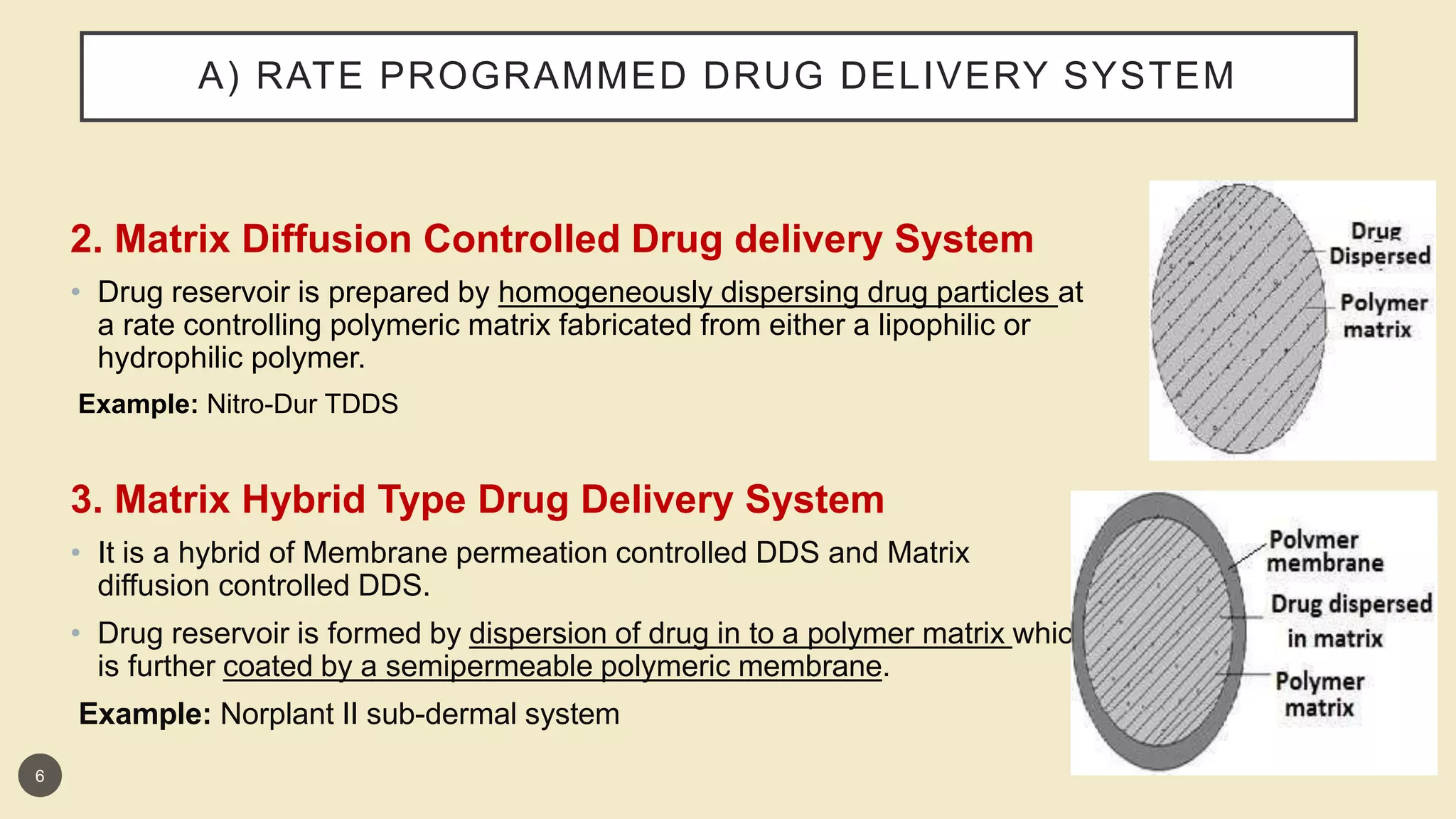
2. Matrix Diffusion Controlled Drug delivery System
• Drug reservoir is prepared by homogeneously dispersing drug particles at
a rate controlling polymeric matrix fabricated from either a lipophilic or
hydrophilic polymer.
Example: Nitro-Dur TDDS
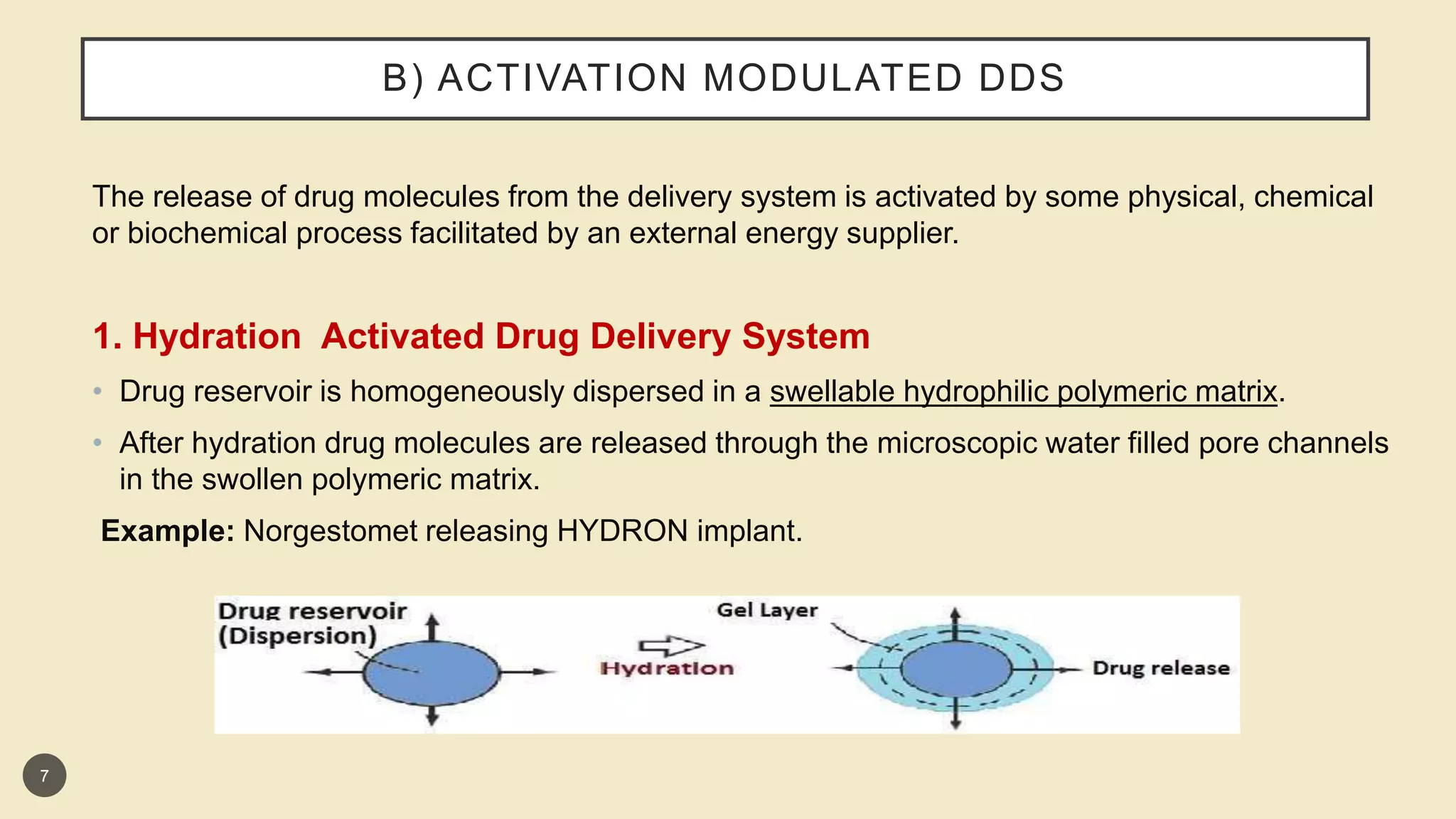
3. Matrix Hybrid Type Drug Delivery System
• It is a hybrid of Membrane permeation controlled DDS and Matrix
diffusion controlled DDS.
• Drug reservoir is formed by dispersion of drug in to a polymer matrix which
is further coated by a semipermeable polymeric membrane.
Example: Norplant II sub-dermal system
6
B) ACTIVATION MODULATED DDS
The release of drug molecules from the delivery system is activated by some physical, chemical
or biochemical process facilitated by an external energy supplier.
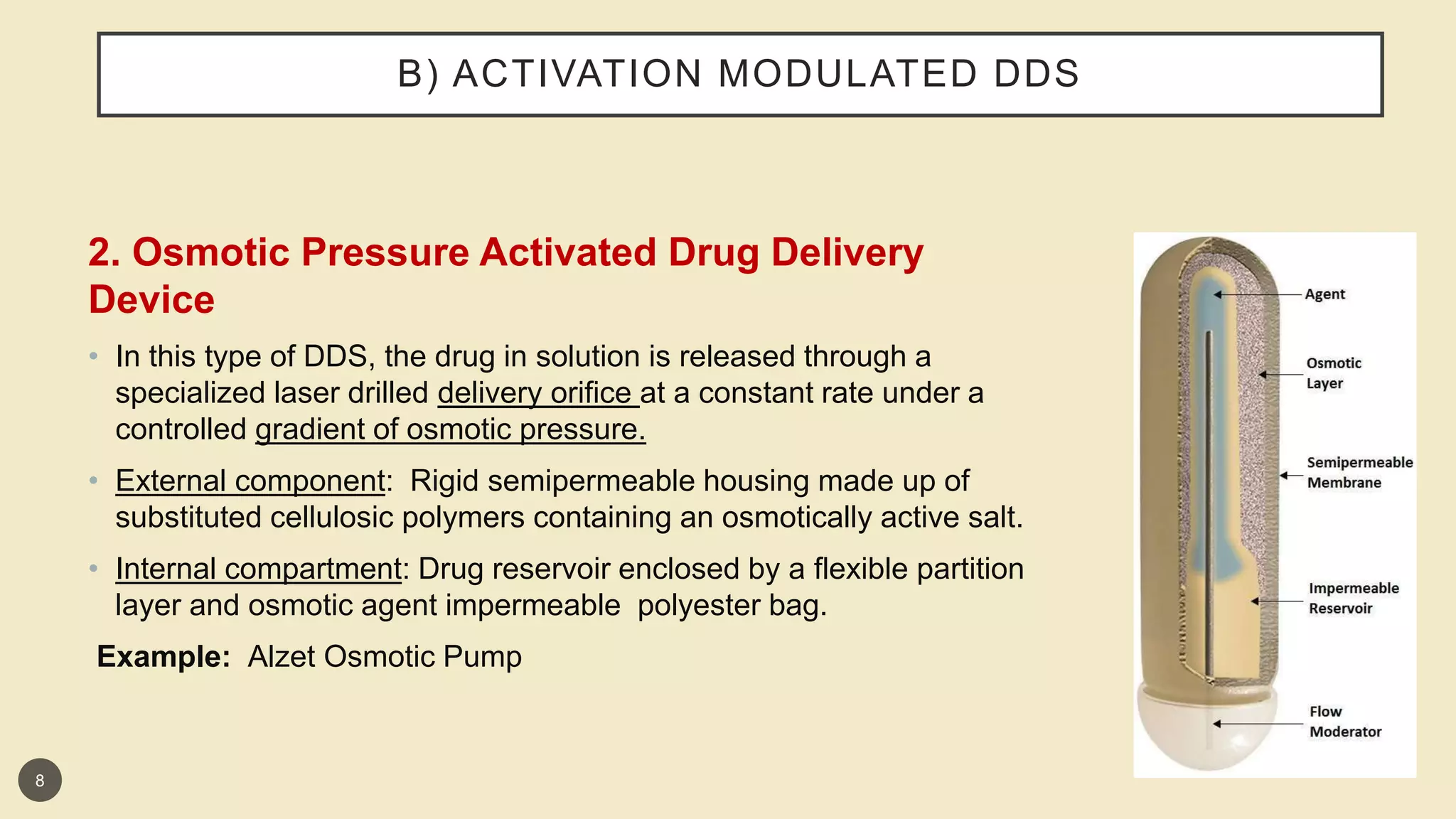
1. Hydration Activated Drug Delivery System
• Drug reservoir is homogeneously dispersed in a swellable hydrophilic polymeric matrix.
• After hydration drug molecules are released through the microscopic water filled pore channels
in the swollen polymeric matrix.
Example: Norgestomet releasing HYDRON implant.
7
B) ACTIVATION MODULATED DDS
2. Osmotic Pressure Activated Drug Delivery
Device
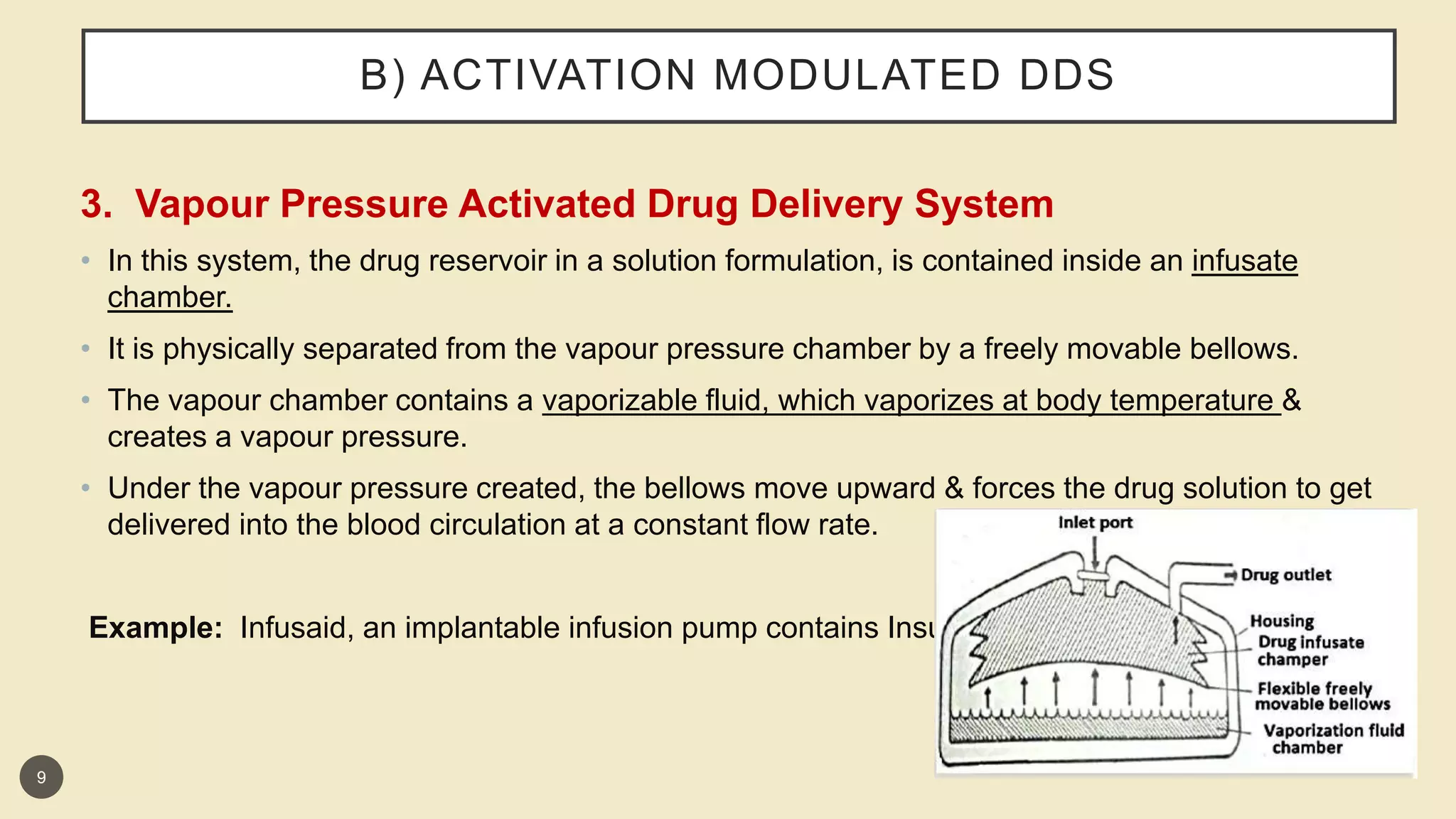
• In this type of DDS, the drug in solution is released through a
specialized laser drilled delivery orifice at a constant rate under a
controlled gradient of osmotic pressure.
• External component: Rigid semipermeable housing made up of
substituted cellulosic polymers containing an osmotically active salt.
• Internal compartment: Drug reservoir enclosed by a flexible partition
layer and osmotic agent impermeable polyester bag.
Example: Alzet Osmotic Pump
8
B) ACTIVATION MODULATED DDS
3. Vapour Pressure Activated Drug Delivery System
• In this system, the drug reservoir in a solution formulation, is contained inside an infusate
chamber.
• It is physically separated from the vapour pressure chamber by a freely movable bellows.
• The vapour chamber contains a vaporizable fluid, which vaporizes at body temperature &
creates a vapour pressure.
• Under the vapour pressure created, the bellows move upward & forces the drug solution to get
delivered into the blood circulation at a constant flow rate.
Example: Infusaid, an implantable infusion pump contains Insulin.
9
B) ACTIVATION MODULATED DDS
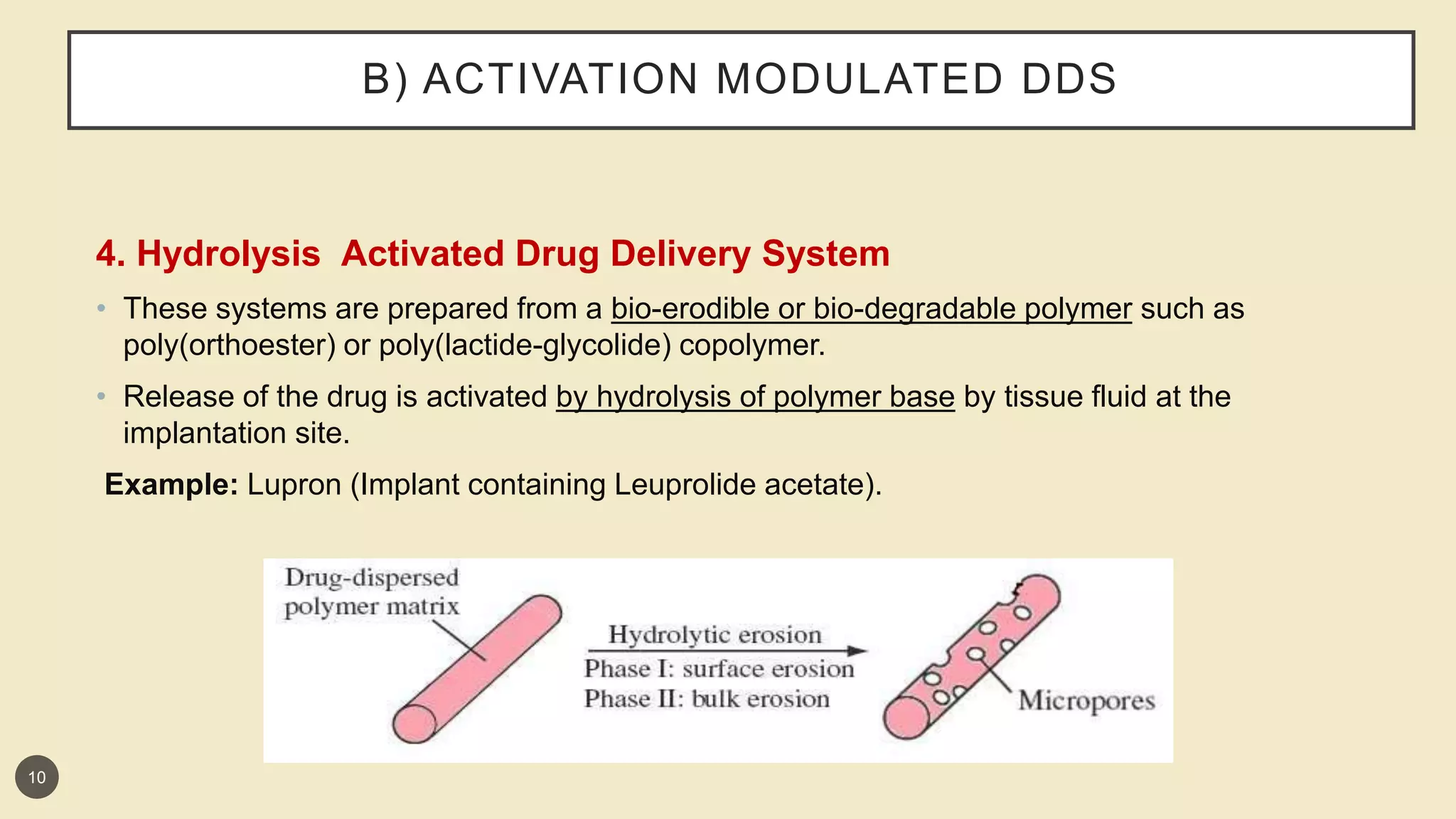
4. Hydrolysis Activated Drug Delivery System
• These systems are prepared from a bio-erodible or bio-degradable polymer such as
poly(orthoester) or poly(lactide-glycolide) copolymer.
• Release of the drug is activated by hydrolysis of polymer base by tissue fluid at the
implantation site.
Example: Lupron (Implant containing Leuprolide acetate).
10
C) FEED BACK REGULATED PROCESS
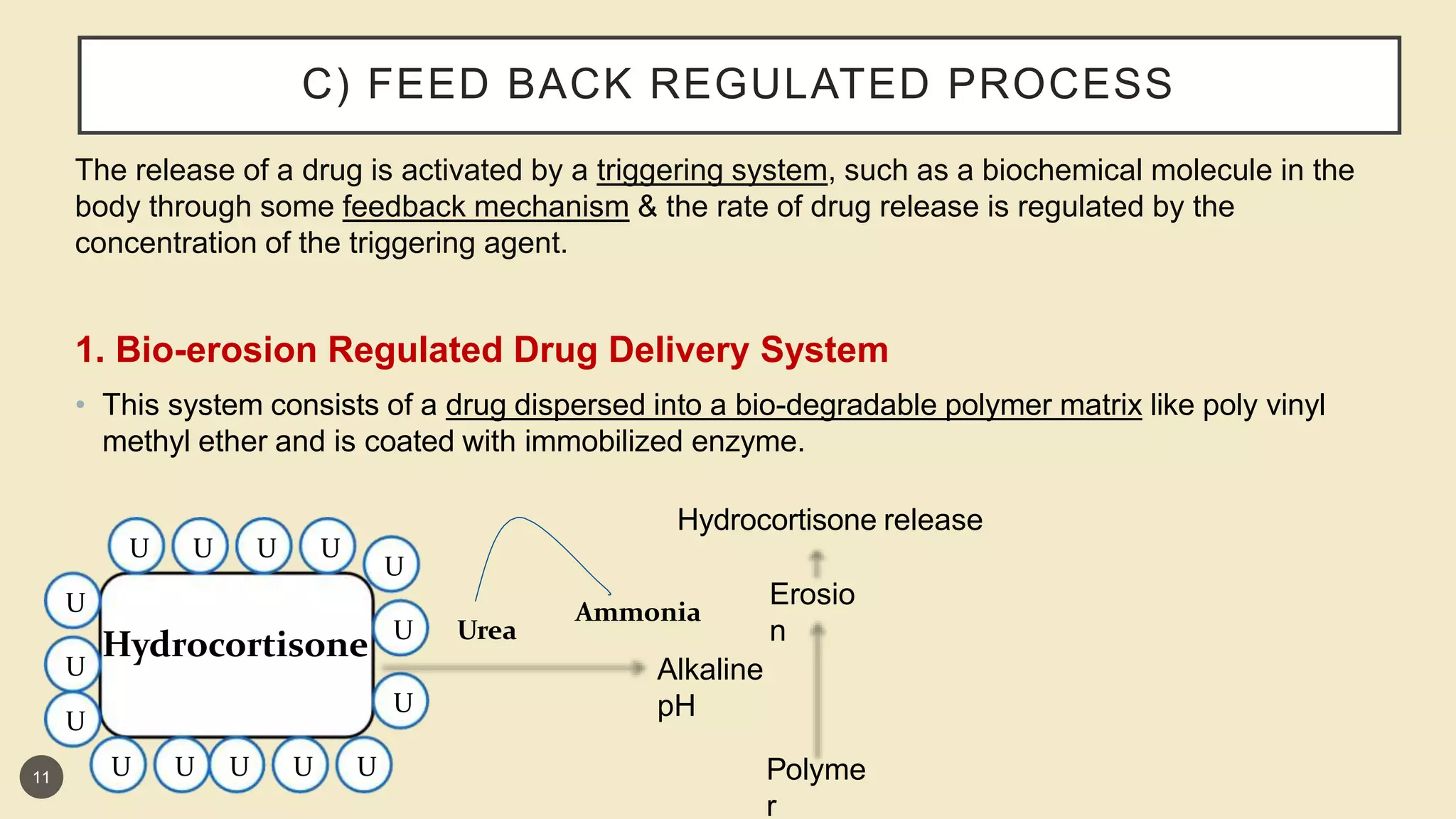
The release of a drug is activated by a triggering system, such as a biochemical molecule in the
body through some feedback mechanism & the rate of drug release is regulated by the
concentration of the triggering agent.
1. Bio-erosion Regulated Drug Delivery System
• This system consists of a drug dispersed into a bio-degradable polymer matrix like poly vinyl
methyl ether and is coated with immobilized enzyme.
Hydrocortisone
U
U U U U
U U U U U
U
U
U
U Urea
U
Ammonia
Alkaline
pH
Polyme
r
Erosio
n
Hydrocortisone release
11
C) FEED BACK REGULATED PROCESS
2. Bio-responsive Drug Delivery System
• The drug reservoir is contained in a device enclosed by a bioresponsive polymer membrane
whose permeability to drug molecules is controlled by concentration of some biochemical agent
in the tissue, where the system is to be implanted.
Example: Glucose Triggered Insulin Delivery System
12
CONCLUSION
 Implanted drug delivery system is a novel drug deliver system having the ability to reduce
the frequency of patient driven dosing and to deliver the drug in targeted manner.
Implantable drug delivery devices are devoid of limitations associated with oral, intravenous,
topical drug administration.
IDDS is a suitable drug delivery system for antibiotics, contraceptives, antineoplastic agents,
steroids, insulin, nutraceuticals etc.
Researches are being conducted on IDDS for improvement of implant preparations to
achieve better drug release profiles, cost reduction of drug treatment and enhanced patient
compliance.
13
REFERENCES
I. Yie.W.Chien; “NOVEL DRUG DELIVERY SYSTEM”; Second edition;
Marcel Dekker Inc; Page no: 441-488.
II. Vasant V. Ranade, Mannfred A. Hollinger, John B. Cannon; “DRUG
DELIVERY SYSTEMS”; Second Edition; CRC Press; Page no: 115-
140.
III. J. R. Robinson, Vincent H. L. Lee; “CONTROLLED DRUG
DELIVERY:FUNDAMENTALS & APPLICATIONS”; Second Edition;
CRC Press; Page no: 481-516.
IV. https://www.mdtmag.com/article/2013/07/implantable-drug-
delivery- devices%E2%80%94-overview(accessed on
24.10.17).
14
Implantable Drug Delivery System

Implantable Drug Delivery System

  • 1.
    A PRESENTATION ON IMPLANTABLEDRUG DELIVERY SYSTEM Prepared by Sourav Kar 7th Sem, Div-II B.Pharm Roll No-1427704097 Mentor: Dr. Gopa Roy Biswas NSHM Institute Of Pharmaceutical Technology
  • 2.
    INTRODUCTION  Implants aresmall sterile solid masses consisting of a highly purified drug made by compression or molding or extrusion.  Implants are intended for implantation in the body ( subcutaneous or intramuscular tissue) by a minor surgical incision or injected through a large bore needle.  Implants are developed with a view to provide continuous release of drug into the bloodstream over long period of time without the repeated insertion of needles.  Well suited for the drug delivery requirements of insulin, steroids, chemotherapeutics, antibiotics, analgesics, total parenteral nutrition and heparin. 2
  • 3.
    ADVANTAGES  Controlled drugdelivery for a long time period.  Improved patient compliance.  Targeted drug delivery.  Bypasses first pass metabolism.  Decreased side effects.  Improved stability of drugs.  Improve bioavailability of drugs. DISADVANTAGES  Surgery is needed for large implants (Painful).  Therapy cannot be simply discontinued.  Reactions between host & implant.  Inadequate release of API. 3
  • 4.
    Classification Rate Programmed Drug Delivery System Activation ModulatedDrug Delivery Feedback Regulated Process - Membrane permeation. - Matrix diffusion - Membrane matrix hybrid type - Microreservior partition- controlled Physical activation - Osmotic pressure - Vapour pressure - Phonophoresis - Hydration - Magnetically activated Chemical activation - Hydrolysis - Bio-erosion - Bio-responsive 4
  • 5.
    A) RATE PROGRAMMEDDRUG DELIVERY SYSTEM o Diffusion of the drug contributes to the drug release process. o Release of the drug from the device is pre-programmed at a specific rate profile. 1. Polymer Membrane Permeation Controlled Drug Delivery • Drug formulation is encapsulated within a compartment that is enclosed by a rate controlling polymeric membrane. • Drug reservoir : solid particle/dispersion of solid particles in a liquid or solid dispersion medium. • Polymer membrane: nonporous/microporous/semipermeable. Example: • Norplant subdermal implant. • Ocusert system. 5
  • 6.
    A) RATE PROGRAMMEDDRUG DELIVERY SYSTEM 2. Matrix Diffusion Controlled Drug delivery System • Drug reservoir is prepared by homogeneously dispersing drug particles at a rate controlling polymeric matrix fabricated from either a lipophilic or hydrophilic polymer. Example: Nitro-Dur TDDS 3. Matrix Hybrid Type Drug Delivery System • It is a hybrid of Membrane permeation controlled DDS and Matrix diffusion controlled DDS. • Drug reservoir is formed by dispersion of drug in to a polymer matrix which is further coated by a semipermeable polymeric membrane. Example: Norplant II sub-dermal system 6
  • 7.
    B) ACTIVATION MODULATEDDDS The release of drug molecules from the delivery system is activated by some physical, chemical or biochemical process facilitated by an external energy supplier. 1. Hydration Activated Drug Delivery System • Drug reservoir is homogeneously dispersed in a swellable hydrophilic polymeric matrix. • After hydration drug molecules are released through the microscopic water filled pore channels in the swollen polymeric matrix. Example: Norgestomet releasing HYDRON implant. 7
  • 8.
    B) ACTIVATION MODULATEDDDS 2. Osmotic Pressure Activated Drug Delivery Device • In this type of DDS, the drug in solution is released through a specialized laser drilled delivery orifice at a constant rate under a controlled gradient of osmotic pressure. • External component: Rigid semipermeable housing made up of substituted cellulosic polymers containing an osmotically active salt. • Internal compartment: Drug reservoir enclosed by a flexible partition layer and osmotic agent impermeable polyester bag. Example: Alzet Osmotic Pump 8
  • 9.
    B) ACTIVATION MODULATEDDDS 3. Vapour Pressure Activated Drug Delivery System • In this system, the drug reservoir in a solution formulation, is contained inside an infusate chamber. • It is physically separated from the vapour pressure chamber by a freely movable bellows. • The vapour chamber contains a vaporizable fluid, which vaporizes at body temperature & creates a vapour pressure. • Under the vapour pressure created, the bellows move upward & forces the drug solution to get delivered into the blood circulation at a constant flow rate. Example: Infusaid, an implantable infusion pump contains Insulin. 9
  • 10.
    B) ACTIVATION MODULATEDDDS 4. Hydrolysis Activated Drug Delivery System • These systems are prepared from a bio-erodible or bio-degradable polymer such as poly(orthoester) or poly(lactide-glycolide) copolymer. • Release of the drug is activated by hydrolysis of polymer base by tissue fluid at the implantation site. Example: Lupron (Implant containing Leuprolide acetate). 10
  • 11.
    C) FEED BACKREGULATED PROCESS The release of a drug is activated by a triggering system, such as a biochemical molecule in the body through some feedback mechanism & the rate of drug release is regulated by the concentration of the triggering agent. 1. Bio-erosion Regulated Drug Delivery System • This system consists of a drug dispersed into a bio-degradable polymer matrix like poly vinyl methyl ether and is coated with immobilized enzyme. Hydrocortisone U U U U U U U U U U U U U U Urea U Ammonia Alkaline pH Polyme r Erosio n Hydrocortisone release 11
  • 12.
    C) FEED BACKREGULATED PROCESS 2. Bio-responsive Drug Delivery System • The drug reservoir is contained in a device enclosed by a bioresponsive polymer membrane whose permeability to drug molecules is controlled by concentration of some biochemical agent in the tissue, where the system is to be implanted. Example: Glucose Triggered Insulin Delivery System 12
  • 13.
    CONCLUSION  Implanted drugdelivery system is a novel drug deliver system having the ability to reduce the frequency of patient driven dosing and to deliver the drug in targeted manner. Implantable drug delivery devices are devoid of limitations associated with oral, intravenous, topical drug administration. IDDS is a suitable drug delivery system for antibiotics, contraceptives, antineoplastic agents, steroids, insulin, nutraceuticals etc. Researches are being conducted on IDDS for improvement of implant preparations to achieve better drug release profiles, cost reduction of drug treatment and enhanced patient compliance. 13
  • 14.
    REFERENCES I. Yie.W.Chien; “NOVELDRUG DELIVERY SYSTEM”; Second edition; Marcel Dekker Inc; Page no: 441-488. II. Vasant V. Ranade, Mannfred A. Hollinger, John B. Cannon; “DRUG DELIVERY SYSTEMS”; Second Edition; CRC Press; Page no: 115- 140. III. J. R. Robinson, Vincent H. L. Lee; “CONTROLLED DRUG DELIVERY:FUNDAMENTALS & APPLICATIONS”; Second Edition; CRC Press; Page no: 481-516. IV. https://www.mdtmag.com/article/2013/07/implantable-drug- delivery- devices%E2%80%94-overview(accessed on 24.10.17). 14