Physicochemical Properties
Influencing The design of
Controlled/Sustained Release
Products
Dr. Rajan Swami
Associate Professor
MMCP
Flow of presentation
 Introduction : Terminologies and graphs
 Advantages & limitations
 Physicochemical factors
 Summary
 Marketed preparations
2
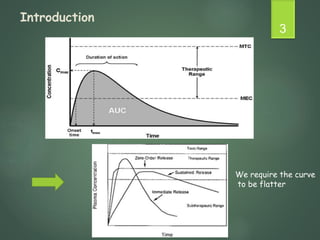
Introduction
3
We require the curve
to be flatter
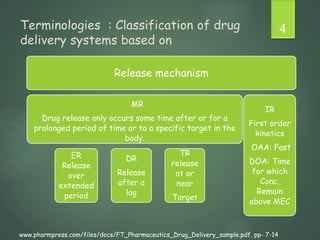
Terminologies : Classification of drug
delivery systems based on
Release mechanism
MR
Drug release only occurs some time after or for a
prolonged period of time or to a specific target in the
body.
ER
Release
over
extended
period
DR
Release
after a
lag
TR
release
at or
near
Target
IR
First order
kinetics
OAA: Fast
DOA: Time
for which
Conc.
Remain
above MEC
4
www.pharmpress.com/files/docs/FT_Pharmaceutics_Drug_Delivery_sample.pdf, pp- 7-14
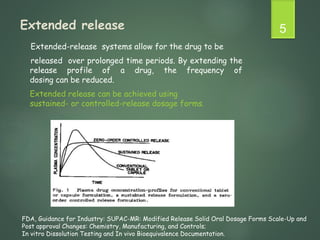
Extended release
Extended-release systems allow for the drug to be
released over prolonged time periods. By extending the
release profile of a drug, the frequency of
dosing can be reduced.
Extended release can be achieved using
sustained- or controlled-release dosage forms.
5
FDA, Guidance for Industry: SUPAC-MR: Modified Release Solid Oral Dosage Forms Scale-Up and
Post approval Changes: Chemistry, Manufacturing, and Controls;
In vitro Dissolution Testing and In vivo Bioequivalence Documentation.
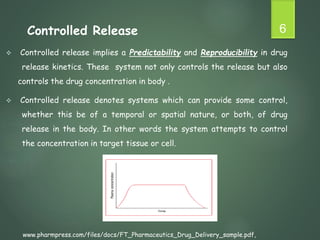
 Controlled release implies a Predictability and Reproducibility in drug
release kinetics. These system not only controls the release but also
controls the drug concentration in body .
 Controlled release denotes systems which can provide some control,
whether this be of a temporal or spatial nature, or both, of drug
release in the body. In other words the system attempts to control
the concentration in target tissue or cell.
6
Controlled Release
www.pharmpress.com/files/docs/FT_Pharmaceutics_Drug_Delivery_sample.pdf,
In general Controlled delivery attempts to :
 Sustain drug action at predetermined rate by
maintaining a relatively constant effective drug level in
body with concomitant minimization of undesirable
side effects associated with sawtooth kinetic pattern.
 Localize the drug action by spatial placement of
controlled release system adjacent to or in the
disease tissue or target
7
Contd…
Lee et.al. Controlled Drug Delivery: Fundamentals and Applications, Volume 29 , Marcel Dekker INC,
New York, 1987, pp. 3-19
Deshpande et. al. Drug Development and Industrial Pharmacy, 22(6), 531-539 (1996)
Sustained Release
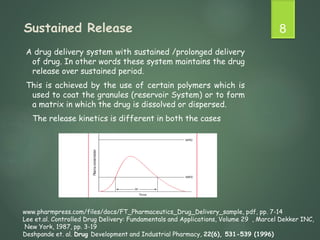
A drug delivery system with sustained /prolonged delivery
of drug. In other words these system maintains the drug
release over sustained period.
This is achieved by the use of certain polymers which is
used to coat the granules (reservoir System) or to form
a matrix in which the drug is dissolved or dispersed.
The release kinetics is different in both the cases
8
www.pharmpress.com/files/docs/FT_Pharmaceutics_Drug_Delivery_sample, pdf, pp. 7-14
Lee et.al. Controlled Drug Delivery: Fundamentals and Applications, Volume 29 , Marcel Dekker INC,
New York, 1987, pp. 3-19
Deshpande et. al. Drug Development and Industrial Pharmacy, 22(6), 531-539 (1996)
Dose and rate consideration
Rate of release for zero order = Css * Cl
Css is the desired steady state concentration
Cl is the drug clearance
Dose = Di + Kr
0 Td
Di = initial dose
Kr
0 = zero order release constant
Td = time desired for sustained release from one dose
9
Advantages of CDDS & SDDS
 Reduction of frequency of dosage administration
 Better control over drug fluctuations in blood
 Reduction of total drug usage hence leading to decreased side
effects and drug accumulation on chronic dosing
 Improved bioavailability
 Economic to patients
 Increased safety margin of high potency drugs
 Reduced gastric irritation
 Better control of disease
 Market Exclusivity
10
Kydonieus et. al. Treatise on Controlled Drug Delivery , Marcel Dekker INC., Ney York , pp. 255-256
Limitations of CDDS & SDDS
 Dose dumping
 Poor in-vitro in-vivo correlation
 Limited choice of selecting desired dose in the unit
 Higher manufacturing costs
 Delay in onset of drug action
 Retrieval of drug is difficult
 Higher initial cost
11
Kydonieus et. al. Treatise on Controlled Drug Delivery , Marcel Dekker INC., Ney York , pp. 255-256
FACTORS INFLUENCING THE DESIGN
AN D PERFORMANCE
OF SUSTAINED/CONTROLLED
RELEASE PRODUCTS
 Drug properties
 Route of delivery
 Target sites
 Acute / chronic therapy
 Disease
 The patient
 Formulation factors
12
Lee et.al. Controlled Drug Delivery: Fundamentals and Applications, Volume 29 ,
Marcel Dekker INC, New York, 1987, pp. 3-19
Deshpande et. al. Drug Development and Industrial Pharmacy, 22(6), 531-539 (1996)
Desired characteristics for
CDDS and SDDS
 Molecular weight <500 Da
 Aq. Solubility >1 mg/ml PH 1 to 7.8
 Permeability > 0.5 X 10⁻⁶ mm/s
 Half-life not lees than 2 hrs & not more than 8 hrs
 Therapeutic index >10
 Conventional oral dose <125 - 500mg
 Should be GI stable
 Not Extensive first pass
13
Aulton M E (2007) Aulton’s Pharmaceutics – The Design and Manufacture of
Medicines. Edinburgh: Churchill Livingstone.
PHYSICOCHEMICAL PROPERTIES OF A
DRUG INFLUENCING
DRUG PRODUCT DESIGN AND
PERFORMANCE
 Aqueous solubility
 Partition coefficient
 Protein binding
 drug stability
 dose size
 ionization constant
14
Lee et.al. Controlled Drug Delivery: Fundamentals and Applications, Volume 29
Marcel Dekker INC, New York, 1987, pp. 3-19
Remington : the science and practice of pharmacy , 20th edition, Volume 1,
Lippincott Williams and Wilkins, New York , pp. 903-910
Aqueous Solubility
It can affect
 Drug Release from CDDS/SDDS
 Loading efficiency of Liposomes & Micro particles if used
for CDDS/SDDS
 Polymer Coating
 Bioavailability
15
We require Aqueous solubility as well as solubility at desired Site
of Absorption i.e at required PH
Lee et.al. Controlled Drug Delivery: Fundamentals and Applications, Volume 29
Marcel Dekker INC, New York, 1987, pp. 3-19
Remington : the science and practice of pharmacy , 20th edition, Volume 1,
Lippincott Williams and Wilkins, New York , pp. 903-910
16
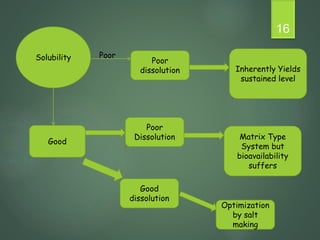
Solubility Poor
dissolution Inherently Yields
sustained level
Good
Poor
Dissolution Matrix Type
System but
bioavailability
suffers
Poor
Good
dissolution
Optimization
by salt
making
Quantitatively
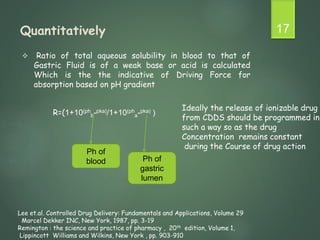
 Ratio of total aqueous solubility in blood to that of
Gastric Fluid is of a weak base or acid is calculated
Which is the the indicative of Driving Force for
absorption based on pH gradient
R=(1+10(ph
b-pka)/1+10(ph
a-pka) )
17
Ph of
blood Ph of
gastric
lumen
Lee et.al. Controlled Drug Delivery: Fundamentals and Applications, Volume 29
Marcel Dekker INC, New York, 1987, pp. 3-19
Remington : the science and practice of pharmacy , 20th edition, Volume 1,
Lippincott Williams and Wilkins, New York , pp. 903-910
Ideally the release of ionizable drug
from CDDS should be programmed in
such a way so as the drug
Concentration remains constant
during the Course of drug action
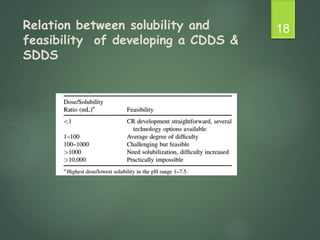
Relation between solubility and
feasibility of developing a CDDS &
SDDS
18
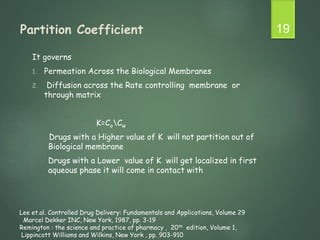
Partition Coefficient
It governs
1. Permeation Across the Biological Membranes
2. Diffusion across the Rate controlling membrane or
through matrix
K=CoCw
Drugs with a Higher value of K will not partition out of
Biological membrane
Drugs with a Lower value of K will get localized in first
aqueous phase it will come in contact with
19
Lee et.al. Controlled Drug Delivery: Fundamentals and Applications, Volume 29
Marcel Dekker INC, New York, 1987, pp. 3-19
Remington : the science and practice of pharmacy , 20th edition, Volume 1,
Lippincott Williams and Wilkins, New York , pp. 903-910
Quantitatively
The relationship between permeability and Partition Coefficient
can be explained by HANSCH relation
20
The optimum value of K for optimum activity is 1000
Drugs with a higher or lower value are poorer
candidates for CDDS/SDDS .
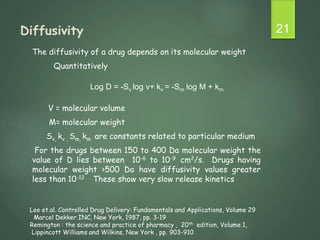
Diffusivity
The diffusivity of a drug depends on its molecular weight
Quantitatively
V = molecular volume
M= molecular weight
Sv, kv , Sm, km are constants related to particular medium
For the drugs between 150 to 400 Da molecular weight the
value of D lies between 10-6 to 10-9 cm2/s. Drugs having
molecular weight >500 Da have diffusivity values greater
less than 10-12 . These show very slow release kinetics
21
Log D = -Sv log v+ kv = -Sm log M + km
Lee et.al. Controlled Drug Delivery: Fundamentals and Applications, Volume 29
Marcel Dekker INC, New York, 1987, pp. 3-19
Remington : the science and practice of pharmacy , 20th edition, Volume 1,
Lippincott Williams and Wilkins, New York , pp. 903-910
Drug Stability
 Drugs showing stability problem in any particular
area of GI tract are less suitable for controlled
release system that release its contents over a
length of GI tract
 The delivery system which is localized in a
particular area of GI tract ( Bio adhesive systems
)act as reservoir for drug release are much more
suitable for these kind of drugs
 CDDS is also suitable for drugs getting destroyed
by enzymatic degradation via protection of drug
by incorporation into polymeric matrix
22
Lee et.al. Controlled Drug Delivery: Fundamentals and Applications, Volume 29
Marcel Dekker INC, New York, 1987, pp. 3-19
Remington : the science and practice of pharmacy , 20th edition, Volume 1,
Lippincott Williams and Wilkins, New York , pp. 903-910
Protein Binding
 Protein binding characteristics of drug play a significant
role in therapeutic effect regardless of the type of
dosage form
 The drug Protein complex serve as reservoir for
controlled release of drugs to extra vascular tissues.
 Extensive Protein binding will be evidenced by long half
life for elimination and such drugs do not require
controlled release dosage form .
23
Lee et.al. Controlled Drug Delivery: Fundamentals and Applications, Volume 29
Marcel Dekker INC, New York, 1987, pp. 3-19
Remington : the science and practice of pharmacy , 20th edition, Volume 1,
Lippincott Williams and Wilkins, New York , pp. 903-910
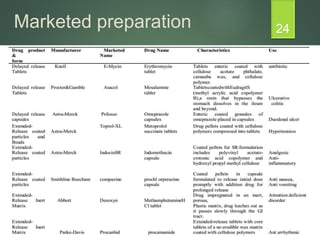
Marketed preparation 24
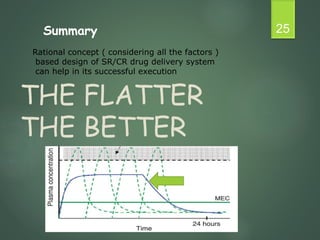
THE FLATTER
THE BETTER
25
Summary
Rational concept ( considering all the factors )
based design of SR/CR drug delivery system
can help in its successful execution
Case Study 26
Sandberg et. al. Eur J Clin Pharmacol (1988) 33 [Suppl]: S3-S7
27

Physicochemical factors for CDDS.pptx

  • 1.
    Physicochemical Properties Influencing Thedesign of Controlled/Sustained Release Products Dr. Rajan Swami Associate Professor MMCP
  • 2.
    Flow of presentation Introduction : Terminologies and graphs  Advantages & limitations  Physicochemical factors  Summary  Marketed preparations 2
  • 3.
    Introduction 3 We require thecurve to be flatter
  • 4.
    Terminologies : Classificationof drug delivery systems based on Release mechanism MR Drug release only occurs some time after or for a prolonged period of time or to a specific target in the body. ER Release over extended period DR Release after a lag TR release at or near Target IR First order kinetics OAA: Fast DOA: Time for which Conc. Remain above MEC 4 www.pharmpress.com/files/docs/FT_Pharmaceutics_Drug_Delivery_sample.pdf, pp- 7-14
  • 5.
    Extended release Extended-release systemsallow for the drug to be released over prolonged time periods. By extending the release profile of a drug, the frequency of dosing can be reduced. Extended release can be achieved using sustained- or controlled-release dosage forms. 5 FDA, Guidance for Industry: SUPAC-MR: Modified Release Solid Oral Dosage Forms Scale-Up and Post approval Changes: Chemistry, Manufacturing, and Controls; In vitro Dissolution Testing and In vivo Bioequivalence Documentation.
  • 6.
     Controlled releaseimplies a Predictability and Reproducibility in drug release kinetics. These system not only controls the release but also controls the drug concentration in body .  Controlled release denotes systems which can provide some control, whether this be of a temporal or spatial nature, or both, of drug release in the body. In other words the system attempts to control the concentration in target tissue or cell. 6 Controlled Release www.pharmpress.com/files/docs/FT_Pharmaceutics_Drug_Delivery_sample.pdf,
  • 7.
    In general Controlleddelivery attempts to :  Sustain drug action at predetermined rate by maintaining a relatively constant effective drug level in body with concomitant minimization of undesirable side effects associated with sawtooth kinetic pattern.  Localize the drug action by spatial placement of controlled release system adjacent to or in the disease tissue or target 7 Contd… Lee et.al. Controlled Drug Delivery: Fundamentals and Applications, Volume 29 , Marcel Dekker INC, New York, 1987, pp. 3-19 Deshpande et. al. Drug Development and Industrial Pharmacy, 22(6), 531-539 (1996)
  • 8.
    Sustained Release A drugdelivery system with sustained /prolonged delivery of drug. In other words these system maintains the drug release over sustained period. This is achieved by the use of certain polymers which is used to coat the granules (reservoir System) or to form a matrix in which the drug is dissolved or dispersed. The release kinetics is different in both the cases 8 www.pharmpress.com/files/docs/FT_Pharmaceutics_Drug_Delivery_sample, pdf, pp. 7-14 Lee et.al. Controlled Drug Delivery: Fundamentals and Applications, Volume 29 , Marcel Dekker INC, New York, 1987, pp. 3-19 Deshpande et. al. Drug Development and Industrial Pharmacy, 22(6), 531-539 (1996)
  • 9.
    Dose and rateconsideration Rate of release for zero order = Css * Cl Css is the desired steady state concentration Cl is the drug clearance Dose = Di + Kr 0 Td Di = initial dose Kr 0 = zero order release constant Td = time desired for sustained release from one dose 9
  • 10.
    Advantages of CDDS& SDDS  Reduction of frequency of dosage administration  Better control over drug fluctuations in blood  Reduction of total drug usage hence leading to decreased side effects and drug accumulation on chronic dosing  Improved bioavailability  Economic to patients  Increased safety margin of high potency drugs  Reduced gastric irritation  Better control of disease  Market Exclusivity 10 Kydonieus et. al. Treatise on Controlled Drug Delivery , Marcel Dekker INC., Ney York , pp. 255-256
  • 11.
    Limitations of CDDS& SDDS  Dose dumping  Poor in-vitro in-vivo correlation  Limited choice of selecting desired dose in the unit  Higher manufacturing costs  Delay in onset of drug action  Retrieval of drug is difficult  Higher initial cost 11 Kydonieus et. al. Treatise on Controlled Drug Delivery , Marcel Dekker INC., Ney York , pp. 255-256
  • 12.
    FACTORS INFLUENCING THEDESIGN AN D PERFORMANCE OF SUSTAINED/CONTROLLED RELEASE PRODUCTS  Drug properties  Route of delivery  Target sites  Acute / chronic therapy  Disease  The patient  Formulation factors 12 Lee et.al. Controlled Drug Delivery: Fundamentals and Applications, Volume 29 , Marcel Dekker INC, New York, 1987, pp. 3-19 Deshpande et. al. Drug Development and Industrial Pharmacy, 22(6), 531-539 (1996)
  • 13.
    Desired characteristics for CDDSand SDDS  Molecular weight <500 Da  Aq. Solubility >1 mg/ml PH 1 to 7.8  Permeability > 0.5 X 10⁻⁶ mm/s  Half-life not lees than 2 hrs & not more than 8 hrs  Therapeutic index >10  Conventional oral dose <125 - 500mg  Should be GI stable  Not Extensive first pass 13 Aulton M E (2007) Aulton’s Pharmaceutics – The Design and Manufacture of Medicines. Edinburgh: Churchill Livingstone.
  • 14.
    PHYSICOCHEMICAL PROPERTIES OFA DRUG INFLUENCING DRUG PRODUCT DESIGN AND PERFORMANCE  Aqueous solubility  Partition coefficient  Protein binding  drug stability  dose size  ionization constant 14 Lee et.al. Controlled Drug Delivery: Fundamentals and Applications, Volume 29 Marcel Dekker INC, New York, 1987, pp. 3-19 Remington : the science and practice of pharmacy , 20th edition, Volume 1, Lippincott Williams and Wilkins, New York , pp. 903-910
  • 15.
    Aqueous Solubility It canaffect  Drug Release from CDDS/SDDS  Loading efficiency of Liposomes & Micro particles if used for CDDS/SDDS  Polymer Coating  Bioavailability 15 We require Aqueous solubility as well as solubility at desired Site of Absorption i.e at required PH Lee et.al. Controlled Drug Delivery: Fundamentals and Applications, Volume 29 Marcel Dekker INC, New York, 1987, pp. 3-19 Remington : the science and practice of pharmacy , 20th edition, Volume 1, Lippincott Williams and Wilkins, New York , pp. 903-910
  • 16.
    16 Solubility Poor dissolution InherentlyYields sustained level Good Poor Dissolution Matrix Type System but bioavailability suffers Poor Good dissolution Optimization by salt making
  • 17.
    Quantitatively  Ratio oftotal aqueous solubility in blood to that of Gastric Fluid is of a weak base or acid is calculated Which is the the indicative of Driving Force for absorption based on pH gradient R=(1+10(ph b-pka)/1+10(ph a-pka) ) 17 Ph of blood Ph of gastric lumen Lee et.al. Controlled Drug Delivery: Fundamentals and Applications, Volume 29 Marcel Dekker INC, New York, 1987, pp. 3-19 Remington : the science and practice of pharmacy , 20th edition, Volume 1, Lippincott Williams and Wilkins, New York , pp. 903-910 Ideally the release of ionizable drug from CDDS should be programmed in such a way so as the drug Concentration remains constant during the Course of drug action
  • 18.
    Relation between solubilityand feasibility of developing a CDDS & SDDS 18
  • 19.
    Partition Coefficient It governs 1.Permeation Across the Biological Membranes 2. Diffusion across the Rate controlling membrane or through matrix K=CoCw Drugs with a Higher value of K will not partition out of Biological membrane Drugs with a Lower value of K will get localized in first aqueous phase it will come in contact with 19 Lee et.al. Controlled Drug Delivery: Fundamentals and Applications, Volume 29 Marcel Dekker INC, New York, 1987, pp. 3-19 Remington : the science and practice of pharmacy , 20th edition, Volume 1, Lippincott Williams and Wilkins, New York , pp. 903-910
  • 20.
    Quantitatively The relationship betweenpermeability and Partition Coefficient can be explained by HANSCH relation 20 The optimum value of K for optimum activity is 1000 Drugs with a higher or lower value are poorer candidates for CDDS/SDDS .
  • 21.
    Diffusivity The diffusivity ofa drug depends on its molecular weight Quantitatively V = molecular volume M= molecular weight Sv, kv , Sm, km are constants related to particular medium For the drugs between 150 to 400 Da molecular weight the value of D lies between 10-6 to 10-9 cm2/s. Drugs having molecular weight >500 Da have diffusivity values greater less than 10-12 . These show very slow release kinetics 21 Log D = -Sv log v+ kv = -Sm log M + km Lee et.al. Controlled Drug Delivery: Fundamentals and Applications, Volume 29 Marcel Dekker INC, New York, 1987, pp. 3-19 Remington : the science and practice of pharmacy , 20th edition, Volume 1, Lippincott Williams and Wilkins, New York , pp. 903-910
  • 22.
    Drug Stability  Drugsshowing stability problem in any particular area of GI tract are less suitable for controlled release system that release its contents over a length of GI tract  The delivery system which is localized in a particular area of GI tract ( Bio adhesive systems )act as reservoir for drug release are much more suitable for these kind of drugs  CDDS is also suitable for drugs getting destroyed by enzymatic degradation via protection of drug by incorporation into polymeric matrix 22 Lee et.al. Controlled Drug Delivery: Fundamentals and Applications, Volume 29 Marcel Dekker INC, New York, 1987, pp. 3-19 Remington : the science and practice of pharmacy , 20th edition, Volume 1, Lippincott Williams and Wilkins, New York , pp. 903-910
  • 23.
    Protein Binding  Proteinbinding characteristics of drug play a significant role in therapeutic effect regardless of the type of dosage form  The drug Protein complex serve as reservoir for controlled release of drugs to extra vascular tissues.  Extensive Protein binding will be evidenced by long half life for elimination and such drugs do not require controlled release dosage form . 23 Lee et.al. Controlled Drug Delivery: Fundamentals and Applications, Volume 29 Marcel Dekker INC, New York, 1987, pp. 3-19 Remington : the science and practice of pharmacy , 20th edition, Volume 1, Lippincott Williams and Wilkins, New York , pp. 903-910
  • 24.
  • 25.
    THE FLATTER THE BETTER 25 Summary Rationalconcept ( considering all the factors ) based design of SR/CR drug delivery system can help in its successful execution
  • 26.
    Case Study 26 Sandberget. al. Eur J Clin Pharmacol (1988) 33 [Suppl]: S3-S7
  • 27.