RATIONALE OF
CONTROLLED DRUG
DELIVERY
Submitted By,
Ameena Kadar K A
Final year B Pharm
Grace College of Pharmacy
 Introduction
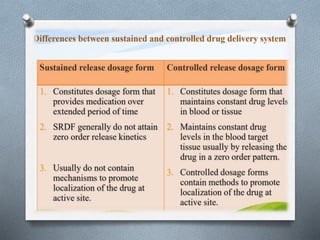
 Controlled drug delivery is one, which delivers the drugs at a
predetermined rate, for locally or systemically, for a specified
period of time.
 It maintains constant level of drug in blood and tissue for extended
period of time.
 Continuous oral delivery of drugs at predictable & reproducible
kinetics for predetermined period throughout the course of GIT.
 Sustained drug delivery may provide an immediate dose required
for the normal therapeutic response, followed by the gradual release
of drug in amounts sufficient to maintain the therapeutic response
for a specific extended period of time usually 8-12 hours.
RATIONALE OF CONTROLLED
DRUG DELIVERY
 The basic rationale of a controlled release drug delivery system is to
optimize the biopharmaceutics, pharmacokinetics and
pharmacodynamics properties of a drug is such a way that it's utility
is maximized through reduction in side effects and cure or control of
disease conditions in the shortest possible time by using smallest
quantity of drug administered by most suitable route.
 The immediate release drug delivery system lacks some features like
dose maintenance, controlled release and site targeting.
 The decrease in frequency of daily dose is more convenient to the
patient and can lead to improved patient compliance.
 Reduction of dosing from 3 to 4 times daily to once or twice daily
has been shown to increase patient compliance.
 A controlled release dosage form may decrease the drug
concentration fluctuations by reducing peak blood levels, thus
potentially reducing dose related adverse effects and increase the
minimum plasma concentrations, there by increasing efficacy if a
threshold concentration is required.
 An ideal drug delivery system should deliver the drug at a rate dictated by
the need of body over a specified period of treatment.
 It is desirable that the duration of drug action become more to design
properly.
 The basic rationale for controlled drug delivery is to alter the
pharmacokinetics and pharmacodynamics of pharmacologically
active moieties by using novel drug delivery system or by modifying
the molecular structure and /or physiological parameters.
ADVANTAGES
 Reduce frequency of administration.
 Employ minimum drug.
 Minimize or eliminates local & systemic side effects, reduced GIT
irritation.
 Better patient compliance and acceptance.
 Reduced duration of treatment period.
 Improved efficacy or safety ratio.
 Cure or control confirm more promptly.
 Minimize drug accumulation with chronic dosing.
 A suitable delivery system for drugs which having a short biological
half-life (3-4 hrs) and drug rapidly eliminate from the body.
 Reduced fluctuations in circulating drug levels.
 Make use of special effects, Eg: sustained release aspect for
morning relief of arthritis by dosing before bed time.
 CRDDS Improve absorption, utilization and there by enhancing
bioavailability.
 Uniform drug effect.
 Suitable for long term treatments for Chronic disease.
CONCLUSION
 A suitably deliberate controlled release drug delivery system can be
a significant progress towards solving problems regarding the
targeting of a drug to a particular organ or tissue and controlling
the rate of drug delivery to the target site.
 Controlled release (C.R) stuff provide an advantage over
conventional quantity forms by optimizing bio-pharmaceutics,
pharmacokinetic and pharmacodynamics properties of medicinal
products.
 In such a way that controlled the release of drugs reduces the drugs
dosing rate to an extent.
 Once the daily dose is enough for remedial management through the
uniform plasma, focus providing maximum efficacy of drug with a
reduction in local and systemic side effects and treatment or control
circumstance in shortest possible time by the smallest amount of drug to
assure greater patient compliance.
 The most significant role of drug release system is to find the drug
delivered to the site of action in ample quantity and at the proper rate, and
it should meet other relevant criteria as physical and chemical stability,
ability to be mass-produced at the particular site.
 With improved understanding of controlled-release mechanisms and
improved development of technologies, it may be possible to design an
appropriate method for efficient drug delivery system at the particular site.
REFERENCES
1. A text book of “Novel Drug Delivery Systems” by Dr. Aijaz
sheikh and et.al ; Page NO:4-5
2. “CONTROLLED RELEASE DRUG FORMULATION IN
PHARMACEUTICALS: A STUDY ON THEIR
APPLICATION AND PROPERTIES” article by Rajesh
Tiwari.
3. CONTROLLED DRUG DELIVERY SYSTEM: A REVIEW
Patel Nidhi1* , Chaudhary Anamika1 , Soni Twinkle1 ,
Sambyal Mehul1 , Jain Hitesh1 , Upadhyay Umesh (article).
Rationale of controlled drug delivery