MICRO TEACHING
Dr. S. Prakash
Principal
Thiagarajar College of Preceptors
Madurai
Definitions
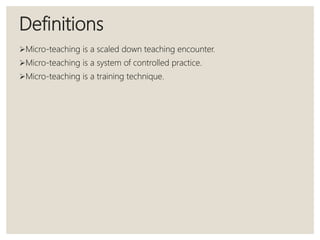
Micro-teaching is a scaled down teaching encounter.
Micro-teaching is a system of controlled practice.
Micro-teaching is a training technique.
Characteristics
It is a teacher training technique and not a
teaching method.
It is a real teaching, though the teaching
SITUATION IS SIMULATED.
In micro teaching teacher trainee practices one
a specific teaching skill at a time, till he/she
attains mastery over the skill.
It is a scale down teaching encounter in class
size, content, class time.
It operates on a predefined model. Plan, teach,
feedback, re-plan, re-teach, re-feedback, etc.
Characteristics
It allows for increased control of practice by providing feedback to the
teacher trainee.
It is not a substitute but a supplement to the teacher training programme.
It is a cyclic process. The pre decided model is repeated till the trainee
achieves the expected level of mastery.
It is a highly individualized training device.
Advantages
Helps in reducing the complexities of the normal class room teaching.
Helps the teacher trainee gain more confidence in real teaching.
It creates among the teacher trainees an awareness of various skills of which
teaching is composed of.
It stimulates the class room scene and gives the teacher trainee an experience
of real teaching.
Advantages
It helps in systematic and objective analysis of
the pattern of class room communication through
specific observation schedule.
It is more effective in modifying teacher
behaviour.
It is an effective for transfer of teaching
competencies to the class room.
It helps in getting acquainted with class room
manners to a certain extent.
Feedback enables the teacher trainee to
consciously concentrate on specific behavioural
modification.
Advantages
It has skilled supervision.
Gives constructive feed back.
It has the component skills approach.
Here the activity of teaching as a whole is broken
down for the learning purpose into its individual
components. (skills)
It focuses on sharpening the specific teaching
skills and eliminating the errors.
It enables understanding of behaviours
important class room teaching.
Advantages
It increases the confidence of learning to.
It provides experts supervision and constructive
feed back.
It provides for repeated practice without adverse
consequences to the training.
A modified concept of Micro Teaching by.
Here teaching skills are practiced in a controlled
low rise environment.
Demerits
Micro teaching is skill oriented and not content
oriented.
It covers only a few specific skills.
Lack of material resources like video recording
facility and trained supervisors.
The question of integrating the skill is quite
challenging.
Teaching is not just a summation of teaching skills.
Sufficient literature on micro teaching is not yet
available
A teaching skill is a group of teaching
acts/behaviours intended to facilitate pupils
Demerits
It produces homogenized standard robots with set
smiles and procedures.
It is said to be a firm of play acting unnatural
surrounding and the acquired skill may not be
internalized.
Micro Teaching is skill oriented and not content
oriented.
It covers only a few specific skills.
Integrating the skill is quite challenging.
Teaching is not first a summation of teaching skills.
Sufficient literature on micro teaching is not yet
available.
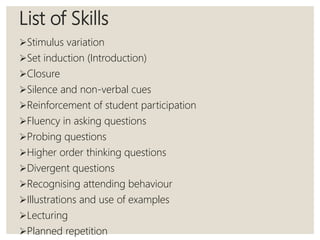
List of Skills
Stimulus variation
Set induction (Introduction)
Closure
Silence and non-verbal cues
Reinforcement of student participation
Fluency in asking questions
Probing questions
Higher order thinking questions
Divergent questions
Recognising attending behaviour
Illustrations and use of examples
Lecturing
Planned repetition
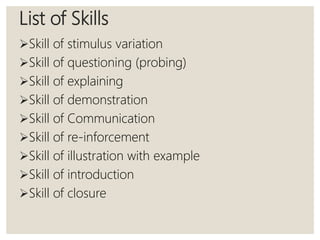
List of Skills
Skill of stimulus variation
Skill of questioning (probing)
Skill of explaining
Skill of demonstration
Skill of Communication
Skill of re-inforcement
Skill of illustration with example
Skill of introduction
Skill of closure
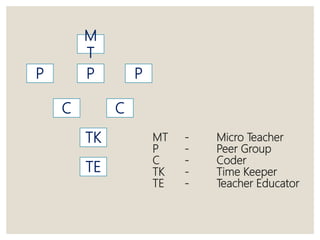
MT - Micro Teacher
P - Peer Group
C - Coder
TK - Time Keeper
TE - Teacher Educator
M
T
P P P
C C
TK
TE
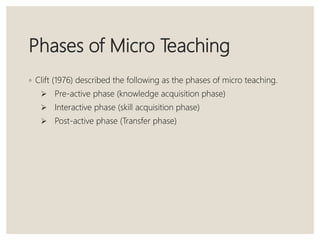
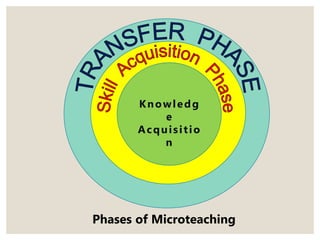
Phases of Micro Teaching
◦ Clift (1976) described the following as the phases of micro teaching.
 Pre-active phase (knowledge acquisition phase)
 Interactive phase (skill acquisition phase)
 Post-active phase (Transfer phase)
Phase - I
◦ Pre-active phase: It emphases the understanding of the teaching skill that is
to be learnt by the teacher trainee. It envisages the following steps.
 Orientation to micro teaching.
 Discussion of teaching skills with their components and teaching
behaviour.
 Presentation of modern demonstration lesson by the teacher educator.
 Observation of the model lesson and criticism by the teacher trainee.
Phase - II
◦ Interactive phase: The main objective of this phase is to enable the teacher
trainee to practice the teaching skill following micro teaching cycle. The
steps are:
 Preparation of micro-lesson plan for the related teaching skill.
 Creating microteaching settings.
 Practice of teaching skill
 Feedback
 Re-planning
 Re-teaching
 Repetition of the micro teaching cycle.
Phase - IIIPost active phase: The main objective of this phase is to enable the teacher
trainee to integrate the teaching skill in real or normal class room situation.
Integration of teaching skill may be defined as process of selections
organization and utilization of different teaching skills to form an effective
pattern for realizing the specified instructional objectives in a teaching
learning situation.
Knowledg
e
Acquisitio
n
Phases of Microteaching
Re-planning Micro Lesson
Replan Session: In the light of the feed back and supervisor’s comments, the
student teacher replans or restructures the same lesson or different lesson in
order to use the same skill effectively.
The mistakes are removed and necessary modifications are made.
Re-planning Micro Lesson
Re Teach Session (re-teaching): The revised micro lesson is taught by the
same student teacher to the same or different comparable group of pupils.
The procedure of observation as need in teach session is followed.
Re Feedback Session: On the basis of the audio tape or video tape or
observation schedule feed back is provided again.
Link Practice
In microteaching technique, teaching skills are practised
one by one separately.
At a time only one skill can be practised.
While practising one skill, the use of that particular skill is
maximised and other related skills may also occur taking
indirect role.
Skills practised in isolation have no meaning unless they
are integrated in teaching.
Hence, after attaining mastery in various skills,
opportunity should be given to the student teacher to
teach in a real situation integrating the skills mastered
already.
So a separate training programme is necessary for this
purpose.
This programme is called Link Practice.
Thank You

Microteaching

  • 1.
    MICRO TEACHING Dr. S.Prakash Principal Thiagarajar College of Preceptors Madurai
  • 3.
    Definitions Micro-teaching is ascaled down teaching encounter. Micro-teaching is a system of controlled practice. Micro-teaching is a training technique.
  • 4.
    Characteristics It is ateacher training technique and not a teaching method. It is a real teaching, though the teaching SITUATION IS SIMULATED. In micro teaching teacher trainee practices one a specific teaching skill at a time, till he/she attains mastery over the skill. It is a scale down teaching encounter in class size, content, class time. It operates on a predefined model. Plan, teach, feedback, re-plan, re-teach, re-feedback, etc.
  • 5.
    Characteristics It allows forincreased control of practice by providing feedback to the teacher trainee. It is not a substitute but a supplement to the teacher training programme. It is a cyclic process. The pre decided model is repeated till the trainee achieves the expected level of mastery. It is a highly individualized training device.
  • 6.
    Advantages Helps in reducingthe complexities of the normal class room teaching. Helps the teacher trainee gain more confidence in real teaching. It creates among the teacher trainees an awareness of various skills of which teaching is composed of. It stimulates the class room scene and gives the teacher trainee an experience of real teaching.
  • 7.
    Advantages It helps insystematic and objective analysis of the pattern of class room communication through specific observation schedule. It is more effective in modifying teacher behaviour. It is an effective for transfer of teaching competencies to the class room. It helps in getting acquainted with class room manners to a certain extent. Feedback enables the teacher trainee to consciously concentrate on specific behavioural modification.
  • 8.
    Advantages It has skilledsupervision. Gives constructive feed back. It has the component skills approach. Here the activity of teaching as a whole is broken down for the learning purpose into its individual components. (skills) It focuses on sharpening the specific teaching skills and eliminating the errors. It enables understanding of behaviours important class room teaching.
  • 9.
    Advantages It increases theconfidence of learning to. It provides experts supervision and constructive feed back. It provides for repeated practice without adverse consequences to the training. A modified concept of Micro Teaching by. Here teaching skills are practiced in a controlled low rise environment.
  • 10.
    Demerits Micro teaching isskill oriented and not content oriented. It covers only a few specific skills. Lack of material resources like video recording facility and trained supervisors. The question of integrating the skill is quite challenging. Teaching is not just a summation of teaching skills. Sufficient literature on micro teaching is not yet available A teaching skill is a group of teaching acts/behaviours intended to facilitate pupils
  • 11.
    Demerits It produces homogenizedstandard robots with set smiles and procedures. It is said to be a firm of play acting unnatural surrounding and the acquired skill may not be internalized. Micro Teaching is skill oriented and not content oriented. It covers only a few specific skills. Integrating the skill is quite challenging. Teaching is not first a summation of teaching skills. Sufficient literature on micro teaching is not yet available.
  • 12.
    List of Skills Stimulusvariation Set induction (Introduction) Closure Silence and non-verbal cues Reinforcement of student participation Fluency in asking questions Probing questions Higher order thinking questions Divergent questions Recognising attending behaviour Illustrations and use of examples Lecturing Planned repetition
  • 13.
    List of Skills Skillof stimulus variation Skill of questioning (probing) Skill of explaining Skill of demonstration Skill of Communication Skill of re-inforcement Skill of illustration with example Skill of introduction Skill of closure
  • 14.
    MT - MicroTeacher P - Peer Group C - Coder TK - Time Keeper TE - Teacher Educator M T P P P C C TK TE
  • 15.
    Phases of MicroTeaching ◦ Clift (1976) described the following as the phases of micro teaching.  Pre-active phase (knowledge acquisition phase)  Interactive phase (skill acquisition phase)  Post-active phase (Transfer phase)
  • 16.
    Phase - I ◦Pre-active phase: It emphases the understanding of the teaching skill that is to be learnt by the teacher trainee. It envisages the following steps.  Orientation to micro teaching.  Discussion of teaching skills with their components and teaching behaviour.  Presentation of modern demonstration lesson by the teacher educator.  Observation of the model lesson and criticism by the teacher trainee.
  • 17.
    Phase - II ◦Interactive phase: The main objective of this phase is to enable the teacher trainee to practice the teaching skill following micro teaching cycle. The steps are:  Preparation of micro-lesson plan for the related teaching skill.  Creating microteaching settings.  Practice of teaching skill  Feedback  Re-planning  Re-teaching  Repetition of the micro teaching cycle.
  • 18.
    Phase - IIIPostactive phase: The main objective of this phase is to enable the teacher trainee to integrate the teaching skill in real or normal class room situation. Integration of teaching skill may be defined as process of selections organization and utilization of different teaching skills to form an effective pattern for realizing the specified instructional objectives in a teaching learning situation.
  • 19.
  • 20.
    Re-planning Micro Lesson ReplanSession: In the light of the feed back and supervisor’s comments, the student teacher replans or restructures the same lesson or different lesson in order to use the same skill effectively. The mistakes are removed and necessary modifications are made.
  • 21.
    Re-planning Micro Lesson ReTeach Session (re-teaching): The revised micro lesson is taught by the same student teacher to the same or different comparable group of pupils. The procedure of observation as need in teach session is followed. Re Feedback Session: On the basis of the audio tape or video tape or observation schedule feed back is provided again.
  • 22.
    Link Practice In microteachingtechnique, teaching skills are practised one by one separately. At a time only one skill can be practised. While practising one skill, the use of that particular skill is maximised and other related skills may also occur taking indirect role. Skills practised in isolation have no meaning unless they are integrated in teaching. Hence, after attaining mastery in various skills, opportunity should be given to the student teacher to teach in a real situation integrating the skills mastered already. So a separate training programme is necessary for this purpose. This programme is called Link Practice.
  • 23.