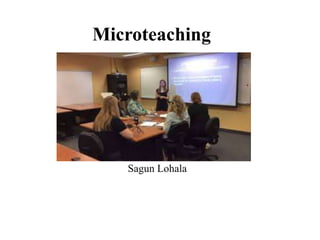
Microteaching
Sagun Lohala
Introduction
• Micro-teaching was invented in 1963 at Stanford
University by Dwight W. Allen, and
• Has subsequently been used to develop educators
in all forms of education.
Assumptions
• Is based on Skinner’s operant conditioning theory.
• Teaching is a complex process but it can be
analyzed into simple skills.
Definition
• Microteaching is a scaled down teaching encounter
in class size and class time. - Allen DW
• Microteaching is a training techniques which
requires student teacher to teach a single concept
using specified teaching skill to a number of
pupils in a short duration of time.
- Passi BK and lalita MS
Definition
• Microteaching can also defined as a teaching
technique especially used in teachers’ pre-service
education to train them systematically by
allowing them to experiment main teacher
behaviors. - (Tasdemir, 2006)
• Micro teaching is a device which provides the
novice and experienced teacher alike new
opportunities to improve teaching.
Purpose
• Aim to prepare teacher candidates to the real
classroom setting
• Help pre-service teachers to see the importance of
planning and taking decisions
Purpose
• Enable them to develop and improve their
teaching skills
• Provide teachers opportunities for discovering and
reflecting on both their own and others’ teaching
styles and enables them to learn about new
teaching techniques
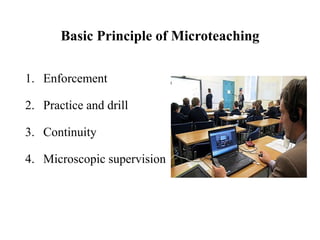
Basic Principle of Microteaching
1. Enforcement
2. Practice and drill
3. Continuity
4. Microscopic supervision
Basic Principle of Microteaching
1. Enforcement:
• Feedback, re-teaching makes teaching perfect
2. Practice and drill:
• Practice and drill of specific teaching skill helps to
gain mastery in any teaching skills.
3. Continuity:
• Is a continuous process
• Repeated teaching, re-planning, feedback, re-
teaching till improvements needed.
Basic Principle of Microteaching
4. Microscopic supervision:
• Even a small teaching tasks and behaviors are
very important to develop teaching skills.
• So that supervisor should be alert and made a
keen observation as well as recorded each
points.
• Uses those points as constructive criticism
during the feedback.
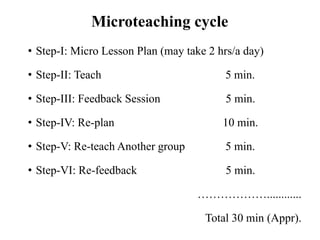
Microteaching cycle
• Step-I: Micro Lesson Plan (may take 2 hrs/a day)
• Step-II: Teach 5 min.
• Step-III: Feedback Session 5 min.
• Step-IV: Re-plan 10 min.
• Step-V: Re-teach Another group 5 min.
• Step-VI: Re-feedback 5 min.
………………............
Total 30 min (Appr).
Microteaching Cycle
1. Plan
2. Teach
3. Feedback
4. Re-plan
5. Re-teach
6.Re-feedback
Microteaching Cycle
• Conducted in simulated situation in which a small
group of learners get together, where one of them
teaches and others act the role of students.
• The teaching session is video taped and replayed
with the help of closed circuit television (CCT) for
the purpose of assessing the teaching encounter and
giving feedback by the peers and the supervisor
on pre-identified special teaching skill.
Cont’d…
• Based on the feedback, the teacher re-plans and
represents the microteaching session until she/he
develops teaching skills at the desirable level.
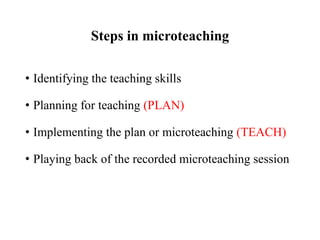
Steps in microteaching
• Identifying the teaching skills
• Planning for teaching (PLAN)
• Implementing the plan or microteaching (TEACH)
• Playing back of the recorded microteaching session
Cont’d…
• Discussions and feedback (FEEDBACK)
• Re-planning of the lesson (RE-PLAN)
• Repetition of teaching session ( RE-TEACH)
• Replaying of the recorded teaching acts for the
discussion and feedback ( RE-FEEDBACK)
Identifying the teaching skills
• First: Those teaching skills that is to be practiced is
identified
• Then, only selected teaching skills not all teaching
skills were developed or modified.
• Maximum of five in number.
Plan
• This involves selection of a topic and relevant
content.
• Selection of appropriate teaching and learning
resources.
• The topic is analyzed into different activities of
the teacher and the students.
• The activities are planned in logical sequence.
Teach
• This involves the attempts of the teacher trainee
to use the components of the skill in suitable
situations in the process of teaching-learning as
per the role or the planning activities.
• If the situation is not different and not as
visualized in the planning of the activities, the
teacher should modify his or her behavior as per
the demand of the situation of the class.
Cont’d…
• The teacher should have the courage and confidence to
handle the situations arising in the class effectively.
• This helps the teacher trainee to improve his or her
performance in the desired direction.
• The teacher trainee teaches the lesson to a small
group of students
Cont’d…
• The teacher supervisor and peers made
observation.
• The teaching learning interaction is recorded on a
video recorder or closed circuit television
whenever it is possible.
Playing back of the recorded microteaching session
• Teaching acts that had been recorded were played
back and studied by teachers, peers and the
trainee himself/herself.
• If video recording is not available, the teaching
activities are assessed and recorded directly in
evaluation sheets.
Feedback
• Refers to the giving information to the teacher
trainee about his performance.
• This helps the teacher trainee to improve his or her
performance in the desired direction.
• Always feedback should be given with strengths
that is observed, and description of the situation not
the judgment should be given.
Re-plan
• The teacher trainee re-plans his lesson
incorporating the points of strength and
removing the points not skillfully handled during
teaching
• Re-plan either on the same topic or on another
topic suiting the teacher trainee for improvement.
Cont’d…
• This involves the teaching the same group of
student if the topic is changed or a different
group of students if the topic is same.
• This is done to remove boredom or monotony in
the students.
• The teacher trainee teaches the class with renewed
courage and confidence to perform better than
the previous attempt.
Cont’d…
• This is the most important component of micro
teaching for behavior modification of the teacher
trainee in the desired direction in each and every
skill practice.
• The recorded microteaching session is replayed for
observation and further criticism is provided.
Five “R”
Microteaching session evolves around Five “R” to
carried out desired change or improvement in
teaching skills.
1. Recording
2. Reviewing
3. Responding
4. Refining
5. Redoing
Characteristics of Microteaching
• It is a real teaching that focuses on teaching skills
on scaled down technique that include
• 5-10 students
• Duration of 5-10 minutes
• Small topic with a few objectives
• Only one teaching skill is considered at a time.
• Highly individualized instruction.
• Provision of immediate feedback.
Cont’d…
• In micro teaching cycle, there is facility of re-
planning, re-teaching and re-evaluation to modify
the behavior.
• Teaching is carried on under controlled situation.
• It puts the teacher under the microscope.
• All the faults of the teacher are observed.
• The problem of discipline can also be controlled.
Skills of Micro teaching Techniques
(PREREQUISITES)
1. Introduction skill
2. Skill of Probing Questions
3. Skill of Explanation
4. Skill of Stimulus Variation
5. Skill of Black-board Writing
6. Skill of Achieving Closure
1. Introduction skill:
• Establishing rapports with the learners.
• Linking with past experiences
• Link between introduction and main parts
• Use of appropriate devices/techniques like
questioning, examples, etc.
2. Skill of probing question
• Probing questions are those help the pupils to think
in depth about the various aspects of the problem.
• By asking such questions again, the teacher makes
the pupils more thoughtful.
• Enable the pupils to understand the subject deeply.
• For e.g.: “Can you explain what do you mean
by…..?”
• Isn’t there more to it?
3. Skill of Explanation
• It involves the ability of a teacher to describe logically
‘How’, ‘Why’ and ‘what’ of concept
• Precautions for skill of Explaining:
a. In simple language
b. In clear, audible and well-modulated voice
c. Should not be given the shape of an advice.
d. Should be in a sequence.
e. Should be according to the age, experience and
mental level of the pupils.
4. Skill of Stimulus Variation
This concerned with the deliberate changes in
teacher’s behavior in order to maintain the learner’s
attention in the class at high level.
1. Teacher movement
2. Teacher gestures
3. Change in voice
4. Change in the
interaction pattern
5. Focusing
6. Pausing
7. Student’s physical
participation.
Cont’d…
This concerned with the deliberate changes in
teacher’s behavior in order to maintain the learner’s
attention in the class at high level.
5. Skill of Black-board Writing
Components of the skill of blackboard writing are:
a. Legibility
b. Size and alignment
c. Highlighting main points
d. Utilization of the space
e. Blackboard summary
f. Correctness
g. Position of the teacher and
h. Contact with the pupils.
6. Skill of Achieving Closure
• Questions and statements by the teacher related to the
consolidation of the major points covered during the
lesson.
• Opportunities provided by the teacher to the pupils for
linking the present knowledge with the past
knowledge.
• Opportunities provided by the teacher to the pupils for
applying the knowledge gained during the lesson to
the new situations.
Skills of Microteaching
According to Allen and Ryan (1969), the Stanford
University (14 points teaching skills).
• Stimulus variation
• Set induction
• Fluency in questioning
• Higher order questions
• Recognizing attending behavior
• Lecturing
Cont’d…
• Nonverbal cues
• Completing the communication
• Probing questions
• Divergent questions
• Reinforcing learning
• Illustrating or use of examples
• Planned repetition
• Closure
Questioning skills
• Standing still
• Thinking
• Facing the student
• Framing the question
• Looking around for a response
• Recalling the names of the students
• Calling students by name.
Cont’d…
• Listening
• Keeping silence
• Pausing to think
• Giving nonverbal cues
• Restating the questions
• Analyzing responses
• Reinforcing correct and nearby correct responses etc
Feedback in Micro teaching
• Helpful information or criticism that is given to
someone to say what can be done to improve a
performance, product etc.
• The success of micro teaching depends on feedback
• It is used in various forms in case of micro teaching
by the supervisor, video-tape, films, T.V., which are
various sources of feedback.
Advantages of Microteaching
• It serves trainees to gain their first teaching
experience and helps to develop the knowledge,
skills, and attitudes.
• Develop new skills and refine old ones.
• It enables understanding of behaviors important in
class-room teaching.
Cont’d…
• It increases the confidence of the learner teacher.
• It is a vehicle of continuous training for both
beginners and for senior teachers.
• Assists in comparing the effectiveness of variation
of one microteaching with another.
Cont’d…
• It provides experts supervision and constructive
feedback.
• Enhance and develop communication, problem-
solving, questioning, critical-thinking and reflective
thinking skills in nursing student teachers.
Disadvantages of Microteaching
• It require competent and suitable trained teacher educators
and a group of peers.
• It is time consuming because microteaching sessions are
repeated multiple times so that the student teacher can
refine his or her skills.
• Application of microteaching to new teaching practice is
limited.
• It can be carried out successfully in a controlled
environment only.
Remember!!!
Even the best teacher can learn
a great deal from his or her
students.
• Indira singh, essentials of education
• KP Neeraja, textbook of nursing education
• Allen DW, Wang W. Beijing: Xinhua Press; 1996.
Microteaching. [Google Scholar]
• https://www.ncbi.nlm.nih.gov/pmc/articles/PMC372
4377/
• https://www.thoughtco.com/microteaching-4580453
• https://www.slideshare.net/maheswarijaikumar/micr
o-teaching-92749649

Unit 5.3 Microteaching.pptx

  • 1.
  • 2.
    Introduction • Micro-teaching wasinvented in 1963 at Stanford University by Dwight W. Allen, and • Has subsequently been used to develop educators in all forms of education.
  • 3.
    Assumptions • Is basedon Skinner’s operant conditioning theory. • Teaching is a complex process but it can be analyzed into simple skills.
  • 4.
    Definition • Microteaching isa scaled down teaching encounter in class size and class time. - Allen DW • Microteaching is a training techniques which requires student teacher to teach a single concept using specified teaching skill to a number of pupils in a short duration of time. - Passi BK and lalita MS
  • 5.
    Definition • Microteaching canalso defined as a teaching technique especially used in teachers’ pre-service education to train them systematically by allowing them to experiment main teacher behaviors. - (Tasdemir, 2006) • Micro teaching is a device which provides the novice and experienced teacher alike new opportunities to improve teaching.
  • 6.
    Purpose • Aim toprepare teacher candidates to the real classroom setting • Help pre-service teachers to see the importance of planning and taking decisions
  • 7.
    Purpose • Enable themto develop and improve their teaching skills • Provide teachers opportunities for discovering and reflecting on both their own and others’ teaching styles and enables them to learn about new teaching techniques
  • 8.
    Basic Principle ofMicroteaching 1. Enforcement 2. Practice and drill 3. Continuity 4. Microscopic supervision
  • 9.
    Basic Principle ofMicroteaching 1. Enforcement: • Feedback, re-teaching makes teaching perfect 2. Practice and drill: • Practice and drill of specific teaching skill helps to gain mastery in any teaching skills. 3. Continuity: • Is a continuous process • Repeated teaching, re-planning, feedback, re- teaching till improvements needed.
  • 10.
    Basic Principle ofMicroteaching 4. Microscopic supervision: • Even a small teaching tasks and behaviors are very important to develop teaching skills. • So that supervisor should be alert and made a keen observation as well as recorded each points. • Uses those points as constructive criticism during the feedback.
  • 11.
    Microteaching cycle • Step-I:Micro Lesson Plan (may take 2 hrs/a day) • Step-II: Teach 5 min. • Step-III: Feedback Session 5 min. • Step-IV: Re-plan 10 min. • Step-V: Re-teach Another group 5 min. • Step-VI: Re-feedback 5 min. ………………............ Total 30 min (Appr).
  • 12.
    Microteaching Cycle 1. Plan 2.Teach 3. Feedback 4. Re-plan 5. Re-teach 6.Re-feedback
  • 13.
    Microteaching Cycle • Conductedin simulated situation in which a small group of learners get together, where one of them teaches and others act the role of students. • The teaching session is video taped and replayed with the help of closed circuit television (CCT) for the purpose of assessing the teaching encounter and giving feedback by the peers and the supervisor on pre-identified special teaching skill.
  • 14.
    Cont’d… • Based onthe feedback, the teacher re-plans and represents the microteaching session until she/he develops teaching skills at the desirable level.
  • 15.
    Steps in microteaching •Identifying the teaching skills • Planning for teaching (PLAN) • Implementing the plan or microteaching (TEACH) • Playing back of the recorded microteaching session
  • 16.
    Cont’d… • Discussions andfeedback (FEEDBACK) • Re-planning of the lesson (RE-PLAN) • Repetition of teaching session ( RE-TEACH) • Replaying of the recorded teaching acts for the discussion and feedback ( RE-FEEDBACK)
  • 17.
    Identifying the teachingskills • First: Those teaching skills that is to be practiced is identified • Then, only selected teaching skills not all teaching skills were developed or modified. • Maximum of five in number.
  • 18.
    Plan • This involvesselection of a topic and relevant content. • Selection of appropriate teaching and learning resources. • The topic is analyzed into different activities of the teacher and the students. • The activities are planned in logical sequence.
  • 19.
    Teach • This involvesthe attempts of the teacher trainee to use the components of the skill in suitable situations in the process of teaching-learning as per the role or the planning activities. • If the situation is not different and not as visualized in the planning of the activities, the teacher should modify his or her behavior as per the demand of the situation of the class.
  • 20.
    Cont’d… • The teachershould have the courage and confidence to handle the situations arising in the class effectively. • This helps the teacher trainee to improve his or her performance in the desired direction. • The teacher trainee teaches the lesson to a small group of students
  • 21.
    Cont’d… • The teachersupervisor and peers made observation. • The teaching learning interaction is recorded on a video recorder or closed circuit television whenever it is possible.
  • 22.
    Playing back ofthe recorded microteaching session • Teaching acts that had been recorded were played back and studied by teachers, peers and the trainee himself/herself. • If video recording is not available, the teaching activities are assessed and recorded directly in evaluation sheets.
  • 23.
    Feedback • Refers tothe giving information to the teacher trainee about his performance. • This helps the teacher trainee to improve his or her performance in the desired direction. • Always feedback should be given with strengths that is observed, and description of the situation not the judgment should be given.
  • 24.
    Re-plan • The teachertrainee re-plans his lesson incorporating the points of strength and removing the points not skillfully handled during teaching • Re-plan either on the same topic or on another topic suiting the teacher trainee for improvement.
  • 25.
    Cont’d… • This involvesthe teaching the same group of student if the topic is changed or a different group of students if the topic is same. • This is done to remove boredom or monotony in the students. • The teacher trainee teaches the class with renewed courage and confidence to perform better than the previous attempt.
  • 26.
    Cont’d… • This isthe most important component of micro teaching for behavior modification of the teacher trainee in the desired direction in each and every skill practice. • The recorded microteaching session is replayed for observation and further criticism is provided.
  • 27.
    Five “R” Microteaching sessionevolves around Five “R” to carried out desired change or improvement in teaching skills. 1. Recording 2. Reviewing 3. Responding 4. Refining 5. Redoing
  • 28.
    Characteristics of Microteaching •It is a real teaching that focuses on teaching skills on scaled down technique that include • 5-10 students • Duration of 5-10 minutes • Small topic with a few objectives • Only one teaching skill is considered at a time. • Highly individualized instruction. • Provision of immediate feedback.
  • 29.
    Cont’d… • In microteaching cycle, there is facility of re- planning, re-teaching and re-evaluation to modify the behavior. • Teaching is carried on under controlled situation. • It puts the teacher under the microscope. • All the faults of the teacher are observed. • The problem of discipline can also be controlled.
  • 30.
    Skills of Microteaching Techniques (PREREQUISITES) 1. Introduction skill 2. Skill of Probing Questions 3. Skill of Explanation 4. Skill of Stimulus Variation 5. Skill of Black-board Writing 6. Skill of Achieving Closure
  • 31.
    1. Introduction skill: •Establishing rapports with the learners. • Linking with past experiences • Link between introduction and main parts • Use of appropriate devices/techniques like questioning, examples, etc.
  • 32.
    2. Skill ofprobing question • Probing questions are those help the pupils to think in depth about the various aspects of the problem. • By asking such questions again, the teacher makes the pupils more thoughtful. • Enable the pupils to understand the subject deeply. • For e.g.: “Can you explain what do you mean by…..?” • Isn’t there more to it?
  • 33.
    3. Skill ofExplanation • It involves the ability of a teacher to describe logically ‘How’, ‘Why’ and ‘what’ of concept • Precautions for skill of Explaining: a. In simple language b. In clear, audible and well-modulated voice c. Should not be given the shape of an advice. d. Should be in a sequence. e. Should be according to the age, experience and mental level of the pupils.
  • 34.
    4. Skill ofStimulus Variation This concerned with the deliberate changes in teacher’s behavior in order to maintain the learner’s attention in the class at high level. 1. Teacher movement 2. Teacher gestures 3. Change in voice 4. Change in the interaction pattern 5. Focusing 6. Pausing 7. Student’s physical participation.
  • 35.
    Cont’d… This concerned withthe deliberate changes in teacher’s behavior in order to maintain the learner’s attention in the class at high level.
  • 36.
    5. Skill ofBlack-board Writing Components of the skill of blackboard writing are: a. Legibility b. Size and alignment c. Highlighting main points d. Utilization of the space e. Blackboard summary f. Correctness g. Position of the teacher and h. Contact with the pupils.
  • 37.
    6. Skill ofAchieving Closure • Questions and statements by the teacher related to the consolidation of the major points covered during the lesson. • Opportunities provided by the teacher to the pupils for linking the present knowledge with the past knowledge. • Opportunities provided by the teacher to the pupils for applying the knowledge gained during the lesson to the new situations.
  • 38.
    Skills of Microteaching Accordingto Allen and Ryan (1969), the Stanford University (14 points teaching skills). • Stimulus variation • Set induction • Fluency in questioning • Higher order questions • Recognizing attending behavior • Lecturing
  • 39.
    Cont’d… • Nonverbal cues •Completing the communication • Probing questions • Divergent questions • Reinforcing learning • Illustrating or use of examples • Planned repetition • Closure
  • 40.
    Questioning skills • Standingstill • Thinking • Facing the student • Framing the question • Looking around for a response • Recalling the names of the students • Calling students by name.
  • 41.
    Cont’d… • Listening • Keepingsilence • Pausing to think • Giving nonverbal cues • Restating the questions • Analyzing responses • Reinforcing correct and nearby correct responses etc
  • 42.
    Feedback in Microteaching • Helpful information or criticism that is given to someone to say what can be done to improve a performance, product etc. • The success of micro teaching depends on feedback • It is used in various forms in case of micro teaching by the supervisor, video-tape, films, T.V., which are various sources of feedback.
  • 43.
    Advantages of Microteaching •It serves trainees to gain their first teaching experience and helps to develop the knowledge, skills, and attitudes. • Develop new skills and refine old ones. • It enables understanding of behaviors important in class-room teaching.
  • 44.
    Cont’d… • It increasesthe confidence of the learner teacher. • It is a vehicle of continuous training for both beginners and for senior teachers. • Assists in comparing the effectiveness of variation of one microteaching with another.
  • 45.
    Cont’d… • It providesexperts supervision and constructive feedback. • Enhance and develop communication, problem- solving, questioning, critical-thinking and reflective thinking skills in nursing student teachers.
  • 46.
    Disadvantages of Microteaching •It require competent and suitable trained teacher educators and a group of peers. • It is time consuming because microteaching sessions are repeated multiple times so that the student teacher can refine his or her skills. • Application of microteaching to new teaching practice is limited. • It can be carried out successfully in a controlled environment only.
  • 47.
    Remember!!! Even the bestteacher can learn a great deal from his or her students.
  • 48.
    • Indira singh,essentials of education • KP Neeraja, textbook of nursing education • Allen DW, Wang W. Beijing: Xinhua Press; 1996. Microteaching. [Google Scholar] • https://www.ncbi.nlm.nih.gov/pmc/articles/PMC372 4377/ • https://www.thoughtco.com/microteaching-4580453 • https://www.slideshare.net/maheswarijaikumar/micr o-teaching-92749649

Editor's Notes

  • #46 It focuses on sharpening and developing specific teaching skills and eliminating errors.
  • #47 It focuses on sharpening and developing specific teaching skills and eliminating errors.