Dr. Jugnu Khatter Bhatia
Skill
Skill
Skill
Skill
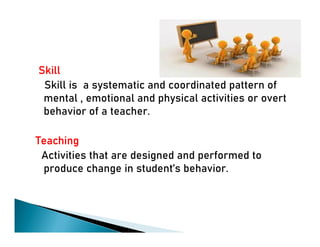
Skill is a systematic and coordinated pattern of
mental , emotional and physical activities or overt
behavior of a teacher.
Teaching
Teaching
Teaching
Teaching
Activities that are designed and performed to
produce change in student’s behavior.
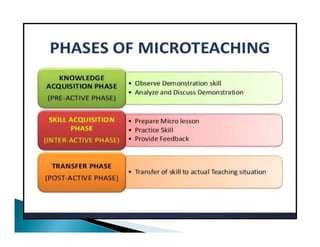
Micro -teaching procedure involves three phases;
1
1
1
1.
.
.
.Knowledge
Knowledge
Knowledge
Knowledge Acquisition
Acquisition
Acquisition
Acquisition Phase
Phase
Phase
Phase :
:
:
: In this phase the teacher trainee learns about the
skill and its components through discussion, illustrations and demonstration of
the skill given by the expert. He/She learns about the purpose of the skill and the
condition under which it proves useful in the teaching-learning process. His/her
analysis of the skill into components leading to various types of behaviors which
is to be practiced. The teacher trainee tries to gain a lot about the skill from the
demonstration given by the expert. He discusses and clarifies each and every
aspect of the skill.
2
2
2
2.
.
.
. Skill
Skill
Skill
Skill Acquisition
Acquisition
Acquisition
Acquisition Phase
Phase
Phase
Phase:
:
:
: On the basis of the demonstration presented by the
expert, the teacher trainee plans a micro-lesson, lesson for practicing the
demonstrated skill. He practices the teaching skill through the Micro-teaching
cycle and continues his efforts till he attains mastery level. The feed-back
component of micro-teaching contributes significantly towards the mastery level
acquisition of the skill. On the basis of the performance of teacher trainee in
teaching, the feedback is provided for the purpose of change in behavior of the
teacher trainee in the desired direction.
3
3
3
3.
.
.
. Transfer
Transfer
Transfer
Transfer Phase
Phase
Phase
Phase of
of
of
of Micro
Micro
Micro
Micro-
-
-
-teaching
teaching
teaching
teaching:
:
:
: After attaining mastery level and command
over each of the skills, the teacher trainee integrates all these skills and transfer
to actual classroom teaching is done during this transfer phase.
1.
1.
1.
1. Micro
Micro
Micro
Micro-
-
-
-teaching
teaching
teaching
teaching Situations
Situations
Situations
Situations:
:
:
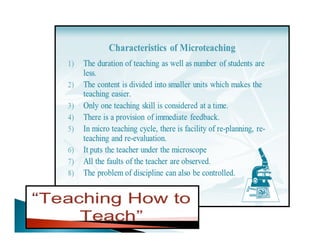
: Micro-Teaching consists of size of the class,
length of the content and teaching method etc. There are 5 to 10
students in the class and the teaching period ranges from 5 to 20
minutes. The content is presented in a unit.
2.
2.
2.
2. Teaching
Teaching
Teaching
Teaching skill
skill
skill
skill:
:
:
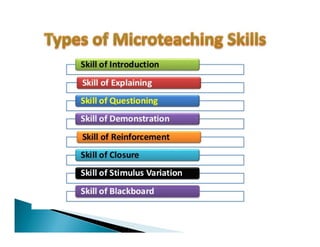
: The development of teaching-skills of the student’s
teachers is provided in the training programme such as lecturing skill,
skill of black-board writing, skill of asking questions etc.
3.
3.
3.
3. Student
Student
Student
Student Teacher
Teacher
Teacher
Teacher :
:
:
: The student who gets the training of a teacher is
called student- teacher. During training his various capacities are
developed in him, such as capacity of class management, capability of
maintaining discipline and capacity of organizing various program of the
school etc
4. Feed
Feed
Feed
Feed-
-
-
-back
back
back
back Devices
Devices
Devices
Devices:
:
:
: Providing feedback is essential to bring changes in
the behavior of the students. Feedback can be provided through
videotape feed-back questionnaires
5.
5.
5.
5. Micro
Micro
Micro
Micro Teaching
Teaching
Teaching
Teaching Laboratory
Laboratory
Laboratory
Laboratory:
:
:
: Necessary facilities to feedback can be
gathers in microteaching laboratory
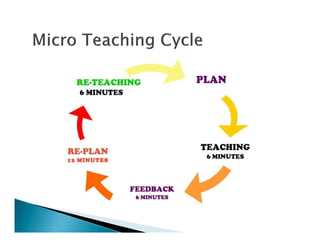
The steps in a microteaching session are
The steps in a microteaching session are:
1. PLANNING
PLANNING
PLANNING
PLANNING:
:
:
: This involves selection of the skill to be practiced,
awareness of components of the skill, selection of a suitable
concept, writing of micro lesson with specific objectives.
2. TEACHING
TEACHING
TEACHING
TEACHING: The following setting is suggested for the micro
teaching technique.
Time: 5 minutes
Students: peer group-5 or so in number
Supervisors: 1or 2
If possible, use of CCTV facility could be made to enable the
teacher trainee to get a first hand look at his weaknesses.
3. FEEDBACK
FEEDBACK
FEEDBACK
FEEDBACK: This is a vital aspect of the micro teaching cycle.
To be effective it must be clearly related to the model of the
teaching skill used. Appraisal guides add to the comments of
the supervisor and fellow students, they focus the feedback on
to specific behaviors and can be used for the analysis session
or be just given to the teacher trainee with a written comment
or rating of his/her skill performance.
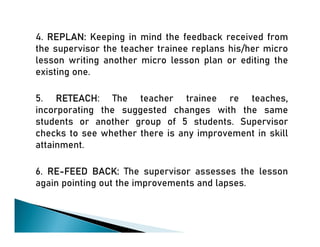
4. REPLAN
REPLAN
REPLAN
REPLAN:
:
:
: Keeping in mind the feedback received from
the supervisor the teacher trainee replans his/her micro
lesson writing another micro lesson plan or editing the
existing one.
5. RETEACH
RETEACH
RETEACH
RETEACH: The teacher trainee re teaches,
incorporating the suggested changes with the same
students or another group of 5 students. Supervisor
checks to see whether there is any improvement in skill
attainment.
6. RE
RE
RE
RE-
-
-
-FEED
FEED
FEED
FEED BACK
BACK
BACK
BACK:
:
:
: The supervisor assesses the lesson
again pointing out the improvements and lapses.
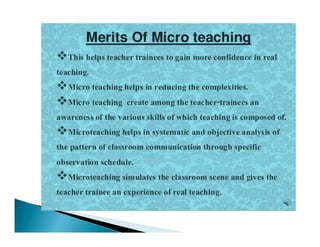
Micro-teaching works as a focused instrument which
helps to practice essential teaching skills safely and
effectively at any age. Micro-teaching as an Efficient
Learning Technique for Effective Teaching. Learning is
a change in behavior, which is brought about by activity,
training, or experiencing at any age. When the learner
is more experienced, learning becomes more effective.
The most important quality of the participants of
microteaching sessions is the ability to give and receive
constructive feedback with an open mind and achieves
appropriate teaching-learning goals. In addition, it
increases self-confidence of teacher in an atmosphere
of friendliness and equanimity.