
BY TEAM 10
SAMRAT
RAJKUMAR
VIKRAM
JASPREET
Methods of Measuring Forecasting
Errors
 Meaning of Forecasting
 Meaning of forecasting Errors
 Importance of Forecasting
 Measures of Aggregate Error
 Problem on Aggregate Error
 Conclusion
Contents
 Forecasting is the process of making statements about events
whose actual outcomes (typically) have not yet been
observed.
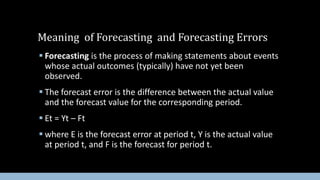
 The forecast error is the difference between the actual value
and the forecast value for the corresponding period.
 Et = Yt – Ft
 where E is the forecast error at period t, Y is the actual value
at period t, and F is the forecast for period t.
Meaning of Forecasting and Forecasting Errors
 Forecast error can be a calendar forecast error or a cross-sectional
forecast error, when we want to summarize the forecast error over a
group of units
 If we observe the average forecast error for a time-series of forecasts for
the same product or phenomenon, then we call this a calendar forecast
error or time-series forecast error.
 If we observe this for multiple products for the same period, then this is
a cross-sectional performance error.
Forecasting Error
 If we observe this for multiple products for the same period, then this is a cross-
sectional performance error.
 While forecasts are never perfect, they are necessary to prepare for actual demand. In
order to maintain an optimized inventory and effective supply chain, accurate demand
Calculating forecast error
The forecast error needs to be calculated using actual sales as a base. There are several
forms of forecast error calculation methods used, namely Mean Percent Error, Root
Mean Squared Error, Tracking Signal and Forecast Bias..
Importance of Forecasting
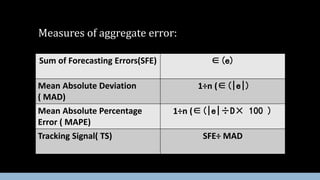
Sum of Forecasting Errors(SFE) ∈(e)
Mean Absolute Deviation
( MAD)
1÷n (∈(|e|)
Mean Absolute Percentage
Error ( MAPE)
1÷n (∈(|e|÷D× 100 )
Tracking Signal( TS) SFE÷ MAD
Measures of aggregate error:
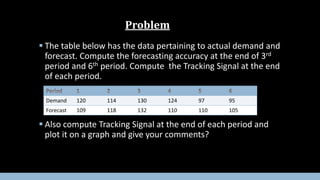
 The table below has the data pertaining to actual demand and
forecast. Compute the forecasting accuracy at the end of 3rd
period and 6th period. Compute the Tracking Signal at the end
of each period.
 Also compute Tracking Signal at the end of each period and
plot it on a graph and give your comments?
Problem
Demand 120 114 130 124 97 95
Forecast 109 118 132 110 110 105
 Forecasting helps managers and businesses develop meaningful plans and reduce
uncertainty of events in the future.
 Managers want to match supply with demand; therefore, it is essential for them to
forecast how much space they need for supply to each demand. Forecasting is a
statement pertaining to the future value of a variable of interest.
 Its crucial for good forecasting to be reliable, cost effective, simple and concise. Its very
important for a forecast to be correct and that their be as few errors as possible.
Conclusion
Measurements Methods of forecasting errors

Measurements Methods of forecasting errors

  • 1.
  • 2.
     Meaning ofForecasting  Meaning of forecasting Errors  Importance of Forecasting  Measures of Aggregate Error  Problem on Aggregate Error  Conclusion Contents
  • 3.
     Forecasting isthe process of making statements about events whose actual outcomes (typically) have not yet been observed.  The forecast error is the difference between the actual value and the forecast value for the corresponding period.  Et = Yt – Ft  where E is the forecast error at period t, Y is the actual value at period t, and F is the forecast for period t. Meaning of Forecasting and Forecasting Errors
  • 4.
     Forecast errorcan be a calendar forecast error or a cross-sectional forecast error, when we want to summarize the forecast error over a group of units  If we observe the average forecast error for a time-series of forecasts for the same product or phenomenon, then we call this a calendar forecast error or time-series forecast error.  If we observe this for multiple products for the same period, then this is a cross-sectional performance error. Forecasting Error
  • 5.
     If weobserve this for multiple products for the same period, then this is a cross- sectional performance error.  While forecasts are never perfect, they are necessary to prepare for actual demand. In order to maintain an optimized inventory and effective supply chain, accurate demand Calculating forecast error The forecast error needs to be calculated using actual sales as a base. There are several forms of forecast error calculation methods used, namely Mean Percent Error, Root Mean Squared Error, Tracking Signal and Forecast Bias.. Importance of Forecasting
  • 6.
    Sum of ForecastingErrors(SFE) ∈(e) Mean Absolute Deviation ( MAD) 1÷n (∈(|e|) Mean Absolute Percentage Error ( MAPE) 1÷n (∈(|e|÷D× 100 ) Tracking Signal( TS) SFE÷ MAD Measures of aggregate error:
  • 7.
     The tablebelow has the data pertaining to actual demand and forecast. Compute the forecasting accuracy at the end of 3rd period and 6th period. Compute the Tracking Signal at the end of each period.  Also compute Tracking Signal at the end of each period and plot it on a graph and give your comments? Problem Demand 120 114 130 124 97 95 Forecast 109 118 132 110 110 105
  • 8.
     Forecasting helpsmanagers and businesses develop meaningful plans and reduce uncertainty of events in the future.  Managers want to match supply with demand; therefore, it is essential for them to forecast how much space they need for supply to each demand. Forecasting is a statement pertaining to the future value of a variable of interest.  Its crucial for good forecasting to be reliable, cost effective, simple and concise. Its very important for a forecast to be correct and that their be as few errors as possible. Conclusion