PRESENTATION ON:
PRESENTED BY,
EBEENA
ANCY
NAVYA
ALFIYA
ASWATHY
ARYA KRISHNAN
ANJALI
ARAFA
ATHIRA CHANDRAN
ABHIJITH
ARYA RAVEENDRAN
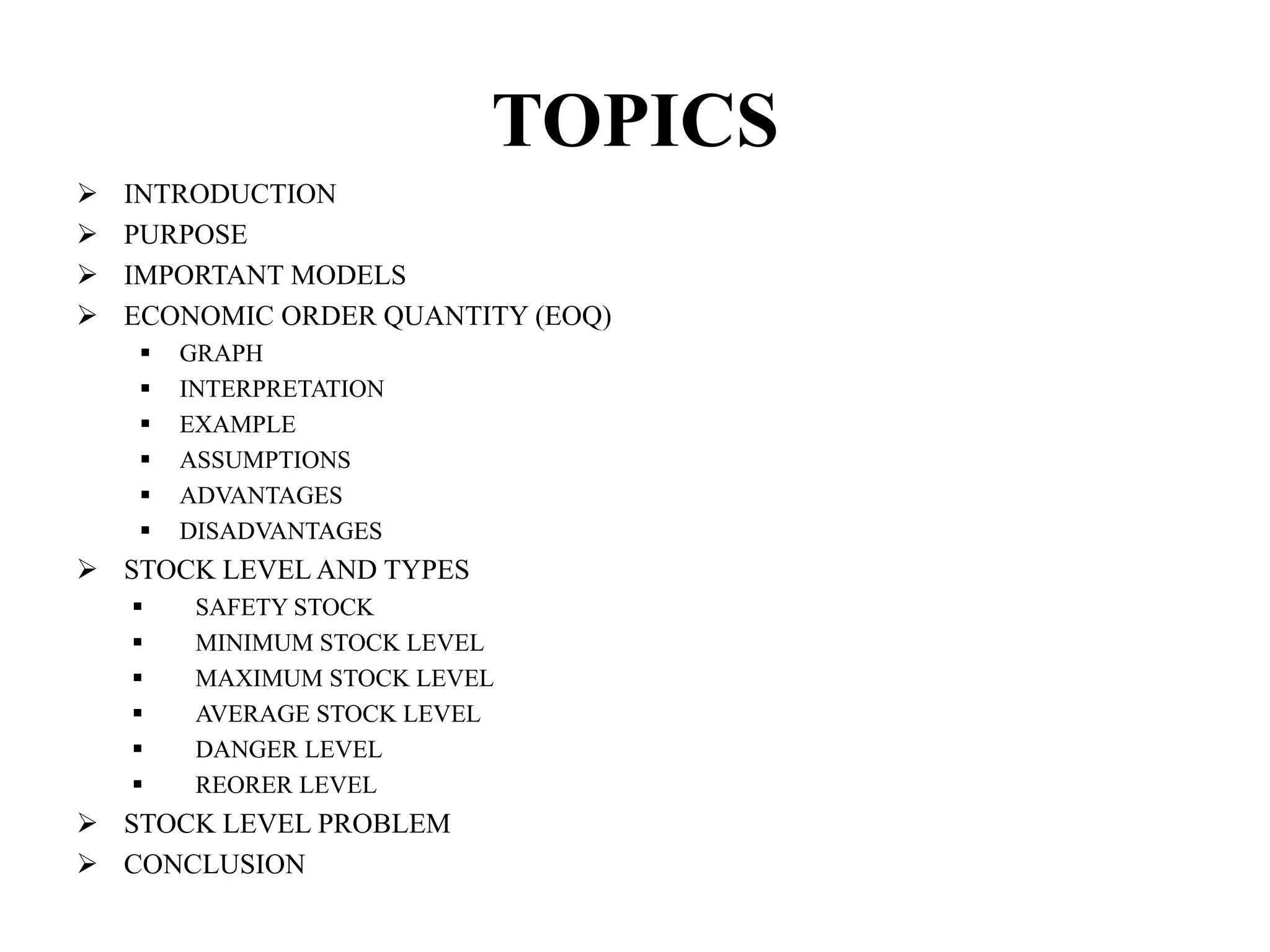
TOPICS
 INTRODUCTION
 PURPOSE
 IMPORTANT MODELS
 ECONOMIC ORDER QUANTITY (EOQ)
 GRAPH
 INTERPRETATION
 EXAMPLE
 ASSUMPTIONS
 ADVANTAGES
 DISADVANTAGES
 STOCK LEVEL AND TYPES
 SAFETY STOCK
 MINIMUM STOCK LEVEL
 MAXIMUM STOCK LEVEL
 AVERAGE STOCK LEVEL
 DANGER LEVEL
 REORER LEVEL
 STOCK LEVEL PROBLEM
 CONCLUSION
INTRODUCTION
One basic problem of
inventory management is to find
out the order quantity so that it
is most economical from overall operational point of
view. Here that problem lies in minimizing the two
conflicting costs, i.e. ordering cost and inventory
carrying cost.
Inventory models help to find out the order
quantity which minimizes the total costs(sum of
ordering costs and inventory carrying costs).
ORDERING COSTS
Ordering costs are the costs related to the
preparation of a supplier’s order, including the
cost of placing an order, inspection costs,
documentation costs, and others.
Ordering Cost = No. of orders * Ordering cost per unit
CARRYING COST
Carrying cost or Holding cost refers to the
total cost of holding inventory. This includes
warehousing costs such as rent, utilities and
salaries, financial costs such as opportunity cost,
and inventory costs related to perishability,
shrinkage (leakage) and insurance.
Carrying Cost = Avg. Order Quantity * Carrying Cost per Unit
PURPOSE
It helps business in determining the optimum
level of inventories that should be maintained in :
• Production process
• Managing frequency of ordering
• Deciding on quantity of goods or raw materials to
be stored
• Tracking flow of supply of raw materials and
goods to provide uninterrupted service to
customers without any delay in delivery.
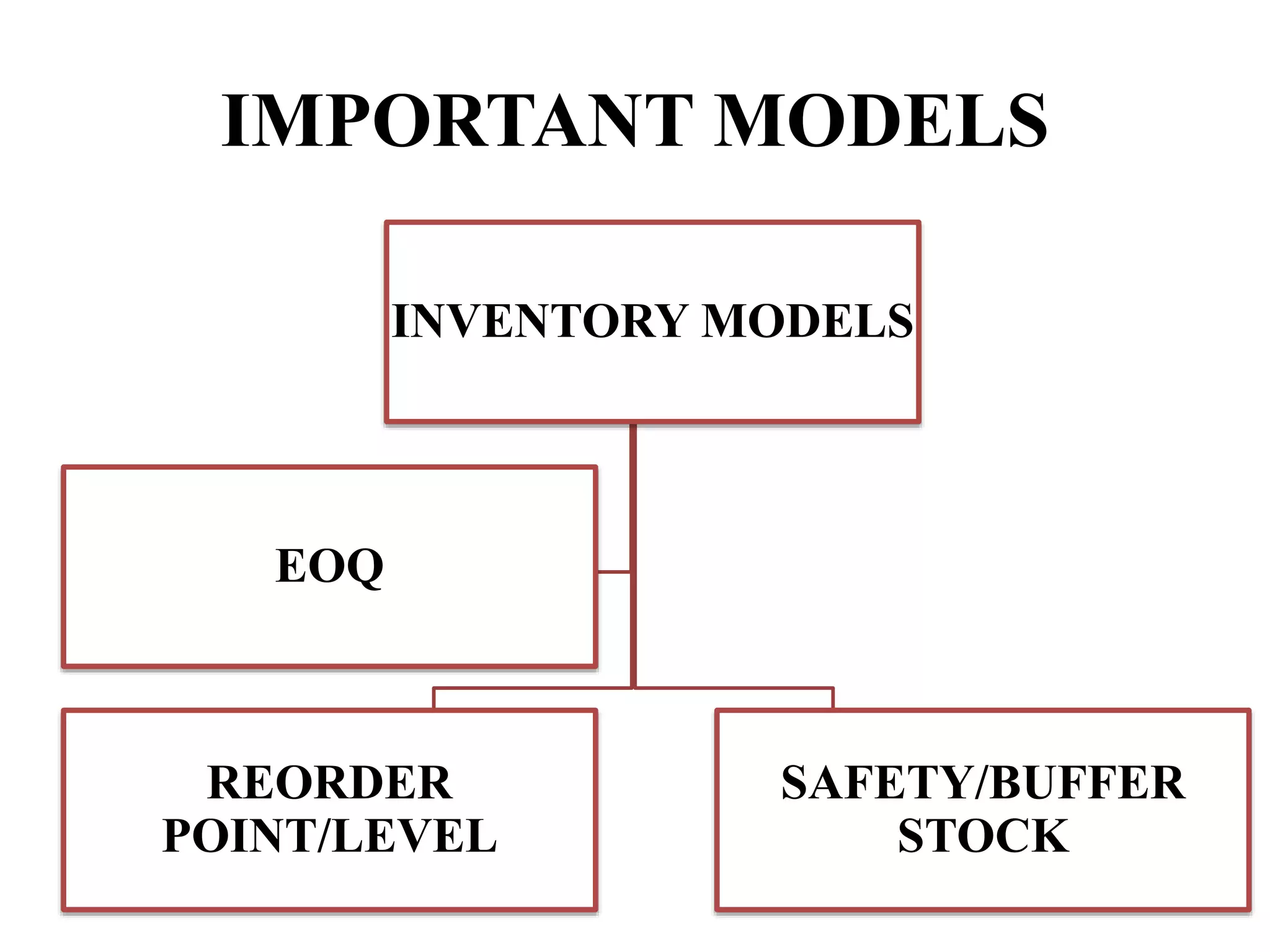
IMPORTANT MODELS
INVENTORY MODELS
REORDER
POINT/LEVEL
SAFETY/BUFFER
STOCK
EOQ
ECONOMIC ORDER QUANTITY
(EOQ) MODEL
Economic order quantity (EOQ) is the ideal
order quantity a company should purchase for
its inventory.
EOQ refers to that quantity of materials to be
purchased at one time to optimise the cost
thereon.
This is done to minimize variable inventory
costs.
GRAPH
1. Size of the order increases, the ordering cost
of an item decreases
2. Size of the order increases, the carrying cost
of an item increases
3. Point at which ordering cost is equal to
carrying cost is called EOQ
4. At that intersection point, Total cost is at the
lowest level
INTERPRETATION
EQUATION
EOQ =
𝟐𝑸𝑶
𝑪
Where, Q= Annual Quantity
demanded
O= Ordering Cost per order
C = Carrying Cost per unit
EXAMPLE
The material DX is used uniformly throughout the
year. The data about annual requirement, ordering
cost and holding cost of this material is given
below:
Annual requirement: 2,400 units
Ordering cost: Rs.10 per order
Holding cost: Rs.0.30 per unit
Required: Determine the economic order quantity
(EOQ) of material DX using above data.
SOLUTION
EOQ =
𝟐𝑸𝑶
𝑪
The economic order quantity for material DX is 400 units.
Now, we can compute the number of orders to be placed per year, annual
ordering cost, annual holding cost as follows:
Number of orders per year = Annual demand/EOQ
= 2,400 units/400 units
= 6 orders per year
Ordering cost = Number or orders per year × Cost per order
= 6 orders × Rs.10
= Rs.60
Holding cost = Average units × Holding cost per unit
= (400/2) × 0.3
= Rs.60
ASSUMPTION
• The cost of the ordering remains constant.
• The demand rate for the year is known and evenly spread
throughout the year.
• The lead time is not fluctuating (lead time is the
time between the placement of an order and delivery).
• The purchasing price is constant for every item.
• Carrying cost is based on average inventory.
ADVANTAGES
• EOQ model gives the customized
recommendation regarding the most
economical number of units to order
• Helps to minimize the cost of inventory
• Mathematical approach is more reliable
• The use of formula is useful if you plan to use
computers for calculation purpose
• It provides a baseline for getting the best deal.
DISADVANTAGES
• Manual calculation takes time and also
expensive.
• EOQ is not applicable when demand is not
constant.
• Faulty basic information
• EOQ models are based on assumptions.
STOCK LEVELS OF MATERIALS
• Stock should be low as possible.
• Ensure the availability as and when it required.
• To maintain required level of material in store
at minimum cost , stock levels are fixed for
each item.
STOCK
LEVELS
MINIIMUM STOCK LEVEL
MAXIMUM STOCK LEVEL
AVERAGE STOCK LEVEL
DANGER LEVEL
REORDER STOCK LEVEL
SAFETY STOCK (SS) OR
MINIMUM STOCK LEVEL
• Also known as Buffer stock or Reserve stock.
• Safety stock is an additional quantity of an item
held in inventory in order to reduce the risk that
the item will be out of stock.
• Safety stock acts as a buffer in case the sales of an
item are greater than planned and/or the supplier
is unable to deliver additional units at the
expected time.
• There are additional holding costs associated with
safety stock.
NEED FOR SS
• Safety stock protects against unforeseen
variation in supply and/or demand
• To compensate forecast inaccuracies (only in
case demand is bigger than the forecast)
• Its purpose is to prevent disruptions in
manufacturing or deliveries
• Avoid stock outs to keep customer service and
satisfaction levels high
• Bulk purchase helps in reducing costs.
FORMULA
SAFETY STOCK = (Max. usage rate–Avg. usage rate)*lead time
SAFETY STOCK = REORDER LEVEL – (AVERAGE CONSUMPTION *
AVERAGE REORDER PERIOD)
EXAMPLE
ABC Ltd. is engaged in production of tires. It
purchases rims from DEL Ltd. an external
supplier. DEL Ltd. takes 10 days in
manufacturing and delivering an order. ABC's
requires 10,000 units of rims per year. Its
ordering cost is Rs.1,000 per order and its
carrying costs are Rs.3 per unit per year. The
maximum usage per day could be 50 unit.
Calculate safety stock.
SOLUTION
Maximum daily usage is 50 units (given)
Lead time is 10 days (given)
Average daily usage is 27.4 (10,000 annual
demand ÷ 365 days).
Safety Stock = (50-27.4) × 10 = 226 units
MAXIMUM STOCK LEVEL
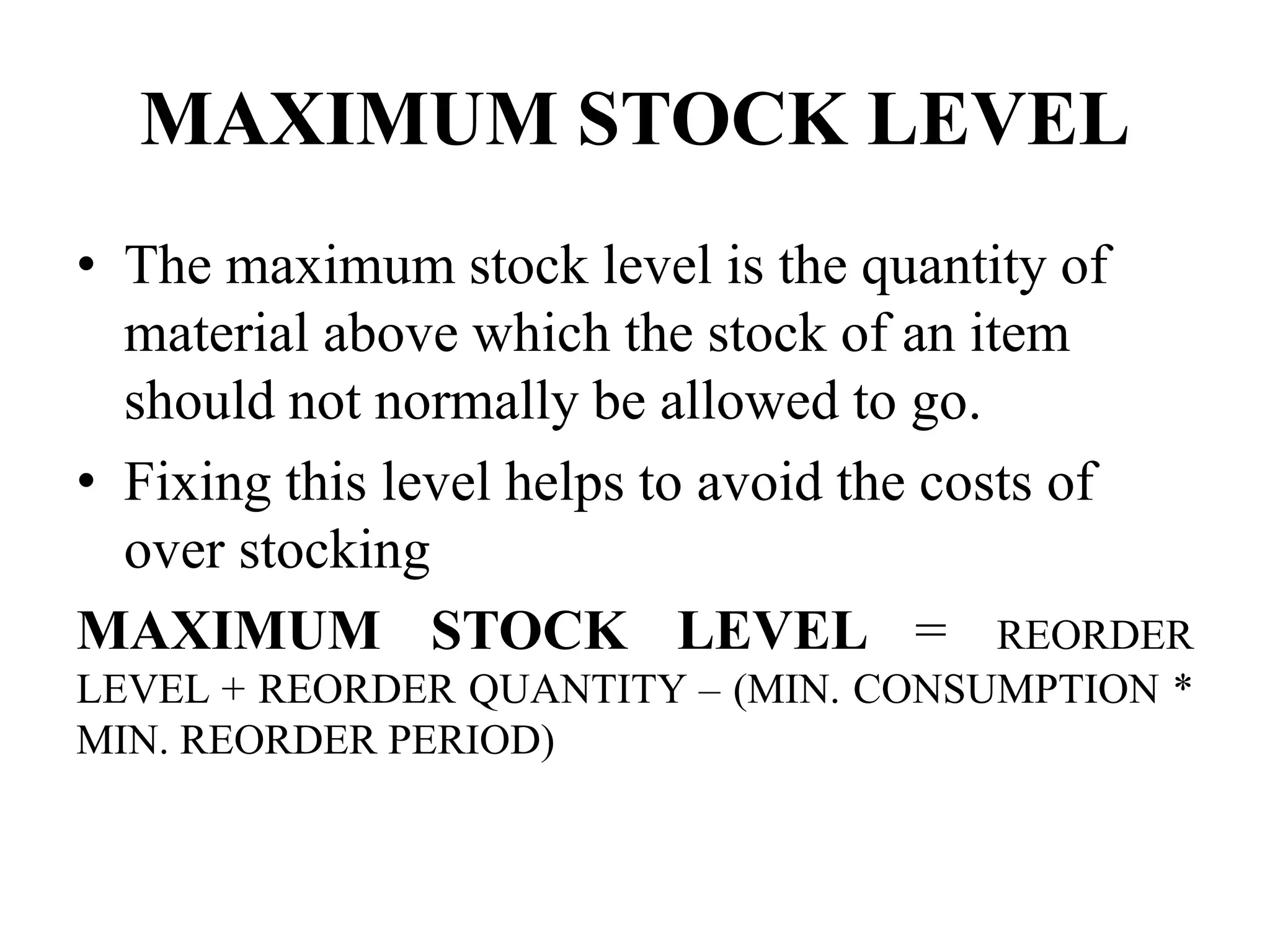
• The maximum stock level is the quantity of
material above which the stock of an item
should not normally be allowed to go.
• Fixing this level helps to avoid the costs of
over stocking
MAXIMUM STOCK LEVEL = REORDER
LEVEL + REORDER QUANTITY – (MIN. CONSUMPTION *
MIN. REORDER PERIOD)
AVERAGE STOCK LEVEL
• It shows the average quantity of materials kept
in the store.
• This regarded as the average of maximum and
minimum stock level.
Average Stock Level=(Min. level + Max. level)/2
DANGER LEVEL
• Level set below the minimum stock level.
• Level at which the normal issue of materials
are stopped.
DANGER LEVEL = Average Consumption * Emergency
supply time
REORDER POINT / LEVEL
REORDER POINT
• Reorder Point (ROP), also known as reorder
level or Lead time.
• The point at which the store keeper makes a
fresh request for the purchase
• Generally, it lies between the Max. and Min.
level
FORMULA
• Reorder Point =lead time * Average
Usage + Safety Stock
• Reorder Point =Max. consumption
×Max. reorder period
PROBLEM
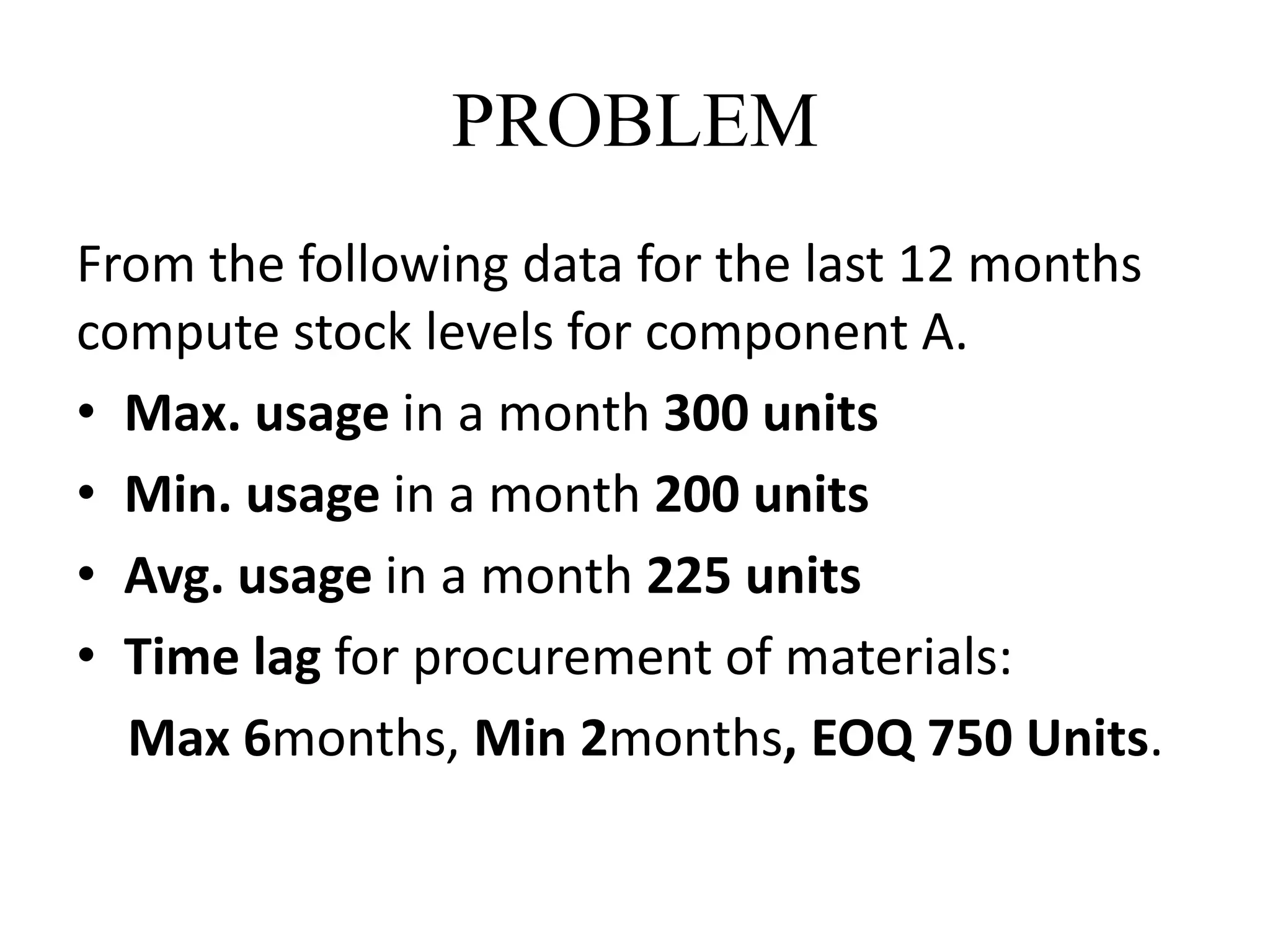
From the following data for the last 12 months
compute stock levels for component A.
• Max. usage in a month 300 units
• Min. usage in a month 200 units
• Avg. usage in a month 225 units
• Time lag for procurement of materials:
Max 6months, Min 2months, EOQ 750 Units.
SOLUTION
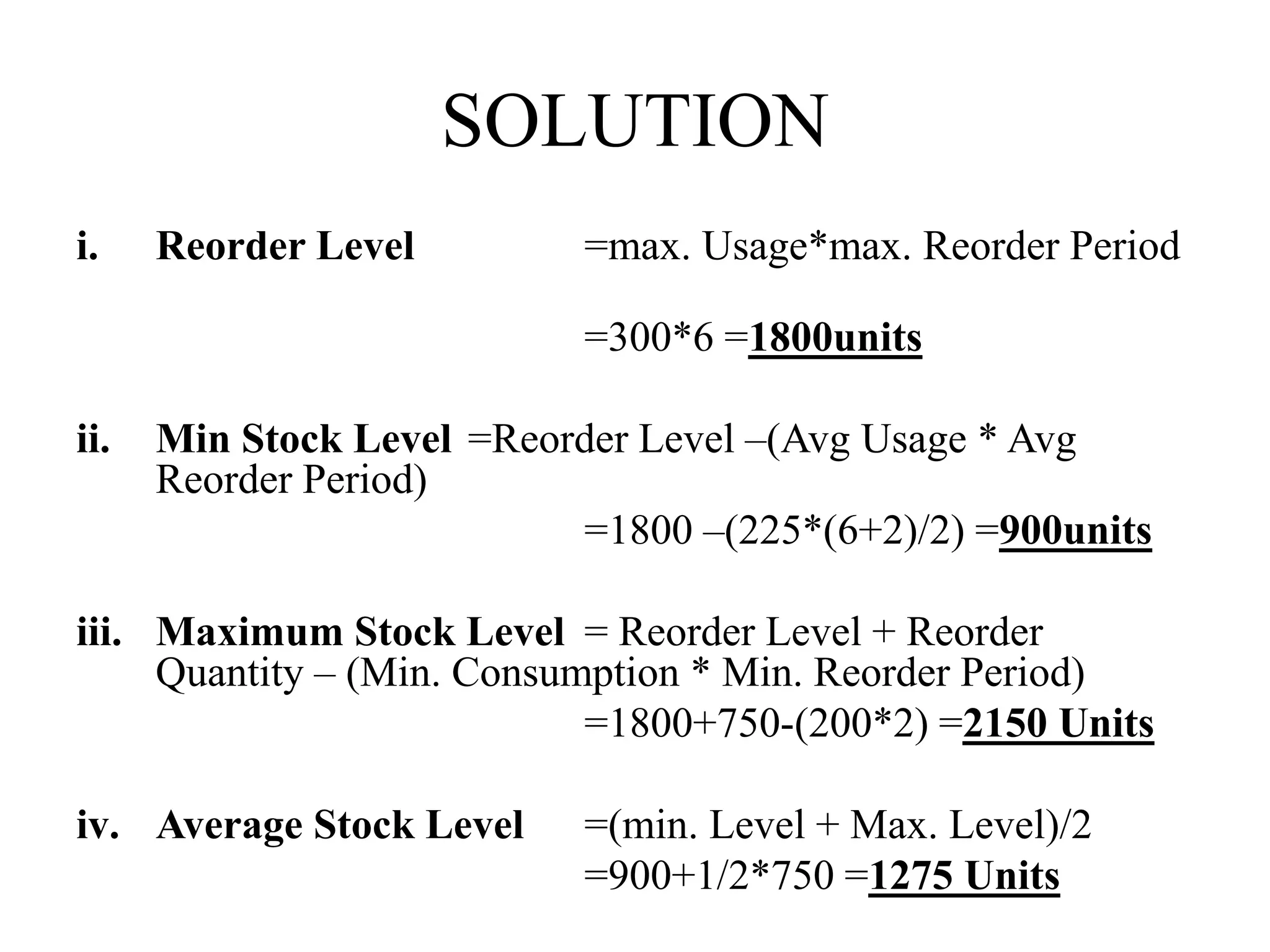
i. Reorder Level =max. Usage*max. Reorder Period
=300*6 =1800units
ii. Min Stock Level =Reorder Level –(Avg Usage * Avg
Reorder Period)
=1800 –(225*(6+2)/2) =900units
iii. Maximum Stock Level = Reorder Level + Reorder
Quantity – (Min. Consumption * Min. Reorder Period)
=1800+750-(200*2) =2150 Units
iv. Average Stock Level =(min. Level + Max. Level)/2
=900+1/2*750 =1275 Units
CONCLUSION
• In any business, make it big or small, we must understand
that taking good care of our inventory is very important.
• If we as managers do not understand the concept of good
inventory management, we must learn to be familiar with it
and its applications.
• One of the reasons for the failure of a business is its
inventory management. There are many ways to fight
failure, and the aforesaid inventory models can be used for
this.
• A truly effective inventory management system will
minimize the complexities involved in planning, executing
and controlling a supply chain network which is critical to
business success.
INVENTORY MODELS

INVENTORY MODELS

  • 2.
    PRESENTATION ON: PRESENTED BY, EBEENA ANCY NAVYA ALFIYA ASWATHY ARYAKRISHNAN ANJALI ARAFA ATHIRA CHANDRAN ABHIJITH ARYA RAVEENDRAN
  • 3.
    TOPICS  INTRODUCTION  PURPOSE IMPORTANT MODELS  ECONOMIC ORDER QUANTITY (EOQ)  GRAPH  INTERPRETATION  EXAMPLE  ASSUMPTIONS  ADVANTAGES  DISADVANTAGES  STOCK LEVEL AND TYPES  SAFETY STOCK  MINIMUM STOCK LEVEL  MAXIMUM STOCK LEVEL  AVERAGE STOCK LEVEL  DANGER LEVEL  REORER LEVEL  STOCK LEVEL PROBLEM  CONCLUSION
  • 4.
    INTRODUCTION One basic problemof inventory management is to find out the order quantity so that it is most economical from overall operational point of view. Here that problem lies in minimizing the two conflicting costs, i.e. ordering cost and inventory carrying cost. Inventory models help to find out the order quantity which minimizes the total costs(sum of ordering costs and inventory carrying costs).
  • 5.
    ORDERING COSTS Ordering costsare the costs related to the preparation of a supplier’s order, including the cost of placing an order, inspection costs, documentation costs, and others. Ordering Cost = No. of orders * Ordering cost per unit
  • 6.
    CARRYING COST Carrying costor Holding cost refers to the total cost of holding inventory. This includes warehousing costs such as rent, utilities and salaries, financial costs such as opportunity cost, and inventory costs related to perishability, shrinkage (leakage) and insurance. Carrying Cost = Avg. Order Quantity * Carrying Cost per Unit
  • 7.
    PURPOSE It helps businessin determining the optimum level of inventories that should be maintained in : • Production process • Managing frequency of ordering • Deciding on quantity of goods or raw materials to be stored • Tracking flow of supply of raw materials and goods to provide uninterrupted service to customers without any delay in delivery.
  • 8.
  • 10.
    ECONOMIC ORDER QUANTITY (EOQ)MODEL Economic order quantity (EOQ) is the ideal order quantity a company should purchase for its inventory. EOQ refers to that quantity of materials to be purchased at one time to optimise the cost thereon. This is done to minimize variable inventory costs.
  • 11.
  • 12.
    1. Size ofthe order increases, the ordering cost of an item decreases 2. Size of the order increases, the carrying cost of an item increases 3. Point at which ordering cost is equal to carrying cost is called EOQ 4. At that intersection point, Total cost is at the lowest level INTERPRETATION
  • 13.
    EQUATION EOQ = 𝟐𝑸𝑶 𝑪 Where, Q=Annual Quantity demanded O= Ordering Cost per order C = Carrying Cost per unit
  • 14.
    EXAMPLE The material DXis used uniformly throughout the year. The data about annual requirement, ordering cost and holding cost of this material is given below: Annual requirement: 2,400 units Ordering cost: Rs.10 per order Holding cost: Rs.0.30 per unit Required: Determine the economic order quantity (EOQ) of material DX using above data.
  • 15.
    SOLUTION EOQ = 𝟐𝑸𝑶 𝑪 The economicorder quantity for material DX is 400 units.
  • 16.
    Now, we cancompute the number of orders to be placed per year, annual ordering cost, annual holding cost as follows: Number of orders per year = Annual demand/EOQ = 2,400 units/400 units = 6 orders per year Ordering cost = Number or orders per year × Cost per order = 6 orders × Rs.10 = Rs.60 Holding cost = Average units × Holding cost per unit = (400/2) × 0.3 = Rs.60
  • 17.
    ASSUMPTION • The costof the ordering remains constant. • The demand rate for the year is known and evenly spread throughout the year. • The lead time is not fluctuating (lead time is the time between the placement of an order and delivery). • The purchasing price is constant for every item. • Carrying cost is based on average inventory.
  • 18.
    ADVANTAGES • EOQ modelgives the customized recommendation regarding the most economical number of units to order • Helps to minimize the cost of inventory • Mathematical approach is more reliable • The use of formula is useful if you plan to use computers for calculation purpose • It provides a baseline for getting the best deal.
  • 19.
    DISADVANTAGES • Manual calculationtakes time and also expensive. • EOQ is not applicable when demand is not constant. • Faulty basic information • EOQ models are based on assumptions.
  • 20.
    STOCK LEVELS OFMATERIALS • Stock should be low as possible. • Ensure the availability as and when it required. • To maintain required level of material in store at minimum cost , stock levels are fixed for each item.
  • 21.
    STOCK LEVELS MINIIMUM STOCK LEVEL MAXIMUMSTOCK LEVEL AVERAGE STOCK LEVEL DANGER LEVEL REORDER STOCK LEVEL
  • 23.
    SAFETY STOCK (SS)OR MINIMUM STOCK LEVEL • Also known as Buffer stock or Reserve stock. • Safety stock is an additional quantity of an item held in inventory in order to reduce the risk that the item will be out of stock. • Safety stock acts as a buffer in case the sales of an item are greater than planned and/or the supplier is unable to deliver additional units at the expected time. • There are additional holding costs associated with safety stock.
  • 24.
    NEED FOR SS •Safety stock protects against unforeseen variation in supply and/or demand • To compensate forecast inaccuracies (only in case demand is bigger than the forecast) • Its purpose is to prevent disruptions in manufacturing or deliveries • Avoid stock outs to keep customer service and satisfaction levels high • Bulk purchase helps in reducing costs.
  • 25.
    FORMULA SAFETY STOCK =(Max. usage rate–Avg. usage rate)*lead time SAFETY STOCK = REORDER LEVEL – (AVERAGE CONSUMPTION * AVERAGE REORDER PERIOD)
  • 26.
    EXAMPLE ABC Ltd. isengaged in production of tires. It purchases rims from DEL Ltd. an external supplier. DEL Ltd. takes 10 days in manufacturing and delivering an order. ABC's requires 10,000 units of rims per year. Its ordering cost is Rs.1,000 per order and its carrying costs are Rs.3 per unit per year. The maximum usage per day could be 50 unit. Calculate safety stock.
  • 27.
    SOLUTION Maximum daily usageis 50 units (given) Lead time is 10 days (given) Average daily usage is 27.4 (10,000 annual demand ÷ 365 days). Safety Stock = (50-27.4) × 10 = 226 units
  • 28.
    MAXIMUM STOCK LEVEL •The maximum stock level is the quantity of material above which the stock of an item should not normally be allowed to go. • Fixing this level helps to avoid the costs of over stocking MAXIMUM STOCK LEVEL = REORDER LEVEL + REORDER QUANTITY – (MIN. CONSUMPTION * MIN. REORDER PERIOD)
  • 29.
    AVERAGE STOCK LEVEL •It shows the average quantity of materials kept in the store. • This regarded as the average of maximum and minimum stock level. Average Stock Level=(Min. level + Max. level)/2
  • 30.
    DANGER LEVEL • Levelset below the minimum stock level. • Level at which the normal issue of materials are stopped. DANGER LEVEL = Average Consumption * Emergency supply time
  • 31.
  • 32.
    REORDER POINT • ReorderPoint (ROP), also known as reorder level or Lead time. • The point at which the store keeper makes a fresh request for the purchase • Generally, it lies between the Max. and Min. level
  • 33.
    FORMULA • Reorder Point=lead time * Average Usage + Safety Stock • Reorder Point =Max. consumption ×Max. reorder period
  • 34.
    PROBLEM From the followingdata for the last 12 months compute stock levels for component A. • Max. usage in a month 300 units • Min. usage in a month 200 units • Avg. usage in a month 225 units • Time lag for procurement of materials: Max 6months, Min 2months, EOQ 750 Units.
  • 35.
    SOLUTION i. Reorder Level=max. Usage*max. Reorder Period =300*6 =1800units ii. Min Stock Level =Reorder Level –(Avg Usage * Avg Reorder Period) =1800 –(225*(6+2)/2) =900units iii. Maximum Stock Level = Reorder Level + Reorder Quantity – (Min. Consumption * Min. Reorder Period) =1800+750-(200*2) =2150 Units iv. Average Stock Level =(min. Level + Max. Level)/2 =900+1/2*750 =1275 Units
  • 36.
    CONCLUSION • In anybusiness, make it big or small, we must understand that taking good care of our inventory is very important. • If we as managers do not understand the concept of good inventory management, we must learn to be familiar with it and its applications. • One of the reasons for the failure of a business is its inventory management. There are many ways to fight failure, and the aforesaid inventory models can be used for this. • A truly effective inventory management system will minimize the complexities involved in planning, executing and controlling a supply chain network which is critical to business success.