What We Can Forecast in our
day to day life???
past ==> future
I see that you will
get an O this semester.
FORECAST:
• A statement about the future value of a variable of
interest such as demand.
• Purpose of demand management is to coordinate and
control all sources of demand so the productive system
can be used efficiently and the product delivered on
time
• Forecasts affect decisions and activities throughout an
organization
– Marketing, sales
– Operations
– Accounting, finance
– Human resources
Accounting Cost /profit estimates
Finance Cash flow and funds
Marketing Pricing, promotion, Sales
Operations Inventory, Schedules, MRP,
workloads
Product/service design New products launch
Human Resources Hiring/recruiting/training
Uses of Forecasts
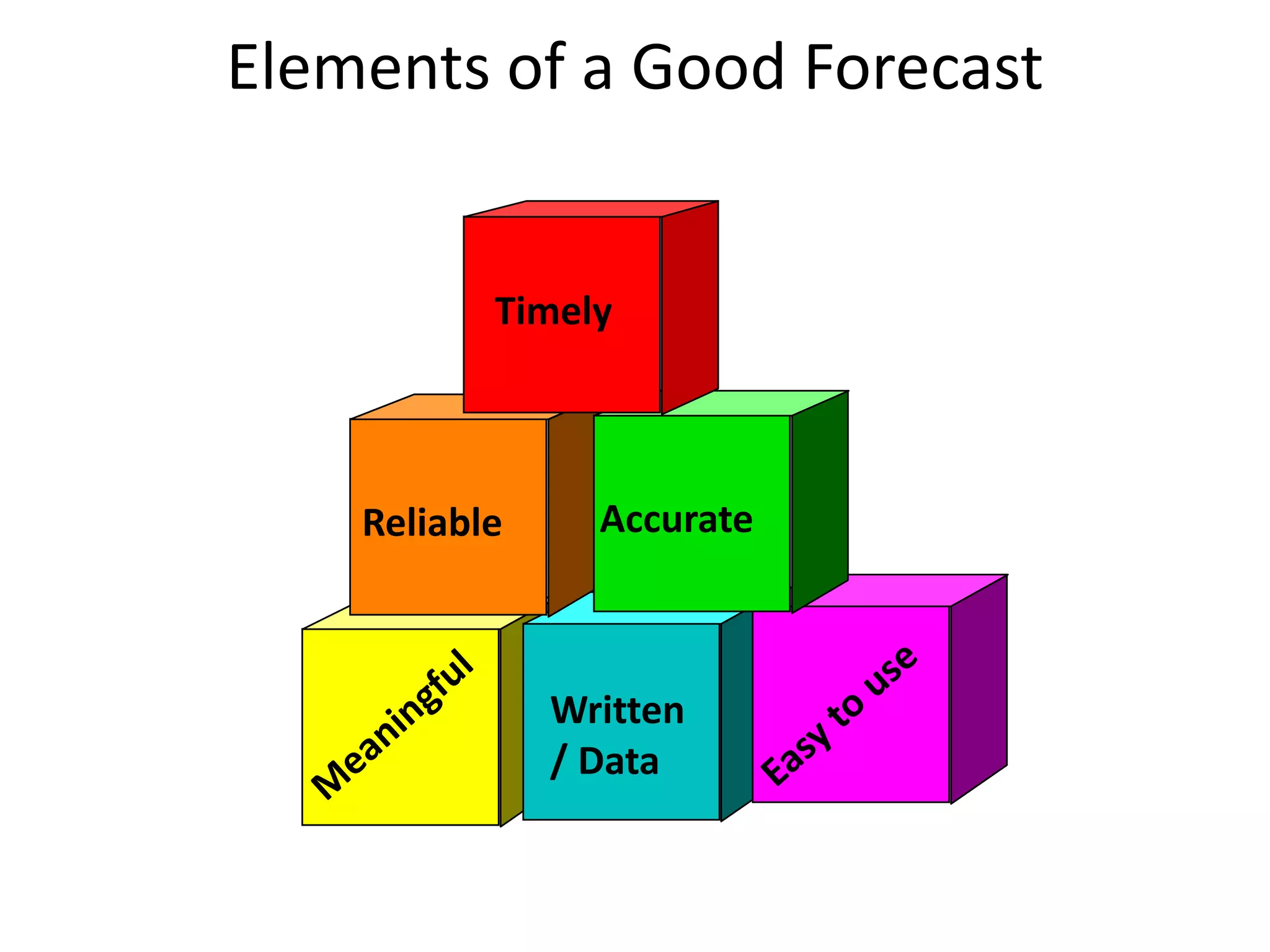
Elements of a Good Forecast
Timely
AccurateReliable
Written
/ Data
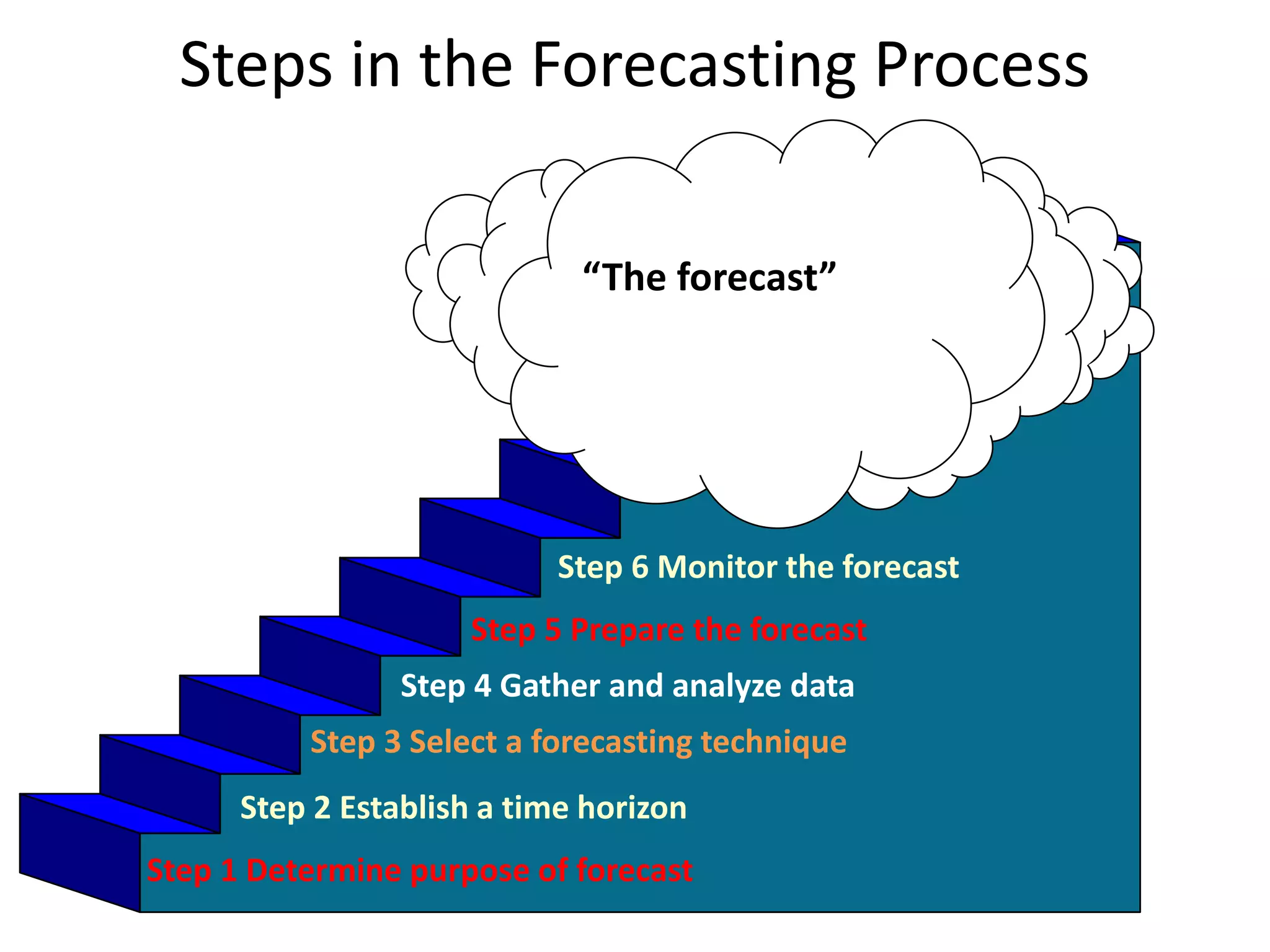
Steps in the Forecasting Process
Step 1 Determine purpose of forecast
Step 2 Establish a time horizon
Step 3 Select a forecasting technique
Step 4 Gather and analyze data
Step 5 Prepare the forecast
Step 6 Monitor the forecast
“The forecast”
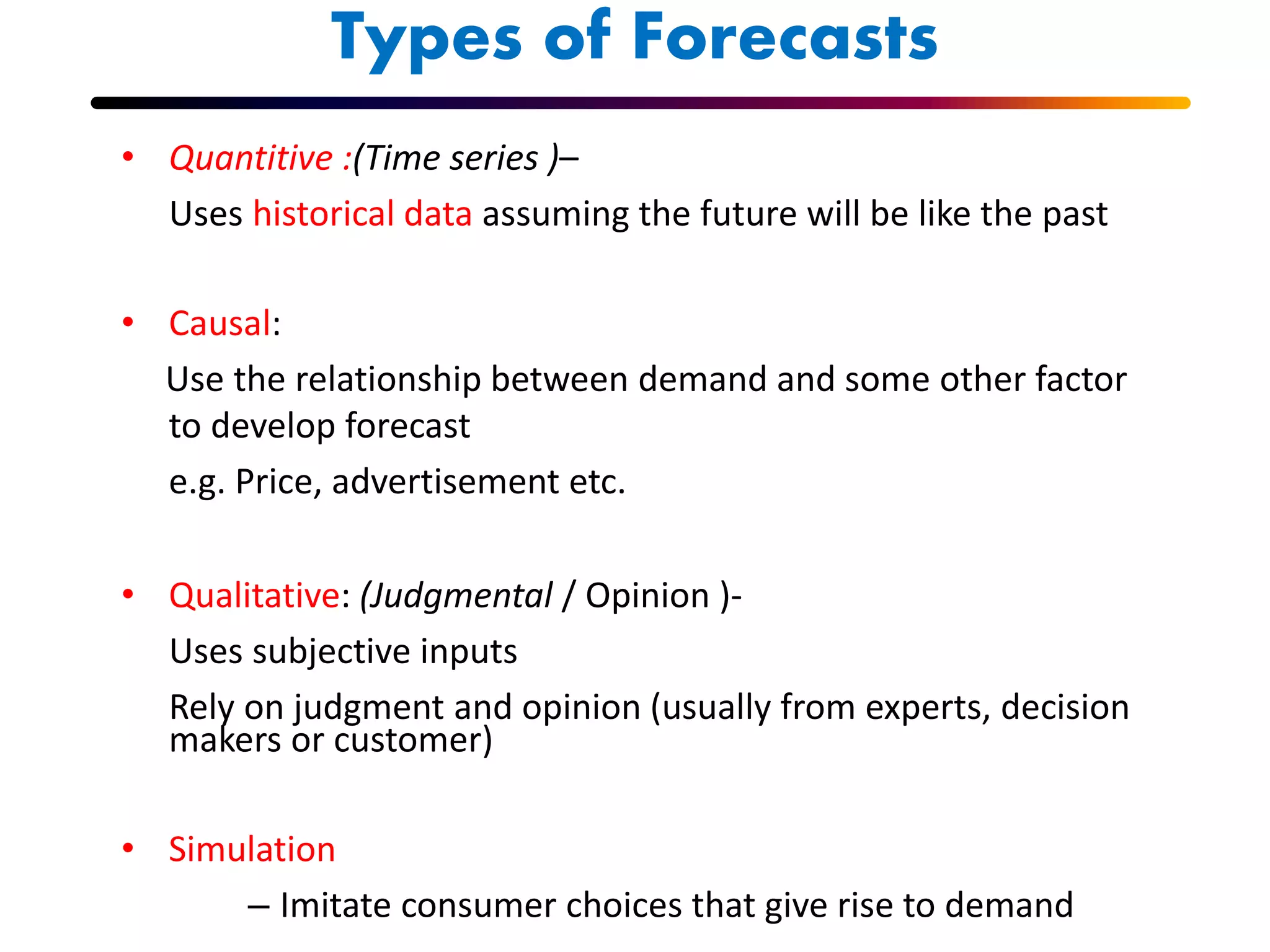
Types of Forecasts
• Quantitive :(Time series )–
Uses historical data assuming the future will be like the past
• Causal:
Use the relationship between demand and some other factor
to develop forecast
e.g. Price, advertisement etc.
• Qualitative: (Judgmental / Opinion )-
Uses subjective inputs
Rely on judgment and opinion (usually from experts, decision
makers or customer)
• Simulation
– Imitate consumer choices that give rise to demand
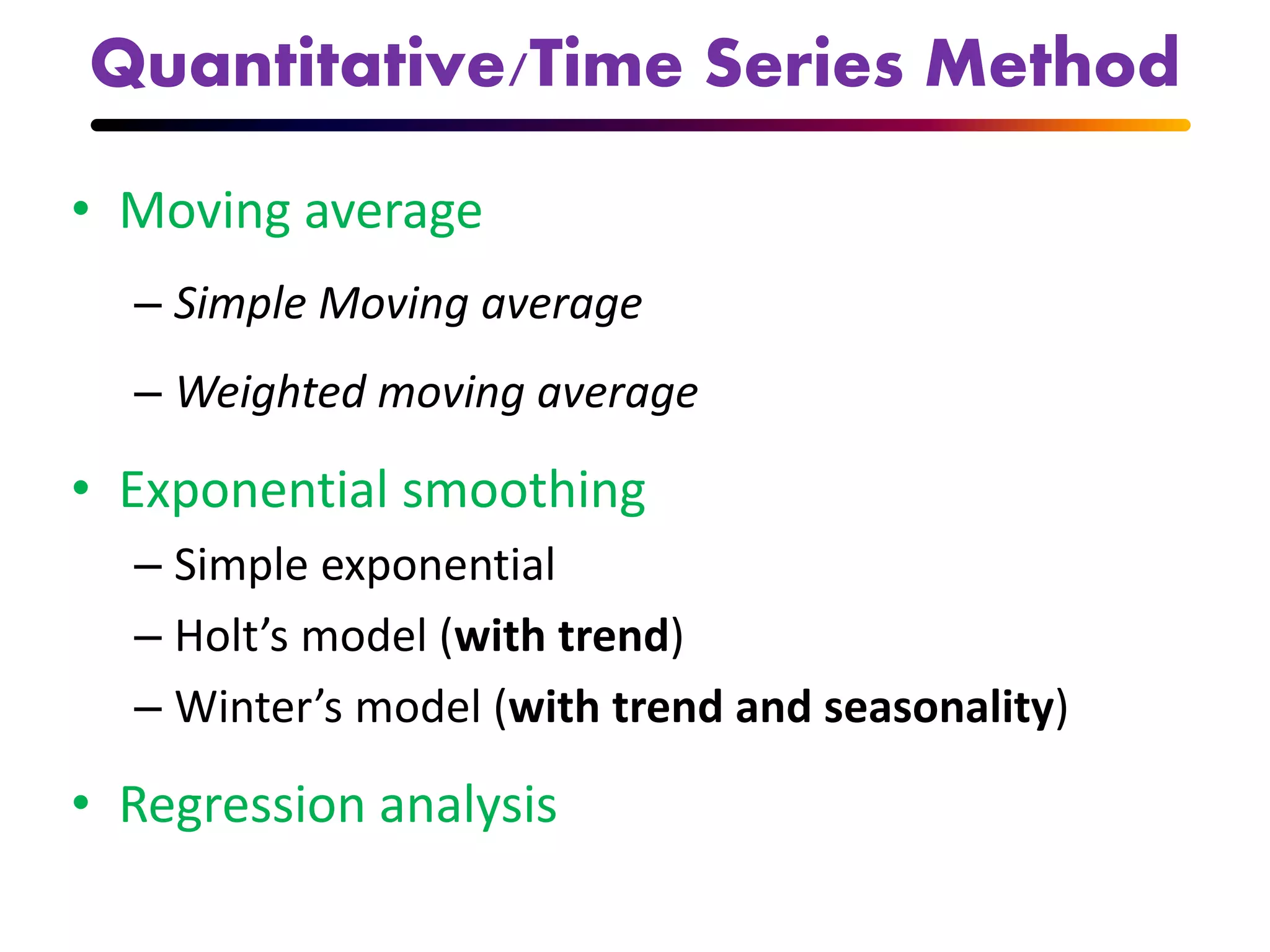
Quantitative/Time Series Method
• Moving average
– Simple Moving average
– Weighted moving average
• Exponential smoothing
– Simple exponential
– Holt’s model (with trend)
– Winter’s model (with trend and seasonality)
• Regression analysis
Qualitative/Judgmental Method
• Opinions
– Sales force opinions
– Executive
– Outside
• Surveys
- Consumer
- Competitor related
• Delphi method
– Opinions of managers and staff
Causal Method for forecasting
• Regression analysis
Time Series Forecasting
• Forecast based only on past values
– Assumes that factors influencing past and present
will continue influence in future
10/7/2018 12
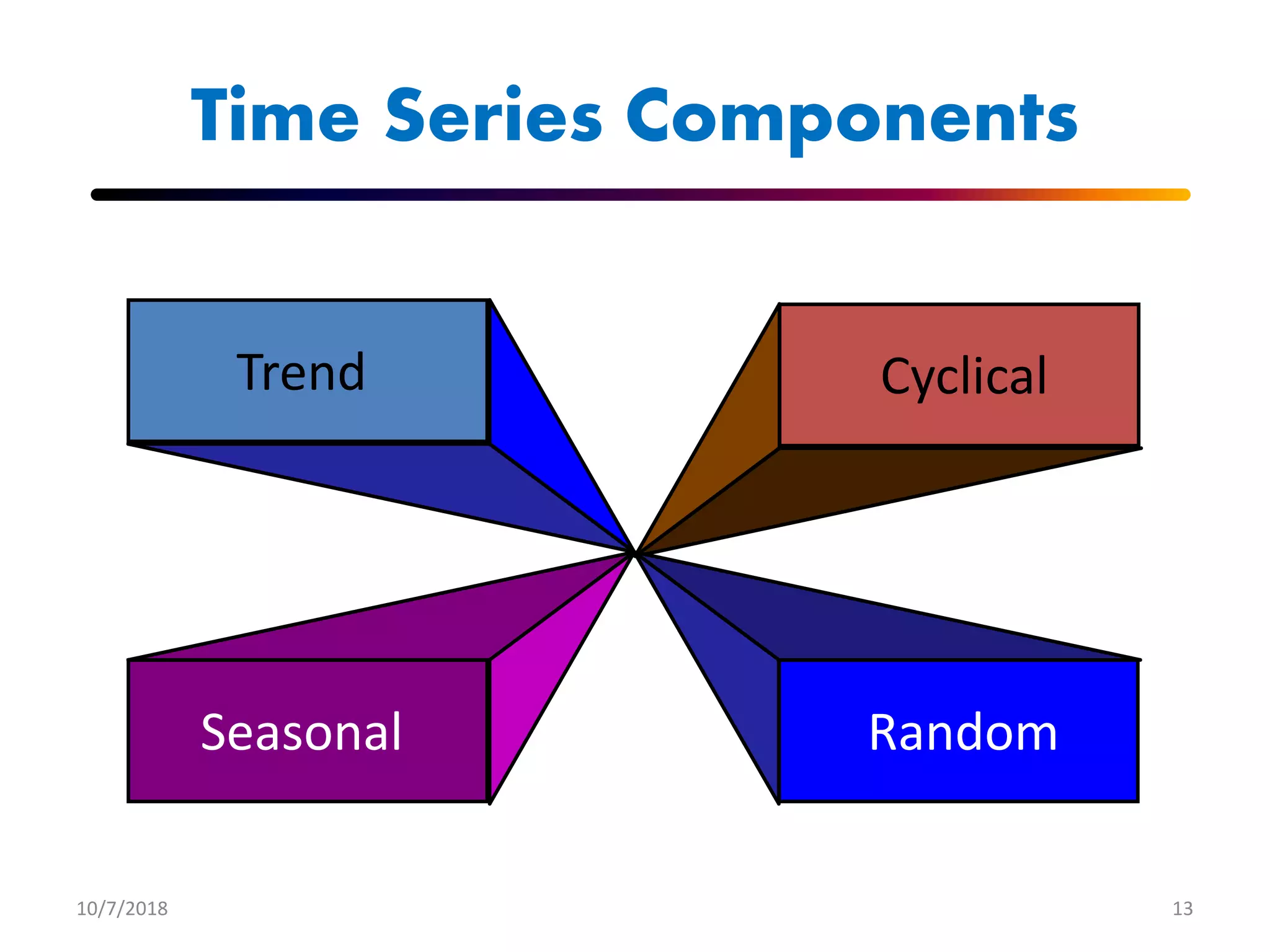
Time Series Components
10/7/2018 13
Trend
Seasonal
Cyclical
Random
Time Series Components
10/7/2018 14
Demandforproductorservice
| | | |
1 2 3 4
Year
Average demand
over four years
Seasonal peaks
Trend
component
Actual
demand
Random
variation
Trend Component
10/7/2018 15
 Usual starting pointing developing a
forecast.
 Adjusted for seasonal effects, cyclical
elements and random effects.
 Changes due to population, technology,
age, culture, etc.
 Typically several years duration
Seasonal Component
10/7/2018 16
 Regular pattern of up and down
fluctuations
 Due to weather, customs, etc.
 Occurs within a single year
Cyclical Component
10/7/2018 17
 Repeating up and down movements
 Affected by business cycle, political, and
economic factors
 Multiple years duration
0 5 10 15 20
Random Component
10/7/2018 18
 Erratic, unsystematic, ‘residual’ fluctuations
 Due to random variation or unforeseen events
 Short duration and no repeating
M T W T F
Naive approach
10/7/2018 19
 Assumes demand in next period is the
same as demand in most recent period
- e.g., If May sales were 48, then June sales will be
48
Sometimes cost effective and efficient
Moving Averages
• Simple Moving average – A technique that averages a
number of recent actual values, updated as new values
become available.
• Take the average demand for a defined number of past
periods
• Forecast will lag behind
– Trends
– Seasonality or other cyclicality
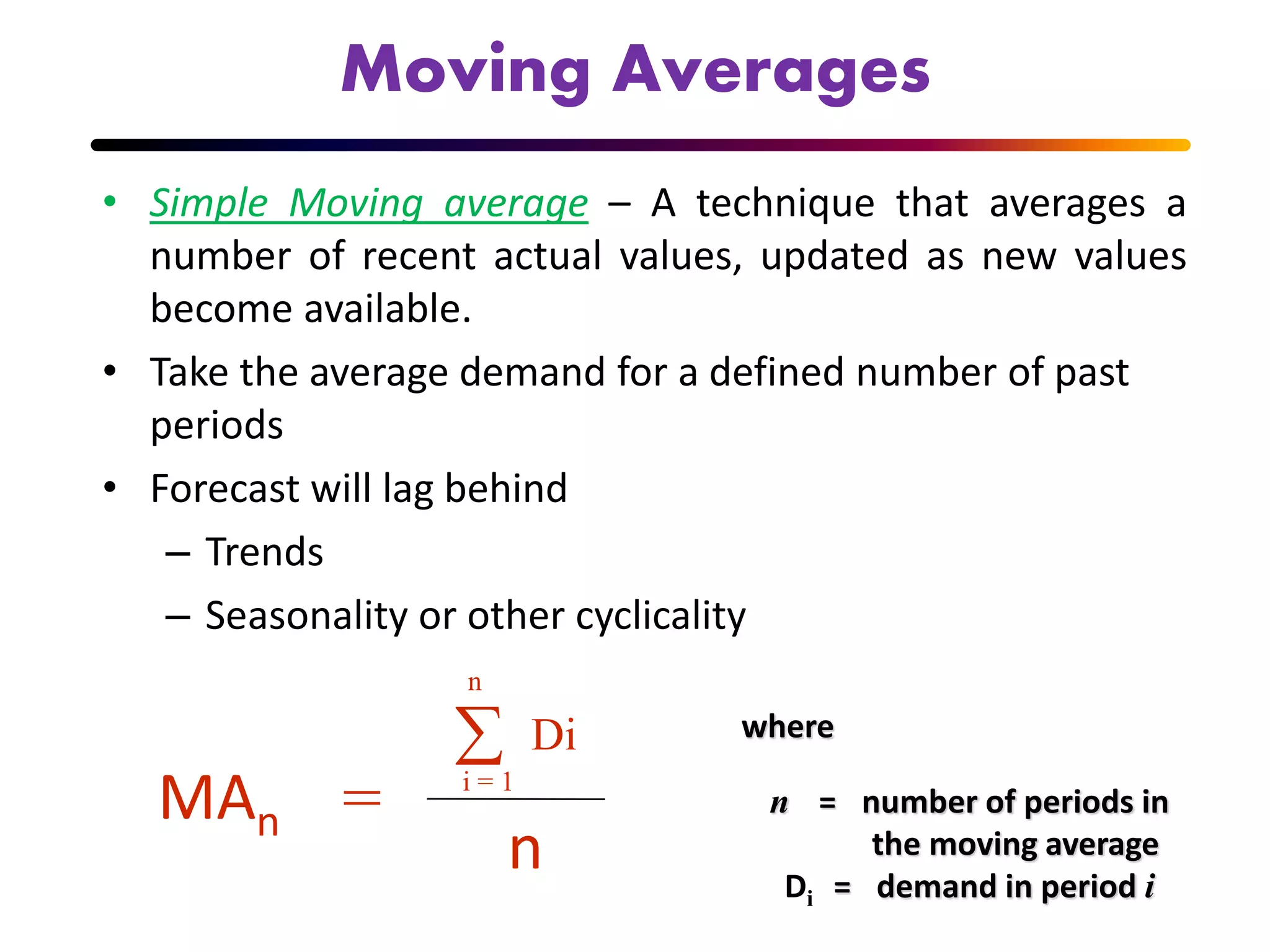
MAn =
n
Di
i = 1

n
where
n = number of periods in
the moving average
Di = demand in period i
3-Month Moving Averages
Jan 120
Feb 90
Mar 100
Apr 75
May 110
June 50
July 75
Aug 130
Sept 110
Oct 90
Nov -
ORDERS
MONTH PER MONTH
MA3 =
3
i = 1
 Di
3
=
90 + 110 + 130
3
= 110 orders
for Nov
–
–
–
103.3
88.3
95.0
78.3
78.3
85.0
105.0
110.0
MOVING
AVERAGE
5-Month Moving Averages
Jan 120
Feb 90
Mar 100
Apr 75
May 110
June 50
July 75
Aug 130
Sept 110
Oct 90
Nov -
ORDERS
MONTH PER MONTH
MA5 =
5
i = 1
 Di
5
=
90 + 110 + 130+75+50
5
= 91 orders
for Nov
–
–
–
–
–
99.0
85.0
82.0
88.0
95.0
91.0
MOVING
AVERAGE
Smoothing effect
10/7/2018 23
150 –
125 –
100 –
75 –
50 –
25 –
0 – | | | | | | | | | | |
Jan Feb Mar Apr May June July Aug Sept Oct Nov
Actual
Orders
Month
5-month
3-month
Weighted moving average
10/7/2018 24
 Adjusts moving average method to more closely reflect data
fluctuations
 Older data usually less important
 Weights based on experience and intuition
WMAn = i = 1
 Wi Di
where
Wi = the weight for period i, between 0
and 100 percent
Di = demand in period i
 Wi = 1.00
Weighted moving average
10/7/2018 25
MONTH WEIGHT DATA
August 17% 130
September 33% 110
October 50% 90
WMA3 =
3
i = 1
 Wi Di
= (0.50)(90) + (0.33)(110) + (0.17)(130)
= 103.4 orders
November Forecast
Weighted moving average
2610/7/2018
January 10
February 12
March 13
April 16
May 19
June 23
July 26
Actual 3-Month Weighted
Month Shed Sales Moving Average
[(3 x 16) + (2 x 13) + (12)]/6 = 141/3
[(3 x 19) + (2 x 16) + (13)]/6 = 17
[(3 x 23) + (2 x 19) + (16)]/6 = 201/2
10
12
13
[(3 x 13) + (2 x 12) + (10)]/6 = 121/6
Weighted moving average
2710/7/2018
30 –
25 –
20 –
15 –
10 –
5 –
Salesdemand
| | | | | | | | | | | |
J F M A M J J A S O N D
Actual
sales
Moving
average
Weighted
moving
average
Exponential Smoothing
2810/7/2018
• Form of weighted moving average
– Weights decline exponentially
– Most recent data weighted most
• Requires smoothing constant (α)
– Ranges from 0 to 1
– Subjectively chosen
• Involves little record keeping of past data
Exponential Smoothing
2910/7/2018
New forecast = last period’s forecast
+ a (last period’s actual demand
– last period’s forecast)
Ft = Ft – 1 + a(At – 1 - Ft – 1)
where Ft = new forecast
Ft – 1 = previous forecast
a = smoothing (or weighting)
constant (0  a  1)
Period Actual Alpha = 0.1 Error Alpha = 0.4 Error
1 42
2 40 42 -2.00 42 -2
3 43 41.8 1.20 41.2 1.8
4 40 41.92 -1.92 41.92 -1.92
5 41 41.73 -0.73 41.15 -0.15
6 39 41.66 -2.66 41.09 -2.09
7 46 41.39 4.61 40.25 5.75
8 44 41.85 2.15 42.55 1.45
9 45 42.07 2.93 43.13 1.87
10 38 42.36 -4.36 43.88 -5.88
11 40 41.92 -1.92 41.53 -1.53
12 41.73 40.92
Example - Exponential Smoothing
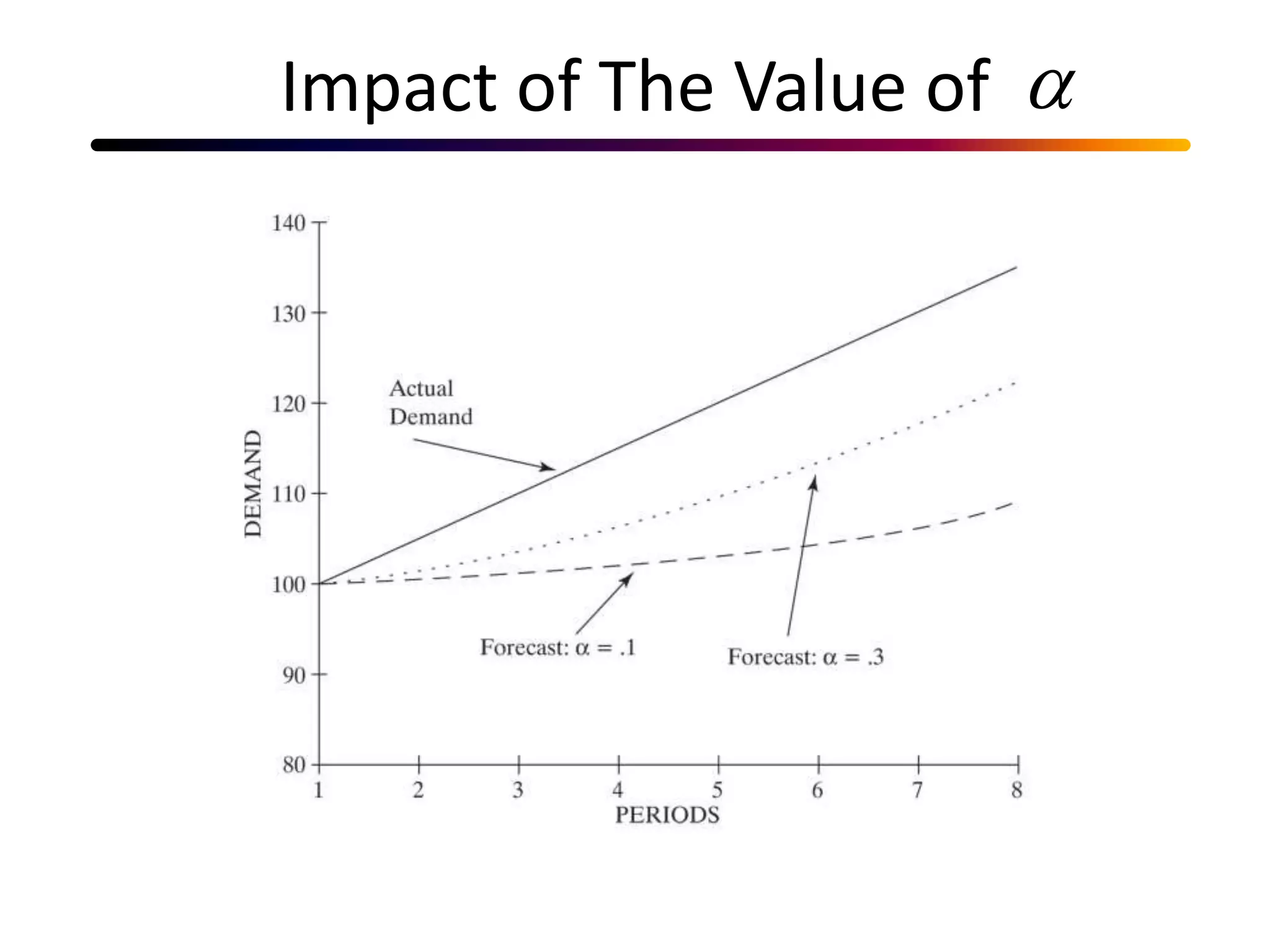
Impact of The Value of a
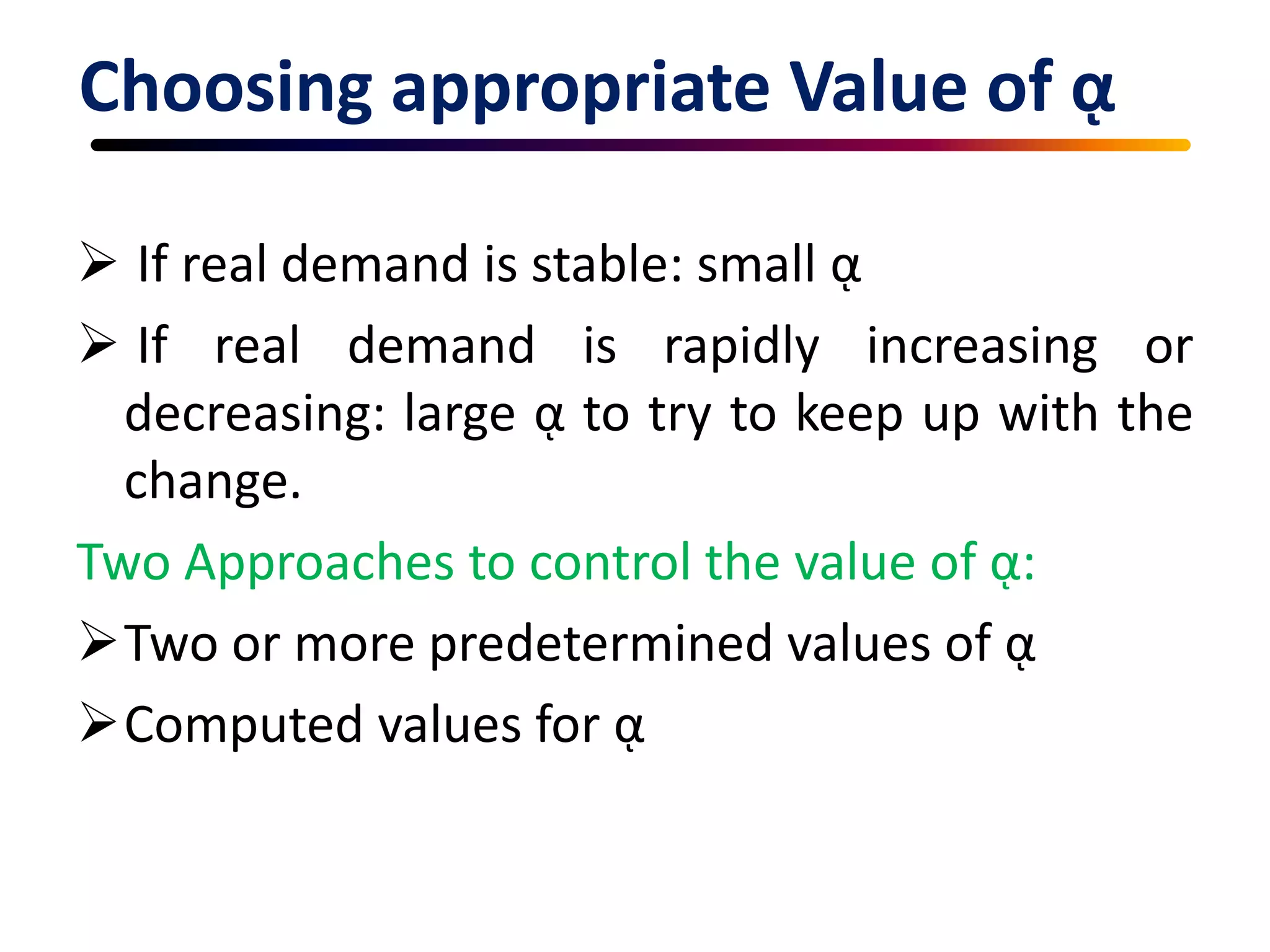
Choosing appropriate Value of ᾳ
 If real demand is stable: small ᾳ
 If real demand is rapidly increasing or
decreasing: large ᾳ to try to keep up with the
change.
Two Approaches to control the value of ᾳ:
Two or more predetermined values of ᾳ
Computed values for ᾳ
Choosing appropriate Value of ᾳ
Two or more predetermined values of ᾳ
If error is large: ᾳ ≥ 0.8
If error is small: ᾳ ≤ 0.2
Computed values for ᾳ
Tracking ᾳ = Exponentially smoothed actual
error divided by exponentially smoothed
absolute error.
Trend effects in exponential smoothing
 To correct the trend to smoothing constant are required:
– Smoothing constant ᾳ and smoothing constant δ
– δ reduces the impact of errors
– For first time, trend value must be entered manually.
– This trend value can be educated guess or a computation based on
observed past data
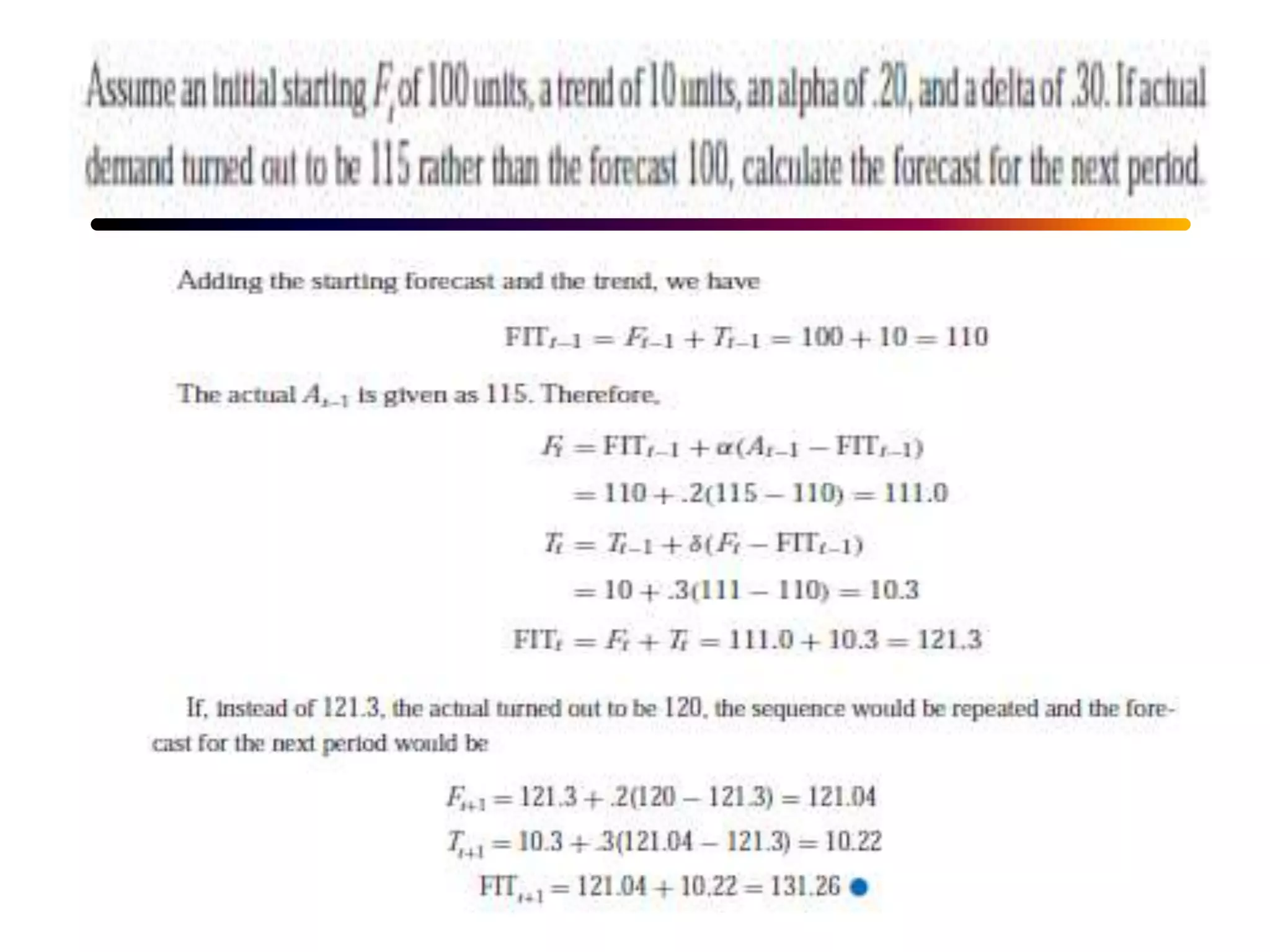
FITt-1 = Ft-1 + Tt-1
Ft = FITt-1 + ᾳ (At -1 - FITt-1 )
Tt = Tt-1 + δ (Ft - FITt-1 )
Linear Regression Analysis
 Useful for long term forecasting of major
occurrences and aggregate planning.
e.g. very useful for product families.
 Used for both time series forecasting and causal
forecasting.
 Time series forecasting: If dependent variable
changes as a result of time
 Casual forecasting: If one variable changes because
of change in another variable.
Linear Regression Analysis
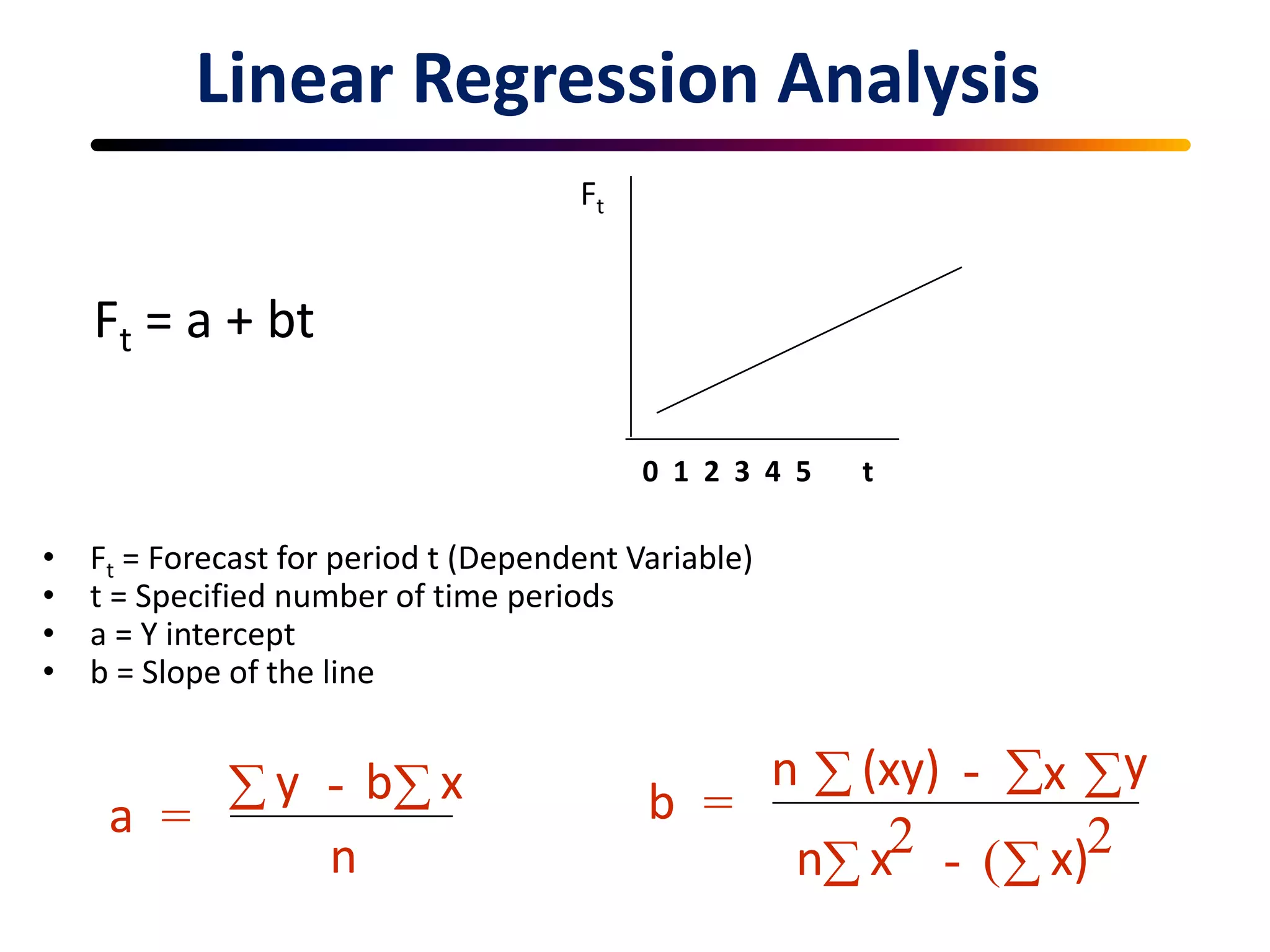
• Ft = Forecast for period t (Dependent Variable)
• t = Specified number of time periods
• a = Y intercept
• b = Slope of the line
Ft = a + bt
0 1 2 3 4 5 t
Ft
b =
n (xy) - y
n x2 - ( x)2
x

a =
y - b x
n

Example
x y
Week x2
Sales xy
1 1 150 150
2 4 157 314
3 9 162 486
4 16 166 664
5 25 177 885
 x = 15 x2
= 55  y = 812  xy = 2499
(x)2
= 225
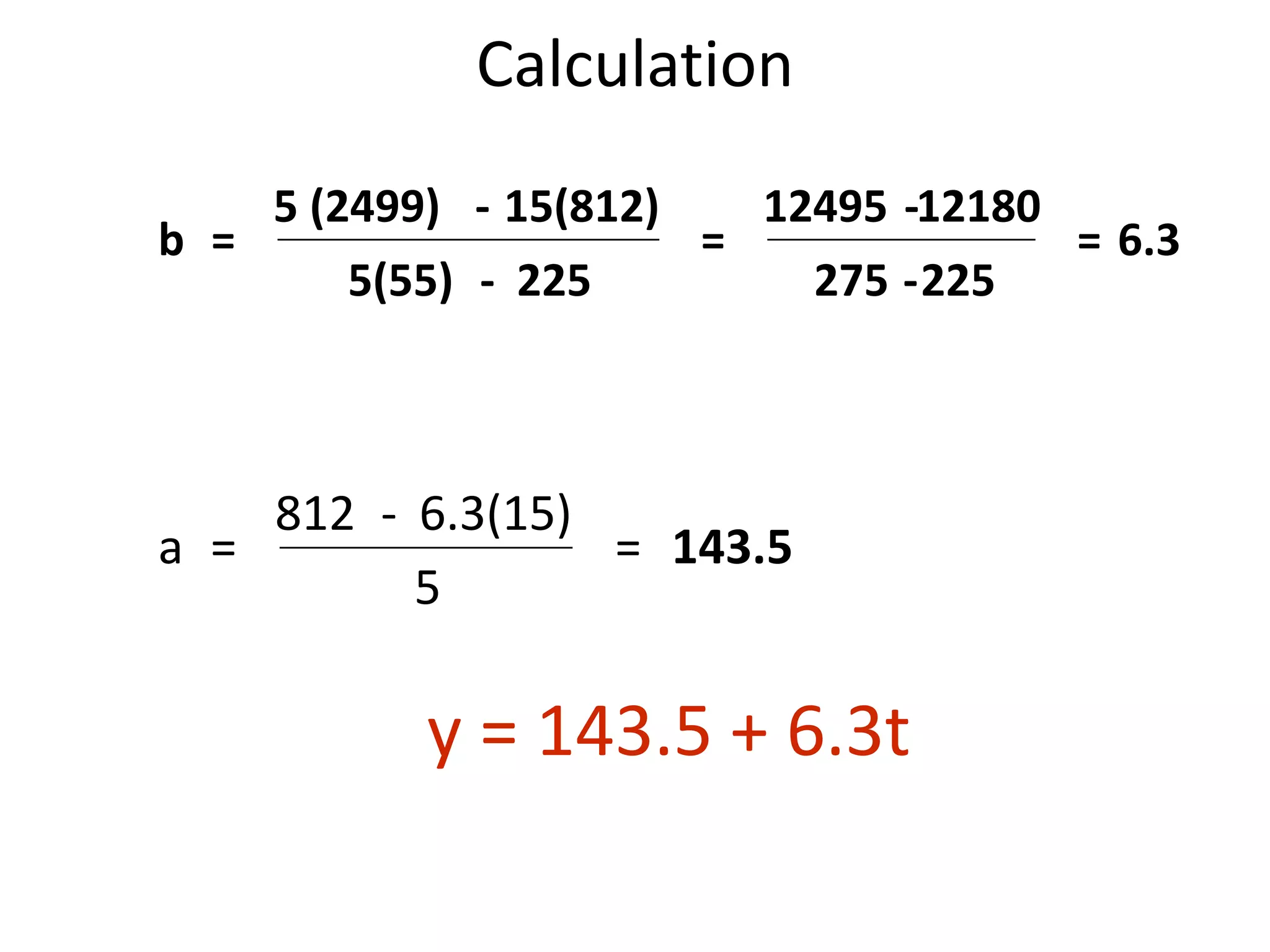
Calculation
y = 143.5 + 6.3t
a =
812 - 6.3(15)
5
=
b =
5 (2499) - 15(812)
5(55) - 225
=
12495 -12180
275 -225
= 6.3
143.5
Correlation Analysis
 How strong is the linear relationship between the
variables?
- a measure of the strength of the relationship between
independent and dependent variables
 Coefficient of correlation, r, measures degree of
association
 Values range from -1 to +1
r =
nxy - xy
[nx2 - (x)2][ny2 - (y)2]
Correlation Analysis
10/7/2018 41
y
x(a) Perfect positive
correlation:
r = +1
y
x
(c) No correlation:
r = 0
y
x(b) Positive
correlation:
0 < r < 1
y
x
(d) Perfect negative
correlation:
r = -1
Correlation Analysis
10/7/2018 42
x y
Week Sales
1 150
2 157
3 162
4 166
5 177
Forecast Accuracy
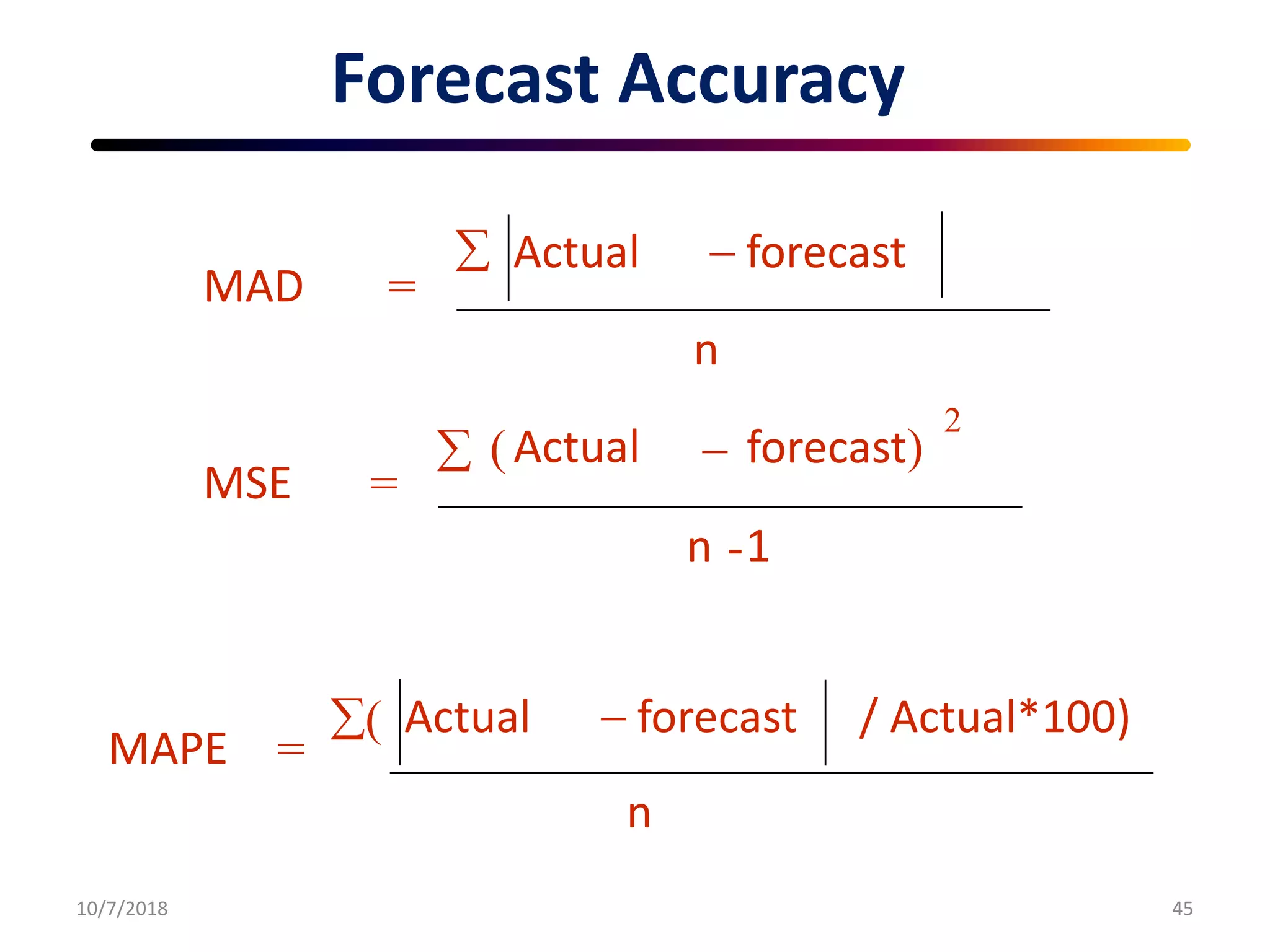
 Error - difference between actual value and predicted
value
 Mean Absolute Deviation (MAD)
- Average absolute error
 Mean Squared Error (MSE)
- Average of squared error
 Mean Absolute Percent Error (MAPE)
- Average absolute percent error
Forecast Accuracy
 MAD
– Easy to compute
– Weights errors linearly
 MSE
– Squares error
– More weight to large errors
 MAPE
– Puts errors in percent
Forecast Accuracy
10/7/2018 45
MAD =
Actual forecast
n
MSE =
Actual forecast)
-1
2

n
(
MAPE =
Actual forecast
n
/ Actual*100)(
Example
Period Actual Forecast (A-F) |A-F| (A-F)^2 (|A-F|/Actual)*100
1 217 215 2 2 4 0.92
2 213 216 -3 3 9 1.41
3 216 215 1 1 1 0.46
4 210 214 -4 4 16 1.90
5 213 211 2 2 4 0.94
6 219 214 5 5 25 2.28
7 216 217 -1 1 1 0.46
8 212 216 -4 4 16 1.89
-2 22 76 10.26
MAD= 2.75
MSE= 10.86
MAPE= 1.28
Mean absolute deviation
MAD =
A - F
n
t t
t=1
n

1 MAD 0.8 standard deviation
1 standard deviation 1.25 MAD


• The ideal MAD is zero which would mean there
is no forecasting error
• The larger the MAD, the less the accurate the
resulting model
Tracking Signal
Tracking signal =
(Actual-forecast)
MAD

•Tracking signal
–Ratio of cumulative error to MAD
Choosing a Forecasting Technique
• No single technique works in every situation
• Two most important factors
– Cost
– Accuracy
• Other factors include the availability of:
– Historical data
– Computers
– Time needed to gather and analyze the data
– Forecast horizon
Thank you!!


Forecasting of demand (management)

  • 1.
    What We CanForecast in our day to day life???
  • 2.
    past ==> future Isee that you will get an O this semester.
  • 4.
    FORECAST: • A statementabout the future value of a variable of interest such as demand. • Purpose of demand management is to coordinate and control all sources of demand so the productive system can be used efficiently and the product delivered on time • Forecasts affect decisions and activities throughout an organization – Marketing, sales – Operations – Accounting, finance – Human resources
  • 5.
    Accounting Cost /profitestimates Finance Cash flow and funds Marketing Pricing, promotion, Sales Operations Inventory, Schedules, MRP, workloads Product/service design New products launch Human Resources Hiring/recruiting/training Uses of Forecasts
  • 6.
    Elements of aGood Forecast Timely AccurateReliable Written / Data
  • 7.
    Steps in theForecasting Process Step 1 Determine purpose of forecast Step 2 Establish a time horizon Step 3 Select a forecasting technique Step 4 Gather and analyze data Step 5 Prepare the forecast Step 6 Monitor the forecast “The forecast”
  • 8.
    Types of Forecasts •Quantitive :(Time series )– Uses historical data assuming the future will be like the past • Causal: Use the relationship between demand and some other factor to develop forecast e.g. Price, advertisement etc. • Qualitative: (Judgmental / Opinion )- Uses subjective inputs Rely on judgment and opinion (usually from experts, decision makers or customer) • Simulation – Imitate consumer choices that give rise to demand
  • 9.
    Quantitative/Time Series Method •Moving average – Simple Moving average – Weighted moving average • Exponential smoothing – Simple exponential – Holt’s model (with trend) – Winter’s model (with trend and seasonality) • Regression analysis
  • 10.
    Qualitative/Judgmental Method • Opinions –Sales force opinions – Executive – Outside • Surveys - Consumer - Competitor related • Delphi method – Opinions of managers and staff
  • 11.
    Causal Method forforecasting • Regression analysis
  • 12.
    Time Series Forecasting •Forecast based only on past values – Assumes that factors influencing past and present will continue influence in future 10/7/2018 12
  • 13.
    Time Series Components 10/7/201813 Trend Seasonal Cyclical Random
  • 14.
    Time Series Components 10/7/201814 Demandforproductorservice | | | | 1 2 3 4 Year Average demand over four years Seasonal peaks Trend component Actual demand Random variation
  • 15.
    Trend Component 10/7/2018 15 Usual starting pointing developing a forecast.  Adjusted for seasonal effects, cyclical elements and random effects.  Changes due to population, technology, age, culture, etc.  Typically several years duration
  • 16.
    Seasonal Component 10/7/2018 16 Regular pattern of up and down fluctuations  Due to weather, customs, etc.  Occurs within a single year
  • 17.
    Cyclical Component 10/7/2018 17 Repeating up and down movements  Affected by business cycle, political, and economic factors  Multiple years duration 0 5 10 15 20
  • 18.
    Random Component 10/7/2018 18 Erratic, unsystematic, ‘residual’ fluctuations  Due to random variation or unforeseen events  Short duration and no repeating M T W T F
  • 19.
    Naive approach 10/7/2018 19 Assumes demand in next period is the same as demand in most recent period - e.g., If May sales were 48, then June sales will be 48 Sometimes cost effective and efficient
  • 20.
    Moving Averages • SimpleMoving average – A technique that averages a number of recent actual values, updated as new values become available. • Take the average demand for a defined number of past periods • Forecast will lag behind – Trends – Seasonality or other cyclicality MAn = n Di i = 1  n where n = number of periods in the moving average Di = demand in period i
  • 21.
    3-Month Moving Averages Jan120 Feb 90 Mar 100 Apr 75 May 110 June 50 July 75 Aug 130 Sept 110 Oct 90 Nov - ORDERS MONTH PER MONTH MA3 = 3 i = 1  Di 3 = 90 + 110 + 130 3 = 110 orders for Nov – – – 103.3 88.3 95.0 78.3 78.3 85.0 105.0 110.0 MOVING AVERAGE
  • 22.
    5-Month Moving Averages Jan120 Feb 90 Mar 100 Apr 75 May 110 June 50 July 75 Aug 130 Sept 110 Oct 90 Nov - ORDERS MONTH PER MONTH MA5 = 5 i = 1  Di 5 = 90 + 110 + 130+75+50 5 = 91 orders for Nov – – – – – 99.0 85.0 82.0 88.0 95.0 91.0 MOVING AVERAGE
  • 23.
    Smoothing effect 10/7/2018 23 150– 125 – 100 – 75 – 50 – 25 – 0 – | | | | | | | | | | | Jan Feb Mar Apr May June July Aug Sept Oct Nov Actual Orders Month 5-month 3-month
  • 24.
    Weighted moving average 10/7/201824  Adjusts moving average method to more closely reflect data fluctuations  Older data usually less important  Weights based on experience and intuition WMAn = i = 1  Wi Di where Wi = the weight for period i, between 0 and 100 percent Di = demand in period i  Wi = 1.00
  • 25.
    Weighted moving average 10/7/201825 MONTH WEIGHT DATA August 17% 130 September 33% 110 October 50% 90 WMA3 = 3 i = 1  Wi Di = (0.50)(90) + (0.33)(110) + (0.17)(130) = 103.4 orders November Forecast
  • 26.
    Weighted moving average 2610/7/2018 January10 February 12 March 13 April 16 May 19 June 23 July 26 Actual 3-Month Weighted Month Shed Sales Moving Average [(3 x 16) + (2 x 13) + (12)]/6 = 141/3 [(3 x 19) + (2 x 16) + (13)]/6 = 17 [(3 x 23) + (2 x 19) + (16)]/6 = 201/2 10 12 13 [(3 x 13) + (2 x 12) + (10)]/6 = 121/6
  • 27.
    Weighted moving average 2710/7/2018 30– 25 – 20 – 15 – 10 – 5 – Salesdemand | | | | | | | | | | | | J F M A M J J A S O N D Actual sales Moving average Weighted moving average
  • 28.
    Exponential Smoothing 2810/7/2018 • Formof weighted moving average – Weights decline exponentially – Most recent data weighted most • Requires smoothing constant (α) – Ranges from 0 to 1 – Subjectively chosen • Involves little record keeping of past data
  • 29.
    Exponential Smoothing 2910/7/2018 New forecast= last period’s forecast + a (last period’s actual demand – last period’s forecast) Ft = Ft – 1 + a(At – 1 - Ft – 1) where Ft = new forecast Ft – 1 = previous forecast a = smoothing (or weighting) constant (0  a  1)
  • 30.
    Period Actual Alpha= 0.1 Error Alpha = 0.4 Error 1 42 2 40 42 -2.00 42 -2 3 43 41.8 1.20 41.2 1.8 4 40 41.92 -1.92 41.92 -1.92 5 41 41.73 -0.73 41.15 -0.15 6 39 41.66 -2.66 41.09 -2.09 7 46 41.39 4.61 40.25 5.75 8 44 41.85 2.15 42.55 1.45 9 45 42.07 2.93 43.13 1.87 10 38 42.36 -4.36 43.88 -5.88 11 40 41.92 -1.92 41.53 -1.53 12 41.73 40.92 Example - Exponential Smoothing
  • 31.
    Impact of TheValue of a
  • 32.
    Choosing appropriate Valueof ᾳ  If real demand is stable: small ᾳ  If real demand is rapidly increasing or decreasing: large ᾳ to try to keep up with the change. Two Approaches to control the value of ᾳ: Two or more predetermined values of ᾳ Computed values for ᾳ
  • 33.
    Choosing appropriate Valueof ᾳ Two or more predetermined values of ᾳ If error is large: ᾳ ≥ 0.8 If error is small: ᾳ ≤ 0.2 Computed values for ᾳ Tracking ᾳ = Exponentially smoothed actual error divided by exponentially smoothed absolute error.
  • 34.
    Trend effects inexponential smoothing  To correct the trend to smoothing constant are required: – Smoothing constant ᾳ and smoothing constant δ – δ reduces the impact of errors – For first time, trend value must be entered manually. – This trend value can be educated guess or a computation based on observed past data FITt-1 = Ft-1 + Tt-1 Ft = FITt-1 + ᾳ (At -1 - FITt-1 ) Tt = Tt-1 + δ (Ft - FITt-1 )
  • 36.
    Linear Regression Analysis Useful for long term forecasting of major occurrences and aggregate planning. e.g. very useful for product families.  Used for both time series forecasting and causal forecasting.  Time series forecasting: If dependent variable changes as a result of time  Casual forecasting: If one variable changes because of change in another variable.
  • 37.
    Linear Regression Analysis •Ft = Forecast for period t (Dependent Variable) • t = Specified number of time periods • a = Y intercept • b = Slope of the line Ft = a + bt 0 1 2 3 4 5 t Ft b = n (xy) - y n x2 - ( x)2 x  a = y - b x n 
  • 38.
    Example x y Week x2 Salesxy 1 1 150 150 2 4 157 314 3 9 162 486 4 16 166 664 5 25 177 885  x = 15 x2 = 55  y = 812  xy = 2499 (x)2 = 225
  • 39.
    Calculation y = 143.5+ 6.3t a = 812 - 6.3(15) 5 = b = 5 (2499) - 15(812) 5(55) - 225 = 12495 -12180 275 -225 = 6.3 143.5
  • 40.
    Correlation Analysis  Howstrong is the linear relationship between the variables? - a measure of the strength of the relationship between independent and dependent variables  Coefficient of correlation, r, measures degree of association  Values range from -1 to +1 r = nxy - xy [nx2 - (x)2][ny2 - (y)2]
  • 41.
    Correlation Analysis 10/7/2018 41 y x(a)Perfect positive correlation: r = +1 y x (c) No correlation: r = 0 y x(b) Positive correlation: 0 < r < 1 y x (d) Perfect negative correlation: r = -1
  • 42.
    Correlation Analysis 10/7/2018 42 xy Week Sales 1 150 2 157 3 162 4 166 5 177
  • 43.
    Forecast Accuracy  Error- difference between actual value and predicted value  Mean Absolute Deviation (MAD) - Average absolute error  Mean Squared Error (MSE) - Average of squared error  Mean Absolute Percent Error (MAPE) - Average absolute percent error
  • 44.
    Forecast Accuracy  MAD –Easy to compute – Weights errors linearly  MSE – Squares error – More weight to large errors  MAPE – Puts errors in percent
  • 45.
    Forecast Accuracy 10/7/2018 45 MAD= Actual forecast n MSE = Actual forecast) -1 2  n ( MAPE = Actual forecast n / Actual*100)(
  • 46.
    Example Period Actual Forecast(A-F) |A-F| (A-F)^2 (|A-F|/Actual)*100 1 217 215 2 2 4 0.92 2 213 216 -3 3 9 1.41 3 216 215 1 1 1 0.46 4 210 214 -4 4 16 1.90 5 213 211 2 2 4 0.94 6 219 214 5 5 25 2.28 7 216 217 -1 1 1 0.46 8 212 216 -4 4 16 1.89 -2 22 76 10.26 MAD= 2.75 MSE= 10.86 MAPE= 1.28
  • 47.
    Mean absolute deviation MAD= A - F n t t t=1 n  1 MAD 0.8 standard deviation 1 standard deviation 1.25 MAD   • The ideal MAD is zero which would mean there is no forecasting error • The larger the MAD, the less the accurate the resulting model
  • 48.
    Tracking Signal Tracking signal= (Actual-forecast) MAD  •Tracking signal –Ratio of cumulative error to MAD
  • 49.
    Choosing a ForecastingTechnique • No single technique works in every situation • Two most important factors – Cost – Accuracy • Other factors include the availability of: – Historical data – Computers – Time needed to gather and analyze the data – Forecast horizon
  • 50.