William J. Stevenson  Operations Management 8 th  edition
CHAPTER 3 Forecasting McGraw-Hill/Irwin Operations Management, Eighth Edition, by William J. Stevenson Copyright © 2005 by The McGraw-Hill Companies, Inc.  All rights reserved.
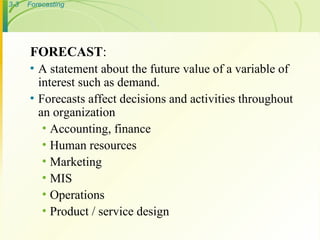
FORECAST : A statement about the future value of a variable of interest such as demand. Forecasts affect decisions and activities throughout an organization Accounting, finance Human resources Marketing MIS Operations Product / service design
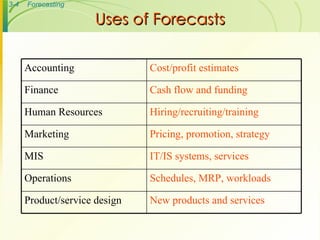
Uses of Forecasts New products and services Product/service design Schedules, MRP, workloads Operations IT/IS systems, services MIS Pricing, promotion, strategy Marketing Hiring/recruiting/training Human Resources Cash flow and funding Finance Cost/profit estimates Accounting
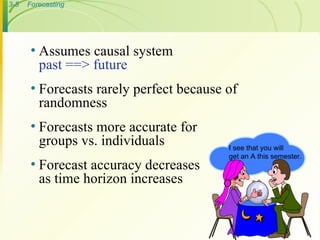
Assumes causal system past ==> future Forecasts rarely perfect because of  randomness Forecasts more accurate for groups vs. individuals Forecast accuracy decreases  as time horizon increases I see that you will get an A this semester.
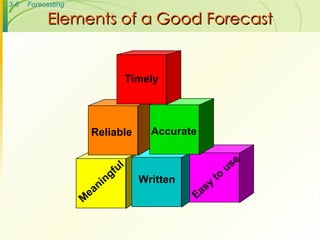
Elements of a Good Forecast Timely Accurate Reliable Meaningful Written Easy to use
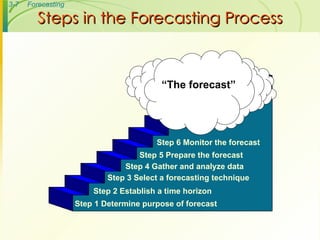
Steps in the Forecasting Process Step 1 Determine purpose of forecast Step 2 Establish a time horizon Step 3 Select a forecasting technique Step 4 Gather and analyze data Step 5 Prepare the forecast Step 6 Monitor the forecast “ The forecast”
Types of Forecasts Judgmental  - uses subjective inputs Time series  - uses historical data assuming the future will be like the past Associative models  - uses explanatory variables to predict the future
Judgmental Forecasts Executive opinions Sales force opinions Consumer surveys Outside opinion Delphi method Opinions of managers and staff Achieves a consensus forecast
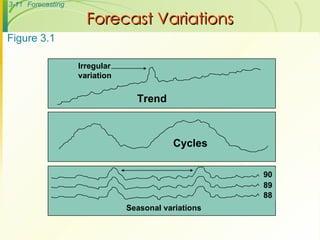
Time Series Forecasts Trend  - long-term movement in data Seasonality  - short-term regular variations in data Cycle  – wavelike variations of more than one year’s duration Irregular variations  - caused by unusual circumstances Random variations  - caused by chance
Forecast Variations Trend Irregular variation Seasonal variations 90 89 88 Figure 3.1 Cycles
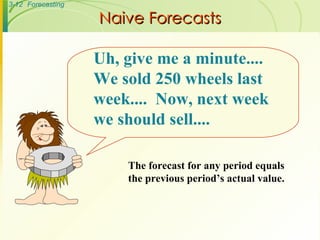
Naive Forecasts The forecast for any period equals the previous period’s actual value. Uh, give me a minute....  We sold 250 wheels last week....  Now, next week we should sell....
Simple to use Virtually no cost Quick and easy to prepare Data analysis is nonexistent Easily understandable Cannot provide high accuracy Can be a standard for accuracy Naïve Forecasts
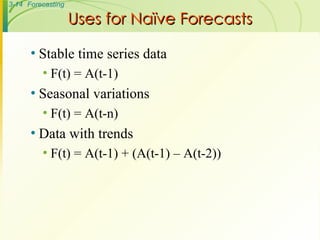
Stable time series data F(t) = A(t-1) Seasonal variations F(t) = A(t-n) Data with trends F(t) = A(t-1) + (A(t-1) – A(t-2)) Uses for Naïve Forecasts
Techniques for Averaging Moving average Weighted moving average Exponential smoothing
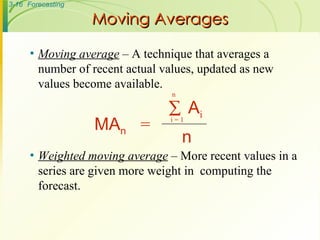
Moving Averages Moving average  – A technique that averages a number of recent actual values, updated as new values become available. Weighted moving average  – More recent values in a series are given more weight in  computing the forecast. MA n  = n A i i = 1  n
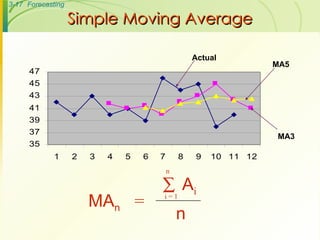
Simple Moving Average Actual MA3 MA5 MA n  = n A i i = 1  n
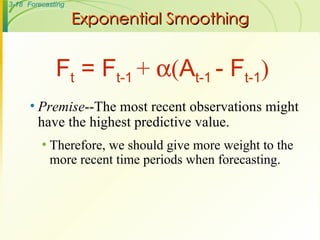
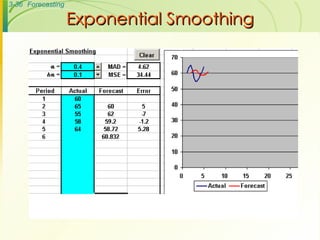
Exponential Smoothing Premise --The most recent observations might have the highest predictive value. Therefore, we should give more weight to the more recent time periods when forecasting. F t  = F t-1  +   ( A t-1  - F t-1 )
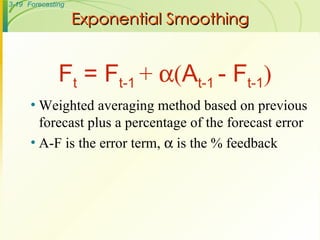
Exponential Smoothing Weighted averaging method based on previous forecast plus a percentage of the forecast error A-F is the error term,    is the % feedback F t  = F t-1  +   ( A t-1  - F t-1 )
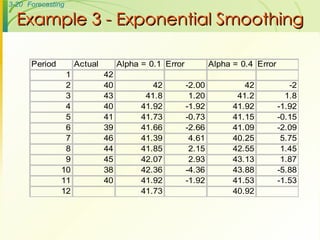
Example 3 - Exponential Smoothing
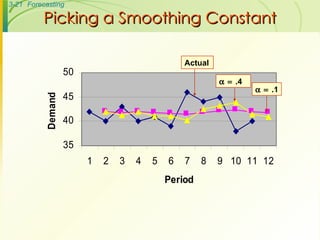
Picking a Smoothing Constant  .1  .4 Actual
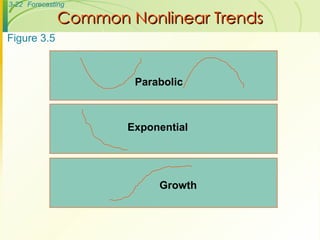
Common Nonlinear Trends Figure 3.5 Parabolic Exponential Growth
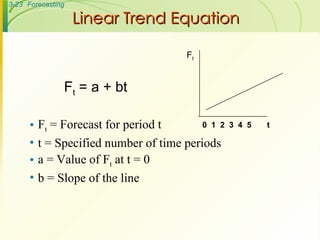
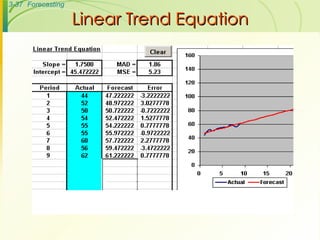
Linear Trend Equation F t  = Forecast for period t t = Specified number of time periods a = Value of F t  at t = 0 b = Slope of the line F t  = a + bt 0  1  2  3  4  5  t F t
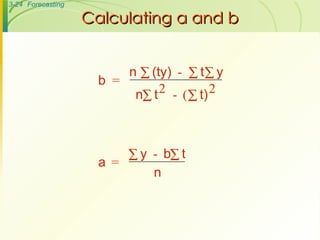
Calculating a and b b  = n  (ty)  - t y n t 2 - ( t) 2 a  = y  - b t n       
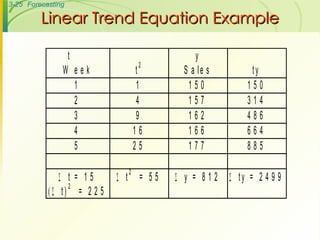
Linear Trend Equation Example
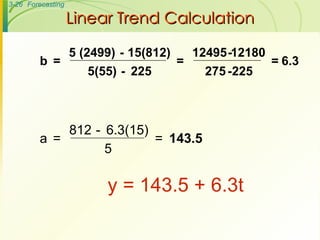
Linear Trend Calculation y = 143.5 + 6.3t  a  = 812  - 6.3(15) 5 = b  = 5 (2499)  - 15(812) 5(55)  - 225 = 12495 - 12180 275 - 225 = 6.3 143.5
Associative Forecasting Predictor variables  - used to predict values of variable interest Regression  - technique for fitting a line to a set of points Least squares line  - minimizes sum of squared deviations around the line
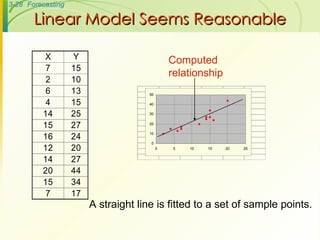
Linear Model Seems Reasonable A straight line is fitted to a set of sample points. Computed relationship
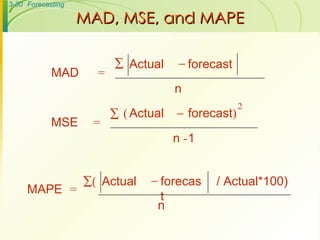
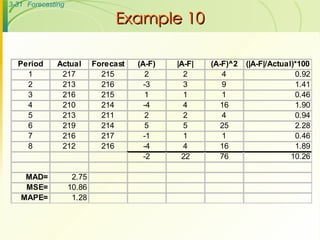
Forecast Accuracy Error - difference between actual value and predicted value Mean Absolute Deviation (MAD) Average absolute error Mean Squared Error (MSE) Average of squared error Mean Absolute Percent Error (MAPE) Average absolute percent error
MAD, MSE, and MAPE MAD  = Actual forecast   n MSE  = Actual forecast ) - 1 2   n ( MAPE  = Actual forecast  n / Actual*100) 
Example 10
Controlling the Forecast Control chart A visual tool for monitoring forecast errors Used to detect non-randomness in errors Forecasting errors are in control if All errors are within the control limits No patterns, such as trends or cycles, are present
Sources of Forecast errors Model may be inadequate Irregular variations Incorrect use of forecasting technique
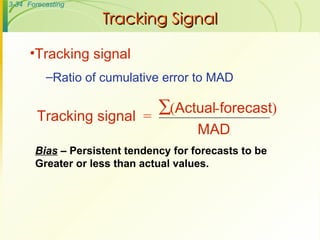
Tracking Signal Tracking signal Ratio of cumulative error to MAD Bias  – Persistent tendency for forecasts to be Greater or less than actual values. Tracking signal = ( Actual - forecast ) MAD 
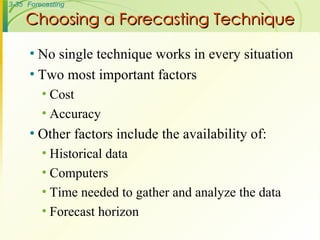
Choosing a Forecasting Technique No single technique works in every situation Two most important factors Cost Accuracy Other factors include the availability of: Historical data Computers Time needed to gather and analyze the data Forecast horizon
Exponential Smoothing
Linear Trend Equation
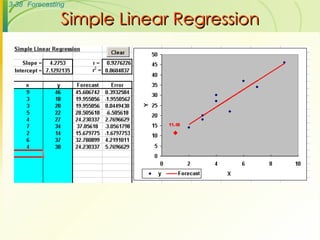
Simple Linear Regression

Chap003 Forecasting

  • 1.
    William J. Stevenson Operations Management 8 th edition
  • 2.
    CHAPTER 3 ForecastingMcGraw-Hill/Irwin Operations Management, Eighth Edition, by William J. Stevenson Copyright © 2005 by The McGraw-Hill Companies, Inc. All rights reserved.
  • 3.
    FORECAST : Astatement about the future value of a variable of interest such as demand. Forecasts affect decisions and activities throughout an organization Accounting, finance Human resources Marketing MIS Operations Product / service design
  • 4.
    Uses of ForecastsNew products and services Product/service design Schedules, MRP, workloads Operations IT/IS systems, services MIS Pricing, promotion, strategy Marketing Hiring/recruiting/training Human Resources Cash flow and funding Finance Cost/profit estimates Accounting
  • 5.
    Assumes causal systempast ==> future Forecasts rarely perfect because of randomness Forecasts more accurate for groups vs. individuals Forecast accuracy decreases as time horizon increases I see that you will get an A this semester.
  • 6.
    Elements of aGood Forecast Timely Accurate Reliable Meaningful Written Easy to use
  • 7.
    Steps in theForecasting Process Step 1 Determine purpose of forecast Step 2 Establish a time horizon Step 3 Select a forecasting technique Step 4 Gather and analyze data Step 5 Prepare the forecast Step 6 Monitor the forecast “ The forecast”
  • 8.
    Types of ForecastsJudgmental - uses subjective inputs Time series - uses historical data assuming the future will be like the past Associative models - uses explanatory variables to predict the future
  • 9.
    Judgmental Forecasts Executiveopinions Sales force opinions Consumer surveys Outside opinion Delphi method Opinions of managers and staff Achieves a consensus forecast
  • 10.
    Time Series ForecastsTrend - long-term movement in data Seasonality - short-term regular variations in data Cycle – wavelike variations of more than one year’s duration Irregular variations - caused by unusual circumstances Random variations - caused by chance
  • 11.
    Forecast Variations TrendIrregular variation Seasonal variations 90 89 88 Figure 3.1 Cycles
  • 12.
    Naive Forecasts Theforecast for any period equals the previous period’s actual value. Uh, give me a minute.... We sold 250 wheels last week.... Now, next week we should sell....
  • 13.
    Simple to useVirtually no cost Quick and easy to prepare Data analysis is nonexistent Easily understandable Cannot provide high accuracy Can be a standard for accuracy Naïve Forecasts
  • 14.
    Stable time seriesdata F(t) = A(t-1) Seasonal variations F(t) = A(t-n) Data with trends F(t) = A(t-1) + (A(t-1) – A(t-2)) Uses for Naïve Forecasts
  • 15.
    Techniques for AveragingMoving average Weighted moving average Exponential smoothing
  • 16.
    Moving Averages Movingaverage – A technique that averages a number of recent actual values, updated as new values become available. Weighted moving average – More recent values in a series are given more weight in computing the forecast. MA n = n A i i = 1  n
  • 17.
    Simple Moving AverageActual MA3 MA5 MA n = n A i i = 1  n
  • 18.
    Exponential Smoothing Premise--The most recent observations might have the highest predictive value. Therefore, we should give more weight to the more recent time periods when forecasting. F t = F t-1 +  ( A t-1 - F t-1 )
  • 19.
    Exponential Smoothing Weightedaveraging method based on previous forecast plus a percentage of the forecast error A-F is the error term,  is the % feedback F t = F t-1 +  ( A t-1 - F t-1 )
  • 20.
    Example 3 -Exponential Smoothing
  • 21.
    Picking a SmoothingConstant  .1  .4 Actual
  • 22.
    Common Nonlinear TrendsFigure 3.5 Parabolic Exponential Growth
  • 23.
    Linear Trend EquationF t = Forecast for period t t = Specified number of time periods a = Value of F t at t = 0 b = Slope of the line F t = a + bt 0 1 2 3 4 5 t F t
  • 24.
    Calculating a andb b = n (ty) - t y n t 2 - ( t) 2 a = y - b t n       
  • 25.
  • 26.
    Linear Trend Calculationy = 143.5 + 6.3t a = 812 - 6.3(15) 5 = b = 5 (2499) - 15(812) 5(55) - 225 = 12495 - 12180 275 - 225 = 6.3 143.5
  • 27.
    Associative Forecasting Predictorvariables - used to predict values of variable interest Regression - technique for fitting a line to a set of points Least squares line - minimizes sum of squared deviations around the line
  • 28.
    Linear Model SeemsReasonable A straight line is fitted to a set of sample points. Computed relationship
  • 29.
    Forecast Accuracy Error- difference between actual value and predicted value Mean Absolute Deviation (MAD) Average absolute error Mean Squared Error (MSE) Average of squared error Mean Absolute Percent Error (MAPE) Average absolute percent error
  • 30.
    MAD, MSE, andMAPE MAD = Actual forecast   n MSE = Actual forecast ) - 1 2   n ( MAPE = Actual forecast  n / Actual*100) 
  • 31.
  • 32.
    Controlling the ForecastControl chart A visual tool for monitoring forecast errors Used to detect non-randomness in errors Forecasting errors are in control if All errors are within the control limits No patterns, such as trends or cycles, are present
  • 33.
    Sources of Forecasterrors Model may be inadequate Irregular variations Incorrect use of forecasting technique
  • 34.
    Tracking Signal Trackingsignal Ratio of cumulative error to MAD Bias – Persistent tendency for forecasts to be Greater or less than actual values. Tracking signal = ( Actual - forecast ) MAD 
  • 35.
    Choosing a ForecastingTechnique No single technique works in every situation Two most important factors Cost Accuracy Other factors include the availability of: Historical data Computers Time needed to gather and analyze the data Forecast horizon
  • 36.
  • 37.
  • 38.