1
Material Requirement Planning
(MRP)
Chapter 16
Feb 9, 2006
2
Material Requirement Planning (MRP)
 ______________________________________
 ______________________________________
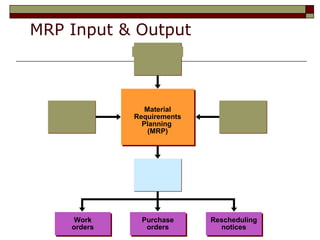
Key Outputs of MRP
 Calculate demand for component items
 Determine requirements for subassemblies, components, and raw
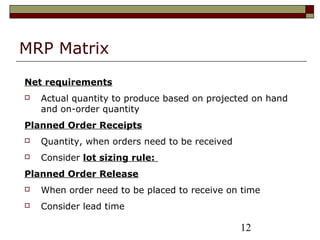
material
 Determine when they are needed
 Generate work orders and purchase order
 Consider lead time
3
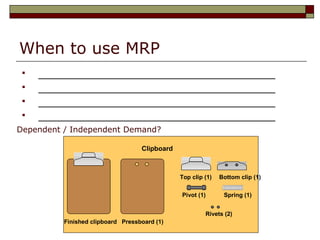
When to use MRP
 ___________________________________
 ___________________________________
 ___________________________________
 ___________________________________
Top clip (1) Bottom clip (1)
Pivot (1) Spring (1)
Rivets (2)
Finished clipboard Pressboard (1)
Clipboard
Dependent / Independent Demand?
4
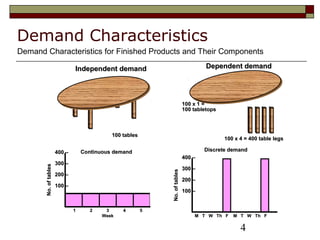
Demand Characteristics
11 22 33 44 55
WeekWeek
400400 –
300300 –
200200 –
100100 –
No.oftablesNo.oftables
Continuous demandContinuous demand
M T W Th F M T W Th FM T W Th F M T W Th F
400400 –
300300 –
200200 –
100100 –
No.oftablesNo.oftables
Discrete demandDiscrete demand
Independent demandIndependent demand
100 tables100 tables
Dependent demandDependent demand
100 x 1 =100 x 1 =
100 tabletops100 tabletops
100 x 4 = 400 table legs100 x 4 = 400 table legs
Demand Characteristics for Finished Products and Their Components
5
MRP Input & Output
Material
Requirements
Planning
(MRP)
Work
orders
Purchase
orders
Rescheduling
notices
6
Major Inputs to MRP Process:
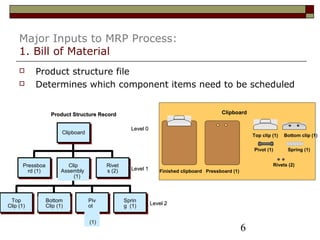
1. Bill of Material
 Product structure file
 Determines which component items need to be scheduled
Product Structure RecordProduct Structure Record
Clipboard
Level 0Level 0
Level 1Level 1
Level 2Level 2
Sprin
g (1)
Bottom
Clip (1)
Top
Clip (1)
Piv
ot
(1)
Rivet
s (2)
Clip
Assembly
(1)
Pressboa
rd (1)
Top clip (1) Bottom clip (1)
Pivot (1) Spring (1)
Rivets (2)
Finished clipboard Pressboard (1)
Clipboard
7
Major Inputs to MRP Process:
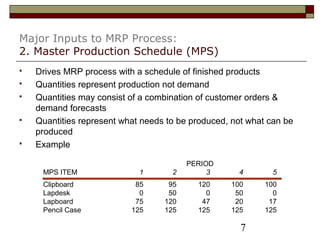
2. Master Production Schedule (MPS)
 Drives MRP process with a schedule of finished products
 Quantities represent production not demand
 Quantities may consist of a combination of customer orders &
demand forecasts
 Quantities represent what needs to be produced, not what can be
produced
 Example
PERIOD
MPS ITEM 1 2 3 4 5
Clipboard 85 95 120 100 100
Lapdesk 0 50 0 50 0
Lapboard 75 120 47 20 17
Pencil Case 125 125 125 125 125
8
Major Inputs to MRP Process:
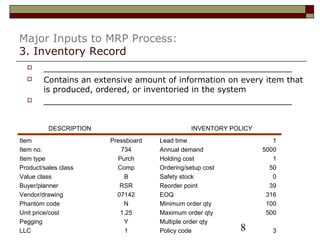
3. Inventory Record
 _________________________________________________
 Contains an extensive amount of information on every item that
is produced, ordered, or inventoried in the system
 _________________________________________________
DESCRIPTION INVENTORY POLICY
Item Pressboard Lead time 1
Item no. 734 Annual demand 5000
Item type Purch Holding cost 1
Product/sales class Comp Ordering/setup cost 50
Value class B Safety stock 0
Buyer/planner RSR Reorder point 39
Vendor/drawing 07142 EOQ 316
Phantom code N Minimum order qty 100
Unit price/cost 1.25 Maximum order qty 500
Pegging Y Multiple order qty
LLC 1 Policy code 3
9
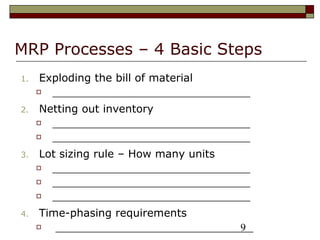
MRP Processes – 4 Basic Steps
1. Exploding the bill of material
 ___________________________________
2. Netting out inventory
 ___________________________________
 ___________________________________
3. Lot sizing rule – How many units
 ___________________________________
 ___________________________________
 ___________________________________
4. Time-phasing requirements
 ___________________________________
10
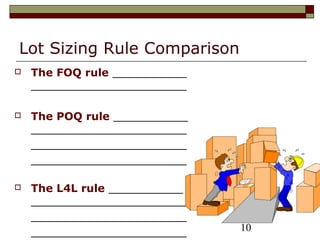
Lot Sizing Rule Comparison
 The FOQ rule ___________
_______________________
 The POQ rule ___________
_______________________
_______________________
_______________________
 The L4L rule ___________
_______________________
_______________________
_______________________
11
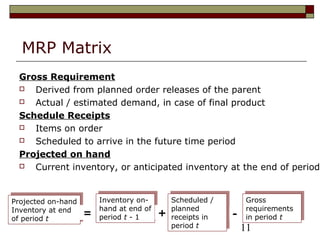
MRP Matrix
Gross Requirement
 Derived from planned order releases of the parent
 Actual / estimated demand, in case of final product
Schedule Receipts
 Items on order
 Scheduled to arrive in the future time period
Projected on hand
 Current inventory, or anticipated inventory at the end of period
Projected on-hand
Inventory at end
of period t
Projected on-hand
Inventory at end
of period t
Inventory on-
hand at end of
period t - 1
Inventory on-
hand at end of
period t - 1= +
Scheduled /
planned
receipts in
period t
Scheduled /
planned
receipts in
period t
-
Gross
requirements
in period t
Gross
requirements
in period t
12
MRP Matrix
Net requirements
 Actual quantity to produce based on projected on hand
and on-order quantity
Planned Order Receipts
 Quantity, when orders need to be received
 Consider lot sizing rule:
Planned Order Release
 When order need to be placed to receive on time
 Consider lead time
13
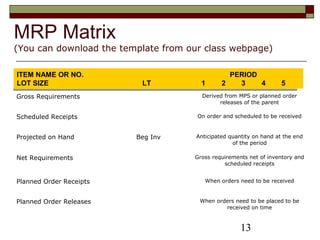
MRP Matrix
(You can download the template from our class webpage)
Gross Requirements Derived from MPS or planned order
releases of the parent
Scheduled Receipts On order and scheduled to be received
Projected on Hand Beg Inv Anticipated quantity on hand at the end
of the period
Net Requirements Gross requirements net of inventory and
scheduled receipts
Planned Order Receipts When orders need to be received
Planned Order Releases When orders need to be placed to be
received on time
ITEM NAME OR NO. PERIOD
LOT SIZE LT 1 2 3 4 5
14
ITEM: CLIPBOARD LLC: 0 PERIOD
LOT SIZE: L4L LT: 1 1 2 3 4 5
Gross Requirements 85 95 120 100 100
Scheduled Receipts 175
Projected on Hand 25
Net Requirements
Planned Order Receipts
Planned Order Releases
Example MRP Matrix
15
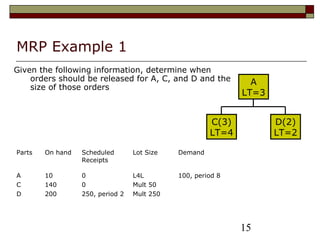
MRP Example 1
Given the following information, determine when
orders should be released for A, C, and D and the
size of those orders
Parts On hand Scheduled
Receipts
Lot Size Demand
A
C
D
10
140
200
0
0
250, period 2
L4L
Mult 50
Mult 250
100, period 8
A
LT=3
C(3)
LT=4
D(2)
LT=2
16
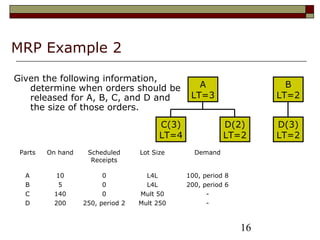
MRP Example 2
Given the following information,
determine when orders should be
released for A, B, C, and D and
the size of those orders.
Parts On hand Scheduled
Receipts
Lot Size Demand
A
B
C
D
10
5
140
200
0
0
0
250, period 2
L4L
L4L
Mult 50
Mult 250
100, period 8
200, period 6
-
-
A
LT=3
C(3)
LT=4
D(2)
LT=2
B
LT=2
D(3)
LT=2
17
Evolution of MRP
 MRP (material requirements planning) was the
precursor to ERP
 Primarily a production planning and control system
 MRP evolved to MRP II (manufacturing resource
planning)
 ERP (Enterprise Resource Planning) and ERP II
continue to extend the links through all business
processes
18
Enterprise Resource Planning (ERP)
An Overview
 Organizes and manages a company’s business processes
by sharing information across functional areas
 Connects with supply-chain and customer management
applications
 ERP in the nutshell*
 Client server software
 Integrates majority of business processes
 Processes majority of transactions
 Enterprise wide database
 Real time data access
* adapted from e-courseware, MIT Sloan
19
ERP Modules
[Figure 12.1 Organizational Data Flow]
20
ERP Modules
[Figure 12.2 ERP’s Central Database]
Finance &
Accounting
Sales
&
Marketing
Human
Resources
Production &
Materials
Management
ERP Data
Repository
21
ERP Implementation Process
 First step is to analyze business processes
 Which processes have the biggest impact on customer
relations?
 Which process would benefit the most from integration?
 Which processes should be standardized?
 Use of Internet portals can aid implementation

Planned order release

  • 1.
  • 2.
    2 Material Requirement Planning(MRP)  ______________________________________  ______________________________________ Key Outputs of MRP  Calculate demand for component items  Determine requirements for subassemblies, components, and raw material  Determine when they are needed  Generate work orders and purchase order  Consider lead time
  • 3.
    3 When to useMRP  ___________________________________  ___________________________________  ___________________________________  ___________________________________ Top clip (1) Bottom clip (1) Pivot (1) Spring (1) Rivets (2) Finished clipboard Pressboard (1) Clipboard Dependent / Independent Demand?
  • 4.
    4 Demand Characteristics 11 2233 44 55 WeekWeek 400400 – 300300 – 200200 – 100100 – No.oftablesNo.oftables Continuous demandContinuous demand M T W Th F M T W Th FM T W Th F M T W Th F 400400 – 300300 – 200200 – 100100 – No.oftablesNo.oftables Discrete demandDiscrete demand Independent demandIndependent demand 100 tables100 tables Dependent demandDependent demand 100 x 1 =100 x 1 = 100 tabletops100 tabletops 100 x 4 = 400 table legs100 x 4 = 400 table legs Demand Characteristics for Finished Products and Their Components
  • 5.
    5 MRP Input &Output Material Requirements Planning (MRP) Work orders Purchase orders Rescheduling notices
  • 6.
    6 Major Inputs toMRP Process: 1. Bill of Material  Product structure file  Determines which component items need to be scheduled Product Structure RecordProduct Structure Record Clipboard Level 0Level 0 Level 1Level 1 Level 2Level 2 Sprin g (1) Bottom Clip (1) Top Clip (1) Piv ot (1) Rivet s (2) Clip Assembly (1) Pressboa rd (1) Top clip (1) Bottom clip (1) Pivot (1) Spring (1) Rivets (2) Finished clipboard Pressboard (1) Clipboard
  • 7.
    7 Major Inputs toMRP Process: 2. Master Production Schedule (MPS)  Drives MRP process with a schedule of finished products  Quantities represent production not demand  Quantities may consist of a combination of customer orders & demand forecasts  Quantities represent what needs to be produced, not what can be produced  Example PERIOD MPS ITEM 1 2 3 4 5 Clipboard 85 95 120 100 100 Lapdesk 0 50 0 50 0 Lapboard 75 120 47 20 17 Pencil Case 125 125 125 125 125
  • 8.
    8 Major Inputs toMRP Process: 3. Inventory Record  _________________________________________________  Contains an extensive amount of information on every item that is produced, ordered, or inventoried in the system  _________________________________________________ DESCRIPTION INVENTORY POLICY Item Pressboard Lead time 1 Item no. 734 Annual demand 5000 Item type Purch Holding cost 1 Product/sales class Comp Ordering/setup cost 50 Value class B Safety stock 0 Buyer/planner RSR Reorder point 39 Vendor/drawing 07142 EOQ 316 Phantom code N Minimum order qty 100 Unit price/cost 1.25 Maximum order qty 500 Pegging Y Multiple order qty LLC 1 Policy code 3
  • 9.
    9 MRP Processes –4 Basic Steps 1. Exploding the bill of material  ___________________________________ 2. Netting out inventory  ___________________________________  ___________________________________ 3. Lot sizing rule – How many units  ___________________________________  ___________________________________  ___________________________________ 4. Time-phasing requirements  ___________________________________
  • 10.
    10 Lot Sizing RuleComparison  The FOQ rule ___________ _______________________  The POQ rule ___________ _______________________ _______________________ _______________________  The L4L rule ___________ _______________________ _______________________ _______________________
  • 11.
    11 MRP Matrix Gross Requirement Derived from planned order releases of the parent  Actual / estimated demand, in case of final product Schedule Receipts  Items on order  Scheduled to arrive in the future time period Projected on hand  Current inventory, or anticipated inventory at the end of period Projected on-hand Inventory at end of period t Projected on-hand Inventory at end of period t Inventory on- hand at end of period t - 1 Inventory on- hand at end of period t - 1= + Scheduled / planned receipts in period t Scheduled / planned receipts in period t - Gross requirements in period t Gross requirements in period t
  • 12.
    12 MRP Matrix Net requirements Actual quantity to produce based on projected on hand and on-order quantity Planned Order Receipts  Quantity, when orders need to be received  Consider lot sizing rule: Planned Order Release  When order need to be placed to receive on time  Consider lead time
  • 13.
    13 MRP Matrix (You candownload the template from our class webpage) Gross Requirements Derived from MPS or planned order releases of the parent Scheduled Receipts On order and scheduled to be received Projected on Hand Beg Inv Anticipated quantity on hand at the end of the period Net Requirements Gross requirements net of inventory and scheduled receipts Planned Order Receipts When orders need to be received Planned Order Releases When orders need to be placed to be received on time ITEM NAME OR NO. PERIOD LOT SIZE LT 1 2 3 4 5
  • 14.
    14 ITEM: CLIPBOARD LLC:0 PERIOD LOT SIZE: L4L LT: 1 1 2 3 4 5 Gross Requirements 85 95 120 100 100 Scheduled Receipts 175 Projected on Hand 25 Net Requirements Planned Order Receipts Planned Order Releases Example MRP Matrix
  • 15.
    15 MRP Example 1 Giventhe following information, determine when orders should be released for A, C, and D and the size of those orders Parts On hand Scheduled Receipts Lot Size Demand A C D 10 140 200 0 0 250, period 2 L4L Mult 50 Mult 250 100, period 8 A LT=3 C(3) LT=4 D(2) LT=2
  • 16.
    16 MRP Example 2 Giventhe following information, determine when orders should be released for A, B, C, and D and the size of those orders. Parts On hand Scheduled Receipts Lot Size Demand A B C D 10 5 140 200 0 0 0 250, period 2 L4L L4L Mult 50 Mult 250 100, period 8 200, period 6 - - A LT=3 C(3) LT=4 D(2) LT=2 B LT=2 D(3) LT=2
  • 17.
    17 Evolution of MRP MRP (material requirements planning) was the precursor to ERP  Primarily a production planning and control system  MRP evolved to MRP II (manufacturing resource planning)  ERP (Enterprise Resource Planning) and ERP II continue to extend the links through all business processes
  • 18.
    18 Enterprise Resource Planning(ERP) An Overview  Organizes and manages a company’s business processes by sharing information across functional areas  Connects with supply-chain and customer management applications  ERP in the nutshell*  Client server software  Integrates majority of business processes  Processes majority of transactions  Enterprise wide database  Real time data access * adapted from e-courseware, MIT Sloan
  • 19.
    19 ERP Modules [Figure 12.1Organizational Data Flow]
  • 20.
    20 ERP Modules [Figure 12.2ERP’s Central Database] Finance & Accounting Sales & Marketing Human Resources Production & Materials Management ERP Data Repository
  • 21.
    21 ERP Implementation Process First step is to analyze business processes  Which processes have the biggest impact on customer relations?  Which process would benefit the most from integration?  Which processes should be standardized?  Use of Internet portals can aid implementation