Relaxation Method
Introduction
• Relaxation method is an iterative approach
solution to systems of linear equations.
• Basic idea behind this method is to improve
the solution vector successively by reducing the
largest residual at a particular iteration.
What is a residual?
• Suppose x(i) € R is an approximation to the
solution of the linear system defined by
Ax=b
• Residual vector for x(i) with respect to this system
is
R(i) =b-A x(i) in ith iteration
• The error: E(I )= x-x(i)
• R(i) = b –Ax(i) = Ax –Ax(i) = A(x –x(i)) = AE(i):
• Residual equation:
– AE(i)=R(i)
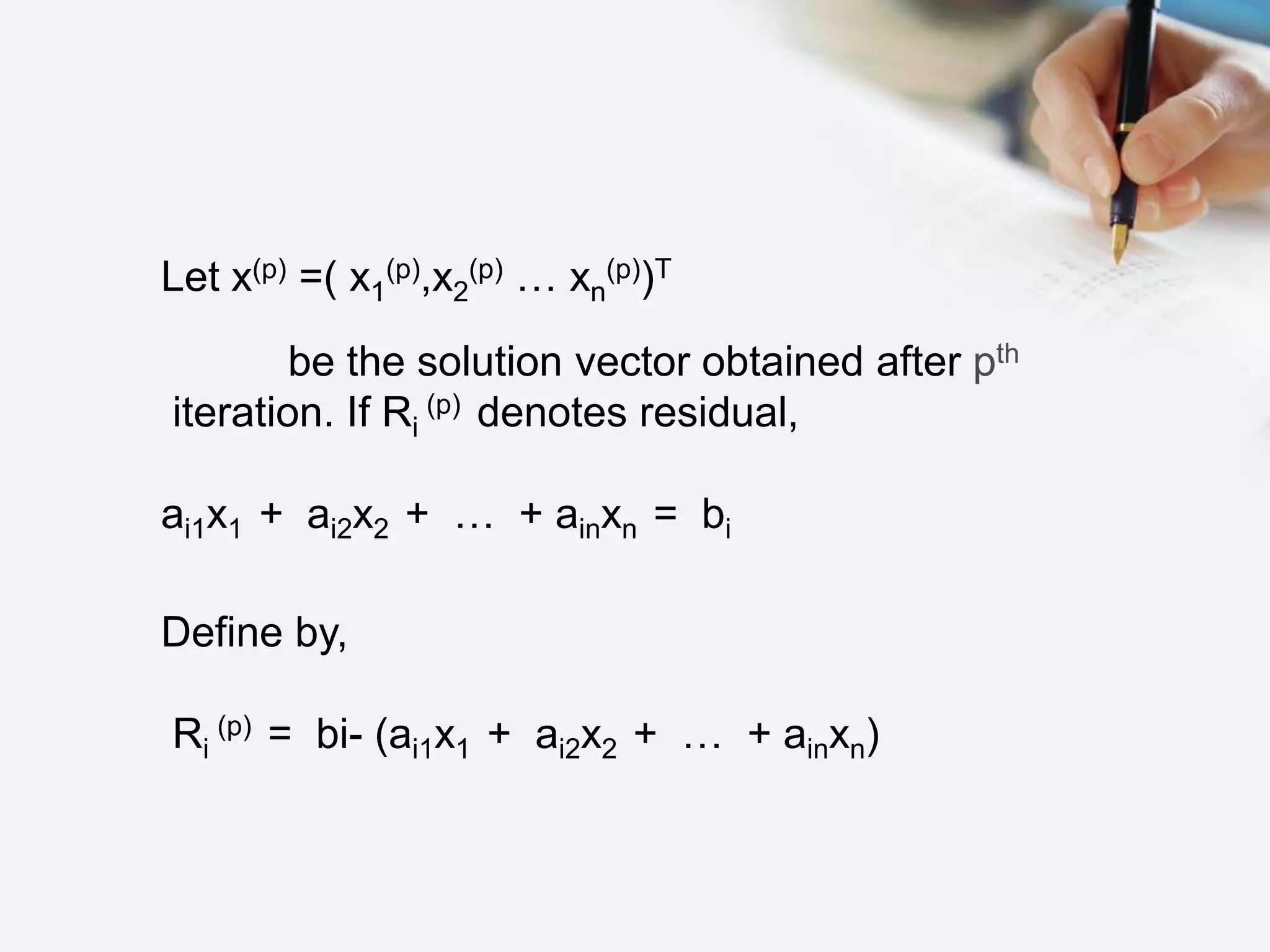
Let x(p) =( x1
(p),x2
(p) … xn
(p))T
be the solution vector obtained after pth
iteration. If Ri
(p) denotes residual,
ai1x1 + ai2x2 + … + ainxn = bi
Define by,
Ri
(p) = bi- (ai1x1 + ai2x2 + … + ainxn)
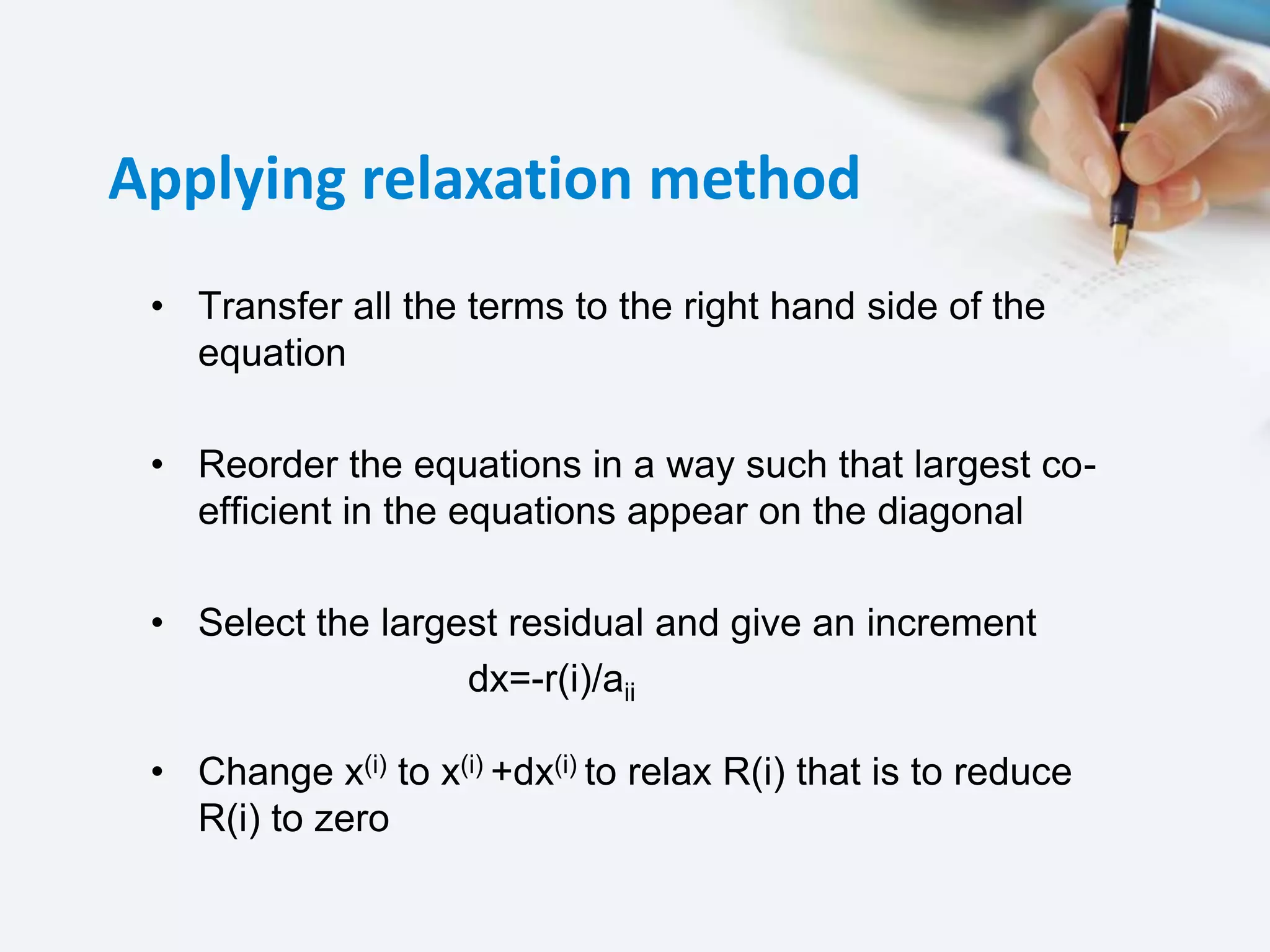
Applying relaxation method
• Transfer all the terms to the right hand side of the
equation
• Reorder the equations in a way such that largest co-
efficient in the equations appear on the diagonal
• Select the largest residual and give an increment
dx=-r(i)/aii
• Change x(i) to x(i) +dx(i) to relax R(i) that is to reduce
R(i) to zero
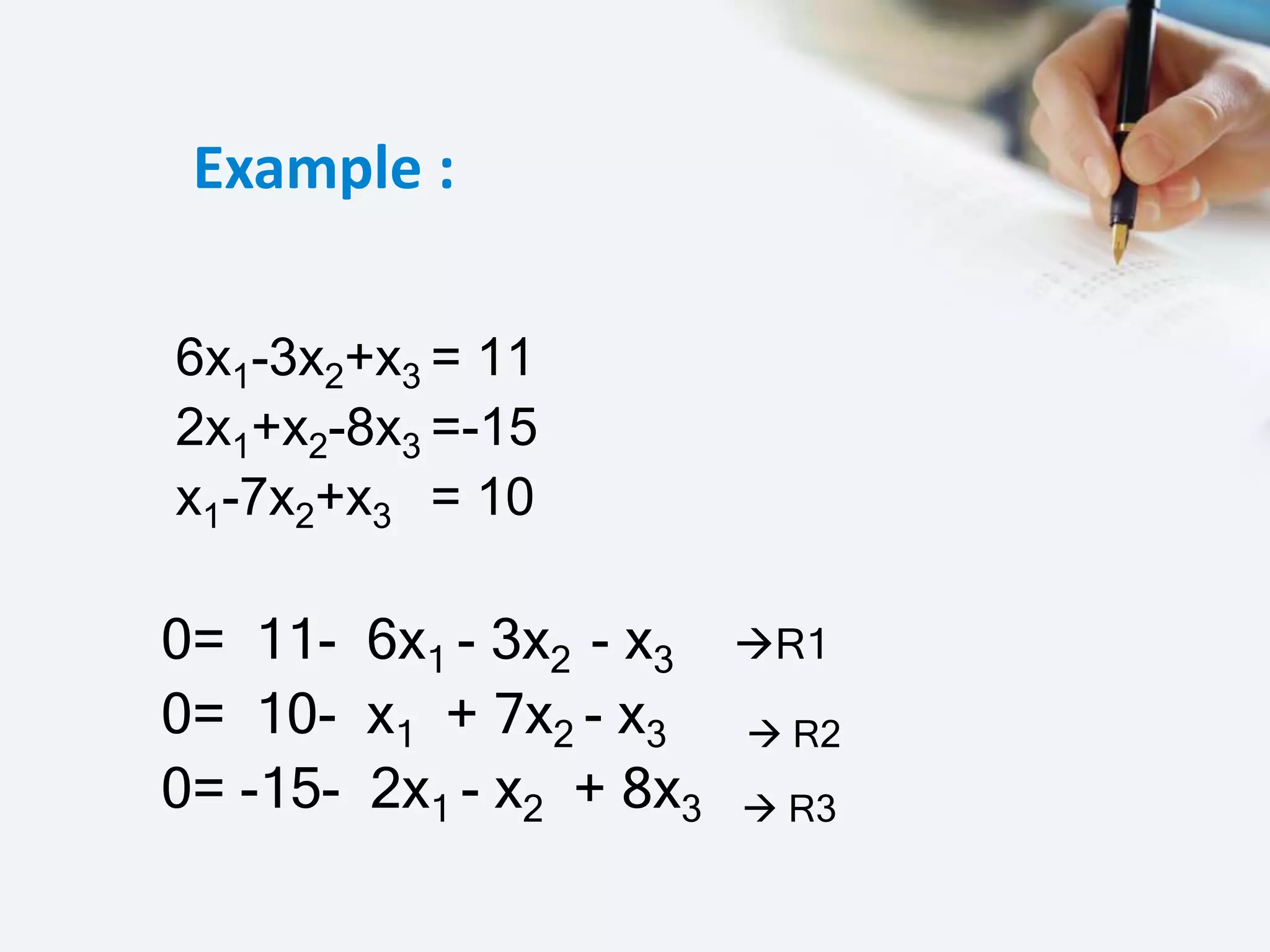
Example :
6x1-3x2+x3 = 11
2x1+x2-8x3 =-15
x1-7x2+x3 = 10
0= 11- 6x1 - 3x2 - x3 R1
0= 10- x1 + 7x2 - x3  R2
0= -15- 2x1 - x2 + 8x3  R3
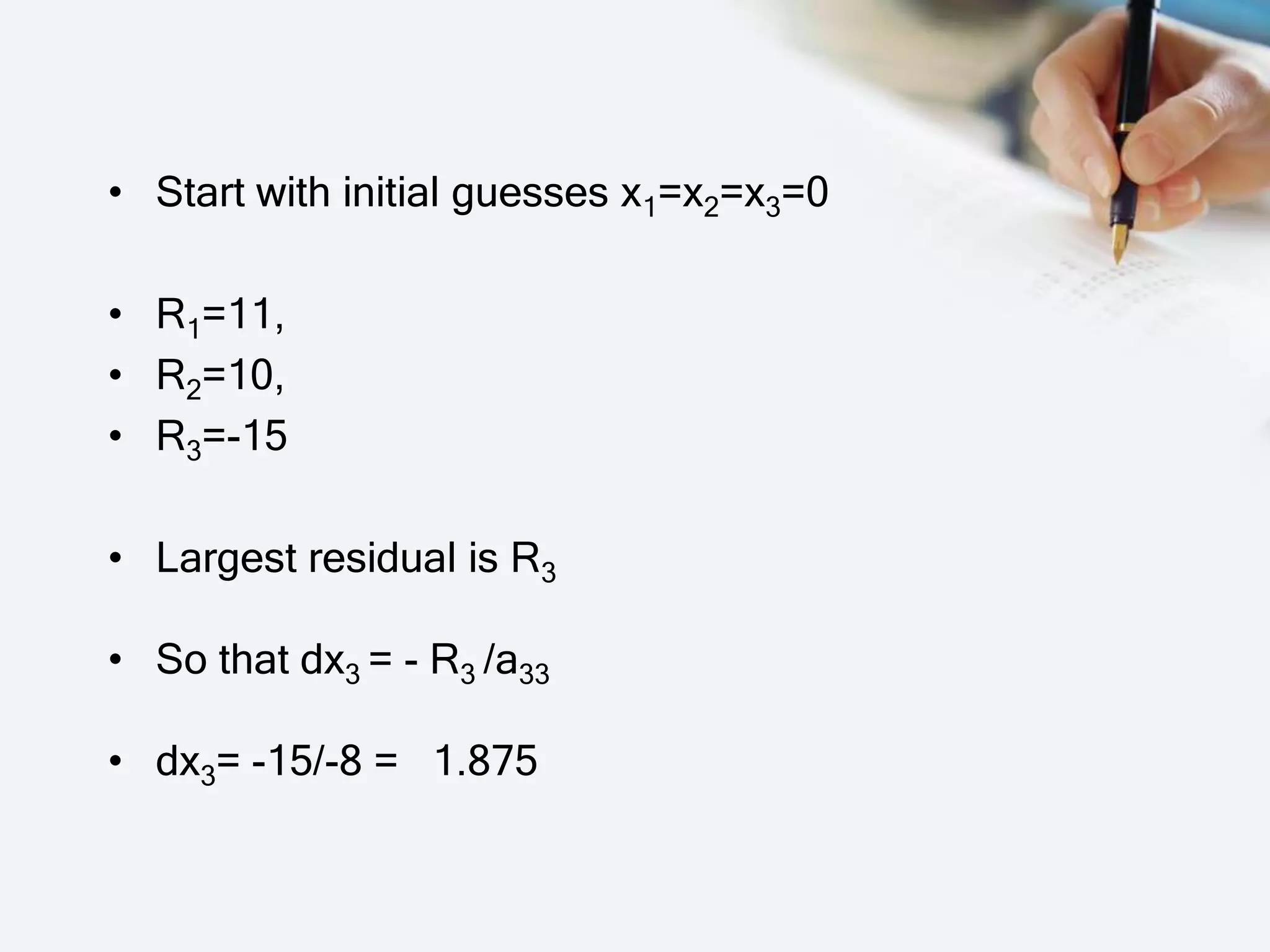
• Start with initial guesses x1=x2=x3=0
• R1=11,
• R2=10,
• R3=-15
• Largest residual is R3
• So that dx3 = - R3 /a33
• dx3= -15/-8 = 1.875
New guesses:
x1=0
x2=0 and
x3=1.875
Continue the process until r  0
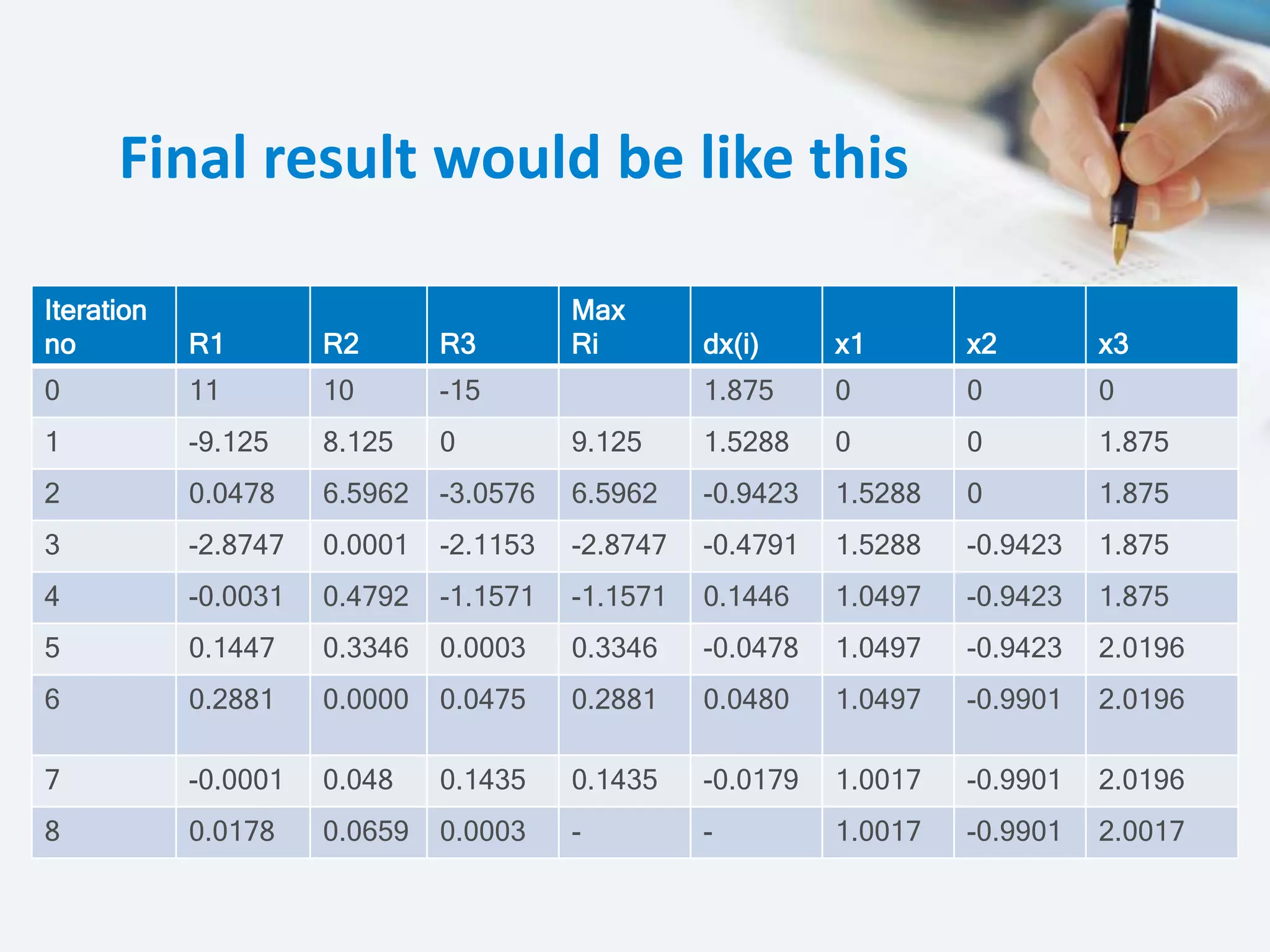
Final result would be like this
Iteration
no R1 R2 R3
Max
Ri dx(i) x1 x2 x3
0 11 10 -15 1.875 0 0 0
1 -9.125 8.125 0 9.125 1.5288 0 0 1.875
2 0.0478 6.5962 -3.0576 6.5962 -0.9423 1.5288 0 1.875
3 -2.8747 0.0001 -2.1153 -2.8747 -0.4791 1.5288 -0.9423 1.875
4 -0.0031 0.4792 -1.1571 -1.1571 0.1446 1.0497 -0.9423 1.875
5 0.1447 0.3346 0.0003 0.3346 -0.0478 1.0497 -0.9423 2.0196
6 0.2881 0.0000 0.0475 0.2881 0.0480 1.0497 -0.9901 2.0196
7 -0.0001 0.048 0.1435 0.1435 -0.0179 1.0017 -0.9901 2.0196
8 0.0178 0.0659 0.0003 - - 1.0017 -0.9901 2.0017
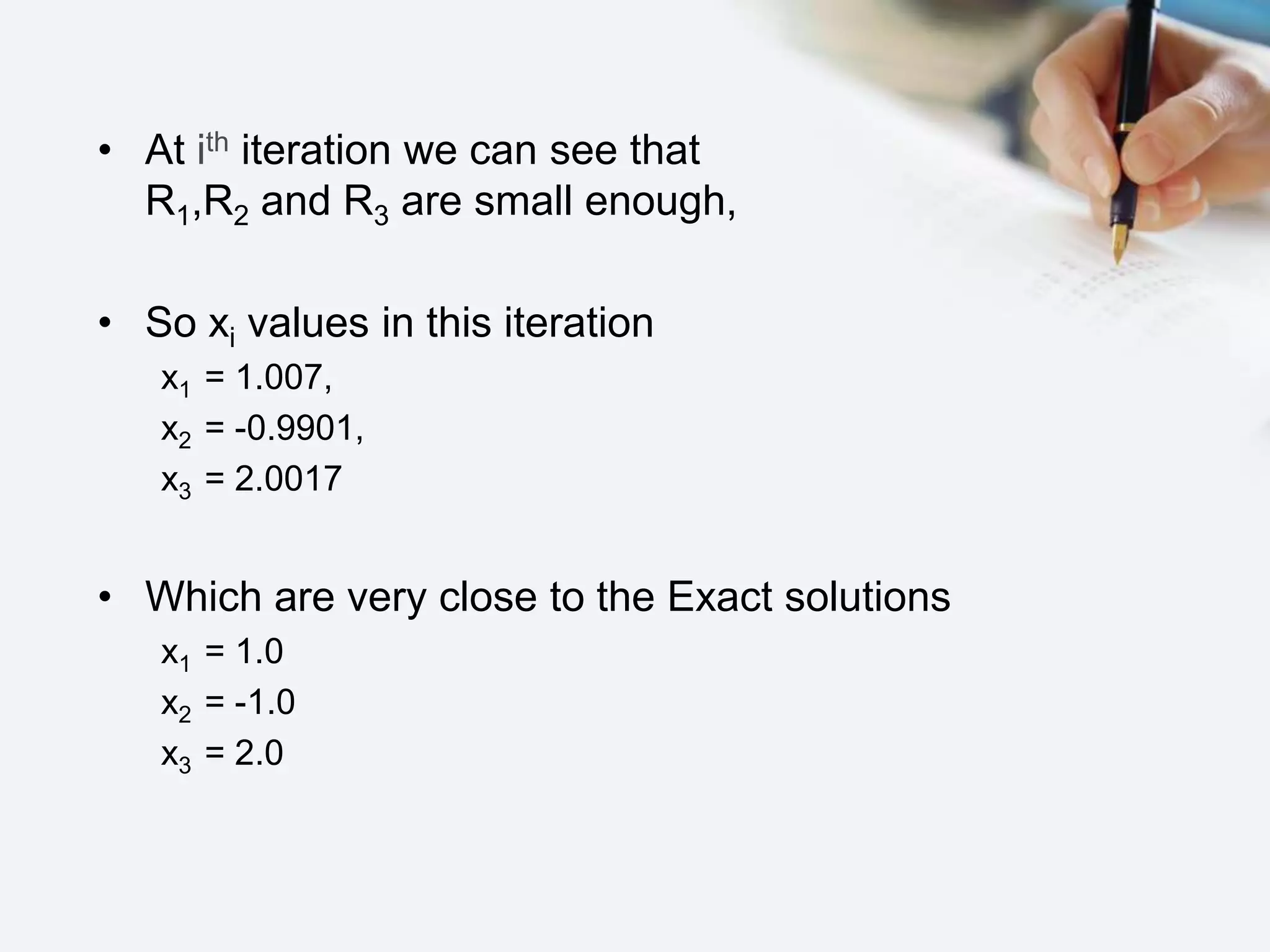
• At ith iteration we can see that
R1,R2 and R3 are small enough,
• So xi values in this iteration
x1 = 1.007,
x2 = -0.9901,
x3 = 2.0017
• Which are very close to the Exact solutions
x1 = 1.0
x2 = -1.0
x3 = 2.0
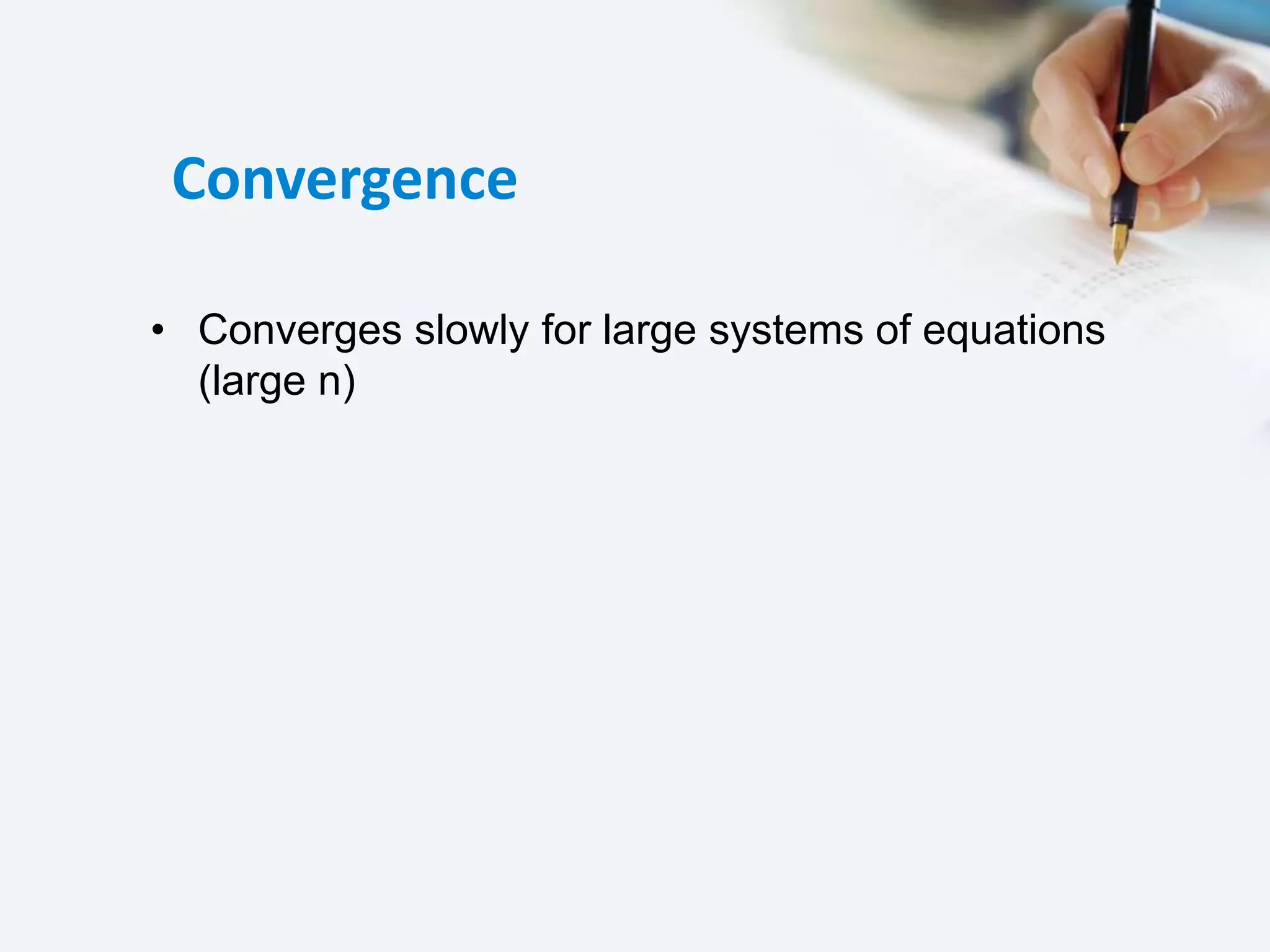
Convergence
• Converges slowly for large systems of equations
(large n)
Special cases
• Simple to implement
• Not useful as a stand alone solution method
• Key ingredients to multi grid methods
– Jacobi
– Gauss seidel
– red
Comparison with Other
Methods
Methods available to find solutions
 Direct
Elimination
 Gaussian elimination
 Gauss-Jordan
elimination
Decomposition
 Court's reduction
(Cholesky's reduction)
 Iterative
 Jacobi's method
 Gauss-Seidel method
 Relaxation method
Advantages and Disadvantages
 Relaxation method is the core part of linear algebra.
 This method provide preconditions for new methods.
 Easily adoptable to computers.
 Can solve more than 100s of linear equations
simultaneously.
 Slower progress than the competing methods
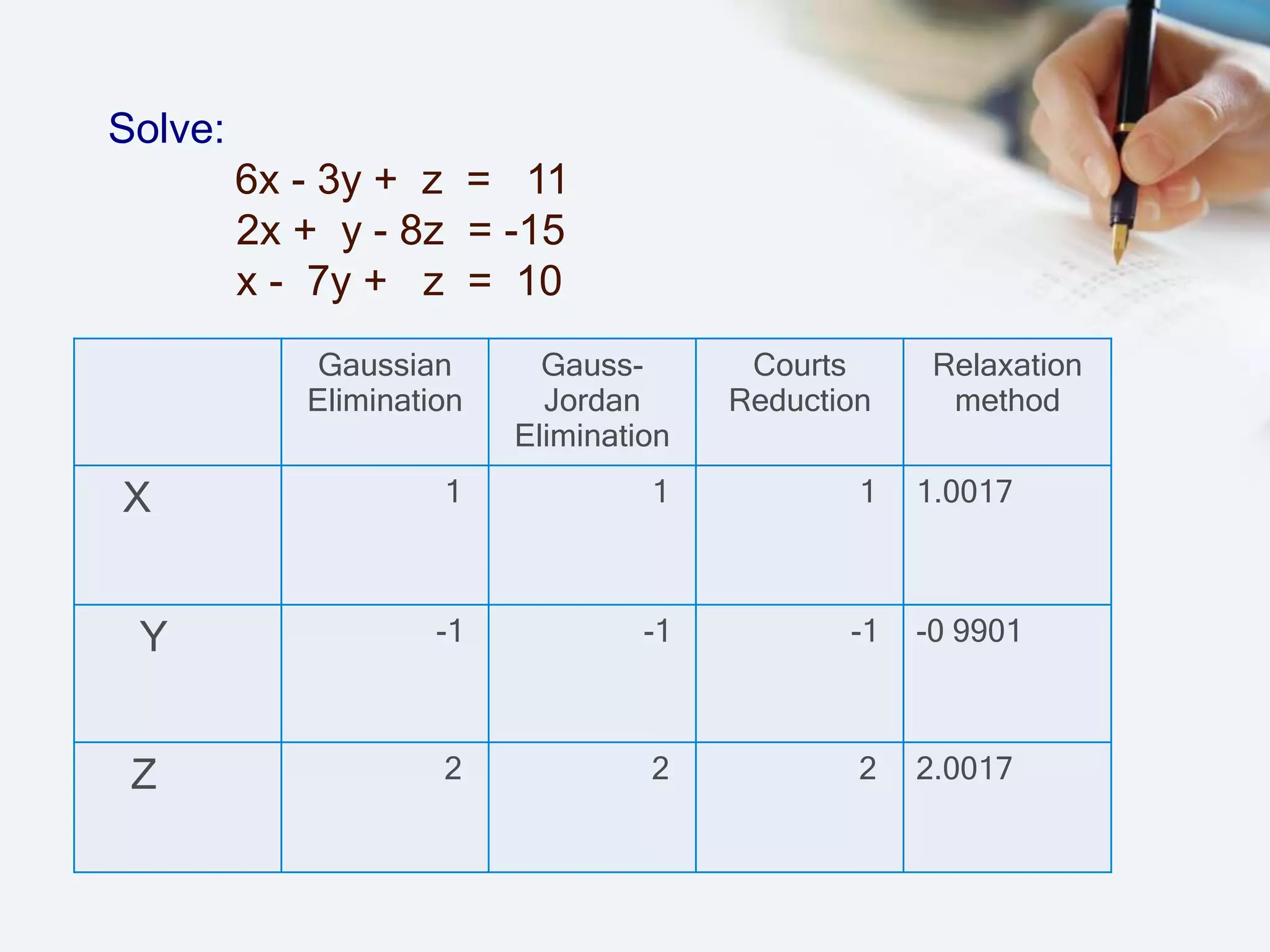
Solve:
6x - 3y + z = 11
2x + y - 8z = -15
x - 7y + z = 10
Gaussian
Elimination
Gauss-
Jordan
Elimination
Courts
Reduction
Relaxation
method
X 1 1 1 1.0017
Y -1 -1 -1 -0 9901
Z 2 2 2 2.0017
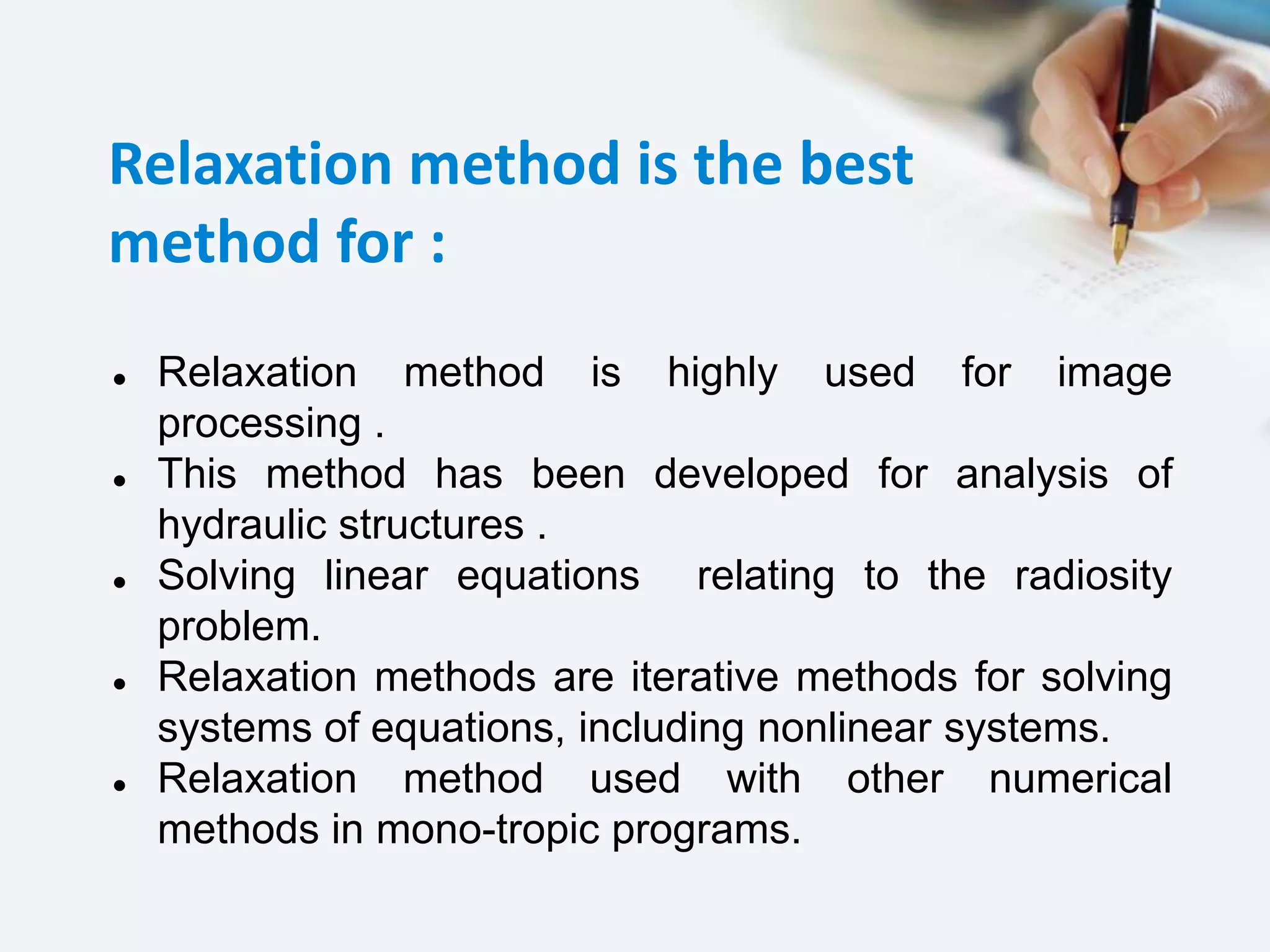
Relaxation method is the best
method for :
 Relaxation method is highly used for image
processing .
 This method has been developed for analysis of
hydraulic structures .
 Solving linear equations relating to the radiosity
problem.
 Relaxation methods are iterative methods for solving
systems of equations, including nonlinear systems.
 Relaxation method used with other numerical
methods in mono-tropic programs.
Completed Researches
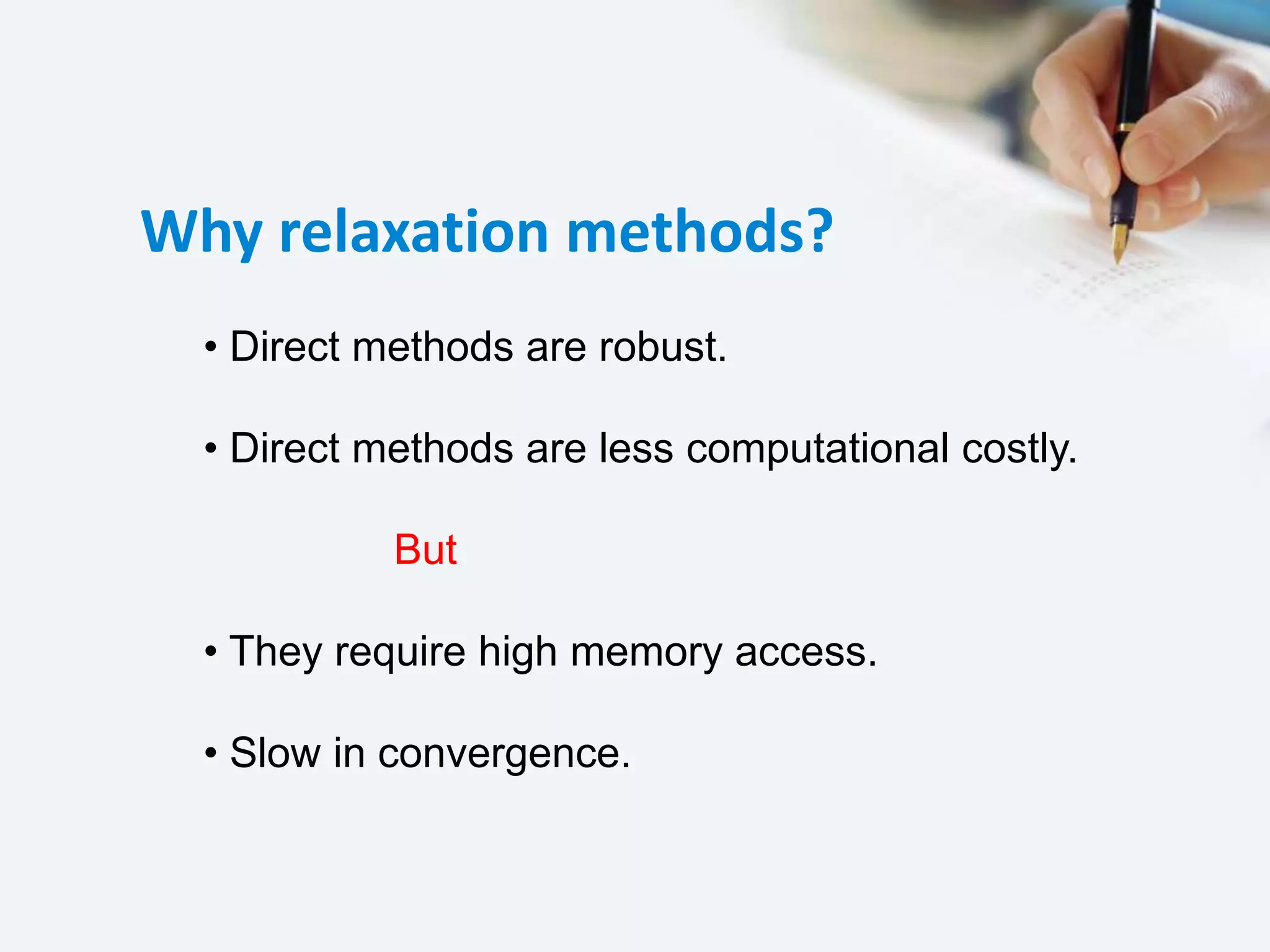
Why relaxation methods?
• Direct methods are robust.
• Direct methods are less computational costly.
But
• They require high memory access.
• Slow in convergence.
Evolution of relaxation methods
• Gauss Siedel Iteration
 Gauss’s letter to Gerling
 Era of electronic computing
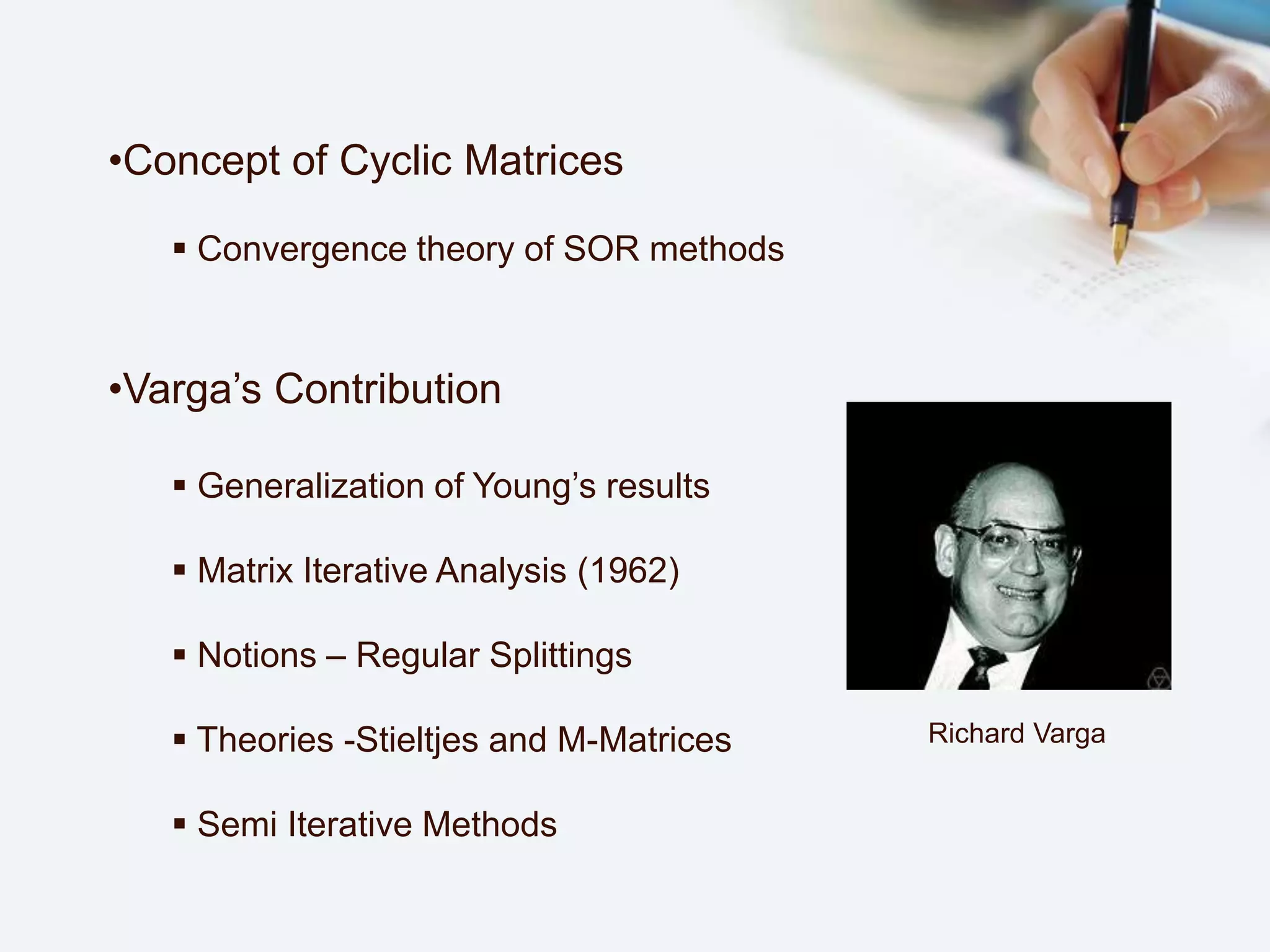
•Work of David Young
 Notions - “Consistent Ordering” and “Property A”
 Convergence of the methods
• Ostrowski (1937)
 Relevant properties for M-Matrices
• Theorem of Stein – Rosenburg (1948)
 Asymptotic rates
• Concept of Irreducibility
 Grid oriented matrices
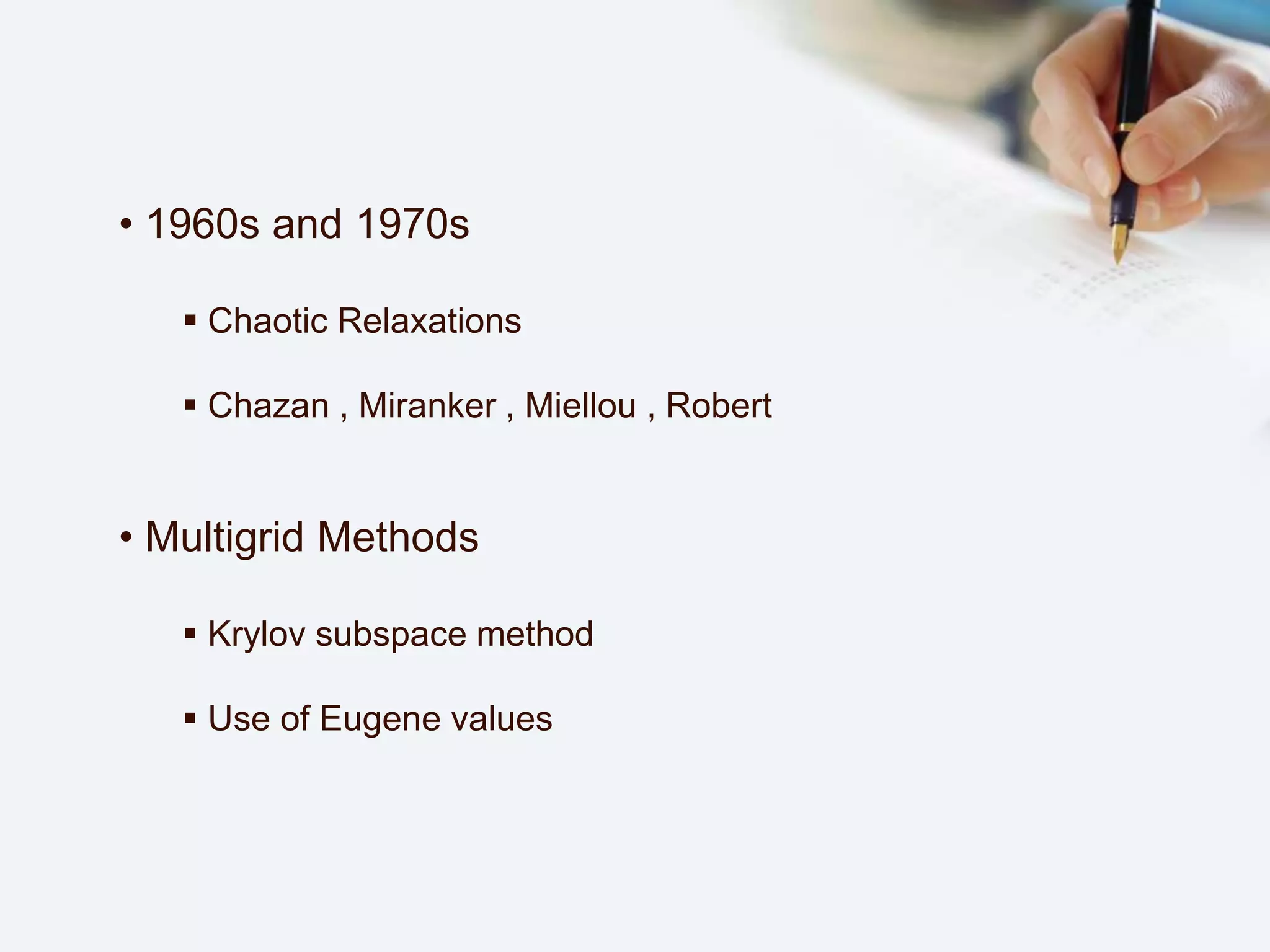
•Concept of Cyclic Matrices
 Convergence theory of SOR methods
•Varga’s Contribution
 Generalization of Young’s results
 Matrix Iterative Analysis (1962)
 Notions – Regular Splittings
 Theories -Stieltjes and M-Matrices
 Semi Iterative Methods
Richard Varga
• 1960s and 1970s
 Chaotic Relaxations
 Chazan , Miranker , Miellou , Robert
• Multigrid Methods
 Krylov subspace method
 Use of Eugene values
References
Rao, K.S., Year. Numerical Methods for Scientists and
Engineers. 2nd ed. Delhi: Prentice-Hall of India.
Yousef Sadd and , Henk A. van der Vorst, Iterative Solution of
Linear Systems in the 20th Century [pdf]. Available at: <www-
users.cs.umn.edu/~saad/PDF/umsi-99-152.pdf> Accessed [12th
July 2012]
Relaxation Methods for Iterative Solution to Linear Systems of
Equations Gerald Recktenwald Portland State University
Mechanical Engineering Department
Scientic Computing II Relaxation MethodsMichael Bader
Summer term 2012
Working scenario
Demonstration

Relaxation method

  • 1.
  • 2.
    Introduction • Relaxation methodis an iterative approach solution to systems of linear equations. • Basic idea behind this method is to improve the solution vector successively by reducing the largest residual at a particular iteration.
  • 3.
    What is aresidual? • Suppose x(i) € R is an approximation to the solution of the linear system defined by Ax=b • Residual vector for x(i) with respect to this system is R(i) =b-A x(i) in ith iteration
  • 4.
    • The error:E(I )= x-x(i) • R(i) = b –Ax(i) = Ax –Ax(i) = A(x –x(i)) = AE(i): • Residual equation: – AE(i)=R(i)
  • 5.
    Let x(p) =(x1 (p),x2 (p) … xn (p))T be the solution vector obtained after pth iteration. If Ri (p) denotes residual, ai1x1 + ai2x2 + … + ainxn = bi Define by, Ri (p) = bi- (ai1x1 + ai2x2 + … + ainxn)
  • 6.
    Applying relaxation method •Transfer all the terms to the right hand side of the equation • Reorder the equations in a way such that largest co- efficient in the equations appear on the diagonal • Select the largest residual and give an increment dx=-r(i)/aii • Change x(i) to x(i) +dx(i) to relax R(i) that is to reduce R(i) to zero
  • 7.
    Example : 6x1-3x2+x3 =11 2x1+x2-8x3 =-15 x1-7x2+x3 = 10 0= 11- 6x1 - 3x2 - x3 R1 0= 10- x1 + 7x2 - x3  R2 0= -15- 2x1 - x2 + 8x3  R3
  • 8.
    • Start withinitial guesses x1=x2=x3=0 • R1=11, • R2=10, • R3=-15 • Largest residual is R3 • So that dx3 = - R3 /a33 • dx3= -15/-8 = 1.875
  • 9.
  • 10.
    Final result wouldbe like this Iteration no R1 R2 R3 Max Ri dx(i) x1 x2 x3 0 11 10 -15 1.875 0 0 0 1 -9.125 8.125 0 9.125 1.5288 0 0 1.875 2 0.0478 6.5962 -3.0576 6.5962 -0.9423 1.5288 0 1.875 3 -2.8747 0.0001 -2.1153 -2.8747 -0.4791 1.5288 -0.9423 1.875 4 -0.0031 0.4792 -1.1571 -1.1571 0.1446 1.0497 -0.9423 1.875 5 0.1447 0.3346 0.0003 0.3346 -0.0478 1.0497 -0.9423 2.0196 6 0.2881 0.0000 0.0475 0.2881 0.0480 1.0497 -0.9901 2.0196 7 -0.0001 0.048 0.1435 0.1435 -0.0179 1.0017 -0.9901 2.0196 8 0.0178 0.0659 0.0003 - - 1.0017 -0.9901 2.0017
  • 11.
    • At ithiteration we can see that R1,R2 and R3 are small enough, • So xi values in this iteration x1 = 1.007, x2 = -0.9901, x3 = 2.0017 • Which are very close to the Exact solutions x1 = 1.0 x2 = -1.0 x3 = 2.0
  • 12.
    Convergence • Converges slowlyfor large systems of equations (large n)
  • 13.
    Special cases • Simpleto implement • Not useful as a stand alone solution method • Key ingredients to multi grid methods – Jacobi – Gauss seidel – red
  • 14.
  • 15.
    Methods available tofind solutions  Direct Elimination  Gaussian elimination  Gauss-Jordan elimination Decomposition  Court's reduction (Cholesky's reduction)  Iterative  Jacobi's method  Gauss-Seidel method  Relaxation method
  • 16.
    Advantages and Disadvantages Relaxation method is the core part of linear algebra.  This method provide preconditions for new methods.  Easily adoptable to computers.  Can solve more than 100s of linear equations simultaneously.  Slower progress than the competing methods
  • 17.
    Solve: 6x - 3y+ z = 11 2x + y - 8z = -15 x - 7y + z = 10 Gaussian Elimination Gauss- Jordan Elimination Courts Reduction Relaxation method X 1 1 1 1.0017 Y -1 -1 -1 -0 9901 Z 2 2 2 2.0017
  • 18.
    Relaxation method isthe best method for :  Relaxation method is highly used for image processing .  This method has been developed for analysis of hydraulic structures .  Solving linear equations relating to the radiosity problem.  Relaxation methods are iterative methods for solving systems of equations, including nonlinear systems.  Relaxation method used with other numerical methods in mono-tropic programs.
  • 19.
  • 20.
    Why relaxation methods? •Direct methods are robust. • Direct methods are less computational costly. But • They require high memory access. • Slow in convergence.
  • 21.
    Evolution of relaxationmethods • Gauss Siedel Iteration  Gauss’s letter to Gerling  Era of electronic computing
  • 22.
    •Work of DavidYoung  Notions - “Consistent Ordering” and “Property A”  Convergence of the methods • Ostrowski (1937)  Relevant properties for M-Matrices • Theorem of Stein – Rosenburg (1948)  Asymptotic rates • Concept of Irreducibility  Grid oriented matrices
  • 23.
    •Concept of CyclicMatrices  Convergence theory of SOR methods •Varga’s Contribution  Generalization of Young’s results  Matrix Iterative Analysis (1962)  Notions – Regular Splittings  Theories -Stieltjes and M-Matrices  Semi Iterative Methods Richard Varga
  • 24.
    • 1960s and1970s  Chaotic Relaxations  Chazan , Miranker , Miellou , Robert • Multigrid Methods  Krylov subspace method  Use of Eugene values
  • 25.
    References Rao, K.S., Year.Numerical Methods for Scientists and Engineers. 2nd ed. Delhi: Prentice-Hall of India. Yousef Sadd and , Henk A. van der Vorst, Iterative Solution of Linear Systems in the 20th Century [pdf]. Available at: <www- users.cs.umn.edu/~saad/PDF/umsi-99-152.pdf> Accessed [12th July 2012] Relaxation Methods for Iterative Solution to Linear Systems of Equations Gerald Recktenwald Portland State University Mechanical Engineering Department Scientic Computing II Relaxation MethodsMichael Bader Summer term 2012
  • 26.
  • 27.