LU decomposition

This   type   of     factorization   is     useful    for    solving   systems   of   equations.
Resume Gaussian elimination process applied to the matrix.

In linear algebra, the LU decomposition is a matrix decomposition which writes a matrix as the
product of a lower triangular matrix and an upper triangular matrix. The product sometimes
includes a permutation matrix as well. This decomposition is used in numerical analysis to solve
systems of linear equations or calculate the determinant.


Let A be a square matrix. An LU decomposition is a decomposition of the form


where L and U are lower and upper triangular matrices (of the same size), respectively. This
means that L has only zeros above the diagonal and U has only zeros below the diagonal. For a
      matrix, this becomes:


An LDU decomposition is a decomposition of the form


where D is a diagonal matrix and L and U are unit triangular matrices, meaning that all the
entries on the diagonals of L and U are one.

An LUP decomposition (also called a LU decomposition with partial pivoting) is a
decomposition of the form


where L and U are again lower and upper triangular matrices and P is a permutation matrix, i.e.,
a matrix of zeros and ones that has exactly one entry 1 in each row and column.

An LU decomposition with full pivoting (Trefethen and Bau) takes the form
Above we required that A be a square matrix, but these decompositions can all be generalized to
rectangular matrices as well. In that case, L and P are square matrices which each have the same
number of rows as A, while U is exactly the same shape as A. Upper triangular should be
interpreted as having only zero entries below the main diagonal, which starts at the upper left
corner.


Example
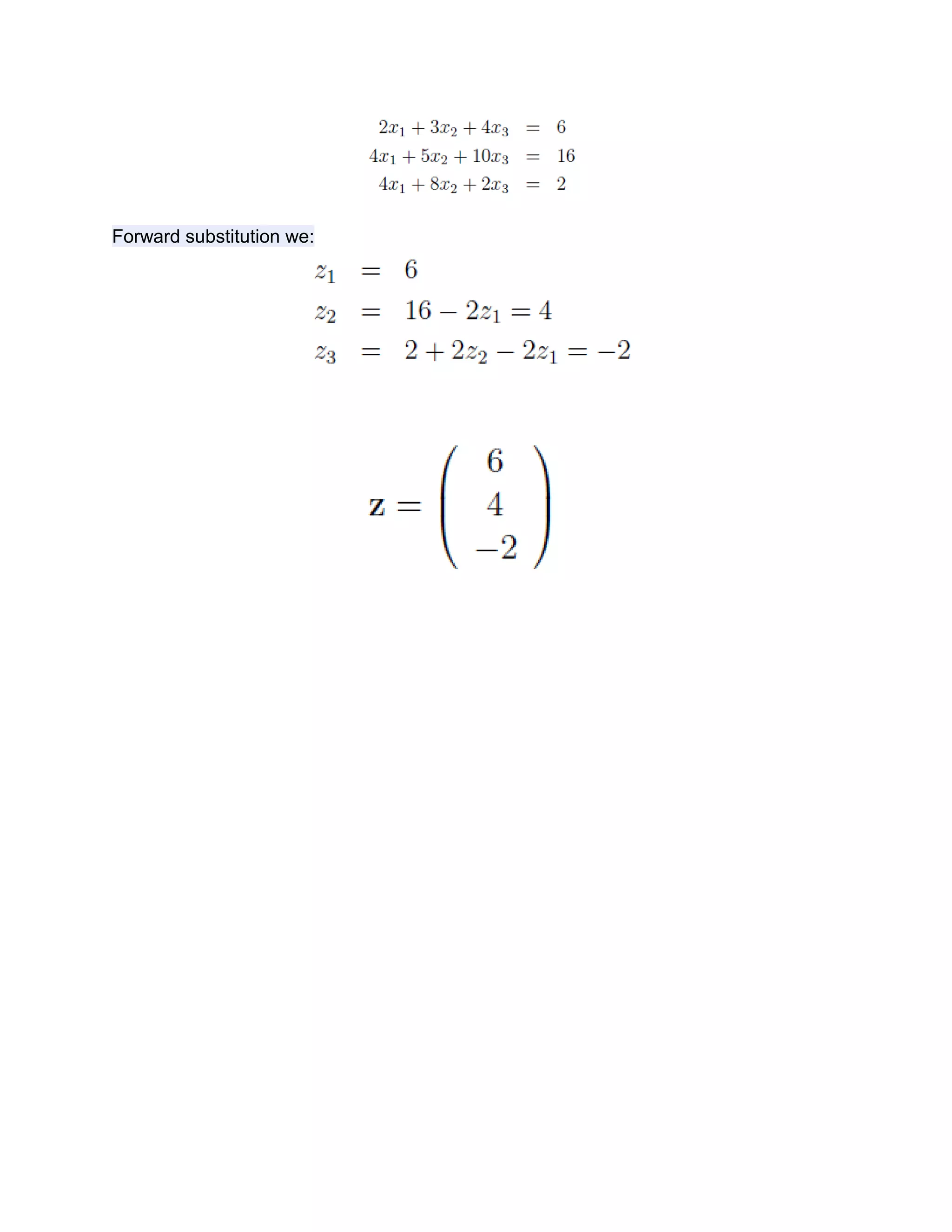
Consider the system of equations:


Whose coefficient matrix is:


Its LU factorization is:


Using Equation (3): Lz = b
Forward substitution we:

Lu decomposition

  • 1.
    LU decomposition This type of factorization is useful for solving systems of equations. Resume Gaussian elimination process applied to the matrix. In linear algebra, the LU decomposition is a matrix decomposition which writes a matrix as the product of a lower triangular matrix and an upper triangular matrix. The product sometimes includes a permutation matrix as well. This decomposition is used in numerical analysis to solve systems of linear equations or calculate the determinant. Let A be a square matrix. An LU decomposition is a decomposition of the form where L and U are lower and upper triangular matrices (of the same size), respectively. This means that L has only zeros above the diagonal and U has only zeros below the diagonal. For a matrix, this becomes: An LDU decomposition is a decomposition of the form where D is a diagonal matrix and L and U are unit triangular matrices, meaning that all the entries on the diagonals of L and U are one. An LUP decomposition (also called a LU decomposition with partial pivoting) is a decomposition of the form where L and U are again lower and upper triangular matrices and P is a permutation matrix, i.e., a matrix of zeros and ones that has exactly one entry 1 in each row and column. An LU decomposition with full pivoting (Trefethen and Bau) takes the form
  • 2.
    Above we requiredthat A be a square matrix, but these decompositions can all be generalized to rectangular matrices as well. In that case, L and P are square matrices which each have the same number of rows as A, while U is exactly the same shape as A. Upper triangular should be interpreted as having only zero entries below the main diagonal, which starts at the upper left corner. Example Consider the system of equations: Whose coefficient matrix is: Its LU factorization is: Using Equation (3): Lz = b
  • 3.