PRESENTED BY
MR.VILAS H.KAMBLE
GIUDED BY
DR.MRS SONALI MAHAPARALE
DR.D.Y.PATIL COLLEGE OF PHARMACY AKURDI,PUNE.
HPLC METHOD DEVELOPMENT AND
VALIDATION
4/17/2017 1
CONTENT
 Introduction
 Principle of HPLC
 Classification
 HPLC
 Types of HPLC
 Modes of HPLC
 Method development in HPLC
 Validation of developed method
 References
4/17/2017 2
INTRODUCTION
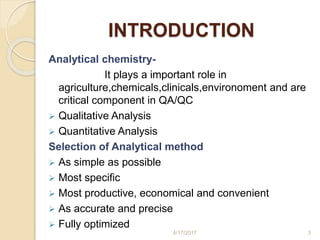
Analytical chemistry-
It plays a important role in
agriculture,chemicals,clinicals,environoment and are
critical component in QA/QC
 Qualitative Analysis
 Quantitative Analysis
Selection of Analytical method
 As simple as possible
 Most specific
 Most productive, economical and convenient
 As accurate and precise
 Fully optimized
4/17/2017 3
INTRODUCTION
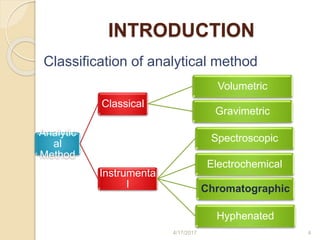
Classification of analytical method
Analytic
al
Method
Classical
Volumetric
Gravimetric
Instrumenta
l
Spectroscopic
Electrochemical
Chromatographic
Hyphenated
4/17/2017 4
CHROMATOGRAPHY
 Chromatography is essentially a group of technique
for separation, identification and determination
compounds.
 This technique is based on difference in migration
rates of components trough stationary phase by
gaseous or liquid mobile phase.
4/17/2017 5
CHROMATOGRAPHY
Principle-
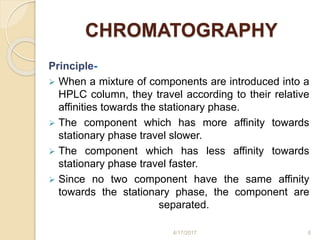
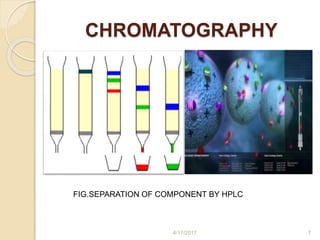
 When a mixture of components are introduced into a
HPLC column, they travel according to their relative
affinities towards the stationary phase.
 The component which has more affinity towards
stationary phase travel slower.
 The component which has less affinity towards
stationary phase travel faster.
 Since no two component have the same affinity
towards the stationary phase, the component are
separated.
4/17/2017 6
CHROMATOGRAPHY
FIG.SEPARATION OF COMPONENT BY HPLC
4/17/2017 7
CHROMATOGRAPHY
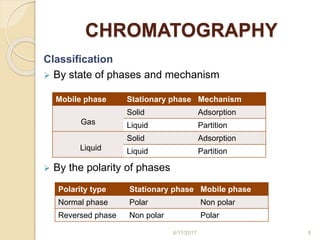
Classification
 By state of phases and mechanism
 By the polarity of phases
Mobile phase Stationary phase Mechanism
Gas
Solid Adsorption
Liquid Partition
Liquid
Solid Adsorption
Liquid Partition
Polarity type Stationary phase Mobile phase
Normal phase Polar Non polar
Reversed phase Non polar Polar
4/17/2017 8
CHROMATOGRAPHY
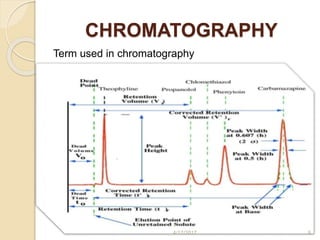
Term used in chromatography
4/17/2017 9
HIGH PERFORMANCE LIQUID
CHROMATOGRAPHY
 HPLC is a versatile analytical technology used for
analysis of pharmaceutical, biomolecules, polymers
and organic and ionic compound.
Advantages of HPLC
 Separation of mixed component
 Qualitative and quantitative analysis
 Automated operation
4/17/2017 10
HIGH PERFORMANCE LIQUID
CHROMATOGRAPHY
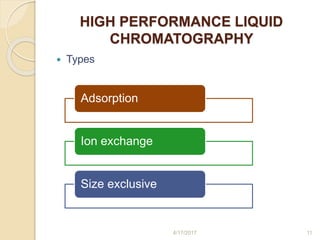
 Types
Adsorption
Ion exchange
Size exclusive
4/17/2017 11
HIGH PERFORMANCE LIQUID
CHROMATOGRAPHY
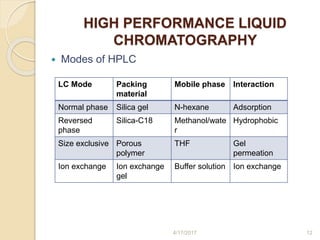
 Modes of HPLC
LC Mode Packing
material
Mobile phase Interaction
Normal phase Silica gel N-hexane Adsorption
Reversed
phase
Silica-C18 Methanol/wate
r
Hydrophobic
Size exclusive Porous
polymer
THF Gel
permeation
Ion exchange Ion exchange
gel
Buffer solution Ion exchange
4/17/2017 12
HIGH PERFORMANCE LIQUID
CHROMATOGRAPHY
Stationary Phase
 The stationary phase can be a solid or liquid which
adsorbed on solid.
 It consist of particle and the separation based on
the surface interaction and depends on the types of
the adsorption site.
 Important feature of adsorbent parameter are
-particle size :3-10 micro meter
-pore size :70-300A
-surface area :50-250 m2/gm
4/17/2017 13
HIGH PERFORMANCE LIQUID
CHROMATOGRAPHY
Mobile phase
 It is the part of the system which carries solute
through the stationary phase.
 In HPLC the mobile phase present in liquid.
e.g. Acetonitrile,water,methanol,isopropyle
alchol,THF, buffer.
4/17/2017 14
METHOD DEVLOPMENT IN
HPLC
 Best column, best mobile phase, best detection
wavelength, efforts in their selection can make a
word difference while developing HPLC method for
routine analysis.
 Chromatography method selected according to the
sample properties
 The HPLC method is optimized with regard to
analysis time, resolution, selectivity and sensitivity.
4/17/2017 15
METHOD DEVLOPMENT IN HPLC
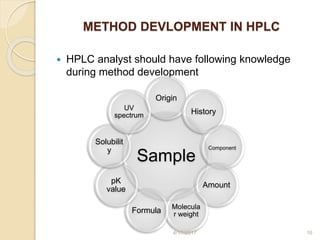
 HPLC analyst should have following knowledge
during method development
Sample
Origin
History
Component
Amount
Molecula
r weightFormula
pK
value
Solubilit
y
UV
spectrum
4/17/2017 16
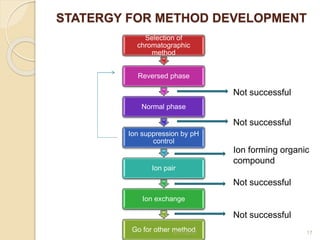
STATERGY FOR METHOD DEVELOPMENT
Selection of
chromatographic
method
Reversed phase
Normal phase
Ion suppression by pH
control
Ion pair
Ion exchange
Go for other method
Not successful
Not successful
Ion forming organic
compound
Not successful
Not successful
4/17/2017 17
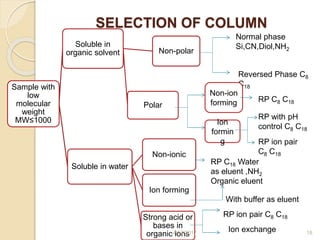
SELECTION OF COLUMN
Sample with
low
molecular
weight
MW≤1000
Soluble in
organic solvent Non-polar
Polar
Soluble in water
Non-ionic
Ion forming
Strong acid or
bases in
organic ions
Normal phase
Si,CN,Diol,NH2
Reversed Phase C8
C18
Non-ion
forming
Ion
formin
g
RP C8 C18
RP with pH
control C8 C18
RP ion pair
C8 C18
RP C18 Water
as eluent ,NH2
Organic eluent
With buffer as eluent
RP ion pair C8 C18
Ion exchange4/17/2017 18
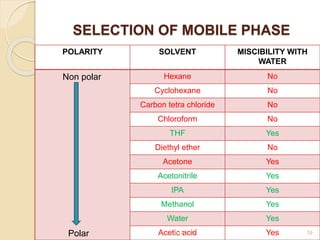
SELECTION OF MOBILE PHASE
POLARITY SOLVENT MISCIBILITY WITH
WATER
Non polar Hexane No
Cyclohexane No
Carbon tetra chloride No
Chloroform No
THF Yes
Diethyl ether No
Acetone Yes
Acetonitrile Yes
IPA Yes
Methanol Yes
Water Yes
Acetic acid YesPolar 4/17/2017 19
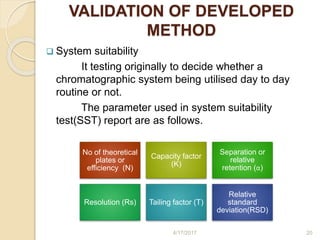
VALIDATION OF DEVELOPED
METHOD
 System suitability
It testing originally to decide whether a
chromatographic system being utilised day to day
routine or not.
The parameter used in system suitability
test(SST) report are as follows.
No of theoretical
plates or
efficiency (N)
Capacity factor
(K)
Separation or
relative
retention (α)
Resolution (Rs) Tailing factor (T)
Relative
standard
deviation(RSD)
4/17/2017 20
VALIDATION OF DEVELOPED
METHOD
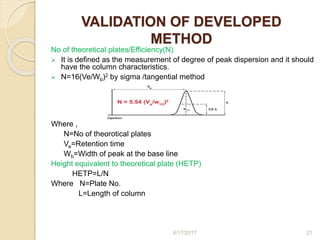
No of theoretical plates/Efficiency(N)
 It is defined as the measurement of degree of peak dispersion and it should
have the column characteristics.
 N=16(Ve/Wb)2 by sigma /tangential method
Where ,
N=No of theorotical plates
Ve=Retention time
Wb=Width of peak at the base line
Height equivalent to theoretical plate (HETP)
HETP=L/N
Where N=Plate No.
L=Length of column
4/17/2017 21
VALIDATION OF DEVELOPED
METHOD
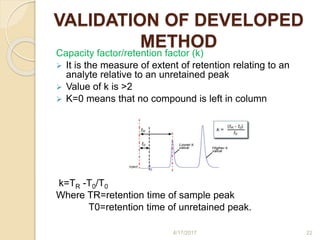
Capacity factor/retention factor (k)
 It is the measure of extent of retention relating to an
analyte relative to an unretained peak
 Value of k is >2
 K=0 means that no compound is left in column
k=TR -T0/T0
Where TR=retention time of sample peak
T0=retention time of unretained peak.
4/17/2017 22
VALIDATION OF DEVELOPED
METHOD
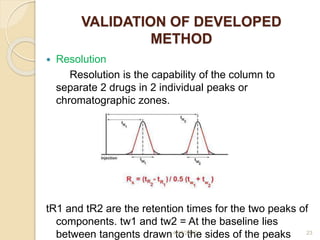
 Resolution
Resolution is the capability of the column to
separate 2 drugs in 2 individual peaks or
chromatographic zones.
tR1 and tR2 are the retention times for the two peaks of
components. tw1 and tw2 = At the baseline lies
between tangents drawn to the sides of the peaks4/17/2017 23
VALIDATION OF DEVELOPED
METHOD
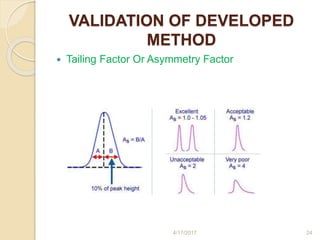
 Tailing Factor Or Asymmetry Factor
4/17/2017 24
VALIDATION OF DEVELOPED
METHOD
 Specificity
It refer to the ability of analytical method to
differentiate and quantify analyte in complex
mixture.
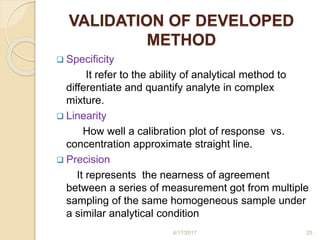
 Linearity
How well a calibration plot of response vs.
concentration approximate straight line.
 Precision
It represents the nearness of agreement
between a series of measurement got from multiple
sampling of the same homogeneous sample under
a similar analytical condition
4/17/2017 25
VALIDATION OF DEVELOPED
METHOD
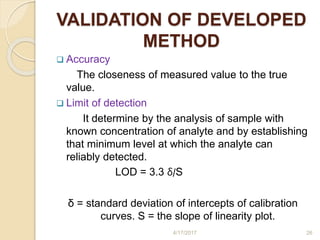
 Accuracy
The closeness of measured value to the true
value.
 Limit of detection
It determine by the analysis of sample with
known concentration of analyte and by establishing
that minimum level at which the analyte can
reliably detected.
LOD = 3.3 δ/S
δ = standard deviation of intercepts of calibration
curves. S = the slope of linearity plot.
4/17/2017 26
VALIDATION OF DEVELOPED
METHOD
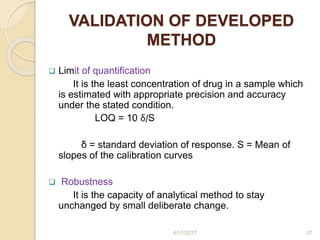
 Limit of quantification
It is the least concentration of drug in a sample which
is estimated with appropriate precision and accuracy
under the stated condition.
LOQ = 10 δ/S
δ = standard deviation of response. S = Mean of
slopes of the calibration curves
 Robustness
It is the capacity of analytical method to stay
unchanged by small deliberate change.
4/17/2017 27
REFERENCES
 Panchumurthy Ravishankar,Naga Navya et.al,a
Review On Step By Step Analytical Method
Validation, IOSR Journal Of Pharmacy ISSN-2250-
3013,07-19
 Bharadwaj Santosh kumar, Dwivedi K,et al A
Review On HPLC Method Development And
Validation, International Journal Of Analytical And
Bioanalytical Chemistry ISSN-2231-5012
 Gupta Vibha,Jajn Ajaydeep kumar et al
,Development And Validation Of HPLC Method A
Review, International Research Journal Of
Pharmaceutical And Applied Science ISSN 2277-
4149,17-25
4/17/2017 28

Method development and validation

  • 1.
    PRESENTED BY MR.VILAS H.KAMBLE GIUDEDBY DR.MRS SONALI MAHAPARALE DR.D.Y.PATIL COLLEGE OF PHARMACY AKURDI,PUNE. HPLC METHOD DEVELOPMENT AND VALIDATION 4/17/2017 1
  • 2.
    CONTENT  Introduction  Principleof HPLC  Classification  HPLC  Types of HPLC  Modes of HPLC  Method development in HPLC  Validation of developed method  References 4/17/2017 2
  • 3.
    INTRODUCTION Analytical chemistry- It playsa important role in agriculture,chemicals,clinicals,environoment and are critical component in QA/QC  Qualitative Analysis  Quantitative Analysis Selection of Analytical method  As simple as possible  Most specific  Most productive, economical and convenient  As accurate and precise  Fully optimized 4/17/2017 3
  • 4.
    INTRODUCTION Classification of analyticalmethod Analytic al Method Classical Volumetric Gravimetric Instrumenta l Spectroscopic Electrochemical Chromatographic Hyphenated 4/17/2017 4
  • 5.
    CHROMATOGRAPHY  Chromatography isessentially a group of technique for separation, identification and determination compounds.  This technique is based on difference in migration rates of components trough stationary phase by gaseous or liquid mobile phase. 4/17/2017 5
  • 6.
    CHROMATOGRAPHY Principle-  When amixture of components are introduced into a HPLC column, they travel according to their relative affinities towards the stationary phase.  The component which has more affinity towards stationary phase travel slower.  The component which has less affinity towards stationary phase travel faster.  Since no two component have the same affinity towards the stationary phase, the component are separated. 4/17/2017 6
  • 7.
  • 8.
    CHROMATOGRAPHY Classification  By stateof phases and mechanism  By the polarity of phases Mobile phase Stationary phase Mechanism Gas Solid Adsorption Liquid Partition Liquid Solid Adsorption Liquid Partition Polarity type Stationary phase Mobile phase Normal phase Polar Non polar Reversed phase Non polar Polar 4/17/2017 8
  • 9.
    CHROMATOGRAPHY Term used inchromatography 4/17/2017 9
  • 10.
    HIGH PERFORMANCE LIQUID CHROMATOGRAPHY HPLC is a versatile analytical technology used for analysis of pharmaceutical, biomolecules, polymers and organic and ionic compound. Advantages of HPLC  Separation of mixed component  Qualitative and quantitative analysis  Automated operation 4/17/2017 10
  • 11.
    HIGH PERFORMANCE LIQUID CHROMATOGRAPHY Types Adsorption Ion exchange Size exclusive 4/17/2017 11
  • 12.
    HIGH PERFORMANCE LIQUID CHROMATOGRAPHY Modes of HPLC LC Mode Packing material Mobile phase Interaction Normal phase Silica gel N-hexane Adsorption Reversed phase Silica-C18 Methanol/wate r Hydrophobic Size exclusive Porous polymer THF Gel permeation Ion exchange Ion exchange gel Buffer solution Ion exchange 4/17/2017 12
  • 13.
    HIGH PERFORMANCE LIQUID CHROMATOGRAPHY StationaryPhase  The stationary phase can be a solid or liquid which adsorbed on solid.  It consist of particle and the separation based on the surface interaction and depends on the types of the adsorption site.  Important feature of adsorbent parameter are -particle size :3-10 micro meter -pore size :70-300A -surface area :50-250 m2/gm 4/17/2017 13
  • 14.
    HIGH PERFORMANCE LIQUID CHROMATOGRAPHY Mobilephase  It is the part of the system which carries solute through the stationary phase.  In HPLC the mobile phase present in liquid. e.g. Acetonitrile,water,methanol,isopropyle alchol,THF, buffer. 4/17/2017 14
  • 15.
    METHOD DEVLOPMENT IN HPLC Best column, best mobile phase, best detection wavelength, efforts in their selection can make a word difference while developing HPLC method for routine analysis.  Chromatography method selected according to the sample properties  The HPLC method is optimized with regard to analysis time, resolution, selectivity and sensitivity. 4/17/2017 15
  • 16.
    METHOD DEVLOPMENT INHPLC  HPLC analyst should have following knowledge during method development Sample Origin History Component Amount Molecula r weightFormula pK value Solubilit y UV spectrum 4/17/2017 16
  • 17.
    STATERGY FOR METHODDEVELOPMENT Selection of chromatographic method Reversed phase Normal phase Ion suppression by pH control Ion pair Ion exchange Go for other method Not successful Not successful Ion forming organic compound Not successful Not successful 4/17/2017 17
  • 18.
    SELECTION OF COLUMN Samplewith low molecular weight MW≤1000 Soluble in organic solvent Non-polar Polar Soluble in water Non-ionic Ion forming Strong acid or bases in organic ions Normal phase Si,CN,Diol,NH2 Reversed Phase C8 C18 Non-ion forming Ion formin g RP C8 C18 RP with pH control C8 C18 RP ion pair C8 C18 RP C18 Water as eluent ,NH2 Organic eluent With buffer as eluent RP ion pair C8 C18 Ion exchange4/17/2017 18
  • 19.
    SELECTION OF MOBILEPHASE POLARITY SOLVENT MISCIBILITY WITH WATER Non polar Hexane No Cyclohexane No Carbon tetra chloride No Chloroform No THF Yes Diethyl ether No Acetone Yes Acetonitrile Yes IPA Yes Methanol Yes Water Yes Acetic acid YesPolar 4/17/2017 19
  • 20.
    VALIDATION OF DEVELOPED METHOD System suitability It testing originally to decide whether a chromatographic system being utilised day to day routine or not. The parameter used in system suitability test(SST) report are as follows. No of theoretical plates or efficiency (N) Capacity factor (K) Separation or relative retention (α) Resolution (Rs) Tailing factor (T) Relative standard deviation(RSD) 4/17/2017 20
  • 21.
    VALIDATION OF DEVELOPED METHOD Noof theoretical plates/Efficiency(N)  It is defined as the measurement of degree of peak dispersion and it should have the column characteristics.  N=16(Ve/Wb)2 by sigma /tangential method Where , N=No of theorotical plates Ve=Retention time Wb=Width of peak at the base line Height equivalent to theoretical plate (HETP) HETP=L/N Where N=Plate No. L=Length of column 4/17/2017 21
  • 22.
    VALIDATION OF DEVELOPED METHOD Capacityfactor/retention factor (k)  It is the measure of extent of retention relating to an analyte relative to an unretained peak  Value of k is >2  K=0 means that no compound is left in column k=TR -T0/T0 Where TR=retention time of sample peak T0=retention time of unretained peak. 4/17/2017 22
  • 23.
    VALIDATION OF DEVELOPED METHOD Resolution Resolution is the capability of the column to separate 2 drugs in 2 individual peaks or chromatographic zones. tR1 and tR2 are the retention times for the two peaks of components. tw1 and tw2 = At the baseline lies between tangents drawn to the sides of the peaks4/17/2017 23
  • 24.
    VALIDATION OF DEVELOPED METHOD Tailing Factor Or Asymmetry Factor 4/17/2017 24
  • 25.
    VALIDATION OF DEVELOPED METHOD Specificity It refer to the ability of analytical method to differentiate and quantify analyte in complex mixture.  Linearity How well a calibration plot of response vs. concentration approximate straight line.  Precision It represents the nearness of agreement between a series of measurement got from multiple sampling of the same homogeneous sample under a similar analytical condition 4/17/2017 25
  • 26.
    VALIDATION OF DEVELOPED METHOD Accuracy The closeness of measured value to the true value.  Limit of detection It determine by the analysis of sample with known concentration of analyte and by establishing that minimum level at which the analyte can reliably detected. LOD = 3.3 δ/S δ = standard deviation of intercepts of calibration curves. S = the slope of linearity plot. 4/17/2017 26
  • 27.
    VALIDATION OF DEVELOPED METHOD Limit of quantification It is the least concentration of drug in a sample which is estimated with appropriate precision and accuracy under the stated condition. LOQ = 10 δ/S δ = standard deviation of response. S = Mean of slopes of the calibration curves  Robustness It is the capacity of analytical method to stay unchanged by small deliberate change. 4/17/2017 27
  • 28.
    REFERENCES  Panchumurthy Ravishankar,NagaNavya et.al,a Review On Step By Step Analytical Method Validation, IOSR Journal Of Pharmacy ISSN-2250- 3013,07-19  Bharadwaj Santosh kumar, Dwivedi K,et al A Review On HPLC Method Development And Validation, International Journal Of Analytical And Bioanalytical Chemistry ISSN-2231-5012  Gupta Vibha,Jajn Ajaydeep kumar et al ,Development And Validation Of HPLC Method A Review, International Research Journal Of Pharmaceutical And Applied Science ISSN 2277- 4149,17-25 4/17/2017 28