Metal Oxide Semiconductor
Field Effect Transistor
MOSFET STRUCTURE
MOSFET - Metal Oxide Semiconductor Field Effect Transistor

3-D view of NMOS Transistor
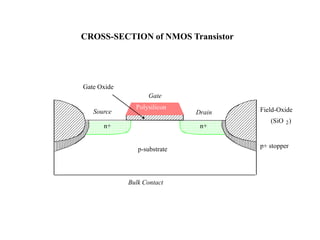
CROSS-SECTION of NMOS Transistor

Gate Oxide
Gate

Source

Polysilicon

n+

Drain

n+

p-substrate

Bulk Contact

Field-Oxide
(SiO 2 )

p+ stopper
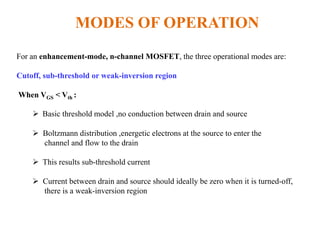
MODES OF OPERATION
For an enhancement-mode, n-channel MOSFET, the three operational modes are:
Cutoff, sub-threshold or weak-inversion region
When VGS < Vth :
 Basic threshold model ,no conduction between drain and source

 Boltzmann distribution ,energetic electrons at the source to enter the
channel and flow to the drain
 This results sub-threshold current
 Current between drain and source should ideally be zero when it is turned-off,
there is a weak-inversion region
Triode or linear region (also known as the ohmic region)
When VGS > Vth and VDS < ( VGS – Vth ) :
 The transistor is turned on, a channel has been created which allows current to
flow between the drain and the source
 The MOSFET operates like a resistor, controlled by the gate voltage relative to
both the source and drain voltages
 The current from drain to source is modeled as:
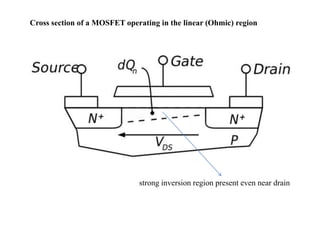
Cross section of a MOSFET operating in the linear (Ohmic) region

strong inversion region present even near drain
Saturation or active region
When VGS > Vth and VDS ≥ ( VGS – Vth )
 Since the drain voltage is higher than the source voltage, the electrons spread
out and conduction occurs
 This region is also known as pinch-off ,indicates the lack of channel region
near the drain.
 The drain current is now weakly dependent upon drain voltage and primarily
controlled by the gate–source voltage, and modeled approximately as:
Cross section of a MOSFET operating in the saturation (active) region

channel exhibits pinch-off near drain
For a Depletion-mode MOSFETs are doped so that a channel exists even with
zero voltage from gate to source
 To control the channel, a negative voltage is applied to the
gate(depleting the channel)
 Which reduces the current flow through the device
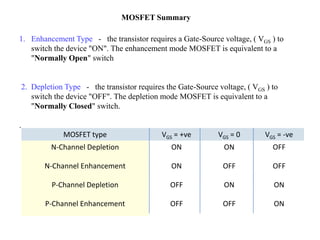
MOSFET Summary
1. Enhancement Type - the transistor requires a Gate-Source voltage, ( VGS ) to
switch the device "ON". The enhancement mode MOSFET is equivalent to a
"Normally Open" switch

2. Depletion Type - the transistor requires the Gate-Source voltage, ( VGS ) to
switch the device "OFF". The depletion mode MOSFET is equivalent to a
"Normally Closed" switch.
.
MOSFET type

VGS = +ve

VGS = 0

VGS = -ve

N-Channel Depletion

ON

ON

OFF

N-Channel Enhancement

ON

OFF

OFF

P-Channel Depletion

OFF

ON

ON

P-Channel Enhancement

OFF

OFF

ON
Symbols and basic construction for both configurations of MOSFET are shown below

Metal oxide semiconductor

  • 1.
  • 2.
    MOSFET STRUCTURE MOSFET -Metal Oxide Semiconductor Field Effect Transistor 3-D view of NMOS Transistor
  • 3.
    CROSS-SECTION of NMOSTransistor Gate Oxide Gate Source Polysilicon n+ Drain n+ p-substrate Bulk Contact Field-Oxide (SiO 2 ) p+ stopper
  • 4.
    MODES OF OPERATION Foran enhancement-mode, n-channel MOSFET, the three operational modes are: Cutoff, sub-threshold or weak-inversion region When VGS < Vth :  Basic threshold model ,no conduction between drain and source  Boltzmann distribution ,energetic electrons at the source to enter the channel and flow to the drain  This results sub-threshold current  Current between drain and source should ideally be zero when it is turned-off, there is a weak-inversion region
  • 5.
    Triode or linearregion (also known as the ohmic region) When VGS > Vth and VDS < ( VGS – Vth ) :  The transistor is turned on, a channel has been created which allows current to flow between the drain and the source  The MOSFET operates like a resistor, controlled by the gate voltage relative to both the source and drain voltages  The current from drain to source is modeled as:
  • 6.
    Cross section ofa MOSFET operating in the linear (Ohmic) region strong inversion region present even near drain
  • 7.
    Saturation or activeregion When VGS > Vth and VDS ≥ ( VGS – Vth )  Since the drain voltage is higher than the source voltage, the electrons spread out and conduction occurs  This region is also known as pinch-off ,indicates the lack of channel region near the drain.  The drain current is now weakly dependent upon drain voltage and primarily controlled by the gate–source voltage, and modeled approximately as:
  • 8.
    Cross section ofa MOSFET operating in the saturation (active) region channel exhibits pinch-off near drain
  • 9.
    For a Depletion-modeMOSFETs are doped so that a channel exists even with zero voltage from gate to source  To control the channel, a negative voltage is applied to the gate(depleting the channel)  Which reduces the current flow through the device
  • 10.
    MOSFET Summary 1. EnhancementType - the transistor requires a Gate-Source voltage, ( VGS ) to switch the device "ON". The enhancement mode MOSFET is equivalent to a "Normally Open" switch 2. Depletion Type - the transistor requires the Gate-Source voltage, ( VGS ) to switch the device "OFF". The depletion mode MOSFET is equivalent to a "Normally Closed" switch. . MOSFET type VGS = +ve VGS = 0 VGS = -ve N-Channel Depletion ON ON OFF N-Channel Enhancement ON OFF OFF P-Channel Depletion OFF ON ON P-Channel Enhancement OFF OFF ON
  • 11.
    Symbols and basicconstruction for both configurations of MOSFET are shown below