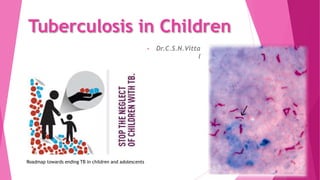
Tuberculosis in Children
• Dr.C.S.N.Vitta
l
Roadmap towards ending TB in children and adolescents
1
2
3
4
5
Clinical Spectrum
Diagnosis
1
2
3
4
5
Clinical Spectrum
Diagnosis
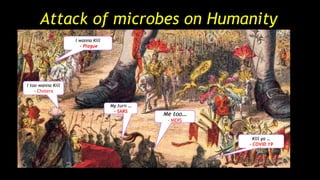
Attack of microbes on Humanity
I wanna Kill
- Plague
Kill ya …
- COVID 19
My turn …
- SARS
I too wanna Kill
- Cholera
Me too…
- MERS
I wanna Kill -
Plague
Kill ya …
COVID 19
My turn
…- SARS
I too
wanna Kill
- Cholera
Me too…
- MERS
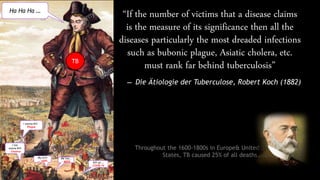
Throughout the 1600-1800s in Europe& United
States, TB caused 25% of all deaths.
“If the number of victims that a disease claims
is the measure of its significance then all the
diseases particularly the most dreaded infections
such as bubonic plague, Asiatic cholera, etc.
must rank far behind tuberculosis”
-- Die Ätiologie der Tuberculose, Robert Koch (1882)
Ha Ha Ha …
TB
1
2
3
4
5
Clinical Spectrum
Diagnosis
Tuberculosis - Burden
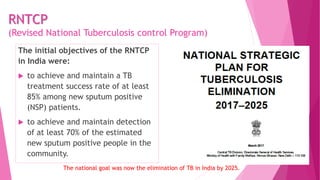
RNTCP
(Revised National Tuberculosis control Program)
The initial objectives of the RNTCP
in India were:
 to achieve and maintain a TB
treatment success rate of at least
85% among new sputum positive
(NSP) patients.
 to achieve and maintain detection
of at least 70% of the estimated
new sputum positive people in the
community.
The national goal was now the elimination of TB in India by 2025.
RNTCP Gets A Name Change
 This implies targeting an 80 per cent reduction in incidence
and 90 per cent reduction in mortality (base line 2015)
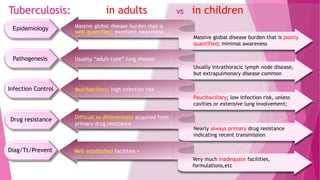
Tuberculosis: in adults vs in children
Massive global disease burden that is
well quantified; excellent awareness
Massive global disease burden that is poorly
quantified; minimal awareness
Usually “adult-type” lung disease
Usually intrathoracic lymph node disease,
but extrapulmonary disease common
Multibacillary; high infection risk
Paucibacillary; low infection risk, unless
cavities or extensive lung involvement;
Difficult to differentiate acquired from
primary drug resistance
Nearly always primary drug resistance
indicating recent transmission
Infection Control
Drug resistance
Epidemiology
Pathogenesis
Well established facilities +
Very much Inadequate facilities,
formulations,etc
Diag/Tt/Prevent
1
2
3
4
5
Clinical Spectrum
Diagnosis
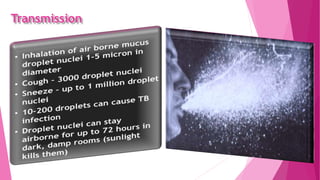
Transmission
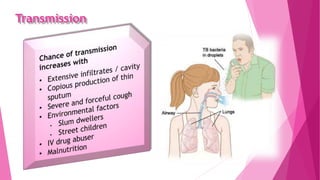
Transmission
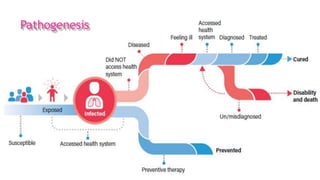
Pathogenesis
1
2
3
4
5
Clinical Spectrum
Diagnosis
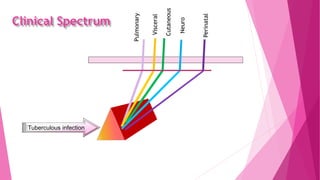
Clinical Spectrum
Tuberculous infection
Pulmonary
Visceral
Cutaneous
Neuro
Perinatal
Clinical Manifestations – Pulmonary TB
 Primary Pulmonary Disease
 Progressive primary pulmonary disease
 Reactivation TB
 Pleural Effusion
 Upper Respiratory tract Disease
 Lymph node disease
 Lympho hematogenous (Disseminated TB) Spread
• Incubation period varies between 4 and 8 weeks
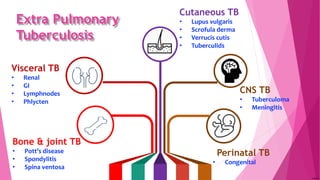
Bone & joint TB
• Pott’s disease
• Spondylitis
• Spina ventosa
Visceral TB
• Renal
• GI
• Lymphnodes
• Phlycten
Perinatal TB
• Congenital
CNS TB
• Tuberculoma
• Meningitis
Cutaneous TB
• Lupus vulgaris
• Scrofula derma
• Verrucis cutis
• Tuberculids
Extra Pulmonary
Tuberculosis
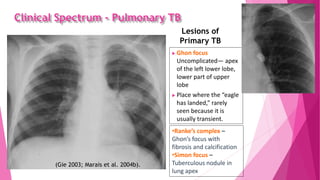
Clinical Spectrum - Pulmonary TB
 Ghon focus
Uncomplicated— apex
of the left lower lobe,
lower part of upper
lobe
 Place where the “eagle
has landed,” rarely
seen because it is
usually transient.
(Gie 2003; Marais et al. 2004b).
•Ranke’s complex –
Ghon’s focus with
fibrosis and calcification
•Simon focus –
Tuberculous nodule in
lung apex
Lesions of
Primary TB
Clinical Spectrum - Pulmonary TB
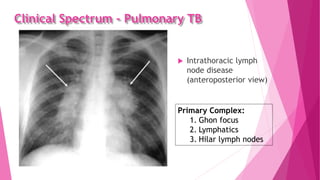
 Intrathoracic lymph
node disease
(anteroposterior view)
Primary Complex:
1. Ghon focus
2. Lymphatics
3. Hilar lymph nodes
Clinical Spectrum – Pulmonary TB
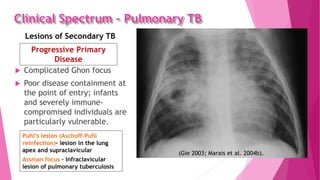
 Complicated Ghon focus
 Poor disease containment at
the point of entry; infants
and severely immune-
compromised individuals are
particularly vulnerable.
(Gie 2003; Marais et al. 2004b).
Lesions of Secondary TB
Puhl’s lesion (Aschoff-Puhl
reinfection)– lesion in the lung
apex and supraclavicular
Assman focus – Infraclavicular
lesion of pulmonary tuberculosis
Progressive Primary
Disease
Clinical Spectrum – Pulmonary TB
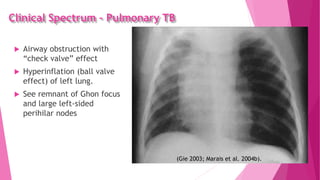
 Airway obstruction with
“check valve” effect
 Hyperinflation (ball valve
effect) of left lung.
 See remnant of Ghon focus
and large left-sided
perihilar nodes
(Gie 2003; Marais et al. 2004b).
Clinical Spectrum – Pulmonary TB
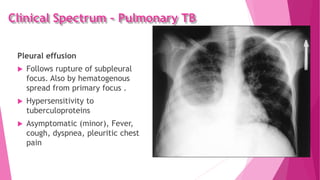
Pleural effusion
 Follows rupture of subpleural
focus. Also by hematogenous
spread from primary focus .
 Hypersensitivity to
tuberculoproteins
 Asymptomatic (minor), Fever,
cough, dyspnea, pleuritic chest
pain
Clinical Spectrum – Pulmonary TB
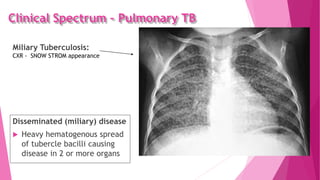
Disseminated (miliary) disease
 Heavy hematogenous spread
of tubercle bacilli causing
disease in 2 or more organs
Miliary Tuberculosis:
CXR - SNOW STROM appearance
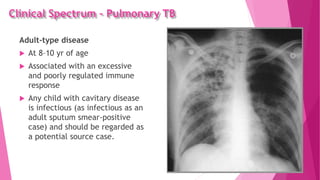
Clinical Spectrum – Pulmonary TB
Adult-type disease
 At 8–10 yr of age
 Associated with an excessive
and poorly regulated immune
response
 Any child with cavitary disease
is infectious (as infectious as an
adult sputum smear-positive
case) and should be regarded as
a potential source case.
Symptoms - Pulmonary TB
 Primary complex – mild fever, anorexia, weight loss, decreased activity,
cough
 Progressive primary complex – high grade fever, cough, expectoration
and hemoptysis – cavity and ulceration of bronchus
 Endobronchial TB – wheeze, fever, troublesome cough, dyspnea,
cyanosis.
 Wheezing child not responding to bronchodilators, less than 2 yrs age
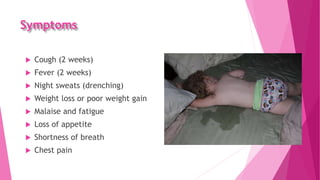
Symptoms
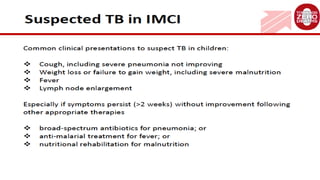
 Cough (2 weeks)
 Fever (2 weeks)
 Night sweats (drenching)
 Weight loss or poor weight gain
 Malaise and fatigue
 Loss of appetite
 Shortness of breath
 Chest pain
1
2
3
4
5
Clinical Spectrum
Diagnosis
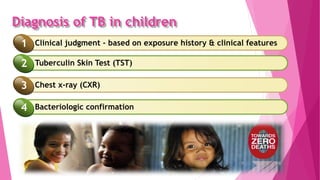
Diagnosis of TB in children
Bacteriologic confirmation
4
Clinical judgment - based on exposure history & clinical features
1
Tuberculin Skin Test (TST)
2
Chest x-ray (CXR)
3
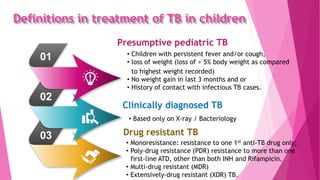
Definitions in treatment of TB in children
• Children with persistent fever and/or cough,
• loss of weight (loss of > 5% body weight as compared
to highest weight recorded)
• No weight gain in last 3 months and or
• History of contact with infectious TB cases.
Presumptive pediatric TB
01
02
03
• Based only on X-ray / Bacteriology
Clinically diagnosed TB
• Monoresistance: resistance to one 1st anti-TB drug only;
• Poly-drug resistance (PDR) resistance to more than one
first-line ATD, other than both INH and Rifampicin.
• Multi-drug resistant (MDR)
• Extensively-drug resistant (XDR) TB.
Drug resistant TB
Clinical judgment Exposure History
 Closeness of contact - living in the same
household or in frequent contact with a source
case with smear-positive PTB.
 Sputum smear result of index case (if known) -
Children are infectious if smear (+) or with
cavitary TB
 Timing of contact children usually develop TB
within 2 years after exposure and most (90%)
within the 1st year
 If no source case is identified, always ask about
anyone in household with cough – if so, request
assessment of that person for possible TB
1
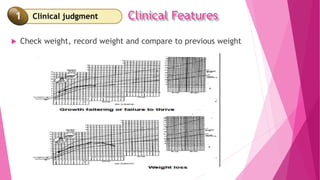
 Check weight, record weight and compare to previous weight
Clinical judgment
1 Clinical Features
PEDISATC
ON 2007
Varinder
Singh
Hassan,
Aug 2007
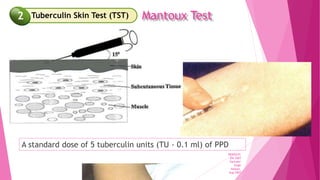
Mantoux Test
A standard dose of 5 tuberculin units (TU - 0.1 ml) of PPD
Tuberculin Skin Test (TST)
2
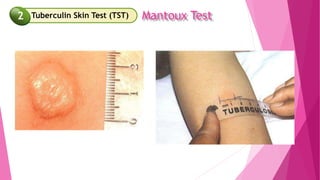
Mantoux Test
Tuberculin Skin Test (TST)
2
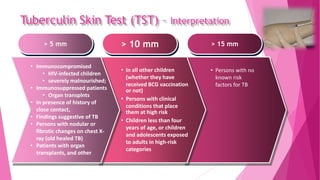
Tuberculin Skin Test (TST) – Interpretation
> 5 mm > 10 mm > 15 mm
• Immunocompromised
• HIV-infected children
• severely malnourished;
• Immunosuppressed patients
• Organ transplnts
• In presence of history of
close contact,
• Findings suggestive of TB
• Persons with nodular or
fibrotic changes on chest X-
ray (old healed TB)
• Patients with organ
transplants, and other
• In all other children
(whether they have
received BCG vaccination
or not)
• Persons with clinical
conditions that place
them at high risk
• Children less than four
years of age, or children
and adolescents exposed
to adults in high-risk
categories
• Persons with no
known risk
factors for TB
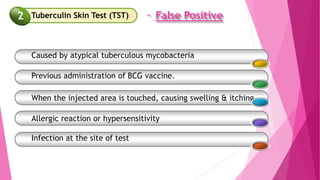
– False Positive
Caused by atypical tuberculous mycobacteria
Previous administration of BCG vaccine.
When the injected area is touched, causing swelling & itching
Allergic reaction or hypersensitivity
Infection at the site of test
Tuberculin Skin Test (TST)
2
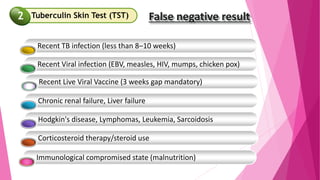
False negative result
Recent TB infection (less than 8–10 weeks)
Recent Viral infection (EBV, measles, HIV, mumps, chicken pox)
Chronic renal failure, Liver failure
Hodgkin's disease, Lymphomas, Leukemia, Sarcoidosis
Corticosteroid therapy/steroid use
Immunological compromised state (malnutrition)
Recent Live Viral Vaccine (3 weeks gap mandatory)
Tuberculin Skin Test (TST)
2
CXR
 The commonest picture: persistent opacification in the lung together
with enlarged hilar or sub-carinal lymph glands.
 A miliary pattern of opacification children is highly suggestive of TB.
Adolescents:
 Large pleural effusions and apical infiltrates with cavity formation
being the most common forms of presentation (similar to adults).
 May also develop primary disease with hilar adenopathy and collapse
lesions visible on CXR.
Chest x-ray
3
Diagnosis of TB
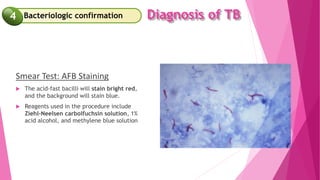
Smear Test: AFB Staining
 The acid-fast bacilli will stain bright red,
and the background will stain blue.
 Reagents used in the procedure include
Ziehl–Neelsen carbolfuchsin solution, 1%
acid alcohol, and methylene blue solution
Bacteriologic confirmation
4
Diagnosis of TB
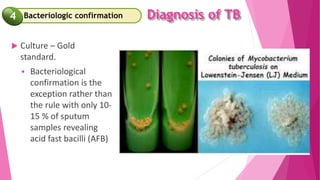
 Culture – Gold
standard.
 Bacteriological
confirmation is the
exception rather than
the rule with only 10-
15 % of sputum
samples revealing
acid fast bacilli (AFB)
Bacteriologic confirmation
4
Gastric aspirate vs induced sputum
Gastric aspirate
 30% to 50% yield
 Stain and culture yield from 3 GW higher than BAL1
Induced sputum
 Inhalation of 3-5% hypertonic saline
 Bronchospasm possible side effect
 Yield of 1 induced sputum equivalent to 3 GW
• Lighter Curr Probl Pediatr Adolesc Health Care 2009 2Zar Lancet 2005
Bacteriologic confirmation
4
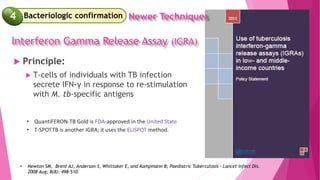
 Principle:
 T-cells of individuals with TB infection
secrete IFN-γ in response to re-stimulation
with M. tb-specific antigens
• Newton SM, Brent AJ, Anderson S, Whittaker E, and Kampmann B; Paediatric Tuberculosis - Lancet Infect Dis.
2008 Aug; 8(8): 498–510.
• QuantiFERON-TB Gold is FDA-approved in the United State
• T-SPOT.TB is another IGRA; it uses the ELISPOT method.
Interferon Gamma Release Assay (IGRA)
Newer Techniques
Bacteriologic confirmation
4
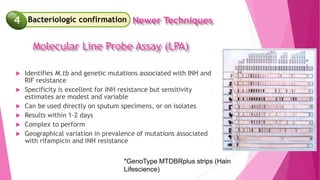
 Identifies M.tb and genetic mutations associated with INH and
RIF resistance
 Specificity is excellent for INH resistance but sensitivity
estimates are modest and variable
 Can be used directly on sputum specimens, or on isolates
 Results within 1-2 days
 Complex to perform
 Geographical variation in prevalence of mutations associated
with rifampicin and INH resistance
*GenoType MTDBRplus strips (Hain
Lifescience)
4 Newer Techniques
Bacteriologic confirmation
4
Molecular Line Probe Assay (LPA)
 Rapid detection of M.tb and Rif resistance
 Sensitivity: 95-99.5%; specificity: 95%
 For sputum smear (+)/(-)
 Minimal training
 Minimal space requirements
 Fully automated
 Results in 2 hours
Cartridge Based Nucleic Acid Amplification Test
4 Newer Techniques
Bacteriologic confirmation
4
Gene Xpert Mtb/Rif [CBNAAT]
1
2
3
4
5
Clinical Spectrum
Diagnosis
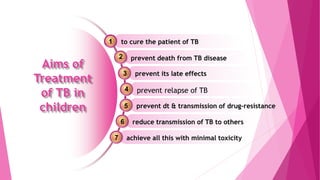
to cure the patient of TB
prevent death from TB disease
prevent its late effects
prevent relapse of TB
prevent dt & transmission of drug-resistance
reduce transmission of TB to others
achieve all this with minimal toxicity
Aims of
Treatment
of TB in
children
1
2
3
4
5
6
7
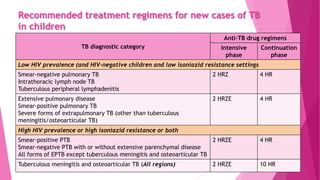
Recommended treatment regimens for new cases of TB
in children
TB diagnostic category
Anti-TB drug regimens
Intensive
phase
Continuation
phase
Low HIV prevalence (and HIV-negative children and low isoniazid resistance settings
Smear-negative pulmonary TB
Intrathoracic lymph node TB
Tuberculous peripheral lymphadenitis
2 HRZ 4 HR
Extensive pulmonary disease
Smear-positive pulmonary TB
Severe forms of extrapulmonary TB (other than tuberculous
meningitis/osteoarticular TB)
2 HRZE 4 HR
High HIV prevalence or high isoniazid resistance or both
Smear-positive PTB
Smear-negative PTB with or without extensive parenchymal disease
All forms of EPTB except tuberculous meningitis and osteoarticular TB
2 HRZE 4 HR
Tuberculous meningitis and osteoarticular TB (All regions) 2 HRZE 10 HR
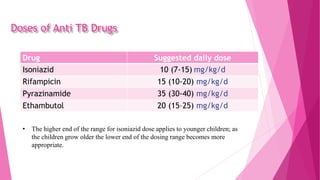
Doses of Anti TB Drugs
Drug Suggested daily dose
Isoniazid 10 (7-15) mg/kg/d
Rifampicin 15 (10-20) mg/kg/d
Pyrazinamide 35 (30-40) mg/kg/d
Ethambutol 20 (15–25) mg/kg/d
• The higher end of the range for isoniazid dose applies to younger children; as
the children grow older the lower end of the dosing range becomes more
appropriate.
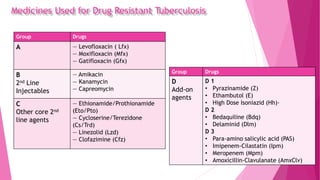
Medicines Used for Drug Resistant Tuberculosis
Group Drugs
A — Levofloxacin ( Lfx)
— Moxifloxacin (Mfx)
— Gatifloxacin (Gfx)
B
2nd Line
Injectables
— Amikacin
— Kanamycin
— Capreomycin
C
Other core 2nd
line agents
— Ethionamide/Prothionamide
(Eto/Pto)
— Cycloserine/Terezidone
(Cs/Trd)
— Linezolid (Lzd)
— Clofazimine (Cfz)
Group Drugs
D
Add-on
agents
D 1
• Pyrazinamide (Z)
• Ethambutol (E)
• High Dose Isoniazid (Hh)·
D 2
• Bedaquiline (Bdq)
• Delaminid (Dlm)
D 3
• Para-amino salicylic acid (PAS)
• Imipenem-Cilastatin (Ipm)
• Meropenem (Mpm)
• Amoxicillin-Clavulanate (AmxClv)
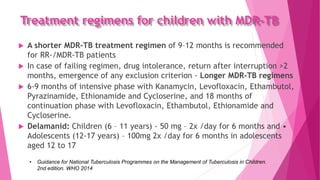
Treatment regimens for children with MDR-TB
 A shorter MDR-TB treatment regimen of 9–12 months is recommended
for RR-/MDR-TB patients
 In case of failing regimen, drug intolerance, return after interruption >2
months, emergence of any exclusion criterion - Longer MDR-TB regimens
 6-9 months of intensive phase with Kanamycin, Levofloxacin, Ethambutol,
Pyrazinamide, Ethionamide and Cycloserine, and 18 months of
continuation phase with Levofloxacin, Ethambutol, Ethionamide and
Cycloserine.
 Delamanid: Children (6 – 11 years) - 50 mg – 2x /day for 6 months and •
Adolescents (12-17 years) – 100mg 2x /day for 6 months in adolescents
aged 12 to 17
• Guidance for National Tuberculosis Programmes on the Management of Tuberculosis in Children.
2nd edition. WHO 2014
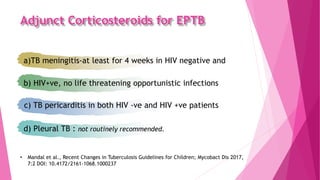
Adjunct Corticosteroids for EPTB
• Mandal et al., Recent Changes in Tuberculosis Guidelines for Children; Mycobact Dis 2017,
7:2 DOI: 10.4172/2161-1068.1000237
a)TB meningitis-at least for 4 weeks in HIV negative and
b) HIV+ve, no life threatening opportunistic infections
c) TB pericarditis in both HIV -ve and HIV +ve patients
d) Pleural TB : not routinely recommended.
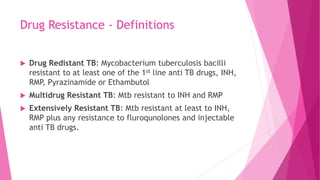
Drug Resistance - Definitions
 Drug Redistant TB: Mycobacterium tuberculosis bacilli
resistant to at least one of the 1st line anti TB drugs, INH,
RMP, Pyrazinamide or Ethambutol
 Multidrug Resistant TB: Mtb resistant to INH and RMP
 Extensively Resistant TB: Mtb resistant at least to INH,
RMP plus any resistance to fluroqunolones and injectable
anti TB drugs.
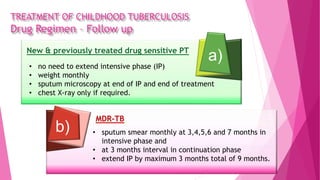
TREATMENT OF CHILDHOOD TUBERCULOSIS
Drug Regimen – Follow up
a)
b)
• no need to extend intensive phase (IP)
• weight monthly
• sputum microscopy at end of IP and end of treatment
• chest X-ray only if required.
New & previously treated drug sensitive PT
• sputum smear monthly at 3,4,5,6 and 7 months in
intensive phase and
• at 3 months interval in continuation phase
• extend IP by maximum 3 months total of 9 months.
MDR-TB
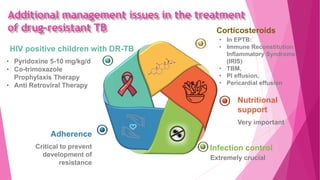
Additional management issues in the treatment
of drug-resistant TB
• In EPTB:
• Immune Reconstitution
Inflammatory Syndrome
(IRIS)
• TBM,
• Pl effusion,
• Pericardial effusion
Corticosteroids
Extremely crucial
Infection control
Very important
Nutritional
support
• Pyridoxine 5-10 mg/kg/d
• Co-trimoxazole
Prophylaxis Therapy
• Anti Retroviral Therapy
HIV positive children with DR-TB
Critical to prevent
development of
resistance
Adherence
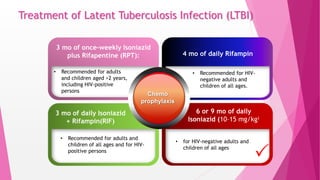
Treatment of Latent Tuberculosis Infection (LTBI)
• Recommended for adults
and children aged >2 years,
including HIV-positive
persons
3 mo of once-weekly Isoniazid
plus Rifapentine (RPT):
• Recommended for HIV-
negative adults and
children of all ages.
4 mo of daily Rifampin
• Recommended for adults and
children of all ages and for HIV-
positive persons
3 mo of daily Isoniazid
+ Rifampin(RIF)
• for HIV-negative adults and
children of all ages
6 or 9 mo of daily
Isoniazid (10–15 mg/kg)
Chemo
prophylaxis
P
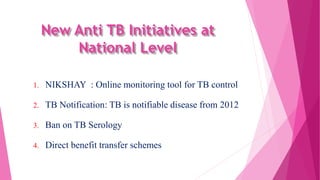
New Anti TB Initiatives at
National Level
1. NIKSHAY : Online monitoring tool for TB control
2. TB Notification: TB is notifiable disease from 2012
3. Ban on TB Serology
4. Direct benefit transfer schemes
 Dr.C.S.N.Vittal
Thank You

TB in pediatrics

  • 1.
    Tuberculosis in Children •Dr.C.S.N.Vitta l Roadmap towards ending TB in children and adolescents
  • 2.
  • 3.
  • 4.
    Attack of microbeson Humanity I wanna Kill - Plague Kill ya … - COVID 19 My turn … - SARS I too wanna Kill - Cholera Me too… - MERS
  • 5.
    I wanna Kill- Plague Kill ya … COVID 19 My turn …- SARS I too wanna Kill - Cholera Me too… - MERS Throughout the 1600-1800s in Europe& United States, TB caused 25% of all deaths. “If the number of victims that a disease claims is the measure of its significance then all the diseases particularly the most dreaded infections such as bubonic plague, Asiatic cholera, etc. must rank far behind tuberculosis” -- Die Ätiologie der Tuberculose, Robert Koch (1882) Ha Ha Ha … TB
  • 6.
  • 7.
  • 8.
  • 9.
    RNTCP (Revised National Tuberculosiscontrol Program) The initial objectives of the RNTCP in India were:  to achieve and maintain a TB treatment success rate of at least 85% among new sputum positive (NSP) patients.  to achieve and maintain detection of at least 70% of the estimated new sputum positive people in the community. The national goal was now the elimination of TB in India by 2025.
  • 10.
    RNTCP Gets AName Change  This implies targeting an 80 per cent reduction in incidence and 90 per cent reduction in mortality (base line 2015)
  • 11.
    Tuberculosis: in adultsvs in children Massive global disease burden that is well quantified; excellent awareness Massive global disease burden that is poorly quantified; minimal awareness Usually “adult-type” lung disease Usually intrathoracic lymph node disease, but extrapulmonary disease common Multibacillary; high infection risk Paucibacillary; low infection risk, unless cavities or extensive lung involvement; Difficult to differentiate acquired from primary drug resistance Nearly always primary drug resistance indicating recent transmission Infection Control Drug resistance Epidemiology Pathogenesis Well established facilities + Very much Inadequate facilities, formulations,etc Diag/Tt/Prevent
  • 12.
  • 13.
  • 14.
  • 15.
  • 16.
  • 17.
  • 18.
    Clinical Manifestations –Pulmonary TB  Primary Pulmonary Disease  Progressive primary pulmonary disease  Reactivation TB  Pleural Effusion  Upper Respiratory tract Disease  Lymph node disease  Lympho hematogenous (Disseminated TB) Spread • Incubation period varies between 4 and 8 weeks
  • 19.
    Bone & jointTB • Pott’s disease • Spondylitis • Spina ventosa Visceral TB • Renal • GI • Lymphnodes • Phlycten Perinatal TB • Congenital CNS TB • Tuberculoma • Meningitis Cutaneous TB • Lupus vulgaris • Scrofula derma • Verrucis cutis • Tuberculids Extra Pulmonary Tuberculosis
  • 20.
    Clinical Spectrum -Pulmonary TB  Ghon focus Uncomplicated— apex of the left lower lobe, lower part of upper lobe  Place where the “eagle has landed,” rarely seen because it is usually transient. (Gie 2003; Marais et al. 2004b). •Ranke’s complex – Ghon’s focus with fibrosis and calcification •Simon focus – Tuberculous nodule in lung apex Lesions of Primary TB
  • 21.
    Clinical Spectrum -Pulmonary TB  Intrathoracic lymph node disease (anteroposterior view) Primary Complex: 1. Ghon focus 2. Lymphatics 3. Hilar lymph nodes
  • 22.
    Clinical Spectrum –Pulmonary TB  Complicated Ghon focus  Poor disease containment at the point of entry; infants and severely immune- compromised individuals are particularly vulnerable. (Gie 2003; Marais et al. 2004b). Lesions of Secondary TB Puhl’s lesion (Aschoff-Puhl reinfection)– lesion in the lung apex and supraclavicular Assman focus – Infraclavicular lesion of pulmonary tuberculosis Progressive Primary Disease
  • 23.
    Clinical Spectrum –Pulmonary TB  Airway obstruction with “check valve” effect  Hyperinflation (ball valve effect) of left lung.  See remnant of Ghon focus and large left-sided perihilar nodes (Gie 2003; Marais et al. 2004b).
  • 24.
    Clinical Spectrum –Pulmonary TB Pleural effusion  Follows rupture of subpleural focus. Also by hematogenous spread from primary focus .  Hypersensitivity to tuberculoproteins  Asymptomatic (minor), Fever, cough, dyspnea, pleuritic chest pain
  • 25.
    Clinical Spectrum –Pulmonary TB Disseminated (miliary) disease  Heavy hematogenous spread of tubercle bacilli causing disease in 2 or more organs Miliary Tuberculosis: CXR - SNOW STROM appearance
  • 26.
    Clinical Spectrum –Pulmonary TB Adult-type disease  At 8–10 yr of age  Associated with an excessive and poorly regulated immune response  Any child with cavitary disease is infectious (as infectious as an adult sputum smear-positive case) and should be regarded as a potential source case.
  • 27.
    Symptoms - PulmonaryTB  Primary complex – mild fever, anorexia, weight loss, decreased activity, cough  Progressive primary complex – high grade fever, cough, expectoration and hemoptysis – cavity and ulceration of bronchus  Endobronchial TB – wheeze, fever, troublesome cough, dyspnea, cyanosis.  Wheezing child not responding to bronchodilators, less than 2 yrs age
  • 28.
    Symptoms  Cough (2weeks)  Fever (2 weeks)  Night sweats (drenching)  Weight loss or poor weight gain  Malaise and fatigue  Loss of appetite  Shortness of breath  Chest pain
  • 29.
  • 30.
    Diagnosis of TBin children Bacteriologic confirmation 4 Clinical judgment - based on exposure history & clinical features 1 Tuberculin Skin Test (TST) 2 Chest x-ray (CXR) 3
  • 31.
    Definitions in treatmentof TB in children • Children with persistent fever and/or cough, • loss of weight (loss of > 5% body weight as compared to highest weight recorded) • No weight gain in last 3 months and or • History of contact with infectious TB cases. Presumptive pediatric TB 01 02 03 • Based only on X-ray / Bacteriology Clinically diagnosed TB • Monoresistance: resistance to one 1st anti-TB drug only; • Poly-drug resistance (PDR) resistance to more than one first-line ATD, other than both INH and Rifampicin. • Multi-drug resistant (MDR) • Extensively-drug resistant (XDR) TB. Drug resistant TB
  • 33.
    Clinical judgment ExposureHistory  Closeness of contact - living in the same household or in frequent contact with a source case with smear-positive PTB.  Sputum smear result of index case (if known) - Children are infectious if smear (+) or with cavitary TB  Timing of contact children usually develop TB within 2 years after exposure and most (90%) within the 1st year  If no source case is identified, always ask about anyone in household with cough – if so, request assessment of that person for possible TB 1
  • 34.
     Check weight,record weight and compare to previous weight Clinical judgment 1 Clinical Features
  • 35.
    PEDISATC ON 2007 Varinder Singh Hassan, Aug 2007 MantouxTest A standard dose of 5 tuberculin units (TU - 0.1 ml) of PPD Tuberculin Skin Test (TST) 2
  • 36.
  • 37.
    Tuberculin Skin Test(TST) – Interpretation > 5 mm > 10 mm > 15 mm • Immunocompromised • HIV-infected children • severely malnourished; • Immunosuppressed patients • Organ transplnts • In presence of history of close contact, • Findings suggestive of TB • Persons with nodular or fibrotic changes on chest X- ray (old healed TB) • Patients with organ transplants, and other • In all other children (whether they have received BCG vaccination or not) • Persons with clinical conditions that place them at high risk • Children less than four years of age, or children and adolescents exposed to adults in high-risk categories • Persons with no known risk factors for TB
  • 38.
    – False Positive Causedby atypical tuberculous mycobacteria Previous administration of BCG vaccine. When the injected area is touched, causing swelling & itching Allergic reaction or hypersensitivity Infection at the site of test Tuberculin Skin Test (TST) 2
  • 39.
    False negative result RecentTB infection (less than 8–10 weeks) Recent Viral infection (EBV, measles, HIV, mumps, chicken pox) Chronic renal failure, Liver failure Hodgkin's disease, Lymphomas, Leukemia, Sarcoidosis Corticosteroid therapy/steroid use Immunological compromised state (malnutrition) Recent Live Viral Vaccine (3 weeks gap mandatory) Tuberculin Skin Test (TST) 2
  • 40.
    CXR  The commonestpicture: persistent opacification in the lung together with enlarged hilar or sub-carinal lymph glands.  A miliary pattern of opacification children is highly suggestive of TB. Adolescents:  Large pleural effusions and apical infiltrates with cavity formation being the most common forms of presentation (similar to adults).  May also develop primary disease with hilar adenopathy and collapse lesions visible on CXR. Chest x-ray 3
  • 41.
    Diagnosis of TB SmearTest: AFB Staining  The acid-fast bacilli will stain bright red, and the background will stain blue.  Reagents used in the procedure include Ziehl–Neelsen carbolfuchsin solution, 1% acid alcohol, and methylene blue solution Bacteriologic confirmation 4
  • 42.
    Diagnosis of TB Culture – Gold standard.  Bacteriological confirmation is the exception rather than the rule with only 10- 15 % of sputum samples revealing acid fast bacilli (AFB) Bacteriologic confirmation 4
  • 43.
    Gastric aspirate vsinduced sputum Gastric aspirate  30% to 50% yield  Stain and culture yield from 3 GW higher than BAL1 Induced sputum  Inhalation of 3-5% hypertonic saline  Bronchospasm possible side effect  Yield of 1 induced sputum equivalent to 3 GW • Lighter Curr Probl Pediatr Adolesc Health Care 2009 2Zar Lancet 2005 Bacteriologic confirmation 4
  • 44.
     Principle:  T-cellsof individuals with TB infection secrete IFN-γ in response to re-stimulation with M. tb-specific antigens • Newton SM, Brent AJ, Anderson S, Whittaker E, and Kampmann B; Paediatric Tuberculosis - Lancet Infect Dis. 2008 Aug; 8(8): 498–510. • QuantiFERON-TB Gold is FDA-approved in the United State • T-SPOT.TB is another IGRA; it uses the ELISPOT method. Interferon Gamma Release Assay (IGRA) Newer Techniques Bacteriologic confirmation 4
  • 45.
     Identifies M.tband genetic mutations associated with INH and RIF resistance  Specificity is excellent for INH resistance but sensitivity estimates are modest and variable  Can be used directly on sputum specimens, or on isolates  Results within 1-2 days  Complex to perform  Geographical variation in prevalence of mutations associated with rifampicin and INH resistance *GenoType MTDBRplus strips (Hain Lifescience) 4 Newer Techniques Bacteriologic confirmation 4 Molecular Line Probe Assay (LPA)
  • 46.
     Rapid detectionof M.tb and Rif resistance  Sensitivity: 95-99.5%; specificity: 95%  For sputum smear (+)/(-)  Minimal training  Minimal space requirements  Fully automated  Results in 2 hours Cartridge Based Nucleic Acid Amplification Test 4 Newer Techniques Bacteriologic confirmation 4 Gene Xpert Mtb/Rif [CBNAAT]
  • 47.
  • 48.
    to cure thepatient of TB prevent death from TB disease prevent its late effects prevent relapse of TB prevent dt & transmission of drug-resistance reduce transmission of TB to others achieve all this with minimal toxicity Aims of Treatment of TB in children 1 2 3 4 5 6 7
  • 49.
    Recommended treatment regimensfor new cases of TB in children TB diagnostic category Anti-TB drug regimens Intensive phase Continuation phase Low HIV prevalence (and HIV-negative children and low isoniazid resistance settings Smear-negative pulmonary TB Intrathoracic lymph node TB Tuberculous peripheral lymphadenitis 2 HRZ 4 HR Extensive pulmonary disease Smear-positive pulmonary TB Severe forms of extrapulmonary TB (other than tuberculous meningitis/osteoarticular TB) 2 HRZE 4 HR High HIV prevalence or high isoniazid resistance or both Smear-positive PTB Smear-negative PTB with or without extensive parenchymal disease All forms of EPTB except tuberculous meningitis and osteoarticular TB 2 HRZE 4 HR Tuberculous meningitis and osteoarticular TB (All regions) 2 HRZE 10 HR
  • 50.
    Doses of AntiTB Drugs Drug Suggested daily dose Isoniazid 10 (7-15) mg/kg/d Rifampicin 15 (10-20) mg/kg/d Pyrazinamide 35 (30-40) mg/kg/d Ethambutol 20 (15–25) mg/kg/d • The higher end of the range for isoniazid dose applies to younger children; as the children grow older the lower end of the dosing range becomes more appropriate.
  • 53.
    Medicines Used forDrug Resistant Tuberculosis Group Drugs A — Levofloxacin ( Lfx) — Moxifloxacin (Mfx) — Gatifloxacin (Gfx) B 2nd Line Injectables — Amikacin — Kanamycin — Capreomycin C Other core 2nd line agents — Ethionamide/Prothionamide (Eto/Pto) — Cycloserine/Terezidone (Cs/Trd) — Linezolid (Lzd) — Clofazimine (Cfz) Group Drugs D Add-on agents D 1 • Pyrazinamide (Z) • Ethambutol (E) • High Dose Isoniazid (Hh)· D 2 • Bedaquiline (Bdq) • Delaminid (Dlm) D 3 • Para-amino salicylic acid (PAS) • Imipenem-Cilastatin (Ipm) • Meropenem (Mpm) • Amoxicillin-Clavulanate (AmxClv)
  • 54.
    Treatment regimens forchildren with MDR-TB  A shorter MDR-TB treatment regimen of 9–12 months is recommended for RR-/MDR-TB patients  In case of failing regimen, drug intolerance, return after interruption >2 months, emergence of any exclusion criterion - Longer MDR-TB regimens  6-9 months of intensive phase with Kanamycin, Levofloxacin, Ethambutol, Pyrazinamide, Ethionamide and Cycloserine, and 18 months of continuation phase with Levofloxacin, Ethambutol, Ethionamide and Cycloserine.  Delamanid: Children (6 – 11 years) - 50 mg – 2x /day for 6 months and • Adolescents (12-17 years) – 100mg 2x /day for 6 months in adolescents aged 12 to 17 • Guidance for National Tuberculosis Programmes on the Management of Tuberculosis in Children. 2nd edition. WHO 2014
  • 55.
    Adjunct Corticosteroids forEPTB • Mandal et al., Recent Changes in Tuberculosis Guidelines for Children; Mycobact Dis 2017, 7:2 DOI: 10.4172/2161-1068.1000237 a)TB meningitis-at least for 4 weeks in HIV negative and b) HIV+ve, no life threatening opportunistic infections c) TB pericarditis in both HIV -ve and HIV +ve patients d) Pleural TB : not routinely recommended.
  • 56.
    Drug Resistance -Definitions  Drug Redistant TB: Mycobacterium tuberculosis bacilli resistant to at least one of the 1st line anti TB drugs, INH, RMP, Pyrazinamide or Ethambutol  Multidrug Resistant TB: Mtb resistant to INH and RMP  Extensively Resistant TB: Mtb resistant at least to INH, RMP plus any resistance to fluroqunolones and injectable anti TB drugs.
  • 57.
    TREATMENT OF CHILDHOODTUBERCULOSIS Drug Regimen – Follow up a) b) • no need to extend intensive phase (IP) • weight monthly • sputum microscopy at end of IP and end of treatment • chest X-ray only if required. New & previously treated drug sensitive PT • sputum smear monthly at 3,4,5,6 and 7 months in intensive phase and • at 3 months interval in continuation phase • extend IP by maximum 3 months total of 9 months. MDR-TB
  • 58.
    Additional management issuesin the treatment of drug-resistant TB • In EPTB: • Immune Reconstitution Inflammatory Syndrome (IRIS) • TBM, • Pl effusion, • Pericardial effusion Corticosteroids Extremely crucial Infection control Very important Nutritional support • Pyridoxine 5-10 mg/kg/d • Co-trimoxazole Prophylaxis Therapy • Anti Retroviral Therapy HIV positive children with DR-TB Critical to prevent development of resistance Adherence
  • 59.
    Treatment of LatentTuberculosis Infection (LTBI) • Recommended for adults and children aged >2 years, including HIV-positive persons 3 mo of once-weekly Isoniazid plus Rifapentine (RPT): • Recommended for HIV- negative adults and children of all ages. 4 mo of daily Rifampin • Recommended for adults and children of all ages and for HIV- positive persons 3 mo of daily Isoniazid + Rifampin(RIF) • for HIV-negative adults and children of all ages 6 or 9 mo of daily Isoniazid (10–15 mg/kg) Chemo prophylaxis P
  • 60.
    New Anti TBInitiatives at National Level 1. NIKSHAY : Online monitoring tool for TB control 2. TB Notification: TB is notifiable disease from 2012 3. Ban on TB Serology 4. Direct benefit transfer schemes
  • 61.