04/09/16 JStar 1
CHILDHOOD DISORDERS
04/09/16 JStar 2
Goals
• Understanding how symptoms of psychiatric
disorders differ in children and adolescents
 Psychiatric disorders:
 Mood
 Anxiety
 Psychotic
 Disorders first usually diagnosed in Infancy.
Childhood and Adolescence
 Eating disorders
04/09/16 JStar 3
Mental Retardation
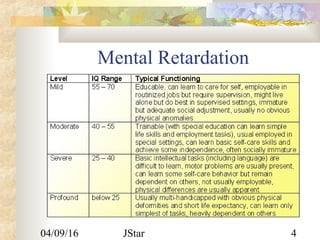
 Defined as intellectual functioning with an IQ less than 70
 Also need delays in two or more adaptive areas
 Self care
 Communication
 Testing:
 Vineland Adaptive Behavior Scales-measure of personal and social
skills
 Weschler-compares individual test performance to normative of age
group
 WISC or Stanford-Binet- intelligence test
04/09/16 JStar 4
Mental Retardation
04/09/16 JStar 5
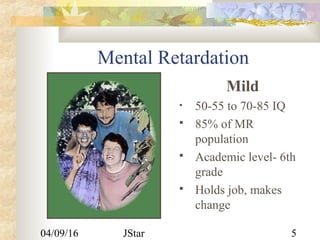
Mental Retardation
Mild
• 50-55 to 70-85 IQ
 85% of MR
population
 Academic level- 6th
grade
 Holds job, makes
change
04/09/16 JStar 6
Mental Retardation
Moderate
 35-40 to 50-55 IQ
 10% of MR
population
 Academic level-2nd
grade
 Makes small change
Severe
 20-25 to 35-40 IQ
 4% of MR population
 Academic level-
below 1st
 Can use coin
machines
04/09/16 JStar 7
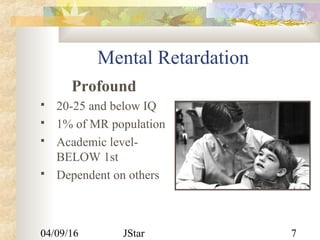
Mental Retardation
Profound
 20-25 and below IQ
 1% of MR population
 Academic level-
BELOW 1st
 Dependent on others
04/09/16 JStar 8
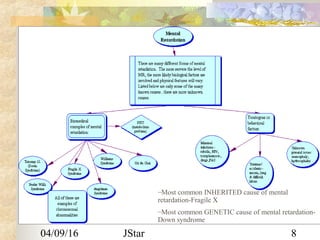
–Most common INHERITED cause of mental
retardation-Fragile X
–Most common GENETIC cause of mental retardation-
Down syndrome
04/09/16 JStar 9
Treatment Considerations
 Family is coping with loss of “ideal” child
 Grief and loss issues
 Appropriate placement.
 School setting, day care, group homes, sheltered workshop and
respite care
 Specific problems responsive to medications
 Seizures Disorders
 Affective Disorders
 ADHD
 Aggression
04/09/16 JStar 10
04/09/16 JStar 11
Pervasive Developmental Disorders
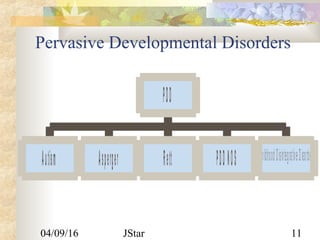
Autism Asperger Rett PDDNOS ChildhoodDisintegrativeDisorder
PDD
04/09/16 JStar 12
Pervasive Developmental Disorders
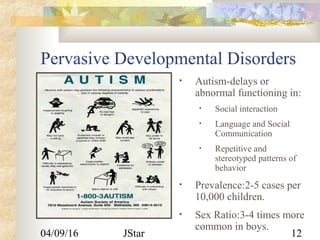
• Autism-delays or
abnormal functioning in:
• Social interaction
• Language and Social
Communication
• Repetitive and
stereotyped patterns of
behavior
• Prevalence:2-5 cases per
10,000 children.
• Sex Ratio:3-4 times more
common in boys.
04/09/16 JStar 13
AUSTISTIC DISORDER
Diagnostic Criteria: (cont)
• Marked lack of awareness of others’ feelings
• No or abnormal comfort-seeking
• No or impaired imitation.
• No or abnormal social play.
• Gross deficits in making friendships
• Impaired non-verbal behavior (e.g. eye contact, body
postures)
A. Qualitative Impairment in Reciprocal Social
Interaction.
04/09/16 JStar 14
AUTISTIC DISORDER
Diagnostic Criteria: (cont)
• Delay or lack of spoken language
• Impaired ability to initiate or maintain
conversation
• Stereotypic, repetitive or idiosyncratic use of
language
• Impaired ability to converse with others
B. Impaired Verbal and Nonverbal Communication
04/09/16 JStar 15
AUTISTIC DISORDER
Diagnostic Criteria: (cont)
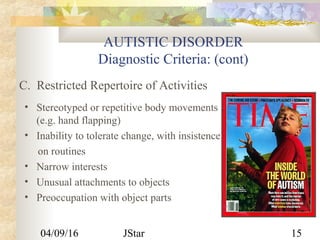
• Stereotyped or repetitive body movements
(e.g. hand flapping)
• Inability to tolerate change, with insistence
on routines
• Narrow interests
• Unusual attachments to objects
• Preoccupation with object parts
C. Restricted Repertoire of Activities
04/09/16 JStar 16
Etiology of Autism
 Psychological theories have not been confirmed
 Not caused by bad parenting
 “Common final pathway” --
i.e., association with a variety of disorders:
-Congenital rubella & - Genetic disorders, including
other infections Fragile X
- Postnatal infection. - Metabolic disorders
• Approximately 70% have mental retardation
• Approximately 30% have seizures
04/09/16 JStar 17
Interventions in Autism
Presently: No curative treatment.
Symptomatic approaches.
Mainstay: Structured behavioral and
educational programs.
Medications: To control seizures,
hyperactivity, severe
aggression, or mood disorders.
Investigational: Reciprocal communication
training
04/09/16 JStar 18
Asperger’s Disorder
 “High functioning autism”
 Stereotypic, repetitive mannerisms
 Lack of interactive play/communication
 Loss of communication skills
 No delays in language and cognitive development
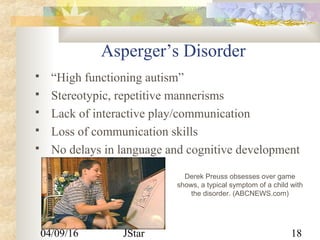
Derek Preuss obsesses over game
shows, a typical symptom of a child with
the disorder. (ABCNEWS.com)
04/09/16 JStar 19
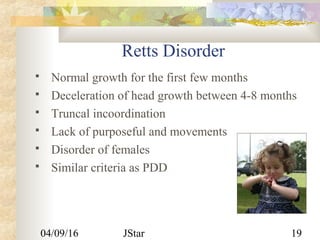
Retts Disorder
 Normal growth for the first few months
 Deceleration of head growth between 4-8 months
 Truncal incoordination
 Lack of purposeful and movements
 Disorder of females
 Similar criteria as PDD
04/09/16 JStar 20
Childhood Disintegrative Disorder
 Normal development for at least two years after
birth
 Clinically significant loss of previously acquired
skills (before age 10 years): in 2 or more of the
following areas:
 Language
 Social skills or adaptive behavior
 Bowel or bladder control
 Play
 Motor skills
04/09/16 JStar 21
PDD NOS
When there is no severe and pervasive
impairment in the development of reciprocal
social interaction, or communication skills, or
when stereotyped behaviors and activities are
present but the criteria are not met for a
specific pervasive developmental disorder.
04/09/16 JStar 22
Pervasive Developmental Disorders
04/09/16 JStar 23
Learning Disorders
Definition
 Skills in a specific academic area are greatly
below those expected for age or IQ and academic
level
 Must cause academic or adaptive defect
04/09/16 JStar 24
Learning, Motor Skills &
Communication Disorders
Types:
- Reading Disorder
- Mathematics Disorder
- Disorder of Written Expression
- Developmental Coordination Disorder
- Expressive Language Disorder
- Mixed Receptive-Expressive Language Disorder
- Phonological Disorder
- Stuttering
04/09/16 JStar 25
Learning Disorders
Course/Prognosis
 Diagnosed in grade
school, but not outgrown
 Complications include:
 low self-esteem
 school dropout
 low frustration tolerance
 Academic achievement
associated with language
skills
04/09/16 JStar 26
Learning Disorders
Diagnosis
 Academic testing
 Speech and language
skills testing
 Motor testing
 Cognitive testing
 Observation of the
child in the classroom
Treatment
 Multidisciplinary plan
 Tx for specific
developmental disorders
in public schools is
mandated by law
 Included least restrictive
environment and
Individual Educational
Plan
04/09/16 JStar 27
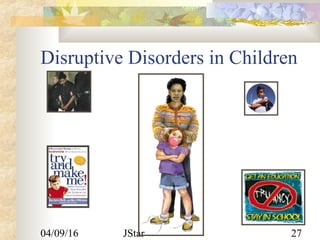
Disruptive Disorders in Children
04/09/16 JStar 28
Oppositional Defiant Disorder
A pattern of negativistic, hostile and defiant behavior
lasting greater than 6 months of which you have 4
or more of the following:
 Loses temper
 Argues with adults
 Actively defies or refuses to comply with rules
 Often deliberately annoys people
 Blames others for his/her mistakes
 Often touchy or easily annoyed with others
 Often angry and resentful
 Often spiteful or vindictive
04/09/16 JStar 29
Oppositional Defiant Disorder
(ODD)
 Prevalence-3-10%
 Male to female -2-3:1
 Outcome-in one study,
44% of 7-12 year old
boys with ODD
developed into CD
 Evaluation-Look for
comorbid ADHD,
depression, anxiety
&LD/MR
04/09/16 JStar 30
Oppositional Defiant Disorder
http://www.hsc.wvu.edu/aap/aap-car/videos.htm
04/09/16 JStar 31
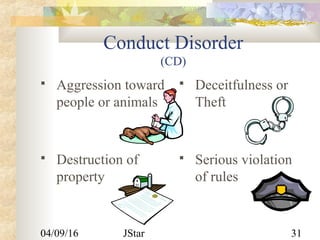
Conduct Disorder
(CD)
 Aggression toward
people or animals
 Deceitfulness or
Theft
 Destruction of
property
 Serious violation
of rules
04/09/16 JStar 32
Conduct Disorder
(CD)
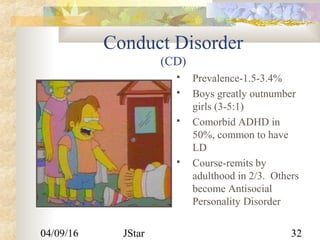
 Prevalence-1.5-3.4%
 Boys greatly outnumber
girls (3-5:1)
 Comorbid ADHD in
50%, common to have
LD
 Course-remits by
adulthood in 2/3. Others
become Antisocial
Personality Disorder
04/09/16 JStar 33
Conduct Disorder
“You left your D__M care in the driveway again!”
04/09/16 JStar 34
Conduct Disorder
http://www.hsc.wvu.edu/aap/aap-car/videos.htm
04/09/16 JStar 35
04/09/16 JStar 36
Movement Disorders
Chorea
 Chorea-Continuous, unsustained, rapid, abrupt and
random contractions
 Causes of chorea-metabolic disorders, medication
induced, Syndenham chorea, metabolic disorders,
nutritional disorders, SLE, CNS abnormalities
 Etiology of Syndenham chorea-Group A hemolytic
streptococcal infection
 Clinical features of Syndenham chorea-irritability,
emotional lability and abnormal choreiform movements
 Treatment of Syndenham chorea-PCN prophylaxis x 10
years, cardiac screening, antipsychotic (severe cases)
04/09/16 JStar 37
Movement Disorders
• Tic-sudden, rapid, recurrent, nonrhythmic,
sterotyped motor movement or vocalization
• Tourette’s syndrome-motor and vocal tics for
greater than one year
• Tourette’s Disorder-1/1000 boys & /10000 girls
 Onset of Tourette’s- ages 7-14 years (rarely
postpubertal)
 Tourette syndrome is associated with LD, ADHD
and OCD
04/09/16 JStar 38
Movement Disorders
http://www.wemove.org/ts_ssv1.0.html
04/09/16 JStar 39
Attention Deficit Hyperactivity Disorder
 Symptoms for at least six
months to a degree that it
is maladaptive and
INCONSISTENT with
developmental level
 Some symptoms present
prior to age 7 years
 Two or more settings
04/09/16 JStar 40
Attention Deficit Hyperactivity Disorder
 Inattention
 Poor organization
 Does not seem to listen
when spoken to
 Loses objects
 Easily distracted
 Forgetful in daily
activities
 Hyperactivity/Impulsivit
y
 Fidget
 Leaves seat often
 Runs or climbs
excessively
 Always “on the go”
 Talks excessively
 Blurts out answers
 Can’t wait turn,
interrupts others
04/09/16 JStar 41
Attention Deficit Hyperactivity Disorder
 Attention deficit disorder can occur WITH
and WITHOUT hyperactivity
 Hyperactivity is more common in boys
than girls
 ADHD is difficult to diagnose in the early
years (age 4-6)
04/09/16 JStar 42
Attention Deficit Hyperactivity Disorder
Medical Causes of hyperactivity and/or attention problems
• Birth complications-hypoxia, toxemia
• Fragile X Syndrome, PKU, resistance to
thyroid hormone
• Brain injury-trauma or infection
• Lead poisoning
04/09/16 JStar 43
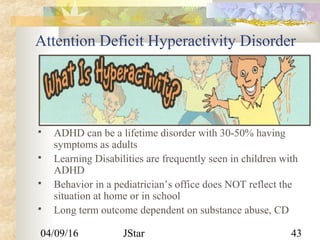
Attention Deficit Hyperactivity Disorder
 ADHD can be a lifetime disorder with 30-50% having
symptoms as adults
 Learning Disabilities are frequently seen in children with
ADHD
 Behavior in a pediatrician’s office does NOT reflect the
situation at home or in school
 Long term outcome dependent on substance abuse, CD
04/09/16 JStar 44
Attention Deficit Hyperactivity Disorder
 Stimulant medications improve attention in
normal individuals as well as children with
ADHD
 Medication alone is usually not sufficient for the
treatment of ADHD
 It is of upmost importance to communicate with
the ADHD/LD child’s teacher
 Mentally retarded children with symptoms of
hyperactivity and short attention may respond to
medication in different manner
04/09/16 JStar 45
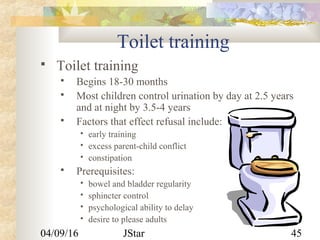
Toilet training
 Toilet training
 Begins 18-30 months
 Most children control urination by day at 2.5 years
and at night by 3.5-4 years
 Factors that effect refusal include:
 early training
 excess parent-child conflict
 constipation
 Prerequisites:
 bowel and bladder regularity
 sphincter control
 psychological ability to delay
 desire to please adults
04/09/16 JStar 46
Enuresis
 Primary vs secondary enuresis
 Nocturnal vs. diurnal
 DIURNAL enuresis after
continence is achieved should
prompt evaluation
 Family history of enuresis
 Laboratory studies are
unlikely to be positive unless
other clinical findings are
present
 Treatment with medications
and behavioral plan
04/09/16 JStar 47
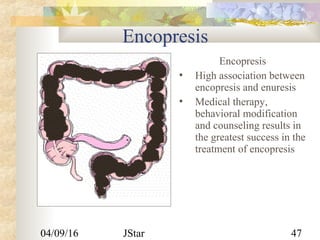
Encopresis
Encopresis
 High association between
encopresis and enuresis
 Medical therapy,
behavioral modification
and counseling results in
the greatest success in the
treatment of encopresis
04/09/16 JStar 48
Our Time is up!

Childhood psychiatry disorders

  • 1.
  • 2.
    04/09/16 JStar 2 Goals •Understanding how symptoms of psychiatric disorders differ in children and adolescents  Psychiatric disorders:  Mood  Anxiety  Psychotic  Disorders first usually diagnosed in Infancy. Childhood and Adolescence  Eating disorders
  • 3.
    04/09/16 JStar 3 MentalRetardation  Defined as intellectual functioning with an IQ less than 70  Also need delays in two or more adaptive areas  Self care  Communication  Testing:  Vineland Adaptive Behavior Scales-measure of personal and social skills  Weschler-compares individual test performance to normative of age group  WISC or Stanford-Binet- intelligence test
  • 4.
  • 5.
    04/09/16 JStar 5 MentalRetardation Mild • 50-55 to 70-85 IQ  85% of MR population  Academic level- 6th grade  Holds job, makes change
  • 6.
    04/09/16 JStar 6 MentalRetardation Moderate  35-40 to 50-55 IQ  10% of MR population  Academic level-2nd grade  Makes small change Severe  20-25 to 35-40 IQ  4% of MR population  Academic level- below 1st  Can use coin machines
  • 7.
    04/09/16 JStar 7 MentalRetardation Profound  20-25 and below IQ  1% of MR population  Academic level- BELOW 1st  Dependent on others
  • 8.
    04/09/16 JStar 8 –Mostcommon INHERITED cause of mental retardation-Fragile X –Most common GENETIC cause of mental retardation- Down syndrome
  • 9.
    04/09/16 JStar 9 TreatmentConsiderations  Family is coping with loss of “ideal” child  Grief and loss issues  Appropriate placement.  School setting, day care, group homes, sheltered workshop and respite care  Specific problems responsive to medications  Seizures Disorders  Affective Disorders  ADHD  Aggression
  • 10.
  • 11.
    04/09/16 JStar 11 PervasiveDevelopmental Disorders Autism Asperger Rett PDDNOS ChildhoodDisintegrativeDisorder PDD
  • 12.
    04/09/16 JStar 12 PervasiveDevelopmental Disorders • Autism-delays or abnormal functioning in: • Social interaction • Language and Social Communication • Repetitive and stereotyped patterns of behavior • Prevalence:2-5 cases per 10,000 children. • Sex Ratio:3-4 times more common in boys.
  • 13.
    04/09/16 JStar 13 AUSTISTICDISORDER Diagnostic Criteria: (cont) • Marked lack of awareness of others’ feelings • No or abnormal comfort-seeking • No or impaired imitation. • No or abnormal social play. • Gross deficits in making friendships • Impaired non-verbal behavior (e.g. eye contact, body postures) A. Qualitative Impairment in Reciprocal Social Interaction.
  • 14.
    04/09/16 JStar 14 AUTISTICDISORDER Diagnostic Criteria: (cont) • Delay or lack of spoken language • Impaired ability to initiate or maintain conversation • Stereotypic, repetitive or idiosyncratic use of language • Impaired ability to converse with others B. Impaired Verbal and Nonverbal Communication
  • 15.
    04/09/16 JStar 15 AUTISTICDISORDER Diagnostic Criteria: (cont) • Stereotyped or repetitive body movements (e.g. hand flapping) • Inability to tolerate change, with insistence on routines • Narrow interests • Unusual attachments to objects • Preoccupation with object parts C. Restricted Repertoire of Activities
  • 16.
    04/09/16 JStar 16 Etiologyof Autism  Psychological theories have not been confirmed  Not caused by bad parenting  “Common final pathway” -- i.e., association with a variety of disorders: -Congenital rubella & - Genetic disorders, including other infections Fragile X - Postnatal infection. - Metabolic disorders • Approximately 70% have mental retardation • Approximately 30% have seizures
  • 17.
    04/09/16 JStar 17 Interventionsin Autism Presently: No curative treatment. Symptomatic approaches. Mainstay: Structured behavioral and educational programs. Medications: To control seizures, hyperactivity, severe aggression, or mood disorders. Investigational: Reciprocal communication training
  • 18.
    04/09/16 JStar 18 Asperger’sDisorder  “High functioning autism”  Stereotypic, repetitive mannerisms  Lack of interactive play/communication  Loss of communication skills  No delays in language and cognitive development Derek Preuss obsesses over game shows, a typical symptom of a child with the disorder. (ABCNEWS.com)
  • 19.
    04/09/16 JStar 19 RettsDisorder  Normal growth for the first few months  Deceleration of head growth between 4-8 months  Truncal incoordination  Lack of purposeful and movements  Disorder of females  Similar criteria as PDD
  • 20.
    04/09/16 JStar 20 ChildhoodDisintegrative Disorder  Normal development for at least two years after birth  Clinically significant loss of previously acquired skills (before age 10 years): in 2 or more of the following areas:  Language  Social skills or adaptive behavior  Bowel or bladder control  Play  Motor skills
  • 21.
    04/09/16 JStar 21 PDDNOS When there is no severe and pervasive impairment in the development of reciprocal social interaction, or communication skills, or when stereotyped behaviors and activities are present but the criteria are not met for a specific pervasive developmental disorder.
  • 22.
    04/09/16 JStar 22 PervasiveDevelopmental Disorders
  • 23.
    04/09/16 JStar 23 LearningDisorders Definition  Skills in a specific academic area are greatly below those expected for age or IQ and academic level  Must cause academic or adaptive defect
  • 24.
    04/09/16 JStar 24 Learning,Motor Skills & Communication Disorders Types: - Reading Disorder - Mathematics Disorder - Disorder of Written Expression - Developmental Coordination Disorder - Expressive Language Disorder - Mixed Receptive-Expressive Language Disorder - Phonological Disorder - Stuttering
  • 25.
    04/09/16 JStar 25 LearningDisorders Course/Prognosis  Diagnosed in grade school, but not outgrown  Complications include:  low self-esteem  school dropout  low frustration tolerance  Academic achievement associated with language skills
  • 26.
    04/09/16 JStar 26 LearningDisorders Diagnosis  Academic testing  Speech and language skills testing  Motor testing  Cognitive testing  Observation of the child in the classroom Treatment  Multidisciplinary plan  Tx for specific developmental disorders in public schools is mandated by law  Included least restrictive environment and Individual Educational Plan
  • 27.
    04/09/16 JStar 27 DisruptiveDisorders in Children
  • 28.
    04/09/16 JStar 28 OppositionalDefiant Disorder A pattern of negativistic, hostile and defiant behavior lasting greater than 6 months of which you have 4 or more of the following:  Loses temper  Argues with adults  Actively defies or refuses to comply with rules  Often deliberately annoys people  Blames others for his/her mistakes  Often touchy or easily annoyed with others  Often angry and resentful  Often spiteful or vindictive
  • 29.
    04/09/16 JStar 29 OppositionalDefiant Disorder (ODD)  Prevalence-3-10%  Male to female -2-3:1  Outcome-in one study, 44% of 7-12 year old boys with ODD developed into CD  Evaluation-Look for comorbid ADHD, depression, anxiety &LD/MR
  • 30.
    04/09/16 JStar 30 OppositionalDefiant Disorder http://www.hsc.wvu.edu/aap/aap-car/videos.htm
  • 31.
    04/09/16 JStar 31 ConductDisorder (CD)  Aggression toward people or animals  Deceitfulness or Theft  Destruction of property  Serious violation of rules
  • 32.
    04/09/16 JStar 32 ConductDisorder (CD)  Prevalence-1.5-3.4%  Boys greatly outnumber girls (3-5:1)  Comorbid ADHD in 50%, common to have LD  Course-remits by adulthood in 2/3. Others become Antisocial Personality Disorder
  • 33.
    04/09/16 JStar 33 ConductDisorder “You left your D__M care in the driveway again!”
  • 34.
    04/09/16 JStar 34 ConductDisorder http://www.hsc.wvu.edu/aap/aap-car/videos.htm
  • 35.
  • 36.
    04/09/16 JStar 36 MovementDisorders Chorea  Chorea-Continuous, unsustained, rapid, abrupt and random contractions  Causes of chorea-metabolic disorders, medication induced, Syndenham chorea, metabolic disorders, nutritional disorders, SLE, CNS abnormalities  Etiology of Syndenham chorea-Group A hemolytic streptococcal infection  Clinical features of Syndenham chorea-irritability, emotional lability and abnormal choreiform movements  Treatment of Syndenham chorea-PCN prophylaxis x 10 years, cardiac screening, antipsychotic (severe cases)
  • 37.
    04/09/16 JStar 37 MovementDisorders • Tic-sudden, rapid, recurrent, nonrhythmic, sterotyped motor movement or vocalization • Tourette’s syndrome-motor and vocal tics for greater than one year • Tourette’s Disorder-1/1000 boys & /10000 girls  Onset of Tourette’s- ages 7-14 years (rarely postpubertal)  Tourette syndrome is associated with LD, ADHD and OCD
  • 38.
    04/09/16 JStar 38 MovementDisorders http://www.wemove.org/ts_ssv1.0.html
  • 39.
    04/09/16 JStar 39 AttentionDeficit Hyperactivity Disorder  Symptoms for at least six months to a degree that it is maladaptive and INCONSISTENT with developmental level  Some symptoms present prior to age 7 years  Two or more settings
  • 40.
    04/09/16 JStar 40 AttentionDeficit Hyperactivity Disorder  Inattention  Poor organization  Does not seem to listen when spoken to  Loses objects  Easily distracted  Forgetful in daily activities  Hyperactivity/Impulsivit y  Fidget  Leaves seat often  Runs or climbs excessively  Always “on the go”  Talks excessively  Blurts out answers  Can’t wait turn, interrupts others
  • 41.
    04/09/16 JStar 41 AttentionDeficit Hyperactivity Disorder  Attention deficit disorder can occur WITH and WITHOUT hyperactivity  Hyperactivity is more common in boys than girls  ADHD is difficult to diagnose in the early years (age 4-6)
  • 42.
    04/09/16 JStar 42 AttentionDeficit Hyperactivity Disorder Medical Causes of hyperactivity and/or attention problems • Birth complications-hypoxia, toxemia • Fragile X Syndrome, PKU, resistance to thyroid hormone • Brain injury-trauma or infection • Lead poisoning
  • 43.
    04/09/16 JStar 43 AttentionDeficit Hyperactivity Disorder  ADHD can be a lifetime disorder with 30-50% having symptoms as adults  Learning Disabilities are frequently seen in children with ADHD  Behavior in a pediatrician’s office does NOT reflect the situation at home or in school  Long term outcome dependent on substance abuse, CD
  • 44.
    04/09/16 JStar 44 AttentionDeficit Hyperactivity Disorder  Stimulant medications improve attention in normal individuals as well as children with ADHD  Medication alone is usually not sufficient for the treatment of ADHD  It is of upmost importance to communicate with the ADHD/LD child’s teacher  Mentally retarded children with symptoms of hyperactivity and short attention may respond to medication in different manner
  • 45.
    04/09/16 JStar 45 Toilettraining  Toilet training  Begins 18-30 months  Most children control urination by day at 2.5 years and at night by 3.5-4 years  Factors that effect refusal include:  early training  excess parent-child conflict  constipation  Prerequisites:  bowel and bladder regularity  sphincter control  psychological ability to delay  desire to please adults
  • 46.
    04/09/16 JStar 46 Enuresis Primary vs secondary enuresis  Nocturnal vs. diurnal  DIURNAL enuresis after continence is achieved should prompt evaluation  Family history of enuresis  Laboratory studies are unlikely to be positive unless other clinical findings are present  Treatment with medications and behavioral plan
  • 47.
    04/09/16 JStar 47 Encopresis Encopresis High association between encopresis and enuresis  Medical therapy, behavioral modification and counseling results in the greatest success in the treatment of encopresis
  • 48.