ATTENTION –DEFICIT  HYPER ACTIVITY DISORDER DR.A.GODSON MD  - PSYCHIATRY
What is ADHD? A pattern of diminished sustained attention and high impulsivity in child or adolescent than expected for someone of that age and developmental level Three types: Combined Type, Predominantly Inattentive Type, and Predominantly Hyperactive-Impulsive Type .
ADHD-STATISTICS: 5-10% of the entire U.S. population Males are 3 to 6 times more likely  than females. At least 50% of ADHD sufferers have another diagnosable mental disorder. 3-5% of all school-age children are estimated to have this disorder

First degree biological relatives are at high risk Parents shows increased incidence of –hyperkinesis,sociopathy,alcohol  abuse,conversion disorder Symptoms often present by 3 years,but diagnosis made only at school setting
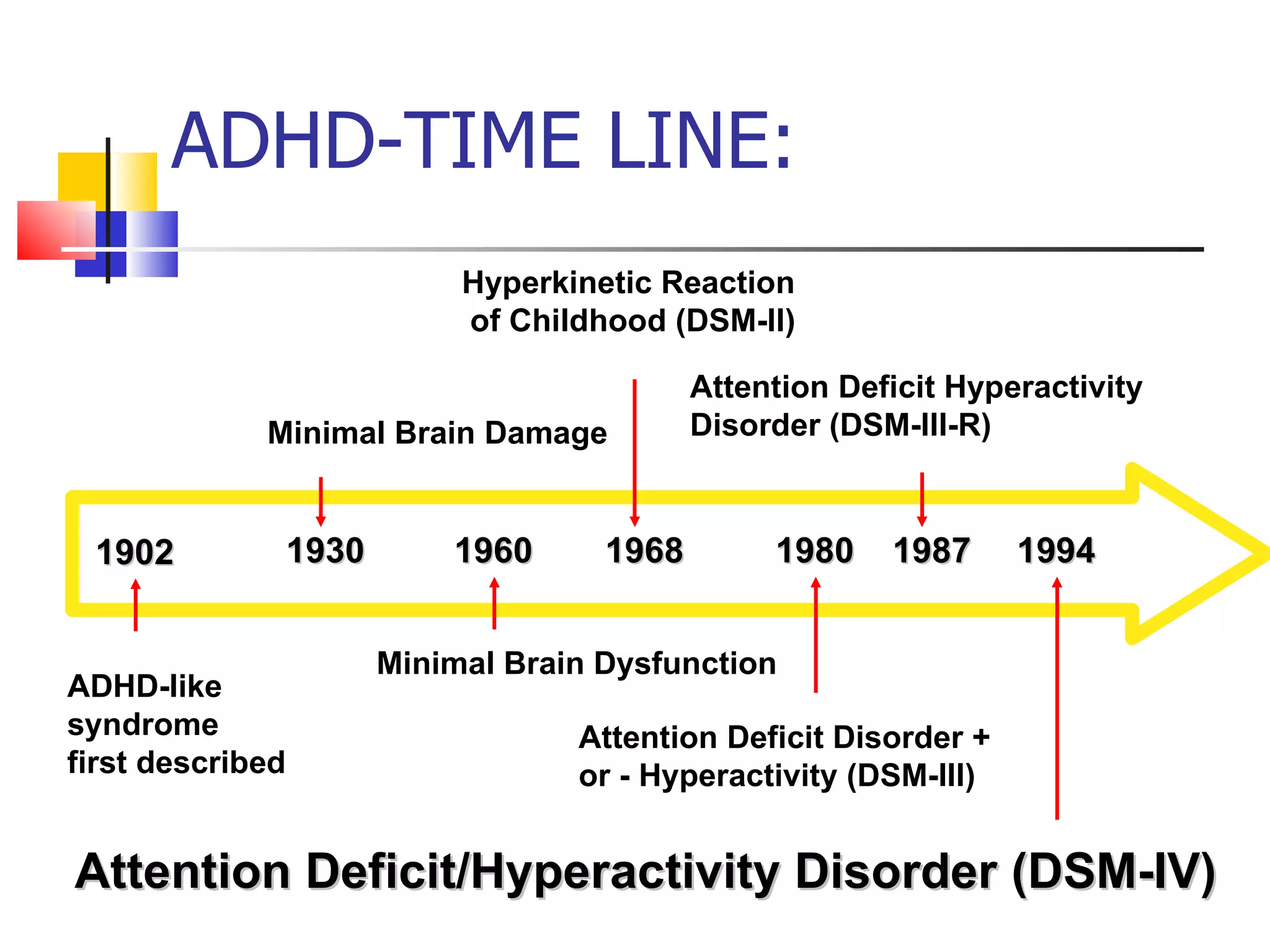
ADHD-TIME LINE: Minimal Brain Dysfunction Minimal Brain Damage Hyperkinetic Reaction  of Childhood (DSM-II) Attention Deficit Disorder + or - Hyperactivity (DSM-III) Attention Deficit Hyperactivity  Disorder (DSM-III-R) 1960 1980 1968 1987 1994 Attention Deficit/Hyperactivity Disorder (DSM-IV) 1930 ADHD-like syndrome first described 1902
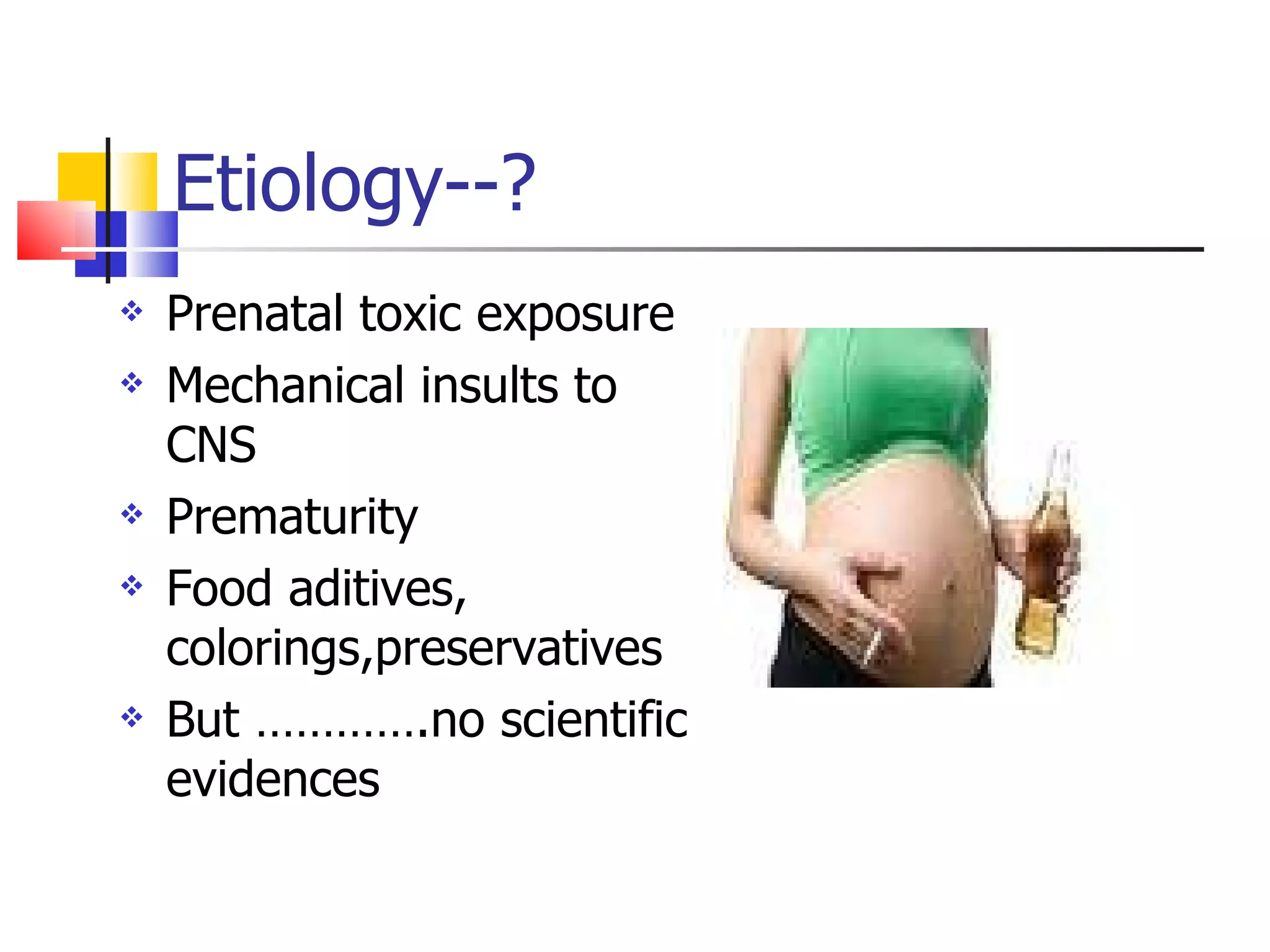
Etiology--? Prenatal toxic exposure  Mechanical insults to CNS Prematurity Food aditives, colorings,preservatives But ………….no scientific evidences
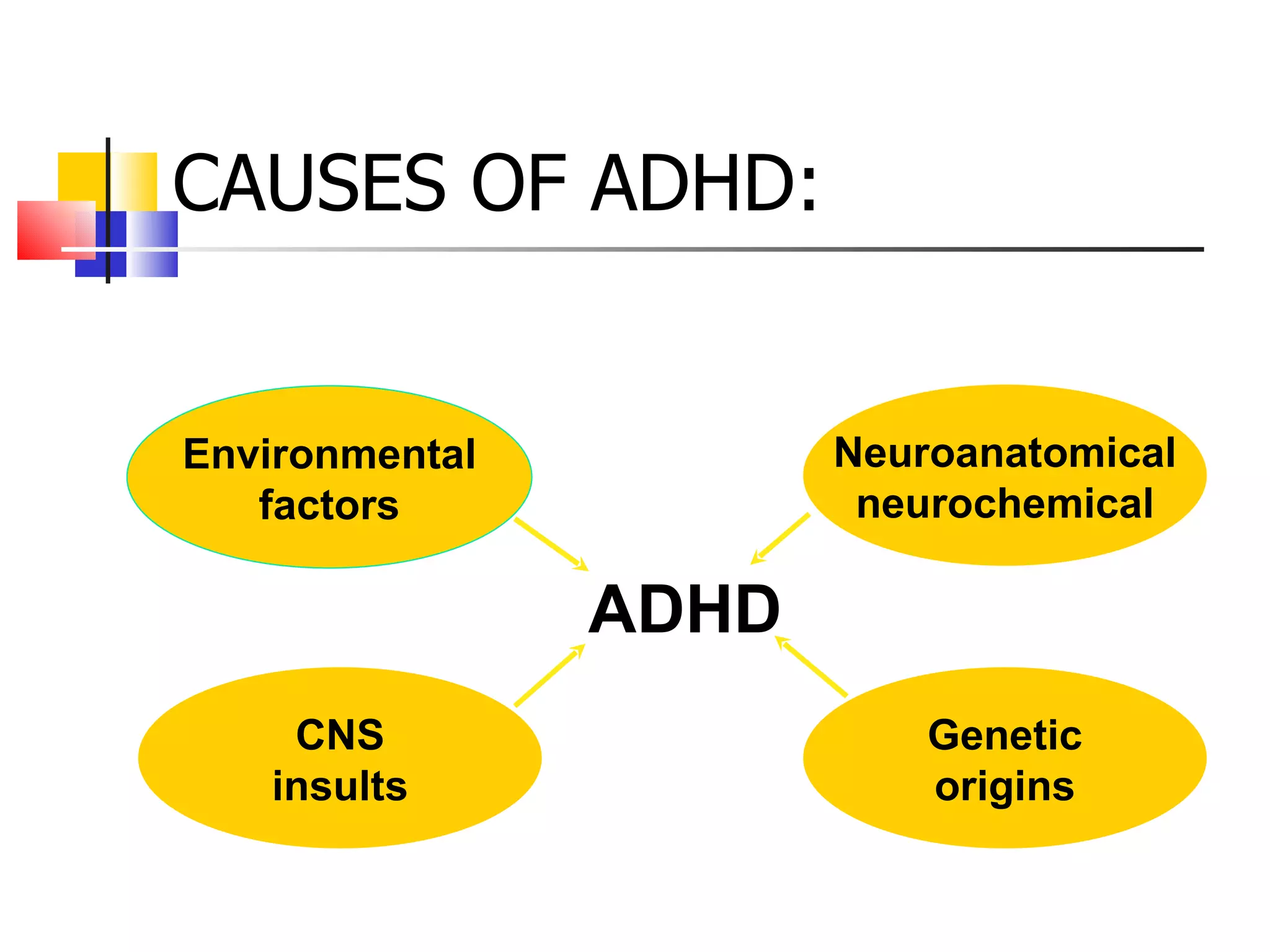
CAUSES OF ADHD: CNS insults Genetic origins Neuroanatomical neurochemical ADHD Environmental factors
Genetic factors Twin studies-great concordance in monozygotic twins Two times risk in siblings Adoption studies-higher incidence in biological parents than adoptive parents
Developmental factors Winter infections during first trimester Subtle damage to CNS during development High rate of soft neurological signs
Neurochemical factors Peripheral nor-adrenergic system dysfunction Possible dopamine system dysfunction Both evidenced by effect of stimulant drugs in improving symptoms
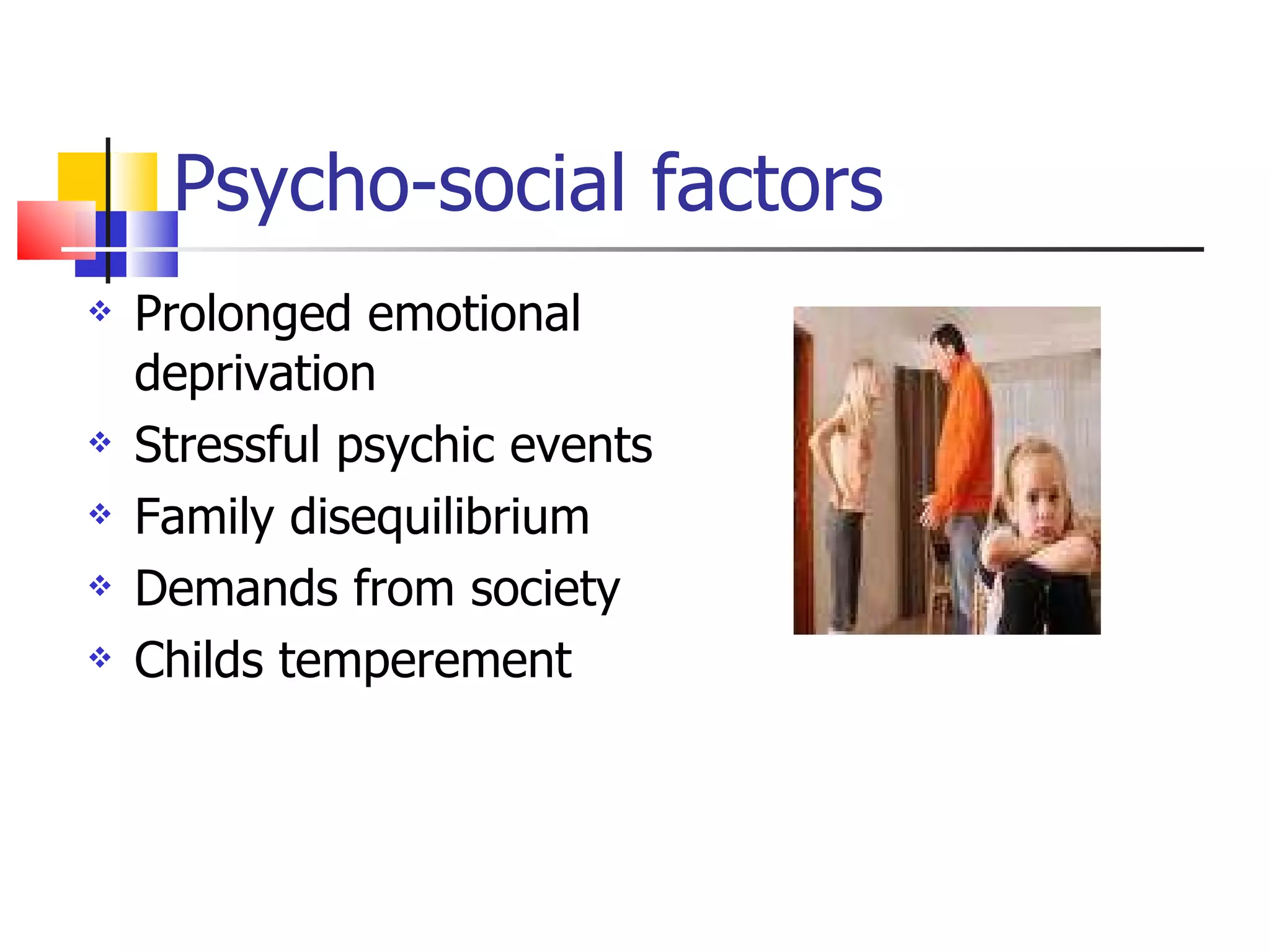
Psycho-social factors Prolonged emotional deprivation Stressful psychic events Family disequilibrium Demands from society Childs temperement
Diagnosis-assessment History, History, and  more  History!! School history Teachers reports Academic performance Clinic based psychological tests Individually administered intelligence tests Pediatric exam to check for an alternate disorder
DSM-IV-TR CRITERIA Inattention  pervasive and persistent for more than 6 months At least 6 symptoms in the list Hyperactivity-impulsivity pervasive and persistent for more than 6 months At least 6 symptoms in the list
Some symptoms onset before 7 years Some symptoms should present in two settings Social ,occupational ,academic function impairment Symptoms not better accounted for pervasive developmental disorder, schizophrenia , any other mental disorder
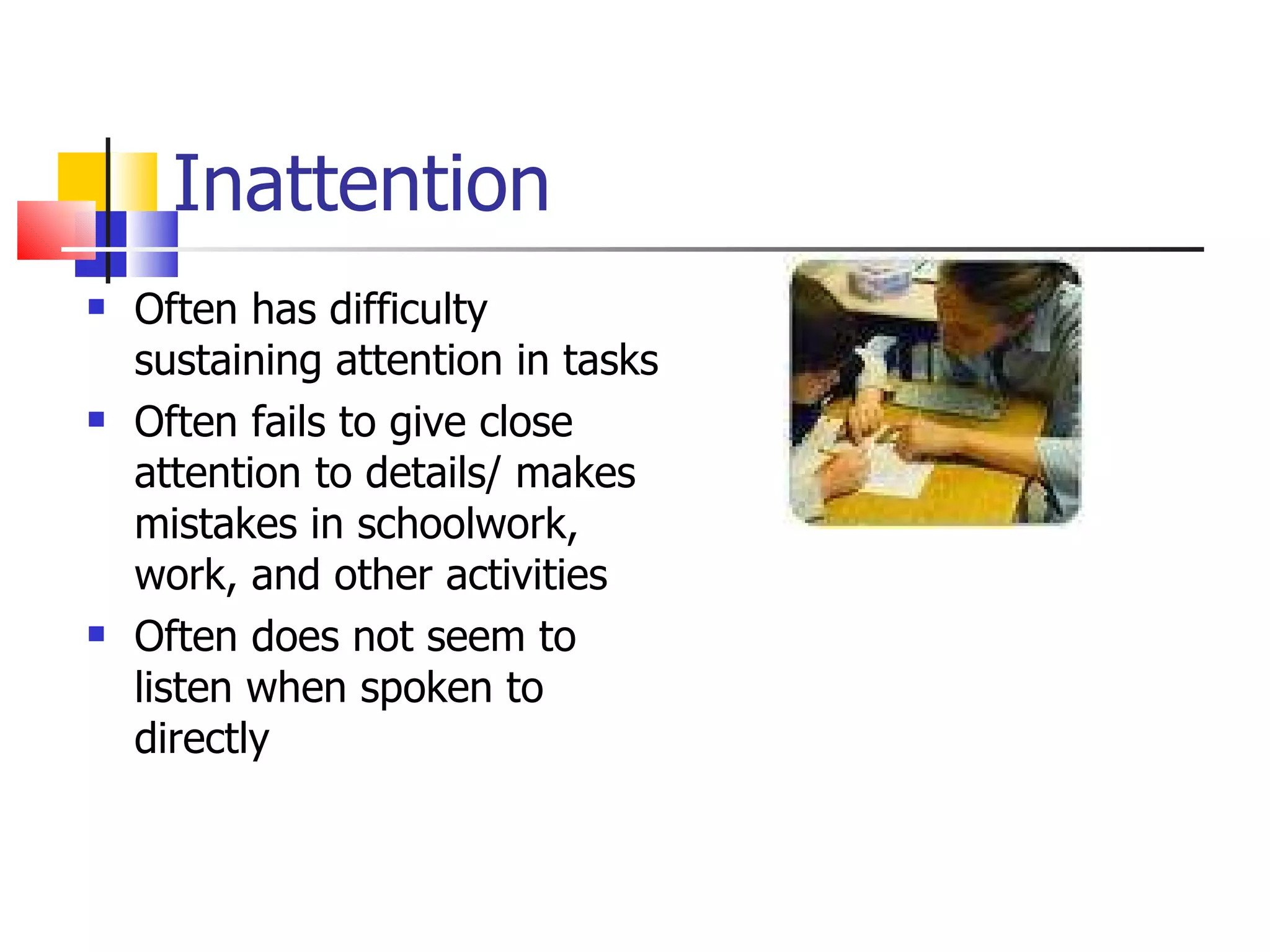
Inattention Often has difficulty sustaining attention in tasks Often fails to give close attention to details/ makes mistakes in schoolwork, work, and other activities Often does not seem to listen when spoken to directly
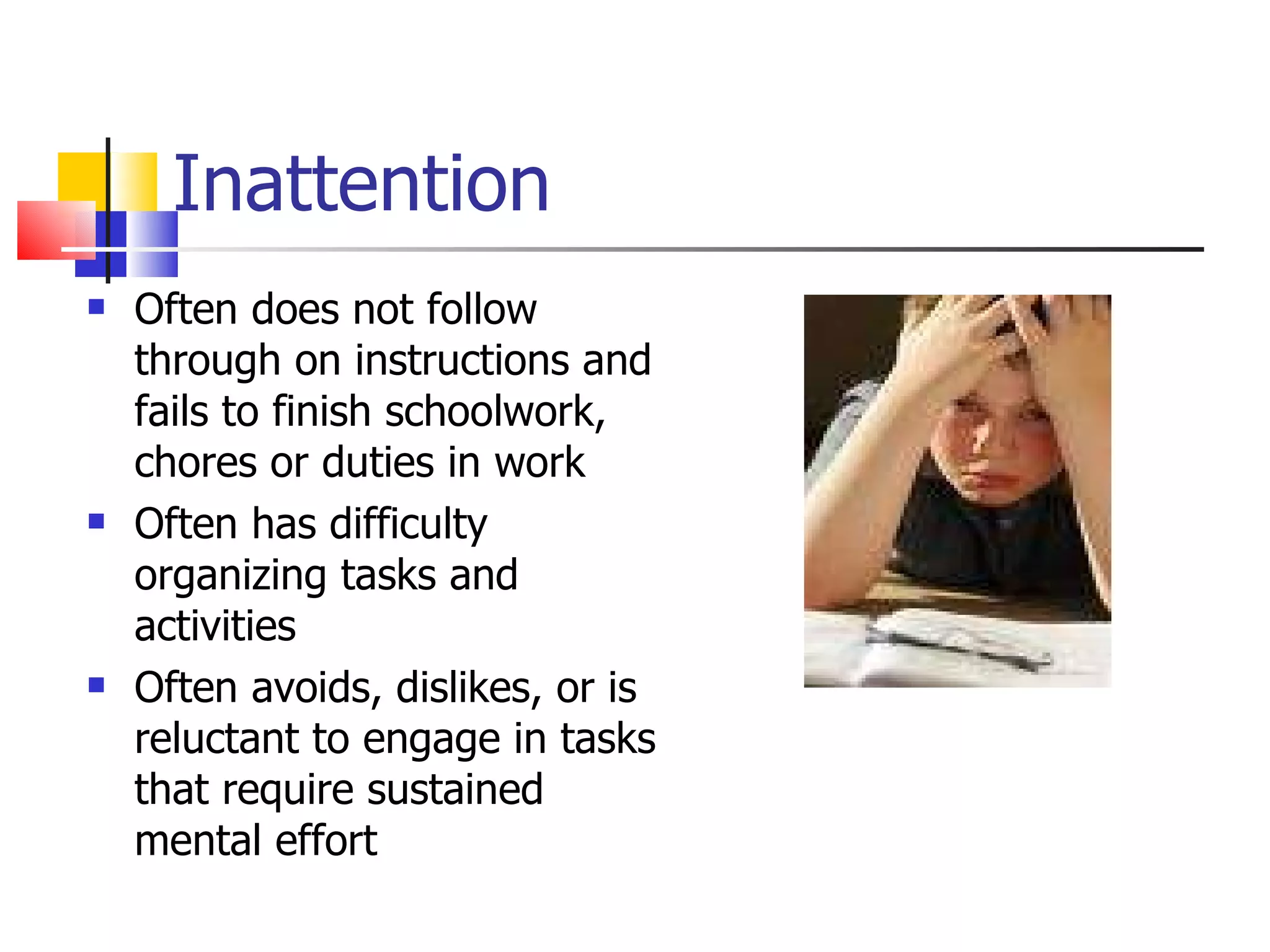
Inattention Often does not follow through on instructions and fails to finish schoolwork, chores or duties in work Often has difficulty organizing tasks and activities Often avoids, dislikes, or is reluctant to engage in tasks that require sustained mental effort
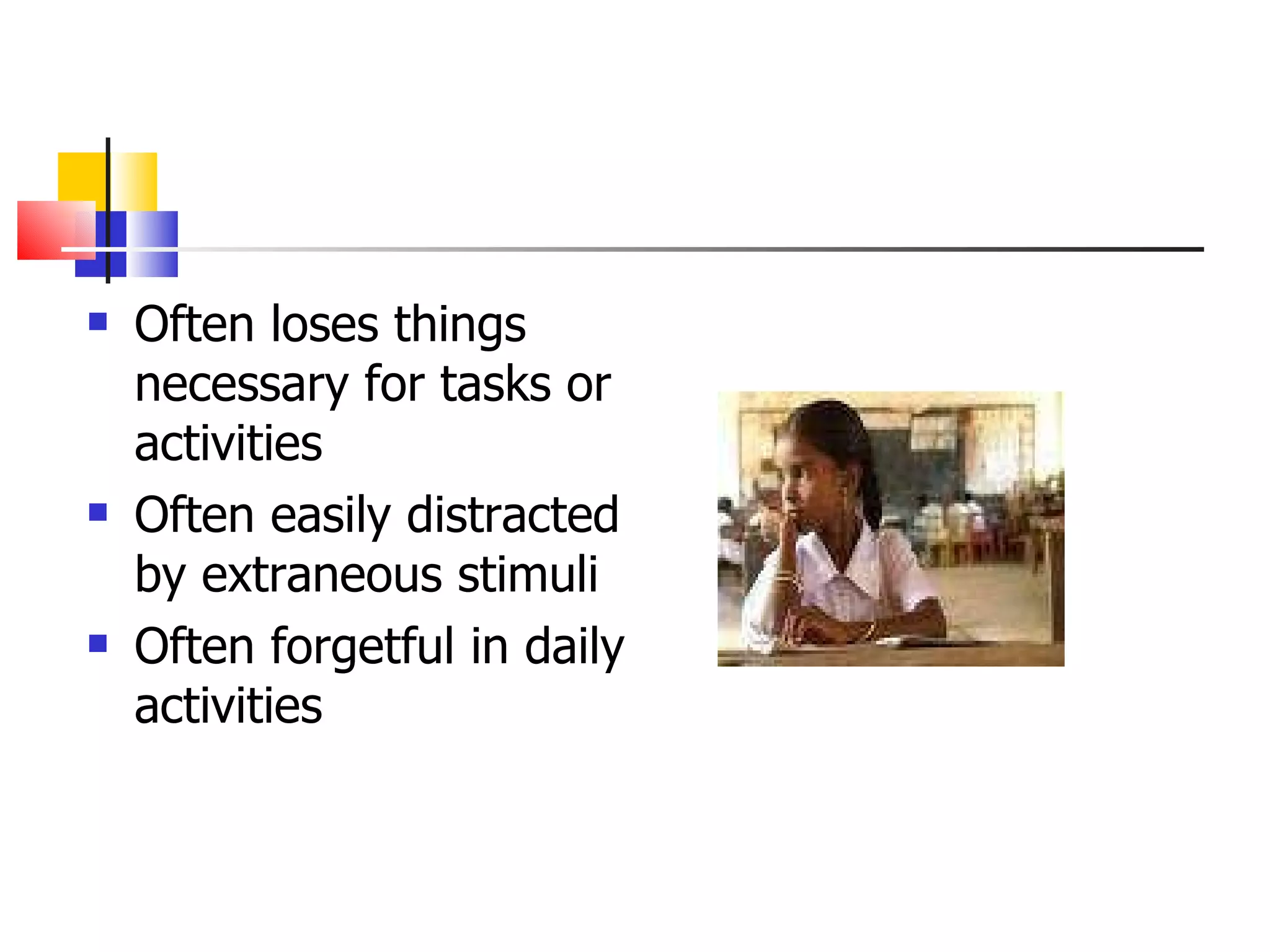
Often loses things necessary for tasks or activities Often easily distracted by extraneous stimuli Often forgetful in daily activities
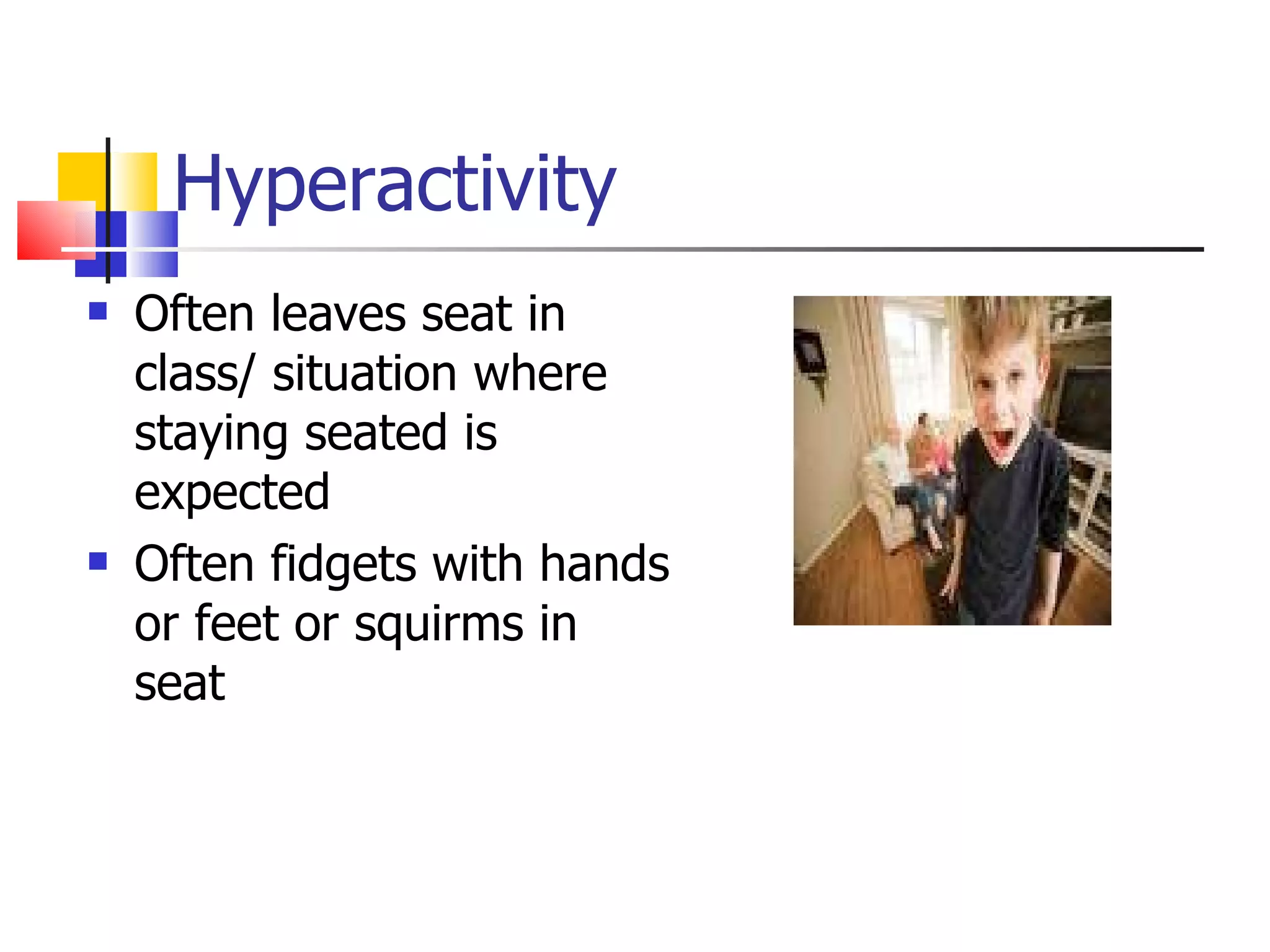
Hyperactivity Often leaves seat in class/ situation where staying seated is expected Often fidgets with hands or feet or squirms in seat
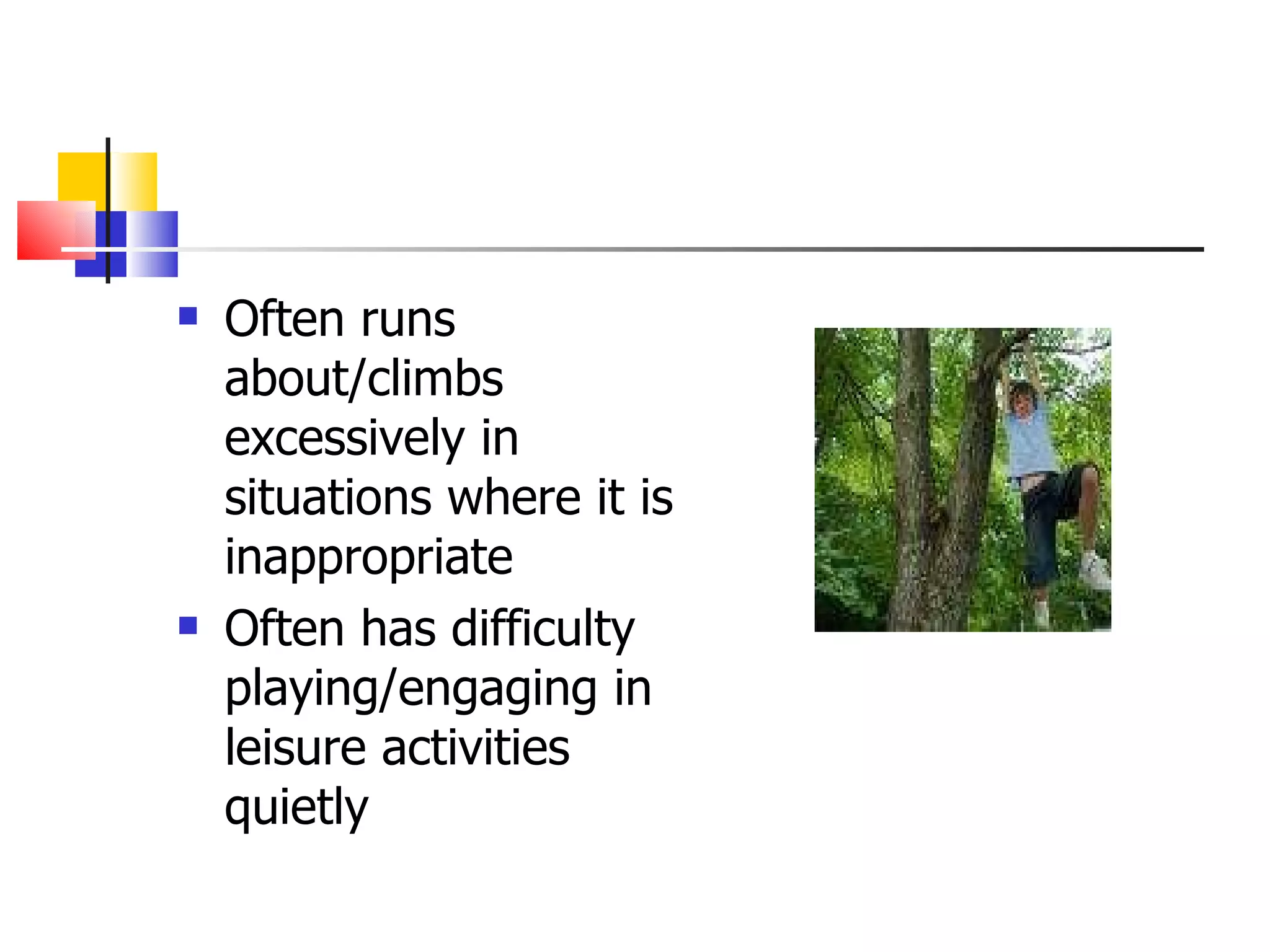
Often runs about/climbs excessively in situations where it is inappropriate Often has difficulty playing/engaging in leisure activities quietly
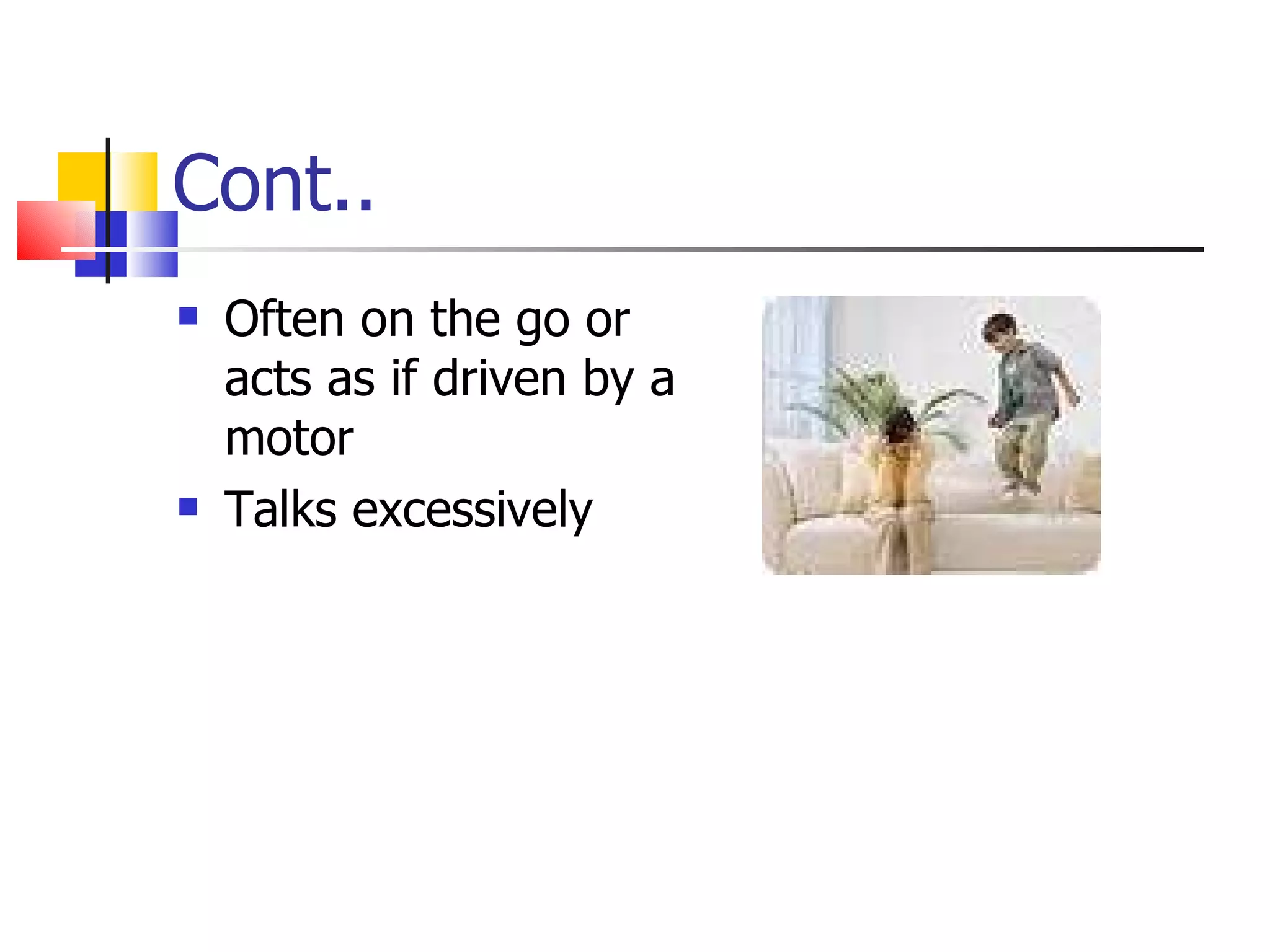
Cont.. Often on the go or acts as if driven by a motor Talks excessively
Impulsivity Often blurts out answers before questions have been completed Often has difficulty waiting to take turns
Often interrupts or intrudes on others
Differential diagnosis Sensory impairment. Epilepsy and related states-TLE Effects of head injury Acute or chronic medical Illness Poor nutrition. Sleep disorders. Side effects of medication
Psychiatric conditions Autism Spectrum Disorder Obsessive Compulsive Disorder Tic Disorders Conduct Disorders Attachment disorders. Depression and emotional disorders. Anxiety disorder Psychosis
Course and prognosis Persistent symptoms at adult/adolescent age-50% Remission at puberty/early adulthood-50% Remission unlikely before-12 years Over activity-first to remit Distractibility-last to remit
Course of partial or non remittance    in adolescent life Antisocial behavior Conduct disorder Substance abuse disorder Mood disorder Social difficulties Learning difficulties
Pharmacotherapy First line treatment  Stimulants are first choice-methylphenidate, amphetamine preparations Second line agents-Atomoxetine, bupropion, venlafaxine, clonidine
Methylphenidate Dopamine agonist Dexmethylphenidate –maximum effect, minimal side effect 0.3-1 mg/kg tid, upto 60 mg/day Sustained release preparations allowed once daily dose, less rebound effects FDA recommendation-should use in children >6 years
Side effects Head ache GI upset Insomnia Exacerbate tic disorder Growth suppression
Amphetamine preparations Second choice when methylphenidate not useful FDA recommend for child >3 years 0.15-0.5 mg/kg bd, upto 40 mg/day Once daily sustained release useful
Non stimulants-Atomoxetine Nor-epinephrine reuptake inhibitor FDA-use in 6 years and above Effective for inattention and impulsivity 0.5-1.8 mg/kg bd dose,upto 40-80 mg/day Side effects-decreased appetite ,dizziness,  irritability, increase in BP & HR
others Bupropion – beware of seizure Clonidine - useful in pts with tic disorder Modafinil – once daily,useful in adolescents Reboxetine – used in methylphenidate resistant cases
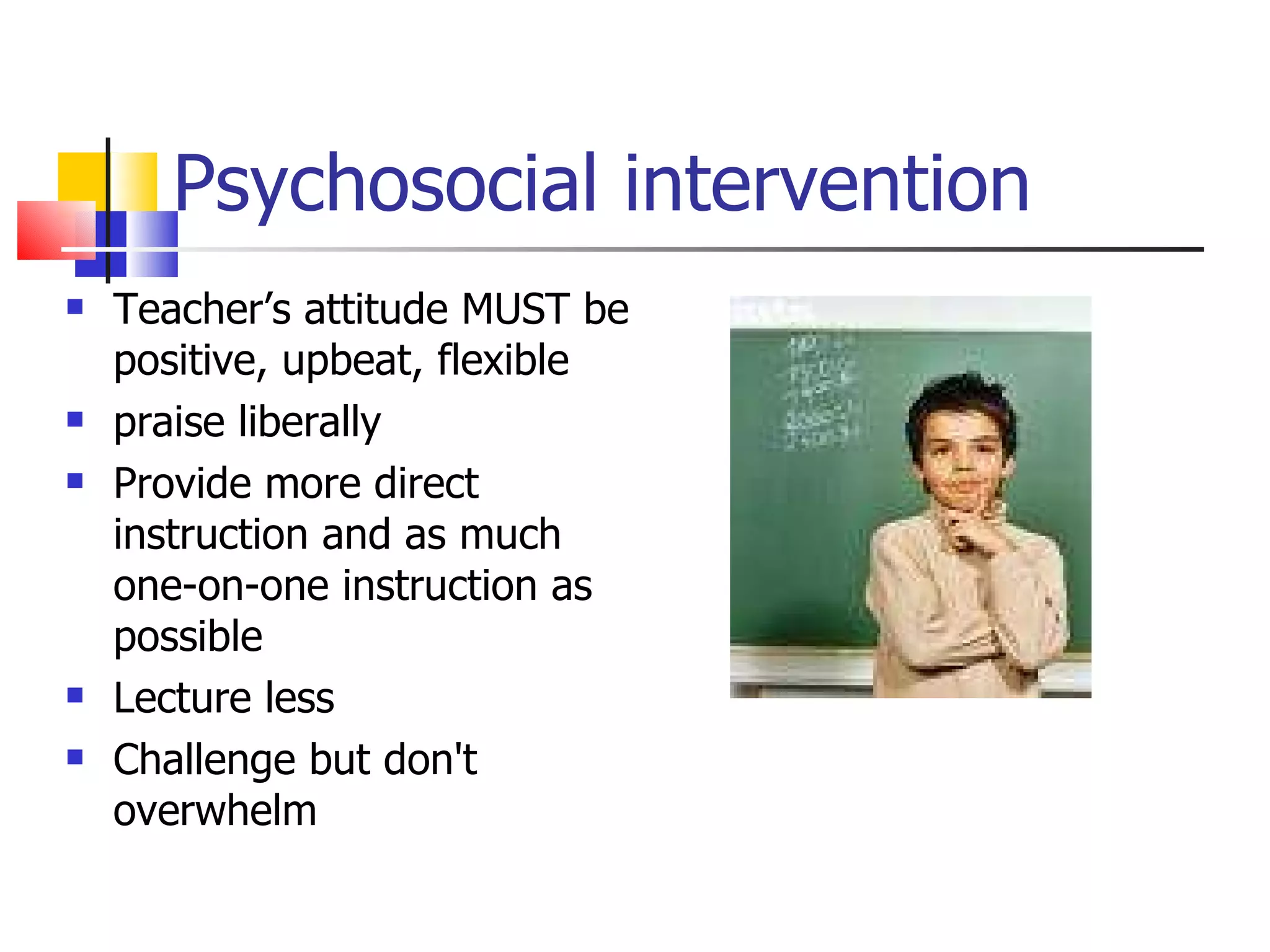
Psychosocial intervention Teacher’s attitude MUST be positive, upbeat, flexible praise liberally Provide more direct instruction and as much one-on-one instruction as possible Lecture less Challenge but don't overwhelm
Design tasks of low to moderate frustration levels Pair the student with a exemplary student frequent communication between home and school Provide frequent feedback Provide frequent and regularly scheduled breaks Teach conflict resolution and peer mediation skills
Adult manifestation of ADHD Prevalence- 4% Difficult to diagnose – lack of school and observer information SPECT - Increases dopamine transporter binding sites in striatum Premature birth , maternal use of nicotine, increased serum lead
Diagnosis-utah criteria Retrospective childhood diagnosis of ADHD At least 3 of following Inattentiveness Hyperactivity Mood lability Irritability, hot ember Low stress tolerance Disorganization impulsivity
DD – hypomania , anxiety disorder Treatment – similar to childhood ADHD Therapy needed indefinitely
THANK YOU

ADHD

  • 1.
    ATTENTION –DEFICIT HYPER ACTIVITY DISORDER DR.A.GODSON MD - PSYCHIATRY
  • 2.
    What is ADHD?A pattern of diminished sustained attention and high impulsivity in child or adolescent than expected for someone of that age and developmental level Three types: Combined Type, Predominantly Inattentive Type, and Predominantly Hyperactive-Impulsive Type .
  • 3.
    ADHD-STATISTICS: 5-10% ofthe entire U.S. population Males are 3 to 6 times more likely than females. At least 50% of ADHD sufferers have another diagnosable mental disorder. 3-5% of all school-age children are estimated to have this disorder
  • 4.
    First degree biologicalrelatives are at high risk Parents shows increased incidence of –hyperkinesis,sociopathy,alcohol abuse,conversion disorder Symptoms often present by 3 years,but diagnosis made only at school setting
  • 5.
    ADHD-TIME LINE: MinimalBrain Dysfunction Minimal Brain Damage Hyperkinetic Reaction of Childhood (DSM-II) Attention Deficit Disorder + or - Hyperactivity (DSM-III) Attention Deficit Hyperactivity Disorder (DSM-III-R) 1960 1980 1968 1987 1994 Attention Deficit/Hyperactivity Disorder (DSM-IV) 1930 ADHD-like syndrome first described 1902
  • 6.
    Etiology--? Prenatal toxicexposure Mechanical insults to CNS Prematurity Food aditives, colorings,preservatives But ………….no scientific evidences
  • 7.
    CAUSES OF ADHD:CNS insults Genetic origins Neuroanatomical neurochemical ADHD Environmental factors
  • 8.
    Genetic factors Twinstudies-great concordance in monozygotic twins Two times risk in siblings Adoption studies-higher incidence in biological parents than adoptive parents
  • 9.
    Developmental factors Winterinfections during first trimester Subtle damage to CNS during development High rate of soft neurological signs
  • 10.
    Neurochemical factors Peripheralnor-adrenergic system dysfunction Possible dopamine system dysfunction Both evidenced by effect of stimulant drugs in improving symptoms
  • 11.
    Psycho-social factors Prolongedemotional deprivation Stressful psychic events Family disequilibrium Demands from society Childs temperement
  • 12.
    Diagnosis-assessment History, History,and more History!! School history Teachers reports Academic performance Clinic based psychological tests Individually administered intelligence tests Pediatric exam to check for an alternate disorder
  • 13.
    DSM-IV-TR CRITERIA Inattention pervasive and persistent for more than 6 months At least 6 symptoms in the list Hyperactivity-impulsivity pervasive and persistent for more than 6 months At least 6 symptoms in the list
  • 14.
    Some symptoms onsetbefore 7 years Some symptoms should present in two settings Social ,occupational ,academic function impairment Symptoms not better accounted for pervasive developmental disorder, schizophrenia , any other mental disorder
  • 15.
    Inattention Often hasdifficulty sustaining attention in tasks Often fails to give close attention to details/ makes mistakes in schoolwork, work, and other activities Often does not seem to listen when spoken to directly
  • 16.
    Inattention Often doesnot follow through on instructions and fails to finish schoolwork, chores or duties in work Often has difficulty organizing tasks and activities Often avoids, dislikes, or is reluctant to engage in tasks that require sustained mental effort
  • 17.
    Often loses thingsnecessary for tasks or activities Often easily distracted by extraneous stimuli Often forgetful in daily activities
  • 18.
    Hyperactivity Often leavesseat in class/ situation where staying seated is expected Often fidgets with hands or feet or squirms in seat
  • 19.
    Often runs about/climbsexcessively in situations where it is inappropriate Often has difficulty playing/engaging in leisure activities quietly
  • 20.
    Cont.. Often onthe go or acts as if driven by a motor Talks excessively
  • 21.
    Impulsivity Often blurtsout answers before questions have been completed Often has difficulty waiting to take turns
  • 22.
    Often interrupts orintrudes on others
  • 23.
    Differential diagnosis Sensoryimpairment. Epilepsy and related states-TLE Effects of head injury Acute or chronic medical Illness Poor nutrition. Sleep disorders. Side effects of medication
  • 24.
    Psychiatric conditions AutismSpectrum Disorder Obsessive Compulsive Disorder Tic Disorders Conduct Disorders Attachment disorders. Depression and emotional disorders. Anxiety disorder Psychosis
  • 25.
    Course and prognosisPersistent symptoms at adult/adolescent age-50% Remission at puberty/early adulthood-50% Remission unlikely before-12 years Over activity-first to remit Distractibility-last to remit
  • 26.
    Course of partialor non remittance in adolescent life Antisocial behavior Conduct disorder Substance abuse disorder Mood disorder Social difficulties Learning difficulties
  • 27.
    Pharmacotherapy First linetreatment Stimulants are first choice-methylphenidate, amphetamine preparations Second line agents-Atomoxetine, bupropion, venlafaxine, clonidine
  • 28.
    Methylphenidate Dopamine agonistDexmethylphenidate –maximum effect, minimal side effect 0.3-1 mg/kg tid, upto 60 mg/day Sustained release preparations allowed once daily dose, less rebound effects FDA recommendation-should use in children >6 years
  • 29.
    Side effects Headache GI upset Insomnia Exacerbate tic disorder Growth suppression
  • 30.
    Amphetamine preparations Secondchoice when methylphenidate not useful FDA recommend for child >3 years 0.15-0.5 mg/kg bd, upto 40 mg/day Once daily sustained release useful
  • 31.
    Non stimulants-Atomoxetine Nor-epinephrinereuptake inhibitor FDA-use in 6 years and above Effective for inattention and impulsivity 0.5-1.8 mg/kg bd dose,upto 40-80 mg/day Side effects-decreased appetite ,dizziness, irritability, increase in BP & HR
  • 32.
    others Bupropion –beware of seizure Clonidine - useful in pts with tic disorder Modafinil – once daily,useful in adolescents Reboxetine – used in methylphenidate resistant cases
  • 33.
    Psychosocial intervention Teacher’sattitude MUST be positive, upbeat, flexible praise liberally Provide more direct instruction and as much one-on-one instruction as possible Lecture less Challenge but don't overwhelm
  • 34.
    Design tasks oflow to moderate frustration levels Pair the student with a exemplary student frequent communication between home and school Provide frequent feedback Provide frequent and regularly scheduled breaks Teach conflict resolution and peer mediation skills
  • 35.
    Adult manifestation ofADHD Prevalence- 4% Difficult to diagnose – lack of school and observer information SPECT - Increases dopamine transporter binding sites in striatum Premature birth , maternal use of nicotine, increased serum lead
  • 36.
    Diagnosis-utah criteria Retrospectivechildhood diagnosis of ADHD At least 3 of following Inattentiveness Hyperactivity Mood lability Irritability, hot ember Low stress tolerance Disorganization impulsivity
  • 37.
    DD – hypomania, anxiety disorder Treatment – similar to childhood ADHD Therapy needed indefinitely
  • 38.

Editor's Notes

  • #6 This slide gives a brief overview of how attention deficit hyperactivity disorder (ADHD) has evolved over the years Symptoms first described as early as 1902 by Dr. Still in Lancet The core symptoms of ADHD have always been defined on the basis of behavioral characteristics At first the symptoms were viewed as identical to those that would follow an insult to the brain, such as a head injury or a CNS infection. When these behavioral characteristics were seen in children with no history of such an insult, the damage to the CNS was considered to be so minimal that the only manifestations were behavioral. Hence the term “minimal brain damage” In the early 1960s, the term “minimal brain dysfunction,” or MBD, was used to describe a cluster of symptoms that included specific learning disabilities, hyperkinesis, impulsivity, and short attention span. But MBD was a vague, overinclusive diagnostic label, and it lacked predictive validity In 1968, DSM-II described this constellation of symptoms—overactivity, restlessness, distractibility, short attention span—as a specific syndrome: “hyperkinetic reaction of childhood.” The emphasis in this diagnostic label was on the motoric symptoms, which, we now know, represents only 1 part of this disorder Our more recent classifications—those in DSM-III, DSM-III-R, and DSM-IV—have described the signs and symptoms of the disorder without implying a specific etiology, as we saw that the “minimal brain damage” diagnosis did. Our current criteria emphasize 3 main behavioral areas: inattention, impulsivity, and hyperactivity
  • #8 ADHD is most likely caused by a complex interplay of factors Biologic factors that predispose an individual for ADHD include post-traumatic or infectious encephalopathy, lead poisoning, and fetal alcohol syndrome Environmental influences include abuse or neglect, family adversity, and situational stress Emerging literature provides support for the hypothesis that abnormalities in frontal networks or frontal-striatal dysfunction and catecholamine dysregulation are involved Family and twin studies reveal compelling data regarding the genetic origin of ADHD; and recent advances in neuroimaging techniques have promoted closer study of neuroanatomic correlates