Mental Retardation
Contents
 Definition
 Prevalence
 Classification
 Causes
 Clinical Evaluation
 Diagnosis
 Prevention
Definition
Mental Retardation Intellectual disability (intellectual
developmental disorder) replaces the term mental retardation
(MR) as intention of decreasing stigmatization. Intellectual
disability (ID) is characterized by impaired cognitive and
adaptive/social functioning. Severity level is currently based
on adaptive functioning, indicating the degree of support
required.
The Classical definition comprises
3 components :
1- subaverage intellectual function .
2- that result from an injury , disease or
abnormality before the age of 18 years .
3- resulting in impaired ability to adapt to the
environment .
Prevalence
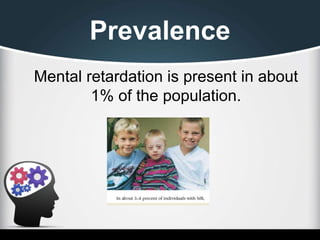
Mental retardation is present in about
1% of the population.
DSM-5 MR Classification
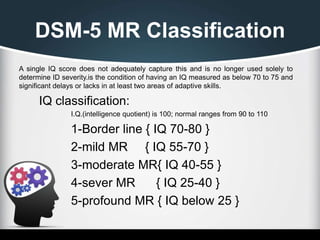
A single IQ score does not adequately capture this and is no longer used solely to
determine ID severity.is the condition of having an IQ measured as below 70 to 75 and
significant delays or lacks in at least two areas of adaptive skills.
IQ classification:
I.Q.(intelligence quotient) is 100; normal ranges from 90 to 110
1-Border line { IQ 70-80 }
2-mild MR { IQ 55-70 }
3-moderate MR{ IQ 40-55 }
4-sever MR { IQ 25-40 }
5-profound MR { IQ below 25 }
Etiology
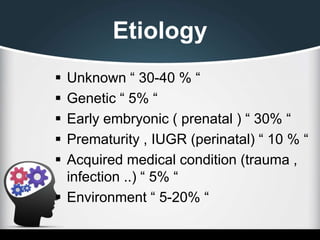
 Unknown “ 30-40 % “
 Genetic “ 5% “
 Early embryonic ( prenatal ) “ 30% “
 Prematurity , IUGR (perinatal) “ 10 % “
 Acquired medical condition (trauma ,
infection ..) “ 5% “
 Environment “ 5-20% “
Causes of MR
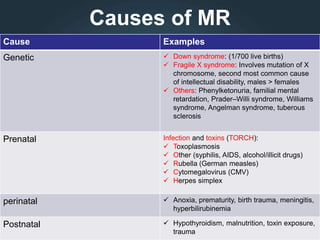
Cause Examples
Genetic  Down syndrome: (1/700 live births)
 Fragile X syndrome: Involves mutation of X
chromosome, second most common cause
of intellectual disability, males > females
 Others: Phenylketonuria, familial mental
retardation, Prader–Willi syndrome, Williams
syndrome, Angelman syndrome, tuberous
sclerosis
Prenatal Infection and toxins (TORCH):
 Toxoplasmosis
 Other (syphilis, AIDS, alcohol/illicit drugs)
 Rubella (German measles)
 Cytomegalovirus (CMV)
 Herpes simplex
perinatal  Anoxia, prematurity, birth trauma, meningitis,
hyperbilirubinemia
Postnatal  Hypothyroidism, malnutrition, toxin exposure,
trauma
Fragile X syndrome (FXS)
• Large ears , Large testes (testicular
volume>30 ml in adults) , Plantar
crease , Hyperextensible joints , Broad
forehead, Increased hand width,
Increased hand length , Elongated face,
Mitral valve prolapse , Hypotonia ,
Hernia….
Clinical Evaluation
 Complete History :
 Examination :
History
»complete and detailed history«
complete systemic review
surgical history : trauma , accidents
medical illnesses : hospitalization , general heath
pregnancy history : maternal age , parity , infections..
birth : type , wt . GA ,complications , apgar score
Postnatal : incubator , ventilator , disease ..
History (cont.)
drugs: mother and child
developmental Hx : mile stones , loss it , speech
educational Hx : schooling , IQ tests
behavioral Hx : skills , attention , activity
family Hx : consanguinity , inherited ds ..
social Hx :
Examination
»complete and detailed examination«
• Growth parameters :
• Dysmorphic features :
• CNS examination :
• Other system and skin exam :
• IQ tests :
• Developmental testing :
Diagnosis
• Deficits in intellectual functioning, such
as reasoning, problem solving, planning,
abstract thinking, judgment, and learning.
• Deficits in adaptive functioning, such as
communication, social participation, and
independent living.
Prevention of MR
 Primary prevention:
Public education about need for prenatal care, dangerous of
pregnant women drinking alcohol………
 Secondary prevention:
 Treatment, as in special diet for PKU children
 Hypothyroidism: neonatal screening is relatively easy to make and the
treatment which is pure replacement therapy by the administration of oral
thyroxine, is both inexpensive and completely effective
 Tertiary prevention
School and community based educational, vocational and
skills training programs
THANK YOU
And finally
Hesham Shaban Elbaz Hend Gamal Mokhtar
Mohamed Mostafa Mohamed Naira Salah Gamal
Our participants

Mental Retrdation...ppt

  • 1.
  • 2.
    Contents  Definition  Prevalence Classification  Causes  Clinical Evaluation  Diagnosis  Prevention
  • 3.
    Definition Mental Retardation Intellectualdisability (intellectual developmental disorder) replaces the term mental retardation (MR) as intention of decreasing stigmatization. Intellectual disability (ID) is characterized by impaired cognitive and adaptive/social functioning. Severity level is currently based on adaptive functioning, indicating the degree of support required.
  • 4.
    The Classical definitioncomprises 3 components : 1- subaverage intellectual function . 2- that result from an injury , disease or abnormality before the age of 18 years . 3- resulting in impaired ability to adapt to the environment .
  • 5.
    Prevalence Mental retardation ispresent in about 1% of the population.
  • 6.
    DSM-5 MR Classification Asingle IQ score does not adequately capture this and is no longer used solely to determine ID severity.is the condition of having an IQ measured as below 70 to 75 and significant delays or lacks in at least two areas of adaptive skills. IQ classification: I.Q.(intelligence quotient) is 100; normal ranges from 90 to 110 1-Border line { IQ 70-80 } 2-mild MR { IQ 55-70 } 3-moderate MR{ IQ 40-55 } 4-sever MR { IQ 25-40 } 5-profound MR { IQ below 25 }
  • 7.
    Etiology  Unknown “30-40 % “  Genetic “ 5% “  Early embryonic ( prenatal ) “ 30% “  Prematurity , IUGR (perinatal) “ 10 % “  Acquired medical condition (trauma , infection ..) “ 5% “  Environment “ 5-20% “
  • 8.
    Causes of MR CauseExamples Genetic  Down syndrome: (1/700 live births)  Fragile X syndrome: Involves mutation of X chromosome, second most common cause of intellectual disability, males > females  Others: Phenylketonuria, familial mental retardation, Prader–Willi syndrome, Williams syndrome, Angelman syndrome, tuberous sclerosis Prenatal Infection and toxins (TORCH):  Toxoplasmosis  Other (syphilis, AIDS, alcohol/illicit drugs)  Rubella (German measles)  Cytomegalovirus (CMV)  Herpes simplex perinatal  Anoxia, prematurity, birth trauma, meningitis, hyperbilirubinemia Postnatal  Hypothyroidism, malnutrition, toxin exposure, trauma
  • 9.
    Fragile X syndrome(FXS) • Large ears , Large testes (testicular volume>30 ml in adults) , Plantar crease , Hyperextensible joints , Broad forehead, Increased hand width, Increased hand length , Elongated face, Mitral valve prolapse , Hypotonia , Hernia….
  • 10.
    Clinical Evaluation  CompleteHistory :  Examination :
  • 11.
    History »complete and detailedhistory« complete systemic review surgical history : trauma , accidents medical illnesses : hospitalization , general heath pregnancy history : maternal age , parity , infections.. birth : type , wt . GA ,complications , apgar score Postnatal : incubator , ventilator , disease ..
  • 12.
    History (cont.) drugs: motherand child developmental Hx : mile stones , loss it , speech educational Hx : schooling , IQ tests behavioral Hx : skills , attention , activity family Hx : consanguinity , inherited ds .. social Hx :
  • 13.
    Examination »complete and detailedexamination« • Growth parameters : • Dysmorphic features : • CNS examination : • Other system and skin exam : • IQ tests : • Developmental testing :
  • 14.
    Diagnosis • Deficits inintellectual functioning, such as reasoning, problem solving, planning, abstract thinking, judgment, and learning. • Deficits in adaptive functioning, such as communication, social participation, and independent living.
  • 15.
    Prevention of MR Primary prevention: Public education about need for prenatal care, dangerous of pregnant women drinking alcohol………  Secondary prevention:  Treatment, as in special diet for PKU children  Hypothyroidism: neonatal screening is relatively easy to make and the treatment which is pure replacement therapy by the administration of oral thyroxine, is both inexpensive and completely effective  Tertiary prevention School and community based educational, vocational and skills training programs
  • 16.
    THANK YOU And finally HeshamShaban Elbaz Hend Gamal Mokhtar Mohamed Mostafa Mohamed Naira Salah Gamal Our participants