NORMAL THINKING
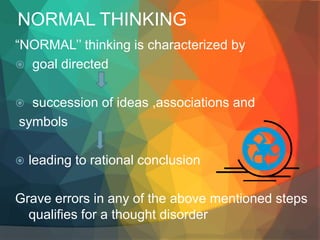
“NORMAL’’ thinking is characterized by
 goal directed
 succession of ideas ,associations and
symbols
 leading to rational conclusion
Grave errors in any of the above mentioned steps
qualifies for a thought disorder
 The process of thinking was divided into
three types:
 Undirected fantasy thinking(autistic
thinking)
 Imaginative thinking
 Rational thinking
Thought disorders are broadly
of 4 types:
 Disorders of form
 Disorders of progression
 Disorders of content
 Disorders of possesion
Delusion is a type of disorder of
content of thought
DEFINATION
 It is a false, unshakable belief that is out
of keeping with the patients social and
cultural background
A false belief based on incorrect inference
about external reality that is firmly held
despite what everyone else believes and
despite what constitutes incontrovertible
and obvious proof or evidence to the
contrary. the belief is not ordinarily
accepted by other members of the
persons culture or subculture
Jaspers claim regarding
delusions are:
 They are false judgments
 They are held with extraordinary
convictions and incomparable subjective
certainty
 They are impervious to
counterarguments
 Their content is impossible
All four criteria have been subjected to
criticism
Kendler et all have proposed
several poorly correlated
dimensions of delusional
severity
 Conviction: the degree to which the patient
is convinced of the reality of delusions
 extension: the degree to which the belief
involves areas f pts life
 Bizareness: depicting degree of departure
from culturally determined consensual
reality
 Disorganization
 Pressure: preoccupation n concern with the
belief
Trema
apophany
anastrophy
consolidation
residuam
Origins of delusion
conrad proposed 5 stages in
the development of delusions
 Trema: delusional mood ;a total change in
perception of the world
 Apophany:a search for and the finding
of,new meaning for psychological events
 Anastrophy:heightening of psychosis
 Consolidation:forming of a new world or
psychological set based on new meanings
 Residuum:eventual autistic state
Conrad’s Stage Model of
Beginning Schizophrenia
StageI: Trema
 (derived from Greek, colloquial for stage
fright)
 Meaning :Delusional mood (or atmosphere)
Characteristics :
Undefinable, but increasingly upsetting
quality spreads from salient aspects to
entire perceptual field. Patient feels
anticipatory excitement, suspiciousness,
alienation, fear, guilt, depression, or
combination of these. Patient may perform
abrupt, seemingly meaningless actions
 II Apophany
 (Greek apo [away from] + phaenein to show → revelation)
 Meaning:Delusion as revelation (Aha-Erlebnis)
 Characteristics :Perceptual Gestalt experienced
incompletely in terms of its expressive rather than its
objective material holistic qualities. Inability to
transcend current perspective or to shift frame of
references. Abnormal connectedness between
seemingly unrelated meanings. Delusional
perception, misidentification. Relentless
(“monotonous, repetitive”) spreading of the delusion
as both “elastic” and fixed to new gestalts.Progression
of delusions from external to inner “space”, delusional
body sensations. Patient uncritically receptive and
unable to detach, as if trapped between sleeping and
waking. Thought insertion, thought broadcasting,
hallucinations
III Anastrophe
(Greek, ana- (back) + strephein (to turn) →
turning back)
Meaning: Patient feels self to be passive
middle point (subject-directed
complement to world-directed apophany)
Characteristics : Delusions of reference.
Events and perceptions are related to self
Classification of delusions
Parameter type
Depending on origin Primary and secondary
Depending on theme Grandiose, persecutory,
jealousy etc
Depending on congruency
with mood
Mood congruent or not
Depending on reality
value
Partial or complete
Depending on complexity Simple or complex
Primary and secondary
delusions
 Primary delusion: that is not occuring in
response to another psychopathological
form
 for eg :in schizophrenia patients
 Secondary delusion: occuring secondary
to some other psychopathological
condition
 For eg:delusion of grandiosity in mania
Primary delusions Secondary
delusions
 Ununderstanble
 Not in correlation with
some other
psychopathology
 Occur in schizophrenia
 Understandable
 In accordance with some
other psychopathological
condition.
 Occur in other conditions
.may be understood in
terms of persons
background ,culture or
emotional state
Types of primary delusions
 Autochthonous delusion(delusional
intuition: sudden delusional idea occurs
out of the blue
 Delusional percept:occurs in two stages
perception and then false interpretation
 Delusional atmosphere/mood
 Delusional memory/retrospective
delusions
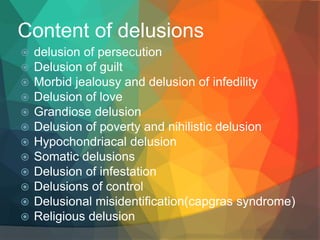
Content of delusions
 delusion of persecution
 Delusion of guilt
 Morbid jealousy and delusion of infedility
 Delusion of love
 Grandiose delusion
 Delusion of poverty and nihilistic delusion
 Hypochondriacal delusion
 Somatic delusions
 Delusion of infestation
 Delusions of control
 Delusional misidentification(capgras syndrome)
 Religious delusion
Delusion of persecution
Incorrectly also known as paranoid delusion
Paranoid actually mean delusional derived from
The Greek word paranoia literal meaning
By the side of mind
Forms of Delusions of
persecution
 Delusion of reference : the patient knows
that people are talking about him,
slandering him or spying on him.ideas are
not confined to schizophrenia can also
occur in depression and other psychotic
illnesses
 Delusion of guilt :seen in patients with
severe depression who feel they are
extremely wicked thus,it is justified to spy
on him.
 Delusion of being poisoned
 Delusion of influence
Delusion of
guilt
The patients believe that
they are bad or evil. And
have ruined their family
Seen in cases of severe
depression.
Delusion of infidelity
Also known incorrectly
As delusion of jealousy
Patients of delusions of infidelity
Have morbid jealousy
Instead of delusion of jealousy
 Can occur in both organic and functional
disorders . also very common in alcohol
dependence
Delusion of love
Oh ! salman
khan is in love
wiith me
Also known as fantasy lover syndrome
And erotomania.
The patient is convinced that
someone is in
Love with them although the
alleged lover
may have never spoken to them.
.these may Be a part of
schizophrenia or they may
also Be isolated
symptoms in certain
personality. Margaret Mary "Peggy" Ray (1952 – October 5, 1998)
was an American woman who suffered from schizophrenia ..
She is best known for stalking American television talk show host
David Letterman and retired astronaut Story Musgrave.
Delusion of grandiosity
Primary are seen in
schizophrenia
Secondary in mania.
PATIENT believes that
He is special or has
Special powers.
Nihilistic
delusion
The patient denies the
existence of their body
,their mind,their loved
ones and the world
around them.
Seen in severe agitated
depression,
schizophrenia and states
of delirium.
Delusion of poverty
The patient is convinced that
they are impoverished and
believe that destitution is facing
them and their family.
Hypochondriacal
delusion/delusions
of Ill health/somatic
delusions
Patients believe that they
have some serious illness
Seen in depression,
schizophrenia etc.patient
may also feel his body is
diseased or changed
Delusion of
infestation
In ekboms syndrome,
the patient believes
that he is infested with
small but macroscopic
organisms.
Seen in hypochondriasis.
persistent delusional
disorder, organic brain
syndromes.
Delusion of
control
The core belief of the patient is that
he is no longer in sole control of his
own body,
thoughts,feelings,impulses or
behavior.
Delusion of
misidentification/capgras
syndrome/fregoli
syndrome
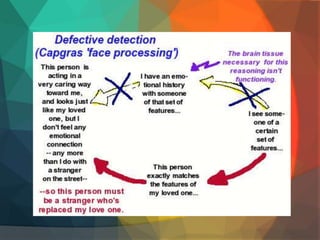
Capgras is a rare syndrome in
which the patient believes that a
person usually closely related has
been replaced by an exact double.
Fregolis syndrome the delusional
misidentification of an unfamiliar
person as a familiar one,even
though there is no physical
resemblance.
Religious delusions
 Patient is preoccupied
with false beliefs of
religious nature.
sometimes they exist
within the context of a
conventional religious
system, such as
antichrist or ideas
about nirvana etc.
Not all delusions lead to action. Depressive delusions of
Guilt and hypochondriasis may lead to action if the patient
Does not exhibit psychomotor retardation.
Hypochondriacal delusions may lead to suicide or
if involve the family may lead to homicide.
Case study 1:
 Mrs. K is a 39-year-old woman who was brought to the
inpatient psychiatric unit by police after being arrested for
trespassing on Mr. L’s property. Upon arrival, Mrs. K was
adamant about being released, stating that she was
simply entering her husband’s home, adamantly declaring
that Mr. L was her husband. She elaborated a story about
how much the two of them loved each other, when they
got married, and how she was currently pregnant with his
child. In actuality, Mr. L used to be Mrs. K’s boss, and had
fired her because of her inappropriate romantic advances
several years prior. Mrs. K was married to another man in
Florida, with whom she denied any relationship, stating
that she was kidnapped for 4 years, and after escaping,
had come to California to be with her husband, Mr. L. Mrs.
K was diagnosed with delusional disorder, erotomanic
type, and was started on risperidone.
Case study 2:
 50 yr male patient Mr.A came to the psychiatry opd on his
own ,alone with complains of sleep disturbance and
headache on further asking he said his wife was having
an affair with his neighbour, which was very distressing to
him due to which he used to remain anxious the whole
day. the was asked to bring a close relative in the next
follow up after 7 days. He was brought after one month
forcefully by his sons and nephew complaining that he
doesn’t sleep at night and is very suspicious on their
mother and also beats her at times . They clarified that
she was NOT HAVING AN AFFAIR with their neighbour.
Despite availability of many facts to prove the same
patients belief was consistent. Otherwise his functioning
was absolutely normal .he was started on tab.risperidone
.
Case study 3:
 55 yr old blind female patient named mrs
r.was referred to the psychiatry OPD by
general surgeon with complains of tingling
sensation, like something was moving
inside her abdomen following hysterectomy
since last 5 yrs .patient was very distressed
because of the same. she had been
investigated thoroughly by the surgeon and
the obstetrician with no significant findings.
She was started on tab olanzapine and on
follow up after one month she reported
much improvement in the symptoms
 Scoring of delusions
Bibliography:
book author
Sims’ symptoms in the
mind
femi oyebode
Fish's clinical
psychopathology
Patricia casey ans brenden
kelly
Internet , PUBMED,industrialpsychiatry
journal
Delusions

Delusions

  • 2.
    NORMAL THINKING “NORMAL’’ thinkingis characterized by  goal directed  succession of ideas ,associations and symbols  leading to rational conclusion Grave errors in any of the above mentioned steps qualifies for a thought disorder
  • 3.
     The processof thinking was divided into three types:  Undirected fantasy thinking(autistic thinking)  Imaginative thinking  Rational thinking
  • 4.
    Thought disorders arebroadly of 4 types:  Disorders of form  Disorders of progression  Disorders of content  Disorders of possesion
  • 5.
    Delusion is atype of disorder of content of thought
  • 7.
    DEFINATION  It isa false, unshakable belief that is out of keeping with the patients social and cultural background
  • 8.
    A false beliefbased on incorrect inference about external reality that is firmly held despite what everyone else believes and despite what constitutes incontrovertible and obvious proof or evidence to the contrary. the belief is not ordinarily accepted by other members of the persons culture or subculture
  • 9.
    Jaspers claim regarding delusionsare:  They are false judgments  They are held with extraordinary convictions and incomparable subjective certainty  They are impervious to counterarguments  Their content is impossible All four criteria have been subjected to criticism
  • 10.
    Kendler et allhave proposed several poorly correlated dimensions of delusional severity  Conviction: the degree to which the patient is convinced of the reality of delusions  extension: the degree to which the belief involves areas f pts life  Bizareness: depicting degree of departure from culturally determined consensual reality  Disorganization  Pressure: preoccupation n concern with the belief
  • 12.
  • 13.
    Origins of delusion conradproposed 5 stages in the development of delusions  Trema: delusional mood ;a total change in perception of the world  Apophany:a search for and the finding of,new meaning for psychological events  Anastrophy:heightening of psychosis  Consolidation:forming of a new world or psychological set based on new meanings  Residuum:eventual autistic state
  • 14.
    Conrad’s Stage Modelof Beginning Schizophrenia StageI: Trema  (derived from Greek, colloquial for stage fright)  Meaning :Delusional mood (or atmosphere) Characteristics : Undefinable, but increasingly upsetting quality spreads from salient aspects to entire perceptual field. Patient feels anticipatory excitement, suspiciousness, alienation, fear, guilt, depression, or combination of these. Patient may perform abrupt, seemingly meaningless actions
  • 15.
     II Apophany (Greek apo [away from] + phaenein to show → revelation)  Meaning:Delusion as revelation (Aha-Erlebnis)  Characteristics :Perceptual Gestalt experienced incompletely in terms of its expressive rather than its objective material holistic qualities. Inability to transcend current perspective or to shift frame of references. Abnormal connectedness between seemingly unrelated meanings. Delusional perception, misidentification. Relentless (“monotonous, repetitive”) spreading of the delusion as both “elastic” and fixed to new gestalts.Progression of delusions from external to inner “space”, delusional body sensations. Patient uncritically receptive and unable to detach, as if trapped between sleeping and waking. Thought insertion, thought broadcasting, hallucinations
  • 16.
    III Anastrophe (Greek, ana-(back) + strephein (to turn) → turning back) Meaning: Patient feels self to be passive middle point (subject-directed complement to world-directed apophany) Characteristics : Delusions of reference. Events and perceptions are related to self
  • 19.
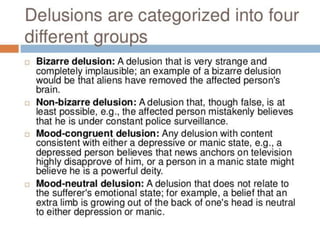
    Classification of delusions Parametertype Depending on origin Primary and secondary Depending on theme Grandiose, persecutory, jealousy etc Depending on congruency with mood Mood congruent or not Depending on reality value Partial or complete Depending on complexity Simple or complex
  • 21.
    Primary and secondary delusions Primary delusion: that is not occuring in response to another psychopathological form  for eg :in schizophrenia patients  Secondary delusion: occuring secondary to some other psychopathological condition  For eg:delusion of grandiosity in mania
  • 22.
    Primary delusions Secondary delusions Ununderstanble  Not in correlation with some other psychopathology  Occur in schizophrenia  Understandable  In accordance with some other psychopathological condition.  Occur in other conditions .may be understood in terms of persons background ,culture or emotional state
  • 23.
    Types of primarydelusions  Autochthonous delusion(delusional intuition: sudden delusional idea occurs out of the blue  Delusional percept:occurs in two stages perception and then false interpretation  Delusional atmosphere/mood  Delusional memory/retrospective delusions
  • 24.
    Content of delusions delusion of persecution  Delusion of guilt  Morbid jealousy and delusion of infedility  Delusion of love  Grandiose delusion  Delusion of poverty and nihilistic delusion  Hypochondriacal delusion  Somatic delusions  Delusion of infestation  Delusions of control  Delusional misidentification(capgras syndrome)  Religious delusion
  • 25.
    Delusion of persecution Incorrectlyalso known as paranoid delusion Paranoid actually mean delusional derived from The Greek word paranoia literal meaning By the side of mind
  • 26.
    Forms of Delusionsof persecution  Delusion of reference : the patient knows that people are talking about him, slandering him or spying on him.ideas are not confined to schizophrenia can also occur in depression and other psychotic illnesses  Delusion of guilt :seen in patients with severe depression who feel they are extremely wicked thus,it is justified to spy on him.  Delusion of being poisoned  Delusion of influence
  • 28.
    Delusion of guilt The patientsbelieve that they are bad or evil. And have ruined their family Seen in cases of severe depression.
  • 29.
    Delusion of infidelity Alsoknown incorrectly As delusion of jealousy Patients of delusions of infidelity Have morbid jealousy Instead of delusion of jealousy
  • 30.
     Can occurin both organic and functional disorders . also very common in alcohol dependence
  • 31.
    Delusion of love Oh! salman khan is in love wiith me Also known as fantasy lover syndrome And erotomania. The patient is convinced that someone is in Love with them although the alleged lover may have never spoken to them. .these may Be a part of schizophrenia or they may also Be isolated symptoms in certain personality. Margaret Mary "Peggy" Ray (1952 – October 5, 1998) was an American woman who suffered from schizophrenia .. She is best known for stalking American television talk show host David Letterman and retired astronaut Story Musgrave.
  • 32.
    Delusion of grandiosity Primaryare seen in schizophrenia Secondary in mania. PATIENT believes that He is special or has Special powers.
  • 34.
    Nihilistic delusion The patient deniesthe existence of their body ,their mind,their loved ones and the world around them. Seen in severe agitated depression, schizophrenia and states of delirium.
  • 35.
    Delusion of poverty Thepatient is convinced that they are impoverished and believe that destitution is facing them and their family.
  • 36.
    Hypochondriacal delusion/delusions of Ill health/somatic delusions Patientsbelieve that they have some serious illness Seen in depression, schizophrenia etc.patient may also feel his body is diseased or changed
  • 39.
    Delusion of infestation In ekbomssyndrome, the patient believes that he is infested with small but macroscopic organisms. Seen in hypochondriasis. persistent delusional disorder, organic brain syndromes.
  • 40.
    Delusion of control The corebelief of the patient is that he is no longer in sole control of his own body, thoughts,feelings,impulses or behavior.
  • 41.
    Delusion of misidentification/capgras syndrome/fregoli syndrome Capgras isa rare syndrome in which the patient believes that a person usually closely related has been replaced by an exact double. Fregolis syndrome the delusional misidentification of an unfamiliar person as a familiar one,even though there is no physical resemblance.
  • 43.
    Religious delusions  Patientis preoccupied with false beliefs of religious nature. sometimes they exist within the context of a conventional religious system, such as antichrist or ideas about nirvana etc.
  • 44.
    Not all delusionslead to action. Depressive delusions of Guilt and hypochondriasis may lead to action if the patient Does not exhibit psychomotor retardation. Hypochondriacal delusions may lead to suicide or if involve the family may lead to homicide.
  • 45.
    Case study 1: Mrs. K is a 39-year-old woman who was brought to the inpatient psychiatric unit by police after being arrested for trespassing on Mr. L’s property. Upon arrival, Mrs. K was adamant about being released, stating that she was simply entering her husband’s home, adamantly declaring that Mr. L was her husband. She elaborated a story about how much the two of them loved each other, when they got married, and how she was currently pregnant with his child. In actuality, Mr. L used to be Mrs. K’s boss, and had fired her because of her inappropriate romantic advances several years prior. Mrs. K was married to another man in Florida, with whom she denied any relationship, stating that she was kidnapped for 4 years, and after escaping, had come to California to be with her husband, Mr. L. Mrs. K was diagnosed with delusional disorder, erotomanic type, and was started on risperidone.
  • 46.
    Case study 2: 50 yr male patient Mr.A came to the psychiatry opd on his own ,alone with complains of sleep disturbance and headache on further asking he said his wife was having an affair with his neighbour, which was very distressing to him due to which he used to remain anxious the whole day. the was asked to bring a close relative in the next follow up after 7 days. He was brought after one month forcefully by his sons and nephew complaining that he doesn’t sleep at night and is very suspicious on their mother and also beats her at times . They clarified that she was NOT HAVING AN AFFAIR with their neighbour. Despite availability of many facts to prove the same patients belief was consistent. Otherwise his functioning was absolutely normal .he was started on tab.risperidone .
  • 47.
    Case study 3: 55 yr old blind female patient named mrs r.was referred to the psychiatry OPD by general surgeon with complains of tingling sensation, like something was moving inside her abdomen following hysterectomy since last 5 yrs .patient was very distressed because of the same. she had been investigated thoroughly by the surgeon and the obstetrician with no significant findings. She was started on tab olanzapine and on follow up after one month she reported much improvement in the symptoms
  • 48.
     Scoring ofdelusions
  • 50.
    Bibliography: book author Sims’ symptomsin the mind femi oyebode Fish's clinical psychopathology Patricia casey ans brenden kelly Internet , PUBMED,industrialpsychiatry journal