
Menopause – what and when
 The menopause may be
 Natural or induced
 Natural menopause - the permanent cessation of
menstruation for 12 months caused by failure of
ovarian function with elevated gonadotropins (FSH,
LH).
 Average is 51 years
Induced menopause
 Specific treatment e.g. chemotherapy or radiotherapy
 Oophorectomy
 Treatment with gonadotrophin-releasing hormone
(GnRH) analogues
Clmacteric (perimenopause): The period of time leading to the
menopause when a women passes from the reproductive stage of
life to the postmenopausal years.
 Menstrual irregularities: 10% of women stop
menstruating abruptly, but the vast majority
experience 4-5 y of varying cycle length due to
progressive ovarian failure.
 Hormone Production: initially characterized by
elevated FSH, decreased inhibin, but normal levels of
estradiol and LH. However there is wide individual
variations. AMH
 Elevated gonadotrophins drive the ovarian stroma to
increase production of androgens.
Diagnosis - symptoms
 Short Term
 Vasomotor
 Flushes
 Night sweats
 Insomnia
 Sexual dysfunction
 Vaginal dryness
 Dyspareunia
 Decreased libido
 Musculoskeletal
 Joint aches
 Fat redistribution
 Psychological
 Depressed mood
 Anxiety
 Irritability
 Mood swings
 Lethargy
 Difficulty concentrating
Consequences of the menopause
 Long term
 Osteoporosis
 1 in 3 increase in risk of fracture
 Cardiovascular disease
 MI and stroke most common cause of death >60y
 Oophorectomised women have 2-3 fold risk of CHD
 Urogenital
 Lower urinary tract and pelvic floor atrophy leading to frequency,
urgency, nocturia, incontinence, recurrent infections
 Vaginal atrophy
Osteoporosis:
 E2 inhibit bone resorption. Postmenopausal women
experience increased bone resorption, diminished
formation , resulting in bone fragility which often
leads to fracture.
 Effects of osteoporosis : 50% of women over 75y have
vertebral fractures and 25 % will develop hip fracture
by the age 80Y.
 Risk factors include Caucasian or Asian descent low
BMI, smoking, family history of osteoporosis.

Investigations
 FSH is only used if diagnosis is in doubt
 FSH >30 iu/L
 Don’t do LH, oestradiol and progesterone as not
helpful
 TFTs if symptoms presents
 Bone mineral density testing (BMD)– Densitometry if
significant risk of osteoporosis
Management – Non-hormonal
• Lifestyle advice
• Avoid hot drinks especially caffeinated ones, and alcohol
• Stop smoking
 exercising regularly – including weight-bearing and
resistance exercises
 eating a healthy diet that includes plenty of fruit,
vegetables and sources of calcium, such as low-fat milk and
yoghurt
 getting some sunlight – sunlight on your skin triggers the
production of vitamin D, which can help to keep your
bones strong
Management – Non-hormonal
Botanicals- Estrogen like effect
Soy products, isoflavones and black cohosh may be helpful
in the short –term treatment of vasomotor symptoms and
depression.
Clonidine - for hot flushes. Clonidine is a medication that lowers
high blood pressure. It is also used to prevent and relieve symptoms of
menopausal flushing.
New medications: Raloxifen is a selective estrogen receptor modulator.
(SERM) that has estrogen agonist effects on bones and cholesterol, but
estrogen-antagonis effects on breast and endometrium.
Gabapentine –anidepressants SSRI have also been used to treat hot
flashes.
Benefits of HRT
 Proven
 Relief of menopausal symptoms
 Prevention/treatment of osteoporosis
 Reduced risk of colorectal cancer
Contraindications to HRT
 Hormone dependent
cancer – endometrial
cancer, current or past
breast cancer
 Active or recent arterial
thrombotic disease
(CVD, CVA)
 VTE
 Otosclerosis
 Severe active liver
disease (oral oestrogen)
 Undiagnosed breast
mass
 Undiagnosed abnormal
vaginal bleeding
Risks of HRT
• Breast cancer
– Increased by 26% in ♀ > 50 years taking combined HRT
for > 5 years
– Returns to baseline 5 years after stopping
• VTE
– 2-3x with oral HRT, highest in first year
•  risk of acute coronary events in women with pre-
existing CVD in first year
•  risk of CVA
Relative contraindications
 May require extra supervision
 Uterine fibroids
 Endometriosis
 Hypertension
 Migraine
Local symptoms
• Vaginal dryness, soreness, dyspareunia, urinary
frequency/urgency
• Various preparations
– Pessaries e.g. Ortho-Gynsest®
– Creams e.g. Gynest ®, Ovestin ®
– Tablets e.g. Vagifem ®
– Rings e.g. Estring ®
• Some damage latex condoms/diaphragms
Non-oral oestrogens
• All estradiol 17 beta
• Avoid first pass
metabolism in liver
• Available as
– Patches
– Gels (less irritating than
a patch)
– Implants (last resort)
• Low, medium and high
doses
• Potentially more suitable
for women:
– With liver disease or
gallstones
– At risk of VTE
– First line for women
with migraine and
malabsorption
Oral oestrogens
 Three types
 Conjugate oestrogens (CEEs)
 Estradiol 17 beta
 Estradiol valerate
 Low, medium, high doses
Progestogens – three types
• Testosterone analogues
– Norethisterone, levonorgestrel (Mirena®), Norgestrel
• Progesterone analogues
– Dydrogesterone, medroxyprogesterone acetate (MPA)
• Newer (derivates of norgestrel)
– Desogestrel, norgestimate, gestodene
Side Effects of HRT
 Nausea, vomiting,
abdominal cramps,
bloating
 Weight changes
 Breast tenderness
 PMS-like syndrome
 Sodium and fluid
retention
 Glucose intolerance
 Altered blood lipids
 Mood changes
 Headache, migraine,
 Leg cramps
 And more…
Premature menopause
 Classification
 Normal: 45 – 55 years (average 51 years)
 Early: 40 – 45 years
 Premature: < 40 years
 Unpredictable, so need to continue contraception
 Diagnosis
 Minimum of two FSH >30 IU/L at least one month apart
Other Investigations
 Pregnancy test!
 TFTs
 Prolactin for hyperprolactinaemia
 Auto-antibodies (ovarian/thyroid)
 Karyotyping if < 30 years for mosaic Turner’s Syndrome
 Baseline DEXA (dual-energy x-ray absorptiometry), then repeat every 2
- 5 years
 Baseline fasting lipids (yearly, depending on RFs)
 Follicle tracking on USS (fertility)
Risks of premature menopause
 Life expectancy is reduced (2 years)
 Untreated,
 50% higher risk of osteoporotic fracture between 50-70
years
  risk of CVD compared to woman of same age
  risk of dementia
  risk Parkinson’s
Treating premature menopause
 Oestrogen replacement with progesterone
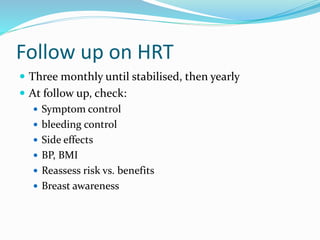
Follow up on HRT
 Three monthly until stabilised, then yearly
 At follow up, check:
 Symptom control
 bleeding control
 Side effects
 BP, BMI
 Reassess risk vs. benefits
 Breast awareness
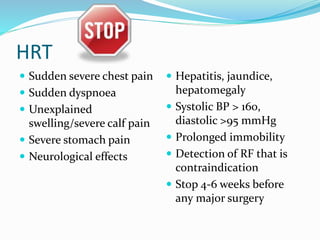
HRT
 Sudden severe chest pain
 Sudden dyspnoea
 Unexplained
swelling/severe calf pain
 Severe stomach pain
 Neurological effects
 Hepatitis, jaundice,
hepatomegaly
 Systolic BP > 160,
diastolic >95 mmHg
 Prolonged immobility
 Detection of RF that is
contraindication
 Stop 4-6 weeks before
any major surgery
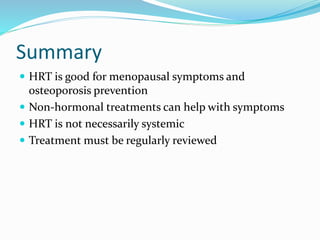
Summary
 HRT is good for menopausal symptoms and
osteoporosis prevention
 Non-hormonal treatments can help with symptoms
 HRT is not necessarily systemic
 Treatment must be regularly reviewed
Menopause
Menopause

Menopause

  • 2.
    Menopause – whatand when  The menopause may be  Natural or induced  Natural menopause - the permanent cessation of menstruation for 12 months caused by failure of ovarian function with elevated gonadotropins (FSH, LH).  Average is 51 years
  • 3.
    Induced menopause  Specifictreatment e.g. chemotherapy or radiotherapy  Oophorectomy  Treatment with gonadotrophin-releasing hormone (GnRH) analogues
  • 4.
    Clmacteric (perimenopause): Theperiod of time leading to the menopause when a women passes from the reproductive stage of life to the postmenopausal years.  Menstrual irregularities: 10% of women stop menstruating abruptly, but the vast majority experience 4-5 y of varying cycle length due to progressive ovarian failure.  Hormone Production: initially characterized by elevated FSH, decreased inhibin, but normal levels of estradiol and LH. However there is wide individual variations. AMH  Elevated gonadotrophins drive the ovarian stroma to increase production of androgens.
  • 5.
    Diagnosis - symptoms Short Term  Vasomotor  Flushes  Night sweats  Insomnia  Sexual dysfunction  Vaginal dryness  Dyspareunia  Decreased libido  Musculoskeletal  Joint aches  Fat redistribution  Psychological  Depressed mood  Anxiety  Irritability  Mood swings  Lethargy  Difficulty concentrating
  • 6.
    Consequences of themenopause  Long term  Osteoporosis  1 in 3 increase in risk of fracture  Cardiovascular disease  MI and stroke most common cause of death >60y  Oophorectomised women have 2-3 fold risk of CHD  Urogenital  Lower urinary tract and pelvic floor atrophy leading to frequency, urgency, nocturia, incontinence, recurrent infections  Vaginal atrophy
  • 7.
    Osteoporosis:  E2 inhibitbone resorption. Postmenopausal women experience increased bone resorption, diminished formation , resulting in bone fragility which often leads to fracture.  Effects of osteoporosis : 50% of women over 75y have vertebral fractures and 25 % will develop hip fracture by the age 80Y.  Risk factors include Caucasian or Asian descent low BMI, smoking, family history of osteoporosis. 
  • 8.
    Investigations  FSH isonly used if diagnosis is in doubt  FSH >30 iu/L  Don’t do LH, oestradiol and progesterone as not helpful  TFTs if symptoms presents  Bone mineral density testing (BMD)– Densitometry if significant risk of osteoporosis
  • 9.
    Management – Non-hormonal •Lifestyle advice • Avoid hot drinks especially caffeinated ones, and alcohol • Stop smoking  exercising regularly – including weight-bearing and resistance exercises  eating a healthy diet that includes plenty of fruit, vegetables and sources of calcium, such as low-fat milk and yoghurt  getting some sunlight – sunlight on your skin triggers the production of vitamin D, which can help to keep your bones strong
  • 10.
    Management – Non-hormonal Botanicals-Estrogen like effect Soy products, isoflavones and black cohosh may be helpful in the short –term treatment of vasomotor symptoms and depression. Clonidine - for hot flushes. Clonidine is a medication that lowers high blood pressure. It is also used to prevent and relieve symptoms of menopausal flushing. New medications: Raloxifen is a selective estrogen receptor modulator. (SERM) that has estrogen agonist effects on bones and cholesterol, but estrogen-antagonis effects on breast and endometrium. Gabapentine –anidepressants SSRI have also been used to treat hot flashes.
  • 11.
    Benefits of HRT Proven  Relief of menopausal symptoms  Prevention/treatment of osteoporosis  Reduced risk of colorectal cancer
  • 12.
    Contraindications to HRT Hormone dependent cancer – endometrial cancer, current or past breast cancer  Active or recent arterial thrombotic disease (CVD, CVA)  VTE  Otosclerosis  Severe active liver disease (oral oestrogen)  Undiagnosed breast mass  Undiagnosed abnormal vaginal bleeding
  • 13.
    Risks of HRT •Breast cancer – Increased by 26% in ♀ > 50 years taking combined HRT for > 5 years – Returns to baseline 5 years after stopping • VTE – 2-3x with oral HRT, highest in first year •  risk of acute coronary events in women with pre- existing CVD in first year •  risk of CVA
  • 14.
    Relative contraindications  Mayrequire extra supervision  Uterine fibroids  Endometriosis  Hypertension  Migraine
  • 15.
    Local symptoms • Vaginaldryness, soreness, dyspareunia, urinary frequency/urgency • Various preparations – Pessaries e.g. Ortho-Gynsest® – Creams e.g. Gynest ®, Ovestin ® – Tablets e.g. Vagifem ® – Rings e.g. Estring ® • Some damage latex condoms/diaphragms
  • 16.
    Non-oral oestrogens • Allestradiol 17 beta • Avoid first pass metabolism in liver • Available as – Patches – Gels (less irritating than a patch) – Implants (last resort) • Low, medium and high doses • Potentially more suitable for women: – With liver disease or gallstones – At risk of VTE – First line for women with migraine and malabsorption
  • 17.
    Oral oestrogens  Threetypes  Conjugate oestrogens (CEEs)  Estradiol 17 beta  Estradiol valerate  Low, medium, high doses
  • 18.
    Progestogens – threetypes • Testosterone analogues – Norethisterone, levonorgestrel (Mirena®), Norgestrel • Progesterone analogues – Dydrogesterone, medroxyprogesterone acetate (MPA) • Newer (derivates of norgestrel) – Desogestrel, norgestimate, gestodene
  • 19.
    Side Effects ofHRT  Nausea, vomiting, abdominal cramps, bloating  Weight changes  Breast tenderness  PMS-like syndrome  Sodium and fluid retention  Glucose intolerance  Altered blood lipids  Mood changes  Headache, migraine,  Leg cramps  And more…
  • 20.
    Premature menopause  Classification Normal: 45 – 55 years (average 51 years)  Early: 40 – 45 years  Premature: < 40 years  Unpredictable, so need to continue contraception  Diagnosis  Minimum of two FSH >30 IU/L at least one month apart
  • 21.
    Other Investigations  Pregnancytest!  TFTs  Prolactin for hyperprolactinaemia  Auto-antibodies (ovarian/thyroid)  Karyotyping if < 30 years for mosaic Turner’s Syndrome  Baseline DEXA (dual-energy x-ray absorptiometry), then repeat every 2 - 5 years  Baseline fasting lipids (yearly, depending on RFs)  Follicle tracking on USS (fertility)
  • 22.
    Risks of prematuremenopause  Life expectancy is reduced (2 years)  Untreated,  50% higher risk of osteoporotic fracture between 50-70 years   risk of CVD compared to woman of same age   risk of dementia   risk Parkinson’s
  • 23.
    Treating premature menopause Oestrogen replacement with progesterone
  • 24.
    Follow up onHRT  Three monthly until stabilised, then yearly  At follow up, check:  Symptom control  bleeding control  Side effects  BP, BMI  Reassess risk vs. benefits  Breast awareness
  • 25.
    HRT  Sudden severechest pain  Sudden dyspnoea  Unexplained swelling/severe calf pain  Severe stomach pain  Neurological effects  Hepatitis, jaundice, hepatomegaly  Systolic BP > 160, diastolic >95 mmHg  Prolonged immobility  Detection of RF that is contraindication  Stop 4-6 weeks before any major surgery
  • 26.
    Summary  HRT isgood for menopausal symptoms and osteoporosis prevention  Non-hormonal treatments can help with symptoms  HRT is not necessarily systemic  Treatment must be regularly reviewed

Editor's Notes

  • #11 The root of black cohosh is used for medicinal purposes. Black cohosh root contains several chemicals that might have effects in the body. Some of these chemicals work on the immune system and might affect the body’s defenses against diseases. Some might help the body to reduce inflammation. Other chemicals in black cohosh root might work in nerves and in the brain. These chemicals might work similar to another chemical in the brain called serotonin. Scientists call this type of chemical a neurotransmitter because it helps the brain send messages to other parts of the body.
  • #19 Mirena® is licensed for endometrial protection alongside oestrogen replacement for up to 4 years.