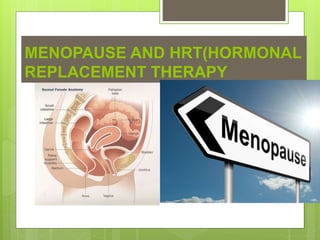
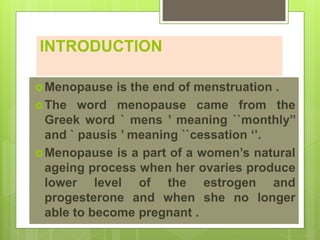


MENOPAUSE AND HRT(HORMONAL
REPLACEMENT THERAPY
INTRODUCTION
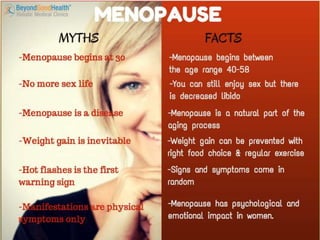
Menopause is the end of menstruation .
The word menopause came from the
Greek word ` mens ’ meaning ``monthly’’
and ` pausis ’ meaning ``cessation ‘’.
Menopause is a part of a women’s natural
ageing process when her ovaries produce
lower level of the estrogen and
progesterone and when she no longer
able to become pregnant .
DEFINITON:
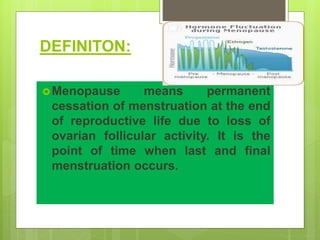
Menopause means permanent
cessation of menstruation at the end
of reproductive life due to loss of
ovarian follicular activity. It is the
point of time when last and final
menstruation occurs.
The clinical diagnosis is confirmed
following stoppage of menstruation for
twelve consecutive months without any
other pathology.
Premenopause- period prior to menopause
Post menopause- period after menopause
Perimenopause-
period around
menopause
(40-55 years)
Climacteric: is the phase of
ageing process during which a
woman passes from the
reproductive to the non-
reproductive stage.
This phase covers 5-10 years on
either side of menopause.
TYPES
Premenopause: is the part of the
climacteric before menopause, when
the menstrual cycle is likely to be
irregular.
Postmenopause: is the phase of life
that comes after the menopause.
AGE OF MENOPAUSE:
Age at which menopause occurs is
genetically predetermined.
The age of menopause is not related to
age of menarche or age at last
pregnancy.
It is also not related to number of
pregnancy, lactation, use of oral pill,
socio economic condition, race, height
or weight.
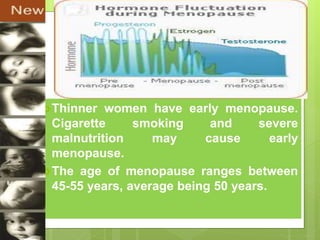
Thinner women have early menopause.
Cigarette smoking and severe
malnutrition may cause early
menopause.
The age of menopause ranges between
45-55 years, average being 50 years.
 Menopause is the stage of a woman's life,
typically between the ages of 45 and 55, when
she stops having menstrual periods.
 Menopause is defined as the time when there
have been no menstrual periods for 12
consecutive months and no other biological or
of fertility, the end of the childbearing years. (A
woman may still, however, be able to become
pregnant unless 12 consecutive months have
passed without a period.)
 Physiological cause can be identified. It is
the end of fertility, the end of the
childbearing years.
 (A woman may still, however, be able to
become pregnant unless 12 consecutive
months have passed without a period.)
CAUSES:
Surgical removal of the ovaries
Cancer chemotherapy and
radiation therapy
Premature ovarian failure
ORGAN CHANGES:-
 - Ovaries:- Shrink in size, become wrinkled
and white. There is thinning of the cortex with
increase in medullary components. There is
abundances of stromal cells which have got
secretory activity.
 - Fallopian tubes:- Show feature of atrophy.
The muscle coat becomes thinner, the cilia
disappear and the plicae becomes less
prominent.
The uterus:- Becomes smaller and the
ratio between the body and the cervix
reverts to the 1:1 ratio. The endometrium
becomes thin and atrophic. Cervical
secretion becomes scanty.
- The vagina:- becomes narrower due to
gradual loss of elasticity. The vaginal
epithelium becomes thin. The rugae
gradually flatten. The vaginal pH
becomes alkaline.
The vulva:- Shows feature of atrophy.
Tha labia becomes flattened and the
pubic hair becomes scantier.
- Breast fat:- is reabsorbed and the
glands atrophy. The nipples decrease
in size. Ultimately, the breasts become
flat and pendulous.
Bladder and urethra:- the epithelium
becomes thin and is more prone to get
infection.
- loss of muscle tone leads to pelvic
relaxation, uterine descend and
anatomic changes in the urethra and
neck of bladder.
skeletal system:- loss of bone mass by
3 to 5 % per year due to deficiency of
estrogen leading to osteoporosis.
- Cardiovascular system:- deficiency of
estrogen increases the risk of
cardiovascular disease because of its
function of decreasing HDL cholesterol
and antioxidant property.
MENSTRUATION PATTERN
PRIOR TO MENOPAUSE:
Abrupt cessation of menstruation
Gradual decrease in both amount
and duration
Irregular with or without
excessive bleeding
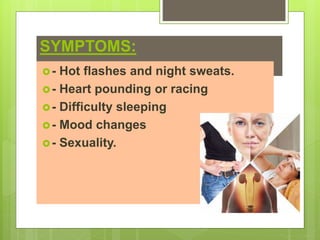
SYMPTOMS:
- Hot flashes and night sweats.
- Heart pounding or racing
- Difficulty sleeping
- Mood changes
- Sexuality.
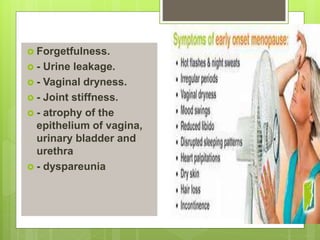
 Forgetfulness.
 - Urine leakage.
 - Vaginal dryness.
 - Joint stiffness.
 - atrophy of the
epithelium of vagina,
urinary bladder and
urethra
 - dyspareunia
 vaginal
infection
 - pruritus
 - leucorrhoea
 - increased
anxiety
 - headache
 - irritability
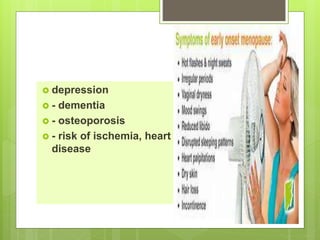
 depression
 - dementia
 - osteoporosis
 - risk of ischemia, heart
disease
COMPLICATIONS:
Menopause and Heart Health
Menopause and Bone Density
Mood Changes
Cognitive Function
Urinary Incontinence
Urinary Tract Infections
Skin Changes
EXAMS AND TESTS
Cessation for menstruation for twelve
consecutive months during climectric
Occurance of hot flushes and night
sweats
Features of low estrogen on vaginal
cytology
Serum estradiol < 20 pg/ml
Serum FSH and LH > 40 mlU/ml at one
week interval for 3 times.
SURGICAL
MENOPAUSE
The ovaries produce oestrogen,
progesterone and androgens which are
essential to the regulation of the
menstrual cycle. When a hysterectomy
occurs, these hormones get suddenly
interrupted and their levels fall resulting
in symptoms of menopause. This is
termed surgical menopause.
Since there is abrupt disruption of
hormones after hysterectomy, the
menopausal symptoms are more
severe, more frequent and last
longer when compared to natural
menopause.
SURGICAL MENOPAUSE
SYMPTOMS OF SURGICAL
MENOPAUSE
 Hot flushes and night sweats are the
commonest symptoms of surgical
menopause.
 This is due to the disturbance of the central
thermostat located in the hypothalamus which
is kept stable by normal circulating estrogen.
 Other symptoms of surgical menopause range
from sleepless nights, vaginal dryness and
itching to decrease in sexual desire and
painful intercourse.
Depression is another common result
of low estrogen level.
Thyroid dysfunction, bladder
infections, incontinence, weight gain,
migraine, and irritability are also
symptoms of surgical menopause.
MANAGEMENT OF SURGICAL
MENOPAUSE:-
Estrogen is immediately given after
surgery to try to prevent the intense
changes especially the hot flashes that
can occur in woman undergoing
hysterectomy.
It is not usually recommended for women
with existing or high risk of
cardiovascular disease.
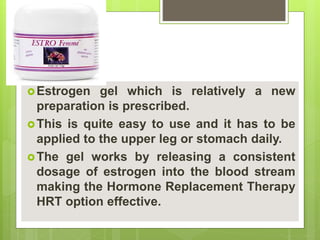
Estrogen gel which is relatively a new
preparation is prescribed.
This is quite easy to use and it has to be
applied to the upper leg or stomach daily.
The gel works by releasing a consistent
dosage of estrogen into the blood stream
making the Hormone Replacement Therapy
HRT option effective.
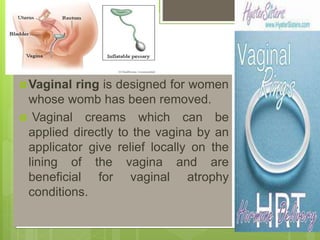
Vaginal ring is designed for women
whose womb has been removed.
 Vaginal creams which can be
applied directly to the vagina by an
applicator give relief locally on the
lining of the vagina and are
beneficial for vaginal atrophy
conditions.
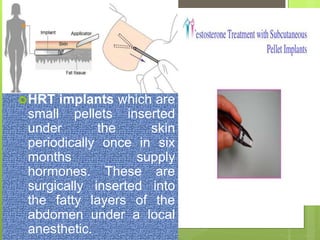
HRT implants which are
small pellets inserted
under the skin
periodically once in six
months supply
hormones. These are
surgically inserted into
the fatty layers of the
abdomen under a local
anesthetic.
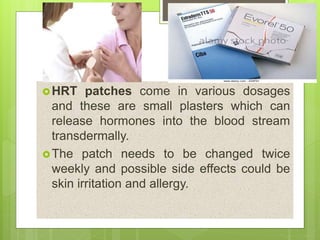
HRT patches come in various dosages
and these are small plasters which can
release hormones into the blood stream
transdermally.
The patch needs to be changed twice
weekly and possible side effects could be
skin irritation and allergy.
Tablets are the most common form of HRT and
they are for long term usage which needs to be
carefully considered.
Exercise is another form of self help which is a
positive therapy. Begin with small but regular
walks and then gradually move over to weight
bearing exercises which help to release
endorphins from the brain that send feel good
messages to the body.
RISKS OF SURGICAL
MENOPAUSE:
Cardiovascular disease
Height loss which may occur as a
result of reduced bone density.
Gum tissues are affected.
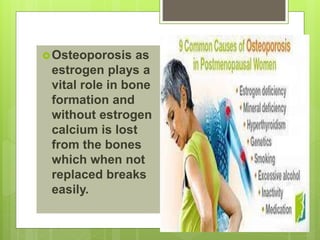
Osteoporosis as
estrogen plays a
vital role in bone
formation and
without estrogen
calcium is lost
from the bones
which when not
replaced breaks
easily.
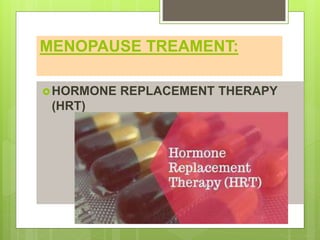
MENOPAUSE TREAMENT:
HORMONE REPLACEMENT THERAPY
(HRT)
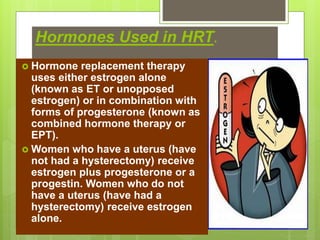
Hormones Used in HRT.
 Hormone replacement therapy
uses either estrogen alone
(known as ET or unopposed
estrogen) or in combination with
forms of progesterone (known as
combined hormone therapy or
EPT).
 Women who have a uterus (have
not had a hysterectomy) receive
estrogen plus progesterone or a
progestin. Women who do not
have a uterus (have had a
hysterectomy) receive estrogen
alone.
HRT comes in several forms:
 Oral tablets or pills
 Skin patches
 Vaginal cream or
tablet
 Vaginal ring
 Nasal spray
 Topical gel
CONTRAINDICATION:
Current, past, or suspected breast cancer
Vaginal bleeding of unknown cause
Current or past history of blood clots
High blood pressure that is untreated or
poorly managed
Angina that is currently symptomatic or
heart attack that occurred recently
Active liver problems
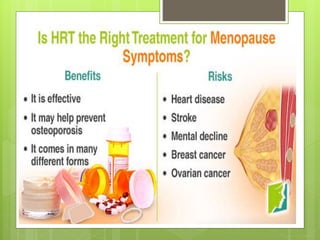
BENEFITS OF HRT
HRT is mainly recommended for
relieving menopausal symptoms,
including hot flashes, night sweats,
vaginal dryness, sleep problems,
and mild depression.
Estrogen increases and helps
maintain bone density.
Estrogen plus progestin HRT may
reduce the risk of colorectal cancer.
Younger women with a natural or
surgically induced menopause are at
increased risk for heart disease and
may benefit from estrogen
replacement therapy.
ADVERSE EFFECTS OF HRT
HRT does not prevent heart disease
except in women with premature
menopause and may increase the risk
for heart disease and heart attack,
especially in older women.
HRT may increase the risk of stroke.
Increase the risk of cognitive decline.
 Only HRT does not significantly increase the risk
of developing breast cancer if it is used for less
than 10 years.
 If used for more than 10 years, it may increase the
risk of breast (and ovarian) cancers, especially for
women already at higher risk for breast cancer
 Estrogen over stimulates the tissue lining the
uterus (the endometrial) and causes uncontrolled
cell growth, a condition known as hyperplasia,
which is a strong risk factor for cancer.
PREVENTION:

 Menopause is a natural and expected part of a
woman's development and does not need to be
prevented.
 You can reduce your risk of long-term problems such
as osteoporosis and heart disease by taking the
following steps:
 Control your blood pressure, cholesterol, and other risk
factors for heart disease.
 Do NOT smoke. Cigarette use can cause early
menopause.
 Eat a low-fat diet.
 Get regular exercise. Resistance exercises
help strengthen your bones and improve your
balance.
 If you show early signs of bone loss or have a
strong family history of osteoporosis, talk to
your doctor about medications that can help
stop further weakening.
 Take calcium and vitamin D.
HEALTH EDUCATION ON
MENOPAUSE
 Women at the menopausal
stage need to be supported emotionally; they
may need counselling to be educated about
how to manage signs and symptoms of
menopause.
 This may also help them to overcome the
symptoms of anxiety and depression.
 Certain life style modification is necessary to
prevent the occurrence or minimise the
effects of the associated condition.
HEALTH EDUCATION ON
MENOPAUSE
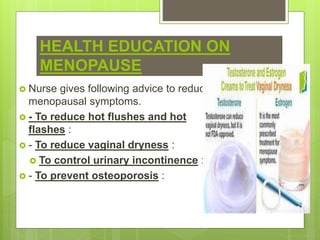
 Nurse gives following advice to reduce
menopausal symptoms.
 - To reduce hot flushes and hot
flashes :
 - To reduce vaginal dryness :
 To control urinary incontinence :
 - To prevent osteoporosis :
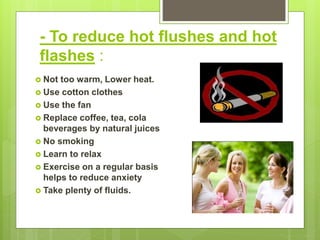
- To reduce hot flushes and hot
flashes :
 Not too warm, Lower heat.
 Use cotton clothes
 Use the fan
 Replace coffee, tea, cola
beverages by natural juices
 No smoking
 Learn to relax
 Exercise on a regular basis
helps to reduce anxiety
 Take plenty of fluids.
To reduce vaginal dryness :
In sexual relations while devoting more
time loving (necking) as this will increase
vaginal lubrication naturally.
Using specific lubricants that are sold in
pharmacies, Vaseline or oil.
To control urinary incontinence :
 Exercises to strengthen pelvic muscles:
When the bladder is empty, try to cut the
flow of urine for a few seconds (the
muscles are contracted) and then relax.
Perform this exercise several times a day.
To prevent osteoporosis :
Physical exercise moderately and
regularly, where all the joints work and
thus hinders the process of decalcification
of bone.
A diet rich in calcium, by increasing the
intake of dairy products.
HEALTH EDUCATION FOR
MENOPAUSAL WOMEN
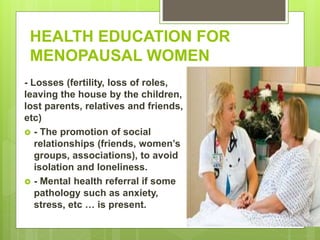
- Losses (fertility, loss of roles,
leaving the house by the children,
lost parents, relatives and friends,
etc)
 - The promotion of social
relationships (friends, women’s
groups, associations), to avoid
isolation and loneliness.
 - Mental health referral if some
pathology such as anxiety,
stress, etc … is present.
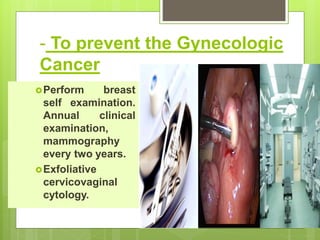
- To prevent the Gynecologic
Cancer
Perform breast
self examination.
Annual clinical
examination,
mammography
every two years.
Exfoliative
cervicovaginal
cytology.
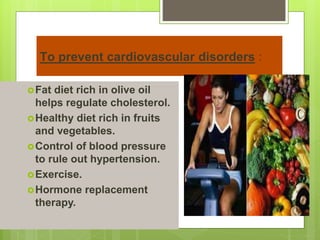
To prevent cardiovascular disorders :
Fat diet rich in olive oil
helps regulate cholesterol.
Healthy diet rich in fruits
and vegetables.
Control of blood pressure
to rule out hypertension.
Exercise.
Hormone replacement
therapy.
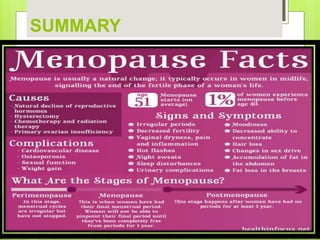
SUMMARY
Menopause

Menopause

  • 1.
  • 2.
    INTRODUCTION Menopause is theend of menstruation . The word menopause came from the Greek word ` mens ’ meaning ``monthly’’ and ` pausis ’ meaning ``cessation ‘’. Menopause is a part of a women’s natural ageing process when her ovaries produce lower level of the estrogen and progesterone and when she no longer able to become pregnant .
  • 3.
    DEFINITON: Menopause means permanent cessationof menstruation at the end of reproductive life due to loss of ovarian follicular activity. It is the point of time when last and final menstruation occurs.
  • 4.
    The clinical diagnosisis confirmed following stoppage of menstruation for twelve consecutive months without any other pathology. Premenopause- period prior to menopause Post menopause- period after menopause
  • 5.
  • 6.
    Climacteric: is thephase of ageing process during which a woman passes from the reproductive to the non- reproductive stage. This phase covers 5-10 years on either side of menopause.
  • 7.
    TYPES Premenopause: is thepart of the climacteric before menopause, when the menstrual cycle is likely to be irregular. Postmenopause: is the phase of life that comes after the menopause.
  • 8.
    AGE OF MENOPAUSE: Ageat which menopause occurs is genetically predetermined. The age of menopause is not related to age of menarche or age at last pregnancy. It is also not related to number of pregnancy, lactation, use of oral pill, socio economic condition, race, height or weight.
  • 9.
    Thinner women haveearly menopause. Cigarette smoking and severe malnutrition may cause early menopause. The age of menopause ranges between 45-55 years, average being 50 years.
  • 10.
     Menopause isthe stage of a woman's life, typically between the ages of 45 and 55, when she stops having menstrual periods.  Menopause is defined as the time when there have been no menstrual periods for 12 consecutive months and no other biological or of fertility, the end of the childbearing years. (A woman may still, however, be able to become pregnant unless 12 consecutive months have passed without a period.)
  • 11.
     Physiological causecan be identified. It is the end of fertility, the end of the childbearing years.  (A woman may still, however, be able to become pregnant unless 12 consecutive months have passed without a period.)
  • 12.
    CAUSES: Surgical removal ofthe ovaries Cancer chemotherapy and radiation therapy Premature ovarian failure
  • 13.
    ORGAN CHANGES:-  -Ovaries:- Shrink in size, become wrinkled and white. There is thinning of the cortex with increase in medullary components. There is abundances of stromal cells which have got secretory activity.  - Fallopian tubes:- Show feature of atrophy. The muscle coat becomes thinner, the cilia disappear and the plicae becomes less prominent.
  • 14.
    The uterus:- Becomessmaller and the ratio between the body and the cervix reverts to the 1:1 ratio. The endometrium becomes thin and atrophic. Cervical secretion becomes scanty. - The vagina:- becomes narrower due to gradual loss of elasticity. The vaginal epithelium becomes thin. The rugae gradually flatten. The vaginal pH becomes alkaline.
  • 15.
    The vulva:- Showsfeature of atrophy. Tha labia becomes flattened and the pubic hair becomes scantier. - Breast fat:- is reabsorbed and the glands atrophy. The nipples decrease in size. Ultimately, the breasts become flat and pendulous.
  • 16.
    Bladder and urethra:-the epithelium becomes thin and is more prone to get infection. - loss of muscle tone leads to pelvic relaxation, uterine descend and anatomic changes in the urethra and neck of bladder.
  • 17.
    skeletal system:- lossof bone mass by 3 to 5 % per year due to deficiency of estrogen leading to osteoporosis. - Cardiovascular system:- deficiency of estrogen increases the risk of cardiovascular disease because of its function of decreasing HDL cholesterol and antioxidant property.
  • 18.
    MENSTRUATION PATTERN PRIOR TOMENOPAUSE: Abrupt cessation of menstruation Gradual decrease in both amount and duration Irregular with or without excessive bleeding
  • 19.
    SYMPTOMS: - Hot flashesand night sweats. - Heart pounding or racing - Difficulty sleeping - Mood changes - Sexuality.
  • 20.
     Forgetfulness.  -Urine leakage.  - Vaginal dryness.  - Joint stiffness.  - atrophy of the epithelium of vagina, urinary bladder and urethra  - dyspareunia
  • 21.
     vaginal infection  -pruritus  - leucorrhoea  - increased anxiety  - headache  - irritability
  • 22.
     depression  -dementia  - osteoporosis  - risk of ischemia, heart disease
  • 23.
    COMPLICATIONS: Menopause and HeartHealth Menopause and Bone Density Mood Changes Cognitive Function Urinary Incontinence Urinary Tract Infections Skin Changes
  • 24.
    EXAMS AND TESTS Cessationfor menstruation for twelve consecutive months during climectric Occurance of hot flushes and night sweats Features of low estrogen on vaginal cytology Serum estradiol < 20 pg/ml Serum FSH and LH > 40 mlU/ml at one week interval for 3 times.
  • 25.
    SURGICAL MENOPAUSE The ovaries produceoestrogen, progesterone and androgens which are essential to the regulation of the menstrual cycle. When a hysterectomy occurs, these hormones get suddenly interrupted and their levels fall resulting in symptoms of menopause. This is termed surgical menopause.
  • 26.
    Since there isabrupt disruption of hormones after hysterectomy, the menopausal symptoms are more severe, more frequent and last longer when compared to natural menopause. SURGICAL MENOPAUSE
  • 27.
    SYMPTOMS OF SURGICAL MENOPAUSE Hot flushes and night sweats are the commonest symptoms of surgical menopause.  This is due to the disturbance of the central thermostat located in the hypothalamus which is kept stable by normal circulating estrogen.  Other symptoms of surgical menopause range from sleepless nights, vaginal dryness and itching to decrease in sexual desire and painful intercourse.
  • 28.
    Depression is anothercommon result of low estrogen level. Thyroid dysfunction, bladder infections, incontinence, weight gain, migraine, and irritability are also symptoms of surgical menopause.
  • 31.
    MANAGEMENT OF SURGICAL MENOPAUSE:- Estrogenis immediately given after surgery to try to prevent the intense changes especially the hot flashes that can occur in woman undergoing hysterectomy. It is not usually recommended for women with existing or high risk of cardiovascular disease.
  • 32.
    Estrogen gel whichis relatively a new preparation is prescribed. This is quite easy to use and it has to be applied to the upper leg or stomach daily. The gel works by releasing a consistent dosage of estrogen into the blood stream making the Hormone Replacement Therapy HRT option effective.
  • 33.
    Vaginal ring isdesigned for women whose womb has been removed.  Vaginal creams which can be applied directly to the vagina by an applicator give relief locally on the lining of the vagina and are beneficial for vaginal atrophy conditions.
  • 34.
    HRT implants whichare small pellets inserted under the skin periodically once in six months supply hormones. These are surgically inserted into the fatty layers of the abdomen under a local anesthetic.
  • 35.
    HRT patches comein various dosages and these are small plasters which can release hormones into the blood stream transdermally. The patch needs to be changed twice weekly and possible side effects could be skin irritation and allergy.
  • 36.
    Tablets are themost common form of HRT and they are for long term usage which needs to be carefully considered. Exercise is another form of self help which is a positive therapy. Begin with small but regular walks and then gradually move over to weight bearing exercises which help to release endorphins from the brain that send feel good messages to the body.
  • 37.
    RISKS OF SURGICAL MENOPAUSE: Cardiovasculardisease Height loss which may occur as a result of reduced bone density. Gum tissues are affected.
  • 38.
    Osteoporosis as estrogen playsa vital role in bone formation and without estrogen calcium is lost from the bones which when not replaced breaks easily.
  • 39.
  • 40.
    Hormones Used inHRT.  Hormone replacement therapy uses either estrogen alone (known as ET or unopposed estrogen) or in combination with forms of progesterone (known as combined hormone therapy or EPT).  Women who have a uterus (have not had a hysterectomy) receive estrogen plus progesterone or a progestin. Women who do not have a uterus (have had a hysterectomy) receive estrogen alone.
  • 41.
    HRT comes inseveral forms:  Oral tablets or pills  Skin patches  Vaginal cream or tablet  Vaginal ring  Nasal spray  Topical gel
  • 43.
    CONTRAINDICATION: Current, past, orsuspected breast cancer Vaginal bleeding of unknown cause Current or past history of blood clots High blood pressure that is untreated or poorly managed Angina that is currently symptomatic or heart attack that occurred recently Active liver problems
  • 44.
    BENEFITS OF HRT HRTis mainly recommended for relieving menopausal symptoms, including hot flashes, night sweats, vaginal dryness, sleep problems, and mild depression. Estrogen increases and helps maintain bone density.
  • 45.
    Estrogen plus progestinHRT may reduce the risk of colorectal cancer. Younger women with a natural or surgically induced menopause are at increased risk for heart disease and may benefit from estrogen replacement therapy.
  • 46.
    ADVERSE EFFECTS OFHRT HRT does not prevent heart disease except in women with premature menopause and may increase the risk for heart disease and heart attack, especially in older women. HRT may increase the risk of stroke. Increase the risk of cognitive decline.
  • 47.
     Only HRTdoes not significantly increase the risk of developing breast cancer if it is used for less than 10 years.  If used for more than 10 years, it may increase the risk of breast (and ovarian) cancers, especially for women already at higher risk for breast cancer  Estrogen over stimulates the tissue lining the uterus (the endometrial) and causes uncontrolled cell growth, a condition known as hyperplasia, which is a strong risk factor for cancer.
  • 48.
    PREVENTION:   Menopause isa natural and expected part of a woman's development and does not need to be prevented.  You can reduce your risk of long-term problems such as osteoporosis and heart disease by taking the following steps:  Control your blood pressure, cholesterol, and other risk factors for heart disease.  Do NOT smoke. Cigarette use can cause early menopause.  Eat a low-fat diet.
  • 49.
     Get regularexercise. Resistance exercises help strengthen your bones and improve your balance.  If you show early signs of bone loss or have a strong family history of osteoporosis, talk to your doctor about medications that can help stop further weakening.  Take calcium and vitamin D.
  • 50.
    HEALTH EDUCATION ON MENOPAUSE Women at the menopausal stage need to be supported emotionally; they may need counselling to be educated about how to manage signs and symptoms of menopause.  This may also help them to overcome the symptoms of anxiety and depression.  Certain life style modification is necessary to prevent the occurrence or minimise the effects of the associated condition.
  • 51.
    HEALTH EDUCATION ON MENOPAUSE Nurse gives following advice to reduce menopausal symptoms.  - To reduce hot flushes and hot flashes :  - To reduce vaginal dryness :  To control urinary incontinence :  - To prevent osteoporosis :
  • 52.
    - To reducehot flushes and hot flashes :  Not too warm, Lower heat.  Use cotton clothes  Use the fan  Replace coffee, tea, cola beverages by natural juices  No smoking  Learn to relax  Exercise on a regular basis helps to reduce anxiety  Take plenty of fluids.
  • 53.
    To reduce vaginaldryness : In sexual relations while devoting more time loving (necking) as this will increase vaginal lubrication naturally. Using specific lubricants that are sold in pharmacies, Vaseline or oil.
  • 54.
    To control urinaryincontinence :  Exercises to strengthen pelvic muscles: When the bladder is empty, try to cut the flow of urine for a few seconds (the muscles are contracted) and then relax. Perform this exercise several times a day.
  • 55.
    To prevent osteoporosis: Physical exercise moderately and regularly, where all the joints work and thus hinders the process of decalcification of bone. A diet rich in calcium, by increasing the intake of dairy products.
  • 56.
    HEALTH EDUCATION FOR MENOPAUSALWOMEN - Losses (fertility, loss of roles, leaving the house by the children, lost parents, relatives and friends, etc)  - The promotion of social relationships (friends, women’s groups, associations), to avoid isolation and loneliness.  - Mental health referral if some pathology such as anxiety, stress, etc … is present.
  • 57.
    - To preventthe Gynecologic Cancer Perform breast self examination. Annual clinical examination, mammography every two years. Exfoliative cervicovaginal cytology.
  • 58.
    To prevent cardiovasculardisorders : Fat diet rich in olive oil helps regulate cholesterol. Healthy diet rich in fruits and vegetables. Control of blood pressure to rule out hypertension. Exercise. Hormone replacement therapy.
  • 59.