
Hot flushes
Night sweats
What is •••?

Hot flushes and night sweats
Very common
A sensation of heat spreads over your
body, in particular your head, face and
chest and is often accompanied by
flushing and sweating, followed by a
chill
 Hot flushes!!
 The hallmark and the most commonly associated
symptom with menopause. This is just one of several
symptoms that may occur letting you know that
menopause is on its way
 Though not welcomed, these symptoms tend to be
experienced by the majority of women and are due to
the declining level of oestrogen in the body which up
until now has maintained the ‘hormonal balance’ all
these years
 The body is now moving into a state of readjustment
and learning to live without oestrogen

Menopause:
last menstrual period
One complete year without a menstrual
cycle
Perimenopause:
transition into menopause. It can last
for 2 to 8 years prior to menopause and
includes the first year after menopause
Definitions

There are three stages of menopause
that take place over about a decade
Peri-menopause
Menopause
Post-menopause

Definition:
In about 2/3 of the women in
perimenopausal period ,there appear
a series of symptoms due to
deficiency of sexual hormone.
usually occurring in women ageing
from 45 to 55.
Perimenopausal syndrome
Menopause affects the women who suffer from
it as well as their loved ones!

Derived from the Greek words for
“month” (men) and “cessation” (pausis)
A natural event in a woman's life - this
is a time of change
Menopause

 ‘Menopause’ refers to the stage in a woman’s life when
her periods cease
 Menopause occurs when the ovaries stop producing the
hormones oestrogen and progesterone
 Usually occurs between ages of 45 and 55 years
 Symptoms such as hot flushes, mood swings, tiredness,
loss of libido and irregular bleeding are common
What is menopause?

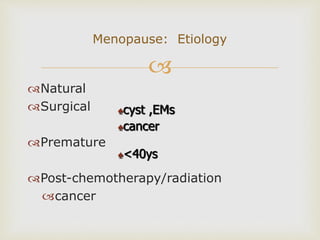
Natural
Surgical
Premature
Post-chemotherapy/radiation
cancer
Menopause: Etiology
♠cyst ,EMs
♠cancer
♠<40ys

Vasomotor symptoms : hot flashes,
night sweats
Vaginal dryness :painful intercourse,
Vulvae pruritus
Insomnia
Weight gain
Sexual changes
Irregular menses
Moon changes: Irritability, depression
Signs and Symptoms

Osteoporosis
Cardiovascular risk
Breast Disease
Diet modification
Exercise
Calcium intake, Vitamin D
Family history
Health Issues:

 Permanent cessation of menstruation which occurs
when the ovaries stop producing the hormones
oestrogen and progesterone
 Natural menopause is recognised to have occurred
once a period of 12-months has lapsed after the last
menstrual period, and for which there is no other
obvious cause
 No specific indication marks the beginning of
menopause other than the onset of symptoms

Post-menopause
When one year has lapsed since the
last menstrual period
Some women may still continue to
experience menopausal symptoms for
several years following their last period

 Issues for primary care physicians and
gynecologists:
 Hormonal changes
 Cardiovascular disease
 Osteoporosis
 Post menopausal bleeding (PMB)
 Abnormal PAP’s
 Sexual Function
 Depression
 Cancer screening and prevention
 Lifestyle and habits
Post menopause

Is hormone replacement therapy (HRT)
safe?
What can I do about my lack of sex
drive?
Commonly–Asked
Questions
 Combination of estrogen, progesterone and sometimes testosterone
 Estrogen is given for relief of hot flashes, night sweats and vaginal dryness
 Other advantages of estrogen:
 Improvement of sexual functioning
 Improvement with sleep
 Improvement with cognition
 Improvement of mood
 Prevents osteoporosis
 Decreases risk of fractures
 Decreases risk of colon and rectal cancer
What is HRT?

Progesterone is given with estrogen to
prevent cancer and hyperplasia (pre-
cancer) of the lining in the uterus
(endometrium)
Estrogen alone is generally given to
those women who don’t have a uterus
Testosterone is given to improve sexual
dysfunction
What is HRT?

Disadvantages of estrogen - based on the
WHI study (Women’s Health Initiative)
Coronary heart disease
Stroke
Venous Thromboembolism - clotting
that occurs in the deep veins (usually
the legs, pelvis or lungs)
Breast cancer
Endometrial cancer and hyperplasia
(known)
Is HRT Safe?

Mission: does Prempro (combo of
premarin and provera) or premarin
alone reduce cardiovascular risk
(premarin is a conjugated estrogen
and provera is medroxyprogesterone
acetate)
WHI Study

Results:
Prempro trial was halted prematurely
after only 5.2 years due to the
increased risk of CHD, stroke, VTE, and
breast cancer
Premarin-alone trial was halted
prematurely due to the increased risk of
stroke
Due to these findings the number of HRT
prescriptions dropped by 50% from 1995
to 2003
WHI Study
The Headlines
41% increase in
strokes
29% increase in
heart attacks
Greater than 100%
increase in VTE
22% increase in total
CVD
26% increase in
breast cancer
WHI Study
♠ 37% decrease in
colorectal cancer
♠ 33% decrease in hip
fracture
♠ 24% decrease in total
fractures

Not in the media about WHI
Average age was 63
Only 16% were within 5 years of their
last menses
Most were an average of 12 years after
their last menses
Most already had silent CVD
50% current or former smokers
Average Body Mass Index 28.5, many
obese
Average participant was older,
overweight smoker
 HRT is safer for younger menopausal women
 HRT is intended for relief of vasomotor
symptoms only (hot flashes, night sweats,
vaginal dryness)
 Flushing is worse between the transition
from pre-menopause to perimenopause
 Vaginal dryness, sweating, insomnia is
most prominent during the transition from
perimenopause to post-menopause
 WHI study tested only premarin and provera
 Many other forms of estrogen and
progesterone
Is HRT Safe?
Take Home Message

Definition:
decreased interest in sexual activity or
lack of sexual satisfaction.
40% of women between ages 18 to 59
report some sort of sexual dysfunction.
Sexual functioning is a very important part
of a woman’s relationship with her partner.
Sexual dysfunction is very common during
the perimenopausal and post-menopausal
years.
What can I do about
my lack of sex drive?

Causes:
Chronic disease
Medications
Psychological causes
Socio-cultural causes
Loss of estrogen
Loss of testosterone
Sexual Dysfunction

Medical problems as a cause for decreased
sexual activity
Endocrine disorders – diabetes, kidney
disease
Vascular diseases
Atherosclerosis
Neurologic disorders or injuries
Alcohol or substance abuse
Removal of the ovaries
Sexual Dysfunction
 The number of women aged 50 and above is increasing as
life expectancy rises
 Women can now expect to live greater portions of their lives
postmenopausal
 Proactively managing menopause is an opportunity for
women to prevent disease and improve their long-term
health and quality of life
 Menopause is a perfect time to evaluate your life and make
changes to ensure that you stay fit and healthy now and in
the future
Snapshot

 Treatment: counseling, anti-depressants,
tranquilizers, ERT: estrone (Ogen); 17-beta estradiol
(oral: Estrace; transdermals: Estraderm, Climara;
vaginal: Estring) estriol: has to be compounded;
conjugated estrogen (Premarin, similar to 17-beta
estradiol, may increase blood pressure)
Menopause Western Overview

Progesterone: acts on osteoblasts:
medroxyprogesterone (Provera),
progesterone USP (Prometrium,
Crinone); testosterone
Natural Treatment: natural OTC
estrogen & progesterone creams, bi-est
(estradiol/estriol mix), tri-est (80 %
estriol, 10 % estrone, 10 % estradiol),
DHEA
Menopause Western Overview
Collecting the information
from the patient
Questioning (history), Inspection (visual, tongue),
Listening & Smelling (voice, breathing, odors),
Palpation (pulse, relevant)
 Disease & their energetic imbalances are
classified into an Oriental medical diagnostic
pattern of disharmony (Bian Zheng Lun Zhi).
 Treatment focuses on correcting patterns of
disharmony by controlling and regulating the flow
and balance of energy to create homeostasis.

However, we now know that hormone
replacement therapy carries significant
risks, so many women and their
families need safe, long-term strategies
to treat menopausal symptoms.
Traditional Chinese medicine has kept
women healthy for centuries and
provides a viable solution to this
problem.
HRT&TCM
Western doctors traditionally prescribed hormones
to replace a woman’s own diminishing production.
Since the Women’s Health Initiative ended early in
2002, however, research has shown that this
strategy is fraught with side effects. This major
long-term study on hormone replacement therapy
found that health risks include greater incidence of
ovarian cancer, stroke, and breast cancer rates—
especially for women who take hormones for 15
years or more.
HRT & RISKS
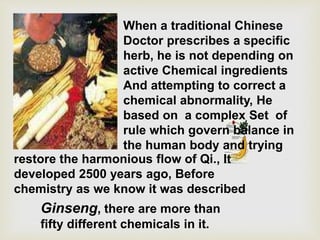
Ginseng, there are more than
fifty different chemicals in it.
When a traditional Chinese
Doctor prescribes a specific
herb, he is not depending on
active Chemical ingredients
And attempting to correct a
chemical abnormality, He
based on a complex Set of
rule which govern balance in
the human body and trying
restore the harmonious flow of Qi., It
developed 2500 years ago, Before
chemistry as we know it was described
Moreover, key diet and lifestyle changes figure
importantly in long-term menopause management.
Specific exercises and relaxation practices help
reduce symptoms both in the short- and long-term.
Personalized dietary plans present another
effective tool, especially when created by a health
professional who understands your particular
medical history and symptom picture. Point in fact:
those cultures with vegetable and fish-based diets
like the Japanese do not technically have a word
for menopause, because the incidence of
symptoms is so low.
DIET AND LIFESTYLE

This isn’t a ‘one size fits all’ situation!
All women are different and will need
different ways to manage their
menopause
THANK YOU!! And REMEMBER!!

Menopause womens health

  • 2.
  • 3.
     Hot flushes andnight sweats Very common A sensation of heat spreads over your body, in particular your head, face and chest and is often accompanied by flushing and sweating, followed by a chill
  • 4.
     Hot flushes!! The hallmark and the most commonly associated symptom with menopause. This is just one of several symptoms that may occur letting you know that menopause is on its way  Though not welcomed, these symptoms tend to be experienced by the majority of women and are due to the declining level of oestrogen in the body which up until now has maintained the ‘hormonal balance’ all these years  The body is now moving into a state of readjustment and learning to live without oestrogen
  • 5.
     Menopause: last menstrual period Onecomplete year without a menstrual cycle Perimenopause: transition into menopause. It can last for 2 to 8 years prior to menopause and includes the first year after menopause Definitions
  • 6.
     There are threestages of menopause that take place over about a decade Peri-menopause Menopause Post-menopause
  • 7.
     Definition: In about 2/3of the women in perimenopausal period ,there appear a series of symptoms due to deficiency of sexual hormone. usually occurring in women ageing from 45 to 55. Perimenopausal syndrome Menopause affects the women who suffer from it as well as their loved ones!
  • 8.
     Derived from theGreek words for “month” (men) and “cessation” (pausis) A natural event in a woman's life - this is a time of change Menopause
  • 9.
      ‘Menopause’ refersto the stage in a woman’s life when her periods cease  Menopause occurs when the ovaries stop producing the hormones oestrogen and progesterone  Usually occurs between ages of 45 and 55 years  Symptoms such as hot flushes, mood swings, tiredness, loss of libido and irregular bleeding are common What is menopause?
  • 10.
  • 11.
     Vasomotor symptoms :hot flashes, night sweats Vaginal dryness :painful intercourse, Vulvae pruritus Insomnia Weight gain Sexual changes Irregular menses Moon changes: Irritability, depression Signs and Symptoms
  • 12.
     Osteoporosis Cardiovascular risk Breast Disease Dietmodification Exercise Calcium intake, Vitamin D Family history Health Issues:
  • 13.
      Permanent cessationof menstruation which occurs when the ovaries stop producing the hormones oestrogen and progesterone  Natural menopause is recognised to have occurred once a period of 12-months has lapsed after the last menstrual period, and for which there is no other obvious cause  No specific indication marks the beginning of menopause other than the onset of symptoms
  • 14.
     Post-menopause When one yearhas lapsed since the last menstrual period Some women may still continue to experience menopausal symptoms for several years following their last period
  • 15.
      Issues forprimary care physicians and gynecologists:  Hormonal changes  Cardiovascular disease  Osteoporosis  Post menopausal bleeding (PMB)  Abnormal PAP’s  Sexual Function  Depression  Cancer screening and prevention  Lifestyle and habits Post menopause
  • 16.
     Is hormone replacementtherapy (HRT) safe? What can I do about my lack of sex drive? Commonly–Asked Questions
  • 17.
     Combination ofestrogen, progesterone and sometimes testosterone  Estrogen is given for relief of hot flashes, night sweats and vaginal dryness  Other advantages of estrogen:  Improvement of sexual functioning  Improvement with sleep  Improvement with cognition  Improvement of mood  Prevents osteoporosis  Decreases risk of fractures  Decreases risk of colon and rectal cancer What is HRT?
  • 18.
     Progesterone is givenwith estrogen to prevent cancer and hyperplasia (pre- cancer) of the lining in the uterus (endometrium) Estrogen alone is generally given to those women who don’t have a uterus Testosterone is given to improve sexual dysfunction What is HRT?
  • 19.
     Disadvantages of estrogen- based on the WHI study (Women’s Health Initiative) Coronary heart disease Stroke Venous Thromboembolism - clotting that occurs in the deep veins (usually the legs, pelvis or lungs) Breast cancer Endometrial cancer and hyperplasia (known) Is HRT Safe?
  • 20.
     Mission: does Prempro(combo of premarin and provera) or premarin alone reduce cardiovascular risk (premarin is a conjugated estrogen and provera is medroxyprogesterone acetate) WHI Study
  • 21.
     Results: Prempro trial washalted prematurely after only 5.2 years due to the increased risk of CHD, stroke, VTE, and breast cancer Premarin-alone trial was halted prematurely due to the increased risk of stroke Due to these findings the number of HRT prescriptions dropped by 50% from 1995 to 2003 WHI Study
  • 22.
    The Headlines 41% increasein strokes 29% increase in heart attacks Greater than 100% increase in VTE 22% increase in total CVD 26% increase in breast cancer WHI Study ♠ 37% decrease in colorectal cancer ♠ 33% decrease in hip fracture ♠ 24% decrease in total fractures
  • 23.
     Not in themedia about WHI Average age was 63 Only 16% were within 5 years of their last menses Most were an average of 12 years after their last menses Most already had silent CVD 50% current or former smokers Average Body Mass Index 28.5, many obese Average participant was older, overweight smoker
  • 24.
     HRT issafer for younger menopausal women  HRT is intended for relief of vasomotor symptoms only (hot flashes, night sweats, vaginal dryness)  Flushing is worse between the transition from pre-menopause to perimenopause  Vaginal dryness, sweating, insomnia is most prominent during the transition from perimenopause to post-menopause  WHI study tested only premarin and provera  Many other forms of estrogen and progesterone Is HRT Safe? Take Home Message
  • 25.
     Definition: decreased interest insexual activity or lack of sexual satisfaction. 40% of women between ages 18 to 59 report some sort of sexual dysfunction. Sexual functioning is a very important part of a woman’s relationship with her partner. Sexual dysfunction is very common during the perimenopausal and post-menopausal years. What can I do about my lack of sex drive?
  • 26.
     Causes: Chronic disease Medications Psychological causes Socio-culturalcauses Loss of estrogen Loss of testosterone Sexual Dysfunction
  • 27.
     Medical problems asa cause for decreased sexual activity Endocrine disorders – diabetes, kidney disease Vascular diseases Atherosclerosis Neurologic disorders or injuries Alcohol or substance abuse Removal of the ovaries Sexual Dysfunction
  • 28.
     The numberof women aged 50 and above is increasing as life expectancy rises  Women can now expect to live greater portions of their lives postmenopausal  Proactively managing menopause is an opportunity for women to prevent disease and improve their long-term health and quality of life  Menopause is a perfect time to evaluate your life and make changes to ensure that you stay fit and healthy now and in the future Snapshot
  • 29.
      Treatment: counseling,anti-depressants, tranquilizers, ERT: estrone (Ogen); 17-beta estradiol (oral: Estrace; transdermals: Estraderm, Climara; vaginal: Estring) estriol: has to be compounded; conjugated estrogen (Premarin, similar to 17-beta estradiol, may increase blood pressure) Menopause Western Overview
  • 30.
     Progesterone: acts onosteoblasts: medroxyprogesterone (Provera), progesterone USP (Prometrium, Crinone); testosterone Natural Treatment: natural OTC estrogen & progesterone creams, bi-est (estradiol/estriol mix), tri-est (80 % estriol, 10 % estrone, 10 % estradiol), DHEA Menopause Western Overview
  • 31.
    Collecting the information fromthe patient Questioning (history), Inspection (visual, tongue), Listening & Smelling (voice, breathing, odors), Palpation (pulse, relevant)  Disease & their energetic imbalances are classified into an Oriental medical diagnostic pattern of disharmony (Bian Zheng Lun Zhi).  Treatment focuses on correcting patterns of disharmony by controlling and regulating the flow and balance of energy to create homeostasis.
  • 32.
     However, we nowknow that hormone replacement therapy carries significant risks, so many women and their families need safe, long-term strategies to treat menopausal symptoms. Traditional Chinese medicine has kept women healthy for centuries and provides a viable solution to this problem. HRT&TCM
  • 33.
    Western doctors traditionallyprescribed hormones to replace a woman’s own diminishing production. Since the Women’s Health Initiative ended early in 2002, however, research has shown that this strategy is fraught with side effects. This major long-term study on hormone replacement therapy found that health risks include greater incidence of ovarian cancer, stroke, and breast cancer rates— especially for women who take hormones for 15 years or more. HRT & RISKS
  • 34.
    Ginseng, there aremore than fifty different chemicals in it. When a traditional Chinese Doctor prescribes a specific herb, he is not depending on active Chemical ingredients And attempting to correct a chemical abnormality, He based on a complex Set of rule which govern balance in the human body and trying restore the harmonious flow of Qi., It developed 2500 years ago, Before chemistry as we know it was described
  • 35.
    Moreover, key dietand lifestyle changes figure importantly in long-term menopause management. Specific exercises and relaxation practices help reduce symptoms both in the short- and long-term. Personalized dietary plans present another effective tool, especially when created by a health professional who understands your particular medical history and symptom picture. Point in fact: those cultures with vegetable and fish-based diets like the Japanese do not technically have a word for menopause, because the incidence of symptoms is so low. DIET AND LIFESTYLE
  • 36.
     This isn’t a‘one size fits all’ situation! All women are different and will need different ways to manage their menopause THANK YOU!! And REMEMBER!!