Quality of Life during Menopause  Dr. Amit Sengupta MBBS, MD, Ph.D. MUMBAI-INDIA
How do we define quality of life? *  Quality of life Index (QLI)  A product of the interplay among social, health, economic and environmental condition which affect human and social development  *std. definition
What is the purpose of QoLI ? To provide a tool for the community development which can be used to monitor  key events  that encompasses the social, health, environmental, economic dimension of the quality of life
Can menopause be a key event? Yes, any defined state in health or disease that potentially affects the human physiology or psychology during the entire life span can be a key event. Physiological events e.g., adolescence, menarche, pregnancy,  menopause,  senility/aging etc, Pathological events e.g., Diabetes, cancer, hypertension etc
Significance of menopause Menopause  basically signifies overall status of middle aged women passing through a particular biological  event  We need menopause- QoLI as a tool to understand, assess, improve their status before, during and after the event
Menopause- present status Menopause (? Aging in India) was believed  to be the beginning of the end, Now it is the beginning of  a new phase  (Middle age) of successful aging in urban India Reproductive period 15 – 35 YEARS Pre- Peri - Post menopause ( 45 yrs to 55  years ) CLIMACTERIC ( 35 TO 65 YRS ) Aging-senility > 65 YEARS
CHANGING DEMOGRAPHY LIFE EXPECTANCY  ( 35 YRS, 1947 ) MIDDLE AGE MISSING ( 67 YRS, 2001 ) FEMALE  LIVES  LONGER THAN MALES WHO- South East Asia
DEMOGRAHIC PATTERN PROPORTION OF MIDDLE-ELDERLY-DEPENDENTS ( ELDERLY 14% 2025; 7%1995; ) 1:4 IN DEVLOPING > BY 2020,  150 MILLION ( 10% OF POPULATION  ) 1:2 IN DEVELOPED; AGE 0-14—NEGATIVE GROWTH RATE; 60 + GROWTH RATE 3/YR
Menopause in India Global - Women constitutes 70% of world’s poorest and 90% of the landless In India, 60% of women beyond 50 are widow 80% or more stay in extended family More than 80% suffers AFFECTIVE/NEUROTIC syndrome (     hysterectomy,    infertile) More than 60% are anemic between 15- 60yrs More than 50% suffers osteoporosis Indians are prone to DM and CAD.
HDI and GDI in Developing world HDI- Human development index ( LONGIVITY;KNOWLEDGE AND DECENT STD LIVING; life exp; adjusted income, education level ) GDI - Gender related development index (Captures inequalities, HDI:GDI > India—0.5; Developed countries-0.9) ( Vast disparity between different population groups )
INDIA - BOMBAY RAILWAY STATION
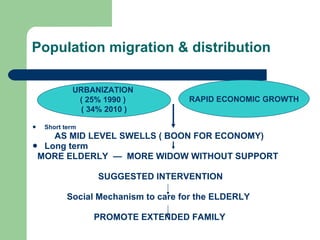
Population migration & distribution Short term AS MID LEVEL SWELLS ( BOON FOR ECONOMY) Long term MORE ELDERLY  —  MORE WIDOW WITHOUT SUPPORT  SUGGESTED INTERVENTION  Social Mechanism to care for the ELDERLY  PROMOTE EXTENDED FAMILY  URBANIZATION  ( 25% 1990 )  ( 34% 2010 ) RAPID ECONOMIC GROWTH
12 10 5 Musculoskeletal pain/cramps 20.5 17 2  Psychosomatic 38.5 32 1  Menstrual irregularity % N 83 Morbidity expressed during Perimenopause
16.2 28 Vasomotor/Flushing 26.6 46 Musculoskeletal symptoms 26.6 46 CVS/Palpitations % N=173 MAJOR 3 BROAD GROUPS Morbidity expressed during Menopause
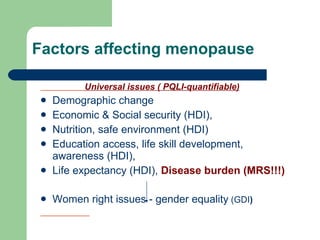
Factors affecting menopause Universal issues ( PQLI-quantifiable) Demographic change Economic & Social security (HDI), Nutrition, safe environment (HDI) Education access, life skill development, awareness (HDI), Life expectancy (HDI),  Disease burden (MRS!!!) Women right issues - gender equality   (GDI )
Factors affecting menopause Cultural issues (subjective)   A ttitude/Belief  Symptoms expression/retrieval Mind - body – soul – spirit interactions Issues related to marriage/ reproductive status / conception / widows / divorce Traditional/religious/spiritual belief
Management modalities PEOPLE BUY BENEFITS AND NOT PRODUCT BENEFIT MAY BE IN THE FORM OF HRT, COUNCELLING, ALTERNATIVE MEDICINE AWARENESS   INFLUNECES DELIVERY OF THE BENEFITS
Intervention principles Body – medical check up, exercises, diet, HRT / drugs etc Mind - counseling, meditations, psychotherapy Social – extended family norm Spiritual – service of mankind, reading religious text, prayers, all path leads to one GOD
Intervention Approach (Improve QLI) EDUCATION  – improves body-mind interaction ( Knowledge / Awareness) ECONOMY – improves Nutrition & self confidence AVAILABILITY  of service – improves Health seeking behavior & expression AUDIT  – Promotes EBM vis-a-vis cultural practices
 

menopause

  • 1.
    Quality of Lifeduring Menopause Dr. Amit Sengupta MBBS, MD, Ph.D. MUMBAI-INDIA
  • 2.
    How do wedefine quality of life? * Quality of life Index (QLI) A product of the interplay among social, health, economic and environmental condition which affect human and social development *std. definition
  • 3.
    What is thepurpose of QoLI ? To provide a tool for the community development which can be used to monitor key events that encompasses the social, health, environmental, economic dimension of the quality of life
  • 4.
    Can menopause bea key event? Yes, any defined state in health or disease that potentially affects the human physiology or psychology during the entire life span can be a key event. Physiological events e.g., adolescence, menarche, pregnancy, menopause, senility/aging etc, Pathological events e.g., Diabetes, cancer, hypertension etc
  • 5.
    Significance of menopauseMenopause basically signifies overall status of middle aged women passing through a particular biological event We need menopause- QoLI as a tool to understand, assess, improve their status before, during and after the event
  • 6.
    Menopause- present statusMenopause (? Aging in India) was believed to be the beginning of the end, Now it is the beginning of a new phase (Middle age) of successful aging in urban India Reproductive period 15 – 35 YEARS Pre- Peri - Post menopause ( 45 yrs to 55 years ) CLIMACTERIC ( 35 TO 65 YRS ) Aging-senility > 65 YEARS
  • 7.
    CHANGING DEMOGRAPHY LIFEEXPECTANCY ( 35 YRS, 1947 ) MIDDLE AGE MISSING ( 67 YRS, 2001 ) FEMALE LIVES LONGER THAN MALES WHO- South East Asia
  • 8.
    DEMOGRAHIC PATTERN PROPORTIONOF MIDDLE-ELDERLY-DEPENDENTS ( ELDERLY 14% 2025; 7%1995; ) 1:4 IN DEVLOPING > BY 2020, 150 MILLION ( 10% OF POPULATION ) 1:2 IN DEVELOPED; AGE 0-14—NEGATIVE GROWTH RATE; 60 + GROWTH RATE 3/YR
  • 9.
    Menopause in IndiaGlobal - Women constitutes 70% of world’s poorest and 90% of the landless In India, 60% of women beyond 50 are widow 80% or more stay in extended family More than 80% suffers AFFECTIVE/NEUROTIC syndrome (  hysterectomy,  infertile) More than 60% are anemic between 15- 60yrs More than 50% suffers osteoporosis Indians are prone to DM and CAD.
  • 10.
    HDI and GDIin Developing world HDI- Human development index ( LONGIVITY;KNOWLEDGE AND DECENT STD LIVING; life exp; adjusted income, education level ) GDI - Gender related development index (Captures inequalities, HDI:GDI > India—0.5; Developed countries-0.9) ( Vast disparity between different population groups )
  • 11.
    INDIA - BOMBAYRAILWAY STATION
  • 12.
    Population migration &distribution Short term AS MID LEVEL SWELLS ( BOON FOR ECONOMY) Long term MORE ELDERLY — MORE WIDOW WITHOUT SUPPORT SUGGESTED INTERVENTION Social Mechanism to care for the ELDERLY PROMOTE EXTENDED FAMILY URBANIZATION ( 25% 1990 ) ( 34% 2010 ) RAPID ECONOMIC GROWTH
  • 13.
    12 10 5Musculoskeletal pain/cramps 20.5 17 2 Psychosomatic 38.5 32 1 Menstrual irregularity % N 83 Morbidity expressed during Perimenopause
  • 14.
    16.2 28 Vasomotor/Flushing26.6 46 Musculoskeletal symptoms 26.6 46 CVS/Palpitations % N=173 MAJOR 3 BROAD GROUPS Morbidity expressed during Menopause
  • 15.
    Factors affecting menopauseUniversal issues ( PQLI-quantifiable) Demographic change Economic & Social security (HDI), Nutrition, safe environment (HDI) Education access, life skill development, awareness (HDI), Life expectancy (HDI), Disease burden (MRS!!!) Women right issues - gender equality (GDI )
  • 16.
    Factors affecting menopauseCultural issues (subjective) A ttitude/Belief Symptoms expression/retrieval Mind - body – soul – spirit interactions Issues related to marriage/ reproductive status / conception / widows / divorce Traditional/religious/spiritual belief
  • 17.
    Management modalities PEOPLEBUY BENEFITS AND NOT PRODUCT BENEFIT MAY BE IN THE FORM OF HRT, COUNCELLING, ALTERNATIVE MEDICINE AWARENESS INFLUNECES DELIVERY OF THE BENEFITS
  • 18.
    Intervention principles Body– medical check up, exercises, diet, HRT / drugs etc Mind - counseling, meditations, psychotherapy Social – extended family norm Spiritual – service of mankind, reading religious text, prayers, all path leads to one GOD
  • 19.
    Intervention Approach (ImproveQLI) EDUCATION – improves body-mind interaction ( Knowledge / Awareness) ECONOMY – improves Nutrition & self confidence AVAILABILITY of service – improves Health seeking behavior & expression AUDIT – Promotes EBM vis-a-vis cultural practices
  • 20.