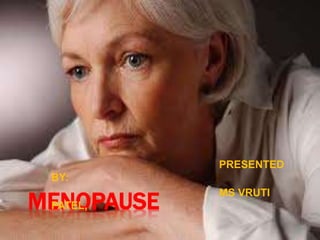




MENOPAUSE
PRESENTED
BY:
MS VRUTI
PATEL,
MEANING OF MENOPAUSE
 The transition from reproductive to non-
reproductive .
 The word "menopause" literally means the
"end of monthly cycles" from the Greek word
pausis (cessation) and the root men-
(month).
 Menopause is an unavoidable change that
every woman will experience.
 The date of menopause in human females is
formally medically defined as the time of the
last menstrual period.
DEFINITION
 Menopause means permanent
cessation of menstruation at the end of
reproductive life due to loss of ovarian
follicular activity. It is the point of time when
last and final menstruation occurs.
OR
 Menopause is the permanent cessation of
the primary functions of the human ovaries.
AGE OF MENOPAUSE
 Age at which menopause occurs is
genetically predetermined and not related to
age of menarche or age at last pregnancy,
lactation, use of oral pill, socioeconomic
condition, race, height or weight.
 In India and the Philippines, the median age
of natural menopause is considerably earlier,
at 44 years.
 Additional factors:
 Smoking
 Surgical menopause/ Artificial menopause
ABNORMAL MENOPAUSE
 Premature menopause : A woman's ovaries
stop working at a very early age, ranging
anywhere from the age of puberty to age 40,
and this is known as premature ovarian
failure (POF).
 Delayed menopause : if the menopause fail
to occur even beyond 55 years it is called
delayed.
TERMINOLOGY RELATED TO MENOPAUSE
 The word "menopause" usually refers not to one
day, but to the whole of the menopause
transition years. This span of time is also
commonly called the change of life, the
change, or the climacteric and more recently is
known as "per menopause", (literally meaning
"around menopause").
 Perimenopause : perimenopause is technically
defined as the time from which menses start to
become irregular and FSH levels have
increased, until the time when it is known that
periods have ceased completely.
 Premenopause :Premenopause is a word
used to describe the years leading up to the
last period, when the levels of reproductive
hormones are already becoming lower and
more erratic, and the effects of hormone
withdrawal may be present.
 Postmenopause : The term postmenopause
is applied to women who have not
experienced a menstrual bleed for a
minimum of 12 months.
ENDOCRANIOLOGY OF CLIMACTRIC AND MENOPAUSE
 In younger women, during a normal menstrual cycle
the ovaries produce estradiol, testosterone and
progesterone in a cyclical pattern under the control of
FSH and luteinising hormone (LH) which are both
produced by the pituitary gland.
 Estradiol: there is a significant fall in the level of
serum estradiol from 50-300 pg/ml before
menopause to 10-20 pg/ml after menopause.
 Oestrogen: The sources fail to supply the precursor
of oestrogen and about 5-10 years after menopause,
there is a sharp fall in oestrogen and also the trophic
hormones.
 Androgens: after menopause, the stromal
cells of overy continue to produce androgens
because or increase in LH.
 Progesterone: A trace amount of
progesterone detected is probably adrenal in
origin.
 Gonadotrophins: The secretions of both
FSH and LH are increased due to absent
negative feedback effect of oestradiol and
inhibin or due to enhanced responsiveness
of pituitary to GnRH.
 Indications and signs:
Menstruation pattern prior to menopause – any
of the following patterns are observed:
1. Abrupt cessation of menstruation (rare) .
2. Gradual decrease in both amount and
duration. It may be spotting or delayed and
ultimately lead to cessation.
3. Irregular with or without excessive bleeding.
One should exclude genital malignancy prior
to declare it as the usual premenopausal
pattern.
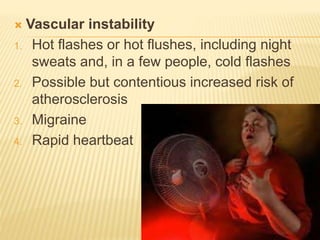
 Vascular instability
1. Hot flashes or hot flushes, including night
sweats and, in a few people, cold flashes
2. Possible but contentious increased risk of
atherosclerosis
3. Migraine
4. Rapid heartbeat
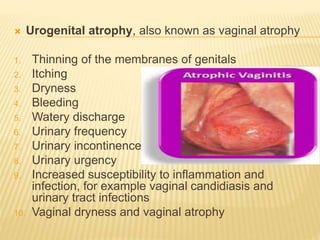
 Urogenital atrophy, also known as vaginal atrophy
1. Thinning of the membranes of genitals
2. Itching
3. Dryness
4. Bleeding
5. Watery discharge
6. Urinary frequency
7. Urinary incontinence
8. Urinary urgency
9. Increased susceptibility to inflammation and
infection, for example vaginal candidiasis and
urinary tract infections
10. Vaginal dryness and vaginal atrophy
 Skeletal
1. Back pain
2. Joint pain, Muscle pain
3. Osteopenia and the risk of osteoporosis
gradually developing over time
 Cardiovascular and cerebrovascular
effects
1. Risk of Ischemic heart disease
2. Coronary artery disease and stoke
increased
3. Atherosclerotic changes
4. Vasoconstriction
5. Thrombus formation
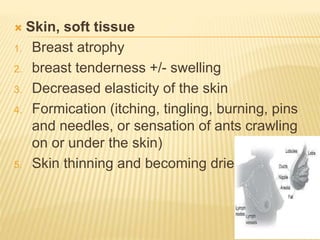
 Skin, soft tissue
1. Breast atrophy
2. breast tenderness +/- swelling
3. Decreased elasticity of the skin
4. Formication (itching, tingling, burning, pins
and needles, or sensation of ants crawling
on or under the skin)
5. Skin thinning and becoming drier
 Sexual
1. Dyspareunia or painful intercourse
2. Decreased libido
3. Problems reaching orgasm
PSYCHOLOGICAL CHANGES
 Depression or unstable mood
 Anxiety
 Fatigue
 Irritability
 Memory loss and problems with
concentration
 Mood disturbance : specially mood swing is
common.
 Sleep disturbances
 Insomnia
 Sleepiness
 Aggressiveness
 Tension
 Phobias
 Low self-esteem
 Tearfulness
 Causes of mood swing :
1. Hormonal changes
2. Sleeplessness
3. Stresses
4. sexual dysfunction
5. changes in the body and negative attitude
towards aging
 Who experiences mood swings during
menopause?
 Peri-menopausal period exceeds 27 month
 Moderate to severe hot flushes. Experiencing
hot flushes is associated with a 4-6 times
increased risk of developing depression
 History of depression are 4–9 times more likely
to experience depressed mood in the
menopausal transitionWomen with other factors
that increase the risk of depression, including:
 Poor relationship satisfaction; Significant life stress;
Low self-esteem; Negative body image; Lack of
exercise
 Excessive alcohol intake
SOCIAL ASPECTS
 The cultural context within which a woman
lives can have a significant impact on the
way she experiences the menopausal
transition.
 Social location affects the way women
perceive menopause and its related
biological effects.
 The way she views menopause
 Ethnicity and geographical location
DIAGNOSIS OF MENOPAUSE
 Cessation of menstruation for consecutive 12
months during climacteric.
 Appearance of menopausal symptoms ‘hot
flush’ and ‘night sweats’.
 Vaginal cytology – showing menstruation index
of at least 10/85/5 (features of low oestrogen).
 Serum oestradiol : < 20 pg/ml.
 Serum FSH and LH: 40 mlU/ml (three values at
weeks interval required.
MANAGEMENT
 Prevention
 Counselling
 Treatment
 Non-hormonal treatment :
1. Nutritious diet
2. Supplementary calcium – daily intake of 1-1.5 gm
3. Exercise – weight bearing exercises, walking, jogging.
4. Vitamin D – supplementation of vitamin D3 (400-800
IU/day) along with calcium can reduce osteoporosis and
fractures.
5. Cessation of smoking and alcohol.
6. Bisphosphonates pre vent osteoclastic bone resorption.
Commonly used drugs are etidronate and alendronate. It
is taken in empty stomach. Nothing should be taken by
mouth for at least 30 minutes after after oral dosing.
7. Fluoride prevents osteoporosis and increases bone
matrix
 Calcitonin inhibits bones resorption.
 Selective oestrogen receptor modulators (SERMs) are
tissue specific in action. Of the SERMs, raloxifene has
many mineral density, reduce serum LDL and to raise
HDL2 level.
 Clonidine, an alpha adrenergic agonist may be used to
reduce the severity and duration of hot flushes.
 Thiazides reduce urinary calcium excretion.
 Paroxetine is effective to reduce hot flushes both the
frequency and severity.
 Gabapentine is an analogue of gamma-amino-butyric
acid. It is found also to be effective.
 Phytoestrogens containing isoflavones are found to
lower the incidence of vasomotor symptoms, osteoporosis
and cardiovascular disease.
 Soy protein is also found effective to reduce vasomotor
symptoms. Soy protein acts as SERMs.
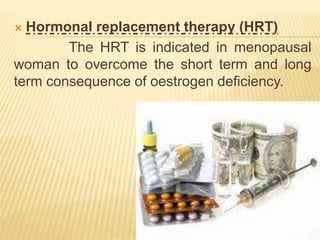
 Hormonal replacement therapy (HRT)
The HRT is indicated in menopausal
woman to overcome the short term and long
term consequence of oestrogen deficiency.
 Indications of hormonal replacement
therapy:
1. Relief of menopausal symptoms
2. Prevention of osteoporosis
3. To maintain the quality of life in menopausal
years
 Special group of woman to whom HRT
should be prescribed:
1. Premature ovarian failure
2. Gonadal dysgenesis
3. Surgical or radiation menopause
 Benefits of hormone replacement
therapy:
1. Improvement of vasomotor symptoms (70-
80%).
2. Improvement of urogenital atrophy.
3. Increase in bone mineral density (2-5%).
4. Decreased risk in vertebral and hip fractures
(25-50%).
5. Reduction in colorectal cancer (20%).
6. Possibly cardio protection.
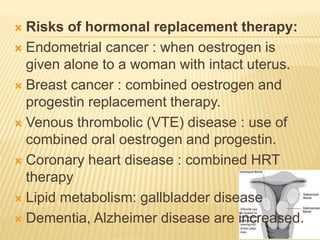
 Risks of hormonal replacement therapy:
 Endometrial cancer : when oestrogen is
given alone to a woman with intact uterus.
 Breast cancer : combined oestrogen and
progestin replacement therapy.
 Venous thrombolic (VTE) disease : use of
combined oral oestrogen and progestin.
 Coronary heart disease : combined HRT
therapy
 Lipid metabolism: gallbladder disease
 Dementia, Alzheimer disease are increased.
 Contraindications to hormonal
replacement therapy:
1. Undiagnosed genital tract bleeding
2. Oestrogen dependent neoplasm in the body
3. History of venous thromboembolism
4. Active liver disease
5. Gallbladder disease
Available preparation for hormone replacement
therapy
 Commonly used oestrogens are conjugated oestrogen
(0.625-1.25 mg/day) or micronized oestradiol (1-2
mg/day).
 Progestins used are medroxyprogestone (100-300
mg/dl)or ndydrogestrone (5-10 mg/day).
 Oral oestrogen regimen: oestrogen – conjugated equine
oestrogen 0.3 mg or o.625 mg is given daily for woman
who had hysterectomy.
 Oestrogen and cyclic progestin: for a woman with
intact uterus oestrogen is given continuously for 25 days
and progestin is added for last 12-14 days.
 Continuous oestrogen and progestin therapy:
continued combined therapy can prevent endometrial
hyperplasia. There may be irregular bleeding with this
regimen.
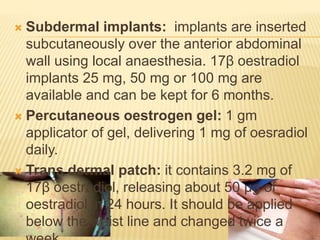
 Subdermal implants: implants are inserted
subcutaneously over the anterior abdominal
wall using local anaesthesia. 17β oestradiol
implants 25 mg, 50 mg or 100 mg are
available and can be kept for 6 months.
 Percutaneous oestrogen gel: 1 gm
applicator of gel, delivering 1 mg of oesradiol
daily.
 Trans dermal patch: it contains 3.2 mg of
17β oestradiol, releasing about 50 µg of
oestradiol in 24 hours. It should be applied
below the waist line and changed twice a
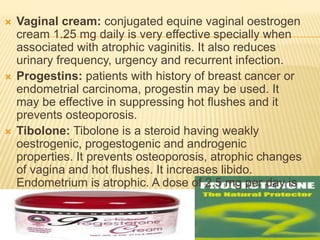
 Vaginal cream: conjugated equine vaginal oestrogen
cream 1.25 mg daily is very effective specially when
associated with atrophic vaginitis. It also reduces
urinary frequency, urgency and recurrent infection.
 Progestins: patients with history of breast cancer or
endometrial carcinoma, progestin may be used. It
may be effective in suppressing hot flushes and it
prevents osteoporosis.
 Tibolone: Tibolone is a steroid having weakly
oestrogenic, progestogenic and androgenic
properties. It prevents osteoporosis, atrophic changes
of vagina and hot flushes. It increases libido.
Endometrium is atrophic. A dose of 2.5 mg per day is
given.
 Duration of HRT use:
A short period of 3-5 years has
been advised. Reduction of dosage should be
done as soon as possible.
ROLE OF MIDWIFERY NURSE PRACTISNOR
MCQS
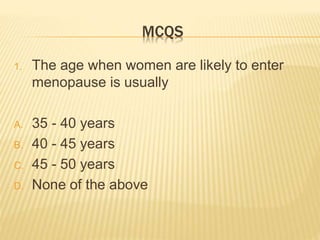
1. The age when women are likely to enter
menopause is usually
A. 35 - 40 years
B. 40 - 45 years
C. 45 - 50 years
D. None of the above
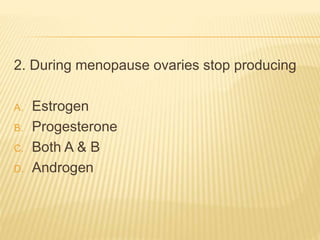
2. During menopause ovaries stop producing
A. Estrogen
B. Progesterone
C. Both A & B
D. Androgen
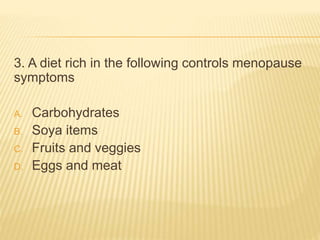
3. A diet rich in the following controls menopause
symptoms
A. Carbohydrates
B. Soya items
C. Fruits and veggies
D. Eggs and meat
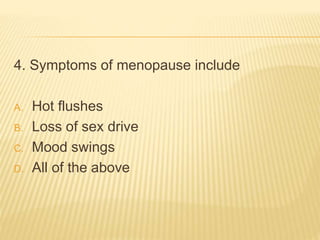
4. Symptoms of menopause include
A. Hot flushes
B. Loss of sex drive
C. Mood swings
D. All of the above
5. The following helps to control the symptoms of
menopause
A. Diet and exercises
B. Medication
C. Lifestyle changes
D. All of the above
ANSWER KEY
1. C
2. C
3. B
4. D
5. D
menopause