
1
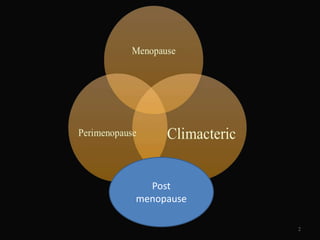
2
Post
menopause
DEFINITION
• Menopause means permanent cessation of
menstruation at the end of reproductive life due
to loss of ovarian follicular activity. It is the point
of time when last and final menstruation occur”
• “Clinical diagnosis is confirmed following
stoppage of menstruation for twelve consecutive
months without any other pathology”
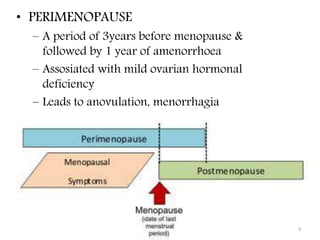
• PERIMENOPAUSE
– A period of 3years before menopause &
followed by 1 year of amenorrhoea
– Assosiated with mild ovarian hormonal
deficiency
– Leads to anovulation, menorrhagia
4
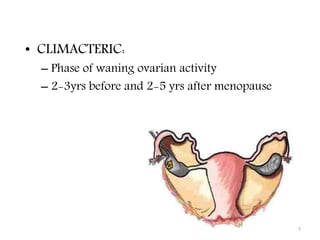
• CLIMACTERIC:
– Phase of waning ovarian activity
– 2-3yrs before and 2-5 yrs after menopause
5
Age
• Usual age 45 to 50yrs average being 47yrs.
• Premature menopause - before 40 yrs
• Late menopause – menstruation beyond
52 yrs
6
• Delayed menopause
– Due to good health and better nutrition.
– Also seen in women with uterine fibroids .
– Also in women with high risk of endometrial
cancer
• Menopausal age is directly associated with smoking
and genetic disposition.
• Smoking induces premature menopause.
7
Pathophysiology
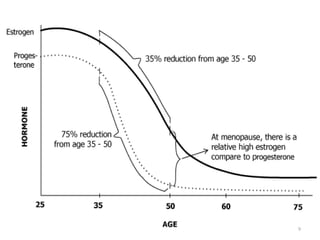
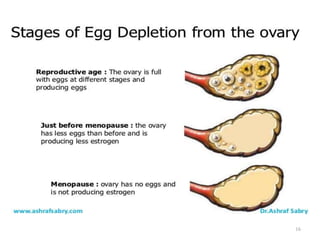
• During climacteric, ovarian activity declines
• Initially, ovulation fails, no corpus luteum forms
and no progesterone is secreted by the ovary
• Later, graffian follicle fails to develop, estrogenic
activity decreases leading to amenorrhea
• Increased secretion of FSH and LH by anterior
pituitary (due to negative feed back mechanism )
8
9
Hormone levels
• 50% reduction in androgen production and 66%
reduction in estrogen production
• Some estrogen produced by ovary (oestrone, E1)
• FSH appears in large concentrations.
• Low estrogen levels(below 20pg/ml) predisposes
to osteoporosis and ischemic heart disease.
10
Risk factors for menopausal related
problems are as follows:
• Early menopause
• Surgical menopause or radiation.
• Chemotherapy.
• smoking., caffeine, alcohol.
• Family history of menopausal diseases.
• Drugs related such as GnRH, heparin,
corticosteroids and clomiphene(anti- oestrogen)
when given over prolonged peiod can cause
oestrogen deficiency.
11
LATE ONSET
• High parity
• Use of oral contraceptive
• Obesity
• Alcohol consumption
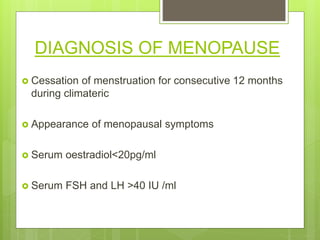
DIAGNOSIS OF MENOPAUSE
 Cessation of menstruation for consecutive 12 months
during climateric
 Appearance of menopausal symptoms
 Serum oestradiol<20pg/ml
 Serum FSH and LH >40 IU /ml
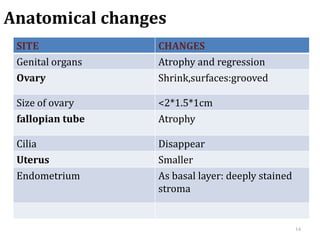
Anatomical changes
SITE CHANGES
Genital organs Atrophy and regression
Ovary Shrink,surfaces:grooved
Size of ovary <2*1.5*1cm
fallopian tube Atrophy
Cilia Disappear
Uterus Smaller
Endometrium As basal layer: deeply stained
stroma
14
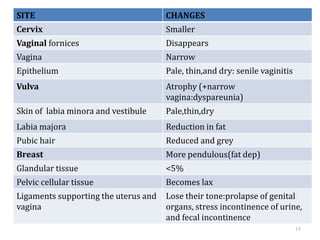
SITE CHANGES
Cervix Smaller
Vaginal fornices Disappears
Vagina Narrow
Epithelium Pale, thin,and dry: senile vaginitis
Vulva Atrophy (+narrow
vagina:dyspareunia)
Skin of labia minora and vestibule Pale,thin,dry
Labia majora Reduction in fat
Pubic hair Reduced and grey
Breast More pendulous(fat dep)
Glandular tissue <5%
Pelvic cellular tissue Becomes lax
Ligaments supporting the uterus and
vagina
Lose their tone:prolapse of genital
organs, stress incontinence of urine,
and fecal incontinence
15
16
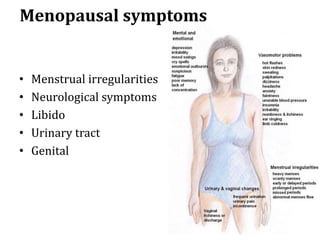
Menopausal symptoms
• Menstrual irregularities
• Neurological symptoms
• Libido
• Urinary tract
• Genital
17
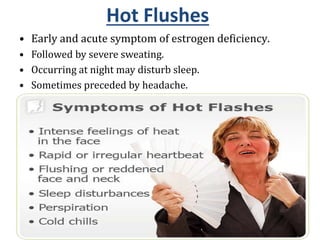
Hot Flushes
• Early and acute symptom of estrogen deficiency.
• Followed by severe sweating.
• Occurring at night may disturb sleep.
• Sometimes preceded by headache.
• Mental depression due to lack of sleep, irritability and lack
of concentration.
• With passage of time severity of hot flushes decreases.
18
Cause of hot flushes
•Caused by noradrenalin, which disturbs the
thermoregulatory system.
•Oestrogen deficiency reduces hypothalamic
endorphins, which release more norepinephrine
and serotonin.
•This leads to inappropriate heat loss mechanism.
19
Neurological
• Vasomotor symptoms and paraesthesia take the
form of sensations of pins and needles in the
extremities.
• Hot flushes
• Head ache
• Faintness
• Numbness
• Itching
• Back pain 20
• The symptoms which develop a little
later are :
– Urinary
• Dysuria
• Stress incontinence and urge
• Recurrent infection
• Urethral curuncle
Genital
Dry vagina
Dyspareunia
Loss of libido
Faecal incontinence
21
Menstrual irregularities
22
• Heavy menstruation
• Scanty menstruation
• Early or delayed menstruation
• Prolonged periods
Mental and emotional symptoms
23
 Depression
 Irritability
 Mood swings
 Emotional out breaks
 Fatigue
 Poor memory
 Lack of concentration
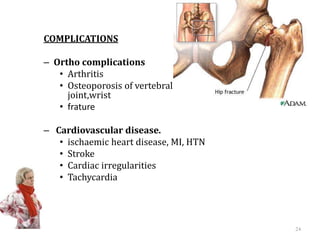
COMPLICATIONS
– Ortho complications
• Arthritis
• Osteoporosis of vertebral bones, upper end of hip
joint,wrist
• frature
– Cardiovascular disease.
• ischaemic heart disease, MI, HTN
• Stroke
• Cardiac irregularities
• Tachycardia
24
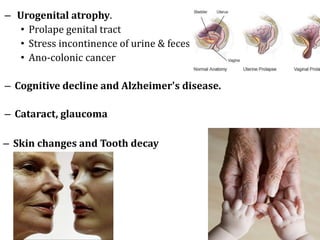
– Urogenital atrophy.
• Prolape genital tract
• Stress incontinence of urine & feces
• Ano-colonic cancer
– Cognitive decline and Alzheimer's disease.
– Cataract, glaucoma
– Skin changes and Tooth decay
25
• A slowly progressing skeletal disorder: Detirioration of bone
mass resulting in increased fragility and predilection to
frature : due to estrogen depletion
26
CARDIOVASCULAR
DISEASE
• Estrogen is cardioprotective(antioxidant
property also)
• After menopause HDL,LDL, total
cholesterol ,
• Estrogen deficiencyatherosclerosis, ischemic
heart disease, MI
• Risk factors: obese women with hypertension ,
previous thromboembolic episodes 27
Stroke
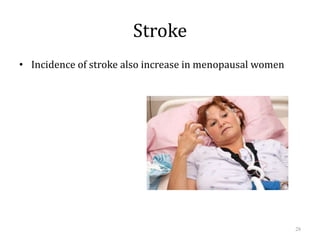
• Incidence of stroke also increase in menopausal women
28
PREVENTION
• Reduce the risk factors for other problems
associated with menopause
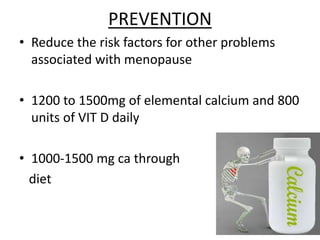
• 1200 to 1500mg of elemental calcium and 800
units of VIT D daily
• 1000-1500 mg ca through
diet
Treatment
1) Counseling
2) Mild tranquillizers
3) non hormonal therapy
4) Hormone replacement therapy(HRT)
30
Counselling
 General advice regarding the physiological process
 The advice on contraceptives
 Diet
 Weight bearing exercise delay onset of osteoporosis.
NON-HORMONAL TREATMENT
 Nutritional diet
 Supplimentary calcium (1-1.5gm )
 Exercise
 Weight bearing exercise
 Cessation of alcohol and smoking
 Biphosphonates (Alendronate and etideonate)
 Fluride (to prevent osteoporesis and increase
bone density
Mild tranquillizers
 Anti depressants like
sulpiride,chlordiazepoxide,alprazolam
etc
 Relieves anxiety, depression,
sleeplessness
Hormone replacement therapy
 Not all women require
HRT
 70-85% of women remain
healthy need only good
nutrition and healthy life
style.
Indications of HRT
1) Women having climacteric
symptoms
 Vasomotor symptoms
 Urinary symptoms
 Sexual dysharmony
 Established osteoporosis
2) All asymptomatic high-risk women
having
Premature menopause (surgical
/ radiation )
Family history of osteoporosis
Poor diet, excess alcohol
CVD, Alzheimer's disease,
colonic cancer
Corticosteroid & other
medications
High urinary calcium / creatinine
HRT can be also prescribed to…
 Premature ovarian failure
 Gonadal dysgenesis
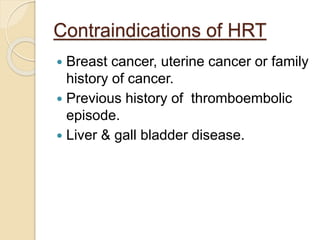
Contraindications of HRT
 Breast cancer, uterine cancer or family
history of cancer.
 Previous history of thromboembolic
episode.
 Liver & gall bladder disease.
DRUGS USED IN HRT
 Oestrogen
 Progesterone
 Other drugs:
◦ Tibolone
◦ Raloxifene
◦ Soya
◦ Bisphosphonates
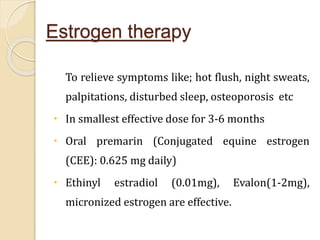
Estrogen therapy
To relieve symptoms like; hot flush, night sweats,
palpitations, disturbed sleep, osteoporosis etc
 In smallest effective dose for 3-6 months
 Oral premarin (Conjugated equine estrogen
(CEE): 0.625 mg daily)
 Ethinyl estradiol (0.01mg), Evalon(1-2mg),
micronized estrogen are effective.
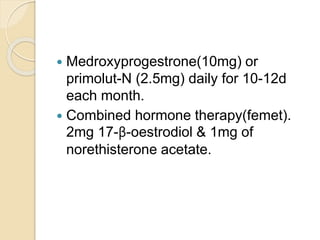
 Medroxyprogestrone(10mg) or
primolut-N (2.5mg) daily for 10-12d
each month.
 Combined hormone therapy(femet).
2mg 17-β-oestrodiol & 1mg of
norethisterone acetate.
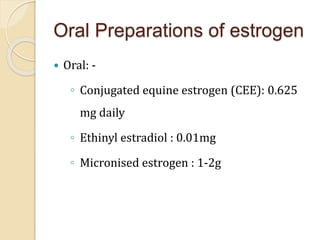
Oral Preparations of estrogen
 Oral: -
◦ Conjugated equine estrogen (CEE): 0.625
mg daily
◦ Ethinyl estradiol : 0.01mg
◦ Micronised estrogen : 1-2g
Transdermal Preparations of
estrogen
 Transdermal (estradiol): -
◦ Patches: contains: 3-4mg; releases 50 micro gm / 24 hour
twice weekly.
◦ Gel :for improving collagen in skin 75 micro gm / 24 hours
daily.
THE RISKS OF HRT
 Vaginal bleeding
 Thrombo embolism
 Endometrial cancer if E2 is taken
alone
 Breast cancer ,if HRT is taken over
5yrs.
 CHD in a women with CVD.
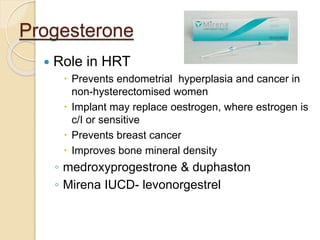
Progesterone
 Role in HRT
 Prevents endometrial hyperplasia and cancer in
non-hysterectomised women
 Implant may replace oestrogen, where estrogen is
c/I or sensitive
 Prevents breast cancer
 Improves bone mineral density
◦ medroxyprogestrone & duphaston
◦ Mirena IUCD- levonorgestrel
Tibolone
 Synthetic derivative of 19-nor-
testosterone.
 Weak oestrogenic, progestogenic, &
androgenic action.
 Endometrial hyperplasia
 Elevates the mood, relieves the VM
symptom, improves sex drive &
reduces bone resoption.
Raloxifene
 Non steroidal comp, reduses the risk
of fracture by 50%.
 It causes 10% reduction in total
cholesterol & LDL & HDL level.
 It does not raise the level of
triglycerides.so cardio protective for
long term.
 Reduces osteoporosis.
soya
 Isoflavone.
 phytoestrogen-oetrogenic- non steroid plant
product.
 45-60mg soya daily –protective- breast cancer,
liver disease &other side effect.
 cholesterol ,LDL,TG & marginal HDL.
 Antiviral, antifungal & ant carcinogenic.
DURATION OF HRT THERAPY
 3-5 years
SELF CARE AT HOME
HOT FLUSHES
• Regular aerobic exercise
• Avoid spicy ,caffeine and alcohol
• Vit E ,soya
HEART DISEASE
• Low fat –low cholestrol containing diets
WEIGHT GAIN
• Regular exercises
• Good nutritious food
OSTEOPORESIS
• Adequate calcium intake
• Weight bearing exercises
STRESS
• Meditation for 15 min
• Exercises
INSOMNIA
• Meditation just before bed
• Bath before bed
• Sedatives for short period of time
GOOD NUTRITION
• Plenty of fruits and vegetables
• Antioxidants and vitamins
• Add Fibre rich diet
• Avoid fat,cholestrol and spicy foods
VAGINAL DRYNESS AND URINARY
INCONTINENCE
• Vaginal oestrogen
• Lubricant for vaginal dryness
• Yam cream contains phytoestrogen
• VIT E
• Kegal exercise

Menopauseppt 130119091724-phpapp02

  • 1.
  • 2.
  • 3.
    DEFINITION • Menopause meanspermanent cessation of menstruation at the end of reproductive life due to loss of ovarian follicular activity. It is the point of time when last and final menstruation occur” • “Clinical diagnosis is confirmed following stoppage of menstruation for twelve consecutive months without any other pathology”
  • 4.
    • PERIMENOPAUSE – Aperiod of 3years before menopause & followed by 1 year of amenorrhoea – Assosiated with mild ovarian hormonal deficiency – Leads to anovulation, menorrhagia 4
  • 5.
    • CLIMACTERIC: – Phaseof waning ovarian activity – 2-3yrs before and 2-5 yrs after menopause 5
  • 6.
    Age • Usual age45 to 50yrs average being 47yrs. • Premature menopause - before 40 yrs • Late menopause – menstruation beyond 52 yrs 6
  • 7.
    • Delayed menopause –Due to good health and better nutrition. – Also seen in women with uterine fibroids . – Also in women with high risk of endometrial cancer • Menopausal age is directly associated with smoking and genetic disposition. • Smoking induces premature menopause. 7
  • 8.
    Pathophysiology • During climacteric,ovarian activity declines • Initially, ovulation fails, no corpus luteum forms and no progesterone is secreted by the ovary • Later, graffian follicle fails to develop, estrogenic activity decreases leading to amenorrhea • Increased secretion of FSH and LH by anterior pituitary (due to negative feed back mechanism ) 8
  • 9.
  • 10.
    Hormone levels • 50%reduction in androgen production and 66% reduction in estrogen production • Some estrogen produced by ovary (oestrone, E1) • FSH appears in large concentrations. • Low estrogen levels(below 20pg/ml) predisposes to osteoporosis and ischemic heart disease. 10
  • 11.
    Risk factors formenopausal related problems are as follows: • Early menopause • Surgical menopause or radiation. • Chemotherapy. • smoking., caffeine, alcohol. • Family history of menopausal diseases. • Drugs related such as GnRH, heparin, corticosteroids and clomiphene(anti- oestrogen) when given over prolonged peiod can cause oestrogen deficiency. 11
  • 12.
    LATE ONSET • Highparity • Use of oral contraceptive • Obesity • Alcohol consumption
  • 13.
    DIAGNOSIS OF MENOPAUSE Cessation of menstruation for consecutive 12 months during climateric  Appearance of menopausal symptoms  Serum oestradiol<20pg/ml  Serum FSH and LH >40 IU /ml
  • 14.
    Anatomical changes SITE CHANGES Genitalorgans Atrophy and regression Ovary Shrink,surfaces:grooved Size of ovary <2*1.5*1cm fallopian tube Atrophy Cilia Disappear Uterus Smaller Endometrium As basal layer: deeply stained stroma 14
  • 15.
    SITE CHANGES Cervix Smaller Vaginalfornices Disappears Vagina Narrow Epithelium Pale, thin,and dry: senile vaginitis Vulva Atrophy (+narrow vagina:dyspareunia) Skin of labia minora and vestibule Pale,thin,dry Labia majora Reduction in fat Pubic hair Reduced and grey Breast More pendulous(fat dep) Glandular tissue <5% Pelvic cellular tissue Becomes lax Ligaments supporting the uterus and vagina Lose their tone:prolapse of genital organs, stress incontinence of urine, and fecal incontinence 15
  • 16.
  • 17.
    Menopausal symptoms • Menstrualirregularities • Neurological symptoms • Libido • Urinary tract • Genital 17
  • 18.
    Hot Flushes • Earlyand acute symptom of estrogen deficiency. • Followed by severe sweating. • Occurring at night may disturb sleep. • Sometimes preceded by headache. • Mental depression due to lack of sleep, irritability and lack of concentration. • With passage of time severity of hot flushes decreases. 18
  • 19.
    Cause of hotflushes •Caused by noradrenalin, which disturbs the thermoregulatory system. •Oestrogen deficiency reduces hypothalamic endorphins, which release more norepinephrine and serotonin. •This leads to inappropriate heat loss mechanism. 19
  • 20.
    Neurological • Vasomotor symptomsand paraesthesia take the form of sensations of pins and needles in the extremities. • Hot flushes • Head ache • Faintness • Numbness • Itching • Back pain 20
  • 21.
    • The symptomswhich develop a little later are : – Urinary • Dysuria • Stress incontinence and urge • Recurrent infection • Urethral curuncle Genital Dry vagina Dyspareunia Loss of libido Faecal incontinence 21
  • 22.
    Menstrual irregularities 22 • Heavymenstruation • Scanty menstruation • Early or delayed menstruation • Prolonged periods
  • 23.
    Mental and emotionalsymptoms 23  Depression  Irritability  Mood swings  Emotional out breaks  Fatigue  Poor memory  Lack of concentration
  • 24.
    COMPLICATIONS – Ortho complications •Arthritis • Osteoporosis of vertebral bones, upper end of hip joint,wrist • frature – Cardiovascular disease. • ischaemic heart disease, MI, HTN • Stroke • Cardiac irregularities • Tachycardia 24
  • 25.
    – Urogenital atrophy. •Prolape genital tract • Stress incontinence of urine & feces • Ano-colonic cancer – Cognitive decline and Alzheimer's disease. – Cataract, glaucoma – Skin changes and Tooth decay 25
  • 26.
    • A slowlyprogressing skeletal disorder: Detirioration of bone mass resulting in increased fragility and predilection to frature : due to estrogen depletion 26
  • 27.
    CARDIOVASCULAR DISEASE • Estrogen iscardioprotective(antioxidant property also) • After menopause HDL,LDL, total cholesterol , • Estrogen deficiencyatherosclerosis, ischemic heart disease, MI • Risk factors: obese women with hypertension , previous thromboembolic episodes 27
  • 28.
    Stroke • Incidence ofstroke also increase in menopausal women 28
  • 29.
    PREVENTION • Reduce therisk factors for other problems associated with menopause • 1200 to 1500mg of elemental calcium and 800 units of VIT D daily • 1000-1500 mg ca through diet
  • 30.
    Treatment 1) Counseling 2) Mildtranquillizers 3) non hormonal therapy 4) Hormone replacement therapy(HRT) 30
  • 31.
    Counselling  General adviceregarding the physiological process  The advice on contraceptives  Diet  Weight bearing exercise delay onset of osteoporosis.
  • 32.
    NON-HORMONAL TREATMENT  Nutritionaldiet  Supplimentary calcium (1-1.5gm )  Exercise  Weight bearing exercise  Cessation of alcohol and smoking  Biphosphonates (Alendronate and etideonate)  Fluride (to prevent osteoporesis and increase bone density
  • 33.
    Mild tranquillizers  Antidepressants like sulpiride,chlordiazepoxide,alprazolam etc  Relieves anxiety, depression, sleeplessness
  • 34.
    Hormone replacement therapy Not all women require HRT  70-85% of women remain healthy need only good nutrition and healthy life style.
  • 35.
    Indications of HRT 1)Women having climacteric symptoms  Vasomotor symptoms  Urinary symptoms  Sexual dysharmony  Established osteoporosis 2) All asymptomatic high-risk women having Premature menopause (surgical / radiation ) Family history of osteoporosis Poor diet, excess alcohol CVD, Alzheimer's disease, colonic cancer Corticosteroid & other medications High urinary calcium / creatinine
  • 36.
    HRT can bealso prescribed to…  Premature ovarian failure  Gonadal dysgenesis
  • 37.
    Contraindications of HRT Breast cancer, uterine cancer or family history of cancer.  Previous history of thromboembolic episode.  Liver & gall bladder disease.
  • 38.
    DRUGS USED INHRT  Oestrogen  Progesterone  Other drugs: ◦ Tibolone ◦ Raloxifene ◦ Soya ◦ Bisphosphonates
  • 39.
    Estrogen therapy To relievesymptoms like; hot flush, night sweats, palpitations, disturbed sleep, osteoporosis etc  In smallest effective dose for 3-6 months  Oral premarin (Conjugated equine estrogen (CEE): 0.625 mg daily)  Ethinyl estradiol (0.01mg), Evalon(1-2mg), micronized estrogen are effective.
  • 40.
     Medroxyprogestrone(10mg) or primolut-N(2.5mg) daily for 10-12d each month.  Combined hormone therapy(femet). 2mg 17-β-oestrodiol & 1mg of norethisterone acetate.
  • 41.
    Oral Preparations ofestrogen  Oral: - ◦ Conjugated equine estrogen (CEE): 0.625 mg daily ◦ Ethinyl estradiol : 0.01mg ◦ Micronised estrogen : 1-2g
  • 42.
    Transdermal Preparations of estrogen Transdermal (estradiol): - ◦ Patches: contains: 3-4mg; releases 50 micro gm / 24 hour twice weekly. ◦ Gel :for improving collagen in skin 75 micro gm / 24 hours daily.
  • 43.
    THE RISKS OFHRT  Vaginal bleeding  Thrombo embolism  Endometrial cancer if E2 is taken alone  Breast cancer ,if HRT is taken over 5yrs.  CHD in a women with CVD.
  • 44.
    Progesterone  Role inHRT  Prevents endometrial hyperplasia and cancer in non-hysterectomised women  Implant may replace oestrogen, where estrogen is c/I or sensitive  Prevents breast cancer  Improves bone mineral density ◦ medroxyprogestrone & duphaston ◦ Mirena IUCD- levonorgestrel
  • 45.
    Tibolone  Synthetic derivativeof 19-nor- testosterone.  Weak oestrogenic, progestogenic, & androgenic action.  Endometrial hyperplasia  Elevates the mood, relieves the VM symptom, improves sex drive & reduces bone resoption.
  • 46.
    Raloxifene  Non steroidalcomp, reduses the risk of fracture by 50%.  It causes 10% reduction in total cholesterol & LDL & HDL level.  It does not raise the level of triglycerides.so cardio protective for long term.  Reduces osteoporosis.
  • 47.
    soya  Isoflavone.  phytoestrogen-oetrogenic-non steroid plant product.  45-60mg soya daily –protective- breast cancer, liver disease &other side effect.  cholesterol ,LDL,TG & marginal HDL.  Antiviral, antifungal & ant carcinogenic.
  • 48.
    DURATION OF HRTTHERAPY  3-5 years
  • 49.
    SELF CARE ATHOME HOT FLUSHES • Regular aerobic exercise • Avoid spicy ,caffeine and alcohol • Vit E ,soya HEART DISEASE • Low fat –low cholestrol containing diets WEIGHT GAIN • Regular exercises • Good nutritious food
  • 50.
    OSTEOPORESIS • Adequate calciumintake • Weight bearing exercises STRESS • Meditation for 15 min • Exercises INSOMNIA • Meditation just before bed • Bath before bed • Sedatives for short period of time
  • 51.
    GOOD NUTRITION • Plentyof fruits and vegetables • Antioxidants and vitamins • Add Fibre rich diet • Avoid fat,cholestrol and spicy foods
  • 52.
    VAGINAL DRYNESS ANDURINARY INCONTINENCE • Vaginal oestrogen • Lubricant for vaginal dryness • Yam cream contains phytoestrogen • VIT E • Kegal exercise