PRESENTATION TOPIC : MENOPAUSE
DEFINITION : Greek word pausis ("pause") and mēn
("month").
Menopause, also known as the climacteric, is the time
in most women's lives when menstrual periods stop
permanently, and they are no longer able to bear
children.
Menopause typically occurs between 49 and 52 years
of age
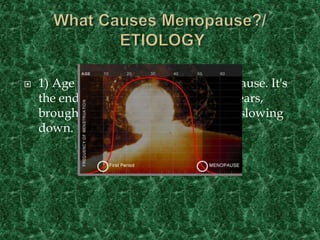
 1) Age is the leading cause of menopause. It's
the end of a woman's childbearing years,
brought on by the ovaries gradually slowing
down.
 On average, women are 51 at natural menopause,
notes the National Institute on Aging. But
menopause can start earlier or later. A few women
start menopause as young as 40, and a very small
percentage as late as 60. Women who smoke tend to
go through menopause a few years earlier than non
smokers.
 There is no proven way to predict menopause age.
It's only after a woman has missed her periods for
12 straight months, without other obvious causes,
that menopause can be confirmed.
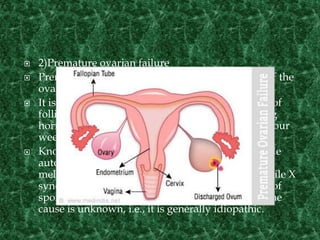
 2)Premature ovarian failure
 Premature ovarian failure (POF) is the cessation of the
ovarian function before the age of 40 years.
 It is diagnosed or confirmed by high blood levels of
follicle stimulating hormone (FSH) and luteinizing
hormone (LH) on at least three occasions at least four
weeks apart.
 Known causes of premature ovarian failure include
autoimmune disorders, thyroid disease, diabetes
mellitus, chemotherapy, being a carrier of the fragile X
syndrome gene, and radiotherapy. about 50–80% of
spontaneous cases of premature ovarian failure, the
cause is unknown, i.e., it is generally idiopathic.
 Menopause can be surgically induced by
(removal of ovaries), and uterus
(hysterectomy).Cessation of menses as a
result of removal of the ovaries is called
"surgical menopause".
 Includes
 Natural decline of reproductive hormones.
 Chemotherapy and radiation therapy.
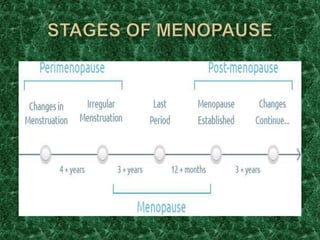
 Premature menopause : A woman's ovaries
stop working at a very early age, ranging
anywhere from the age of puberty to age 40,
and this is known as premature ovarian
failure (POF).
 Delayed menopause : if the menopause fail
to occur even beyond 55 years it is called
delayed.
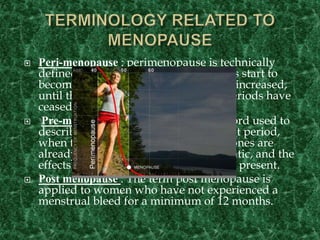
 Peri-menopause : perimenopause is technically
defined as the time from which menses start to
become irregular and FSH levels have increased,
until the time when it is known that periods have
ceased completely.
 Pre-menopause :Premenopause is a word used to
describe the years leading up to the last period,
when the levels of reproductive hormones are
already becoming lower and more erratic, and the
effects of hormone withdrawal may be present.
 Post menopause : The term post menopause is
applied to women who have not experienced a
menstrual bleed for a minimum of 12 months.
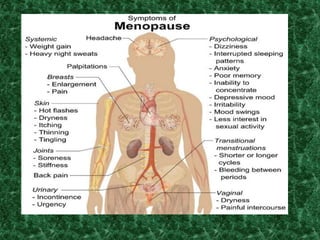
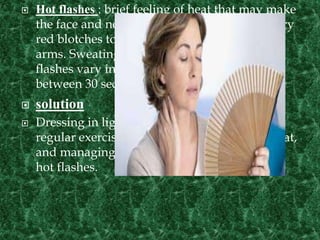
 Hot flashes : brief feeling of heat that may make
the face and neck flushed and cause temporary
red blotches to appear on the chest, back, and
arms. Sweating and chills may follow. Hot
flashes vary in intensity and typically last
between 30 seconds and 10 minutes.
 solution
 Dressing in light layers, using a fan, getting
regular exercise, avoiding spicy foods and heat,
and managing stress may help you deal with
hot flashes.
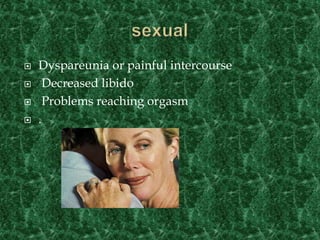
 Dyspareunia or painful intercourse
 Decreased libido
 Problems reaching orgasm
 .
 Depression , Anxiety , Fatigue , Irritability
Memory loss and problems with concentration
Mood disturbance : specially mood swing is
common.
 Sleep disturbances
 Insomnia , Sleepiness , Aggressiveness ,
Tension ,Phobias , Low self-esteem ,Tearfulness
 1. Hormonal changes
 2. Sleeplessness
 3. Stress
 4. sexual dysfunction
 5. changes in the body and negative attitude
towards aging
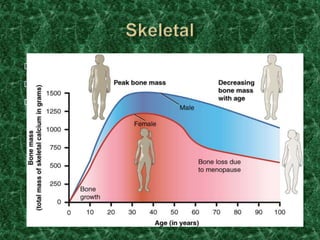
 1. Back pain
 2. Joint pain, Muscle pain
 3. Osteopenia and the risk of osteoporosis
gradually developing over time
 Risk of Ischemic heart disease.
 Coronary artery disease and stoke increased.
 Atherosclerotic changes .
 Vasoconstriction .
 Thrombus formation
 Breast atrophy .
 breast tenderness +/- swelling .
 Decreased elasticity of the skin .
 Formication (itching, tingling, burning, pins
and needles, or sensation of ants crawling on or
under the skin) .
 Skin thinning and becoming drier
 Cessation of menstruation for consecutive 12
months during climacteric.
 Appearance of menopausal symptoms ‘hot
flush’ and ‘night sweats’.
 Vaginal cytology – showing menstruation
index of at least 10/85/5 (features of low
oestrogen).
 Serum oestradiol : < 20 pg/ml.
 Serum FSH and LH: 40 mlU/ml (three values
at weeks interval required.
 Prevention
 Counselling
 Treatment
 hormone replacement therapy (HRT) :-is
the use of estrogen in women without a uterus
and estrogen plus progestin in women who
have an intact uterus.
 HRT may be reasonable for the treatment of
menopausal symptoms, such as hot flashes.
 It is the most effective treatment option,
especially when delivered as a skin patch.
 The HRT is indicated in menopausal woman to
overcome the short term and long term
consequence of oestrogen deficiency.
 Indications of hormonal replacement therapy:
 1. Relief of menopausal symptoms
 2. Prevention of osteoporosis
 3. To maintain the quality of life in
menopausal years
 Special group of woman to whom HRT should
be prescribed:
 1. Premature ovarian failure
 2. Gonadal dysgenesis
 3. Surgical or radiation menopause
 Endometrial cancer , Venous thromboembolic
disease: , Increased risk within 1-2 years after
initiation of hormone therapy.
 Breast cancer ,Increased breast density with
progestogens via proliferation of estrogen-
dependent mammary tissue, making it more
difficult to detect breast cancer early with a
mammogram , Family history
 Duration of exposure Ovarian cancer >10
years estrogen therapy
 Cerebrovascular accidents
 1. Undiagnosed genital tract bleeding
 2. Oestrogen dependent neoplasm in the body
3. History of venous thromboembolism
 4. Active liver disease
 5. Gallbladder disease
 Nutritious diet
 Supplementary calcium – daily intake of 1-
1.5 gm
 Exercise – weight bearing exercises,
walking, jogging.
 Vitamin D – supplementation of vitamin D3
(400-800 IU/day) along with calcium can
reduce osteoporosis and fractures.
 Cessation of smoking and alcohol.
 There is no evidence of consistent benefit of
alternative therapies for menopausal
symptoms despite their popularity.
 Evidence does not support a benefit from
phytoestrogens such as coumestrol,
femarelle,or the non-phytoestrogen black
cohoshThere is no evidence to support the
efficacy of acupuncture as a management for
menopausal symptoms
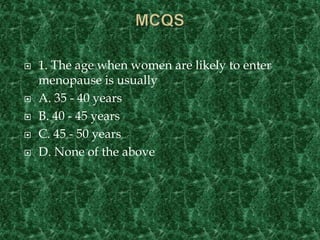
 1. The age when women are likely to enter
menopause is usually
 A. 35 - 40 years
 B. 40 - 45 years
 C. 45 - 50 years
 D. None of the above
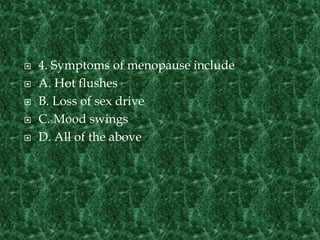
 4. Symptoms of menopause include
 A. Hot flushes
 B. Loss of sex drive
 C. Mood swings
 D. All of the above
 5. The following helps to control the symptoms
of menopause
 A. Diet and exercises
 B. Medication
 C. Lifestyle changes
 D. All of the above
Thanks

Menopause ppt

  • 1.
  • 2.
    DEFINITION : Greekword pausis ("pause") and mēn ("month"). Menopause, also known as the climacteric, is the time in most women's lives when menstrual periods stop permanently, and they are no longer able to bear children. Menopause typically occurs between 49 and 52 years of age
  • 3.
     1) Ageis the leading cause of menopause. It's the end of a woman's childbearing years, brought on by the ovaries gradually slowing down.
  • 4.
     On average,women are 51 at natural menopause, notes the National Institute on Aging. But menopause can start earlier or later. A few women start menopause as young as 40, and a very small percentage as late as 60. Women who smoke tend to go through menopause a few years earlier than non smokers.  There is no proven way to predict menopause age. It's only after a woman has missed her periods for 12 straight months, without other obvious causes, that menopause can be confirmed.
  • 5.
     2)Premature ovarianfailure  Premature ovarian failure (POF) is the cessation of the ovarian function before the age of 40 years.  It is diagnosed or confirmed by high blood levels of follicle stimulating hormone (FSH) and luteinizing hormone (LH) on at least three occasions at least four weeks apart.  Known causes of premature ovarian failure include autoimmune disorders, thyroid disease, diabetes mellitus, chemotherapy, being a carrier of the fragile X syndrome gene, and radiotherapy. about 50–80% of spontaneous cases of premature ovarian failure, the cause is unknown, i.e., it is generally idiopathic.
  • 6.
     Menopause canbe surgically induced by (removal of ovaries), and uterus (hysterectomy).Cessation of menses as a result of removal of the ovaries is called "surgical menopause".
  • 7.
     Includes  Naturaldecline of reproductive hormones.  Chemotherapy and radiation therapy.
  • 9.
     Premature menopause: A woman's ovaries stop working at a very early age, ranging anywhere from the age of puberty to age 40, and this is known as premature ovarian failure (POF).  Delayed menopause : if the menopause fail to occur even beyond 55 years it is called delayed.
  • 10.
     Peri-menopause :perimenopause is technically defined as the time from which menses start to become irregular and FSH levels have increased, until the time when it is known that periods have ceased completely.  Pre-menopause :Premenopause is a word used to describe the years leading up to the last period, when the levels of reproductive hormones are already becoming lower and more erratic, and the effects of hormone withdrawal may be present.  Post menopause : The term post menopause is applied to women who have not experienced a menstrual bleed for a minimum of 12 months.
  • 12.
     Hot flashes: brief feeling of heat that may make the face and neck flushed and cause temporary red blotches to appear on the chest, back, and arms. Sweating and chills may follow. Hot flashes vary in intensity and typically last between 30 seconds and 10 minutes.  solution  Dressing in light layers, using a fan, getting regular exercise, avoiding spicy foods and heat, and managing stress may help you deal with hot flashes.
  • 13.
     Dyspareunia orpainful intercourse  Decreased libido  Problems reaching orgasm  .
  • 14.
     Depression ,Anxiety , Fatigue , Irritability Memory loss and problems with concentration Mood disturbance : specially mood swing is common.  Sleep disturbances  Insomnia , Sleepiness , Aggressiveness , Tension ,Phobias , Low self-esteem ,Tearfulness
  • 15.
     1. Hormonalchanges  2. Sleeplessness  3. Stress  4. sexual dysfunction  5. changes in the body and negative attitude towards aging
  • 16.
     1. Backpain  2. Joint pain, Muscle pain  3. Osteopenia and the risk of osteoporosis gradually developing over time
  • 17.
     Risk ofIschemic heart disease.  Coronary artery disease and stoke increased.  Atherosclerotic changes .  Vasoconstriction .  Thrombus formation
  • 18.
     Breast atrophy.  breast tenderness +/- swelling .  Decreased elasticity of the skin .  Formication (itching, tingling, burning, pins and needles, or sensation of ants crawling on or under the skin) .  Skin thinning and becoming drier
  • 19.
     Cessation ofmenstruation for consecutive 12 months during climacteric.  Appearance of menopausal symptoms ‘hot flush’ and ‘night sweats’.  Vaginal cytology – showing menstruation index of at least 10/85/5 (features of low oestrogen).  Serum oestradiol : < 20 pg/ml.  Serum FSH and LH: 40 mlU/ml (three values at weeks interval required.
  • 20.
  • 21.
     hormone replacementtherapy (HRT) :-is the use of estrogen in women without a uterus and estrogen plus progestin in women who have an intact uterus.  HRT may be reasonable for the treatment of menopausal symptoms, such as hot flashes.  It is the most effective treatment option, especially when delivered as a skin patch.
  • 22.
     The HRTis indicated in menopausal woman to overcome the short term and long term consequence of oestrogen deficiency.  Indications of hormonal replacement therapy:  1. Relief of menopausal symptoms  2. Prevention of osteoporosis  3. To maintain the quality of life in menopausal years
  • 24.
     Special groupof woman to whom HRT should be prescribed:  1. Premature ovarian failure  2. Gonadal dysgenesis  3. Surgical or radiation menopause
  • 25.
     Endometrial cancer, Venous thromboembolic disease: , Increased risk within 1-2 years after initiation of hormone therapy.  Breast cancer ,Increased breast density with progestogens via proliferation of estrogen- dependent mammary tissue, making it more difficult to detect breast cancer early with a mammogram , Family history  Duration of exposure Ovarian cancer >10 years estrogen therapy  Cerebrovascular accidents
  • 26.
     1. Undiagnosedgenital tract bleeding  2. Oestrogen dependent neoplasm in the body 3. History of venous thromboembolism  4. Active liver disease  5. Gallbladder disease
  • 27.
     Nutritious diet Supplementary calcium – daily intake of 1- 1.5 gm  Exercise – weight bearing exercises, walking, jogging.  Vitamin D – supplementation of vitamin D3 (400-800 IU/day) along with calcium can reduce osteoporosis and fractures.  Cessation of smoking and alcohol.
  • 28.
     There isno evidence of consistent benefit of alternative therapies for menopausal symptoms despite their popularity.  Evidence does not support a benefit from phytoestrogens such as coumestrol, femarelle,or the non-phytoestrogen black cohoshThere is no evidence to support the efficacy of acupuncture as a management for menopausal symptoms
  • 31.
     1. Theage when women are likely to enter menopause is usually  A. 35 - 40 years  B. 40 - 45 years  C. 45 - 50 years  D. None of the above
  • 32.
     4. Symptomsof menopause include  A. Hot flushes  B. Loss of sex drive  C. Mood swings  D. All of the above
  • 33.
     5. Thefollowing helps to control the symptoms of menopause  A. Diet and exercises  B. Medication  C. Lifestyle changes  D. All of the above
  • 34.