DYSFUNCTIONAL UTERINE
BLEEDING ( DUB )
PRESENTED BY:
ABHILASHA VERMA
LECTURER
( M.Sc. Nursing Obg & Gynae)
TERMINOLOGY
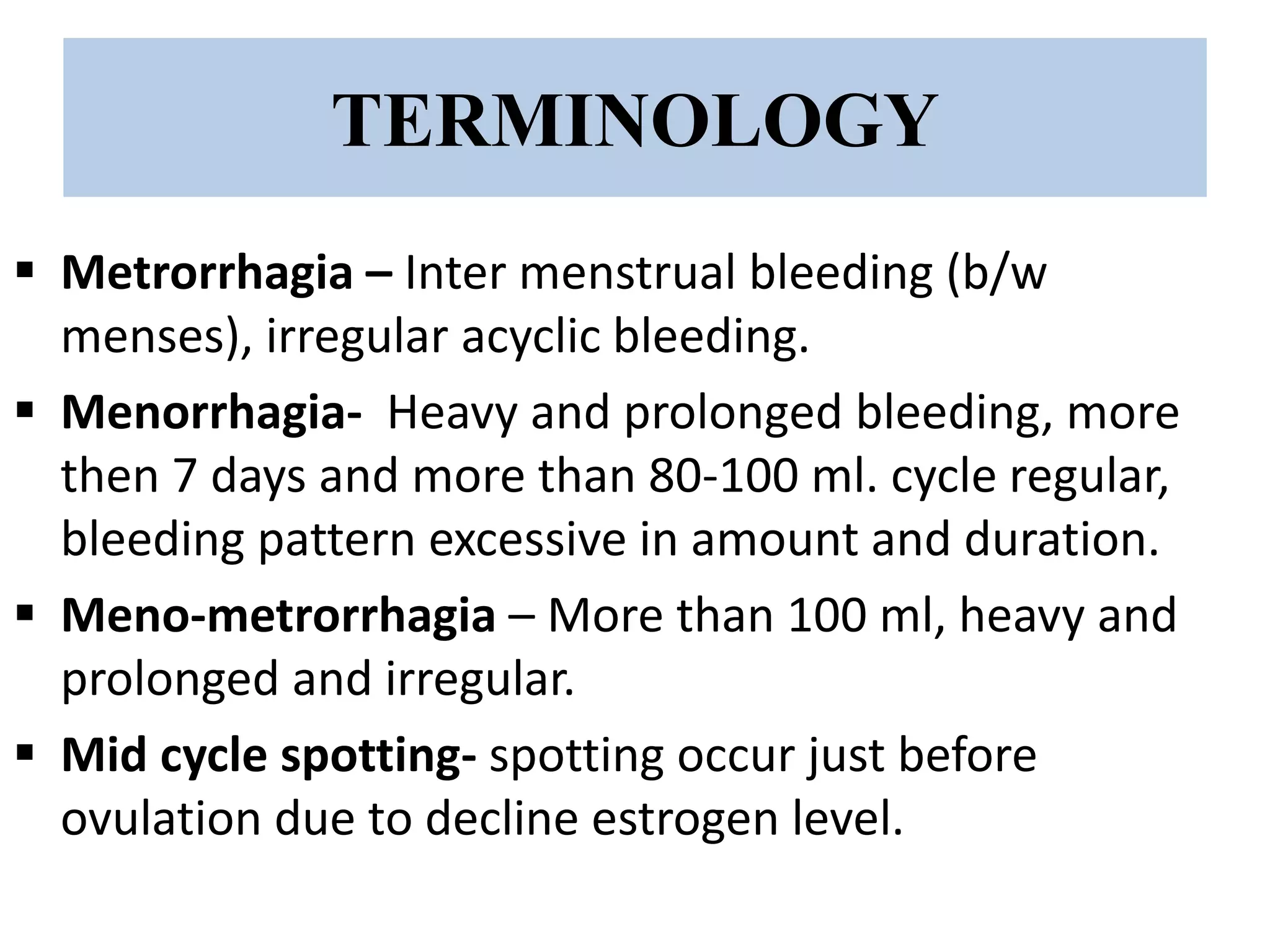
 Metrorrhagia – Inter menstrual bleeding (b/w
menses), irregular acyclic bleeding.
 Menorrhagia- Heavy and prolonged bleeding, more
then 7 days and more than 80-100 ml. cycle regular,
bleeding pattern excessive in amount and duration.
 Meno-metrorrhagia – More than 100 ml, heavy and
prolonged and irregular.
 Mid cycle spotting- spotting occur just before
ovulation due to decline estrogen level.
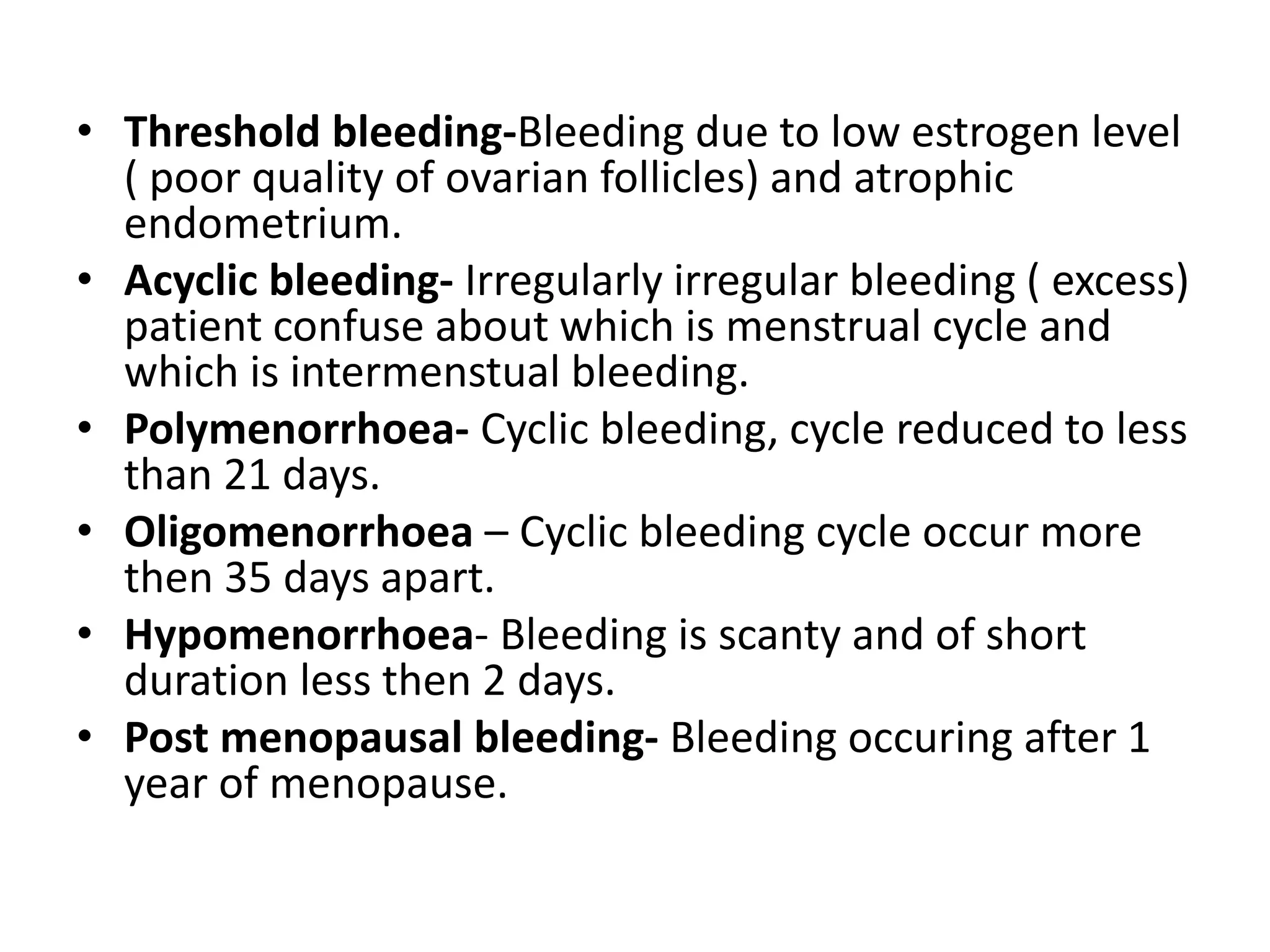
• Threshold bleeding-Bleeding due to low estrogen level
( poor quality of ovarian follicles) and atrophic
endometrium.
• Acyclic bleeding- Irregularly irregular bleeding ( excess)
patient confuse about which is menstrual cycle and
which is intermenstual bleeding.
• Polymenorrhoea- Cyclic bleeding, cycle reduced to less
than 21 days.
• Oligomenorrhoea – Cyclic bleeding cycle occur more
then 35 days apart.
• Hypomenorrhoea- Bleeding is scanty and of short
duration less then 2 days.
• Post menopausal bleeding- Bleeding occuring after 1
year of menopause.
CAUSES OF AUB
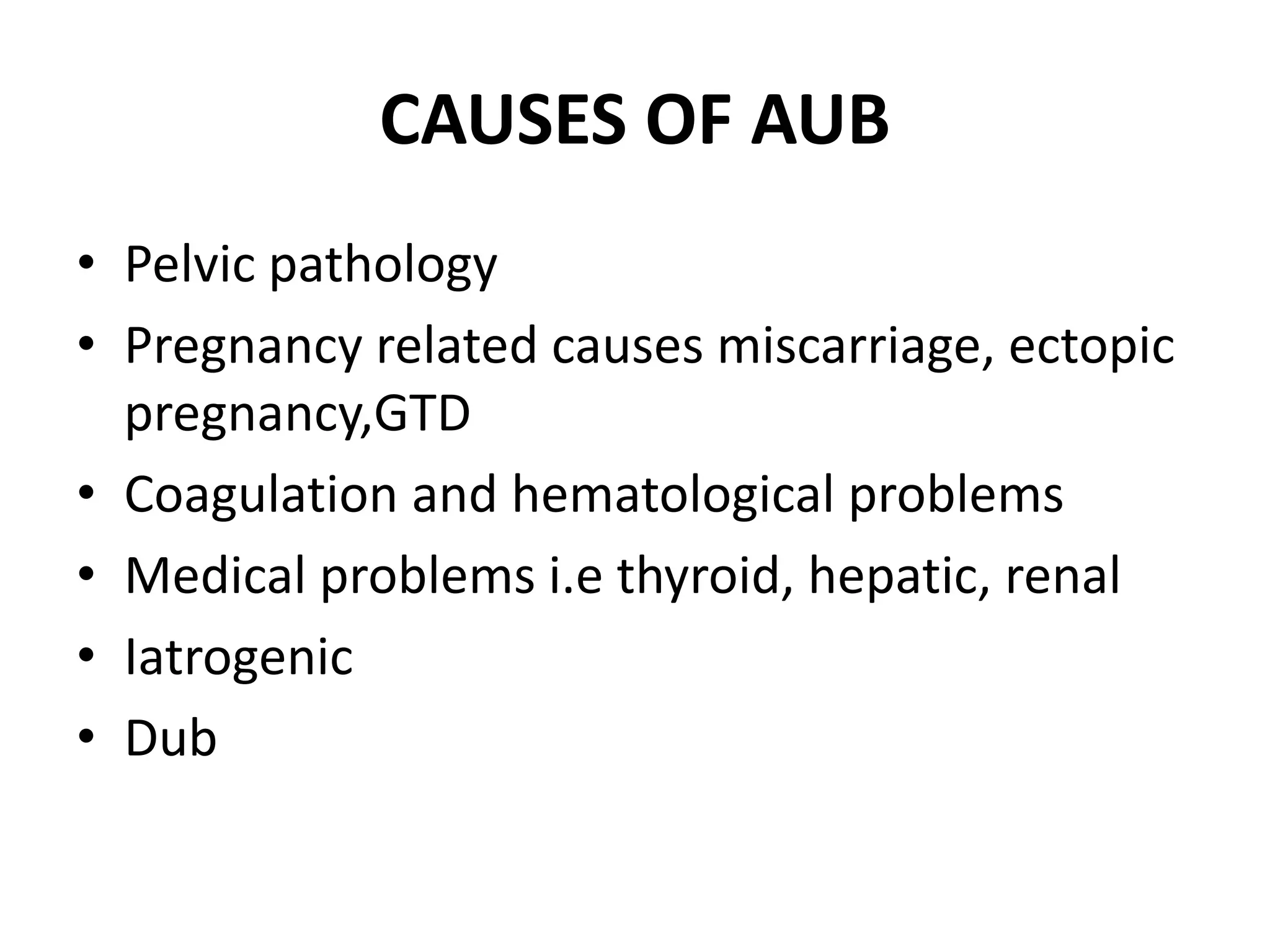
• Pelvic pathology
• Pregnancy related causes miscarriage, ectopic
pregnancy,GTD
• Coagulation and hematological problems
• Medical problems i.e thyroid, hepatic, renal
• Iatrogenic
• Dub
DEFINITION OF DUB
It is state of abnormal uterine bleeding in
absence of pregnancy, genital tract pathogy a,
it is due to failure of hypothalamic pitutory
ovarian axis.
it is mainly of endocrinal origin due
to hormonal disturbance.
INCIDENCE
• 10-20% OPD cases
• 20% adolescents (12-19)
• 30% reproductive age(20-40)
• 50% near menopause
TYPES
Anovulatory bleeding (80%)
• In absence of growth limiting progesterone due
to anovulation, carpus lutium does not formed.
• Continuous unopposed production of oestradiol,
it stimulate overgrowth of endometrium,
endometrium thickens and outgrows its blood
sulpply, necrosis and irregular bleeding occurs.
• In adolescents HTOPA is still immature, it take
time in establishing positive feed back an LH
surge.
TYPES
OVULATORY BLEEDING (20%)
• It includes polymenorrhoea, oligomenorrhoea,
functional menorrhagia ( irregular shedding and
irregular ripening of endometrium).
• Irregular shedding post menstrual spotting,
irregular ripening ( pre menstrual spotting)
• failure in regeneration of endometrium ( normally
regeneration of endometrium starts from 3rd
menstrual day.
• Poor formation and inadequate function of corpus
leutium , secreation of both estrogen and
progestrone inadequate to support endometrium.
INVESTIGATIONS
Aims at-
• To confirm menstrual abnormality as stated by
patient.
• To exclude systemic, iatrogenic and organic
pelvic pathology.
• To identify possible etiology of DUB.
• To work out the definite therapy protocol.
• History taking
• Internal examination
• Special investigations-
Blood values
Trans-vaginal sonography (TVS)
Saline infusion sonography
Hysteroscopy
Endometrial biopsy
Diagnostic D&C
Laparoscopy
MANAGEMENT
Because of diverse etiopathology of DUB in
different phases of woman’s life, the
management protocol vary.
Management depends on:
• Age
• Desire for child bearing
• Severity of bleeding
• Associated pathology
 GENERAL MEASURES
• Rest advised during bleeding phase.
• Assurance and sympathy
• Anemia should be corrected appropriately by
diet, hematinics, and even by blood
transfusion.
• Any systemic or endocrinal abnormality
should be investigated accordingly.
MEDICAL MANAGEMENT
Majority of DUB cases responds well to conservative
treatment during adolescence and early reproductive
period.
 NONHORMONAL MANAGEMENT –
i) Prostaglandin synthetase inhibitors-
Mefenemic acid 150-600 mg, oral in divided doses
during bleeding phase.
• NSAIDs may be used as second line medical
treatment. NSAIDs may reduce menstrual blood loss by
25-40%
• ii) Antifibrinolytic agents:
Tranexamic acid, reduces menstrual blood loss by 50%.
It mainly used in IUCD induced menorrhagia
HORMONAL MANAGEMENT:
• Norethisterone acetate
• Medroxyprogesterone acetate (MPA)
• Progestin releasing IUCD:LNG-IUS ( 5 years effect)
Antiestrogenic action of progestins inhibit
estrogen receptors, antimitotic effect on
endometrium.
Isolated progestin therapy is highly effective in
anovular DUB, while in ovular DUB combined
preparation of progestin and estrogen are
effective.
Other hormonal contraceptives-
• Combine pill estrogen and progesterone pill
• Danazol
• GnRh agonist
• Desmopressin
• Dydrogesterone in ovular DUB.
SURGICAL MANAGEMENT
• Uterine curettage-
Hemostatic and therapeutic effect by removing necrosed
and unhealthy endometrium . USG guided D&C for
detection of endometrial pathology.
• Endometrial ablation / resection-
Destruction of endometrium using various methods like-
thermal balloon with hot normal saline 87 C for 8-10 min.
other methods are TCRE trans cervical resection of
endometrium, laser resection, Novasure radio frequency,
rollar ball ablation.
• Hysterectomy Removal of uterus done by various route by
vaginal, abdominal, laparoscopic assisted vaginal route, etc.
MANAGEMENT PROTOCOL OF DUB

Dysfunctional uterine bleeding ( dub )

  • 1.
    DYSFUNCTIONAL UTERINE BLEEDING (DUB ) PRESENTED BY: ABHILASHA VERMA LECTURER ( M.Sc. Nursing Obg & Gynae)
  • 2.
    TERMINOLOGY  Metrorrhagia –Inter menstrual bleeding (b/w menses), irregular acyclic bleeding.  Menorrhagia- Heavy and prolonged bleeding, more then 7 days and more than 80-100 ml. cycle regular, bleeding pattern excessive in amount and duration.  Meno-metrorrhagia – More than 100 ml, heavy and prolonged and irregular.  Mid cycle spotting- spotting occur just before ovulation due to decline estrogen level.
  • 3.
    • Threshold bleeding-Bleedingdue to low estrogen level ( poor quality of ovarian follicles) and atrophic endometrium. • Acyclic bleeding- Irregularly irregular bleeding ( excess) patient confuse about which is menstrual cycle and which is intermenstual bleeding. • Polymenorrhoea- Cyclic bleeding, cycle reduced to less than 21 days. • Oligomenorrhoea – Cyclic bleeding cycle occur more then 35 days apart. • Hypomenorrhoea- Bleeding is scanty and of short duration less then 2 days. • Post menopausal bleeding- Bleeding occuring after 1 year of menopause.
  • 4.
    CAUSES OF AUB •Pelvic pathology • Pregnancy related causes miscarriage, ectopic pregnancy,GTD • Coagulation and hematological problems • Medical problems i.e thyroid, hepatic, renal • Iatrogenic • Dub
  • 5.
    DEFINITION OF DUB Itis state of abnormal uterine bleeding in absence of pregnancy, genital tract pathogy a, it is due to failure of hypothalamic pitutory ovarian axis. it is mainly of endocrinal origin due to hormonal disturbance.
  • 6.
    INCIDENCE • 10-20% OPDcases • 20% adolescents (12-19) • 30% reproductive age(20-40) • 50% near menopause
  • 7.
    TYPES Anovulatory bleeding (80%) •In absence of growth limiting progesterone due to anovulation, carpus lutium does not formed. • Continuous unopposed production of oestradiol, it stimulate overgrowth of endometrium, endometrium thickens and outgrows its blood sulpply, necrosis and irregular bleeding occurs. • In adolescents HTOPA is still immature, it take time in establishing positive feed back an LH surge.
  • 8.
    TYPES OVULATORY BLEEDING (20%) •It includes polymenorrhoea, oligomenorrhoea, functional menorrhagia ( irregular shedding and irregular ripening of endometrium). • Irregular shedding post menstrual spotting, irregular ripening ( pre menstrual spotting) • failure in regeneration of endometrium ( normally regeneration of endometrium starts from 3rd menstrual day. • Poor formation and inadequate function of corpus leutium , secreation of both estrogen and progestrone inadequate to support endometrium.
  • 9.
    INVESTIGATIONS Aims at- • Toconfirm menstrual abnormality as stated by patient. • To exclude systemic, iatrogenic and organic pelvic pathology. • To identify possible etiology of DUB. • To work out the definite therapy protocol.
  • 10.
    • History taking •Internal examination • Special investigations- Blood values Trans-vaginal sonography (TVS) Saline infusion sonography Hysteroscopy Endometrial biopsy Diagnostic D&C Laparoscopy
  • 11.
    MANAGEMENT Because of diverseetiopathology of DUB in different phases of woman’s life, the management protocol vary. Management depends on: • Age • Desire for child bearing • Severity of bleeding • Associated pathology
  • 12.
     GENERAL MEASURES •Rest advised during bleeding phase. • Assurance and sympathy • Anemia should be corrected appropriately by diet, hematinics, and even by blood transfusion. • Any systemic or endocrinal abnormality should be investigated accordingly.
  • 13.
    MEDICAL MANAGEMENT Majority ofDUB cases responds well to conservative treatment during adolescence and early reproductive period.  NONHORMONAL MANAGEMENT – i) Prostaglandin synthetase inhibitors- Mefenemic acid 150-600 mg, oral in divided doses during bleeding phase. • NSAIDs may be used as second line medical treatment. NSAIDs may reduce menstrual blood loss by 25-40% • ii) Antifibrinolytic agents: Tranexamic acid, reduces menstrual blood loss by 50%. It mainly used in IUCD induced menorrhagia
  • 14.
    HORMONAL MANAGEMENT: • Norethisteroneacetate • Medroxyprogesterone acetate (MPA) • Progestin releasing IUCD:LNG-IUS ( 5 years effect) Antiestrogenic action of progestins inhibit estrogen receptors, antimitotic effect on endometrium. Isolated progestin therapy is highly effective in anovular DUB, while in ovular DUB combined preparation of progestin and estrogen are effective.
  • 15.
    Other hormonal contraceptives- •Combine pill estrogen and progesterone pill • Danazol • GnRh agonist • Desmopressin • Dydrogesterone in ovular DUB.
  • 16.
    SURGICAL MANAGEMENT • Uterinecurettage- Hemostatic and therapeutic effect by removing necrosed and unhealthy endometrium . USG guided D&C for detection of endometrial pathology. • Endometrial ablation / resection- Destruction of endometrium using various methods like- thermal balloon with hot normal saline 87 C for 8-10 min. other methods are TCRE trans cervical resection of endometrium, laser resection, Novasure radio frequency, rollar ball ablation. • Hysterectomy Removal of uterus done by various route by vaginal, abdominal, laparoscopic assisted vaginal route, etc.
  • 17.