AMENORRHEAAMENORRHEA
DR POLY BEGUM
Assistant Professor
DAMC, Faridpur
Amenorrhea Definition
Primary amenorrhea :
A young girl who has not yet menstruated by
her 16 yrs of age is having primary amenorrhea
rather than delayed menarche. The normal
upper age limit for menarche is 15 years.
(currently a cut off value at 14 yrs – in the
absence of secondary sexual characteristics
and 16 yrs – presence of secondary sexual
characteristics.
Secondary amenorrhea:
Absence of menstruation for 3 or more
months in previously menstruating
women of reproductive age.
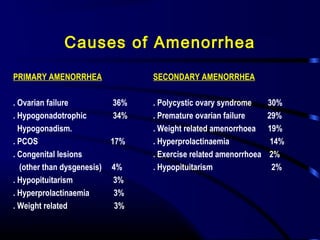
Causes of Amenorrhea
PRIMARY AMENORRHEA
. Ovarian failure 36%
. Hypogonadotrophic 34%
Hypogonadism.
. PCOS 17%
. Congenital lesions
(other than dysgenesis) 4%
. Hypopituitarism 3%
. Hyperprolactinaemia 3%
. Weight related 3%
SECONDARY AMENORRHEA
. Polycystic ovary syndrome 30%
. Premature ovarian failure 29%
. Weight related amenorrhoea 19%
. Hyperprolactinaemia 14%
. Exercise related amenorrhoea 2%
. Hypopituitarism 2%
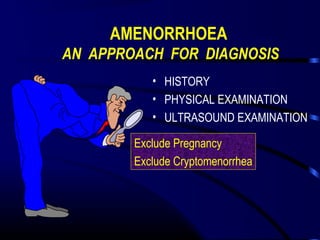
AMENORRHOEA
AN APPROACH FOR DIAGNOSIS
• HISTORY
• PHYSICAL EXAMINATION
• ULTRASOUND EXAMINATION
Exclude Pregnancy
Exclude Cryptomenorrhea
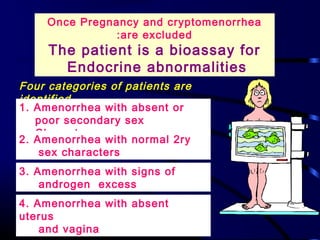
Once Pregnancy and cryptomenorrhea
are excluded:
The patient is a bioassay for
Endocrine abnormalities
Four categories of patients are
identified
1. Amenorrhea with absent or
poor secondary sex
Characters
2. Amenorrhea with normal 2ry
sex characters
3. Amenorrhea with signs of
androgen excess
4. Amenorrhea with absent
uterus
and vagina
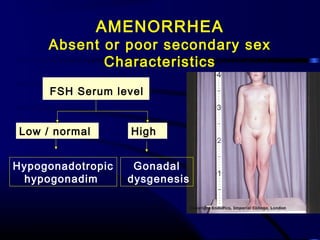
FSH Serum level
Low / normal High
Hypogonadotropic
hypogonadim
Gonadal
dysgenesis
AMENORRHEA
Absent or poor secondary sex
Characteristics
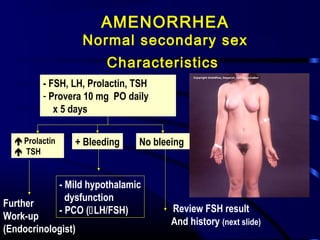
AMENORRHEA
Normal secondary sex
Characteristics
- FSH, LH, Prolactin, TSH
- Provera 10 mg PO daily
x 5 days
+ Bleeding No bleeingProlactin
 TSH
Further
Work-up
(Endocrinologist)
- Mild hypothalamic
dysfunction
- PCO (LH/FSH) Review FSH result
And history (next slide)
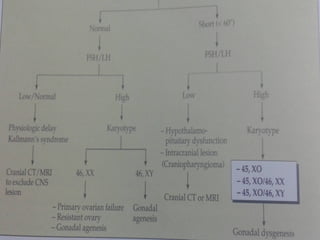
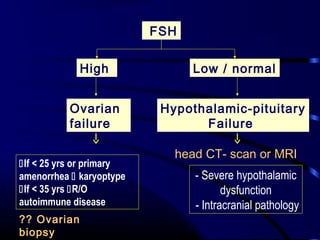
FSH
Low / normalHigh
Hypothalamic-pituitary
Failure
Ovarian
failure
If < 25 yrs or primary
amenorrhea  karyoptype
If < 35 yrs R/O
autoimmune disease
?? Ovarian
biopsy
head CT- scan or MRI
- Severe hypothalamic
dysfunction
- Intracranial pathology
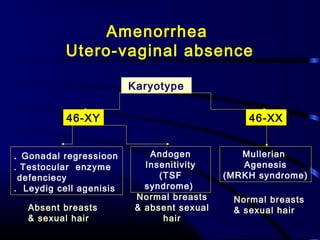
Amenorrhea
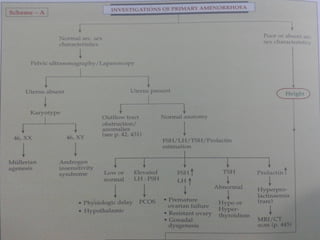
Utero-vaginal absence
Karyotype
46-XX
Mullerian
Agenesis
(MRKH syndrome)
Andogen
Insenitivity
(TSF
syndrome)
. Gonadal regressioon
. Testocular enzyme
defenciecy
. Leydig cell agenisis
46-XY
Normal breasts
& sexual hair
Normal breasts
& absent sexual
hair
Absent breasts
& sexual hair
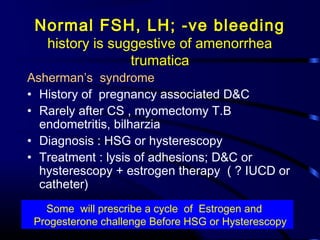
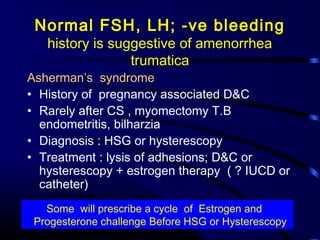
Normal FSH, LH; -ve bleeding
history is suggestive of amenorrhea
trumatica
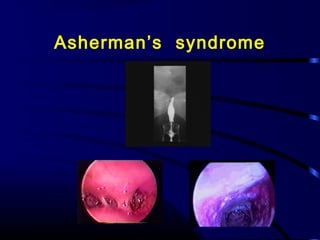
Asherman’s syndrome
• History of pregnancy associated D&C
• Rarely after CS , myomectomy T.B
endometritis, bilharzia
• Diagnosis : HSG or hysterescopy
• Treatment : lysis of adhesions; D&C or
hysterescopy + estrogen therapy ( ? IUCD or
catheter)
Some will prescribe a cycle of Estrogen and
Progesterone challenge Before HSG or Hysterescopy
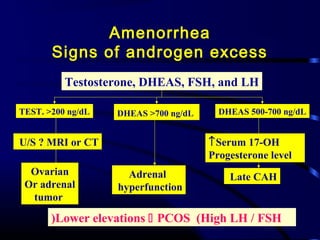
Amenorrhea
Signs of androgen excess
Testosterone, DHEAS, FSH, and LH
DHEAS 500-700 ng/dLDHEAS >700 ng/dLTEST. >200 ng/dL
↑Serum 17-OH
Progesterone level
Late CAHAdrenal
hyperfunction
U/S ? MRI or CT
Ovarian
Or adrenal
tumor
Lower elevations  PCOS (High LH / FSH(
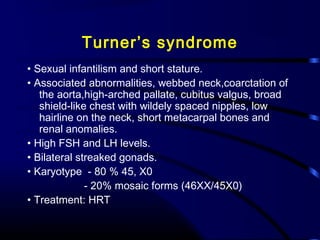
Turner’s syndrome
• Sexual infantilism and short stature.
• Associated abnormalities, webbed neck,coarctation of
the aorta,high-arched pallate, cubitus valgus, broad
shield-like chest with wildely spaced nipples, low
hairline on the neck, short metacarpal bones and
renal anomalies.
• High FSH and LH levels.
• Bilateral streaked gonads.
• Karyotype - 80 % 45, X0
- 20% mosaic forms (46XX/45X0)
• Treatment: HRT
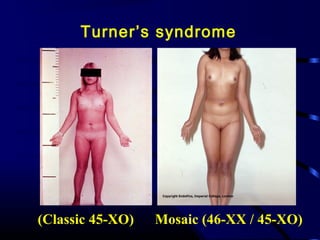
Mosaic (46-XX / 45-XO((Classic 45-XO(
Turner’s syndrome
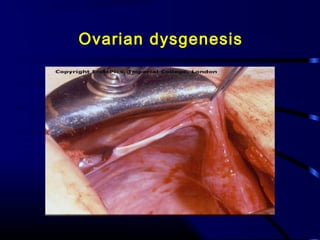
Ovarian dysgenesis
Premature ovarian failure
• Serum estradiol < 50 pg/ml and FSH > 40 IU/ml on
repeated occasions
• 10% of secondary amenorrhea
• Few cases reported, where high dose estrogen or
HMG therapy resulted in ovulation
• Sometimes immuno therapy may reverse autoimmue
ovarian failure
• Rarely  spont. ovulation (resistant ovaries)
• Treatment: HRT (osteoporosis, atherogenesis)
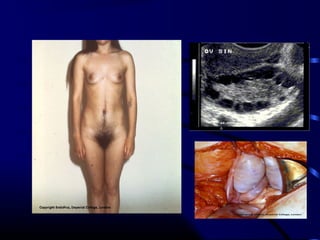
Polycystic ovary syndrome
• The most common cause of chronic
anovulation
• Hyperandrogenism ;  LH/FSH ratio
• Insulin resitance is a major biochemical feature
( blood insulin level hyperandrogenism )
• Long term risks: Obesity, hirsutism, infertility,
type 2 diabetes, dyslipidemia, cardiovasular
risks, endometrial hyperplassia and cancer
• Treatment depends on the needs of the patient
and preventing long term health problems
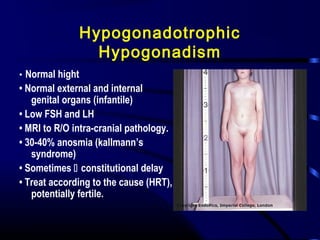
Hypogonadotrophic
Hypogonadism
• Normal hight
• Normal external and internal
genital organs (infantile)
• Low FSH and LH
• MRI to R/O intra-cranial pathology.
• 30-40% anosmia (kallmann’s
syndrome)
• Sometimes  constitutional delay
• Treat according to the cause (HRT),
potentially fertile.
Exercise-associated
amenorrhoea
• Common in women who participate
in sports (e.g. competitive athletes,
ballet dancers)
• Eating disorders have a higher
prevalence in female athletes than
non-athletes
• Hypothalamic disorder caused by
abnormal gonadotrophin-releasing
hormone pulsatility, resulting in
impaired gonadotrophin levels,
particularly LH, and subsequently
low oestrogen levels
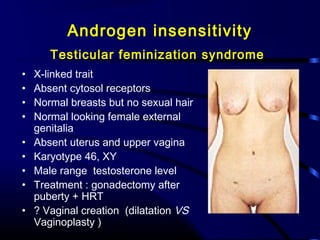
Androgen insensitivity
Testicular feminization syndrome
• X-linked trait
• Absent cytosol receptors
• Normal breasts but no sexual hair
• Normal looking female external
genitalia
• Absent uterus and upper vagina
• Karyotype 46, XY
• Male range testosterone level
• Treatment : gonadectomy after
puberty + HRT
• ? Vaginal creation (dilatation VS
Vaginoplasty )
General Principles of management
of Amenorrhea
. Attempts to restore ovulatory function
. If this is not possible HRT (oestrogen and
progesterone) is given to hypo-estrogenic
amenorrheic women (to prevent osteoporosis; atherogenesis)
. Periodic progestogen should be taken by euestrogenic
amenorrheic women (to avoid endometrial cancer)
. If Y chromosome is present gonadectomy is indicated
. Many cases require frequent re-evaluation
Hormonal treatment
Primary Amenorrhea with absent
secondary sexual characteristics
To achieve pubertal development
Premarin 5mg D1-D25 + provera 10mg D15-D25
X 3 months; ↓ 2.5mg premarin X 3 months and
↓ 1.25mg premarin X 3 months
Maintenance therapy
0.625mg premarin + provera OR ready HRT
preparation OR 30µg oral contraceptive pill
Summary
• Although the work-up of amenorrhea may seem to be
complex, a carefully conducted physical examination with the
history, and Looking to the patient as a bioassay for endocrine
abnormalities, should permit the clinician to narrow the
diagnostic possibilities and an accurate diagnosis can be
obtained quickly.
• Management aims at restoring ovulatory cycles if possible,
replacing estrogen when deficient and Progestogegen to
protect endometrium from unopposed estrogen.
• Frequent re-evaluation and reassurance of the patient.
Cryptomenorrhea
Outflow obstruction to menstrual blood
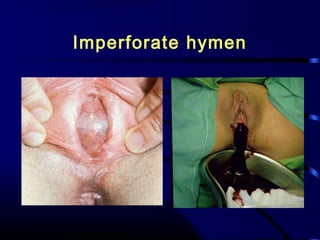
- Imperforate hymen
- Transverse Vaginal septum with functioning uterus
- Isolated Vaginal agenesis with functioning uterus
- Isolated Cervical agenesis with functioning uterus
- Intermittent abdominal pain
- Possible difficulty with micturition
- Possible lower abdominal swelling
- Bulging bluish membrane at the introitus or absent
vagina (only dimple)
Imperforate hymen
Normal FSH, LH; -ve bleeding
history is suggestive of amenorrhea
trumatica
Asherman’s syndrome
• History of pregnancy associated D&C
• Rarely after CS , myomectomy T.B
endometritis, bilharzia
• Diagnosis : HSG or hysterescopy
• Treatment : lysis of adhesions; D&C or
hysterescopy + estrogen therapy ( ? IUCD or
catheter)
Some will prescribe a cycle of Estrogen and
Progesterone challenge Before HSG or Hysterescopy
Asherman’s syndrome
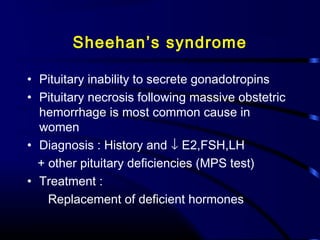
Sheehan’s syndrome
• Pituitary inability to secrete gonadotropins
• Pituitary necrosis following massive obstetric
hemorrhage is most common cause in
women
• Diagnosis : History and ↓ E2,FSH,LH
+ other pituitary deficiencies (MPS test)
• Treatment :
Replacement of deficient hormones
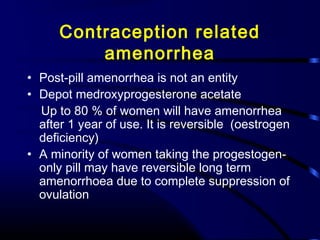
Contraception related
amenorrhea
• Post-pill amenorrhea is not an entity
• Depot medroxyprogesterone acetate
Up to 80 % of women will have amenorrhea
after 1 year of use. It is reversible (oestrogen
deficiency)
• A minority of women taking the progestogen-
only pill may have reversible long term
amenorrhoea due to complete suppression of
ovulation
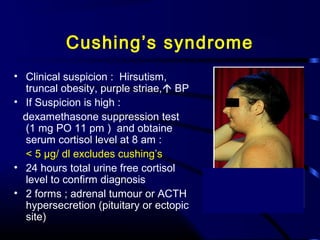
Cushing’s syndrome
• Clinical suspicion : Hirsutism,
truncal obesity, purple striae, BP
• If Suspicion is high :
dexamethasone suppression test
(1 mg PO 11 pm ) and obtaine
serum cortisol level at 8 am :
< 5 µg/ dl excludes cushing’s
• 24 hours total urine free cortisol
level to confirm diagnosis
• 2 forms ; adrenal tumour or ACTH
hypersecretion (pituitary or ectopic
site)
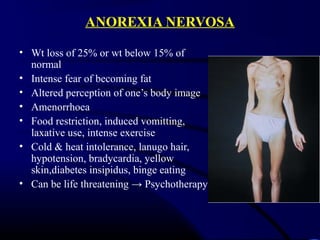
ANOREXIA NERVOSA
• Wt loss of 25% or wt below 15% of
normal
• Intense fear of becoming fat
• Altered perception of one’s body image
• Amenorrhoea
• Food restriction, induced vomitting,
laxative use, intense exercise
• Cold & heat intolerance, lanugo hair,
hypotension, bradycardia, yellow
skin,diabetes insipidus, binge eating
• Can be life threatening → Psychotherapy
Mullerian agenesis
(Mayer-Rokitansky-Kuster-Hauser syndrome)
Physical appearance:
-Normal breast development
-Normal sexual hair
-Average stature
External genitalia – Normal
Internal genitalia – Absence of vagina, Absent
uterus.
Investigations:
• -Ultrasonography –uterus absent.
• -Laparoscopy-ut absent,tube and ovaries
present.
• -Karyotype -46,xx
• -IVP –urinary tract abnormalities(30%)
THANK YOU
FOR YOUR
ATTENTION

Amenorrhea

  • 1.
  • 2.
    Amenorrhea Definition Primary amenorrhea: A young girl who has not yet menstruated by her 16 yrs of age is having primary amenorrhea rather than delayed menarche. The normal upper age limit for menarche is 15 years. (currently a cut off value at 14 yrs – in the absence of secondary sexual characteristics and 16 yrs – presence of secondary sexual characteristics.
  • 3.
    Secondary amenorrhea: Absence ofmenstruation for 3 or more months in previously menstruating women of reproductive age.
  • 4.
    Causes of Amenorrhea PRIMARYAMENORRHEA . Ovarian failure 36% . Hypogonadotrophic 34% Hypogonadism. . PCOS 17% . Congenital lesions (other than dysgenesis) 4% . Hypopituitarism 3% . Hyperprolactinaemia 3% . Weight related 3% SECONDARY AMENORRHEA . Polycystic ovary syndrome 30% . Premature ovarian failure 29% . Weight related amenorrhoea 19% . Hyperprolactinaemia 14% . Exercise related amenorrhoea 2% . Hypopituitarism 2%
  • 5.
    AMENORRHOEA AN APPROACH FORDIAGNOSIS • HISTORY • PHYSICAL EXAMINATION • ULTRASOUND EXAMINATION Exclude Pregnancy Exclude Cryptomenorrhea
  • 8.
    Once Pregnancy andcryptomenorrhea are excluded: The patient is a bioassay for Endocrine abnormalities Four categories of patients are identified 1. Amenorrhea with absent or poor secondary sex Characters 2. Amenorrhea with normal 2ry sex characters 3. Amenorrhea with signs of androgen excess 4. Amenorrhea with absent uterus and vagina
  • 9.
    FSH Serum level Low/ normal High Hypogonadotropic hypogonadim Gonadal dysgenesis AMENORRHEA Absent or poor secondary sex Characteristics
  • 10.
    AMENORRHEA Normal secondary sex Characteristics -FSH, LH, Prolactin, TSH - Provera 10 mg PO daily x 5 days + Bleeding No bleeingProlactin  TSH Further Work-up (Endocrinologist) - Mild hypothalamic dysfunction - PCO (LH/FSH) Review FSH result And history (next slide)
  • 11.
    FSH Low / normalHigh Hypothalamic-pituitary Failure Ovarian failure If< 25 yrs or primary amenorrhea  karyoptype If < 35 yrs R/O autoimmune disease ?? Ovarian biopsy head CT- scan or MRI - Severe hypothalamic dysfunction - Intracranial pathology
  • 12.
    Amenorrhea Utero-vaginal absence Karyotype 46-XX Mullerian Agenesis (MRKH syndrome) Andogen Insenitivity (TSF syndrome) .Gonadal regressioon . Testocular enzyme defenciecy . Leydig cell agenisis 46-XY Normal breasts & sexual hair Normal breasts & absent sexual hair Absent breasts & sexual hair
  • 13.
    Normal FSH, LH;-ve bleeding history is suggestive of amenorrhea trumatica Asherman’s syndrome • History of pregnancy associated D&C • Rarely after CS , myomectomy T.B endometritis, bilharzia • Diagnosis : HSG or hysterescopy • Treatment : lysis of adhesions; D&C or hysterescopy + estrogen therapy ( ? IUCD or catheter) Some will prescribe a cycle of Estrogen and Progesterone challenge Before HSG or Hysterescopy
  • 14.
    Amenorrhea Signs of androgenexcess Testosterone, DHEAS, FSH, and LH DHEAS 500-700 ng/dLDHEAS >700 ng/dLTEST. >200 ng/dL ↑Serum 17-OH Progesterone level Late CAHAdrenal hyperfunction U/S ? MRI or CT Ovarian Or adrenal tumor Lower elevations  PCOS (High LH / FSH(
  • 15.
    Turner’s syndrome • Sexualinfantilism and short stature. • Associated abnormalities, webbed neck,coarctation of the aorta,high-arched pallate, cubitus valgus, broad shield-like chest with wildely spaced nipples, low hairline on the neck, short metacarpal bones and renal anomalies. • High FSH and LH levels. • Bilateral streaked gonads. • Karyotype - 80 % 45, X0 - 20% mosaic forms (46XX/45X0) • Treatment: HRT
  • 16.
    Mosaic (46-XX /45-XO((Classic 45-XO( Turner’s syndrome
  • 17.
  • 18.
    Premature ovarian failure •Serum estradiol < 50 pg/ml and FSH > 40 IU/ml on repeated occasions • 10% of secondary amenorrhea • Few cases reported, where high dose estrogen or HMG therapy resulted in ovulation • Sometimes immuno therapy may reverse autoimmue ovarian failure • Rarely  spont. ovulation (resistant ovaries) • Treatment: HRT (osteoporosis, atherogenesis)

  • 19.
    Polycystic ovary syndrome •The most common cause of chronic anovulation • Hyperandrogenism ;  LH/FSH ratio • Insulin resitance is a major biochemical feature ( blood insulin level hyperandrogenism ) • Long term risks: Obesity, hirsutism, infertility, type 2 diabetes, dyslipidemia, cardiovasular risks, endometrial hyperplassia and cancer • Treatment depends on the needs of the patient and preventing long term health problems
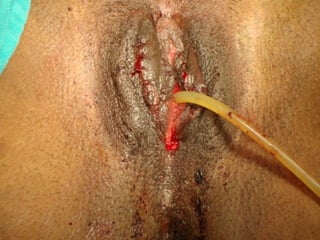
  • 21.
    Hypogonadotrophic Hypogonadism • Normal hight •Normal external and internal genital organs (infantile) • Low FSH and LH • MRI to R/O intra-cranial pathology. • 30-40% anosmia (kallmann’s syndrome) • Sometimes  constitutional delay • Treat according to the cause (HRT), potentially fertile.
  • 22.
    Exercise-associated amenorrhoea • Common inwomen who participate in sports (e.g. competitive athletes, ballet dancers) • Eating disorders have a higher prevalence in female athletes than non-athletes • Hypothalamic disorder caused by abnormal gonadotrophin-releasing hormone pulsatility, resulting in impaired gonadotrophin levels, particularly LH, and subsequently low oestrogen levels

  • 23.
    Androgen insensitivity Testicular feminizationsyndrome • X-linked trait • Absent cytosol receptors • Normal breasts but no sexual hair • Normal looking female external genitalia • Absent uterus and upper vagina • Karyotype 46, XY • Male range testosterone level • Treatment : gonadectomy after puberty + HRT • ? Vaginal creation (dilatation VS Vaginoplasty )
  • 24.
    General Principles ofmanagement of Amenorrhea . Attempts to restore ovulatory function . If this is not possible HRT (oestrogen and progesterone) is given to hypo-estrogenic amenorrheic women (to prevent osteoporosis; atherogenesis) . Periodic progestogen should be taken by euestrogenic amenorrheic women (to avoid endometrial cancer) . If Y chromosome is present gonadectomy is indicated . Many cases require frequent re-evaluation
  • 25.
    Hormonal treatment Primary Amenorrheawith absent secondary sexual characteristics To achieve pubertal development Premarin 5mg D1-D25 + provera 10mg D15-D25 X 3 months; ↓ 2.5mg premarin X 3 months and ↓ 1.25mg premarin X 3 months Maintenance therapy 0.625mg premarin + provera OR ready HRT preparation OR 30µg oral contraceptive pill
  • 26.
    Summary • Although thework-up of amenorrhea may seem to be complex, a carefully conducted physical examination with the history, and Looking to the patient as a bioassay for endocrine abnormalities, should permit the clinician to narrow the diagnostic possibilities and an accurate diagnosis can be obtained quickly. • Management aims at restoring ovulatory cycles if possible, replacing estrogen when deficient and Progestogegen to protect endometrium from unopposed estrogen. • Frequent re-evaluation and reassurance of the patient.
  • 27.
    Cryptomenorrhea Outflow obstruction tomenstrual blood - Imperforate hymen - Transverse Vaginal septum with functioning uterus - Isolated Vaginal agenesis with functioning uterus - Isolated Cervical agenesis with functioning uterus - Intermittent abdominal pain - Possible difficulty with micturition - Possible lower abdominal swelling - Bulging bluish membrane at the introitus or absent vagina (only dimple)
  • 28.
  • 29.
    Normal FSH, LH;-ve bleeding history is suggestive of amenorrhea trumatica Asherman’s syndrome • History of pregnancy associated D&C • Rarely after CS , myomectomy T.B endometritis, bilharzia • Diagnosis : HSG or hysterescopy • Treatment : lysis of adhesions; D&C or hysterescopy + estrogen therapy ( ? IUCD or catheter) Some will prescribe a cycle of Estrogen and Progesterone challenge Before HSG or Hysterescopy
  • 30.
  • 31.
    Sheehan’s syndrome • Pituitaryinability to secrete gonadotropins • Pituitary necrosis following massive obstetric hemorrhage is most common cause in women • Diagnosis : History and ↓ E2,FSH,LH + other pituitary deficiencies (MPS test) • Treatment : Replacement of deficient hormones
  • 32.
    Contraception related amenorrhea • Post-pillamenorrhea is not an entity • Depot medroxyprogesterone acetate Up to 80 % of women will have amenorrhea after 1 year of use. It is reversible (oestrogen deficiency) • A minority of women taking the progestogen- only pill may have reversible long term amenorrhoea due to complete suppression of ovulation
  • 33.
    Cushing’s syndrome • Clinicalsuspicion : Hirsutism, truncal obesity, purple striae, BP • If Suspicion is high : dexamethasone suppression test (1 mg PO 11 pm ) and obtaine serum cortisol level at 8 am : < 5 µg/ dl excludes cushing’s • 24 hours total urine free cortisol level to confirm diagnosis • 2 forms ; adrenal tumour or ACTH hypersecretion (pituitary or ectopic site)
  • 34.
    ANOREXIA NERVOSA • Wtloss of 25% or wt below 15% of normal • Intense fear of becoming fat • Altered perception of one’s body image • Amenorrhoea • Food restriction, induced vomitting, laxative use, intense exercise • Cold & heat intolerance, lanugo hair, hypotension, bradycardia, yellow skin,diabetes insipidus, binge eating • Can be life threatening → Psychotherapy
  • 35.
    Mullerian agenesis (Mayer-Rokitansky-Kuster-Hauser syndrome) Physicalappearance: -Normal breast development -Normal sexual hair -Average stature External genitalia – Normal Internal genitalia – Absence of vagina, Absent uterus.
  • 36.
    Investigations: • -Ultrasonography –uterusabsent. • -Laparoscopy-ut absent,tube and ovaries present. • -Karyotype -46,xx • -IVP –urinary tract abnormalities(30%)
  • 39.