MENOPAUSE & HRT
DEFINITION
● MENOPAUSE is defined as,
“The woman’s final menstrual period and the accepted
confirmation of this is made retrospectively after 1 year of amenorrhea”.
CAUSE: cessation of regular ovarian function.
PERIMENOPAUSE: The time of life from the onset of ovarian dysfunction until 1 year
after the last period and the diagnosis of menopause is made. This time is also known
as climacteric.
POSTMENOPAUSAL:
All the women who have been 1 year since their last period are
deemed postmenopausal.
The “CHANGE”:
A colloquial discription of Perimenopause and Postmenopause.
TYPES
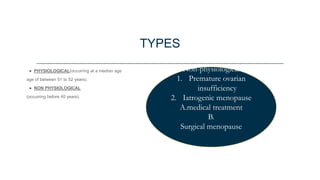
● PHYSIOLOGICAL(occurring at a median age
age of between 51 to 52 years).
● NON PHYSIOLOGICAL
(occurring before 40 years).
Non-physiological
1. Premature ovarian
insufficiency
2. Iatrogenic menopause
A.medical treatment
B.
Surgical menopause
ENDOCRINE CHANGES
Menopause occurs at the time of depletion of oocytes from the ovary and is irreversible.
Hormones that maintain reproductive function
● GnRH(by hypothalamus)
● LH and FSH(pituitary)
● Inhibin(ovarian follicles)
● Steroids (estrogen, progesterone, testosterone(ovaries, peripheral adipose tissue, adrenal
gland)
Female hormone production and changes
around the menopausal years
Hormones Perimenopause Early postmenopause Late postmenopause
GnRH Increased pulsatility Progressive decrease in
pulsatility
Reduction in overall
levels
LH&FSH Increased Increased Progressive decline
Oestrogen Slight decline Rapid decline in levels Sustained very low levels
Progesterone Moderate falls Unpredictable Undetectable
Inhibin Slight decline Significant decline Undetectable
Testosterone Progressive decline Progressive decline Sustained low levels
Non physiological menopause
Premature ovarian insufficiency
● Before 40 years
● Premature ovarian failure
● Supportive care counseling by
Specialist unit.
● Gamete donation
Primary • Chromosomal
Abnormalities(turner
, fragile X)
• Autoimmume(hypot
hyroidism, Addison,
myasthenia gravis)
• Enzyme deficiencies
(Galactosemia, 17
@-hydroxylase
deficiency
Secondary Chemotherapy or
radiotherapy,
infections(mumps, TB,
varicella, malaria).
Medical treatment associated menopause
● Chemotherapy
● Radiotherapy
● GnRH Agonists (buserelin , goseralin )
● Backup therapy (hormones and drugs)
● Surgical procedures to treat gynecological problems
● Menstrual disorders, fibroid, endometriosis
● BSO(Bilateral salpingoophorectomy (high risk women🡪 breast and ovarian cancer, BRCA1and 2
gene mutation screening.
● planning
effects of menopause by time of onset
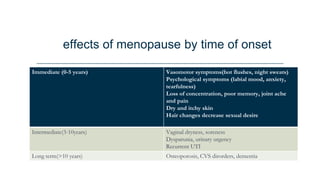
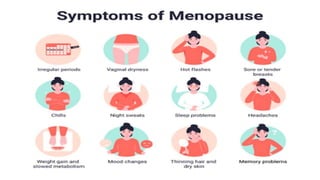
Immediate (0-5 years) Vasomotor symptoms(hot flushes, night sweats)
Psychological symptoms (labial mood, anxiety,
tearfulness)
Loss of concentration, poor memory, joint ache
and pain
Dry and itchy skin
Hair changes decrease sexual desire
Intermediate(3-10years) Vaginal dryness, soreness
Dysparunia, urinary urgency
Recurrent UTI
Long term(>10 years) Osteoporosis, CVS dirorders, dementia
CNS Symptoms
Vasomotor
● Mostly during perimenopausal Period
● Hot flushes, night sweat(loss of modulating effect of estrogen on serotinergic
receptors within thermoregulatory Centre in brain exagerrated peripheral
vasodialtory response to minor atmospheric changes)
● Sleep disturbance poor performance and quality of life.
Psychological symptoms
● Tiredness
● Anxiety and depression
Cognitive function
● Memory changes
THE GENITAL TRACT
Changes in menstrual bleeding
Endometrial effects
Initially scanty bleeding because of low estrogenic endometrial stimulation and then completely
stop.
Urogenital and vulvovaginal atrophy
● Vaginal dryness, burning, irritation, Dysparunia, shrinkage and fusion of labia and narrowing of
vaginal introitus.
● Loss of oestrogenic support🡪 Vaginal epithelium less elastic, more easily traumatized
● Incontinence , prolapse, urogynaecological problems
Bone health
● Loss of estrogenic support on skeleton🡪 osteoporotic fractures
● Bone formation(osteoblasts) decreases and bone destruction increases(osteoclasts). Bone
density peaks at 20 to 30 then declines afterwards then a steady decline till menopause then
accelerated loss until 60 years then further steady decline till death.
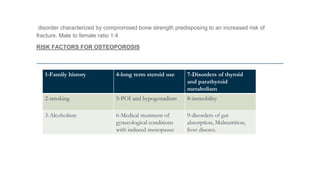
disorder characterized by compromised bone strength predisposing to an increased risk of
fracture. Male to female ratio 1:4
RISK FACTORS FOR OSTEOPOROSIS
1-Family history 4-long term steroid use 7-Disorders of thyroid
and parathyroid
metabolism
2-smoking 5-POI and hypogonadism 8-immobility
3-Alcoholism 6-Medical treatment of
gynecological conditions
with induced menopause
9-disorders of gut
absorption, Malnutrition,
liver diseses.
CVS symptoms
● Due to low estrogen following changes are observed
1. Incresed TAGs, total cholesterol, LDL and reduction in HDL
2. Femlae physiology changes, nutrition, exercise, changes in fat distribution from
a more gynaecoid to android .
3. Loss of estrogenic support on vessel walls(^atherogenesis)
Management of menopause
● Treatment options
1. Non Pharmacological
- Lifestyle modification
- Natural herbs & remedies
- Diet & suppliments, vit C, E
2. Pharmacological
- Hormone replacement therapy (HRT)
- Alpha 2 agonist
- Beta blockers
- Gabapentin
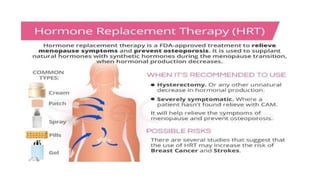
Hormone replacement therapy (HRT)
● Includes a wide range of hormonal products(estrogen, progesterone,
androgens, tibolone) with various methods & routes of administration,
potentially different risks and benefits .
Evaluation before starting HRT
● History and physical examination
● BP measurement
● Breast and pelvic examination
● Serum TSH (T4 > 500mg/dl absolute C/I for HRT)
● Mammography
● Lipid profile
● Baseline USG
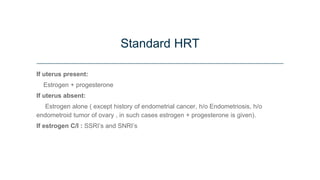
Standard HRT
If uterus present:
Estrogen + progesterone
If uterus absent:
Estrogen alone ( except history of endometrial cancer, h/o Endometriosis, h/o
endometroid tumor of ovary , in such cases estrogen + progesterone is given).
If estrogen C/I : SSRI’s and SNRI’s
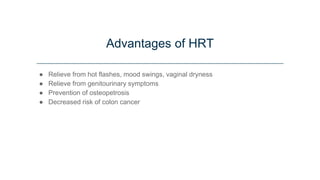
Advantages of HRT
● Relieve from hot flashes, mood swings, vaginal dryness
● Relieve from genitourinary symptoms
● Prevention of osteopetrosis
● Decreased risk of colon cancer
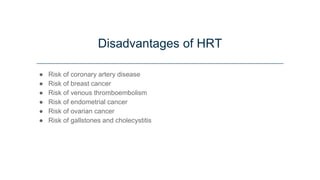
Disadvantages of HRT
● Risk of coronary artery disease
● Risk of breast cancer
● Risk of venous thromboembolism
● Risk of endometrial cancer
● Risk of ovarian cancer
● Risk of gallstones and cholecystitis
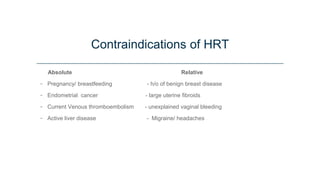
Contraindications of HRT
Absolute Relative
- Pregnancy/ breastfeeding - h/o of benign breast disease
- Endometrial cancer - large uterine fibroids
- Current Venous thromboembolism - unexplained vaginal bleeding
- Active liver disease - Migraine/ headaches
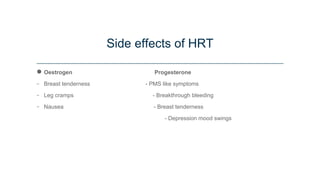
Side effects of HRT
● Oestrogen Progesterone
- Breast tenderness - PMS like symptoms
- Leg cramps - Breakthrough bleeding
- Nausea - Breast tenderness
- Depression mood swings
Menopause & HRT1.pptx

Menopause & HRT1.pptx

  • 1.
  • 2.
    DEFINITION ● MENOPAUSE isdefined as, “The woman’s final menstrual period and the accepted confirmation of this is made retrospectively after 1 year of amenorrhea”. CAUSE: cessation of regular ovarian function. PERIMENOPAUSE: The time of life from the onset of ovarian dysfunction until 1 year after the last period and the diagnosis of menopause is made. This time is also known as climacteric.
  • 3.
    POSTMENOPAUSAL: All the womenwho have been 1 year since their last period are deemed postmenopausal. The “CHANGE”: A colloquial discription of Perimenopause and Postmenopause.
  • 4.
    TYPES ● PHYSIOLOGICAL(occurring ata median age age of between 51 to 52 years). ● NON PHYSIOLOGICAL (occurring before 40 years). Non-physiological 1. Premature ovarian insufficiency 2. Iatrogenic menopause A.medical treatment B. Surgical menopause
  • 5.
    ENDOCRINE CHANGES Menopause occursat the time of depletion of oocytes from the ovary and is irreversible. Hormones that maintain reproductive function ● GnRH(by hypothalamus) ● LH and FSH(pituitary) ● Inhibin(ovarian follicles) ● Steroids (estrogen, progesterone, testosterone(ovaries, peripheral adipose tissue, adrenal gland)
  • 6.
    Female hormone productionand changes around the menopausal years
  • 7.
    Hormones Perimenopause Earlypostmenopause Late postmenopause GnRH Increased pulsatility Progressive decrease in pulsatility Reduction in overall levels LH&FSH Increased Increased Progressive decline Oestrogen Slight decline Rapid decline in levels Sustained very low levels Progesterone Moderate falls Unpredictable Undetectable Inhibin Slight decline Significant decline Undetectable Testosterone Progressive decline Progressive decline Sustained low levels
  • 8.
    Non physiological menopause Prematureovarian insufficiency ● Before 40 years ● Premature ovarian failure ● Supportive care counseling by Specialist unit. ● Gamete donation Primary • Chromosomal Abnormalities(turner , fragile X) • Autoimmume(hypot hyroidism, Addison, myasthenia gravis) • Enzyme deficiencies (Galactosemia, 17 @-hydroxylase deficiency Secondary Chemotherapy or radiotherapy, infections(mumps, TB, varicella, malaria).
  • 9.
    Medical treatment associatedmenopause ● Chemotherapy ● Radiotherapy ● GnRH Agonists (buserelin , goseralin ) ● Backup therapy (hormones and drugs) ● Surgical procedures to treat gynecological problems ● Menstrual disorders, fibroid, endometriosis ● BSO(Bilateral salpingoophorectomy (high risk women🡪 breast and ovarian cancer, BRCA1and 2 gene mutation screening. ● planning
  • 10.
    effects of menopauseby time of onset Immediate (0-5 years) Vasomotor symptoms(hot flushes, night sweats) Psychological symptoms (labial mood, anxiety, tearfulness) Loss of concentration, poor memory, joint ache and pain Dry and itchy skin Hair changes decrease sexual desire Intermediate(3-10years) Vaginal dryness, soreness Dysparunia, urinary urgency Recurrent UTI Long term(>10 years) Osteoporosis, CVS dirorders, dementia
  • 11.
    CNS Symptoms Vasomotor ● Mostlyduring perimenopausal Period ● Hot flushes, night sweat(loss of modulating effect of estrogen on serotinergic receptors within thermoregulatory Centre in brain exagerrated peripheral vasodialtory response to minor atmospheric changes) ● Sleep disturbance poor performance and quality of life.
  • 12.
    Psychological symptoms ● Tiredness ●Anxiety and depression Cognitive function ● Memory changes THE GENITAL TRACT Changes in menstrual bleeding Endometrial effects Initially scanty bleeding because of low estrogenic endometrial stimulation and then completely stop.
  • 13.
    Urogenital and vulvovaginalatrophy ● Vaginal dryness, burning, irritation, Dysparunia, shrinkage and fusion of labia and narrowing of vaginal introitus. ● Loss of oestrogenic support🡪 Vaginal epithelium less elastic, more easily traumatized ● Incontinence , prolapse, urogynaecological problems Bone health ● Loss of estrogenic support on skeleton🡪 osteoporotic fractures ● Bone formation(osteoblasts) decreases and bone destruction increases(osteoclasts). Bone density peaks at 20 to 30 then declines afterwards then a steady decline till menopause then accelerated loss until 60 years then further steady decline till death.
  • 14.
    disorder characterized bycompromised bone strength predisposing to an increased risk of fracture. Male to female ratio 1:4 RISK FACTORS FOR OSTEOPOROSIS 1-Family history 4-long term steroid use 7-Disorders of thyroid and parathyroid metabolism 2-smoking 5-POI and hypogonadism 8-immobility 3-Alcoholism 6-Medical treatment of gynecological conditions with induced menopause 9-disorders of gut absorption, Malnutrition, liver diseses.
  • 15.
    CVS symptoms ● Dueto low estrogen following changes are observed 1. Incresed TAGs, total cholesterol, LDL and reduction in HDL 2. Femlae physiology changes, nutrition, exercise, changes in fat distribution from a more gynaecoid to android . 3. Loss of estrogenic support on vessel walls(^atherogenesis)
  • 17.
    Management of menopause ●Treatment options 1. Non Pharmacological - Lifestyle modification - Natural herbs & remedies - Diet & suppliments, vit C, E 2. Pharmacological - Hormone replacement therapy (HRT) - Alpha 2 agonist - Beta blockers - Gabapentin
  • 18.
    Hormone replacement therapy(HRT) ● Includes a wide range of hormonal products(estrogen, progesterone, androgens, tibolone) with various methods & routes of administration, potentially different risks and benefits .
  • 20.
    Evaluation before startingHRT ● History and physical examination ● BP measurement ● Breast and pelvic examination ● Serum TSH (T4 > 500mg/dl absolute C/I for HRT) ● Mammography ● Lipid profile ● Baseline USG
  • 21.
    Standard HRT If uteruspresent: Estrogen + progesterone If uterus absent: Estrogen alone ( except history of endometrial cancer, h/o Endometriosis, h/o endometroid tumor of ovary , in such cases estrogen + progesterone is given). If estrogen C/I : SSRI’s and SNRI’s
  • 22.
    Advantages of HRT ●Relieve from hot flashes, mood swings, vaginal dryness ● Relieve from genitourinary symptoms ● Prevention of osteopetrosis ● Decreased risk of colon cancer
  • 23.
    Disadvantages of HRT ●Risk of coronary artery disease ● Risk of breast cancer ● Risk of venous thromboembolism ● Risk of endometrial cancer ● Risk of ovarian cancer ● Risk of gallstones and cholecystitis
  • 24.
    Contraindications of HRT AbsoluteRelative - Pregnancy/ breastfeeding - h/o of benign breast disease - Endometrial cancer - large uterine fibroids - Current Venous thromboembolism - unexplained vaginal bleeding - Active liver disease - Migraine/ headaches
  • 25.
    Side effects ofHRT ● Oestrogen Progesterone - Breast tenderness - PMS like symptoms - Leg cramps - Breakthrough bleeding - Nausea - Breast tenderness - Depression mood swings