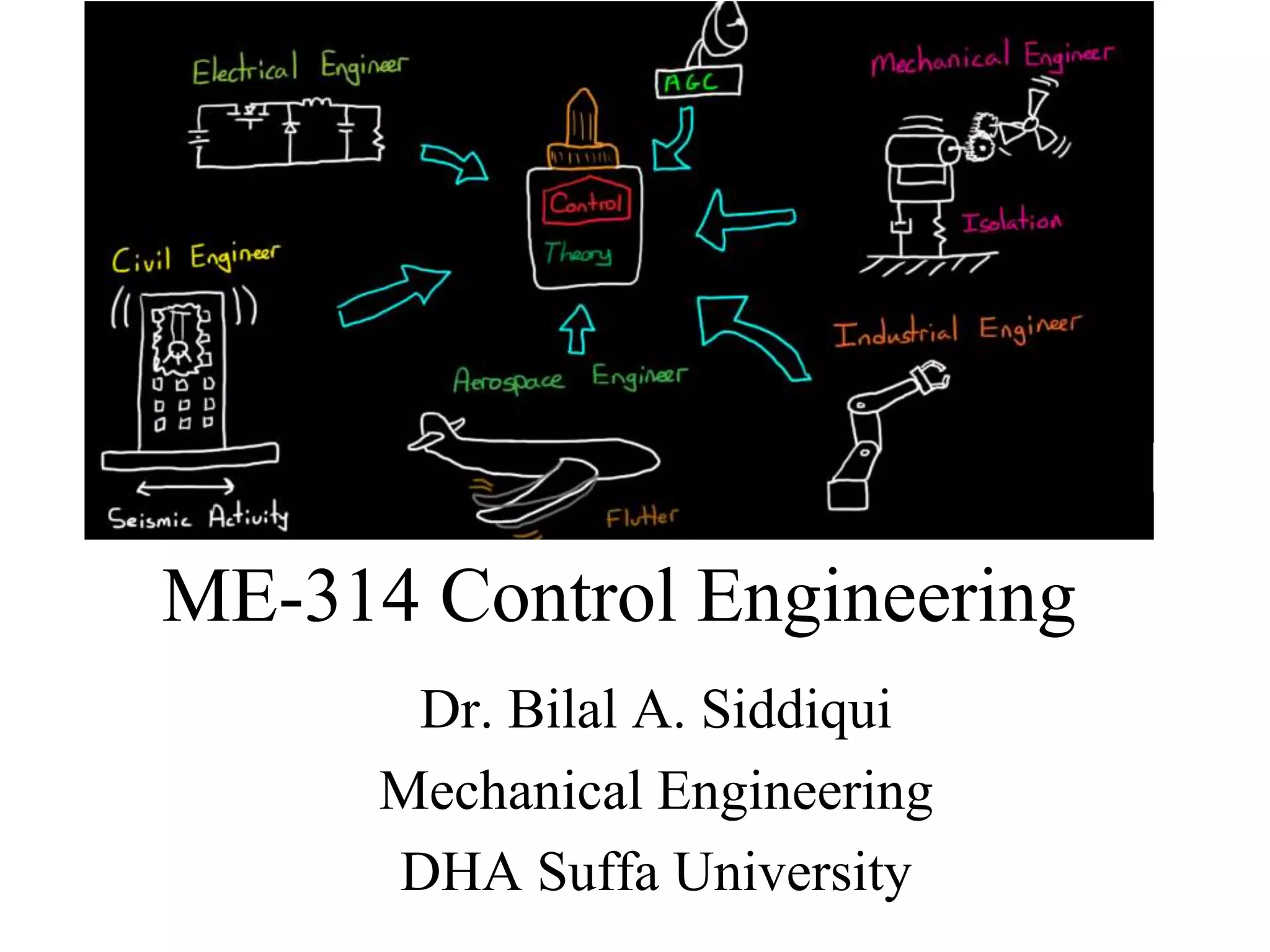
ME-314 Control Engineering
Dr. Bilal A. Siddiqui
Mechanical Engineering
DHA Suffa University
Stability of Dynamical Systems
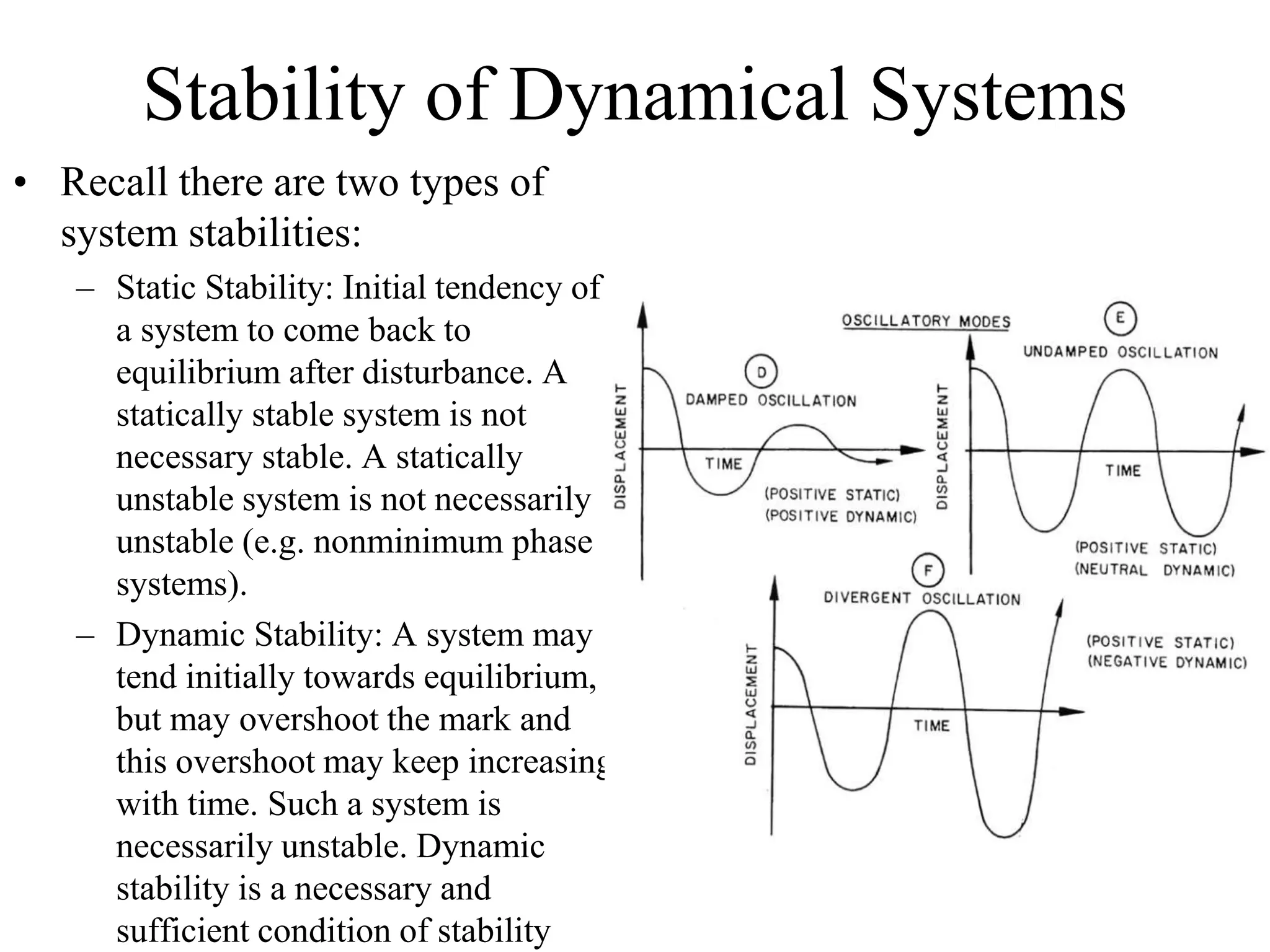
• Recall there are two types of
system stabilities:
– Static Stability: Initial tendency of
a system to come back to
equilibrium after disturbance. A
statically stable system is not
necessary stable. A statically
unstable system is not necessarily
unstable (e.g. nonminimum phase
systems).
– Dynamic Stability: A system may
tend initially towards equilibrium,
but may overshoot the mark and
this overshoot may keep increasing
with time. Such a system is
necessarily unstable. Dynamic
stability is a necessary and
sufficient condition of stability
Stability Requirements from
Control Systems
• System response consists of two parts
𝑐 𝑡 = 𝑐𝑓𝑜𝑟𝑐𝑒𝑑 𝑡 + 𝑐 𝑛𝑎𝑡𝑢𝑟𝑎𝑙(𝑡)
• For a control system to be useful, the natural response must
eventually approach zero, thus leaving only the forced response.
• Control systems must be designed to be stable, 𝑐 𝑛𝑎𝑡𝑢𝑟𝑎𝑙 ∞ → 0
• In many systems transient response you see on a time response
plot can be directly related to the natural response.
• If the natural response decays to zero as time approaches infinity,
the transient response will also die out, leaving only the forced
response.
• If the system is stable, the proper transient response and steady-
state error characteristics can be designed
System Stability in terms of Poles
• Shape of response is determined only by poles. Zeros
determine only the magnitude of response
• Poles in the left half of s-plane yield either pure
exponential decay (𝑒 𝜎𝑡) or damped sinusoidal
(𝑒 𝜎𝑡cos𝜔 𝑑 𝑡) natural responses.
• These natural responses decay to zero as time
approaches infinity.
• Stable systems have closed-loop transfer functions
with poles only in the left half-plane, i.e. real part
of all poles is negative (𝝈 < 𝟎)
• Unstable systems have at least one pole in right hand
plane; real part is positive (𝝈 > 𝟎)
Another type of instability
• A system is marginally stable if there are complex
pair of poles on imaginary axis (𝜎 = 0)
• Another type of instability can occur if the system has
repeated poles on the imaginary axis. This will cause
natural response to be of the type 𝐴𝑡 𝑛 cos 𝜔 𝑑 𝑡, where
n+1 is the number of repeated roots at imaginary axis.
• Unstable systems have closed loop transfer functions
with at least one pole in the right half-plane and/or
repeated poles on the imaginary axis.
Determining Stability of Systems when
Loop is Closed
• Feedback is generally useful. Too much feedback
can also destabilize a system originally stable
without feedback.
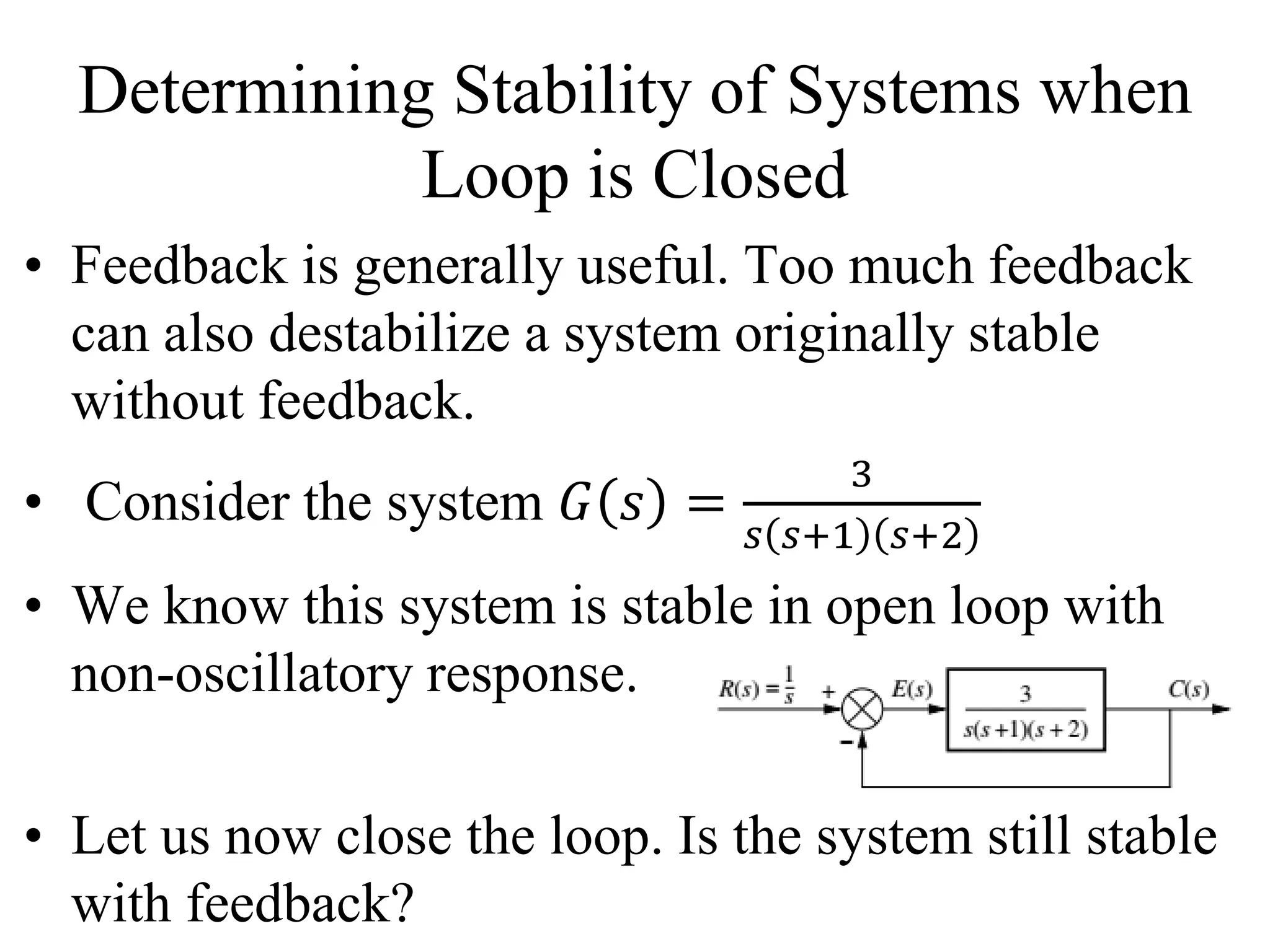
• Consider the system 𝐺 𝑠 =
3
𝑠 𝑠+1 𝑠+2
• We know this system is stable in open loop with
non-oscillatory response.
• Let us now close the loop. Is the system still stable
with feedback?
Stability of Close Loop Systems
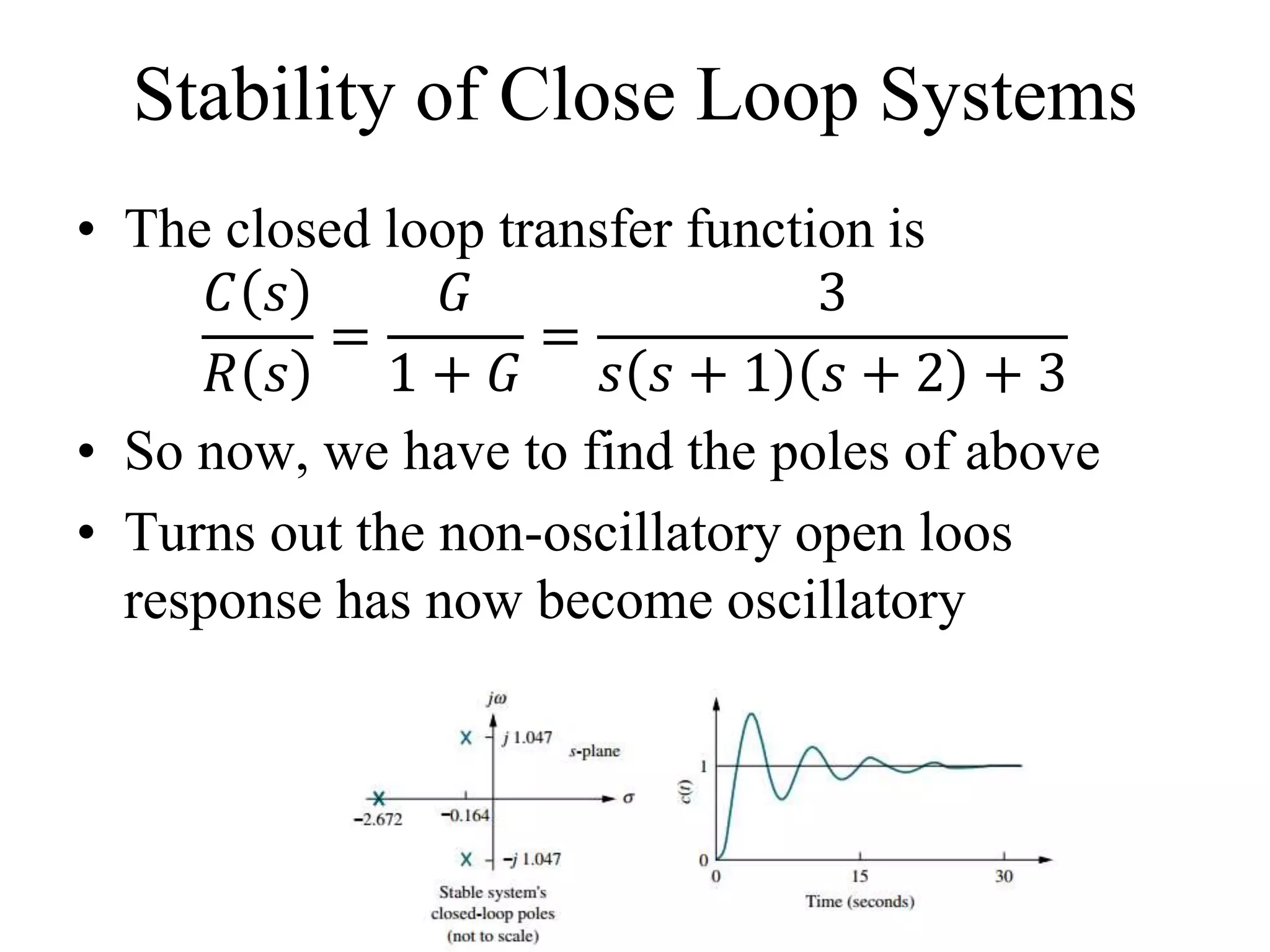
• The closed loop transfer function is
𝐶 𝑠
𝑅 𝑠
=
𝐺
1 + 𝐺
=
3
𝑠 𝑠 + 1 𝑠 + 2 + 3
• So now, we have to find the poles of above
• Turns out the non-oscillatory open loos
response has now become oscillatory
Destabilizing Effect of Feedback
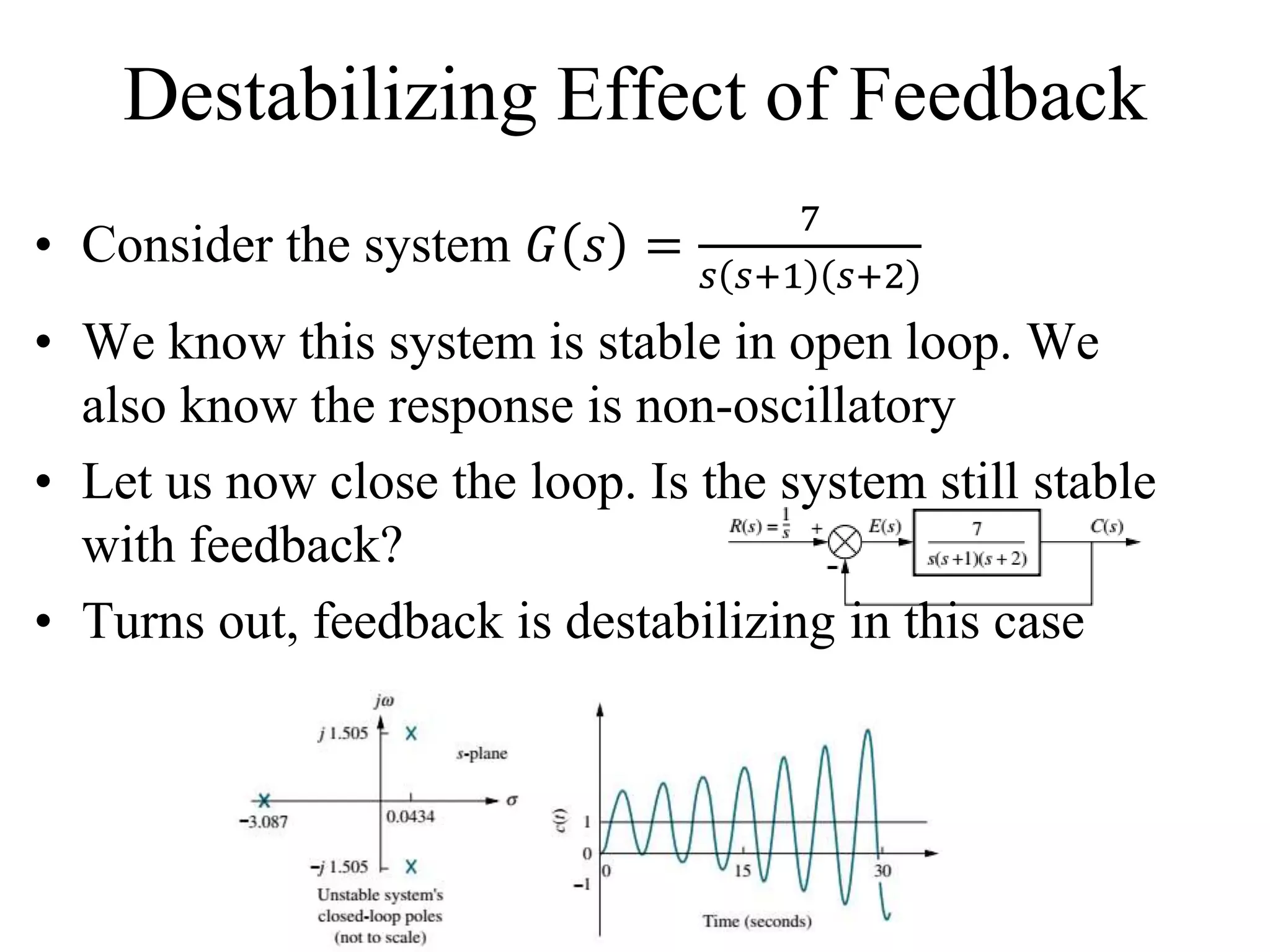
• Consider the system 𝐺 𝑠 =
7
𝑠 𝑠+1 𝑠+2
• We know this system is stable in open loop. We
also know the response is non-oscillatory
• Let us now close the loop. Is the system still stable
with feedback?
• Turns out, feedback is destabilizing in this case
An Important Observation
• If all closed loop transfer function poles are in left half-
plane, then they are of type (𝑠 + 𝛼𝑖) or (𝑠 + 𝜎𝑖 ∓ 𝑗𝜔 𝑑 𝑖
),
where 𝛼𝑖, 𝜎𝑖 > 0.
• No term in the polynomial can be missing, otherwise
there will be poles on imaginary axis or some positive
and negative coefficients got cancelled.
• Thus, a sufficient condition for a system to be stable is
that all signs of the coefficients of the denominator of
the closed-loop transfer function are the same. If
powers of s are missing, the system is either unstable
or, at best, marginally stable.
Routh Hurwitz Criterion – Reading
Assignment
• It’s a method that yields stability information
without the need to solve for the closed-loop
system poles.
• Using this method, we can tell how many
closed-loop system poles are in the left half-
plane, in the right half-plane, and on the
imaginary-axis.
• The method is archaic and of practically no
use. I am not going to waste a whole lecture on
this, and so this is part of your reading
assignment. Watch these lectures [1, 2, 3]
Assignment 5a
• Watch these lectures [1, 2, 3] on Routh
Hurwitz method by Brian Douglas.
• Solve the following problems from Nise Ch 6
• Questions 42, 55, 57
Steady State Errors
• Control systems analysis and design focus on
three specifications:
– transient response (𝑇𝑠, 𝑇𝑝, 𝑇𝑟, %𝑂𝑆, 𝜁, 𝜔 𝑛)
– stability
– steady-state errors
• Steady-state error is the difference between the
input and the output for a prescribed test input
as 𝑡 → ∞.
Test Inputs
• Different test inputs are used depending on
which type of inputs need to be tracked.
Types of Test Inputs
• Step inputs represent constant position and thus are
useful in determining the ability
of the control system to position itself with respect
to a stationary target, such as a
satellite in geostationary orbit. An antenna position
control is an example of a system that can be tested
for accuracy using step inputs.
• A position control system that tracks a satellite that
moves across the sky at a constant angular velocity,
would be
tested with a ramp input to evaluate the steady-state
error between the satellite’s
angular position and that of the control system.
• Parabolas, whose second derivatives are constant,
represent constant acceleration inputs to position
control systems and can be used to represent
accelerating targets, such as a missile to determine
the steady-state
error performance.
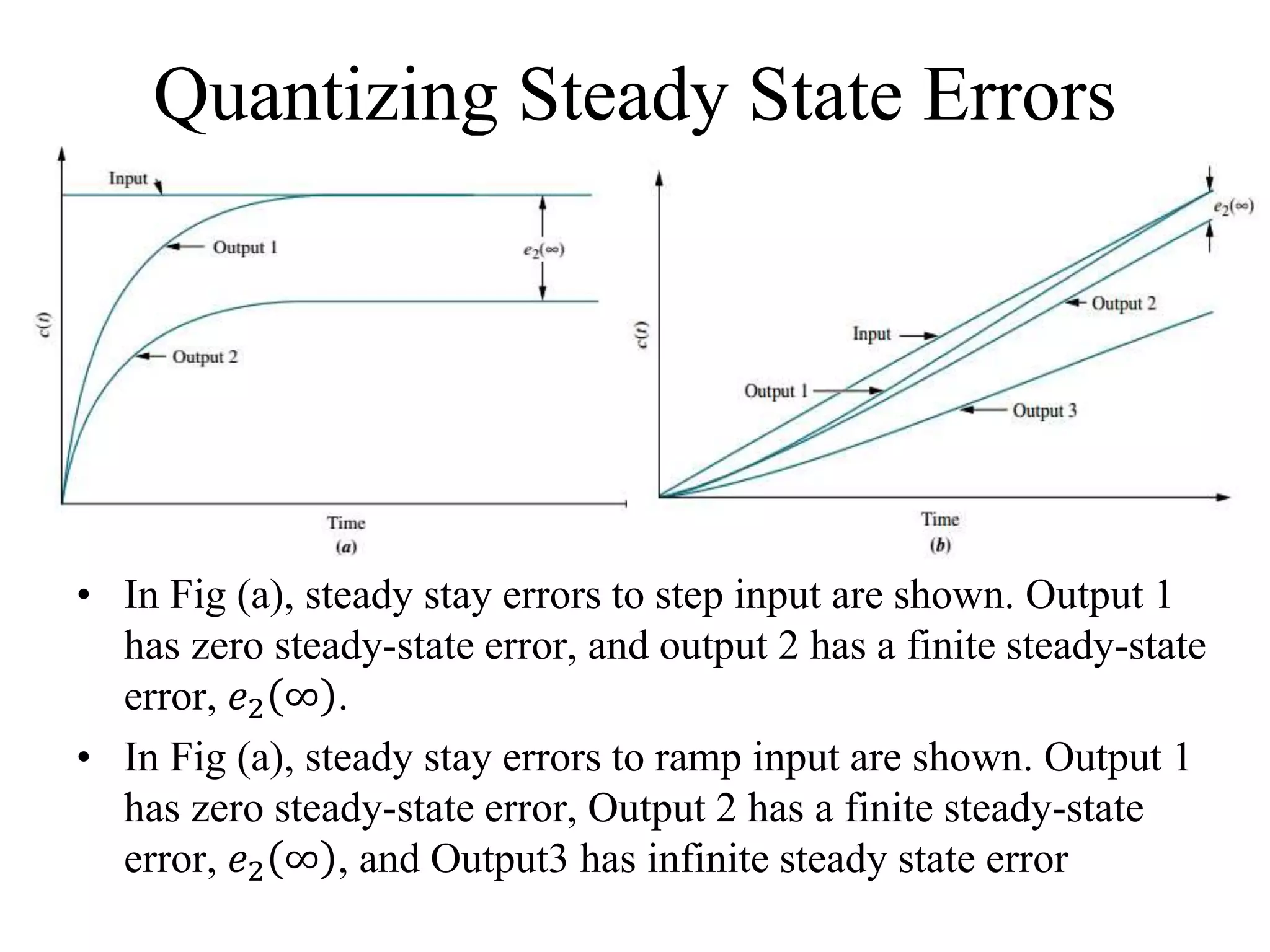
Quantizing Steady State Errors
• In Fig (a), steady stay errors to step input are shown. Output 1
has zero steady-state error, and output 2 has a finite steady-state
error, 𝑒2 ∞ .
• In Fig (a), steady stay errors to ramp input are shown. Output 1
has zero steady-state error, Output 2 has a finite steady-state
error, 𝑒2 ∞ , and Output3 has infinite steady state error
Sources of Steady State Errors
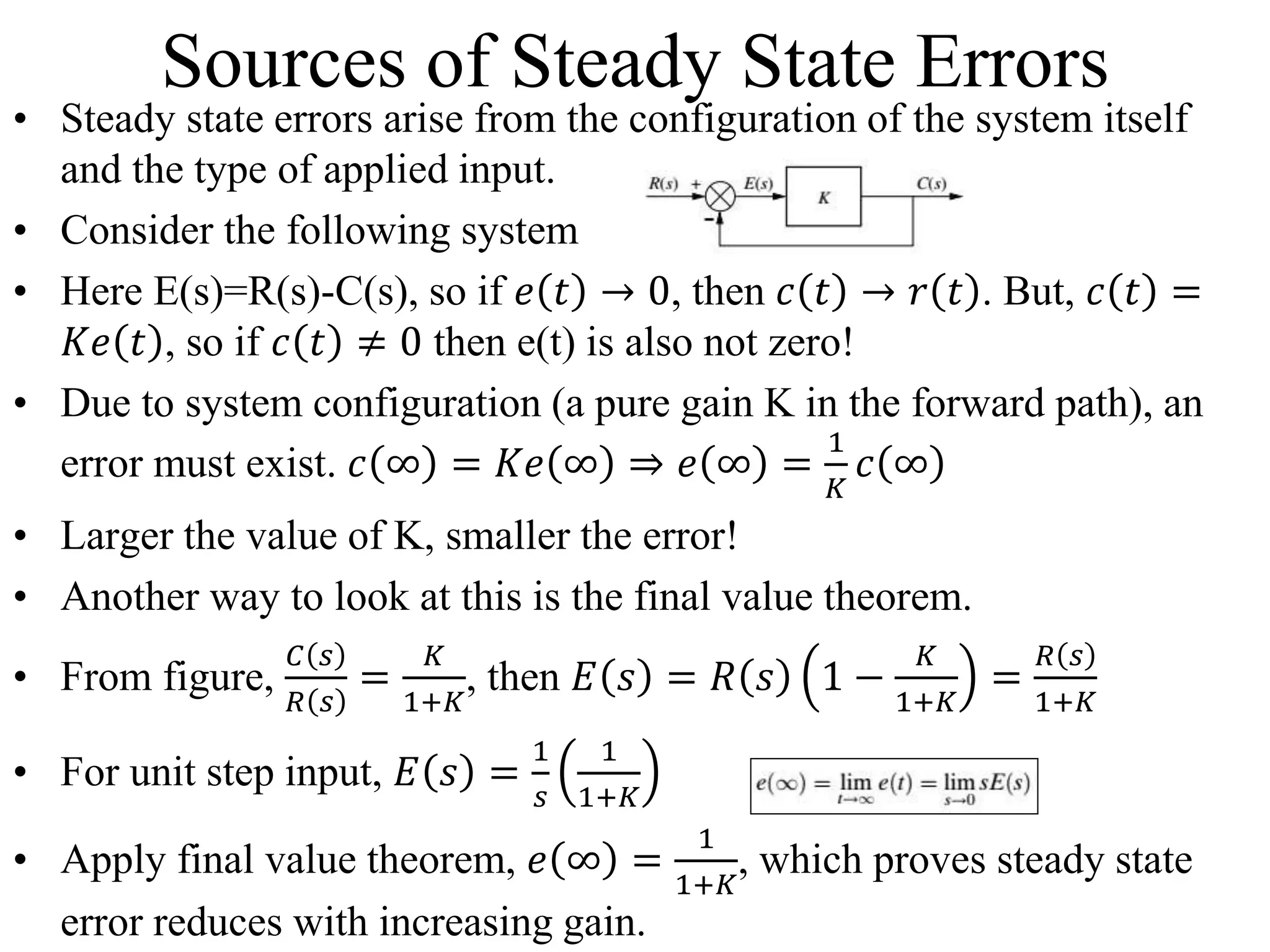
• Steady state errors arise from the configuration of the system itself
and the type of applied input.
• Consider the following system
• Here E(s)=R(s)-C(s), so if 𝑒 𝑡 → 0, then 𝑐 𝑡 → 𝑟 𝑡 . But, 𝑐 𝑡 =
𝐾𝑒 𝑡 , so if 𝑐 𝑡 ≠ 0 then e(t) is also not zero!
• Due to system configuration (a pure gain K in the forward path), an
error must exist. 𝑐 ∞ = 𝐾𝑒 ∞ ⇒ 𝑒 ∞ =
1
𝐾
𝑐 ∞
• Larger the value of K, smaller the error!
• Another way to look at this is the final value theorem.
• From figure,
𝐶 𝑠
𝑅 𝑠
=
𝐾
1+𝐾
, then 𝐸 𝑠 = 𝑅 𝑠 1 −
𝐾
1+𝐾
=
𝑅 𝑠
1+𝐾
• For unit step input, 𝐸 𝑠 =
1
𝑠
1
1+𝐾
• Apply final value theorem, 𝑒 ∞ =
1
1+𝐾
, which proves steady state
error reduces with increasing gain.
Sources of Steady State Errors
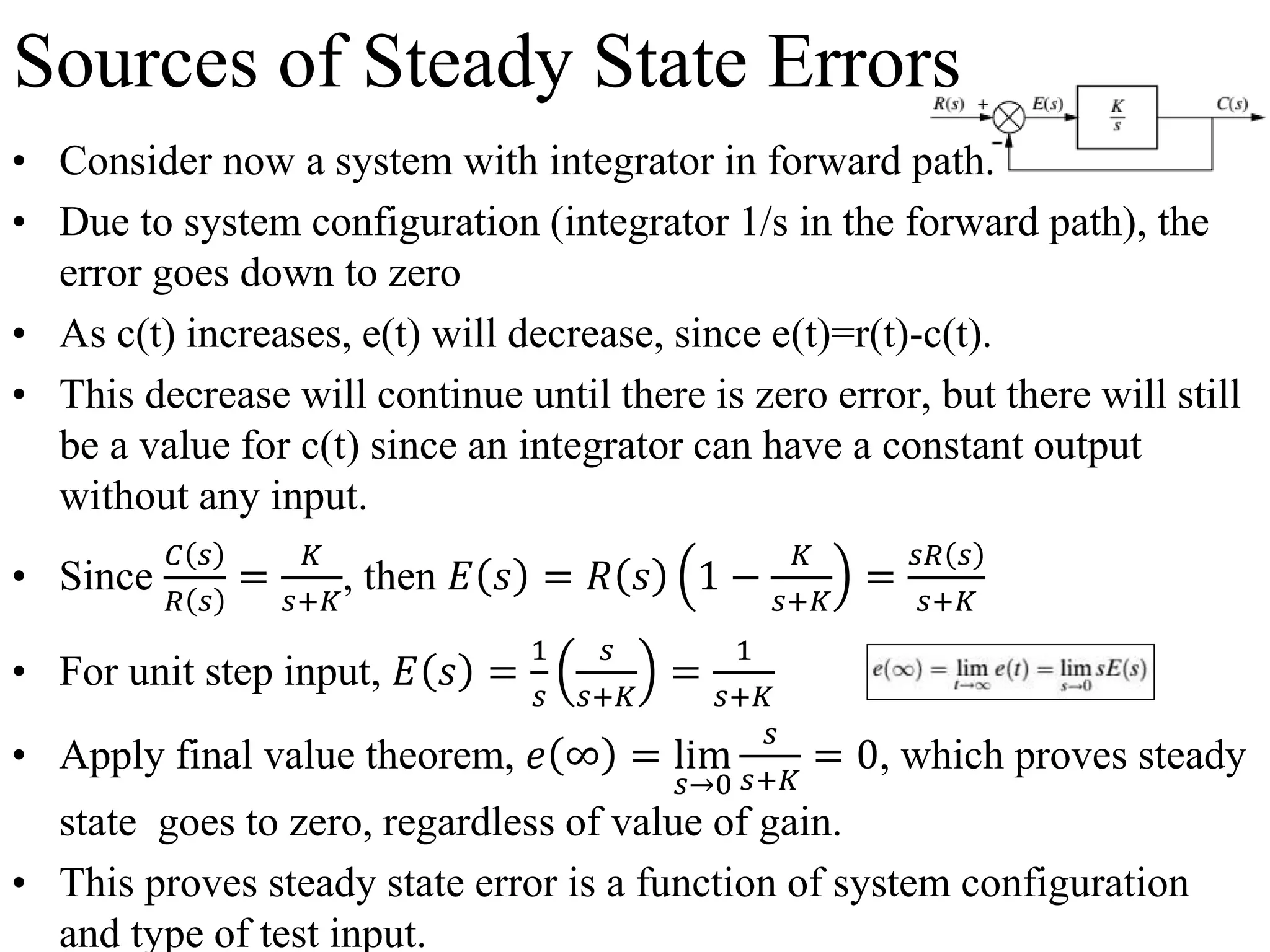
• Consider now a system with integrator in forward path.
• Due to system configuration (integrator 1/s in the forward path), the
error goes down to zero
• As c(t) increases, e(t) will decrease, since e(t)=r(t)-c(t).
• This decrease will continue until there is zero error, but there will still
be a value for c(t) since an integrator can have a constant output
without any input.
• Since
𝐶 𝑠
𝑅 𝑠
=
𝐾
𝑠+𝐾
, then 𝐸 𝑠 = 𝑅 𝑠 1 −
𝐾
𝑠+𝐾
=
𝑠𝑅 𝑠
𝑠+𝐾
• For unit step input, 𝐸 𝑠 =
1
𝑠
𝑠
𝑠+𝐾
=
1
𝑠+𝐾
• Apply final value theorem, 𝑒 ∞ = lim
𝑠→0
𝑠
𝑠+𝐾
= 0, which proves steady
state goes to zero, regardless of value of gain.
• This proves steady state error is a function of system configuration
and type of test input.
Generalizing the Steady State Error for
Unity Feedback Systems
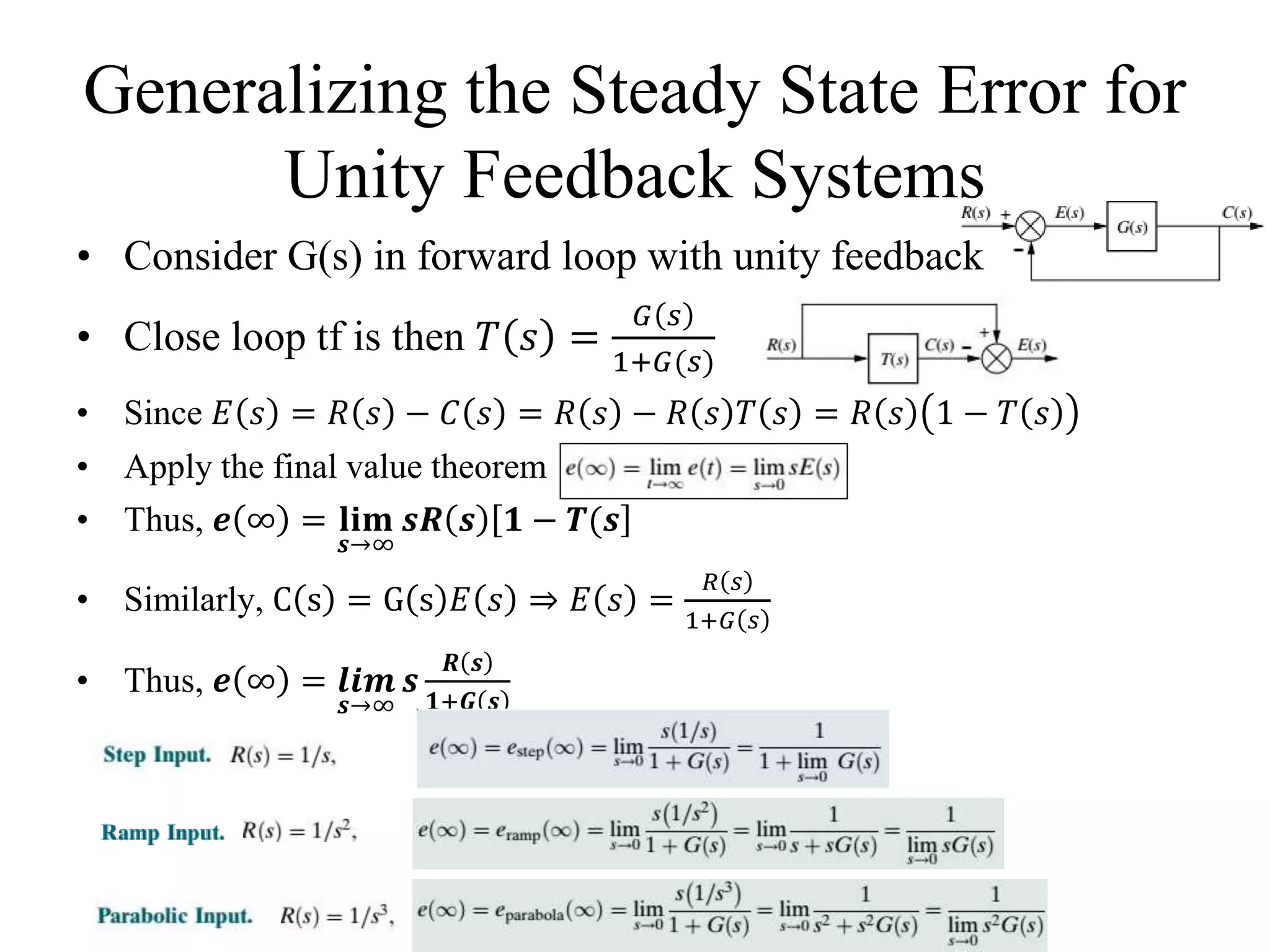
• Consider G(s) in forward loop with unity feedback
• Close loop tf is then 𝑇 𝑠 =
𝐺 𝑠
1+𝐺(𝑠)
• Since 𝐸 𝑠 = 𝑅 𝑠 − 𝐶 𝑠 = 𝑅 𝑠 − 𝑅 𝑠 𝑇 𝑠 = 𝑅 𝑠 1 − 𝑇 𝑠
• Apply the final value theorem
• Thus, 𝒆 ∞ = 𝐥𝐢𝐦
𝒔→∞
𝒔𝑹 𝒔 𝟏 − 𝑻(𝒔
• Similarly, C s = G s 𝐸 𝑠 ⇒ 𝐸 𝑠 =
𝑅 𝑠
1+𝐺 𝑠
• Thus, 𝒆 ∞ = 𝒍𝒊𝒎
𝒔→∞
𝒔
𝑹 𝒔
𝟏+𝑮 𝒔
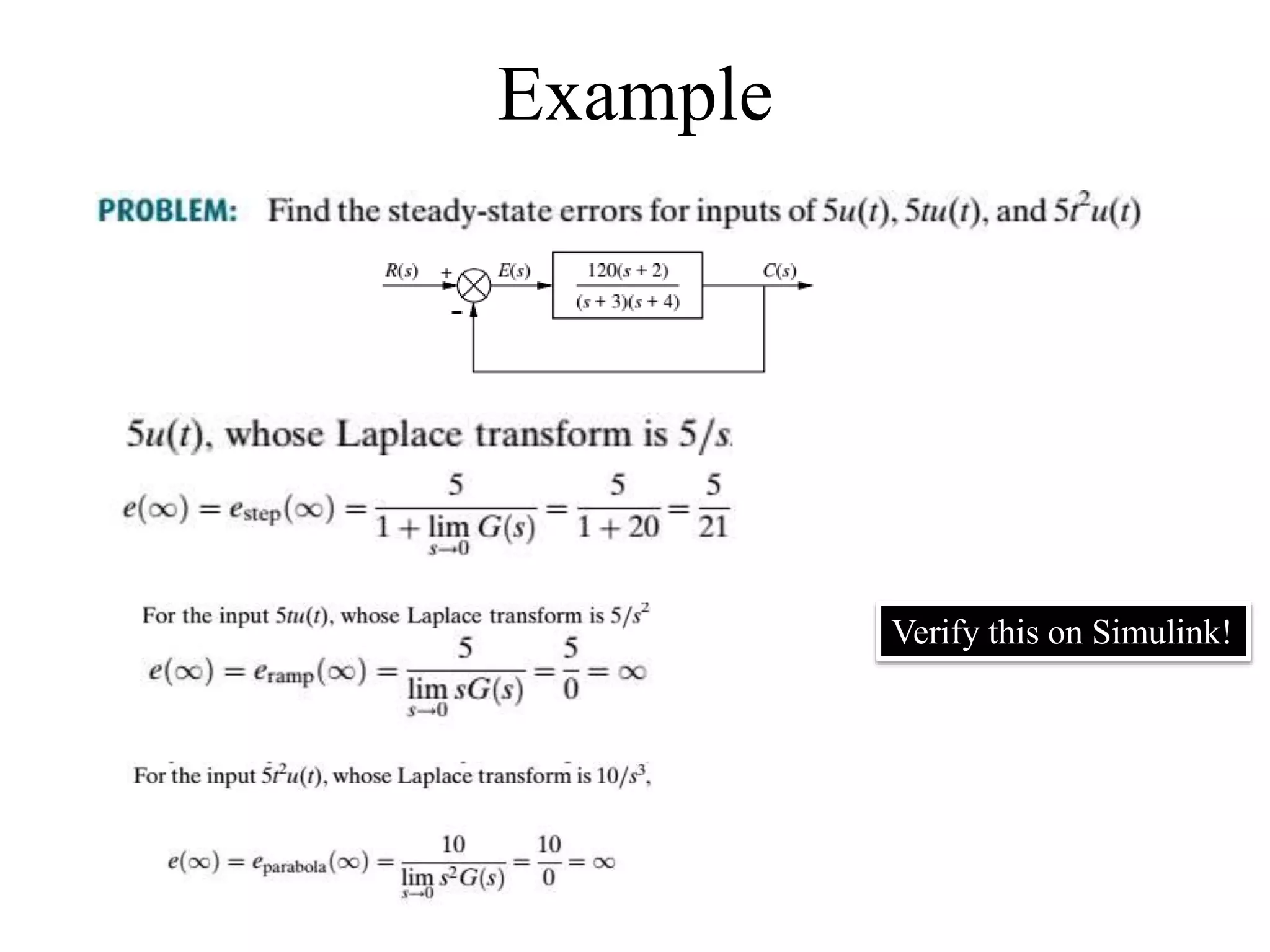
Example
Verify this on Simulink!
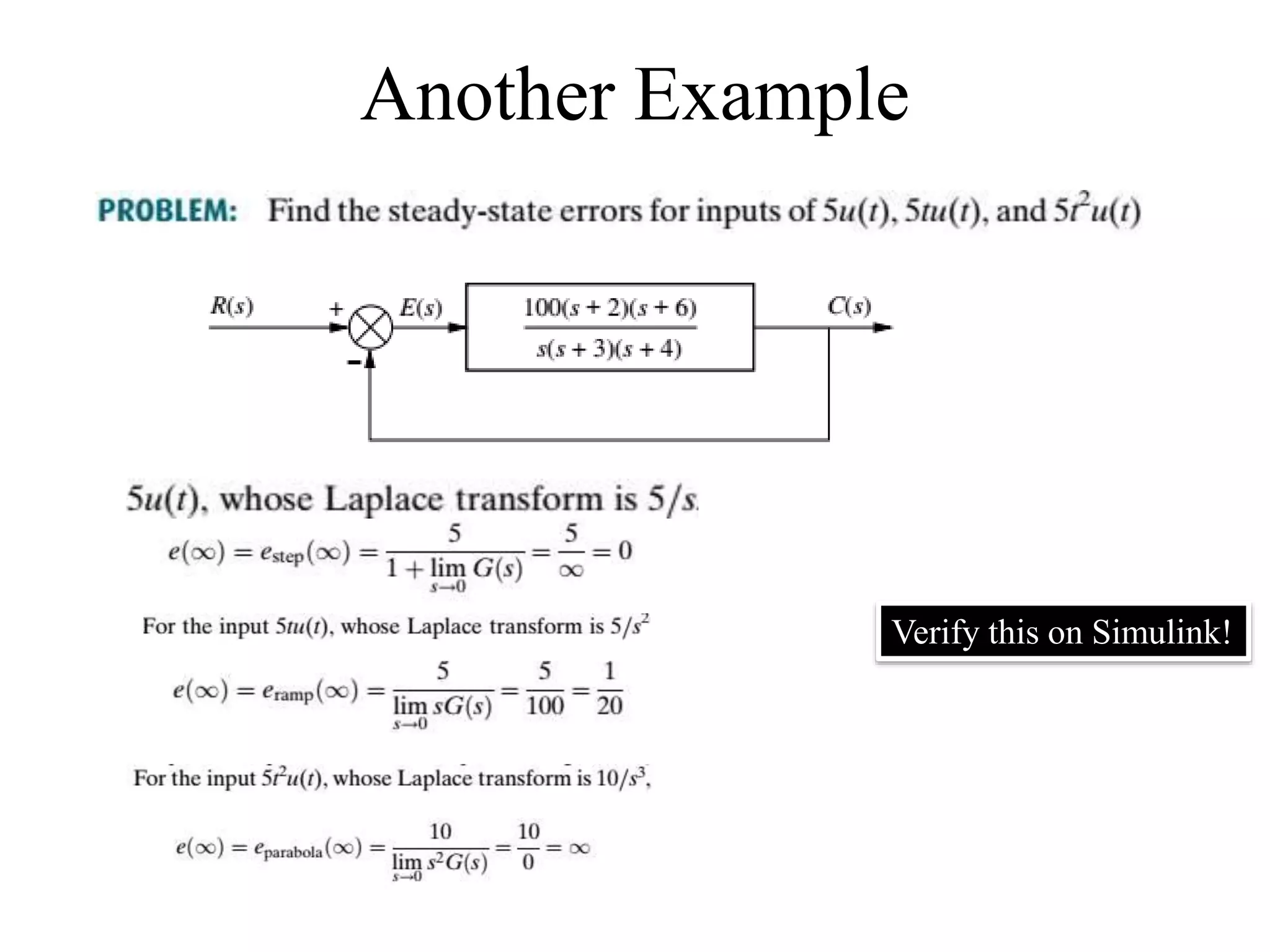
Another Example
Verify this on Simulink!
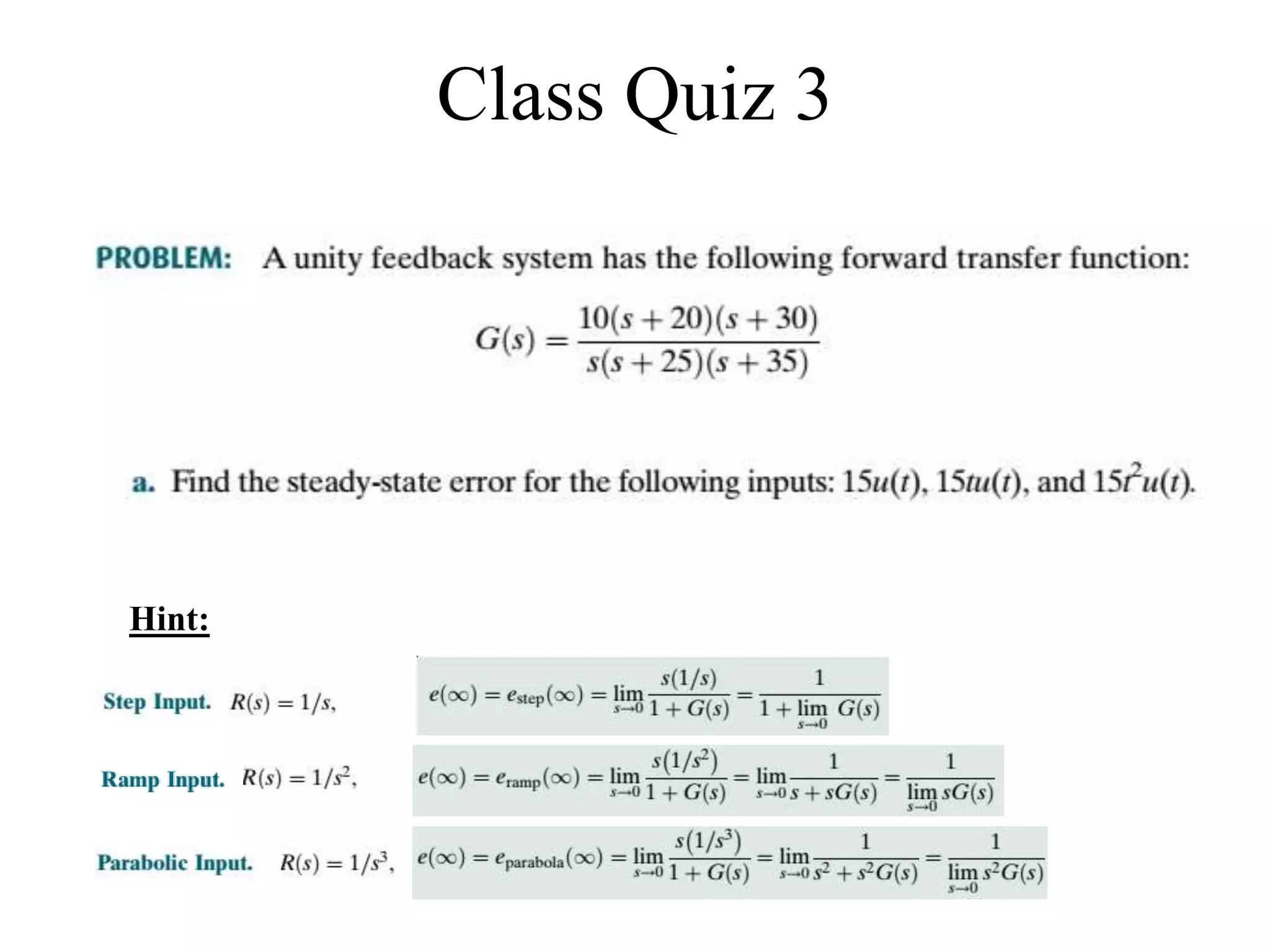
Class Quiz 3
Hint:
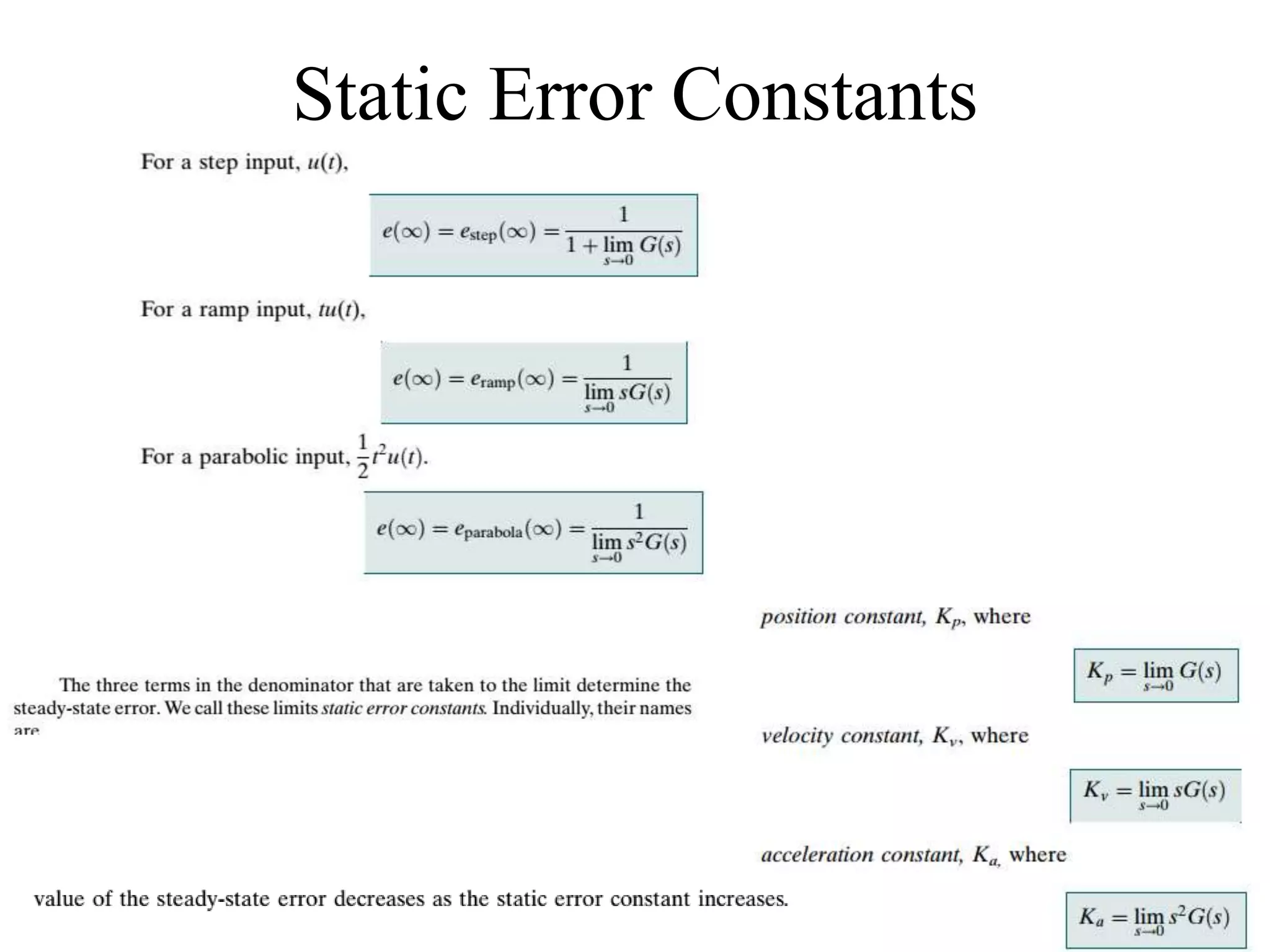
Static Error Constants
Example
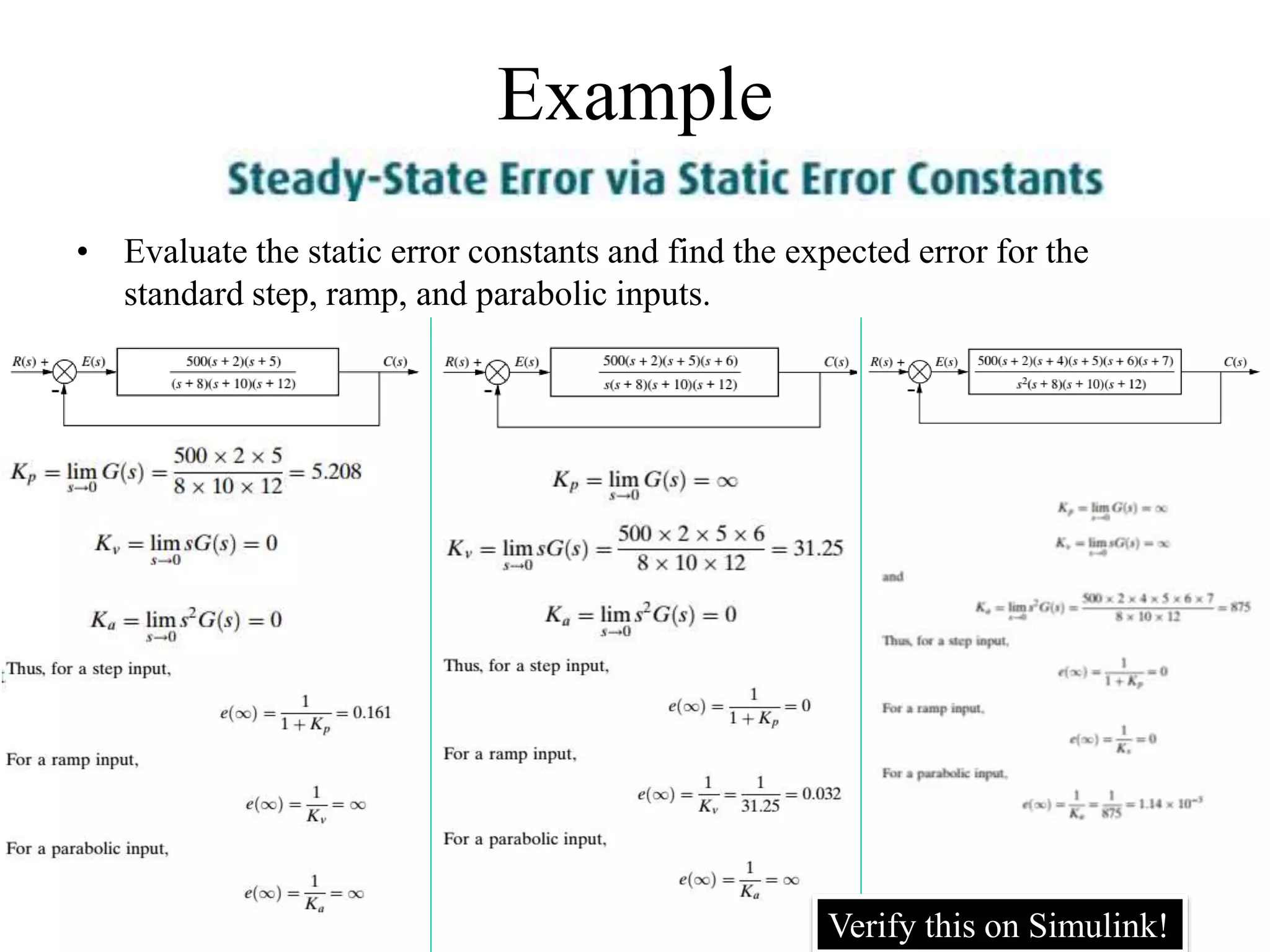
• Evaluate the static error constants and find the expected error for the
standard step, ramp, and parabolic inputs.
Verify this on Simulink!
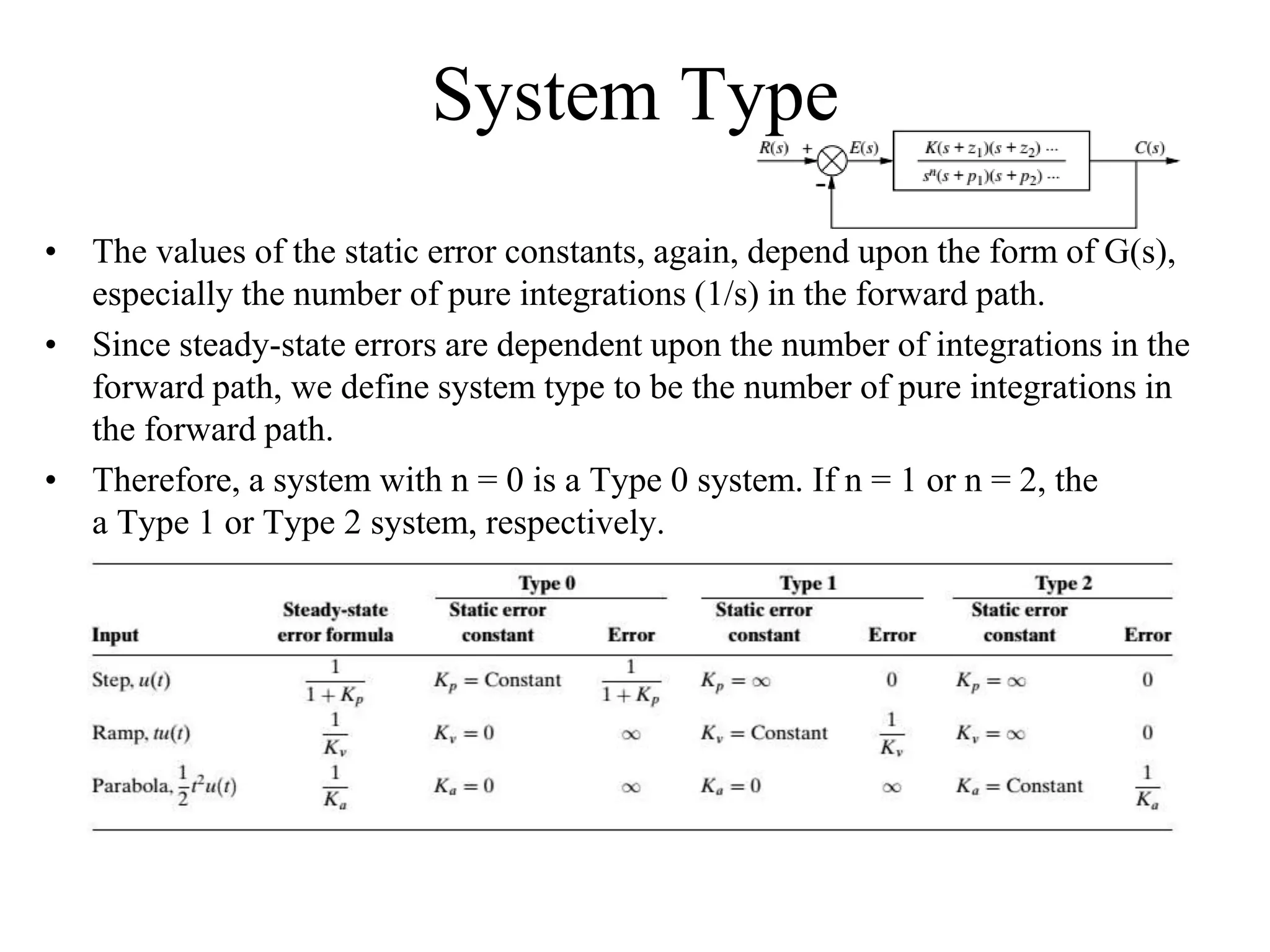
System Type
• The values of the static error constants, again, depend upon the form of G(s),
especially the number of pure integrations (1/s) in the forward path.
• Since steady-state errors are dependent upon the number of integrations in the
forward path, we define system type to be the number of pure integrations in
the forward path.
• Therefore, a system with n = 0 is a Type 0 system. If n = 1 or n = 2, the
a Type 1 or Type 2 system, respectively.
Example
Assignment 5b

Me314 week08-stability and steady state errors

  • 1.
    ME-314 Control Engineering Dr.Bilal A. Siddiqui Mechanical Engineering DHA Suffa University
  • 2.
    Stability of DynamicalSystems • Recall there are two types of system stabilities: – Static Stability: Initial tendency of a system to come back to equilibrium after disturbance. A statically stable system is not necessary stable. A statically unstable system is not necessarily unstable (e.g. nonminimum phase systems). – Dynamic Stability: A system may tend initially towards equilibrium, but may overshoot the mark and this overshoot may keep increasing with time. Such a system is necessarily unstable. Dynamic stability is a necessary and sufficient condition of stability
  • 3.
    Stability Requirements from ControlSystems • System response consists of two parts 𝑐 𝑡 = 𝑐𝑓𝑜𝑟𝑐𝑒𝑑 𝑡 + 𝑐 𝑛𝑎𝑡𝑢𝑟𝑎𝑙(𝑡) • For a control system to be useful, the natural response must eventually approach zero, thus leaving only the forced response. • Control systems must be designed to be stable, 𝑐 𝑛𝑎𝑡𝑢𝑟𝑎𝑙 ∞ → 0 • In many systems transient response you see on a time response plot can be directly related to the natural response. • If the natural response decays to zero as time approaches infinity, the transient response will also die out, leaving only the forced response. • If the system is stable, the proper transient response and steady- state error characteristics can be designed
  • 4.
    System Stability interms of Poles • Shape of response is determined only by poles. Zeros determine only the magnitude of response • Poles in the left half of s-plane yield either pure exponential decay (𝑒 𝜎𝑡) or damped sinusoidal (𝑒 𝜎𝑡cos𝜔 𝑑 𝑡) natural responses. • These natural responses decay to zero as time approaches infinity. • Stable systems have closed-loop transfer functions with poles only in the left half-plane, i.e. real part of all poles is negative (𝝈 < 𝟎) • Unstable systems have at least one pole in right hand plane; real part is positive (𝝈 > 𝟎)
  • 5.
    Another type ofinstability • A system is marginally stable if there are complex pair of poles on imaginary axis (𝜎 = 0) • Another type of instability can occur if the system has repeated poles on the imaginary axis. This will cause natural response to be of the type 𝐴𝑡 𝑛 cos 𝜔 𝑑 𝑡, where n+1 is the number of repeated roots at imaginary axis. • Unstable systems have closed loop transfer functions with at least one pole in the right half-plane and/or repeated poles on the imaginary axis.
  • 6.
    Determining Stability ofSystems when Loop is Closed • Feedback is generally useful. Too much feedback can also destabilize a system originally stable without feedback. • Consider the system 𝐺 𝑠 = 3 𝑠 𝑠+1 𝑠+2 • We know this system is stable in open loop with non-oscillatory response. • Let us now close the loop. Is the system still stable with feedback?
  • 7.
    Stability of CloseLoop Systems • The closed loop transfer function is 𝐶 𝑠 𝑅 𝑠 = 𝐺 1 + 𝐺 = 3 𝑠 𝑠 + 1 𝑠 + 2 + 3 • So now, we have to find the poles of above • Turns out the non-oscillatory open loos response has now become oscillatory
  • 8.
    Destabilizing Effect ofFeedback • Consider the system 𝐺 𝑠 = 7 𝑠 𝑠+1 𝑠+2 • We know this system is stable in open loop. We also know the response is non-oscillatory • Let us now close the loop. Is the system still stable with feedback? • Turns out, feedback is destabilizing in this case
  • 9.
    An Important Observation •If all closed loop transfer function poles are in left half- plane, then they are of type (𝑠 + 𝛼𝑖) or (𝑠 + 𝜎𝑖 ∓ 𝑗𝜔 𝑑 𝑖 ), where 𝛼𝑖, 𝜎𝑖 > 0. • No term in the polynomial can be missing, otherwise there will be poles on imaginary axis or some positive and negative coefficients got cancelled. • Thus, a sufficient condition for a system to be stable is that all signs of the coefficients of the denominator of the closed-loop transfer function are the same. If powers of s are missing, the system is either unstable or, at best, marginally stable.
  • 10.
    Routh Hurwitz Criterion– Reading Assignment • It’s a method that yields stability information without the need to solve for the closed-loop system poles. • Using this method, we can tell how many closed-loop system poles are in the left half- plane, in the right half-plane, and on the imaginary-axis. • The method is archaic and of practically no use. I am not going to waste a whole lecture on this, and so this is part of your reading assignment. Watch these lectures [1, 2, 3]
  • 11.
    Assignment 5a • Watchthese lectures [1, 2, 3] on Routh Hurwitz method by Brian Douglas. • Solve the following problems from Nise Ch 6 • Questions 42, 55, 57
  • 12.
    Steady State Errors •Control systems analysis and design focus on three specifications: – transient response (𝑇𝑠, 𝑇𝑝, 𝑇𝑟, %𝑂𝑆, 𝜁, 𝜔 𝑛) – stability – steady-state errors • Steady-state error is the difference between the input and the output for a prescribed test input as 𝑡 → ∞.
  • 13.
    Test Inputs • Differenttest inputs are used depending on which type of inputs need to be tracked.
  • 14.
    Types of TestInputs • Step inputs represent constant position and thus are useful in determining the ability of the control system to position itself with respect to a stationary target, such as a satellite in geostationary orbit. An antenna position control is an example of a system that can be tested for accuracy using step inputs. • A position control system that tracks a satellite that moves across the sky at a constant angular velocity, would be tested with a ramp input to evaluate the steady-state error between the satellite’s angular position and that of the control system. • Parabolas, whose second derivatives are constant, represent constant acceleration inputs to position control systems and can be used to represent accelerating targets, such as a missile to determine the steady-state error performance.
  • 15.
    Quantizing Steady StateErrors • In Fig (a), steady stay errors to step input are shown. Output 1 has zero steady-state error, and output 2 has a finite steady-state error, 𝑒2 ∞ . • In Fig (a), steady stay errors to ramp input are shown. Output 1 has zero steady-state error, Output 2 has a finite steady-state error, 𝑒2 ∞ , and Output3 has infinite steady state error
  • 16.
    Sources of SteadyState Errors • Steady state errors arise from the configuration of the system itself and the type of applied input. • Consider the following system • Here E(s)=R(s)-C(s), so if 𝑒 𝑡 → 0, then 𝑐 𝑡 → 𝑟 𝑡 . But, 𝑐 𝑡 = 𝐾𝑒 𝑡 , so if 𝑐 𝑡 ≠ 0 then e(t) is also not zero! • Due to system configuration (a pure gain K in the forward path), an error must exist. 𝑐 ∞ = 𝐾𝑒 ∞ ⇒ 𝑒 ∞ = 1 𝐾 𝑐 ∞ • Larger the value of K, smaller the error! • Another way to look at this is the final value theorem. • From figure, 𝐶 𝑠 𝑅 𝑠 = 𝐾 1+𝐾 , then 𝐸 𝑠 = 𝑅 𝑠 1 − 𝐾 1+𝐾 = 𝑅 𝑠 1+𝐾 • For unit step input, 𝐸 𝑠 = 1 𝑠 1 1+𝐾 • Apply final value theorem, 𝑒 ∞ = 1 1+𝐾 , which proves steady state error reduces with increasing gain.
  • 17.
    Sources of SteadyState Errors • Consider now a system with integrator in forward path. • Due to system configuration (integrator 1/s in the forward path), the error goes down to zero • As c(t) increases, e(t) will decrease, since e(t)=r(t)-c(t). • This decrease will continue until there is zero error, but there will still be a value for c(t) since an integrator can have a constant output without any input. • Since 𝐶 𝑠 𝑅 𝑠 = 𝐾 𝑠+𝐾 , then 𝐸 𝑠 = 𝑅 𝑠 1 − 𝐾 𝑠+𝐾 = 𝑠𝑅 𝑠 𝑠+𝐾 • For unit step input, 𝐸 𝑠 = 1 𝑠 𝑠 𝑠+𝐾 = 1 𝑠+𝐾 • Apply final value theorem, 𝑒 ∞ = lim 𝑠→0 𝑠 𝑠+𝐾 = 0, which proves steady state goes to zero, regardless of value of gain. • This proves steady state error is a function of system configuration and type of test input.
  • 18.
    Generalizing the SteadyState Error for Unity Feedback Systems • Consider G(s) in forward loop with unity feedback • Close loop tf is then 𝑇 𝑠 = 𝐺 𝑠 1+𝐺(𝑠) • Since 𝐸 𝑠 = 𝑅 𝑠 − 𝐶 𝑠 = 𝑅 𝑠 − 𝑅 𝑠 𝑇 𝑠 = 𝑅 𝑠 1 − 𝑇 𝑠 • Apply the final value theorem • Thus, 𝒆 ∞ = 𝐥𝐢𝐦 𝒔→∞ 𝒔𝑹 𝒔 𝟏 − 𝑻(𝒔 • Similarly, C s = G s 𝐸 𝑠 ⇒ 𝐸 𝑠 = 𝑅 𝑠 1+𝐺 𝑠 • Thus, 𝒆 ∞ = 𝒍𝒊𝒎 𝒔→∞ 𝒔 𝑹 𝒔 𝟏+𝑮 𝒔
  • 19.
  • 20.
  • 21.
  • 22.
  • 23.
    Example • Evaluate thestatic error constants and find the expected error for the standard step, ramp, and parabolic inputs. Verify this on Simulink!
  • 24.
    System Type • Thevalues of the static error constants, again, depend upon the form of G(s), especially the number of pure integrations (1/s) in the forward path. • Since steady-state errors are dependent upon the number of integrations in the forward path, we define system type to be the number of pure integrations in the forward path. • Therefore, a system with n = 0 is a Type 0 system. If n = 1 or n = 2, the a Type 1 or Type 2 system, respectively.
  • 25.
  • 26.