Dr.D.SUVANKAR
ANAESTHESIA IN ENT SCOPIES
 Bronchoscopy
 Microlaryngoscopy
 Esophagoscopy
Bronchoscopy
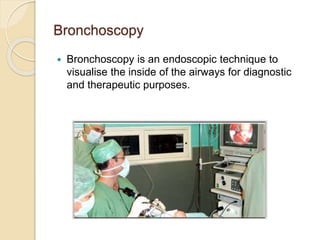
 Bronchoscopy is an endoscopic technique to
visualise the inside of the airways for diagnostic
and therapeutic purposes.
History
 Killian- First Rigid bronchoscopy
(1898)
-Father of bronchoscopy
 Algernon Coolidge- First successful
removal of tracheal foregion body
 Jackson- Lighted Bronchoscope
 Szigeti Ikeda-fibreoptic bronchoscope
(1967)
Types
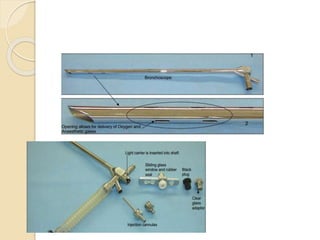
1.Rigid Bronchoscopy
2.Felxible bronchoscopy
Indications for Rigid Bronchoscopy
 Malignant or benign tumours
 Foreign bodies
 Palliative obstruction relief of the main
airway
 Iatrogenic stenosis
 Extrinsic compression
 Intra-luminal tracheo-bronchial repair of
sealing defects
 Biopsies and cryotherapy
Contraindications
 Uncontrolled coagulopathy
 Extreme ventilation and oxygenation
demands
 Tracheal obstruction
Challenges in Bronchoscopy
 Shared area of interest
 Instrumentation of airway
 Ventilation
 Inadequate starvation
 Depth of Anaesthesia
 Arrythmias
Foreign Body in AIRWAY
 Where ??
 What ?
 When ??
 Starvation?
Goals of anaesthesia in Bronchoscopy
 Maintenance of adequate ventilation
and oxygenation
 Adequate depth of anesthesia,
amnesia, analgesia
 Prevention of pulmonary aspiration
 Quick return of consciousness,
respiratory drive and upper airway
reflexes
 Minimization of secretions.
Preoperative evaluation
 Routine investigations
 Coagulation profile
 ABG
 PFT
 CT SCAN
Intra operative monitoring
 Pulse oximetry
 ECG
 NIBP
 ABG
Premedication
 Antisialogogues –Atropine
Glycopyrrolete
 Antiemetics-Ondensetron
Metoclopramide
 Benzodiazepines – Midazolam
 Opioids
 Bronchodilators
VENTILATION STRATEGIES IN
BRONCHOSCOPY
 Apnoeic oxygenation
 Spontaneous assisted ventilation
 Controlled ventilation
 Manual jet ventilation
 High frequency jet ventilation.
1.Apnoeic ventilation
 Preoxygenation
 Patient is hyperventilated to achieve profound
hypocapnia
 Fine catheter is passed through trachea &
oxygen insufflated at 15-20 liters/min through
out the procedure
 TIVA & Muscle relaxant
 Rise in arterial co2 tension
 Not suitable for prolonged bronchoscopy
 Not more the 10 minutes procedure
 Works well in patients without significant
pulmonary disease
2.Spontaneous assisted ventilation
 TIVA
 Supplemental oxygen is given via rigid
bronchoscope and the ventilation is
assisted.
 Bronchoscope is introduced and the
patient is ventilated with high flow
oxygen manually.
 Muscle relaxants are not used
 Anaesthesia is maintained with repeated
injections/infusion of intravenous drugs
and ventilation assisted in case of
apnoea or desaturation.
3.Jet ventilation
 This method is based on Bernoulli’s
principle High pressure gas source
that is applied to the open airway in
small bursts via a small catheter.
 Two techniques of jet ventilation
A)Manual jet ventilation
B)Automated jet ventilation
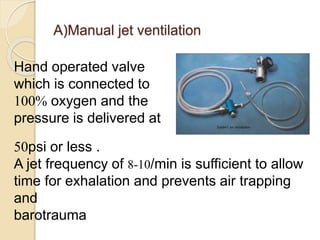
A)Manual jet ventilation
Hand operated valve
which is connected to
100% oxygen and the
pressure is delivered at
50psi or less .
A jet frequency of 8-10/min is sufficient to allow
time for exhalation and prevents air trapping
and
barotrauma
 Airway pressure monitoring
 I:E Ratio -1:4
 Monitoring tidal volume is difficult
 Periodic CO2 and blood gas measurement
or transcutaneous capnography may be
used to assess ventilation.
B)Automated jet ventilation
 Higher respiratory rates 60-300/ min.
 The operator controls the applied
pressure, respiratory rate and inspiratory
time to maintain adequate oxygenation.
 High respiratory rate and low VT gives a
‘quiet’ procedure field
 Advantage-can be used in patients with
bronchopleural,bronchoesophageal and
bronchomediastinal fistula which
requires low airway pressures.
4)Controlled ventilation
 The bronchoscope is used like an
endotracheal tube for positive pressure
ventilation.
 Other ports are closed of rigid scope and
packing of the oropharynx is done to
minimize the leak
 Manual bag ventilation
 Limitations-
operator judgement
lack of control of FiO2with high flow
rate and inappropriate delivery of
 TIVA
 Opiods-to suppress airway reflexes and
blunt adrenergic responses to pain
 Propofol or thoipentone can be used ,after
induction propofol infusion of 100-200
ug/kg /min can be used to maintain depth
of anaesthesia
 Muscle relaxants
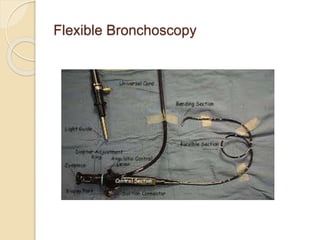
Flexible Bronchoscopy
Anaesthesia for flexible bronchoscopy
 Antisialogogues
 Minimal sedation with benzodiaepines
and opioids
 Dexmedetomidine
 Topical anaesthesia
 Blocks-Glossopharyngeal Block
-Superior laryngeal nerve Block
-Translaryngeal Block
Indications for flexible bronchoscopy
 Aspiration of retained secretions
 Bronchopulmonary lavage
 Placement of endotracheal tube in a
difficult situation
 Laser resection of tumour
 Placement of airway stent
 Removal of foreign body
 Evaluation of airway
Contraindications-
Absolute-
 Inability to maintain adequate oxygenation
 Operator inexperience
 Relative-
 Profound refractory hypoxemia
 Severe bleeding diathesis uncorrectable
prior to the procedure
Anaesthesia for flexible bronchoscopy
 Antisialogogues
 Minimal sedation with benzodiaepines
and opioids
 Dexmedetomidine
 Topical anaesthesia
 Blocks-Glossopharyngeal Block
-Superior laryngeal nerve Block
-Translaryngeal Block
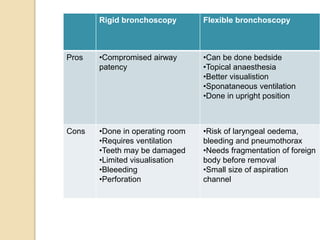
Rigid bronchoscopy Flexible bronchoscopy
Pros •Compromised airway
patency
•Can be done bedside
•Topical anaesthesia
•Better visualistion
•Sponataneous ventilation
•Done in upright position
Cons •Done in operating room
•Requires ventilation
•Teeth may be damaged
•Limited visualisation
•Bleeeding
•Perforation
•Risk of laryngeal oedema,
bleeding and pneumothorax
•Needs fragmentation of foreign
body before removal
•Small size of aspiration
channel
Complications of bronchoscopy
 Oral trauma
 Bleeding
 Dysrrythmias
 Hypoxia
 Perforation of airway
Microlaryngoscopy
 Larynx is visualised through microscope
 Allows magnified vision of larynx
 Indications
 A)Diagnostic
1.Hoarseness of voice cannot be
diagnosed on direct or indirect
laryngoscopy
2.Biopsy of laryngeal lesion
3.assesment of laryngeal trauma
 B)Therapeutic
1.Removal of foreign bodies
2.laser cordectomy in ca vocal cord
3.Dilatation of subglottic stenosis
4.Arytenoidectomy in cases of
abductor cord palsy
5.Excision of vocal cord cysts ,nodules
and haemangiomas
Advantages over direct laryngoscopy
 Magnified binocular vision
 Both hands of operating surgeon are
free
 Exact precision achieved when
performing laser or crayosurgery
 Video attachment
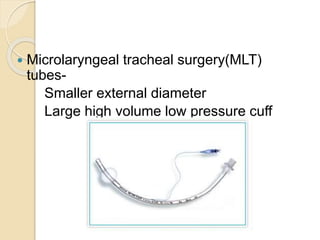
 Microlaryngeal tracheal surgery(MLT)
tubes-
Smaller external diameter
Large high volume low pressure cuff
Esophagoscopy
 Esophagoscopy is a procedure in
which a flexible or rigid endoscope is
inserted through the mouth or, more
rarely, through the nares and into the
esophagus
Indications
 Foreign body or food bolus
impaction
 Evaluation of GERD
 Screening of barrets esophagus
 Treatment of varices
 Evaluation and management of
dysphagia
 Biopsy of lesion
 Dilatation of esophagus
 In ENT esophagoscopy is done mainly
for foregion body removal.
 In adult patients it can be done in
minimal sedation
 But for paediatric patients general
anaesthesia with endotracheal
intubation is recommended.
 Foreign body can get dislodged in
airway while removing
 Symptoms-
 Most common site of impaction is
cricopharynx
 Starvation
 Preoperative evaluation- X ray neck
 Induction
 Small sized endotracheal tube
 Intra operative monitoring
 Intraoperative Complications
 1. Esophageal perforation which may
lead to pneumothorax (Right > Left).
 2.Mediastinitis
 2. Compression of endotracheal tube.
 3. Dysrhythmia.
 4. Aspiration.
 5. Accidental extubation.
 6. Stridor secondary to subglottic
edema

Ent scopies

  • 1.
  • 2.
  • 3.
    Bronchoscopy  Bronchoscopy isan endoscopic technique to visualise the inside of the airways for diagnostic and therapeutic purposes.
  • 4.
    History  Killian- FirstRigid bronchoscopy (1898) -Father of bronchoscopy  Algernon Coolidge- First successful removal of tracheal foregion body  Jackson- Lighted Bronchoscope  Szigeti Ikeda-fibreoptic bronchoscope (1967)
  • 5.
  • 7.
    Indications for RigidBronchoscopy  Malignant or benign tumours  Foreign bodies  Palliative obstruction relief of the main airway  Iatrogenic stenosis  Extrinsic compression  Intra-luminal tracheo-bronchial repair of sealing defects  Biopsies and cryotherapy
  • 8.
    Contraindications  Uncontrolled coagulopathy Extreme ventilation and oxygenation demands  Tracheal obstruction
  • 9.
    Challenges in Bronchoscopy Shared area of interest  Instrumentation of airway  Ventilation  Inadequate starvation  Depth of Anaesthesia  Arrythmias
  • 10.
    Foreign Body inAIRWAY  Where ??  What ?  When ??  Starvation?
  • 11.
    Goals of anaesthesiain Bronchoscopy  Maintenance of adequate ventilation and oxygenation  Adequate depth of anesthesia, amnesia, analgesia  Prevention of pulmonary aspiration  Quick return of consciousness, respiratory drive and upper airway reflexes  Minimization of secretions.
  • 12.
    Preoperative evaluation  Routineinvestigations  Coagulation profile  ABG  PFT  CT SCAN
  • 13.
    Intra operative monitoring Pulse oximetry  ECG  NIBP  ABG
  • 14.
    Premedication  Antisialogogues –Atropine Glycopyrrolete Antiemetics-Ondensetron Metoclopramide  Benzodiazepines – Midazolam  Opioids  Bronchodilators
  • 15.
    VENTILATION STRATEGIES IN BRONCHOSCOPY Apnoeic oxygenation  Spontaneous assisted ventilation  Controlled ventilation  Manual jet ventilation  High frequency jet ventilation.
  • 17.
    1.Apnoeic ventilation  Preoxygenation Patient is hyperventilated to achieve profound hypocapnia  Fine catheter is passed through trachea & oxygen insufflated at 15-20 liters/min through out the procedure  TIVA & Muscle relaxant  Rise in arterial co2 tension  Not suitable for prolonged bronchoscopy  Not more the 10 minutes procedure  Works well in patients without significant pulmonary disease
  • 18.
    2.Spontaneous assisted ventilation TIVA  Supplemental oxygen is given via rigid bronchoscope and the ventilation is assisted.  Bronchoscope is introduced and the patient is ventilated with high flow oxygen manually.  Muscle relaxants are not used  Anaesthesia is maintained with repeated injections/infusion of intravenous drugs and ventilation assisted in case of apnoea or desaturation.
  • 19.
    3.Jet ventilation  Thismethod is based on Bernoulli’s principle High pressure gas source that is applied to the open airway in small bursts via a small catheter.  Two techniques of jet ventilation A)Manual jet ventilation B)Automated jet ventilation
  • 20.
    A)Manual jet ventilation Handoperated valve which is connected to 100% oxygen and the pressure is delivered at 50psi or less . A jet frequency of 8-10/min is sufficient to allow time for exhalation and prevents air trapping and barotrauma
  • 21.
     Airway pressuremonitoring  I:E Ratio -1:4  Monitoring tidal volume is difficult  Periodic CO2 and blood gas measurement or transcutaneous capnography may be used to assess ventilation.
  • 22.
    B)Automated jet ventilation Higher respiratory rates 60-300/ min.  The operator controls the applied pressure, respiratory rate and inspiratory time to maintain adequate oxygenation.  High respiratory rate and low VT gives a ‘quiet’ procedure field  Advantage-can be used in patients with bronchopleural,bronchoesophageal and bronchomediastinal fistula which requires low airway pressures.
  • 23.
    4)Controlled ventilation  Thebronchoscope is used like an endotracheal tube for positive pressure ventilation.  Other ports are closed of rigid scope and packing of the oropharynx is done to minimize the leak  Manual bag ventilation  Limitations- operator judgement lack of control of FiO2with high flow rate and inappropriate delivery of
  • 24.
     TIVA  Opiods-tosuppress airway reflexes and blunt adrenergic responses to pain  Propofol or thoipentone can be used ,after induction propofol infusion of 100-200 ug/kg /min can be used to maintain depth of anaesthesia  Muscle relaxants
  • 25.
  • 26.
    Anaesthesia for flexiblebronchoscopy  Antisialogogues  Minimal sedation with benzodiaepines and opioids  Dexmedetomidine  Topical anaesthesia  Blocks-Glossopharyngeal Block -Superior laryngeal nerve Block -Translaryngeal Block
  • 27.
    Indications for flexiblebronchoscopy  Aspiration of retained secretions  Bronchopulmonary lavage  Placement of endotracheal tube in a difficult situation  Laser resection of tumour  Placement of airway stent  Removal of foreign body  Evaluation of airway
  • 28.
    Contraindications- Absolute-  Inability tomaintain adequate oxygenation  Operator inexperience  Relative-  Profound refractory hypoxemia  Severe bleeding diathesis uncorrectable prior to the procedure
  • 29.
    Anaesthesia for flexiblebronchoscopy  Antisialogogues  Minimal sedation with benzodiaepines and opioids  Dexmedetomidine  Topical anaesthesia  Blocks-Glossopharyngeal Block -Superior laryngeal nerve Block -Translaryngeal Block
  • 30.
    Rigid bronchoscopy Flexiblebronchoscopy Pros •Compromised airway patency •Can be done bedside •Topical anaesthesia •Better visualistion •Sponataneous ventilation •Done in upright position Cons •Done in operating room •Requires ventilation •Teeth may be damaged •Limited visualisation •Bleeeding •Perforation •Risk of laryngeal oedema, bleeding and pneumothorax •Needs fragmentation of foreign body before removal •Small size of aspiration channel
  • 31.
    Complications of bronchoscopy Oral trauma  Bleeding  Dysrrythmias  Hypoxia  Perforation of airway
  • 32.
    Microlaryngoscopy  Larynx isvisualised through microscope  Allows magnified vision of larynx  Indications  A)Diagnostic 1.Hoarseness of voice cannot be diagnosed on direct or indirect laryngoscopy 2.Biopsy of laryngeal lesion 3.assesment of laryngeal trauma
  • 33.
     B)Therapeutic 1.Removal offoreign bodies 2.laser cordectomy in ca vocal cord 3.Dilatation of subglottic stenosis 4.Arytenoidectomy in cases of abductor cord palsy 5.Excision of vocal cord cysts ,nodules and haemangiomas
  • 34.
    Advantages over directlaryngoscopy  Magnified binocular vision  Both hands of operating surgeon are free  Exact precision achieved when performing laser or crayosurgery  Video attachment
  • 35.
     Microlaryngeal trachealsurgery(MLT) tubes- Smaller external diameter Large high volume low pressure cuff
  • 36.
    Esophagoscopy  Esophagoscopy isa procedure in which a flexible or rigid endoscope is inserted through the mouth or, more rarely, through the nares and into the esophagus
  • 37.
    Indications  Foreign bodyor food bolus impaction  Evaluation of GERD  Screening of barrets esophagus  Treatment of varices  Evaluation and management of dysphagia  Biopsy of lesion  Dilatation of esophagus
  • 38.
     In ENTesophagoscopy is done mainly for foregion body removal.  In adult patients it can be done in minimal sedation  But for paediatric patients general anaesthesia with endotracheal intubation is recommended.  Foreign body can get dislodged in airway while removing
  • 39.
     Symptoms-  Mostcommon site of impaction is cricopharynx  Starvation  Preoperative evaluation- X ray neck  Induction  Small sized endotracheal tube  Intra operative monitoring
  • 40.
     Intraoperative Complications 1. Esophageal perforation which may lead to pneumothorax (Right > Left).  2.Mediastinitis  2. Compression of endotracheal tube.  3. Dysrhythmia.  4. Aspiration.  5. Accidental extubation.  6. Stridor secondary to subglottic edema

Editor's Notes

  • #9 No absolute c/i
  • #13 CT-haemoptyis or suspiscion of tumour
  • #15 Atro glyco 30 min prior iv/im –vagolytic prevent arrythmia
  • #19 Iv infusion,ventialted in case of apnea or desaturation
  • #21 Obese pts with low complaince difficult hypoxia n hypercarbia
  • #22 Pressr monitr using catheter placed in distl trcha <35
  • #24 Due to leak venti not recommnd
  • #28 reserved for hypoxemia and/or atelectasis due to impacted secretions Airway-burns,trauma,haemoptysis
  • #33 whisch is not possible on direct or indirect laryngoscopy
  • #35 Video for documentation n teaching
  • #36 High resistance to gas flows ,long expiratory pause,distal cuff
  • #40 Sharp objects with rigid scopes,tube fixed on left side