PULMONAR 
Y SURGERY 
Dr. Tarpan Shah. MPT (CPD&ICU care), 
(DNHE) 
Vice-Principal &Asst.Prof 
Shree Swaminarayan Physiotherapy college
• Lung surgery is the surgery to repair or 
remove lung tissue 
• Biopsy of an unknown growth 
• Lobectomy 
• Lung transplant 
• Pneumonectomy 
• Surgery to prevent the build up or return of 
fluid to the chest (pleurodesis) 
Dr.Tarpan Shah 2
• Surgery to remove an infection or blood in the 
chest cavity(empyema) 
Dr.Tarpan Shah 3
• General anaesthesia given 
• Pt will be be asleep and not felt any pain 
• Two common ways thoracotomy and video 
assisted thoracoscopic surgery(VATS) 
• Thoracotomy means open surgery 
• Risks in surgey--- 
• Allergic reactions to medicines 
• Breathing problems 
Dr.Tarpan Shah 4
• Bleeding 
• Blood clots 
• Infection 
• Failure of lung to expand 
• Injury to the lungs 
• Pain 
Dr.Tarpan Shah 5
• Prognosis--- 
• Depends on 
• Type of problem being treated 
• How much of the lung is removed 
• Overall health before surgery 
Dr.Tarpan Shah 6
INDICATIONS FOR SURGERY 
• Commonest is bronchial carcinoma 
1.Malignancy- primary bronchial carcinoma, 
isolated secondaries arising from kidney or 
large intestine 
2.Inflammatory- lung resection is required 
occasionally for lung abscess, tuberculosis , 
bronchiectasis 
Dr.Tarpan Shah 7
3.Trauma- stab wounds, gun shot wounds 
4.Degerative- large bullae in selected patients 
where there is compression of normal lung 
5.Congenital- lobar emphysema 
Dr.Tarpan Shah 8
INCISIONS 
A)Lateral incision 
1) Posterolateral incision:- this follow the vertebral 
border of scapula and line of rib 5th 6th 7th 8th to 
anterior angle of costal margin 
Muscles cut are:- trapezius, LD, serratus anterior, 
rhomboids, intercostals, erector spinae 
This incision is used for the lung operation 
Dr.Tarpan Shah 9
Dr.Tarpan Shah 10
2) Antero-lateral incision:- this start at middle of 
the anterior chest up to the posterior axillary 
fold. 
Muscles cut are:- pectoralis major and minor, 
serratus anterior, intercostals. 
This incision is used for mitral valvotomy and 
pleurectomy. 
Dr.Tarpan Shah 11
B) Anterior incision 
1) Transverse:- this passes across the one side of 
the 4th IC space to the other. 
Muscles cut are:- pectoralis major, 
intercostals. 
2) Vertical incision:- splitting of the sternum 
down the middle 
NO MUSCLE CUT 
This incision is used for open heart surgery. 
Dr.Tarpan Shah 12
Types of operaTion 
1) Pneumonectomy 
2) lobectomy 
3) Segmental or wedge resection 
Dr.Tarpan Shah 13
Dr.Tarpan Shah 14
Dr.Tarpan Shah 15
CompliCaTion of 
surgery 
1) Respiratory 
- infection of the lung 
- consolidation / collapsed 
- pneumothorax 
- broncho-pleural fistula 
Dr.Tarpan Shah 16
BronCHopleural 
fisTula 
• It implies breakdown of the bronchial stump 
and it occcurs around the 10 th postoperative 
day ,if small it may not be noticed untill much 
later 
• It is recognised by dyspnea ,an irritating cough 
and possible expectoration of dark fluid 
• The patient should be sat up or turned on to 
the operated side to prevent spill over of 
infected fluid in to the remaining lung 
Dr.Tarpan Shah 17
Dr.Tarpan Shah 18
2) Circulatory:- 
ď‚§ DVT 
ď‚§ Cardiac arrhythmia 
ď‚§ Haemorrhage 
3) Wound:- 
ď‚§ Infection 
ď‚§ Failure to heal 
ď‚§ Adherent scar 
4) Joint stiffness:- 
ď‚§ Sh joint 
ď‚§ Thoracic spine 
ď‚§ Costo-vertebral joints 
Dr.Tarpan Shah 19
5) Muscle weakness:- 
ď‚§ LD 
ď‚§ Serratus anterior 
ď‚§ leg muscle if unexercised 
ď‚§ other divided muscles 
6) Postural deformity:- 
ď‚§ forward or sideward bending 
Dr.Tarpan Shah 20
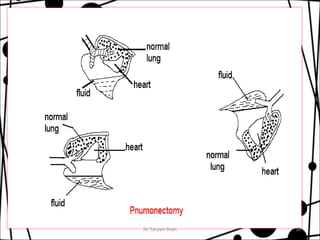
pneumoneCTomy 
• Removal of entire lung 
• Radical Pneumonectomy along with that of entire 
lung mediastinal gland is also removed. 
Complication:- 
• Damage to phrenic nerve 
• Damage to recurrent laryngeal nerve 
Indication:- Carcinoma, bronchiectasis, 
tuberculosis 
incision is posterolateral incision Dr.Tarpan Shah 21
preoperaTive 
pHysioTHerapy 
• Gain the confidence of patient 
• Clear the lung field 
• Breathing exercise 
• Postural awareness 
• Teach arm, trunk, leg exercise 
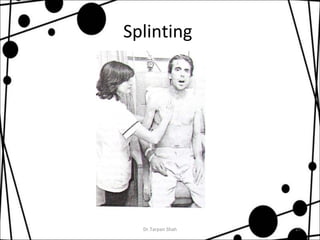
• Splinting of incision during coughing 
• Bed mobility 
Dr.Tarpan Shah 22
Postoperative chest physiotherapy 
• Clear the lung field 
• Reexpansion of the lung 
• Prevent circulatory complication 
• Prevent wound complication 
• Regain the arm and trunk movement 
• Maintain the good posture 
• Conditioning exercise 
Dr.Tarpan Shah 23
Key points 
• Breathing exercises should be started on the 
day of surgery if possible. 
• ACBT to remove the secretion and restore the 
lung volumes and capacities 
• Adequate wound support for huffing and 
coughing should be taught. 
Dr.Tarpan Shah 24
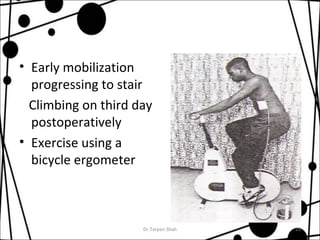
• Early mobilization 
progressing to stair 
Climbing on third day 
postoperatively 
• Exercise using a 
bicycle ergometer 
Dr.Tarpan Shah 25
• Tracheal deviation- result into ineffective 
cough production 
• Huffing rather than coughing is emphasized 
because of less chances of increase in 
intrathoracic pressure 
• If suctioning is required than take care of 
stump. 
• Breathing control with stair climbing may 
increase exercise tolerance. 
Dr.Tarpan Shah 26
Splinting 
Dr.Tarpan Shah 27
lobectomy 
• Indication 
• Bronchiectasis 
• Tuberculosis 
• Lung abscess 
• Carcinoma 
Dr.Tarpan Shah 28
Day of operation 
• Half lying 
• Breathing exercise to expand the whole lung 
• Vibration over unoperated side 
• Huffing with splinting 
• Foot or ankle exercise 
Dr.Tarpan Shah 29
Day – 1 ( 3- 4 session) 
• Analgesia to reduce the pain so pt will 
cooperate in treatment 
• Nebulizer therapy or humidification therapy 
• Breathing exercise with inspiratory hold 
• Side lying on unoperated side 
• Chest expansion exercise on remaining side 
• Postural drainage 
Dr.Tarpan Shah 30
• Exercise of arm 
• Assisted arm elevation 
• Assisted arm movement in functional pattern 
• Neck exercise 
Dr.Tarpan Shah 31
• Exercise for leg 
• Foot and ankle exercise 
• Quadriceps contraction 
• Hip and knee bending exercise 
Start ambulation 
Dr.Tarpan Shah 32
Day-2 
• Self supported splinting 
• Chest expansion exercise 
• Breathing exercise 
• Unoperated side positioning 
• Arm as well as leg exercise 
• Start trunk exercise 
• Discourage the pt for crossleg sitting it will occlude 
popliteal artery and can result into DVT 
Dr.Tarpan Shah 33
Day 3- 4 
• Arm and trunk exercise should continue 
• Increase the walking distance 
• Stair climbing 
• Group therapy 
• Aerobic exercise 
Dr.Tarpan Shah 34
• Discharge at 10-12 days of post op 
• Home exercise programme 
• Aerobic exercise ( hyper Chest expansion 
exercise 
• Ventilatory muscle training 
Dr.Tarpan Shah 35
• Pain. Extrapleural bupivicaine infusion is an 
increasingly popular method of pain control 
following a thoracotomy. 
• Bronchial secretions. The appropriate timing 
and selection of minitracheotomy can help reduce 
the incidence of sputum retention. 
• Pneumonia is a serious complication with a 
high mortality rate. 
Dr.Tarpan Shah 36
• Atrial fibrillation is common with extensive 
resection in the elderly. Onset is usually 2-5 
days postoperatively. 
• Wound infection 
• Haemorrhage. Significant bleeding, usually 
involving the bronchial arteries, occurs in 1-2% 
of patients. It is more likely after a 
pneumonectomy. 
Dr.Tarpan Shah 37
SEGMENTAL RESECTION 
• A bronchopulmonary segment is removed 
with its segmental artery and bronchus 
• Used for tuberculosis 
Dr.Tarpan Shah 38
WEDGE RESECTION 
• This non anatomical resection is used for 
diagnosis in open lung biopsy and treatment 
of well localised peripheral carcinomas in 
patients with redused lung function 
Dr.Tarpan Shah 39
ThORACOpLASTy 
• This operation is performed to produce the 
permanent collapse of a lung. 
• This operation is performed in TB and 
emphysema. 
– Complication: deformity 
paradoxical breathing 
Dr.Tarpan Shah 40
pLEuRAL SuRGERy 
1) Pleurectomy: is removal of parietal layer of 
pleura e.g. pneumothorax 
-Visceral layer pleura stick with the chest wall 
2) Pleurodesis: insertion of powder into the 
pleural cavity, which act as a irritants. 
- Position the pt in 10 min for each position 
- Expansion breathing exercise is performed in 
each position. 
Dr.Tarpan Shah 41
• 3) Decortication : 
- stripping of the two layer of pleura that 
have become adherent with eachother. 
• E.g. empyema 
Dr.Tarpan Shah 42
Dr.Tarpan Shah 43

Pulmonary surgery

  • 1.
    PULMONAR Y SURGERY Dr. Tarpan Shah. MPT (CPD&ICU care), (DNHE) Vice-Principal &Asst.Prof Shree Swaminarayan Physiotherapy college
  • 2.
    • Lung surgeryis the surgery to repair or remove lung tissue • Biopsy of an unknown growth • Lobectomy • Lung transplant • Pneumonectomy • Surgery to prevent the build up or return of fluid to the chest (pleurodesis) Dr.Tarpan Shah 2
  • 3.
    • Surgery toremove an infection or blood in the chest cavity(empyema) Dr.Tarpan Shah 3
  • 4.
    • General anaesthesiagiven • Pt will be be asleep and not felt any pain • Two common ways thoracotomy and video assisted thoracoscopic surgery(VATS) • Thoracotomy means open surgery • Risks in surgey--- • Allergic reactions to medicines • Breathing problems Dr.Tarpan Shah 4
  • 5.
    • Bleeding •Blood clots • Infection • Failure of lung to expand • Injury to the lungs • Pain Dr.Tarpan Shah 5
  • 6.
    • Prognosis--- •Depends on • Type of problem being treated • How much of the lung is removed • Overall health before surgery Dr.Tarpan Shah 6
  • 7.
    INDICATIONS FOR SURGERY • Commonest is bronchial carcinoma 1.Malignancy- primary bronchial carcinoma, isolated secondaries arising from kidney or large intestine 2.Inflammatory- lung resection is required occasionally for lung abscess, tuberculosis , bronchiectasis Dr.Tarpan Shah 7
  • 8.
    3.Trauma- stab wounds,gun shot wounds 4.Degerative- large bullae in selected patients where there is compression of normal lung 5.Congenital- lobar emphysema Dr.Tarpan Shah 8
  • 9.
    INCISIONS A)Lateral incision 1) Posterolateral incision:- this follow the vertebral border of scapula and line of rib 5th 6th 7th 8th to anterior angle of costal margin Muscles cut are:- trapezius, LD, serratus anterior, rhomboids, intercostals, erector spinae This incision is used for the lung operation Dr.Tarpan Shah 9
  • 10.
  • 11.
    2) Antero-lateral incision:-this start at middle of the anterior chest up to the posterior axillary fold. Muscles cut are:- pectoralis major and minor, serratus anterior, intercostals. This incision is used for mitral valvotomy and pleurectomy. Dr.Tarpan Shah 11
  • 12.
    B) Anterior incision 1) Transverse:- this passes across the one side of the 4th IC space to the other. Muscles cut are:- pectoralis major, intercostals. 2) Vertical incision:- splitting of the sternum down the middle NO MUSCLE CUT This incision is used for open heart surgery. Dr.Tarpan Shah 12
  • 13.
    Types of operaTion 1) Pneumonectomy 2) lobectomy 3) Segmental or wedge resection Dr.Tarpan Shah 13
  • 14.
  • 15.
  • 16.
    CompliCaTion of surgery 1) Respiratory - infection of the lung - consolidation / collapsed - pneumothorax - broncho-pleural fistula Dr.Tarpan Shah 16
  • 17.
    BronCHopleural fisTula •It implies breakdown of the bronchial stump and it occcurs around the 10 th postoperative day ,if small it may not be noticed untill much later • It is recognised by dyspnea ,an irritating cough and possible expectoration of dark fluid • The patient should be sat up or turned on to the operated side to prevent spill over of infected fluid in to the remaining lung Dr.Tarpan Shah 17
  • 18.
  • 19.
    2) Circulatory:- ď‚§DVT ď‚§ Cardiac arrhythmia ď‚§ Haemorrhage 3) Wound:- ď‚§ Infection ď‚§ Failure to heal ď‚§ Adherent scar 4) Joint stiffness:- ď‚§ Sh joint ď‚§ Thoracic spine ď‚§ Costo-vertebral joints Dr.Tarpan Shah 19
  • 20.
    5) Muscle weakness:- ď‚§ LD ď‚§ Serratus anterior ď‚§ leg muscle if unexercised ď‚§ other divided muscles 6) Postural deformity:- ď‚§ forward or sideward bending Dr.Tarpan Shah 20
  • 21.
    pneumoneCTomy • Removalof entire lung • Radical Pneumonectomy along with that of entire lung mediastinal gland is also removed. Complication:- • Damage to phrenic nerve • Damage to recurrent laryngeal nerve Indication:- Carcinoma, bronchiectasis, tuberculosis incision is posterolateral incision Dr.Tarpan Shah 21
  • 22.
    preoperaTive pHysioTHerapy •Gain the confidence of patient • Clear the lung field • Breathing exercise • Postural awareness • Teach arm, trunk, leg exercise • Splinting of incision during coughing • Bed mobility Dr.Tarpan Shah 22
  • 23.
    Postoperative chest physiotherapy • Clear the lung field • Reexpansion of the lung • Prevent circulatory complication • Prevent wound complication • Regain the arm and trunk movement • Maintain the good posture • Conditioning exercise Dr.Tarpan Shah 23
  • 24.
    Key points •Breathing exercises should be started on the day of surgery if possible. • ACBT to remove the secretion and restore the lung volumes and capacities • Adequate wound support for huffing and coughing should be taught. Dr.Tarpan Shah 24
  • 25.
    • Early mobilization progressing to stair Climbing on third day postoperatively • Exercise using a bicycle ergometer Dr.Tarpan Shah 25
  • 26.
    • Tracheal deviation-result into ineffective cough production • Huffing rather than coughing is emphasized because of less chances of increase in intrathoracic pressure • If suctioning is required than take care of stump. • Breathing control with stair climbing may increase exercise tolerance. Dr.Tarpan Shah 26
  • 27.
  • 28.
    lobectomy • Indication • Bronchiectasis • Tuberculosis • Lung abscess • Carcinoma Dr.Tarpan Shah 28
  • 29.
    Day of operation • Half lying • Breathing exercise to expand the whole lung • Vibration over unoperated side • Huffing with splinting • Foot or ankle exercise Dr.Tarpan Shah 29
  • 30.
    Day – 1( 3- 4 session) • Analgesia to reduce the pain so pt will cooperate in treatment • Nebulizer therapy or humidification therapy • Breathing exercise with inspiratory hold • Side lying on unoperated side • Chest expansion exercise on remaining side • Postural drainage Dr.Tarpan Shah 30
  • 31.
    • Exercise ofarm • Assisted arm elevation • Assisted arm movement in functional pattern • Neck exercise Dr.Tarpan Shah 31
  • 32.
    • Exercise forleg • Foot and ankle exercise • Quadriceps contraction • Hip and knee bending exercise Start ambulation Dr.Tarpan Shah 32
  • 33.
    Day-2 • Selfsupported splinting • Chest expansion exercise • Breathing exercise • Unoperated side positioning • Arm as well as leg exercise • Start trunk exercise • Discourage the pt for crossleg sitting it will occlude popliteal artery and can result into DVT Dr.Tarpan Shah 33
  • 34.
    Day 3- 4 • Arm and trunk exercise should continue • Increase the walking distance • Stair climbing • Group therapy • Aerobic exercise Dr.Tarpan Shah 34
  • 35.
    • Discharge at10-12 days of post op • Home exercise programme • Aerobic exercise ( hyper Chest expansion exercise • Ventilatory muscle training Dr.Tarpan Shah 35
  • 36.
    • Pain. Extrapleuralbupivicaine infusion is an increasingly popular method of pain control following a thoracotomy. • Bronchial secretions. The appropriate timing and selection of minitracheotomy can help reduce the incidence of sputum retention. • Pneumonia is a serious complication with a high mortality rate. Dr.Tarpan Shah 36
  • 37.
    • Atrial fibrillationis common with extensive resection in the elderly. Onset is usually 2-5 days postoperatively. • Wound infection • Haemorrhage. Significant bleeding, usually involving the bronchial arteries, occurs in 1-2% of patients. It is more likely after a pneumonectomy. Dr.Tarpan Shah 37
  • 38.
    SEGMENTAL RESECTION •A bronchopulmonary segment is removed with its segmental artery and bronchus • Used for tuberculosis Dr.Tarpan Shah 38
  • 39.
    WEDGE RESECTION •This non anatomical resection is used for diagnosis in open lung biopsy and treatment of well localised peripheral carcinomas in patients with redused lung function Dr.Tarpan Shah 39
  • 40.
    ThORACOpLASTy • Thisoperation is performed to produce the permanent collapse of a lung. • This operation is performed in TB and emphysema. – Complication: deformity paradoxical breathing Dr.Tarpan Shah 40
  • 41.
    pLEuRAL SuRGERy 1)Pleurectomy: is removal of parietal layer of pleura e.g. pneumothorax -Visceral layer pleura stick with the chest wall 2) Pleurodesis: insertion of powder into the pleural cavity, which act as a irritants. - Position the pt in 10 min for each position - Expansion breathing exercise is performed in each position. Dr.Tarpan Shah 41
  • 42.
    • 3) Decortication: - stripping of the two layer of pleura that have become adherent with eachother. • E.g. empyema Dr.Tarpan Shah 42
  • 43.