ACAPELLA
SUBJECT:402-PHYSIOTHERAPY IN CARDIOPULMONARY CONDITIONS
SUBMITTED BY:
FARAZ SHAMS
ROLL NO. 9
BPT 4TH YEAR
SUBMITTED TO:
DR. JAMAL ALI MOIZ
CENTRE FOR PHYSIOTHERAPY AND REHABLITATION
JAMIA MILLIA ISLAMIA
Acapella
• The Acapella® is also a flow-operated oscillatory device, which uses a
counterweighted plug and magnet to create airflow oscillations.
• Acapella combines the benefits of both PEP therapy and airway vibrations
to mobilize pulmonary secretions and can be used in virtually any position
allowing patients to move freely and sit, stand or recline.
• It improves clearance of secretions, is easier to tolerate than Chest Physical
Therapy (CPT), takes less than half the time of conventional CPT sessions.
• facilitates opening of airways in patients with lung diseases with secretory
problems such as COPD, asthma and Cystic Fibrosis.
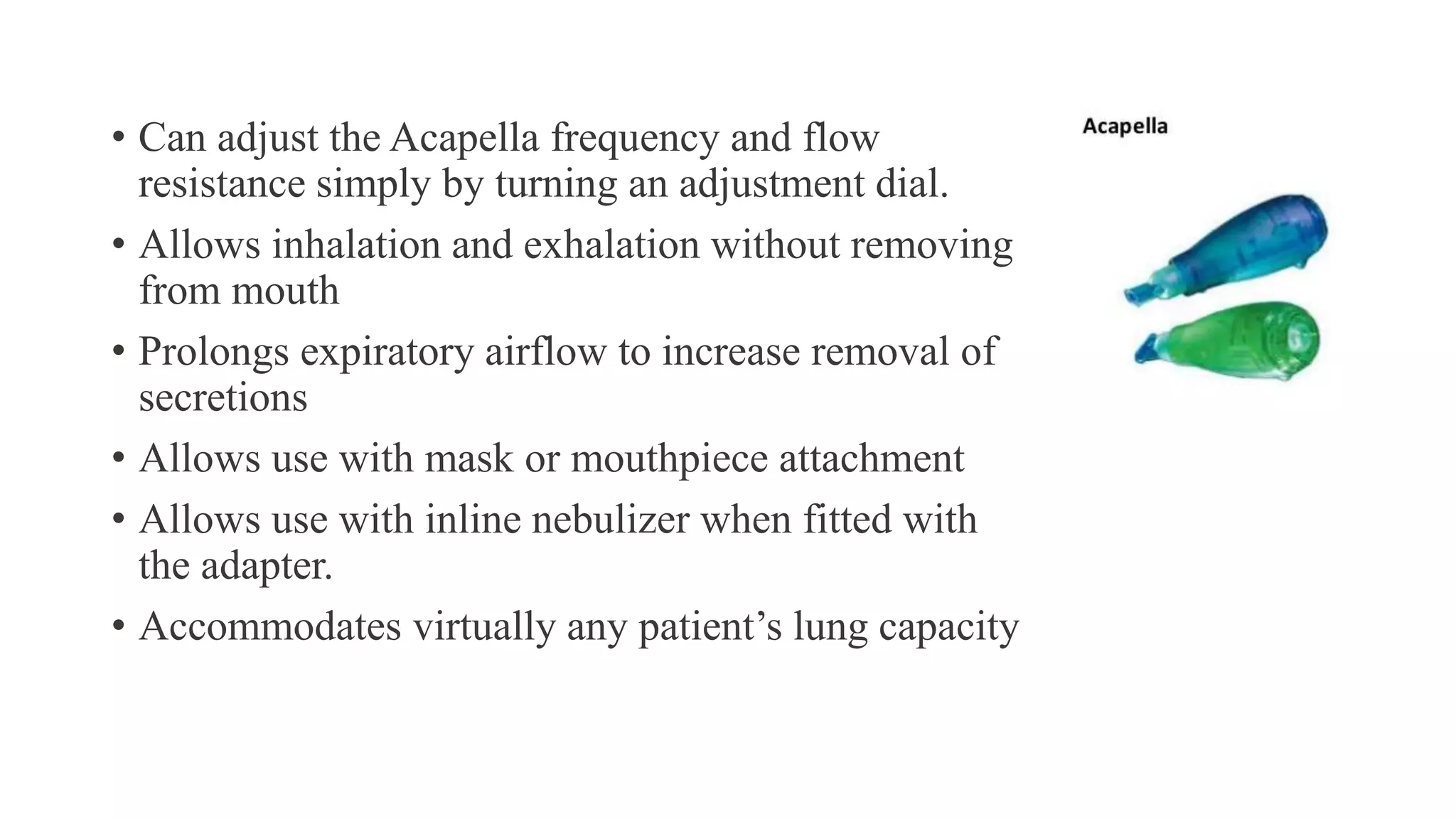
• Color-coded units (green for high-flow, blue for low) help customize
treatment for each patient based on their clinical needs.
• Can adjust the Acapella frequency and flow
resistance simply by turning an adjustment dial.
• Allows inhalation and exhalation without removing
from mouth
• Prolongs expiratory airflow to increase removal of
secretions
• Allows use with mask or mouthpiece attachment
• Allows use with inline nebulizer when fitted with
the adapter.
• Accommodates virtually any patient’s lung capacity
There are several Acapella devices:
• Acapella Blue - produces a lower amplitude of vibrations compared to
Acapella Green or Acapella Choice. Acapella blue is generally used
for individuals with a flow rate of < 15L/min. For this reason, it may
be more useful than other oscillating PEP devices, as it can be applied
in those with lower expiratory flows, due to severe airflow obstruction
or airway instability, age or size. (Volsko et al2003)
• Acapella Green - used for flow rates of > "15L/min.
• Acapella Choice-used for flow rates of > 15L/min. It is able to be
taken apart and thoroughly cleaned.
• Acapella Duet-It is able to be taken apart and thoroughly cleaned and
has a dedicated nebulizer port
Contraindications
Although no absolute contraindications to the use of PEP Therapy have been
reported, the following should be carefully evaluated before a decision is made to
initiate therapy
• Inability to tolerate increased work of breathing.
• Intracranial pressure (ICP) > 20 mm Hg.
• Recent facial, oral, or skull surgery or trauma.
• Esophageal surgery.
• Untreated pneumothorax.
• Known or suspected tympanic membrane rupture or other middle ear pathology.
• Hemodynamic instability.
• Acute sinusitis.
• Nausea
Application of the Acapella
Application of the Acapella has 2 components-
• Breathing (inhalation and slightly forced exhalation)
• Coughing/huffing
Breathing
• The individual is instructed to inspire slowly to a volume slightly
greater than tidal volume through the mouthpiece and perform an
inspiratory breath hold for 2 to 3 seconds
• Following the breath hold, the individual is instructed to expire against
a slight expiratory resistance through the Acapella, at a slightly faster
rate than normal. This is repeated consecutively for the prescribed
number of breaths.
• Optimal oscillation frequency and flow are those which give
reinforcement of airway resonance/vibration in the lower chest and
upper abdominal region. Individuals are generally taught to recognise
this tactile feedback and use this to adapt their technique
Physiology
• Inspiration should be slow, with the inspiratory hold encouraging
homogenous ventilation.
• During expiration, the exhaled air passes through a cone, which is
intermittently occluded by a counterweighted plug attached to a lever,
to produce airflow oscillations. In addition, the proximity between the
counterweighted plug and a magnet can be adjusted to alter the
vibration frequency and amplitude and the positive expiratory
pressure, with 5 settings available. The frequency of oscillations
generally range between 11 and 15Hz.
Forced Expiration Technique
• Cycles of breaths are followed by the forced expiration technique
(FET), then coughing to further mobilize secretions. The performance
of FET is outlined in the FET and ACBT sections
Prescription
• This form of oscillating PEP therapy can be performed in either an
upright seated position or a gravity assisted drainage position.
A typical cycle of oscillating PEP with an Acapella consists of:
• The number of breaths through the device may vary from 6 to 10. This
will depend on the individual's sputum volume, fatigue and dyspnoea
levels, which will vary according to the clinical status.
• The forced expiration technique (huffing followed by breathing
control) is repeated 1 to 3 times depending on the clinical status of the
patient, either through or outside of the device.
• The total number of cycles may range from 6 to 10. This will depend
on individuals' symptoms and sputum volume, which will vary
according to the clinical status.
• Depending on the daily secretion production, this type of OscPEP
therapy may be applied daily or twice daily in a stable clinical state.
During an acute infection, the frequency, the number of breaths per
cycle and the number of cycles may alter.
• The patient should be given written instructions including the
technique, prescription and cleaning of the device.

Acapella

  • 1.
    ACAPELLA SUBJECT:402-PHYSIOTHERAPY IN CARDIOPULMONARYCONDITIONS SUBMITTED BY: FARAZ SHAMS ROLL NO. 9 BPT 4TH YEAR SUBMITTED TO: DR. JAMAL ALI MOIZ CENTRE FOR PHYSIOTHERAPY AND REHABLITATION JAMIA MILLIA ISLAMIA
  • 2.
    Acapella • The Acapella®is also a flow-operated oscillatory device, which uses a counterweighted plug and magnet to create airflow oscillations. • Acapella combines the benefits of both PEP therapy and airway vibrations to mobilize pulmonary secretions and can be used in virtually any position allowing patients to move freely and sit, stand or recline. • It improves clearance of secretions, is easier to tolerate than Chest Physical Therapy (CPT), takes less than half the time of conventional CPT sessions. • facilitates opening of airways in patients with lung diseases with secretory problems such as COPD, asthma and Cystic Fibrosis. • Color-coded units (green for high-flow, blue for low) help customize treatment for each patient based on their clinical needs.
  • 3.
    • Can adjustthe Acapella frequency and flow resistance simply by turning an adjustment dial. • Allows inhalation and exhalation without removing from mouth • Prolongs expiratory airflow to increase removal of secretions • Allows use with mask or mouthpiece attachment • Allows use with inline nebulizer when fitted with the adapter. • Accommodates virtually any patient’s lung capacity
  • 4.
    There are severalAcapella devices: • Acapella Blue - produces a lower amplitude of vibrations compared to Acapella Green or Acapella Choice. Acapella blue is generally used for individuals with a flow rate of < 15L/min. For this reason, it may be more useful than other oscillating PEP devices, as it can be applied in those with lower expiratory flows, due to severe airflow obstruction or airway instability, age or size. (Volsko et al2003) • Acapella Green - used for flow rates of > "15L/min. • Acapella Choice-used for flow rates of > 15L/min. It is able to be taken apart and thoroughly cleaned. • Acapella Duet-It is able to be taken apart and thoroughly cleaned and has a dedicated nebulizer port
  • 5.
    Contraindications Although no absolutecontraindications to the use of PEP Therapy have been reported, the following should be carefully evaluated before a decision is made to initiate therapy • Inability to tolerate increased work of breathing. • Intracranial pressure (ICP) > 20 mm Hg. • Recent facial, oral, or skull surgery or trauma. • Esophageal surgery. • Untreated pneumothorax. • Known or suspected tympanic membrane rupture or other middle ear pathology. • Hemodynamic instability. • Acute sinusitis. • Nausea
  • 6.
    Application of theAcapella Application of the Acapella has 2 components- • Breathing (inhalation and slightly forced exhalation) • Coughing/huffing
  • 7.
    Breathing • The individualis instructed to inspire slowly to a volume slightly greater than tidal volume through the mouthpiece and perform an inspiratory breath hold for 2 to 3 seconds • Following the breath hold, the individual is instructed to expire against a slight expiratory resistance through the Acapella, at a slightly faster rate than normal. This is repeated consecutively for the prescribed number of breaths. • Optimal oscillation frequency and flow are those which give reinforcement of airway resonance/vibration in the lower chest and upper abdominal region. Individuals are generally taught to recognise this tactile feedback and use this to adapt their technique
  • 8.
    Physiology • Inspiration shouldbe slow, with the inspiratory hold encouraging homogenous ventilation. • During expiration, the exhaled air passes through a cone, which is intermittently occluded by a counterweighted plug attached to a lever, to produce airflow oscillations. In addition, the proximity between the counterweighted plug and a magnet can be adjusted to alter the vibration frequency and amplitude and the positive expiratory pressure, with 5 settings available. The frequency of oscillations generally range between 11 and 15Hz.
  • 9.
    Forced Expiration Technique •Cycles of breaths are followed by the forced expiration technique (FET), then coughing to further mobilize secretions. The performance of FET is outlined in the FET and ACBT sections
  • 10.
    Prescription • This formof oscillating PEP therapy can be performed in either an upright seated position or a gravity assisted drainage position.
  • 11.
    A typical cycleof oscillating PEP with an Acapella consists of: • The number of breaths through the device may vary from 6 to 10. This will depend on the individual's sputum volume, fatigue and dyspnoea levels, which will vary according to the clinical status. • The forced expiration technique (huffing followed by breathing control) is repeated 1 to 3 times depending on the clinical status of the patient, either through or outside of the device. • The total number of cycles may range from 6 to 10. This will depend on individuals' symptoms and sputum volume, which will vary according to the clinical status.
  • 12.
    • Depending onthe daily secretion production, this type of OscPEP therapy may be applied daily or twice daily in a stable clinical state. During an acute infection, the frequency, the number of breaths per cycle and the number of cycles may alter. • The patient should be given written instructions including the technique, prescription and cleaning of the device.