 There are many aspects to maintenance of
machinery.
 The main purpose of maintenance is to ensure
that machinery always operates at an optimal
level.
 Routine maintenance includes inspection,
cleaning, lubricating, adjusting and replacing
parts.
 Moving parts of machines rubbing against one another
causes wear.
 Over time the wear results in these parts working loose
and becoming irregular in shape.
 In extreme cases, the whole machine may seize or result
in other breakages.
 The effects of excessive wear are costly and can be
dangerous so it is better to perform regular
maintenance tasks to increase the working life of
machines.
 One of the best ways of reducing friction (which causes
wear) is to use a suitable lubricant.
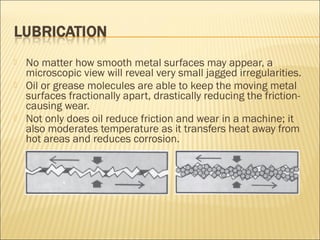
 No matter how smooth metal surfaces may appear, a
microscopic view will reveal very small jagged irregularities.
 Oil or grease molecules are able to keep the moving metal
surfaces fractionally apart, drastically reducing the friction-
causing wear.
 Not only does oil reduce friction and wear in a machine; it
also moderates temperature as it transfers heat away from
hot areas and reduces corrosion.
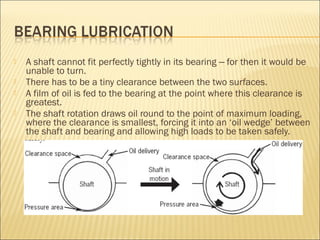
 A shaft cannot fit perfectly tightly in its bearing for then it would be‒
unable to turn.
 There has to be a tiny clearance between the two surfaces.
 A film of oil is fed to the bearing at the point where this clearance is
greatest.
 The shaft rotation draws oil round to the point of maximum loading,
where the clearance is smallest, forcing it into an ‘oil wedge’ between
the shaft and bearing and allowing high loads to be taken safely.
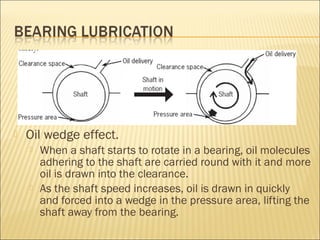
 Oil wedge effect.
 When a shaft starts to rotate in a bearing, oil molecules
adhering to the shaft are carried round with it and more
oil is drawn into the clearance.
 As the shaft speed increases, oil is drawn in quickly
and forced into a wedge in the pressure area, lifting the
shaft away from the bearing.
 Oil (a liquid) and grease (a semi-solid) are generally
used as lubricants.
 Oil in a machine is fed to the bearings under pressure,
and the film of oil keeps the bearing surfaces apart.
 This is known as full-film lubrication.
 Grease is used for joints which do not keep the bearing
surfaces fully separated this type of lubrication is‒
boundary lubrication.
 The steering and suspension of motor vehicles are
examples of grease being used for boundary lubrication.
 Oiliness
 Oil must be able to cling to a metal surface to provide a
boundary layer.
 Viscosity
 It is the resistance of an oil to flow and is calculated by
the time it takes a set quantity of oil to flow through a
tube of fixed diameter.
 The longer the oil takes to flow, the higher the oil’s
viscosity, and the higher the viscosity number which
identifies it.
 Simply put, ‘the higher the number, the thicker the oil’.
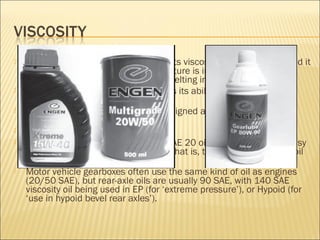
 One of the problems with oil is that its viscosity tends to reduce and it
becomes ‘thinner’ when its temperature is increased (in much the
same way as a lump of margarine melting in a hot frying pan).
 When oil becomes ‘too thin’ it looses its ability to reduce friction
adequately.
 Modern engine oils are specially designed as multi-grades to
overcome this problem.
 A typical designation is 20W50 SAE.
 This means that the oil acts like a SAE 20 oil when it is cold, for easy
cold starting; and like a SAE 50 oil (that is, thicker than a 20 SAE oil
would be) when it is hot.
 Motor vehicle gearboxes often use the same kind of oil as engines
(20/50 SAE), but rear-axle oils are usually 90 SAE, with 140 SAE
viscosity oil being used in EP (for ‘extreme pressure’), or Hypoid (for
‘use in hypoid bevel rear axles’).
 Oils can also be classified according to their base which is either
mineral oil (refined crude oil) or vegetable oil such as castor oil.
 Vegetable oils are used only for special applications such as racing
motor cycles.
 Most oil firms make synthetic oil.
 Synthetic oil is a chemically engineered mineral oil which is
suitable for high-performance and turbo-charged engines.
 The viscosity of synthetic oil is usually slightly lower than that of a
conventional mineral oil to achieve similar characteristics when
both oils have reached working temperatures.
 Oil manufacturers may also add agents to give oil special
properties, such as corrosion resistance, friction modification and
longevity (for extended use or harsh conditions).
 There is a wide variety of grease products on the market.
 Grease is highly viscous and very sticky.
 It may appear white, brown, black, grey or even red in colour.
 The choice of grease will depend on the conditions under which it will
labour.
 The type of load, temperature and exposure to water which will be
applied to a machine component generally determine the type of
grease to be used.
 The grease manufacturer’s recommendation charts will specify the
grease type suitable for the required task.
 Never use grease which is not specifically recommended for a certain
application.
 Multi-purpose grease, for example, is useful for many applications,
but not all applications.
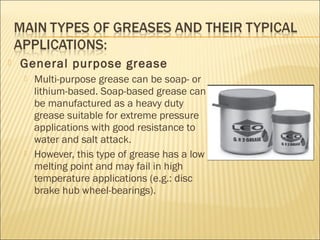
 General purpose grease
 Multi-purpose grease can be soap- or
lithium-based. Soap-based grease can
be manufactured as a heavy duty
grease suitable for extreme pressure
applications with good resistance to
water and salt attack.
 However, this type of grease has a low
melting point and may fail in high
temperature applications (e.g.: disc
brake hub wheel-bearings).
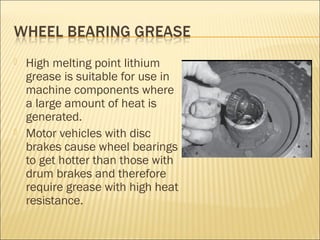
 High melting point lithium
grease is suitable for use in
machine components where
a large amount of heat is
generated.
 Motor vehicles with disc
brakes cause wheel bearings
to get hotter than those with
drum brakes and therefore
require grease with high heat
resistance.
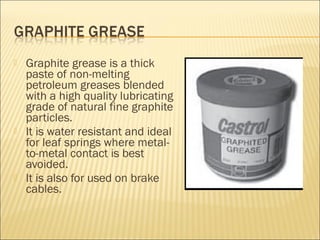
 Graphite grease is a thick
paste of non-melting
petroleum greases blended
with a high quality lubricating
grade of natural fine graphite
particles.
 It is water resistant and ideal
for leaf springs where metal-
to-metal contact is best
avoided.
 It is also for used on brake
cables.
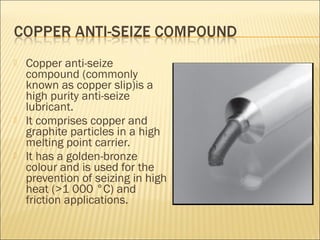
 Copper anti-seize
compound (commonly
known as copper slip)is a
high purity anti-seize
lubricant.
 It comprises copper and
graphite particles in a high
melting point carrier.
 It has a golden-bronze
colour and is used for the
prevention of seizing in high
heat (>1 000 °C) and
friction applications.
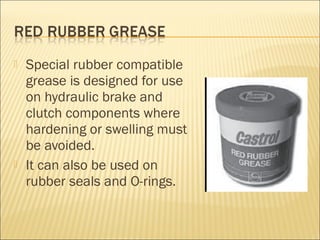
 Special rubber compatible
grease is designed for use
on hydraulic brake and
clutch components where
hardening or swelling must
be avoided.
 It can also be used on
rubber seals and O-rings.
 Machine components are lubricated in many ways.
 Accessible components are lubricated manually, with
oil or grease, using various devices or automatic
lubrication systems.
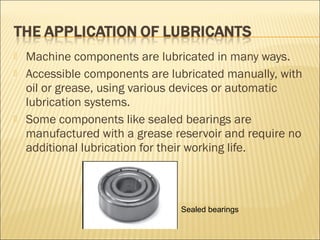
 Some components like sealed bearings are
manufactured with a grease reservoir and require no
additional lubrication for their working life.
Sealed bearings
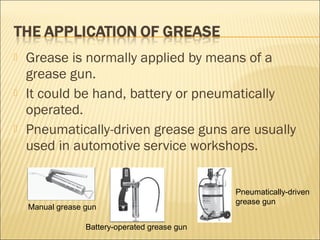
 Grease is normally applied by means of a
grease gun.
 It could be hand, battery or pneumatically
operated.
 Pneumatically-driven grease guns are usually
used in automotive service workshops.
Manual grease gun
Battery-operated grease gun
Pneumatically-driven
grease gun
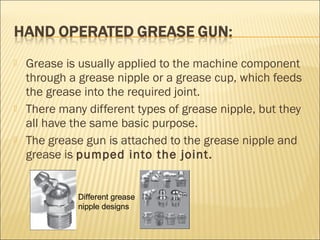
 Grease is usually applied to the machine component
through a grease nipple or a grease cup, which feeds
the grease into the required joint.
 There many different types of grease nipple, but they
all have the same basic purpose.
 The grease gun is attached to the grease nipple and
grease is pumped into the joint.
Different grease
nipple designs
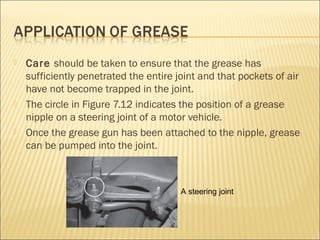
 Care should be taken to ensure that the grease has
sufficiently penetrated the entire joint and that pockets of air
have not become trapped in the joint.
 The circle in Figure 7.12 indicates the position of a grease
nipple on a steering joint of a motor vehicle.
 Once the grease gun has been attached to the nipple, grease
can be pumped into the joint.
A steering joint
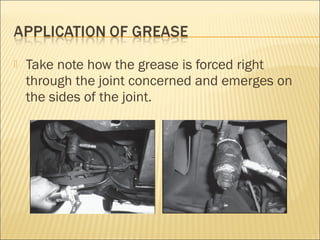
 Take note how the grease is forced right
through the joint concerned and emerges on
the sides of the joint.
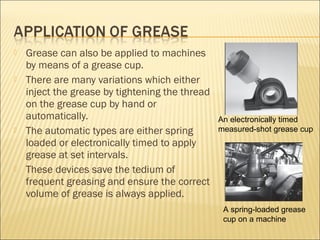
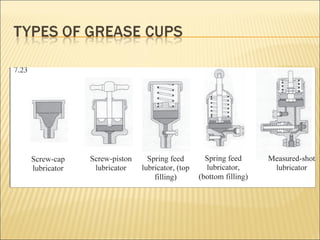
 Grease can also be applied to machines
by means of a grease cup.
 There are many variations which either
inject the grease by tightening the thread
on the grease cup by hand or
automatically.
 The automatic types are either spring
loaded or electronically timed to apply
grease at set intervals.
 These devices save the tedium of
frequent greasing and ensure the correct
volume of grease is always applied.
A spring-loaded grease
cup on a machine
An electronically timed
measured-shot grease cup
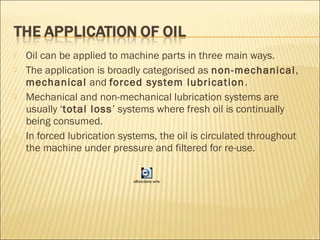
 Oil can be applied to machine parts in three main ways.
 The application is broadly categorised as non-mechanical,
mechanical and forced system lubrication.
 Mechanical and non-mechanical lubrication systems are
usually ‘total loss’ systems where fresh oil is continually
being consumed.
 In forced lubrication systems, the oil is circulated throughout
the machine under pressure and filtered for re-use.
oilfunctions.wmv
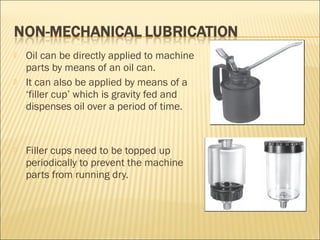
 Oil can be directly applied to machine
parts by means of an oil can.
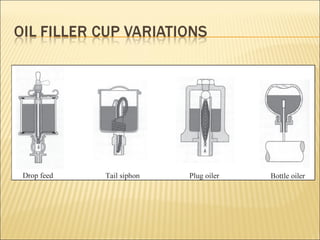
 It can also be applied by means of a
‘filler cup’ which is gravity fed and
dispenses oil over a period of time.
 Filler cups need to be topped up
periodically to prevent the machine
parts from running dry.
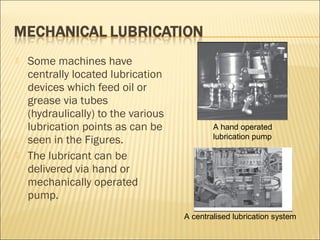
 Some machines have
centrally located lubrication
devices which feed oil or
grease via tubes
(hydraulically) to the various
lubrication points as can be
seen in the Figures.
 The lubricant can be
delivered via hand or
mechanically operated
pump.
A hand operated
lubrication pump
A centralised lubrication system
 The internal combustion engine is a very good example of a
forced lubrication system.
 Similar principles apply to most major machine lubrication
systems.
 These and other engines have hundreds of moving parts, which
operate under enormous loads and very high heat.
 Because of this, machines need very efficient lubrication
systems.
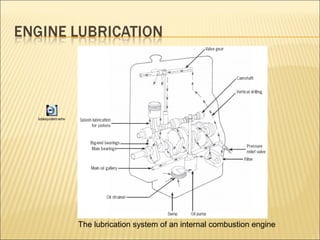
 The diagram below gives a very simplified, schematic
representation of how oil is circulated under pressure through
the engine in order to lubricate all the bearing surfaces and
moving parts.
 The most popular type of lubrication system is the wet-sump
type. This is so called because the engine sump is kept wet by
being used as a reservoir for the lubricating oil.
 In operation, the engine oil is drawn from the sump by the oil
pump.
 To prevent large items being drawn up into the pump the oil
must first pass through the strainer.
 From the pump the oil is passed through the filter and then to
the main oil gallery.
The lubrication system of an internal combustion engine
lubesystem.wmv
 The pump sends the oil to the main gallery under a pressure of
approximately 400 kPa.
 To ensure that this pressure is not exceeded, and so to prevent
damage to oil seals and bearings, an oil pressure relief valve is
fitted into the main gallery.
 From the main gallery the oil goes under pressure to the main
bearings and through drillings in the crankshaft to the big-end
bearings.
 At one end of the engine there is a long vertical drilling; this
takes oil up to the camshaft and valve gear.
 Each component in the system needs to be properly
maintained, as failure in any of the components will result in
major damage to the machine.
 Oil pumps are usually inspected at engine overhauls
and replaced when excessive wear is detected.
 Gear-type pump
 This contains a pair of meshing gears revolving in a closely
fitting housing.
 Oil fed in at one side is carried round the edge and out at
the other side.
 Rotor-type pump
 The inner rotor meshes internally with the outer one,
which has one more lobe. The two have different axes of
rotation, so the spaces vary in size, causing oil to be drawn
in and forced out.
Oilpump.wmv
 The oil filter catches small particles of dirt and metal in the oil,
which could otherwise cause damage inside the engine.
 Eventually, the filter starts to clog up and the oil can’t flow
through it as easily.
 If the filter clogs up completely, a bypass valve will open so that
some oil can still reach the engine, but dirt and metal particles
will be circulating as well.
 A new filter should always be fitted whenever the engine oil is
changed.
 Always make sure that the correct filter for the particular
engine is used.
 Engine oil is typically replaced after 10 000 km of driving.
repoilfilter_cable[1].wmv
The cartridge type oil filter
 Excessive wear, overheating, seizing and distortion is generally
referred to as machine failure.
 We will not be studying it in any great depth but we will however look
at a few of the basic causes.
 Excessive wear can take on different forms in different components.
 For example, the type of wear on a bearing will not be the same as
that on a gear.
 Excessive wear can be caused by prolonged wear and tear, as
machine parts are designed for a certain life-span.
 However machine parts’ life-spans can be greatly increased if they
are maintained correctly.
 Failure can occur if parts are overloaded or there is a
breakdown in the lubrication or the cooling system.
 As wear increases in machine parts, the effectiveness of the
lubrication and cooling systems lessens and the parts tend to
overheat.
 As parts overheat, they expand and apply greater pressure to
their surrounding parts which in turn creates more friction and
even more heat.
 If machine parts are allowed to deteriorate to the extent that
they overheat, they will eventually seize.
 This means that they will jam together, get distorted or even
disintegrate and result in very costly repairs.
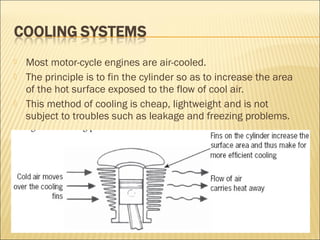
 Most motor-cycle engines are air-cooled.
 The principle is to fin the cylinder so as to increase the area
of the hot surface exposed to the flow of cool air.
 This method of cooling is cheap, lightweight and is not
subject to troubles such as leakage and freezing problems.
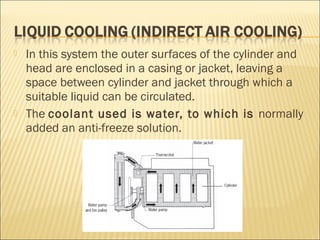
 In this system the outer surfaces of the cylinder and
head are enclosed in a casing or jacket, leaving a
space between cylinder and jacket through which a
suitable liquid can be circulated.
 The coolant used is water, to which is normally
added an anti-freeze solution.
waterpump.wmv
 The basic system consists of a water jacket which is
connected by a rubber hose to a header tank.
 This tank forms part of the radiator, a heat exchanger
made by connecting two tanks, header and lower, with a
number of finned tubes to provide a large surface area for
the disposal of the unwanted heat.
 Air flow over the tubes and fins carries away the heat
radiated from the hot coolant and so lowers the
temperature of the coolant as it passes down the tubes.
 A bottom hose connects the lower tank to the jacket to
provide a return path to the engine for the coolant.
 There are hundreds of different types of failure that
can affect machine parts.
 We include a few examples of failure in bearings and
gears, as well as their possible causes.
 Visit a scrap yard in your local area and try to
identify some of the failures in the scrapped
engines as shown in the in the table.
 Make a list and sketch all the faults you are able
to identify and try to explain the cause of the
failure.
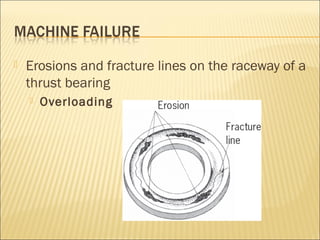
 Erosions and fracture lines on the raceway of a
thrust bearing
 Overloading
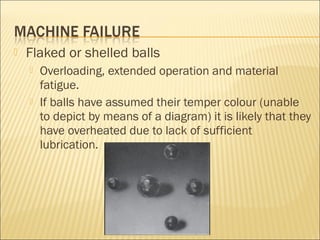
 Flaked or shelled balls
 Overloading, extended operation and material
fatigue.
 If balls have assumed their temper colour (unable
to depict by means of a diagram) it is likely that they
have overheated due to lack of sufficient
lubrication.
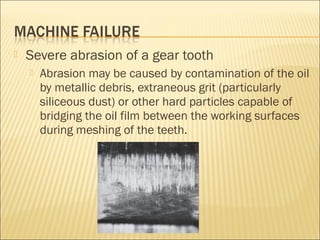
 Severe abrasion of a gear tooth
 Abrasion may be caused by contamination of the oil
by metallic debris, extraneous grit (particularly
siliceous dust) or other hard particles capable of
bridging the oil film between the working surfaces
during meshing of the teeth.
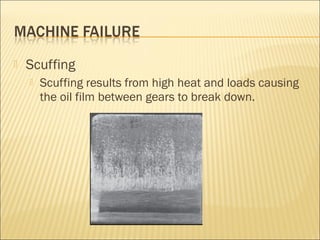
 Scuffing
 Scuffing results from high heat and loads causing
the oil film between gears to break down.
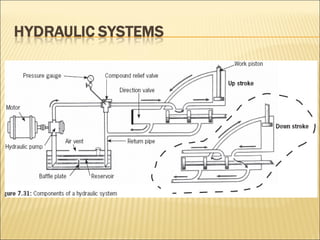
 Hydraulic control systems are control systems
in which remote operation is obtained by the
transmission of pressure from a pedal or lever
through thehydraulic fluid.
 Hydraulic systems are used to do work.
 They are mostly used in cranes and other lifting
devices.
 Failure in these systems leads to a loss in control of the
machine.
 It is obvious that any failure in these systems may have life-
threatening consequences.
 It is very important to ensure thorough, scheduled maintenance
is carried out on these systems to ensure correct working at all
times.
 Hydraulic fluid reservoir levels should be periodically checked,
as should lines and hoses.
 If any moisture is detected around the lines and hoses,
immediate action should be taken to repair or replace the
components.
 Pneumatic systems are control systems
in which remote operation is obtained
by the transmission of compressed air through
valves and switches.
 They are most commonly used in factory
production lines.
 It is very important to ensure the air pressure is
correctly regulated and that condensed water
vapour is removed through water traps.
 Cables are routinely used in all types of machinery for control
purposes.
 Some examples are accelerator cables and hand brake cables
in motor vehicles.
 It is imperative that cables are also kept in good condition, free
from barbs and well lubricated.
 Cables may also stretch with age and use, and may have to be
replaced periodically.
 The performance of routine maintenance may involve many
tasks.
 One of the most common tasks in the maintenance of a motor
vehicle is replacing old engine oil.

Mechanical Technology Grade 10 Chapter 9 Maintenance

  • 3.
     There aremany aspects to maintenance of machinery.  The main purpose of maintenance is to ensure that machinery always operates at an optimal level.  Routine maintenance includes inspection, cleaning, lubricating, adjusting and replacing parts.
  • 4.
     Moving partsof machines rubbing against one another causes wear.  Over time the wear results in these parts working loose and becoming irregular in shape.  In extreme cases, the whole machine may seize or result in other breakages.  The effects of excessive wear are costly and can be dangerous so it is better to perform regular maintenance tasks to increase the working life of machines.  One of the best ways of reducing friction (which causes wear) is to use a suitable lubricant.
  • 5.
     No matterhow smooth metal surfaces may appear, a microscopic view will reveal very small jagged irregularities.  Oil or grease molecules are able to keep the moving metal surfaces fractionally apart, drastically reducing the friction- causing wear.  Not only does oil reduce friction and wear in a machine; it also moderates temperature as it transfers heat away from hot areas and reduces corrosion.
  • 6.
     A shaftcannot fit perfectly tightly in its bearing for then it would be‒ unable to turn.  There has to be a tiny clearance between the two surfaces.  A film of oil is fed to the bearing at the point where this clearance is greatest.  The shaft rotation draws oil round to the point of maximum loading, where the clearance is smallest, forcing it into an ‘oil wedge’ between the shaft and bearing and allowing high loads to be taken safely.
  • 7.
     Oil wedgeeffect.  When a shaft starts to rotate in a bearing, oil molecules adhering to the shaft are carried round with it and more oil is drawn into the clearance.  As the shaft speed increases, oil is drawn in quickly and forced into a wedge in the pressure area, lifting the shaft away from the bearing.
  • 8.
     Oil (aliquid) and grease (a semi-solid) are generally used as lubricants.  Oil in a machine is fed to the bearings under pressure, and the film of oil keeps the bearing surfaces apart.  This is known as full-film lubrication.  Grease is used for joints which do not keep the bearing surfaces fully separated this type of lubrication is‒ boundary lubrication.  The steering and suspension of motor vehicles are examples of grease being used for boundary lubrication.
  • 9.
     Oiliness  Oilmust be able to cling to a metal surface to provide a boundary layer.  Viscosity  It is the resistance of an oil to flow and is calculated by the time it takes a set quantity of oil to flow through a tube of fixed diameter.  The longer the oil takes to flow, the higher the oil’s viscosity, and the higher the viscosity number which identifies it.  Simply put, ‘the higher the number, the thicker the oil’.
  • 10.
     One ofthe problems with oil is that its viscosity tends to reduce and it becomes ‘thinner’ when its temperature is increased (in much the same way as a lump of margarine melting in a hot frying pan).  When oil becomes ‘too thin’ it looses its ability to reduce friction adequately.  Modern engine oils are specially designed as multi-grades to overcome this problem.  A typical designation is 20W50 SAE.  This means that the oil acts like a SAE 20 oil when it is cold, for easy cold starting; and like a SAE 50 oil (that is, thicker than a 20 SAE oil would be) when it is hot.  Motor vehicle gearboxes often use the same kind of oil as engines (20/50 SAE), but rear-axle oils are usually 90 SAE, with 140 SAE viscosity oil being used in EP (for ‘extreme pressure’), or Hypoid (for ‘use in hypoid bevel rear axles’).
  • 11.
     Oils canalso be classified according to their base which is either mineral oil (refined crude oil) or vegetable oil such as castor oil.  Vegetable oils are used only for special applications such as racing motor cycles.  Most oil firms make synthetic oil.  Synthetic oil is a chemically engineered mineral oil which is suitable for high-performance and turbo-charged engines.  The viscosity of synthetic oil is usually slightly lower than that of a conventional mineral oil to achieve similar characteristics when both oils have reached working temperatures.  Oil manufacturers may also add agents to give oil special properties, such as corrosion resistance, friction modification and longevity (for extended use or harsh conditions).
  • 12.
     There isa wide variety of grease products on the market.  Grease is highly viscous and very sticky.  It may appear white, brown, black, grey or even red in colour.  The choice of grease will depend on the conditions under which it will labour.  The type of load, temperature and exposure to water which will be applied to a machine component generally determine the type of grease to be used.  The grease manufacturer’s recommendation charts will specify the grease type suitable for the required task.  Never use grease which is not specifically recommended for a certain application.  Multi-purpose grease, for example, is useful for many applications, but not all applications.
  • 13.
     General purposegrease  Multi-purpose grease can be soap- or lithium-based. Soap-based grease can be manufactured as a heavy duty grease suitable for extreme pressure applications with good resistance to water and salt attack.  However, this type of grease has a low melting point and may fail in high temperature applications (e.g.: disc brake hub wheel-bearings).
  • 14.
     High meltingpoint lithium grease is suitable for use in machine components where a large amount of heat is generated.  Motor vehicles with disc brakes cause wheel bearings to get hotter than those with drum brakes and therefore require grease with high heat resistance.
  • 15.
     Graphite greaseis a thick paste of non-melting petroleum greases blended with a high quality lubricating grade of natural fine graphite particles.  It is water resistant and ideal for leaf springs where metal- to-metal contact is best avoided.  It is also for used on brake cables.
  • 16.
     Copper anti-seize compound(commonly known as copper slip)is a high purity anti-seize lubricant.  It comprises copper and graphite particles in a high melting point carrier.  It has a golden-bronze colour and is used for the prevention of seizing in high heat (>1 000 °C) and friction applications.
  • 17.
     Special rubbercompatible grease is designed for use on hydraulic brake and clutch components where hardening or swelling must be avoided.  It can also be used on rubber seals and O-rings.
  • 18.
     Machine componentsare lubricated in many ways.  Accessible components are lubricated manually, with oil or grease, using various devices or automatic lubrication systems.  Some components like sealed bearings are manufactured with a grease reservoir and require no additional lubrication for their working life. Sealed bearings
  • 19.
     Grease isnormally applied by means of a grease gun.  It could be hand, battery or pneumatically operated.  Pneumatically-driven grease guns are usually used in automotive service workshops. Manual grease gun Battery-operated grease gun Pneumatically-driven grease gun
  • 20.
     Grease isusually applied to the machine component through a grease nipple or a grease cup, which feeds the grease into the required joint.  There many different types of grease nipple, but they all have the same basic purpose.  The grease gun is attached to the grease nipple and grease is pumped into the joint. Different grease nipple designs
  • 21.
     Care shouldbe taken to ensure that the grease has sufficiently penetrated the entire joint and that pockets of air have not become trapped in the joint.  The circle in Figure 7.12 indicates the position of a grease nipple on a steering joint of a motor vehicle.  Once the grease gun has been attached to the nipple, grease can be pumped into the joint. A steering joint
  • 22.
     Take notehow the grease is forced right through the joint concerned and emerges on the sides of the joint.
  • 23.
     Grease canalso be applied to machines by means of a grease cup.  There are many variations which either inject the grease by tightening the thread on the grease cup by hand or automatically.  The automatic types are either spring loaded or electronically timed to apply grease at set intervals.  These devices save the tedium of frequent greasing and ensure the correct volume of grease is always applied. A spring-loaded grease cup on a machine An electronically timed measured-shot grease cup
  • 25.
     Oil canbe applied to machine parts in three main ways.  The application is broadly categorised as non-mechanical, mechanical and forced system lubrication.  Mechanical and non-mechanical lubrication systems are usually ‘total loss’ systems where fresh oil is continually being consumed.  In forced lubrication systems, the oil is circulated throughout the machine under pressure and filtered for re-use. oilfunctions.wmv
  • 26.
     Oil canbe directly applied to machine parts by means of an oil can.  It can also be applied by means of a ‘filler cup’ which is gravity fed and dispenses oil over a period of time.  Filler cups need to be topped up periodically to prevent the machine parts from running dry.
  • 28.
     Some machineshave centrally located lubrication devices which feed oil or grease via tubes (hydraulically) to the various lubrication points as can be seen in the Figures.  The lubricant can be delivered via hand or mechanically operated pump. A hand operated lubrication pump A centralised lubrication system
  • 29.
     The internalcombustion engine is a very good example of a forced lubrication system.  Similar principles apply to most major machine lubrication systems.  These and other engines have hundreds of moving parts, which operate under enormous loads and very high heat.  Because of this, machines need very efficient lubrication systems.  The diagram below gives a very simplified, schematic representation of how oil is circulated under pressure through the engine in order to lubricate all the bearing surfaces and moving parts.
  • 30.
     The mostpopular type of lubrication system is the wet-sump type. This is so called because the engine sump is kept wet by being used as a reservoir for the lubricating oil.  In operation, the engine oil is drawn from the sump by the oil pump.  To prevent large items being drawn up into the pump the oil must first pass through the strainer.  From the pump the oil is passed through the filter and then to the main oil gallery.
  • 31.
    The lubrication systemof an internal combustion engine lubesystem.wmv
  • 32.
     The pumpsends the oil to the main gallery under a pressure of approximately 400 kPa.  To ensure that this pressure is not exceeded, and so to prevent damage to oil seals and bearings, an oil pressure relief valve is fitted into the main gallery.  From the main gallery the oil goes under pressure to the main bearings and through drillings in the crankshaft to the big-end bearings.  At one end of the engine there is a long vertical drilling; this takes oil up to the camshaft and valve gear.  Each component in the system needs to be properly maintained, as failure in any of the components will result in major damage to the machine.
  • 33.
     Oil pumpsare usually inspected at engine overhauls and replaced when excessive wear is detected.  Gear-type pump  This contains a pair of meshing gears revolving in a closely fitting housing.  Oil fed in at one side is carried round the edge and out at the other side.  Rotor-type pump  The inner rotor meshes internally with the outer one, which has one more lobe. The two have different axes of rotation, so the spaces vary in size, causing oil to be drawn in and forced out. Oilpump.wmv
  • 34.
     The oilfilter catches small particles of dirt and metal in the oil, which could otherwise cause damage inside the engine.  Eventually, the filter starts to clog up and the oil can’t flow through it as easily.  If the filter clogs up completely, a bypass valve will open so that some oil can still reach the engine, but dirt and metal particles will be circulating as well.  A new filter should always be fitted whenever the engine oil is changed.  Always make sure that the correct filter for the particular engine is used.  Engine oil is typically replaced after 10 000 km of driving. repoilfilter_cable[1].wmv The cartridge type oil filter
  • 35.
     Excessive wear,overheating, seizing and distortion is generally referred to as machine failure.  We will not be studying it in any great depth but we will however look at a few of the basic causes.  Excessive wear can take on different forms in different components.  For example, the type of wear on a bearing will not be the same as that on a gear.  Excessive wear can be caused by prolonged wear and tear, as machine parts are designed for a certain life-span.  However machine parts’ life-spans can be greatly increased if they are maintained correctly.
  • 36.
     Failure canoccur if parts are overloaded or there is a breakdown in the lubrication or the cooling system.  As wear increases in machine parts, the effectiveness of the lubrication and cooling systems lessens and the parts tend to overheat.  As parts overheat, they expand and apply greater pressure to their surrounding parts which in turn creates more friction and even more heat.  If machine parts are allowed to deteriorate to the extent that they overheat, they will eventually seize.  This means that they will jam together, get distorted or even disintegrate and result in very costly repairs.
  • 37.
     Most motor-cycleengines are air-cooled.  The principle is to fin the cylinder so as to increase the area of the hot surface exposed to the flow of cool air.  This method of cooling is cheap, lightweight and is not subject to troubles such as leakage and freezing problems.
  • 38.
     In thissystem the outer surfaces of the cylinder and head are enclosed in a casing or jacket, leaving a space between cylinder and jacket through which a suitable liquid can be circulated.  The coolant used is water, to which is normally added an anti-freeze solution. waterpump.wmv
  • 39.
     The basicsystem consists of a water jacket which is connected by a rubber hose to a header tank.  This tank forms part of the radiator, a heat exchanger made by connecting two tanks, header and lower, with a number of finned tubes to provide a large surface area for the disposal of the unwanted heat.  Air flow over the tubes and fins carries away the heat radiated from the hot coolant and so lowers the temperature of the coolant as it passes down the tubes.  A bottom hose connects the lower tank to the jacket to provide a return path to the engine for the coolant.
  • 40.
     There arehundreds of different types of failure that can affect machine parts.  We include a few examples of failure in bearings and gears, as well as their possible causes.  Visit a scrap yard in your local area and try to identify some of the failures in the scrapped engines as shown in the in the table.  Make a list and sketch all the faults you are able to identify and try to explain the cause of the failure.
  • 41.
     Erosions andfracture lines on the raceway of a thrust bearing  Overloading
  • 42.
     Flaked orshelled balls  Overloading, extended operation and material fatigue.  If balls have assumed their temper colour (unable to depict by means of a diagram) it is likely that they have overheated due to lack of sufficient lubrication.
  • 43.
     Severe abrasionof a gear tooth  Abrasion may be caused by contamination of the oil by metallic debris, extraneous grit (particularly siliceous dust) or other hard particles capable of bridging the oil film between the working surfaces during meshing of the teeth.
  • 44.
     Scuffing  Scuffingresults from high heat and loads causing the oil film between gears to break down.
  • 45.
     Hydraulic controlsystems are control systems in which remote operation is obtained by the transmission of pressure from a pedal or lever through thehydraulic fluid.  Hydraulic systems are used to do work.  They are mostly used in cranes and other lifting devices.
  • 47.
     Failure inthese systems leads to a loss in control of the machine.  It is obvious that any failure in these systems may have life- threatening consequences.  It is very important to ensure thorough, scheduled maintenance is carried out on these systems to ensure correct working at all times.  Hydraulic fluid reservoir levels should be periodically checked, as should lines and hoses.  If any moisture is detected around the lines and hoses, immediate action should be taken to repair or replace the components.
  • 48.
     Pneumatic systemsare control systems in which remote operation is obtained by the transmission of compressed air through valves and switches.  They are most commonly used in factory production lines.  It is very important to ensure the air pressure is correctly regulated and that condensed water vapour is removed through water traps.
  • 49.
     Cables areroutinely used in all types of machinery for control purposes.  Some examples are accelerator cables and hand brake cables in motor vehicles.  It is imperative that cables are also kept in good condition, free from barbs and well lubricated.  Cables may also stretch with age and use, and may have to be replaced periodically.  The performance of routine maintenance may involve many tasks.  One of the most common tasks in the maintenance of a motor vehicle is replacing old engine oil.