Systems and Control
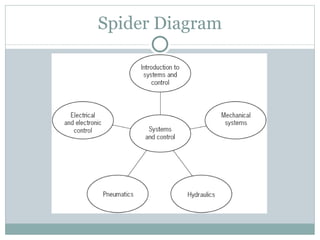
Spider Diagram
Introduction This chapter deals primarily with the use of mechanical components, and the characteristics of liquids (hydraulics), air (pneumatics) and electrical/electronic control. For centuries, people have used power transmission devices to their advantage to carry out tasks. The wheel itself represents a method of transmitting rotary motion into linear motion. Adding teeth to the rim of the wheel assured the positive, no-slip transmission of energy. Earliest recordings shows that devices such as pumps and waterwheels were known in very ancient times. In the nineteenth century, high-pressured water and air devices were introduced as alternative power sources.
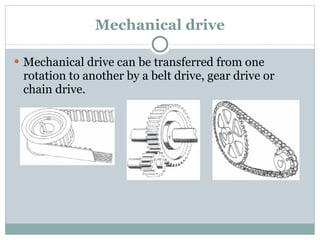
Mechanical drive Mechanical drive can be transferred from one rotation to another by a belt drive, gear drive or chain drive.
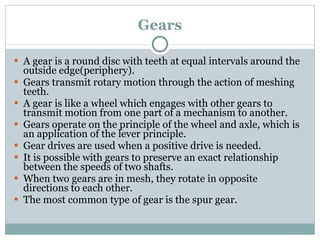
Gears A gear is a round disc with teeth at equal intervals around the outside edge(periphery). Gears transmit rotary motion through the action of meshing teeth. A gear is like a wheel which engages with other gears to transmit motion from one part of a mechanism to another. Gears operate on the principle of the wheel and axle, which is an application of the lever principle. Gear drives are used when a positive drive is needed. It is possible with gears to preserve an exact relationship between the speeds of two shafts. When two gears are in mesh, they rotate in opposite directions to each other. The most common type of gear is the spur gear.
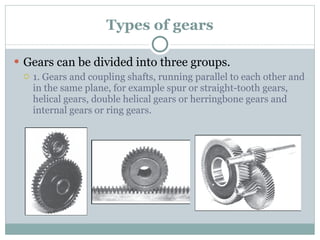
Types of gears Gears can be divided into three groups. 1. Gears and coupling shafts, running parallel to each other and in the same plane, for example spur or straight-tooth gears, helical gears, double helical gears or herringbone gears and internal gears or ring gears.
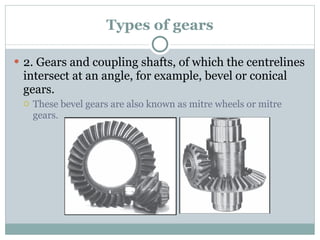
Types of gears 2. Gears and coupling shafts, of which the centrelines intersect at an angle, for example, bevel or conical gears. These bevel gears are also known as mitre wheels or mitre gears.
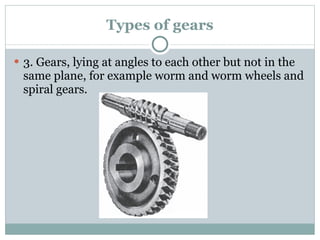
Types of gears 3. Gears, lying at angles to each other but not in the same plane, for example worm and worm wheels and spiral gears.
Pulleys Pulleys are manufactured from wrought iron, cast iron, wood or steel and even plastic. Wooden pulleys are light in mass, and consist of two halves that are bolted together. Large pulleys that run at high speeds should be accurately balanced before being assembled. Fixed pulleys are used with belts to transfer force from one rotating axis to another.
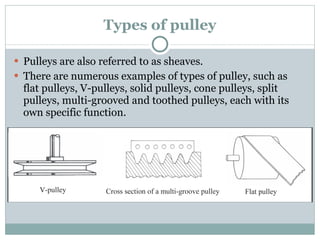
Types of pulley Pulleys are also referred to as sheaves. There are numerous examples of types of pulley, such as flat pulleys, V-pulleys, solid pulleys, cone pulleys, split pulleys, multi-grooved and toothed pulleys, each with its own specific function.
Belts Pulleys are usually belt driven. When unusually high loads are applied to belt and pulley systems, the belts will tend to slip on the pulleys and thus absorb the additional stresses which would have been conveyed to the machine parts. In so doing, they prevent damage and expensive repair to the machine. Belts are ideal where the distance between driver and driven shafts is long. The basic feature of belt drives is the absence of noise in comparison to gear drives and chain drives.
Types of belt-1 Flat belt  drives are mainly used for long distance drives, for example conveyor belts (between main shafts and intermediate shafts and from loose pulleys to fixed pulleys), and where belts are to be twisted, for example crossed belt drives. Flat belts are cut to the pre-determined length and joined, using one or a combination of these methods: cementing, Riveting, stitching and metallic fasteners.
Types of belt-2 V-belt  drives were widely used to transmit power (over a short distance) from a motor to a specific machine such as a fan, sewing machine etc. V-belts are continuous belts and run in V-shaped grooves and do not need fasteners.
Types of belt-3 Most new drives nowadays are based on the  Wedge belt  application, which is an improvement on the V-belt. The V-groove on the wedge-belt pulley is deeper than on the V-pulley.
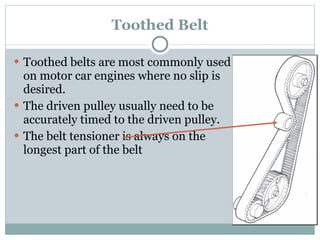
Toothed Belt Toothed belts are most commonly used on motor car engines where no slip is desired. The driven pulley usually need to be accurately timed to the driven pulley. The belt tensioner is always on the longest part of the belt
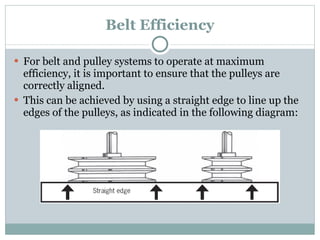
Belt Efficiency For belt and pulley systems to operate at maximum efficiency, it is important to ensure that the pulleys are correctly aligned. This can be achieved by using a straight edge to line up the edges of the pulleys, as indicated in the following diagram:
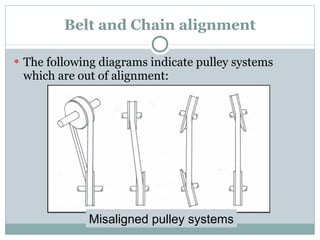
Belt and Chain alignment The following diagrams indicate pulley systems which are out of alignment: Misaligned pulley systems
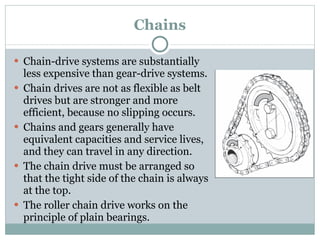
Chains Chain-drive systems are substantially less expensive than gear-drive systems. Chain drives are not as flexible as belt drives but are stronger and more efficient, because no slipping occurs. Chains and gears generally have equivalent capacities and service lives, and they can travel in any direction. The chain drive must be arranged so that the tight side of the chain is always at the top. The roller chain drive works on the principle of plain bearings.
Threads The screw thread is a spiral groove or ridge that is cut on a shaft. It has a typical form or profile that has been specified to allow for interchange ability. Although there are various types of screw thread, we will concentrate on the ISO metric screw threads.
Screw threads functions Transmit and increase the effect of power, for example the lead screw of the centre lathe and machine jack such as Acme, square, buttress and worm threads control movement, as in the micrometer, for example V-form threads. convey material, as in a food grinder, for example cast spiral threads. hold parts together, with the use of nuts, bolts, studs and screws, for example V-form threads. form a pressure-tight joint, for example tapered pipe threads.
Pitch of a screw thread The  pitch is the distance moved from  one point of the screw thread to a corresponding point on the adjacent thread, measured parallel to the axis of the thread.
Lead of a screw thread The lead is the distance that a screw thread will move axially in one revolution. The lead is calculated by multiplying the pitch by the number of starts of the screw thread.
Multiple threads Most screw threads are the single type. This means that the screw thread consists of a single ridge, groove or one starting point. A double thread differs from the single thread in that it has two threads, grooves and starts, starting at diametrically opposing directions. A triple thread has three grooves, starting at three equally spaced points around the circumference. The objective of using multiple threads is to obtain an increased lead without weakening the screw thread by an increase of pitch and depth.
Linkages Linkages are vital mechanisms. All around us, there are many examples of linkages. We will now look at the more common types of linkage. Reverse motion linkage Parallel motion linkage Bell crank linkage
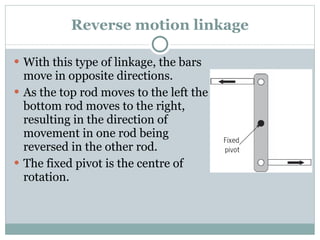
Reverse motion linkage With this type of linkage, the bars move in opposite directions. As the top rod moves to the left the bottom rod moves to the right, resulting in the direction of movement in one rod being reversed in the other rod. The fixed pivot is the centre of rotation.
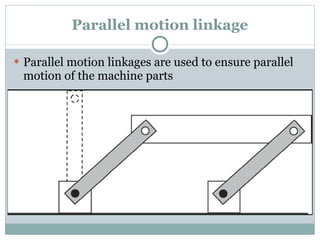
Parallel motion linkage Parallel motion linkages are used to ensure parallel motion of the machine parts
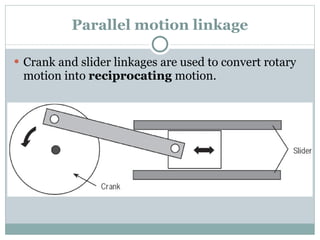
Parallel motion linkage Crank and slider linkages are used to convert rotary motion into  reciprocating  motion.
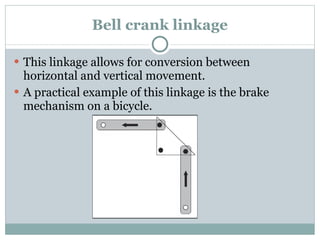
Bell crank linkage This linkage allows for conversion between horizontal and vertical movement. A practical example of this linkage is the brake mechanism on a bicycle.
Clutches A clutch is a device that enables two shafts (or rotating members) to be connected or disconnected, either while at rest or when in motion. When clutches connect two shafts, misalignment must be minimised. Clutch-life can be extended and maintenance time reduced by having parallel and concentric contact surfaces. The closer the alignment is, the longer the life of the clutch.
Clutches There are three types of clutch, each with a different means of power transmission: mechanical (positive contact, friction type, over-running) hydraulic electrical. Clutches can also be grouped according to their shaft position: all parts on the same shaft connecting different shafts, or used as a coupling.
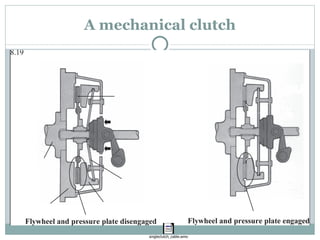
A mechanical clutch
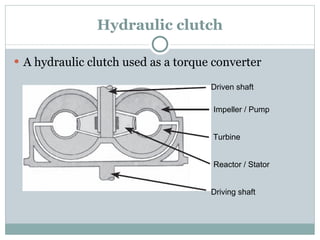
Hydraulic clutch A hydraulic clutch used as a torque converter Driven shaft Impeller / Pump Turbine Reactor / Stator Driving shaft
Levers Levers are machines used to increase force. Levers are rigid rods that move around a fixed point. The fixed point is called a fulcrum. When you push on one side of a lever, the lever moves around the fulcrum and causes another part of the lever to move the load.
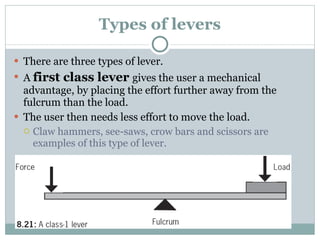
Types of levers There are three types of lever. A  first class lever  gives the user a mechanical advantage, by placing the effort further away from the fulcrum than the load. The user then needs less effort to move the load. Claw hammers, see-saws, crow bars and scissors are examples of this type of lever.
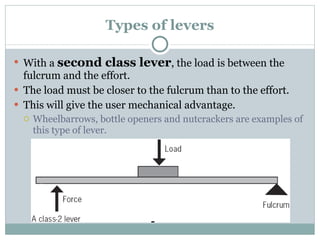
Types of levers With a  second class lever , the load is between the fulcrum and the effort. The load must be closer to the fulcrum than to the effort. This will give the user mechanical advantage. Wheelbarrows, bottle openers and nutcrackers are examples of this type of lever.
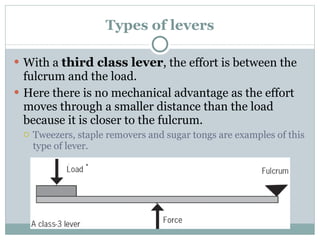
Types of levers With a  third class lever , the effort is between the fulcrum and the load. Here there is no mechanical advantage as the effort moves through a smaller distance than the load because it is closer to the fulcrum. Tweezers, staple removers and sugar tongs are examples of this type of lever.
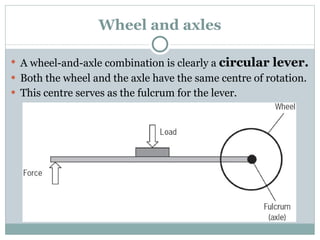
Wheel and axles A wheel-and-axle combination is clearly a  circular lever. Both the wheel and the axle have the same centre of rotation. This centre serves as the fulcrum for the lever.
Assessment Pg 159
Hydraulics/Pneumatics Hydraulic and  pneumatic systems are similar systems.  Both: use pressurised fluid or air to function need pumps, reservoirs, control valves, pressure tubes and cylinders or motors are usually used with other machinery for the purpose of control.
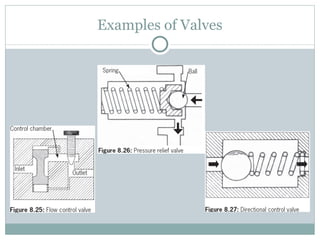
Valves Valves are used in hydraulic systems to control the operations of the actuators. Pressure control valves perform functions such as limiting maximum system pressure or regulating reduced pressure in certain portions of a circuit.  Their operation is based on a balance between pressure and spring force.
Functions & classification of valves Functions of valves include: regulating pressure in the circuit directing the hydraulic fluid into lines or in specific directions determining the amount of fluid that will flow in different parts of the circuit. Hydraulic valves can be classified as follows: flow control valves pressure relief valves directional control valves.
Examples of Valves
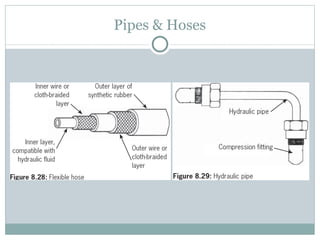
Pipes Piping is relatively economical. It is applied primarily in straight runs, and is generally made from steel, copper, stainless steel or aluminium because these materials are suitable for conveying compressed air. However, one disadvantage of copper tubing is that the vibrations in a hydraulic system can harden the copper and cause cracks at the flares. Moreover, copper decreases the life of hydraulic oil. The pipes in a pneumatic system act as air conductors.
Pipes It may be necessary to channel the air under pressure from the compressor to the actuator and also to other points of application around the pneumatic system. Tubing is sometimes favoured over piping because it seals better and is convenient to reuse and service. Flexible hoses, however, must be limited to moving applications, when pressure lines must be flexible or where rigid conduit is unsuitable. Tubing may be considerably more convenient in short runs.
Pipes & Hoses
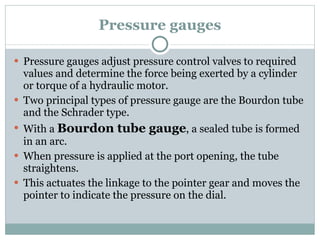
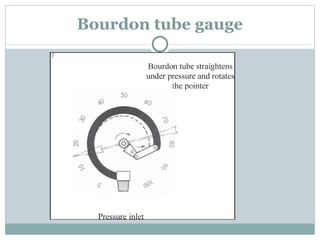
Pressure gauges Pressure gauges adjust pressure control valves to required values and determine the force being exerted by a cylinder or torque of a hydraulic motor. Two principal types of pressure gauge are the Bourdon tube and the Schrader type. With a  Bourdon tube gauge , a sealed tube is formed in an arc. When pressure is applied at the port opening, the tube straightens. This actuates the linkage to the pointer gear and moves the pointer to indicate the pressure on the dial.
Bourdon tube gauge
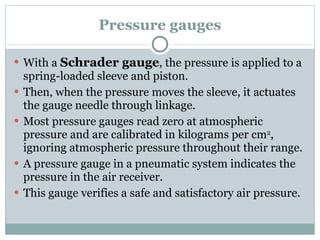
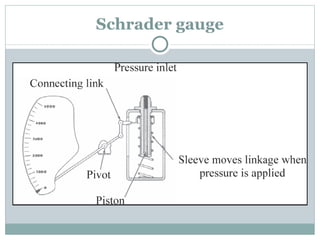
Pressure gauges With a  Schrader gauge , the pressure is applied to a spring-loaded sleeve and piston. Then, when the pressure moves the sleeve, it actuates the gauge needle through linkage. Most pressure gauges read zero at atmospheric pressure and are calibrated in kilograms per cm 2 , ignoring atmospheric pressure throughout their range. A pressure gauge in a pneumatic system indicates the pressure in the air receiver. This gauge verifies a safe and satisfactory air pressure.
Schrader gauge
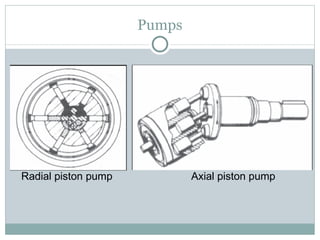
Pistons Pistons are integral to hydraulic pumps. All piston pumps employ the principle of a reciprocating piston in a bore, drawing in fluid as it is retracted, and expelling it on the forward stroke. The two basic designs are  radial and axial , and are available as fixed or variable displacement models. A radial pump has the pistons arranged radially in a cylinder block, while the pistons in axial units are parallel to one another and to the cylinder block. Axial pumps may be further divided into in-line (swash plate or wobble plate) and bent axis types.
Pumps Radial piston pump Axial piston pump
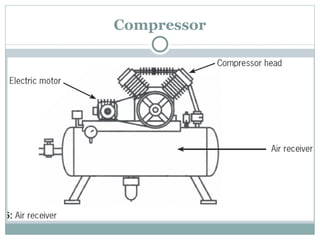
Air receiver In a pneumatic system the reservoir is known as the air receiver. The air receiver or tank is a pressure vessel in which compressed air is stored for later use. The compressor capacity determines the size of the air receiver. The air receiver must be fitted with a drain valve at the bottom, to regularly drain condensate. It must have a pressure gauge and a safety valve as well. An air receiver must be able to absorb the noise and vibration in the discharge line from the compressor, serves as a reservoir for temporary demands in excess of the compressor output, and smoothes the airflow to the service lines and compressor controls.
Compressor
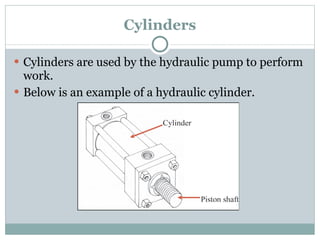
Cylinders Cylinders are used by the hydraulic pump to perform work. Below is an example of a hydraulic cylinder.
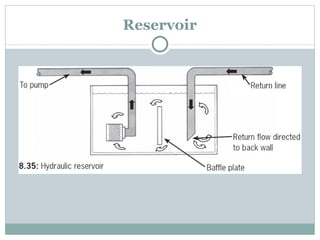
Reservoir The storage space for the fluid in a system is the oil reservoir. A reservoir is a storehouse for the fluid until it is needed by the system. Hydraulic fluid is kept clean by strainers, filters and magnetic plugs. The reservoir, also called the sump or tank, should be deep and narrow. The reservoir provides a place for the air to separate out of the fluid and should permit contaminants to settle out as well. A well-designed reservoir will help dispel any heat generated in the system. In the case of a solid tank, it helps to decrease the noise level. Every hydraulic system should have its own oil reservoir.
Reservoir
Assessment As a group design a hydraulic/pneumatic system. This hydraulic or pneumatic system must have all the basic components to make it productive. (Hint: Study the catalogues of several  manufacturers of hydraulic/pneumatic components to help you complete this task.)
Electrical/Electronic control Electricity and electronics are usually used in conjunction with hydraulic and pneumatic systems to control machinery.  Warning lights and gauges are often used to inform the operator of different conditions. e.g. Low fuel-level warning light Oil pressure warning light Temperature warning light Oil pressure indicator Fuel gauge Water-temperature gauge
Warning lights and gauges Most motor vehicles have an ignition light, which is usually red. In addition, some manufacturers fit warning lights instead of gauges. Sometimes a gauge, such as an oil-pressure or temperature gauge, operates together with a warning light, for example on the dashboard. Many motor vehicles are fitted with an ammeter or charge indicator, a fuel gauge, an oil pressure indicator and an engine temperature indicator. These instruments keep the driver informed of engine operating conditions.
Low fuel-level warning light A thermistor is a special sort of resistor that loses resistance as it gets hot. As long the thermistor in the fuel tank is covered with fuel, it keeps cool. However, when the level of fuel is low and the thermistor is exposed to air, it gets hotter, resistance is decreased and more current flows. The increase of current flow operates the warning relay and the warning light comes on to signal to the driver that fuel is low.
Oil pressure warning light Many vehicles have an oil pressure warning light instead of a gauge. The light, connected to a pressure switch in the engine, comes on when the ignition is turned on.  This switch is kept closed until the oil pressure increases to above the minimum safe pressure. Thereafter, the light goes off. If this warning light remains on, the motorist should check the engine and lubricating system immediately to investigate the low oil pressure.
Temperature warning light An operator continually needs to be aware of the engine coolant’s temperature. For this purpose, most motor vehicles have a temperature warning light. Any sudden rise in the engine temperature activates the warning light and the motorist should switch off the engine before any serious damage occurs.
Oil pressure indicator Accurate registration of variations in oil pressure can provide hints to potential or actual engine troubles, which would not be revealed by other warning systems. High pressure or a build up of pressure can be the cause of a dysfunctional pressure release valve. This may be caused by thick, cold (high viscosity) oil circulating through the engine or machine. High speeds on the machine or high revolutions on the engine should be prevented until such time as the oil has heated up and is circulating more freely. Low pressure might indicate low oil levels in the oil tank, reservoir or sump, or damage or a blockage in the lubricating system pipes or tubing. Thus the motorist is given early warning if something in the lubricating system prevents oil being delivered to the relevant parts.
Operation of the oil pressure gauge A flexible tube coiled inside the gauge is fixed to the oil lubricating system by a pipe. As the oil pressure builds up, the tube uncoils, and moves the needle linked to it around the coil, to register the oil pressure.
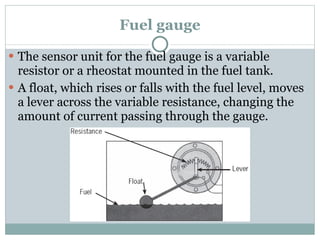
Fuel gauge The sensor unit for the fuel gauge is a variable resistor or a rheostat mounted in the fuel tank. A float, which rises or falls with the fuel level, moves a lever across the variable resistance, changing the amount of current passing through the gauge.
Fuel gauge The higher the fuel level, the lower the resistance, the greater the current and the higher the reading on the gauge. Older fuel gauges have a electromagnet, giving an immediate reading A modern fuel gauge uses a bi-metal strip. The time the heat takes to affect the bi-metal strip is a factor governing the comparatively slow swing of the needle to its reading when the motor vehicle is first switched on.
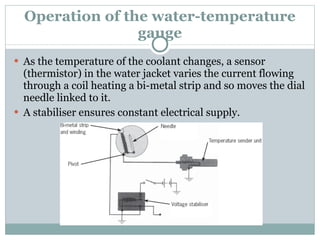
Water-temperature gauge A temperature gauge shows temperature in one of the following ways: C (cold), N (normal) and H (hot) exact reading in degrees centigrade. Modern temperature gauges and fuel gauges work on the same principle. Bi-metal strips and needles are incorporated in both gauges though the dials may differ. When current flows through the coil, the bi-metal strip is heated up and bends because its metals expand at different rates.
Water-temperature gauge As the strip bends, the needle fixed to it moves over the face of the dial. The amount of current, and hence the temperature of the strip, is controlled by a sensor unit (also known as a sender unit). In the temperature gauge, the sender unit is a thermistor. The thermistor is an electrical resistor that is sensitive to heat and is mounted in the water jacket of the engine.
Operation of the water-temperature gauge As the temperature of the coolant changes, a sensor (thermistor) in the water jacket varies the current flowing through a coil heating a bi-metal strip and so moves the dial needle linked to it. A stabiliser ensures constant electrical supply.
Assessment – Pg 166 Work on your own. Describe the functions of the following parts: 1. sender unit in the water jacket 2. water temperature gauge 3. bi-metal strip 4. fuel gauge 5. fuel tank 6. oil gauge 7. float in fuel tank 8. oil pressure warning light When you have finished this task, compare your answers with a partner’s.

Mechanical Technology Grade 10 Chapter 10 Systems And Control

  • 1.
  • 2.
  • 3.
    Introduction This chapterdeals primarily with the use of mechanical components, and the characteristics of liquids (hydraulics), air (pneumatics) and electrical/electronic control. For centuries, people have used power transmission devices to their advantage to carry out tasks. The wheel itself represents a method of transmitting rotary motion into linear motion. Adding teeth to the rim of the wheel assured the positive, no-slip transmission of energy. Earliest recordings shows that devices such as pumps and waterwheels were known in very ancient times. In the nineteenth century, high-pressured water and air devices were introduced as alternative power sources.
  • 4.
    Mechanical drive Mechanicaldrive can be transferred from one rotation to another by a belt drive, gear drive or chain drive.
  • 5.
    Gears A gearis a round disc with teeth at equal intervals around the outside edge(periphery). Gears transmit rotary motion through the action of meshing teeth. A gear is like a wheel which engages with other gears to transmit motion from one part of a mechanism to another. Gears operate on the principle of the wheel and axle, which is an application of the lever principle. Gear drives are used when a positive drive is needed. It is possible with gears to preserve an exact relationship between the speeds of two shafts. When two gears are in mesh, they rotate in opposite directions to each other. The most common type of gear is the spur gear.
  • 6.
    Types of gearsGears can be divided into three groups. 1. Gears and coupling shafts, running parallel to each other and in the same plane, for example spur or straight-tooth gears, helical gears, double helical gears or herringbone gears and internal gears or ring gears.
  • 7.
    Types of gears2. Gears and coupling shafts, of which the centrelines intersect at an angle, for example, bevel or conical gears. These bevel gears are also known as mitre wheels or mitre gears.
  • 8.
    Types of gears3. Gears, lying at angles to each other but not in the same plane, for example worm and worm wheels and spiral gears.
  • 9.
    Pulleys Pulleys aremanufactured from wrought iron, cast iron, wood or steel and even plastic. Wooden pulleys are light in mass, and consist of two halves that are bolted together. Large pulleys that run at high speeds should be accurately balanced before being assembled. Fixed pulleys are used with belts to transfer force from one rotating axis to another.
  • 10.
    Types of pulleyPulleys are also referred to as sheaves. There are numerous examples of types of pulley, such as flat pulleys, V-pulleys, solid pulleys, cone pulleys, split pulleys, multi-grooved and toothed pulleys, each with its own specific function.
  • 11.
    Belts Pulleys areusually belt driven. When unusually high loads are applied to belt and pulley systems, the belts will tend to slip on the pulleys and thus absorb the additional stresses which would have been conveyed to the machine parts. In so doing, they prevent damage and expensive repair to the machine. Belts are ideal where the distance between driver and driven shafts is long. The basic feature of belt drives is the absence of noise in comparison to gear drives and chain drives.
  • 12.
    Types of belt-1Flat belt drives are mainly used for long distance drives, for example conveyor belts (between main shafts and intermediate shafts and from loose pulleys to fixed pulleys), and where belts are to be twisted, for example crossed belt drives. Flat belts are cut to the pre-determined length and joined, using one or a combination of these methods: cementing, Riveting, stitching and metallic fasteners.
  • 13.
    Types of belt-2V-belt drives were widely used to transmit power (over a short distance) from a motor to a specific machine such as a fan, sewing machine etc. V-belts are continuous belts and run in V-shaped grooves and do not need fasteners.
  • 14.
    Types of belt-3Most new drives nowadays are based on the Wedge belt application, which is an improvement on the V-belt. The V-groove on the wedge-belt pulley is deeper than on the V-pulley.
  • 15.
    Toothed Belt Toothedbelts are most commonly used on motor car engines where no slip is desired. The driven pulley usually need to be accurately timed to the driven pulley. The belt tensioner is always on the longest part of the belt
  • 16.
    Belt Efficiency Forbelt and pulley systems to operate at maximum efficiency, it is important to ensure that the pulleys are correctly aligned. This can be achieved by using a straight edge to line up the edges of the pulleys, as indicated in the following diagram:
  • 17.
    Belt and Chainalignment The following diagrams indicate pulley systems which are out of alignment: Misaligned pulley systems
  • 18.
    Chains Chain-drive systemsare substantially less expensive than gear-drive systems. Chain drives are not as flexible as belt drives but are stronger and more efficient, because no slipping occurs. Chains and gears generally have equivalent capacities and service lives, and they can travel in any direction. The chain drive must be arranged so that the tight side of the chain is always at the top. The roller chain drive works on the principle of plain bearings.
  • 19.
    Threads The screwthread is a spiral groove or ridge that is cut on a shaft. It has a typical form or profile that has been specified to allow for interchange ability. Although there are various types of screw thread, we will concentrate on the ISO metric screw threads.
  • 20.
    Screw threads functionsTransmit and increase the effect of power, for example the lead screw of the centre lathe and machine jack such as Acme, square, buttress and worm threads control movement, as in the micrometer, for example V-form threads. convey material, as in a food grinder, for example cast spiral threads. hold parts together, with the use of nuts, bolts, studs and screws, for example V-form threads. form a pressure-tight joint, for example tapered pipe threads.
  • 21.
    Pitch of ascrew thread The pitch is the distance moved from one point of the screw thread to a corresponding point on the adjacent thread, measured parallel to the axis of the thread.
  • 22.
    Lead of ascrew thread The lead is the distance that a screw thread will move axially in one revolution. The lead is calculated by multiplying the pitch by the number of starts of the screw thread.
  • 23.
    Multiple threads Mostscrew threads are the single type. This means that the screw thread consists of a single ridge, groove or one starting point. A double thread differs from the single thread in that it has two threads, grooves and starts, starting at diametrically opposing directions. A triple thread has three grooves, starting at three equally spaced points around the circumference. The objective of using multiple threads is to obtain an increased lead without weakening the screw thread by an increase of pitch and depth.
  • 24.
    Linkages Linkages arevital mechanisms. All around us, there are many examples of linkages. We will now look at the more common types of linkage. Reverse motion linkage Parallel motion linkage Bell crank linkage
  • 25.
    Reverse motion linkageWith this type of linkage, the bars move in opposite directions. As the top rod moves to the left the bottom rod moves to the right, resulting in the direction of movement in one rod being reversed in the other rod. The fixed pivot is the centre of rotation.
  • 26.
    Parallel motion linkageParallel motion linkages are used to ensure parallel motion of the machine parts
  • 27.
    Parallel motion linkageCrank and slider linkages are used to convert rotary motion into reciprocating motion.
  • 28.
    Bell crank linkageThis linkage allows for conversion between horizontal and vertical movement. A practical example of this linkage is the brake mechanism on a bicycle.
  • 29.
    Clutches A clutchis a device that enables two shafts (or rotating members) to be connected or disconnected, either while at rest or when in motion. When clutches connect two shafts, misalignment must be minimised. Clutch-life can be extended and maintenance time reduced by having parallel and concentric contact surfaces. The closer the alignment is, the longer the life of the clutch.
  • 30.
    Clutches There arethree types of clutch, each with a different means of power transmission: mechanical (positive contact, friction type, over-running) hydraulic electrical. Clutches can also be grouped according to their shaft position: all parts on the same shaft connecting different shafts, or used as a coupling.
  • 31.
  • 32.
    Hydraulic clutch Ahydraulic clutch used as a torque converter Driven shaft Impeller / Pump Turbine Reactor / Stator Driving shaft
  • 33.
    Levers Levers aremachines used to increase force. Levers are rigid rods that move around a fixed point. The fixed point is called a fulcrum. When you push on one side of a lever, the lever moves around the fulcrum and causes another part of the lever to move the load.
  • 34.
    Types of leversThere are three types of lever. A first class lever gives the user a mechanical advantage, by placing the effort further away from the fulcrum than the load. The user then needs less effort to move the load. Claw hammers, see-saws, crow bars and scissors are examples of this type of lever.
  • 35.
    Types of leversWith a second class lever , the load is between the fulcrum and the effort. The load must be closer to the fulcrum than to the effort. This will give the user mechanical advantage. Wheelbarrows, bottle openers and nutcrackers are examples of this type of lever.
  • 36.
    Types of leversWith a third class lever , the effort is between the fulcrum and the load. Here there is no mechanical advantage as the effort moves through a smaller distance than the load because it is closer to the fulcrum. Tweezers, staple removers and sugar tongs are examples of this type of lever.
  • 37.
    Wheel and axlesA wheel-and-axle combination is clearly a circular lever. Both the wheel and the axle have the same centre of rotation. This centre serves as the fulcrum for the lever.
  • 38.
  • 39.
    Hydraulics/Pneumatics Hydraulic and pneumatic systems are similar systems. Both: use pressurised fluid or air to function need pumps, reservoirs, control valves, pressure tubes and cylinders or motors are usually used with other machinery for the purpose of control.
  • 40.
    Valves Valves areused in hydraulic systems to control the operations of the actuators. Pressure control valves perform functions such as limiting maximum system pressure or regulating reduced pressure in certain portions of a circuit. Their operation is based on a balance between pressure and spring force.
  • 41.
    Functions & classificationof valves Functions of valves include: regulating pressure in the circuit directing the hydraulic fluid into lines or in specific directions determining the amount of fluid that will flow in different parts of the circuit. Hydraulic valves can be classified as follows: flow control valves pressure relief valves directional control valves.
  • 42.
  • 43.
    Pipes Piping isrelatively economical. It is applied primarily in straight runs, and is generally made from steel, copper, stainless steel or aluminium because these materials are suitable for conveying compressed air. However, one disadvantage of copper tubing is that the vibrations in a hydraulic system can harden the copper and cause cracks at the flares. Moreover, copper decreases the life of hydraulic oil. The pipes in a pneumatic system act as air conductors.
  • 44.
    Pipes It maybe necessary to channel the air under pressure from the compressor to the actuator and also to other points of application around the pneumatic system. Tubing is sometimes favoured over piping because it seals better and is convenient to reuse and service. Flexible hoses, however, must be limited to moving applications, when pressure lines must be flexible or where rigid conduit is unsuitable. Tubing may be considerably more convenient in short runs.
  • 45.
  • 46.
    Pressure gauges Pressuregauges adjust pressure control valves to required values and determine the force being exerted by a cylinder or torque of a hydraulic motor. Two principal types of pressure gauge are the Bourdon tube and the Schrader type. With a Bourdon tube gauge , a sealed tube is formed in an arc. When pressure is applied at the port opening, the tube straightens. This actuates the linkage to the pointer gear and moves the pointer to indicate the pressure on the dial.
  • 47.
  • 48.
    Pressure gauges Witha Schrader gauge , the pressure is applied to a spring-loaded sleeve and piston. Then, when the pressure moves the sleeve, it actuates the gauge needle through linkage. Most pressure gauges read zero at atmospheric pressure and are calibrated in kilograms per cm 2 , ignoring atmospheric pressure throughout their range. A pressure gauge in a pneumatic system indicates the pressure in the air receiver. This gauge verifies a safe and satisfactory air pressure.
  • 49.
  • 50.
    Pistons Pistons areintegral to hydraulic pumps. All piston pumps employ the principle of a reciprocating piston in a bore, drawing in fluid as it is retracted, and expelling it on the forward stroke. The two basic designs are radial and axial , and are available as fixed or variable displacement models. A radial pump has the pistons arranged radially in a cylinder block, while the pistons in axial units are parallel to one another and to the cylinder block. Axial pumps may be further divided into in-line (swash plate or wobble plate) and bent axis types.
  • 51.
    Pumps Radial pistonpump Axial piston pump
  • 52.
    Air receiver Ina pneumatic system the reservoir is known as the air receiver. The air receiver or tank is a pressure vessel in which compressed air is stored for later use. The compressor capacity determines the size of the air receiver. The air receiver must be fitted with a drain valve at the bottom, to regularly drain condensate. It must have a pressure gauge and a safety valve as well. An air receiver must be able to absorb the noise and vibration in the discharge line from the compressor, serves as a reservoir for temporary demands in excess of the compressor output, and smoothes the airflow to the service lines and compressor controls.
  • 53.
  • 54.
    Cylinders Cylinders areused by the hydraulic pump to perform work. Below is an example of a hydraulic cylinder.
  • 55.
    Reservoir The storagespace for the fluid in a system is the oil reservoir. A reservoir is a storehouse for the fluid until it is needed by the system. Hydraulic fluid is kept clean by strainers, filters and magnetic plugs. The reservoir, also called the sump or tank, should be deep and narrow. The reservoir provides a place for the air to separate out of the fluid and should permit contaminants to settle out as well. A well-designed reservoir will help dispel any heat generated in the system. In the case of a solid tank, it helps to decrease the noise level. Every hydraulic system should have its own oil reservoir.
  • 56.
  • 57.
    Assessment As agroup design a hydraulic/pneumatic system. This hydraulic or pneumatic system must have all the basic components to make it productive. (Hint: Study the catalogues of several manufacturers of hydraulic/pneumatic components to help you complete this task.)
  • 58.
    Electrical/Electronic control Electricityand electronics are usually used in conjunction with hydraulic and pneumatic systems to control machinery. Warning lights and gauges are often used to inform the operator of different conditions. e.g. Low fuel-level warning light Oil pressure warning light Temperature warning light Oil pressure indicator Fuel gauge Water-temperature gauge
  • 59.
    Warning lights andgauges Most motor vehicles have an ignition light, which is usually red. In addition, some manufacturers fit warning lights instead of gauges. Sometimes a gauge, such as an oil-pressure or temperature gauge, operates together with a warning light, for example on the dashboard. Many motor vehicles are fitted with an ammeter or charge indicator, a fuel gauge, an oil pressure indicator and an engine temperature indicator. These instruments keep the driver informed of engine operating conditions.
  • 60.
    Low fuel-level warninglight A thermistor is a special sort of resistor that loses resistance as it gets hot. As long the thermistor in the fuel tank is covered with fuel, it keeps cool. However, when the level of fuel is low and the thermistor is exposed to air, it gets hotter, resistance is decreased and more current flows. The increase of current flow operates the warning relay and the warning light comes on to signal to the driver that fuel is low.
  • 61.
    Oil pressure warninglight Many vehicles have an oil pressure warning light instead of a gauge. The light, connected to a pressure switch in the engine, comes on when the ignition is turned on. This switch is kept closed until the oil pressure increases to above the minimum safe pressure. Thereafter, the light goes off. If this warning light remains on, the motorist should check the engine and lubricating system immediately to investigate the low oil pressure.
  • 62.
    Temperature warning lightAn operator continually needs to be aware of the engine coolant’s temperature. For this purpose, most motor vehicles have a temperature warning light. Any sudden rise in the engine temperature activates the warning light and the motorist should switch off the engine before any serious damage occurs.
  • 63.
    Oil pressure indicatorAccurate registration of variations in oil pressure can provide hints to potential or actual engine troubles, which would not be revealed by other warning systems. High pressure or a build up of pressure can be the cause of a dysfunctional pressure release valve. This may be caused by thick, cold (high viscosity) oil circulating through the engine or machine. High speeds on the machine or high revolutions on the engine should be prevented until such time as the oil has heated up and is circulating more freely. Low pressure might indicate low oil levels in the oil tank, reservoir or sump, or damage or a blockage in the lubricating system pipes or tubing. Thus the motorist is given early warning if something in the lubricating system prevents oil being delivered to the relevant parts.
  • 64.
    Operation of theoil pressure gauge A flexible tube coiled inside the gauge is fixed to the oil lubricating system by a pipe. As the oil pressure builds up, the tube uncoils, and moves the needle linked to it around the coil, to register the oil pressure.
  • 65.
    Fuel gauge Thesensor unit for the fuel gauge is a variable resistor or a rheostat mounted in the fuel tank. A float, which rises or falls with the fuel level, moves a lever across the variable resistance, changing the amount of current passing through the gauge.
  • 66.
    Fuel gauge Thehigher the fuel level, the lower the resistance, the greater the current and the higher the reading on the gauge. Older fuel gauges have a electromagnet, giving an immediate reading A modern fuel gauge uses a bi-metal strip. The time the heat takes to affect the bi-metal strip is a factor governing the comparatively slow swing of the needle to its reading when the motor vehicle is first switched on.
  • 67.
    Water-temperature gauge Atemperature gauge shows temperature in one of the following ways: C (cold), N (normal) and H (hot) exact reading in degrees centigrade. Modern temperature gauges and fuel gauges work on the same principle. Bi-metal strips and needles are incorporated in both gauges though the dials may differ. When current flows through the coil, the bi-metal strip is heated up and bends because its metals expand at different rates.
  • 68.
    Water-temperature gauge Asthe strip bends, the needle fixed to it moves over the face of the dial. The amount of current, and hence the temperature of the strip, is controlled by a sensor unit (also known as a sender unit). In the temperature gauge, the sender unit is a thermistor. The thermistor is an electrical resistor that is sensitive to heat and is mounted in the water jacket of the engine.
  • 69.
    Operation of thewater-temperature gauge As the temperature of the coolant changes, a sensor (thermistor) in the water jacket varies the current flowing through a coil heating a bi-metal strip and so moves the dial needle linked to it. A stabiliser ensures constant electrical supply.
  • 70.
    Assessment – Pg166 Work on your own. Describe the functions of the following parts: 1. sender unit in the water jacket 2. water temperature gauge 3. bi-metal strip 4. fuel gauge 5. fuel tank 6. oil gauge 7. float in fuel tank 8. oil pressure warning light When you have finished this task, compare your answers with a partner’s.