Course: B.Tech.
Subject: Engineering
Chemistry
Unit: III
DEFINITION:-
“A substance such as oil or grease, that reduced friction when
applied as a surface coating to moving parts”.
“A substance used to prevent contact of parts in relative motion, and
thereby reduce friction and wear and prevent rusting”.
This process of introducing lubricant is called “Lubrication".
LUBRICANTS-
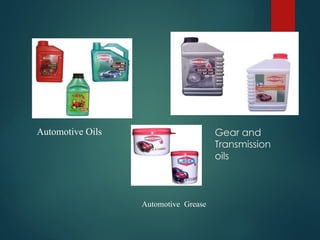
Automotive Oils Gear and
Transmission
oils
Automotive Grease
COMPOSITION-
 Typically contains Base oil 90%(petroleum-mineral oils)and
less than 10% additives
 Non liquid lubricants contains Grease powder (dry Powder such as
Molybdenum disulphite, graphite), Teflon tape used in plumbing etc
 Those non-liquid lubricants provide lubrication at higher temperature
(up to 350°C)
Friction-
 Friction is a force between two surfaces that are sliding, or trying to slide, across
each other. For example, when you try to push a book along the floor, friction
makes this difficult.
 Friction always works in the direction opposite to the direction in which the
object is moving, or trying to move. Friction always slows a moving object down
Functions of Lubricants-
i). The first and foremost function of a lubricant is to reduce friction.
ii). Lubricants reduce wear, tear and surface deformation. In actual
machinery, excessive wear on any part may result in malfunction of
entire unit. Bearing wear can induce gear mis-alignment, may affect
product shape and quality
iii). Lubricants acts as coolant to carry
away heat.
Lubricants carry away heat.
iv). Lubricants keep out dirt. The proper use of a lubricant can prevent foreign matter or
dirt from entering a bearing and damaging the smooth surface of the journal and bearing.
v). Lubricants acts as a seal. For example, in an internal combustion engine, the lubricant
used between the piston and the cylinder wall acts as a seal. This seals prevents the leakage of
gases under high pressure from the cylinder.
vi). Lubricants prevents corrosion. Lubricants reduced the maintenance and running
cost of machine as it prevent rust and corrosion.
vii). Lubricants transmit fluid power.The hydraulic lift raises automobiles in a service station
uses a piston inside a cylinder for transmitting power or force by means of petrol oil
viii). Lubricants improve the machine efficiency.as the use of lubricants minimise
the liberation of frictional heat hence it avoids seizure of moving surface and
expansion of metal. It also reduce loss of energy in the form of heat.hence it improve
the efficiency of the machine.
Lubrication-
“Lubrication is the process or technique employed to reduce friction and
wear between two relatively sliding or moving surface by interposing a
lubricant between the surfaces to carry or to help carry the load between
th opposing surface”.
 The science of friction, lubrication and wear is called Tribology.
 Adequate lubrication allows smooth continuous operation of
mechanical system(such as piston, pumps, bearings, turbines, cutting
tools etc.) without lubrication metal or components can rub
destructively over each other, causing destructive damage, heat and
failure.
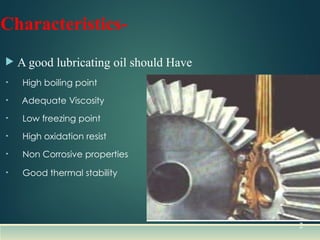
Characteristics-
 A good lubricating oil should Have
• High boiling point
• Adequate Viscosity
• Low freezing point
• High oxidation resist
• Non Corrosive properties
• Good thermal stability
2
FEATURES OF LUBRICANTS-
 Increase efficiency and reduce wear
 Dissolving or transporting foreign particles and distributing heat
 Single largest application is in form of Motor Oil, protecting
internal combustion engines in motor vehicles and equipments
 Another approach is to use ball bearings, roller bearing or air
bearings which in turn require internal lubrication themselves.
ADDITIVES USED IN LUBRICANTS
 Anti oxidant --- retard oxidative decomposition.
Ex-Aromatic amines, Phenols, Sulphides and phosphates.
 Corrosion Inhibitor --- prevents rusting and corrosion of metal parts.
Ex-Amino salts and salts of sulphonic acids.
 Antifoamant--- Prevents persistence foam formation by lubricants.
Ex-Silicon Polymers.
 Antiwear--- Reduce friction and wear.
Ex- Zinc di thio phosphates, organic phosphates and acid phosphates.
 Friction Modifier--- changes coefficients of friction.
Ex- High molecular wt, organic phosphorus and phosphoric
acids ,esters.
 Detergents--- Keep surface deposite free. Ex- Magnesium
phenolates, phosphate and sulfonates.
 Dispersant--- Keep insoluble contaminants dispersed in the
lubricants. Ex- Alkyl succinimides and alkyl-
thiophosphates.
Mechanism-
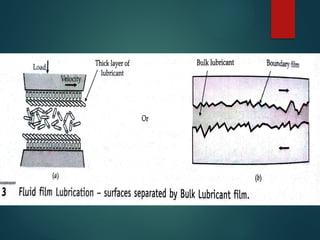
i). Hydrodynamic lubrication or fluid film lubrication or Thick
film lubrication.
ii)Boundary lubrication or thin- film lubrication.
iii)Extrem- pressure Lubrication.
Lubrication Mechanism can be classified into following types
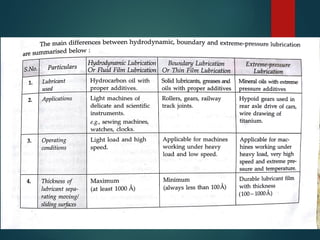
 This is also called Hydrodynamic or fluid film lubrication.
 Two sliding metal surfaces are separated from each other by
a thick film of fluid ( 1000 Angstrom thick).
 The coefficient of friction in such cases
is as low as 0.001 to 0.03
 Lubricants used : Hydrocarbon Oils.
 Ex- instruments such as watches,
clocks, light machines like sewing
machines, scientific instruments etc.
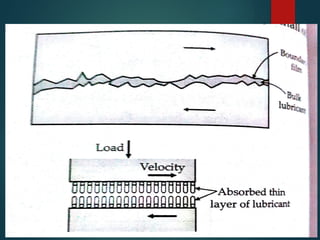
 This lubrication is also called Boundary
Lubrication.
 Its used for high load conditions ,Very thin film
of the lubricant is adsorbed on the surface by
physical or chemical forces.
 The coefficient of friction is 0.05 to 0.15.
 A thin layer of lubricant is adsorbed on the
metallic surfaces which avoids direct metal-
metal contact.
 lubrication should have high viscosity index, resistance to heat and
oxidation, good oiliness.
 Examples are Organic oils, Vegetable oils, Graphite and MoS2,
Mineral Oils etc.
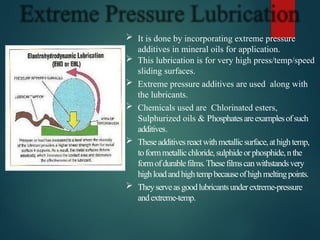
 It is done by incorporating extreme pressure
additives in mineral oils for application.
 This lubrication is for very high press/temp/speed
sliding surfaces.
 Extreme pressure additives are used along with
the lubricants.
 Chemicals used are Chlorinated esters,
Sulphurized oils & Phosphatesareexamplesofsuch
additives.
 Theseadditivesreactwithmetallicsurface,athightemp,
toformmetallicchloride,sulphideorphosphide,nthe
formofdurablefilms.Thesefilmscanwithstandsvery
highloadandhightempbecauseofhighmeltingpoints.
 Theyserveasgoodlubricantsunderextreme-pressure
andextreme-temp.
TYPES OF LUBRICANTS
 On the basis of their physical states, lubricants can
be classified as:-
 i) Liquid lubricants.
 ii) Solid lubricants.
 iii)Semi-solid lubricants.
 iv)Synthetic lubricants.
 v) Biodegradable lubricants.
LIQUID LUBRICANTS
Lubricating oils are also known as liquid lubricants
and are further classified into three categories-
a. Animal and vegetable oils,
b. Mineral or Petroleum oils and,
c. Blended oils.
Animal and Vegetable Oils-
 Animal oils are extracted from the crude fats by rendering process in
which the enclosing tissues is broken by treatment with steam or the
combined action of steam and water. Vegetable oils such as cotton
seed oil and castor oil are obtained by crushing the seeds. and
process it.
 Animal and vegetable oils possess good oiliness and hence they stick
to the surface of machines parts, even at high temperature and
heavy loads. Have very limited uses at presents they are costly.
 Examples- Animal oils and Vegetable oils
 Lard oil- For lubricating ordinary Machines parts
 Neats foot oil- For lubricating clocks and sewing machines.
 Castor oil- Very good lubricant for bearing and machines operating
at high speeds and low pressure like racing cars.
 Palm oil- For lubricating delicates instruments such as Scientific
equipments.
Minerals or Petroleum Oils
 These are basically lower Molecular weight hydrocarbons with
about 12 to 50 carbon atoms.
 Their Viscosity Increases with the length of the hydrocarbons chain.
 They are obtained by distillaltion of petroleum.
 As they are cheap, available in abundance and stable under service
conditions, hence they are widely used.
 Oiliness of mineral or petroleum oils is less compare to animals or
vegetable oils. Addition of high molecular weight compounds like
oleic acid and stearic acids, increases the oiliness of mineral oil.
Blended Oils-
 Desirable characterstics of lubricating oils can be improved
by adding small quantities of various additives.
 The oils thus obtained are knowns as Blended oils or
Compounded oils.
 An additives is a material that imparts a new or desired
property to the lubricating oil. It may also enhance a
desirable properties that the lubricating oils already
possesses to some degree.
SEMI-SOLIDs LUBRICANTS Or GREASES-
 A semi- solid lubricants obtained by combining lubricating oil with
thickening agent is termed as “Grease”.
 Lubricating oils is the principal components and it can be either
petroleum oil or a synthetic hydrocarbon of low to high viscosity.

 The thickeners consist primarily of special soaps of lithium,
sodium, calcium, barium, aluminium etc.
 Non- soap thickeners include carbon black, silica gel, Poly-ureas
and other synthetic polymers, bentonite clays etc.
 The fibrous structure of thickeners traps the oil and enables the
lubricants to cling to moving parts.
Preparation-
 Grease are made by saponification of fat with alkali like caustic soda followed by
adding hot lubricating oils with constant mixing.
 Consistency of finished grease is governed by the total amount of the mineral oils.
Classification of greases on the basis of the soap used in their
manufacture:-
i). Soda-based greases employ sodium soaps as thickening agent in petroleum
oils.
ii).Lithium- based employ lithium soaps as thickening agent in petroleum oils.
iii).Calcium-based grease employ calcium soaps as thickening agent in petroleum
oils. These greases are also known as cap-grease. And they are cheapest and most
commonly used.
Applications and Condition-
 In rails axel boxes and other apllication where oil cannot remain
in place due to high load, low speed, sudden jerks etc.
 In bearing,
 In machines preparing paper, textiles.
 In situations where bearing needs to be sealed against entry of
dust, dirts, grit or moisture as the greases are more resistance to
contamination by these agents.
Solid Lubricants-
 Solid lubricants reduce friction by separating two moving surfaces
under boundary conditions.
 They are used either in the dry powder form or mixed with oil.
 The usual coefficents of friction of solid lubricants is between 0.005
to 0.01.
Applications and conditions for using solid lubricants:-
i) Commutator bushes of motors and electronic generators.
ii)Internal combustion engines where a tight film is desired between the
piston ring and the cylinder for increasing compression.
The two most commonly used solid lubricants are:-
 Graphite.
 Molybdenum disulphide
Graphite-
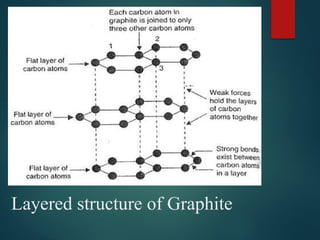
 Graphite consists of number of flat plates made up of network of
hexagons in which each carbon is in sp2 hybridisation state.
 These plates are separated from each other by 4 angstrom and are
held together by weak vander wall’s forces so that even a small
force is sufficient to slide the layers parallel to each other.
 Hence it has low coefficient of friction.
 It is very soapy to touch, non inflammable and not oxidized in air
below 375degree.
 It is used in the powdered form or as suspension in oil or water
along with emulsifying agents
 Graphite is used as lubricant in air-compressors, foodstuff industry,
railway track-joints,open grease, cast iron bearings, general - shop
works etc.
Layered structure of Graphite
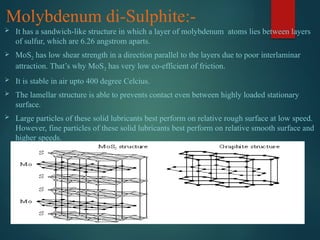
Molybdenum di-Sulphite:-
 It has a sandwich-like structure in which a layer of molybdenum atoms lies between layers
of sulfur, which are 6.26 angstrom aparts.
 MoS2 has low shear strength in a direction parallel to the layers due to poor interlaminar
attraction. That’s why MoS2 has very low co-efficient of friction.
 It is stable in air upto 400 degree Celcius.
 The lamellar structure is able to prevents contact even between highly loaded stationary
surface.
 Large particles of these solid lubricants best perform on relative rough surface at low speed.
However, fine particles of these solid lubricants best perform on relative smooth surface and
higher speeds.
These are synthesized specially to meet the severe operating conditions.
The synthetic lubricants can perform well over a wide range of temperatures
from-50"C upto260"C.
These lubricants possess low freezing points, high viscosity index and non
flammable.
Polyalkene glycols, silicones, chlorinated and fluorinated hydrocarbons; organic
amines, imines and oxides are the important synthetic oils.
Advantages of synthetic lubricants
They possess high thermal stability at high operating temperatures.
They have viscosity index and high flash points.
They are chemically stable and having low freezing points.
SYNTHETIC LUBRICANTS:
CONTINUE-----
 Polyalkene glycols: Polyalkene glycols like polyethylene glycol, poly-propylene
glycol etc. can be used as both water soluble and water insoluble lubricants in
rubber bearings and joints. They have all the three advantages mentioned above.
 Silicones: These synthetic lubricants are not oxidized below 2000
C and possess high
viscosity index. At temperature above 2000
C, silicones are oxidized quickly and
undergo cracking process at about 230°C. Therefore such lubricants are used for
low temperature lubrication purposes but not employed for high temperature
applications.
 Chlorinated and fluorinated hydrocarbons: They are not decomposed by heat,
not easily oxidisable and chemically inert and resistant to chemicals etc.
 Organic amines: They are good synthetic lubricants, since they possess low pour
points and high viscosity index. They can be used under temperature conditions of -
50"C to 250"C.
Biodegradable Lubricants-
A lubricant is classified as biodegradable if its percentage degradation
in standard test exceeds a target level.
Characteristics of Ideal Biodegradable Lubricants-
a. Low temperature fluidity,
b. Oxidation and thermastablity,
c. Protection from corrosion and wear,
d. Load carrying capacity.
 Generally the Lubricating oils are tested for their Physical and chemical
properties.
PROPERTIES AND TESTING OF LUBRICATING OILS
• Physical properties
Viscosity and viscosity Index,
Flash point and Fire Point,
Cloud and Pour Point,
Carbon Residue,
• Chemical properties-
Aniline Point,
Emulsification and steam emulsion Number,
Saponification Value,
Oiliness or Lubricity,
Neutralization Number or Acid Number.
 It is the property of a fluid that determines its resistance to flow. It is an
indicator of flowability of a lubricating oil, the lower the viscosity, greater the
flowability.
It is mainly, due to the forces of cohesion between the molecules of lubricating
oil.
Absolute viscosity may be defined as "the tangential force per unit area which
is required to maintain a unit velocity gradient between two parallel layers; It is
denoted by eta (η).
Absolute Kinematic viscosity is the ratio of absolute viscosity to 'density for any
fluid.
It is denoted by v.
VISCOSITY
Effect of temperature on viscosity.
Like any other fluid, viscosity of lubricating oil is inversely proportional to temperature. i.e.,
with increase of temperature, viscosity decreases. This is due to the decreases in
intermolecular attraction. At higher temperatures oils must have sufficient viscosity to carry
loads. Hence, heavier oils are used at higher temperatures. Similarly, light oils are used at low
ambient temperatures.
Effect of pressure on Viscosity
Lubricating oils are subjected to extreme pressure at the interface between gears and between
rolling element and in a rolling bearing. At such high pressures, viscosity of lubricating oils
increases considerably.
Significance of Viscosity.
Viscosity helps in the selection of good Lubricating oil. For instance, Light oils have low
densities and easy f'lowability. These oils i.e., generally used on parts moving at high speed
promotes the formation of a good oil film. Moreover, light oils do not impose much drag on high-
speed parts.
The Saybolt Viscometer
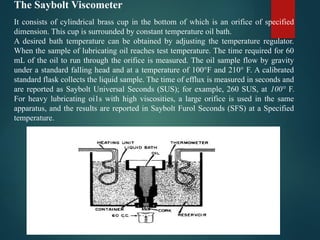
It consists of cylindrical brass cup in the bottom of which is an orifice of specified
dimension. This cup is surrounded by constant temperature oil bath.
A desired bath temperature can be obtained by adjusting the temperature regulator.
When the sample of lubricating oil reaches test temperature. The time required for 60
mL of the oil to run through the orifice is measured. The oil sample flow by gravity
under a standard falling head and at a temperature of 100°F and 210° F. A calibrated
standard flask collects the liquid sample. The time of efflux is measured in seconds and
are reported as Saybolt Universal Seconds (SUS); for example, 260 SUS, at 100° F.
For heavy lubricating oi1s with high viscosities, a large orifice is used in the same
apparatus, and the results are reported in Saybolt Furol Seconds (SFS) at a Specified
temperature.
KINEMATIC VISCOMETER-
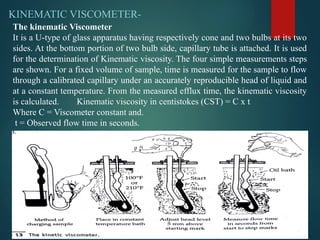
The kinematic Viscometer
It is a U-type of glass apparatus having respectively cone and two bulbs at its two
sides. At the bottom portion of two bulb side, capillary tube is attached. It is used
for the determination of Kinematic viscosity. The four simple measurements steps
are shown. For a fixed volume of sample, time is measured for the sample to flow
through a calibrated capillary under an accurately reproducible head of liquid and
at a constant temperature. From the measured efflux time, the kinematic viscosity
is calculated. Kinematic viscosity in centistokes (CST) = C x t
Where C = Viscometer constant and.
t = Observed flow time in seconds.
The Redwood Viscometer –It is of two types
a).REDWOOD VISCOSITY NO. I-UNIVERSAL.
b).REDWOOD VISCOSITY NO.2-ADMIRALTY.
The essential difference between the two are.
Red wood viscometer No 1 :
It is used for determining viscosities of thin lubricating oils. It has an orifice/opening of
diameter 1.62mm and length 10mm.
Red wood viscometer No 2:
It is used for measuring viscosities of highly viscous oil. It has an orifice of diameter 3.8mm
and length 15mm
Working – The oil to be tested is filled in the oil cup to the pointer level
Kohlrausch’s flask is kept below the jet outlet to collect the oil
Temperature of oil is noted with the help of thermometer.
At desired temp the valve from jet hole is removed.
The time taken to collect 50ml of oil in the flask is noted .
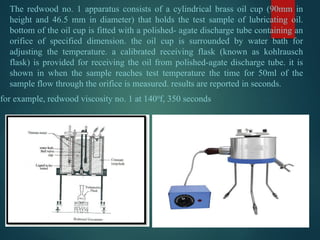
The redwood no. 1 apparatus consists of a cylindrical brass oil cup (90mm in
height and 46.5 mm in diameter) that holds the test sample of lubricating oil.
bottom of the oil cup is fitted with a polished- agate discharge tube containing an
orifice of specified dimension. the oil cup is surrounded by water bath for
adjusting the temperature. a calibrated receiving flask (known as kohlrausch
flask) is provided for receiving the oil from polished-agate discharge tube. it is
shown in when the sample reaches test temperature the time for 50ml of the
sample flow through the orifice is measured. results are reported in seconds.
for example, redwood viscosity no. 1 at 1400
f, 350 seconds
 With changes in temperature, the viscosity of lubricating oil varies, the higher
the temperature, the lower the viscosity and vice-versa.
 The rate of variation of viscosity with temperature is different for different
base oils or fluids. For example, in petroleum oils, the viscosities of
naphthenic base oils vary more over the same temperature range than those of
paraffinic base oils.
 The rate at which the viscosity of oil changes with temperature is measured by
an empirical number, known as the viscosity-index (V.I.).
 A relatively small change in viscosity with temperature is indicated by high
viscosity index. Whereas a low viscosity index shows a relatively large change
in viscosity with temperature.
 The pennsylvanian oils, consisting mainly of paraffin’s, are arbitrarily
assigned a viscosity index value of 100 as they exhibit a relatively small
change in viscosity with a rise in temperature. Oils of gulf-coast origin,
consists mainly of alicyclic (naphthenic), and are arbitrarily assigned a
viscosity index value of Zero as they exhibit a larger change in viscosity with
a rise in temperature.
 In industry, lubricating oils of high viscosity index are preferred since they
have practically the same viscosity over a range of temperatures.
Viscosity Index
----
the help of two types of standard oils viz. Pennsylvanian oils and Gulf oils having V.I.'s
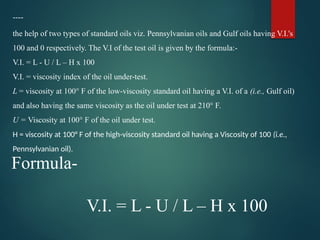
100 and 0 respectively. The V.I of the test oil is given by the formula:-
V.I. = L - U / L – H x 100
V.I. = viscosity index of the oil under-test.
L = viscosity at 100° F of the low-viscosity standard oil having a V.I. of a (i.e., Gulf oil)
and also having the same viscosity as the oil under test at 210° F.
U = Viscosity at 100° F of the oil under test.
H = viscosity at 100° F of the high-viscosity standard oil having a Viscosity of 100 (i.e.,
Pennsylvanian oil).
Formula-
V.I. = L - U / L – H x 100
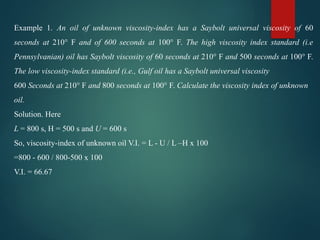
Example 1. An oil of unknown viscosity-index has a Saybolt universal viscosity of 60
seconds at 210° F and of 600 seconds at 100° F. The high viscosity index standard (i.e
Pennsylvanian) oil has Saybolt viscosity of 60 seconds at 210° F and 500 seconds at 100° F.
The low viscosity-index standard (i.e., Gulf oil has a Saybolt universal viscosity
600 Seconds at 210° F and 800 seconds at 100° F. Calculate the viscosity index of unknown
oil.
Solution. Here
L = 800 s, H = 500 s and U = 600 s
So, viscosity-index of unknown oil V.I. = L - U / L –H x 100
=800 - 600 / 800-500 x 100
V.I. = 66.67
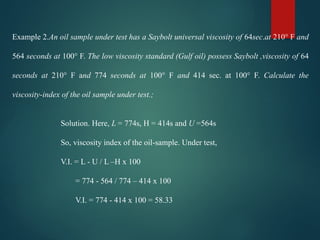
Example 2.An oil sample under test has a Saybolt universal viscosity of 64sec.at 210° F and
564 seconds at 100° F. The low viscosity standard (Gulf oil) possess Saybolt ,viscosity of 64
seconds at 210° F and 774 seconds at 100° F and 414 sec. at 100° F. Calculate the
viscosity-index of the oil sample under test.;
Solution. Here, L = 774s, H = 414s and U =564s
So, viscosity index of the oil-sample. Under test,
V.I. = L - U / L –H x 100
= 774 - 564 / 774 – 414 x 100
V.I. = 774 - 414 x 100 = 58.33
Viscosity is the property of lubricating oil that determines its
ability to lubricates.
Viscosity values are used in evaluating load carrying capacity, in
denoting the effect of temperature changes for establishing
uniformity in shipments and for determining the presence of
contaminants in used oil during absolute viscosity values are
required for use in all bearing design calculations and other
lubrication engg, technical design problems,
Significance of viscosity measurements-
Flash and Fire & Point-
 The flash point of oil is the lowest temperature at which it gives off
vapors that will ignite for a moment when a small flame is brought near
it.
 The fire point of oil is the lowest temperature at which the vapors of the
oil burn continuously for at least 5 seconds when a small flame is brought
near it.
 The flash points and fire points are used to indicate the fire hazards of
petroleum products arid evaporation losses under high temperature
operations.
 Knowledge of flash and fire points in lubricating oil aids in
precautionary measures against fire hazards.
 A good lubricant should have flash point at least above the temperature
at which it is to be used.
Apparatus used to determine
 Abel’s Closed Cup
 Pensky Marten’s closed cup
 Clevland open cup
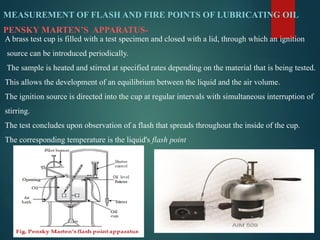
MEASUREMENT OF FLASH AND FIRE POINTS OF LUBRICATING OIL
PENSKY MARTEN’S APPARATUS-
A brass test cup is filled with a test specimen and closed with a lid, through which an ignition
source can be introduced periodically.
The sample is heated and stirred at specified rates depending on the material that is being tested.
This allows the development of an equilibrium between the liquid and the air volume.
The ignition source is directed into the cup at regular intervals with simultaneous interruption of
stirring.
The test concludes upon observation of a flash that spreads throughout the inside of the cup.
The corresponding temperature is the liquid's flash point
Abel’s closed cup
The sample is place in the cup of an Abel flash point apparatus and heated at a
very slow uniform rate with stirring. A small test – flame is directed into the cup
at regular intervals, and the flash point is taken as the lowest temperature at
which application of the test flame causes the vapour above the sample to ignite
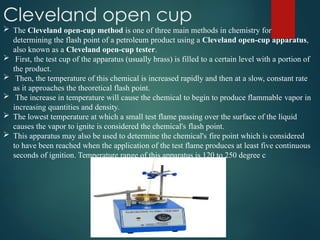
Cleveland open cup
 The Cleveland open-cup method is one of three main methods in chemistry for
determining the flash point of a petroleum product using a Cleveland open-cup apparatus,
also known as a Cleveland open-cup tester.
 First, the test cup of the apparatus (usually brass) is filled to a certain level with a portion of
the product.
 Then, the temperature of this chemical is increased rapidly and then at a slow, constant rate
as it approaches the theoretical flash point.
 The increase in temperature will cause the chemical to begin to produce flammable vapor in
increasing quantities and density.
 The lowest temperature at which a small test flame passing over the surface of the liquid
causes the vapor to ignite is considered the chemical's flash point.
 This apparatus may also be used to determine the chemical's fire point which is considered
to have been reached when the application of the test flame produces at least five continuous
seconds of ignition. Temperature range of this apparatus is 120 to 250 degree c
The oil sample is filled up to the specified filling mark in the cup. It is then covered and
positioned properly in the stove. The thermometer is inserted in the sample. The test flame
is lighted, while being stirred, the sample is heated at the rate of 9° to 11°F per minute.
Upto 220° F, the test flame is applied at every 2° F rise in temperature, thereafter it is
applied at every 5° F rise in temperature. When a distinct flash occurs in the interior of the
cup at the time of the flame application, the temperature reading on the thermometer is the
flash point.
Procedure:-
CLOUD AND POUR POINTS-
 The cloud point of petroleum oil is the temperature at which solidifiable
compounds, like paraffin wax, present in the oil begin to crystallize or
separate from solution.
 When the oil is cooled under specified conditions. Naphthenic type of oils
that are quite wax-free show no cloud points.
 The pour point of a petroleum oil is the temperature at which the oil ceases
to flow or pour.
 At the Cloud point, oil becomes cloudy or hazy in appearance. Cloud and
pour-points indicate the suitability of lubricants in cold conditions.
 Lubricants used in a machine working at low temperature should possess
low pour-point; otherwise solidification of lubricant will cause jamming of
the machine.
 Pour point is of importance in establishing the lowest temperature at which a
diesel fuel is still sufficiently fluid to be pumped or transferred.
 Oil with a low pour point should be selected whenever the oil must remain
fluid at low temperatures.
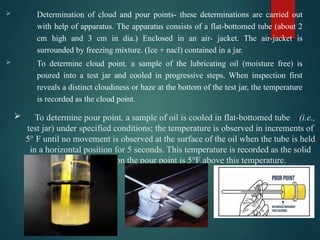
 To determine pour point, a sample of oil is cooled in flat-bottomed tube (i.e.,
test jar) under specified conditions; the temperature is observed in increments of
5° F until no movement is observed at the surface of the oil when the tube is held
in a horizontal position for 5 seconds. This temperature is recorded as the solid
point. By definition the pour point is 5°F above this temperature.
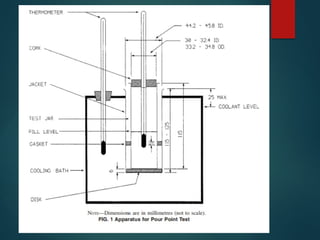
 Determination of cloud and pour points- these determinations are carried out
with help of apparatus. The apparatus consists of a flat-bottomed tube (about 2
cm high and 3 cm in dia.) Enclosed in an air- jacket. The air-jacket is
surrounded by freezing mixture. (Ice + nacl) contained in a jar.
 To determine cloud point, a sample of the lubricating oil (moisture free) is
poured into a test jar and cooled in progressive steps. When inspection first
reveals a distinct cloudiness or haze at the bottom of the test jar, the temperature
is recorded as the cloud point.
SIGNIFICANCE:-
Pour-points indicate the suitability of lubricants in cold conditions. Lubricant used in
machine working at low temperature should possess low pour-point, otherwise
solidification of lubricant will cause jamming of the machine. Pourpoint values of
petroleum and non-petroleum lubricants are significant as many operations must
function is sub-freezing conditions.
Cloud and pour point of lubricant: When the temperature is lowered up to a particular
point, the oil becomes cloudy in appearance. This temperature is called cloud point. When
the temperature is further lowered up to a certain temperature, the oil ceases to flow or
pour or becomes semisolid.
ANILINE POINT:-
 Aniline point is defined as "the minimum equilibrium solution temperature for equal
volume of aniline and oil sample.
 " It is determined by thoroughly mixing equal volumes of oil sample af aniline in a test
tube and heating the mixture until a homogeneous solution is obtained.
 Then, the tube is allowed to cool at a controlled rate.
 The temperature at which the oil and aniline phases separate out is recorded as the aniline
point. A lower aniline point of oil means a higher percentage of aromatic hydrocarbons in
it. Since aromatic hydrocarbons have a tendency to dissolve natural rubber and certain
types of synthetic rubbers.
 Thus, higher the percentage of aromatic hydrocarbon or lower the aniline point of a oil,
more are the chances of deterioration of an oil when it comes in contact with rubber
sealing’s, packing, etc.
 Consequently, low aromatic content in the lubricants or their higher aniline point is
desirable.
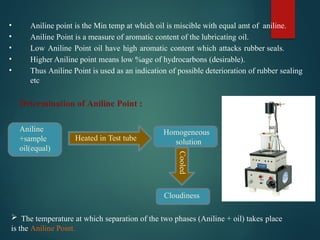
Determination of Aniline Point :
Aniline
+sample
oil(equal)
Heated in Test tube
Homogeneous
solution
Cooled
 The temperature at which separation of the two phases (Aniline + oil) takes place
is the Aniline Point.
• Aniline point is the Min temp at which oil is miscible with equal amt of aniline.
• Aniline Point is a measure of aromatic content of the lubricating oil.
• Low Aniline Point oil have high aromatic content which attacks rubber seals.
• Higher Aniline point means low %age of hydrocarbons (desirable).
• Thus Aniline Point is used as an indication of possible deterioration of rubber sealing
etc
Cloudiness
Significance-
 A lower aniline point of oil means a higher percentage of aromatic hydrocarbons in it.
Since aromatic hydrocarbons have a tendency to dissolve natural rubber and certain
types of synthetic rubbers.
 Thus, higher the percentage of aromatic hydrocarbon or lower the aniline point of a
oil, more are the chances of deterioration of an oil when it comes in contact with
rubber sealing’s, packing, etc.
 Consequently, low aromatic content in the lubricants or their higher aniline point is
desirable.
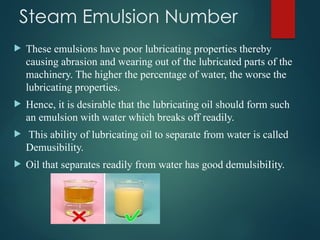
Steam Emulsion Number
 These emulsions have poor lubricating properties thereby
causing abrasion and wearing out of the lubricated parts of the
machinery. The higher the percentage of water, the worse the
lubricating properties.
 Hence, it is desirable that the lubricating oil should form such
an emulsion with water which breaks off readily.
 This ability of lubricating oil to separate from water is called
Demusibility.
 Oil that separates readily from water has good demulsibiIity.
Steam Emulsion Number
 Oil that does not has poor demulsibility.
 The tendency of lubricant Water emulsion to break is determined by
following test; steam at 100°.C is bubbled through a test tube
containing 20 mL of oil, till the increases to 90° C and the time is
noted when the oil, and water separate out in distinct layers.
 The time in second in which oil and water emulsion separate out in
distinct layers is called 'steam emulsion number'(SEN) or
'emulsification number'.
 The quicker the oil separates out from the emulsion, the lower the
steam emulsion number and the better the lubricating oil for most
purposes.
Significance
 To avoid corrosion of polished steel surfaces like roll necks and to
ensure proper lubrication, it is important to evaluate the speed of
water and oil separation (demulsibility properties) of medium to
high viscosity circulating oils used in rolling mills subject to
cooling water contamination.
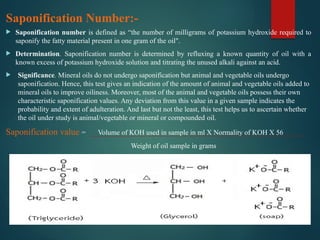
Saponification Number:-
 Saponification number is defined as “the number of milligrams of potassium hydroxide required to
saponify the fatty material present in one gram of the oil".
 Determination. Saponification number is determined by refluxing a known quantity of oil with a
known excess of potassium hydroxide solution and titrating the unused alkali against an acid.
 Significance. Mineral oils do not undergo saponification but animal and vegetable oils undergo
saponification. Hence, this test gives an indication of the amount of animal and vegetable oils added to
mineral oils to improve oiliness. Moreover, most of the animal and vegetable oils possess their own
characteristic saponification values. Any deviation from this value in a given sample indicates the
probability and extent of adulteration. And last but not the least, this test helps us to ascertain whether
the oil under study is animal/vegetable or mineral or compounded oil.
Saponification value = Volume of KOH used in sample in ml X Normality of KOH X 56
Weight of oil sample in grams
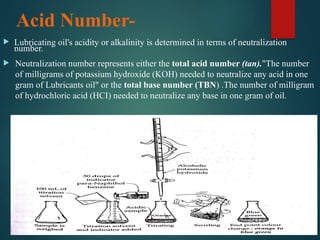
Acid Number-
 Lubricating oil's acidity or alkalinity is determined in terms of neutralization
number.
 Neutralization number represents either the total acid number (tan)."The number
of milligrams of potassium hydroxide (KOH) needed to neutralize any acid in one
gram of Lubricants oil" or the total base number (TBN) .The number of milligram
of hydrochloric acid (HCI) needed to neutralize any base in one gram of oil.
(i) Into 300 ml conical flask, take a weighed amount of the sample (20 gm sample for
light-colored oil or 2 gm sample for dark-colored oil).
(ii)Add 100 ml of titration solvent and 30 drops of indicator solution to the flask, then
carefully swirl the mixture until the sample is completely dissolved.
(iii)If the solution turns yellow-orange or deep orange in color, it means the oil sample
was acidic [but if it assumes green or green-blue color, it means the oil sample was
basic, then titration should be done with HCl.
(iv)Slowly add the alc. KOH solution from the burette drop by drop with careful
swirling until the green or green-blue end point is reached which persist for at least
15 s .[The color change is reversed if alc . HCl is the titrating agent].
(v) Read from the burette the number of ml of solution required to reach the end point.
(vi)The acid value should not exceed than 0.1mg/g for good Lubricants.
Determination of tan is more common and its
test procedure is given below:
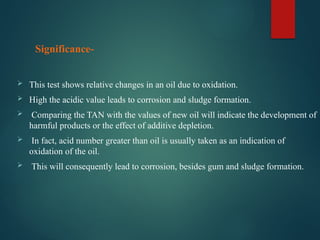
 This test shows relative changes in an oil due to oxidation.
 High the acidic value leads to corrosion and sludge formation.
 Comparing the TAN with the values of new oil will indicate the development of
harmful products or the effect of additive depletion.
 In fact, acid number greater than oil is usually taken as an indication of
oxidation of the oil.
 This will consequently lead to corrosion, besides gum and sludge formation.
Significance-
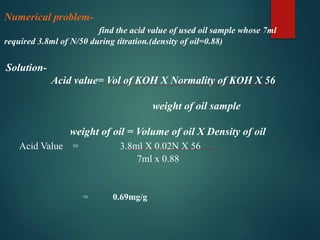
Numerical problem-
find the acid value of used oil sample whose 7ml
required 3.8ml of N/50 during titration.(density of oil=0.88)
Solution-
Acid value= Vol of KOH X Normality of KOH X 56
weight of oil sample
weight of oil = Volume of oil X Density of oil
Acid Value = 3.8ml X 0.02N X 56
7ml x 0.88
= 0.69mg/g
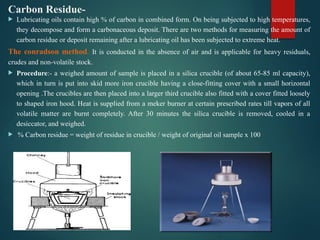
Carbon Residue-
 Lubricating oils contain high % of carbon in combined form. On being subjected to high temperatures,
they decompose and form a carbonaceous deposit. There are two methods for measuring the amount of
carbon residue or deposit remaining after a lubricating oil has been subjected to extreme heat.
The conradson method. It is conducted in the absence of air and is applicable for heavy residuals,
crudes and non-volatile stock.
 Procedure:- a weighed amount of sample is placed in a silica crucible (of about 65-85 ml capacity),
which in turn is put into skid more iron crucible having a close-fitting cover with a small horizontal
opening .The crucibles are then placed into a larger third crucible also fitted with a cover fitted loosely
to shaped iron hood. Heat is supplied from a meker burner at certain prescribed rates till vapors of all
volatile matter are burnt completely. After 30 minutes the silica crucible is removed, cooled in a
desiccator, and weighed.
 % Carbon residue = weight of residue in crucible / weight of original oil sample x 100
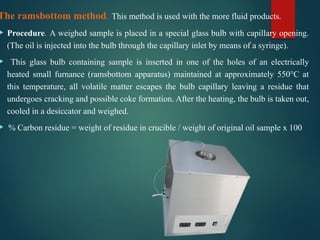
The ramsbottom method. This method is used with the more fluid products.
 Procedure. A weighed sample is placed in a special glass bulb with capillary opening.
(The oil is injected into the bulb through the capillary inlet by means of a syringe).
 This glass bulb containing sample is inserted in one of the holes of an electrically
heated small furnance (ramsbottom apparatus) maintained at approximately 550°C at
this temperature, all volatile matter escapes the bulb capillary leaving a residue that
undergoes cracking and possible coke formation. After the heating, the bulb is taken out,
cooled in a desiccator and weighed.
 % Carbon residue = weight of residue in crucible / weight of original oil sample x 100
 Significance of carbon-residue tests.
 Certain lubricating oils tend to deposit carbon in the combustion chambers of internal
combustion engines, due to the carbonizing of the lubricating oil carried up past the
piston rings into the combustion chambers.
 Incomplete combustion of fuel also results in carbon deposition. Excessive buildup of
carbon deposits in the combustion chamber results in decreased volume of the charge
at the end of the compression stroke giving increasing compression ratio which
eventually leads to detonation/ explosion.
 The tests are used in the evaluation of base crudes and feed stocks for the formulation
of lubricants and fuels to be used in extreme temperature service.
Oiliness-
 It is a property by virtue of which an oil remains adhered to the
lubricating surface.
 It is directly related to specific of oil.
 Lowe the specific gravity [specific gravity of an object is
the density of that object divided by the density of water], higher
is oiliness.
 Oiliness is fell on touching, but is cannot be measured by any
standard test.
 The vegetables /animals oils are with high oiliness, compare to
mineral oils.
 Oiliness is an oil enhancement property provided through the use
of chemical additives known as antiwear agent.
 Most oils intended for use in heavier machine applications
containing AW agents.
 True lubricants differ from ordinary liquids of equal viscosity in
as much as they possess the property of “Oiliness” This property
which enables them to maintain an unbroken film between
surface when the loads are heavy.
 It is possessed most markedly by vegetables and animals oils and
fats, and less markedly by mineral oils.
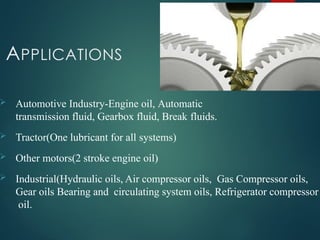
APPLICATIONS
 Automotive Industry-Engine oil, Automatic
transmission fluid, Gearbox fluid, Break fluids.
 Tractor(One lubricant for all systems)
 Other motors(2 stroke engine oil)
 Industrial(Hydraulic oils, Air compressor oils, Gas Compressor oils,
Gear oils Bearing and circulating system oils, Refrigerator compressor
oil.
unit 3Lubrications ppt_1698398759 (2).pptx

unit 3Lubrications ppt_1698398759 (2).pptx

  • 1.
  • 2.
    DEFINITION:- “A substance suchas oil or grease, that reduced friction when applied as a surface coating to moving parts”. “A substance used to prevent contact of parts in relative motion, and thereby reduce friction and wear and prevent rusting”. This process of introducing lubricant is called “Lubrication". LUBRICANTS-
  • 3.
    Automotive Oils Gearand Transmission oils Automotive Grease
  • 4.
    COMPOSITION-  Typically containsBase oil 90%(petroleum-mineral oils)and less than 10% additives  Non liquid lubricants contains Grease powder (dry Powder such as Molybdenum disulphite, graphite), Teflon tape used in plumbing etc  Those non-liquid lubricants provide lubrication at higher temperature (up to 350°C)
  • 5.
    Friction-  Friction isa force between two surfaces that are sliding, or trying to slide, across each other. For example, when you try to push a book along the floor, friction makes this difficult.  Friction always works in the direction opposite to the direction in which the object is moving, or trying to move. Friction always slows a moving object down
  • 6.
    Functions of Lubricants- i).The first and foremost function of a lubricant is to reduce friction. ii). Lubricants reduce wear, tear and surface deformation. In actual machinery, excessive wear on any part may result in malfunction of entire unit. Bearing wear can induce gear mis-alignment, may affect product shape and quality iii). Lubricants acts as coolant to carry away heat. Lubricants carry away heat.
  • 7.
    iv). Lubricants keepout dirt. The proper use of a lubricant can prevent foreign matter or dirt from entering a bearing and damaging the smooth surface of the journal and bearing. v). Lubricants acts as a seal. For example, in an internal combustion engine, the lubricant used between the piston and the cylinder wall acts as a seal. This seals prevents the leakage of gases under high pressure from the cylinder. vi). Lubricants prevents corrosion. Lubricants reduced the maintenance and running cost of machine as it prevent rust and corrosion. vii). Lubricants transmit fluid power.The hydraulic lift raises automobiles in a service station uses a piston inside a cylinder for transmitting power or force by means of petrol oil viii). Lubricants improve the machine efficiency.as the use of lubricants minimise the liberation of frictional heat hence it avoids seizure of moving surface and expansion of metal. It also reduce loss of energy in the form of heat.hence it improve the efficiency of the machine.
  • 8.
    Lubrication- “Lubrication is theprocess or technique employed to reduce friction and wear between two relatively sliding or moving surface by interposing a lubricant between the surfaces to carry or to help carry the load between th opposing surface”.  The science of friction, lubrication and wear is called Tribology.  Adequate lubrication allows smooth continuous operation of mechanical system(such as piston, pumps, bearings, turbines, cutting tools etc.) without lubrication metal or components can rub destructively over each other, causing destructive damage, heat and failure.
  • 9.
    Characteristics-  A goodlubricating oil should Have • High boiling point • Adequate Viscosity • Low freezing point • High oxidation resist • Non Corrosive properties • Good thermal stability 2
  • 10.
    FEATURES OF LUBRICANTS- Increase efficiency and reduce wear  Dissolving or transporting foreign particles and distributing heat  Single largest application is in form of Motor Oil, protecting internal combustion engines in motor vehicles and equipments  Another approach is to use ball bearings, roller bearing or air bearings which in turn require internal lubrication themselves.
  • 11.
    ADDITIVES USED INLUBRICANTS  Anti oxidant --- retard oxidative decomposition. Ex-Aromatic amines, Phenols, Sulphides and phosphates.  Corrosion Inhibitor --- prevents rusting and corrosion of metal parts. Ex-Amino salts and salts of sulphonic acids.  Antifoamant--- Prevents persistence foam formation by lubricants. Ex-Silicon Polymers.  Antiwear--- Reduce friction and wear. Ex- Zinc di thio phosphates, organic phosphates and acid phosphates.
  • 12.
     Friction Modifier---changes coefficients of friction. Ex- High molecular wt, organic phosphorus and phosphoric acids ,esters.  Detergents--- Keep surface deposite free. Ex- Magnesium phenolates, phosphate and sulfonates.  Dispersant--- Keep insoluble contaminants dispersed in the lubricants. Ex- Alkyl succinimides and alkyl- thiophosphates.
  • 13.
    Mechanism- i). Hydrodynamic lubricationor fluid film lubrication or Thick film lubrication. ii)Boundary lubrication or thin- film lubrication. iii)Extrem- pressure Lubrication. Lubrication Mechanism can be classified into following types
  • 14.
     This isalso called Hydrodynamic or fluid film lubrication.  Two sliding metal surfaces are separated from each other by a thick film of fluid ( 1000 Angstrom thick).  The coefficient of friction in such cases is as low as 0.001 to 0.03  Lubricants used : Hydrocarbon Oils.  Ex- instruments such as watches, clocks, light machines like sewing machines, scientific instruments etc.
  • 16.
     This lubricationis also called Boundary Lubrication.  Its used for high load conditions ,Very thin film of the lubricant is adsorbed on the surface by physical or chemical forces.  The coefficient of friction is 0.05 to 0.15.  A thin layer of lubricant is adsorbed on the metallic surfaces which avoids direct metal- metal contact.  lubrication should have high viscosity index, resistance to heat and oxidation, good oiliness.  Examples are Organic oils, Vegetable oils, Graphite and MoS2, Mineral Oils etc.
  • 18.
     It isdone by incorporating extreme pressure additives in mineral oils for application.  This lubrication is for very high press/temp/speed sliding surfaces.  Extreme pressure additives are used along with the lubricants.  Chemicals used are Chlorinated esters, Sulphurized oils & Phosphatesareexamplesofsuch additives.  Theseadditivesreactwithmetallicsurface,athightemp, toformmetallicchloride,sulphideorphosphide,nthe formofdurablefilms.Thesefilmscanwithstandsvery highloadandhightempbecauseofhighmeltingpoints.  Theyserveasgoodlubricantsunderextreme-pressure andextreme-temp.
  • 20.
    TYPES OF LUBRICANTS On the basis of their physical states, lubricants can be classified as:-  i) Liquid lubricants.  ii) Solid lubricants.  iii)Semi-solid lubricants.  iv)Synthetic lubricants.  v) Biodegradable lubricants.
  • 21.
    LIQUID LUBRICANTS Lubricating oilsare also known as liquid lubricants and are further classified into three categories- a. Animal and vegetable oils, b. Mineral or Petroleum oils and, c. Blended oils.
  • 22.
    Animal and VegetableOils-  Animal oils are extracted from the crude fats by rendering process in which the enclosing tissues is broken by treatment with steam or the combined action of steam and water. Vegetable oils such as cotton seed oil and castor oil are obtained by crushing the seeds. and process it.  Animal and vegetable oils possess good oiliness and hence they stick to the surface of machines parts, even at high temperature and heavy loads. Have very limited uses at presents they are costly.  Examples- Animal oils and Vegetable oils  Lard oil- For lubricating ordinary Machines parts  Neats foot oil- For lubricating clocks and sewing machines.  Castor oil- Very good lubricant for bearing and machines operating at high speeds and low pressure like racing cars.  Palm oil- For lubricating delicates instruments such as Scientific equipments.
  • 23.
    Minerals or PetroleumOils  These are basically lower Molecular weight hydrocarbons with about 12 to 50 carbon atoms.  Their Viscosity Increases with the length of the hydrocarbons chain.  They are obtained by distillaltion of petroleum.  As they are cheap, available in abundance and stable under service conditions, hence they are widely used.  Oiliness of mineral or petroleum oils is less compare to animals or vegetable oils. Addition of high molecular weight compounds like oleic acid and stearic acids, increases the oiliness of mineral oil.
  • 24.
    Blended Oils-  Desirablecharacterstics of lubricating oils can be improved by adding small quantities of various additives.  The oils thus obtained are knowns as Blended oils or Compounded oils.  An additives is a material that imparts a new or desired property to the lubricating oil. It may also enhance a desirable properties that the lubricating oils already possesses to some degree.
  • 25.
    SEMI-SOLIDs LUBRICANTS OrGREASES-  A semi- solid lubricants obtained by combining lubricating oil with thickening agent is termed as “Grease”.  Lubricating oils is the principal components and it can be either petroleum oil or a synthetic hydrocarbon of low to high viscosity.  The thickeners consist primarily of special soaps of lithium, sodium, calcium, barium, aluminium etc.  Non- soap thickeners include carbon black, silica gel, Poly-ureas and other synthetic polymers, bentonite clays etc.  The fibrous structure of thickeners traps the oil and enables the lubricants to cling to moving parts.
  • 26.
    Preparation-  Grease aremade by saponification of fat with alkali like caustic soda followed by adding hot lubricating oils with constant mixing.  Consistency of finished grease is governed by the total amount of the mineral oils. Classification of greases on the basis of the soap used in their manufacture:- i). Soda-based greases employ sodium soaps as thickening agent in petroleum oils. ii).Lithium- based employ lithium soaps as thickening agent in petroleum oils. iii).Calcium-based grease employ calcium soaps as thickening agent in petroleum oils. These greases are also known as cap-grease. And they are cheapest and most commonly used.
  • 27.
    Applications and Condition- In rails axel boxes and other apllication where oil cannot remain in place due to high load, low speed, sudden jerks etc.  In bearing,  In machines preparing paper, textiles.  In situations where bearing needs to be sealed against entry of dust, dirts, grit or moisture as the greases are more resistance to contamination by these agents.
  • 28.
    Solid Lubricants-  Solidlubricants reduce friction by separating two moving surfaces under boundary conditions.  They are used either in the dry powder form or mixed with oil.  The usual coefficents of friction of solid lubricants is between 0.005 to 0.01. Applications and conditions for using solid lubricants:- i) Commutator bushes of motors and electronic generators. ii)Internal combustion engines where a tight film is desired between the piston ring and the cylinder for increasing compression. The two most commonly used solid lubricants are:-  Graphite.  Molybdenum disulphide
  • 29.
    Graphite-  Graphite consistsof number of flat plates made up of network of hexagons in which each carbon is in sp2 hybridisation state.  These plates are separated from each other by 4 angstrom and are held together by weak vander wall’s forces so that even a small force is sufficient to slide the layers parallel to each other.  Hence it has low coefficient of friction.  It is very soapy to touch, non inflammable and not oxidized in air below 375degree.  It is used in the powdered form or as suspension in oil or water along with emulsifying agents  Graphite is used as lubricant in air-compressors, foodstuff industry, railway track-joints,open grease, cast iron bearings, general - shop works etc.
  • 30.
  • 31.
    Molybdenum di-Sulphite:-  Ithas a sandwich-like structure in which a layer of molybdenum atoms lies between layers of sulfur, which are 6.26 angstrom aparts.  MoS2 has low shear strength in a direction parallel to the layers due to poor interlaminar attraction. That’s why MoS2 has very low co-efficient of friction.  It is stable in air upto 400 degree Celcius.  The lamellar structure is able to prevents contact even between highly loaded stationary surface.  Large particles of these solid lubricants best perform on relative rough surface at low speed. However, fine particles of these solid lubricants best perform on relative smooth surface and higher speeds.
  • 32.
    These are synthesizedspecially to meet the severe operating conditions. The synthetic lubricants can perform well over a wide range of temperatures from-50"C upto260"C. These lubricants possess low freezing points, high viscosity index and non flammable. Polyalkene glycols, silicones, chlorinated and fluorinated hydrocarbons; organic amines, imines and oxides are the important synthetic oils. Advantages of synthetic lubricants They possess high thermal stability at high operating temperatures. They have viscosity index and high flash points. They are chemically stable and having low freezing points. SYNTHETIC LUBRICANTS:
  • 33.
    CONTINUE-----  Polyalkene glycols:Polyalkene glycols like polyethylene glycol, poly-propylene glycol etc. can be used as both water soluble and water insoluble lubricants in rubber bearings and joints. They have all the three advantages mentioned above.  Silicones: These synthetic lubricants are not oxidized below 2000 C and possess high viscosity index. At temperature above 2000 C, silicones are oxidized quickly and undergo cracking process at about 230°C. Therefore such lubricants are used for low temperature lubrication purposes but not employed for high temperature applications.  Chlorinated and fluorinated hydrocarbons: They are not decomposed by heat, not easily oxidisable and chemically inert and resistant to chemicals etc.  Organic amines: They are good synthetic lubricants, since they possess low pour points and high viscosity index. They can be used under temperature conditions of - 50"C to 250"C.
  • 34.
    Biodegradable Lubricants- A lubricantis classified as biodegradable if its percentage degradation in standard test exceeds a target level. Characteristics of Ideal Biodegradable Lubricants- a. Low temperature fluidity, b. Oxidation and thermastablity, c. Protection from corrosion and wear, d. Load carrying capacity.
  • 35.
     Generally theLubricating oils are tested for their Physical and chemical properties. PROPERTIES AND TESTING OF LUBRICATING OILS • Physical properties Viscosity and viscosity Index, Flash point and Fire Point, Cloud and Pour Point, Carbon Residue, • Chemical properties- Aniline Point, Emulsification and steam emulsion Number, Saponification Value, Oiliness or Lubricity, Neutralization Number or Acid Number.
  • 36.
     It isthe property of a fluid that determines its resistance to flow. It is an indicator of flowability of a lubricating oil, the lower the viscosity, greater the flowability. It is mainly, due to the forces of cohesion between the molecules of lubricating oil. Absolute viscosity may be defined as "the tangential force per unit area which is required to maintain a unit velocity gradient between two parallel layers; It is denoted by eta (η). Absolute Kinematic viscosity is the ratio of absolute viscosity to 'density for any fluid. It is denoted by v. VISCOSITY
  • 37.
    Effect of temperatureon viscosity. Like any other fluid, viscosity of lubricating oil is inversely proportional to temperature. i.e., with increase of temperature, viscosity decreases. This is due to the decreases in intermolecular attraction. At higher temperatures oils must have sufficient viscosity to carry loads. Hence, heavier oils are used at higher temperatures. Similarly, light oils are used at low ambient temperatures. Effect of pressure on Viscosity Lubricating oils are subjected to extreme pressure at the interface between gears and between rolling element and in a rolling bearing. At such high pressures, viscosity of lubricating oils increases considerably. Significance of Viscosity. Viscosity helps in the selection of good Lubricating oil. For instance, Light oils have low densities and easy f'lowability. These oils i.e., generally used on parts moving at high speed promotes the formation of a good oil film. Moreover, light oils do not impose much drag on high- speed parts.
  • 38.
    The Saybolt Viscometer Itconsists of cylindrical brass cup in the bottom of which is an orifice of specified dimension. This cup is surrounded by constant temperature oil bath. A desired bath temperature can be obtained by adjusting the temperature regulator. When the sample of lubricating oil reaches test temperature. The time required for 60 mL of the oil to run through the orifice is measured. The oil sample flow by gravity under a standard falling head and at a temperature of 100°F and 210° F. A calibrated standard flask collects the liquid sample. The time of efflux is measured in seconds and are reported as Saybolt Universal Seconds (SUS); for example, 260 SUS, at 100° F. For heavy lubricating oi1s with high viscosities, a large orifice is used in the same apparatus, and the results are reported in Saybolt Furol Seconds (SFS) at a Specified temperature.
  • 39.
    KINEMATIC VISCOMETER- The kinematicViscometer It is a U-type of glass apparatus having respectively cone and two bulbs at its two sides. At the bottom portion of two bulb side, capillary tube is attached. It is used for the determination of Kinematic viscosity. The four simple measurements steps are shown. For a fixed volume of sample, time is measured for the sample to flow through a calibrated capillary under an accurately reproducible head of liquid and at a constant temperature. From the measured efflux time, the kinematic viscosity is calculated. Kinematic viscosity in centistokes (CST) = C x t Where C = Viscometer constant and. t = Observed flow time in seconds.
  • 40.
    The Redwood Viscometer–It is of two types a).REDWOOD VISCOSITY NO. I-UNIVERSAL. b).REDWOOD VISCOSITY NO.2-ADMIRALTY. The essential difference between the two are. Red wood viscometer No 1 : It is used for determining viscosities of thin lubricating oils. It has an orifice/opening of diameter 1.62mm and length 10mm. Red wood viscometer No 2: It is used for measuring viscosities of highly viscous oil. It has an orifice of diameter 3.8mm and length 15mm Working – The oil to be tested is filled in the oil cup to the pointer level Kohlrausch’s flask is kept below the jet outlet to collect the oil Temperature of oil is noted with the help of thermometer. At desired temp the valve from jet hole is removed. The time taken to collect 50ml of oil in the flask is noted .
  • 41.
    The redwood no.1 apparatus consists of a cylindrical brass oil cup (90mm in height and 46.5 mm in diameter) that holds the test sample of lubricating oil. bottom of the oil cup is fitted with a polished- agate discharge tube containing an orifice of specified dimension. the oil cup is surrounded by water bath for adjusting the temperature. a calibrated receiving flask (known as kohlrausch flask) is provided for receiving the oil from polished-agate discharge tube. it is shown in when the sample reaches test temperature the time for 50ml of the sample flow through the orifice is measured. results are reported in seconds. for example, redwood viscosity no. 1 at 1400 f, 350 seconds
  • 42.
     With changesin temperature, the viscosity of lubricating oil varies, the higher the temperature, the lower the viscosity and vice-versa.  The rate of variation of viscosity with temperature is different for different base oils or fluids. For example, in petroleum oils, the viscosities of naphthenic base oils vary more over the same temperature range than those of paraffinic base oils.  The rate at which the viscosity of oil changes with temperature is measured by an empirical number, known as the viscosity-index (V.I.).  A relatively small change in viscosity with temperature is indicated by high viscosity index. Whereas a low viscosity index shows a relatively large change in viscosity with temperature.  The pennsylvanian oils, consisting mainly of paraffin’s, are arbitrarily assigned a viscosity index value of 100 as they exhibit a relatively small change in viscosity with a rise in temperature. Oils of gulf-coast origin, consists mainly of alicyclic (naphthenic), and are arbitrarily assigned a viscosity index value of Zero as they exhibit a larger change in viscosity with a rise in temperature.  In industry, lubricating oils of high viscosity index are preferred since they have practically the same viscosity over a range of temperatures. Viscosity Index
  • 43.
    ---- the help oftwo types of standard oils viz. Pennsylvanian oils and Gulf oils having V.I.'s 100 and 0 respectively. The V.I of the test oil is given by the formula:- V.I. = L - U / L – H x 100 V.I. = viscosity index of the oil under-test. L = viscosity at 100° F of the low-viscosity standard oil having a V.I. of a (i.e., Gulf oil) and also having the same viscosity as the oil under test at 210° F. U = Viscosity at 100° F of the oil under test. H = viscosity at 100° F of the high-viscosity standard oil having a Viscosity of 100 (i.e., Pennsylvanian oil). Formula- V.I. = L - U / L – H x 100
  • 44.
    Example 1. Anoil of unknown viscosity-index has a Saybolt universal viscosity of 60 seconds at 210° F and of 600 seconds at 100° F. The high viscosity index standard (i.e Pennsylvanian) oil has Saybolt viscosity of 60 seconds at 210° F and 500 seconds at 100° F. The low viscosity-index standard (i.e., Gulf oil has a Saybolt universal viscosity 600 Seconds at 210° F and 800 seconds at 100° F. Calculate the viscosity index of unknown oil. Solution. Here L = 800 s, H = 500 s and U = 600 s So, viscosity-index of unknown oil V.I. = L - U / L –H x 100 =800 - 600 / 800-500 x 100 V.I. = 66.67
  • 45.
    Example 2.An oilsample under test has a Saybolt universal viscosity of 64sec.at 210° F and 564 seconds at 100° F. The low viscosity standard (Gulf oil) possess Saybolt ,viscosity of 64 seconds at 210° F and 774 seconds at 100° F and 414 sec. at 100° F. Calculate the viscosity-index of the oil sample under test.; Solution. Here, L = 774s, H = 414s and U =564s So, viscosity index of the oil-sample. Under test, V.I. = L - U / L –H x 100 = 774 - 564 / 774 – 414 x 100 V.I. = 774 - 414 x 100 = 58.33
  • 46.
    Viscosity is theproperty of lubricating oil that determines its ability to lubricates. Viscosity values are used in evaluating load carrying capacity, in denoting the effect of temperature changes for establishing uniformity in shipments and for determining the presence of contaminants in used oil during absolute viscosity values are required for use in all bearing design calculations and other lubrication engg, technical design problems, Significance of viscosity measurements-
  • 47.
    Flash and Fire& Point-  The flash point of oil is the lowest temperature at which it gives off vapors that will ignite for a moment when a small flame is brought near it.  The fire point of oil is the lowest temperature at which the vapors of the oil burn continuously for at least 5 seconds when a small flame is brought near it.  The flash points and fire points are used to indicate the fire hazards of petroleum products arid evaporation losses under high temperature operations.  Knowledge of flash and fire points in lubricating oil aids in precautionary measures against fire hazards.  A good lubricant should have flash point at least above the temperature at which it is to be used.
  • 48.
    Apparatus used todetermine  Abel’s Closed Cup  Pensky Marten’s closed cup  Clevland open cup
  • 49.
    MEASUREMENT OF FLASHAND FIRE POINTS OF LUBRICATING OIL PENSKY MARTEN’S APPARATUS- A brass test cup is filled with a test specimen and closed with a lid, through which an ignition source can be introduced periodically. The sample is heated and stirred at specified rates depending on the material that is being tested. This allows the development of an equilibrium between the liquid and the air volume. The ignition source is directed into the cup at regular intervals with simultaneous interruption of stirring. The test concludes upon observation of a flash that spreads throughout the inside of the cup. The corresponding temperature is the liquid's flash point
  • 50.
    Abel’s closed cup Thesample is place in the cup of an Abel flash point apparatus and heated at a very slow uniform rate with stirring. A small test – flame is directed into the cup at regular intervals, and the flash point is taken as the lowest temperature at which application of the test flame causes the vapour above the sample to ignite
  • 51.
    Cleveland open cup The Cleveland open-cup method is one of three main methods in chemistry for determining the flash point of a petroleum product using a Cleveland open-cup apparatus, also known as a Cleveland open-cup tester.  First, the test cup of the apparatus (usually brass) is filled to a certain level with a portion of the product.  Then, the temperature of this chemical is increased rapidly and then at a slow, constant rate as it approaches the theoretical flash point.  The increase in temperature will cause the chemical to begin to produce flammable vapor in increasing quantities and density.  The lowest temperature at which a small test flame passing over the surface of the liquid causes the vapor to ignite is considered the chemical's flash point.  This apparatus may also be used to determine the chemical's fire point which is considered to have been reached when the application of the test flame produces at least five continuous seconds of ignition. Temperature range of this apparatus is 120 to 250 degree c
  • 52.
    The oil sampleis filled up to the specified filling mark in the cup. It is then covered and positioned properly in the stove. The thermometer is inserted in the sample. The test flame is lighted, while being stirred, the sample is heated at the rate of 9° to 11°F per minute. Upto 220° F, the test flame is applied at every 2° F rise in temperature, thereafter it is applied at every 5° F rise in temperature. When a distinct flash occurs in the interior of the cup at the time of the flame application, the temperature reading on the thermometer is the flash point. Procedure:-
  • 53.
    CLOUD AND POURPOINTS-  The cloud point of petroleum oil is the temperature at which solidifiable compounds, like paraffin wax, present in the oil begin to crystallize or separate from solution.  When the oil is cooled under specified conditions. Naphthenic type of oils that are quite wax-free show no cloud points.  The pour point of a petroleum oil is the temperature at which the oil ceases to flow or pour.  At the Cloud point, oil becomes cloudy or hazy in appearance. Cloud and pour-points indicate the suitability of lubricants in cold conditions.  Lubricants used in a machine working at low temperature should possess low pour-point; otherwise solidification of lubricant will cause jamming of the machine.  Pour point is of importance in establishing the lowest temperature at which a diesel fuel is still sufficiently fluid to be pumped or transferred.  Oil with a low pour point should be selected whenever the oil must remain fluid at low temperatures.
  • 54.
     To determinepour point, a sample of oil is cooled in flat-bottomed tube (i.e., test jar) under specified conditions; the temperature is observed in increments of 5° F until no movement is observed at the surface of the oil when the tube is held in a horizontal position for 5 seconds. This temperature is recorded as the solid point. By definition the pour point is 5°F above this temperature.  Determination of cloud and pour points- these determinations are carried out with help of apparatus. The apparatus consists of a flat-bottomed tube (about 2 cm high and 3 cm in dia.) Enclosed in an air- jacket. The air-jacket is surrounded by freezing mixture. (Ice + nacl) contained in a jar.  To determine cloud point, a sample of the lubricating oil (moisture free) is poured into a test jar and cooled in progressive steps. When inspection first reveals a distinct cloudiness or haze at the bottom of the test jar, the temperature is recorded as the cloud point.
  • 56.
    SIGNIFICANCE:- Pour-points indicate thesuitability of lubricants in cold conditions. Lubricant used in machine working at low temperature should possess low pour-point, otherwise solidification of lubricant will cause jamming of the machine. Pourpoint values of petroleum and non-petroleum lubricants are significant as many operations must function is sub-freezing conditions. Cloud and pour point of lubricant: When the temperature is lowered up to a particular point, the oil becomes cloudy in appearance. This temperature is called cloud point. When the temperature is further lowered up to a certain temperature, the oil ceases to flow or pour or becomes semisolid.
  • 57.
    ANILINE POINT:-  Anilinepoint is defined as "the minimum equilibrium solution temperature for equal volume of aniline and oil sample.  " It is determined by thoroughly mixing equal volumes of oil sample af aniline in a test tube and heating the mixture until a homogeneous solution is obtained.  Then, the tube is allowed to cool at a controlled rate.  The temperature at which the oil and aniline phases separate out is recorded as the aniline point. A lower aniline point of oil means a higher percentage of aromatic hydrocarbons in it. Since aromatic hydrocarbons have a tendency to dissolve natural rubber and certain types of synthetic rubbers.  Thus, higher the percentage of aromatic hydrocarbon or lower the aniline point of a oil, more are the chances of deterioration of an oil when it comes in contact with rubber sealing’s, packing, etc.  Consequently, low aromatic content in the lubricants or their higher aniline point is desirable.
  • 58.
    Determination of AnilinePoint : Aniline +sample oil(equal) Heated in Test tube Homogeneous solution Cooled  The temperature at which separation of the two phases (Aniline + oil) takes place is the Aniline Point. • Aniline point is the Min temp at which oil is miscible with equal amt of aniline. • Aniline Point is a measure of aromatic content of the lubricating oil. • Low Aniline Point oil have high aromatic content which attacks rubber seals. • Higher Aniline point means low %age of hydrocarbons (desirable). • Thus Aniline Point is used as an indication of possible deterioration of rubber sealing etc Cloudiness
  • 59.
    Significance-  A loweraniline point of oil means a higher percentage of aromatic hydrocarbons in it. Since aromatic hydrocarbons have a tendency to dissolve natural rubber and certain types of synthetic rubbers.  Thus, higher the percentage of aromatic hydrocarbon or lower the aniline point of a oil, more are the chances of deterioration of an oil when it comes in contact with rubber sealing’s, packing, etc.  Consequently, low aromatic content in the lubricants or their higher aniline point is desirable.
  • 60.
    Steam Emulsion Number These emulsions have poor lubricating properties thereby causing abrasion and wearing out of the lubricated parts of the machinery. The higher the percentage of water, the worse the lubricating properties.  Hence, it is desirable that the lubricating oil should form such an emulsion with water which breaks off readily.  This ability of lubricating oil to separate from water is called Demusibility.  Oil that separates readily from water has good demulsibiIity.
  • 61.
    Steam Emulsion Number Oil that does not has poor demulsibility.  The tendency of lubricant Water emulsion to break is determined by following test; steam at 100°.C is bubbled through a test tube containing 20 mL of oil, till the increases to 90° C and the time is noted when the oil, and water separate out in distinct layers.  The time in second in which oil and water emulsion separate out in distinct layers is called 'steam emulsion number'(SEN) or 'emulsification number'.  The quicker the oil separates out from the emulsion, the lower the steam emulsion number and the better the lubricating oil for most purposes.
  • 62.
    Significance  To avoidcorrosion of polished steel surfaces like roll necks and to ensure proper lubrication, it is important to evaluate the speed of water and oil separation (demulsibility properties) of medium to high viscosity circulating oils used in rolling mills subject to cooling water contamination.
  • 63.
    Saponification Number:-  Saponificationnumber is defined as “the number of milligrams of potassium hydroxide required to saponify the fatty material present in one gram of the oil".  Determination. Saponification number is determined by refluxing a known quantity of oil with a known excess of potassium hydroxide solution and titrating the unused alkali against an acid.  Significance. Mineral oils do not undergo saponification but animal and vegetable oils undergo saponification. Hence, this test gives an indication of the amount of animal and vegetable oils added to mineral oils to improve oiliness. Moreover, most of the animal and vegetable oils possess their own characteristic saponification values. Any deviation from this value in a given sample indicates the probability and extent of adulteration. And last but not the least, this test helps us to ascertain whether the oil under study is animal/vegetable or mineral or compounded oil. Saponification value = Volume of KOH used in sample in ml X Normality of KOH X 56 Weight of oil sample in grams
  • 64.
    Acid Number-  Lubricatingoil's acidity or alkalinity is determined in terms of neutralization number.  Neutralization number represents either the total acid number (tan)."The number of milligrams of potassium hydroxide (KOH) needed to neutralize any acid in one gram of Lubricants oil" or the total base number (TBN) .The number of milligram of hydrochloric acid (HCI) needed to neutralize any base in one gram of oil.
  • 65.
    (i) Into 300ml conical flask, take a weighed amount of the sample (20 gm sample for light-colored oil or 2 gm sample for dark-colored oil). (ii)Add 100 ml of titration solvent and 30 drops of indicator solution to the flask, then carefully swirl the mixture until the sample is completely dissolved. (iii)If the solution turns yellow-orange or deep orange in color, it means the oil sample was acidic [but if it assumes green or green-blue color, it means the oil sample was basic, then titration should be done with HCl. (iv)Slowly add the alc. KOH solution from the burette drop by drop with careful swirling until the green or green-blue end point is reached which persist for at least 15 s .[The color change is reversed if alc . HCl is the titrating agent]. (v) Read from the burette the number of ml of solution required to reach the end point. (vi)The acid value should not exceed than 0.1mg/g for good Lubricants. Determination of tan is more common and its test procedure is given below:
  • 66.
     This testshows relative changes in an oil due to oxidation.  High the acidic value leads to corrosion and sludge formation.  Comparing the TAN with the values of new oil will indicate the development of harmful products or the effect of additive depletion.  In fact, acid number greater than oil is usually taken as an indication of oxidation of the oil.  This will consequently lead to corrosion, besides gum and sludge formation. Significance-
  • 67.
    Numerical problem- find theacid value of used oil sample whose 7ml required 3.8ml of N/50 during titration.(density of oil=0.88) Solution- Acid value= Vol of KOH X Normality of KOH X 56 weight of oil sample weight of oil = Volume of oil X Density of oil Acid Value = 3.8ml X 0.02N X 56 7ml x 0.88 = 0.69mg/g
  • 68.
    Carbon Residue-  Lubricatingoils contain high % of carbon in combined form. On being subjected to high temperatures, they decompose and form a carbonaceous deposit. There are two methods for measuring the amount of carbon residue or deposit remaining after a lubricating oil has been subjected to extreme heat. The conradson method. It is conducted in the absence of air and is applicable for heavy residuals, crudes and non-volatile stock.  Procedure:- a weighed amount of sample is placed in a silica crucible (of about 65-85 ml capacity), which in turn is put into skid more iron crucible having a close-fitting cover with a small horizontal opening .The crucibles are then placed into a larger third crucible also fitted with a cover fitted loosely to shaped iron hood. Heat is supplied from a meker burner at certain prescribed rates till vapors of all volatile matter are burnt completely. After 30 minutes the silica crucible is removed, cooled in a desiccator, and weighed.  % Carbon residue = weight of residue in crucible / weight of original oil sample x 100
  • 69.
    The ramsbottom method.This method is used with the more fluid products.  Procedure. A weighed sample is placed in a special glass bulb with capillary opening. (The oil is injected into the bulb through the capillary inlet by means of a syringe).  This glass bulb containing sample is inserted in one of the holes of an electrically heated small furnance (ramsbottom apparatus) maintained at approximately 550°C at this temperature, all volatile matter escapes the bulb capillary leaving a residue that undergoes cracking and possible coke formation. After the heating, the bulb is taken out, cooled in a desiccator and weighed.  % Carbon residue = weight of residue in crucible / weight of original oil sample x 100
  • 70.
     Significance ofcarbon-residue tests.  Certain lubricating oils tend to deposit carbon in the combustion chambers of internal combustion engines, due to the carbonizing of the lubricating oil carried up past the piston rings into the combustion chambers.  Incomplete combustion of fuel also results in carbon deposition. Excessive buildup of carbon deposits in the combustion chamber results in decreased volume of the charge at the end of the compression stroke giving increasing compression ratio which eventually leads to detonation/ explosion.  The tests are used in the evaluation of base crudes and feed stocks for the formulation of lubricants and fuels to be used in extreme temperature service.
  • 71.
    Oiliness-  It isa property by virtue of which an oil remains adhered to the lubricating surface.  It is directly related to specific of oil.  Lowe the specific gravity [specific gravity of an object is the density of that object divided by the density of water], higher is oiliness.  Oiliness is fell on touching, but is cannot be measured by any standard test.  The vegetables /animals oils are with high oiliness, compare to mineral oils.
  • 72.
     Oiliness isan oil enhancement property provided through the use of chemical additives known as antiwear agent.  Most oils intended for use in heavier machine applications containing AW agents.  True lubricants differ from ordinary liquids of equal viscosity in as much as they possess the property of “Oiliness” This property which enables them to maintain an unbroken film between surface when the loads are heavy.  It is possessed most markedly by vegetables and animals oils and fats, and less markedly by mineral oils.
  • 73.
    APPLICATIONS  Automotive Industry-Engineoil, Automatic transmission fluid, Gearbox fluid, Break fluids.  Tractor(One lubricant for all systems)  Other motors(2 stroke engine oil)  Industrial(Hydraulic oils, Air compressor oils, Gas Compressor oils, Gear oils Bearing and circulating system oils, Refrigerator compressor oil.