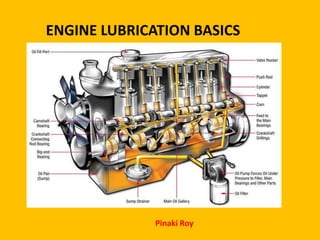
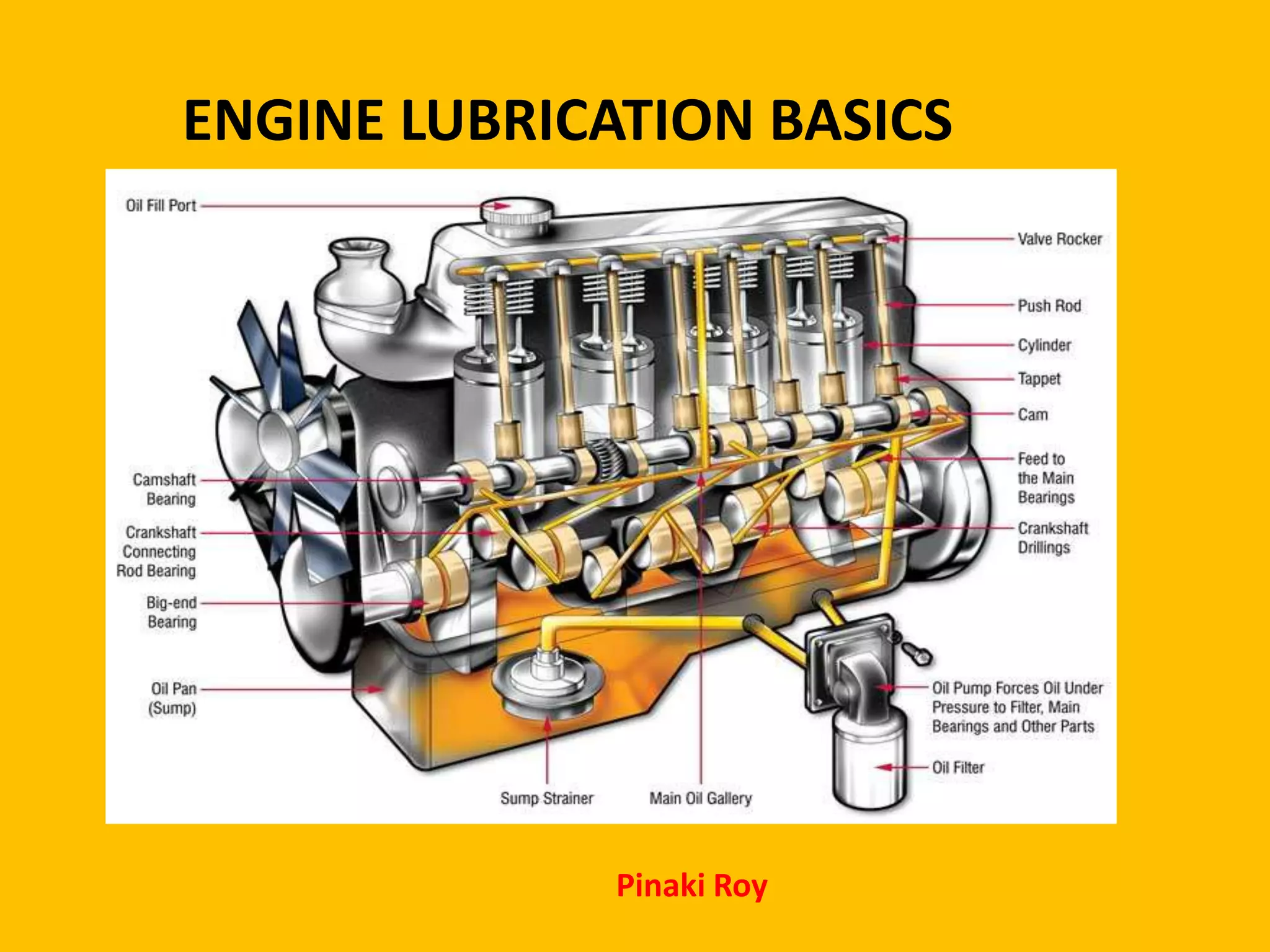
ENGINE LUBRICATION BASICS

Pinaki Roy
Engine Lubrication –What’s that?
• Lubrication, like in all moving parts, plays a key
role in the life expectancy of an engine.
• Without oil, an engine would succumb to
overheating and seizing very quickly.
• Lubricants help mitigate this problem and if
properly monitored and maintained, can extend
the life of an ENGINE!
• Lets try to understand it a bit more.
Where Does Engine Lubrication Begin
• The process of lubrication in an internal
combustion engine begins in the sump,
commonly referred to as the oil pan.
• From here, the oil is pulled through a strainer,
by the oil pump, removing larger
contaminants from the mass of the fluid.
• The oil then goes through the oil filter.
Understanding the Oil Filter
• An oil filter is designed to remove contaminants
from the engine oil.
• Filters are designed differently as not all filters
perform the same.
• A filter’s ability to remove particles is
dependent upon many factors, including the
media material (pore size, surface area and
depth of filter), the differential pressure across
the media and the flow rate across the media.
Where Does the Oil Go?
• The engine oil after passing through the filters
goes through passageways to the various
components of the engine such as the cam,
main bearings, rod, pistons, etc.
• Gravity then pulls the oil back down to the
bottom of the motor to drain back into the
sump, and the cycle repeats.
Engine Oil Formulation
• To appreciate the full impact of the engine
lubrication process, it is important to understand
how oils are formulated.
• All engine oils have two components: additives
and base oil. The total volume of additives in
motor oil can range from 20 to 30 percent,
depending on brand, formulation and
application.
• These additives can enhance, suppress or add
properties to the base oil.
Understanding Additives
• A typical additive found in an engine oil would
include a detergent and a dispersant. These
two work together to help rid the engine
system of deposits caused by the burning of
fuel and by the blow-by gases.
• Dispersants and detergents are small particles
that have a polar head and an oleophilic tail.
The polar heads are attracted to contaminants
within the oil and surround them, forming a
structure called a micelle.
What is Soot?
• Soot is a good example of a deposit that is controlled
by detergents and dispersants.
• Soot particles are enveloped by dispersant particles,
forming a micelle, and are kept from attaching to metal
surfaces. They are moved in this state through the oil
system until they are removed by the filter.
• This also prevents a process known as congealing.
During congealing, soot particles begin to stack upon
each other or congeal into a larger particle. Smaller
soot particles that could pass through components
without interrupting the fluid film can congeal to make
larger particles, which may disrupt the film and
damage surfaces.
Multi-grade Oils
• Most vehicle engines use some form of multi-grade oil.
This types of oil have an additive called a viscosity -index
(VI) improver. A common example would be 10W-30,
5W-40 or 15W-40.
• These VI improvers are long-chain organic molecules that
change shape as the temperature of their environment
changes. For example, in cold environments (engine
startup), these molecules are tightly bound. As the oil
heats up, they begin to stretch out. This allows the oil to
flow more readily at colder temperatures but still
maintain an acceptable viscosity and, more importantly, a
lubricating layer in the operating temperature range.
Other Additives
• Another common additive has an anti-wear (AW)
property. AW additives have particles that are
shaped similar to detergents and dispersants, but
the polar heads of these molecules are attracted to
metal surfaces.
• Once attached to a metal surface, AW additives
form a sacrificial layer that protects the surfaces
beneath them from degradation under boundary
conditions.
• Zinc di-alkyldi-thiophosphate (ZDDP) is a common
form of this additive.
Engine Oil Failures
• Engine oils are subject to several types of failures.
• Contamination poses a major problem within engines.
• Environmental contaminants can expedite the process
of oxidation and cause premature filter plugging.
• Fuel contamination can lower the viscosity of the oil,
leading to boundary conditions within the engine’s
moving parts.
• Antifreeze contamination does the opposite, increasing
viscosity so the oil doesn’t flow as well into places that
require thinner oil.
• Overheating and long drain intervals can also hasten
the degradation of the oil and result in oxidation and
poor lubricity.
More Failures…
• Besides the above, shearing of the contained additives
can also create engine lubrication problems.
• This is because over a period of time, VI improvers are
sheared down thereby reducing the oil’s viscosity at
operating temperatures.
• Anti-Wear and dispersants/detergents also become
depleted and the remaining molecules are not as
effective.
• Failures can also be caused by extended drain intervals
and poor maintenance.
• An oil change then becomes imperative.
Summing Up…
• Always remember that in cases of engines, the
same basic principles of lubrication apply.
• The lubricating film must be maintained to
ensure proper operating conditions and to
achieve the maximum life of the engine’s
components.
• Changing oil regularly and sustaining
appropriate fluid levels are the keys to overall
engine health and lifespan.
Tips to Improve the Efficiency of your Vehicle
& Save up to 50%
• Regular maintenance as prescribed by the vehicle's
manual will help the vehicle achieve its best fuel
economy.
• Some overlooked maintenance items, such as a dirty &
clogged filters and under-inflated tires, can increase
fuel cost up to 13%.
• When replacing tires, replace them with the same
make and model as the original tires when the vehicle
was purchased.
• A study has estimated that if all Californians properly
inflated and aligned their tires, it would save 300
million gallons of gasoline a year!
Happy Driving

Engine lubrication basics

  • 1.
  • 2.
    Engine Lubrication –What’sthat? • Lubrication, like in all moving parts, plays a key role in the life expectancy of an engine. • Without oil, an engine would succumb to overheating and seizing very quickly. • Lubricants help mitigate this problem and if properly monitored and maintained, can extend the life of an ENGINE! • Lets try to understand it a bit more.
  • 3.
    Where Does EngineLubrication Begin • The process of lubrication in an internal combustion engine begins in the sump, commonly referred to as the oil pan. • From here, the oil is pulled through a strainer, by the oil pump, removing larger contaminants from the mass of the fluid. • The oil then goes through the oil filter.
  • 4.
    Understanding the OilFilter • An oil filter is designed to remove contaminants from the engine oil. • Filters are designed differently as not all filters perform the same. • A filter’s ability to remove particles is dependent upon many factors, including the media material (pore size, surface area and depth of filter), the differential pressure across the media and the flow rate across the media.
  • 5.
    Where Does theOil Go? • The engine oil after passing through the filters goes through passageways to the various components of the engine such as the cam, main bearings, rod, pistons, etc. • Gravity then pulls the oil back down to the bottom of the motor to drain back into the sump, and the cycle repeats.
  • 6.
    Engine Oil Formulation •To appreciate the full impact of the engine lubrication process, it is important to understand how oils are formulated. • All engine oils have two components: additives and base oil. The total volume of additives in motor oil can range from 20 to 30 percent, depending on brand, formulation and application. • These additives can enhance, suppress or add properties to the base oil.
  • 7.
    Understanding Additives • Atypical additive found in an engine oil would include a detergent and a dispersant. These two work together to help rid the engine system of deposits caused by the burning of fuel and by the blow-by gases. • Dispersants and detergents are small particles that have a polar head and an oleophilic tail. The polar heads are attracted to contaminants within the oil and surround them, forming a structure called a micelle.
  • 8.
    What is Soot? •Soot is a good example of a deposit that is controlled by detergents and dispersants. • Soot particles are enveloped by dispersant particles, forming a micelle, and are kept from attaching to metal surfaces. They are moved in this state through the oil system until they are removed by the filter. • This also prevents a process known as congealing. During congealing, soot particles begin to stack upon each other or congeal into a larger particle. Smaller soot particles that could pass through components without interrupting the fluid film can congeal to make larger particles, which may disrupt the film and damage surfaces.
  • 9.
    Multi-grade Oils • Mostvehicle engines use some form of multi-grade oil. This types of oil have an additive called a viscosity -index (VI) improver. A common example would be 10W-30, 5W-40 or 15W-40. • These VI improvers are long-chain organic molecules that change shape as the temperature of their environment changes. For example, in cold environments (engine startup), these molecules are tightly bound. As the oil heats up, they begin to stretch out. This allows the oil to flow more readily at colder temperatures but still maintain an acceptable viscosity and, more importantly, a lubricating layer in the operating temperature range.
  • 10.
    Other Additives • Anothercommon additive has an anti-wear (AW) property. AW additives have particles that are shaped similar to detergents and dispersants, but the polar heads of these molecules are attracted to metal surfaces. • Once attached to a metal surface, AW additives form a sacrificial layer that protects the surfaces beneath them from degradation under boundary conditions. • Zinc di-alkyldi-thiophosphate (ZDDP) is a common form of this additive.
  • 11.
    Engine Oil Failures •Engine oils are subject to several types of failures. • Contamination poses a major problem within engines. • Environmental contaminants can expedite the process of oxidation and cause premature filter plugging. • Fuel contamination can lower the viscosity of the oil, leading to boundary conditions within the engine’s moving parts. • Antifreeze contamination does the opposite, increasing viscosity so the oil doesn’t flow as well into places that require thinner oil. • Overheating and long drain intervals can also hasten the degradation of the oil and result in oxidation and poor lubricity.
  • 12.
    More Failures… • Besidesthe above, shearing of the contained additives can also create engine lubrication problems. • This is because over a period of time, VI improvers are sheared down thereby reducing the oil’s viscosity at operating temperatures. • Anti-Wear and dispersants/detergents also become depleted and the remaining molecules are not as effective. • Failures can also be caused by extended drain intervals and poor maintenance. • An oil change then becomes imperative.
  • 13.
    Summing Up… • Alwaysremember that in cases of engines, the same basic principles of lubrication apply. • The lubricating film must be maintained to ensure proper operating conditions and to achieve the maximum life of the engine’s components. • Changing oil regularly and sustaining appropriate fluid levels are the keys to overall engine health and lifespan.
  • 14.
    Tips to Improvethe Efficiency of your Vehicle & Save up to 50% • Regular maintenance as prescribed by the vehicle's manual will help the vehicle achieve its best fuel economy. • Some overlooked maintenance items, such as a dirty & clogged filters and under-inflated tires, can increase fuel cost up to 13%. • When replacing tires, replace them with the same make and model as the original tires when the vehicle was purchased. • A study has estimated that if all Californians properly inflated and aligned their tires, it would save 300 million gallons of gasoline a year!
  • 15.