Performing Bench work
Department of EMMT
Level I (summer program)
Module trainer
Lemma Kiftaga(BSc in Engineering)
1. Introduction to engineering metals
• We will group materials of similar types
together and discuss their properties
• Generally Materials can be classified :
– metallic and ,non metallic material
• Metal:We can consider metals as substances
that have a lustrous sheen when cut, are good
conductors of heat, and are good conductors
of electricity.eg. aluminum, copper and iron
• Non metal:These can be elements,
compounds of elements and mixtures of
compounds. They include wood, rubber,
plastics, ceramics and glass.
Continued …
• Some materials are compounds of metals and
non-metals. eg, naturally occurring abrasive
grits, such as corundum contain between 70%
and 90% of aluminium oxide (a compound of
aluminium and oxygen).
1.1. Importance of metals
• Metal are the most important elements on
earth that are mostly applicable in many
industrial activities and construction sectors.
• A repair man repairs broken parts and
manufactures replacements according to
samples and blueprints.
1.2 Classification of metals
• Metals can be classified as ferrous and non
ferrous metals.
• Ferrous metals: Ferrous metals and alloys are
based on the metal iron.
• Iron is a soft grey metal and is rarely found in
the pure state outside a laboratory
• For engineering purposes the metal iron is
usually associated with the non-metal carbon.
Continued…
i. Plain carbon steels:as their name implies,
mainly of iron with small quantities of
carbon.
• There will also be traces of impurities left over
from when the metallic iron was extracted for
its mineral ore.
• A small amount of the metal manganese is
added to counteract the effects of the
impurities.
Plain carbon steel Contains
0.1% to 1.4% carbon.
Up to 1.0% manganese (not to be
confused with magnesium).
Up to 0.3% silicon.
Up to 0.05% sulphur.
Up to 0.05% phosphorus.
Effect of carbon content on the
properties of plain carbon steel
plain carbon steels can be grouped in
to categories
i. Low carbon steels
(below 0.3% carbon).
ii. Medium carbon steels
(0.3% to 0.8% carbon).
iii. High carbon steels
(between 0.8% and 1.4% carbon).
i. Low carbon steels
• It is referred to as mild steels
• If the carbon content is kept between
0.1% and 0.15%, the steel is often referred
to as ‘ dead mild ’ steel.
• This steel is very ductile and very soft,
and can be pressed into complicated
shapes for car body panels at room
temperature without cracking
Continued…
• It is used for the sub-strate of tin-plate and galvanized
steel. It is slightly weaker than the next group of low
carbon steels to be considered
• Mild steel can be forged, rolled and drawn both in the
hot and in the cold condition. It is easily machined with
high-speed steel cutting tools.
• Because of its ease of manufacture and the very large
quantities produced, mild steels are the cheapest and
most plentiful of the steel products.
• Hot worked mild steel is available as structural sections
for fabrication engineering (e.g. I-section beams, rolled
steel joists, reinforcing rods and mesh for concrete,
etc.), forgings, sheet, strip, plate, rods, bars and seam-
welded tubes.

Cold worked mild steel
• also known as bright drawn mild
steel is available as
bright drawn bars
 rods
solid drawn tubes
sheet and strip
formed wire goods.
Medium carbon steels
• There are two groups of medium carbon steels
From 0.3% to 0.5% carbon(can be heat treated to
make them tough and strong)
From 0.5% to 0.8% carbon can be heat treated to
make them fairly hard yet remain a degree of
toughness (impact resistance).
• Medium carbon steels are harder, stronger and
tougher than low carbon steels.
• They are also more expensive. They cannot be
bent or formed in the cold condition to the same
extent as low carbon steels without cracking.
Continued…
• medium carbon steels hot forge well, but
close temperature control is required to
prevent(burning and cracking)
 Burning’ at high temperatures over 1150°C, as
this leads to embrittlement. The metal cannot be
reclaimed and the forging has to be scrapped.
Cracking when forging is continued below 700°C.
Cracking is due to work hardening as the steel is in
the ‘cold’ condition from a forging point of view.
Continued…
• Medium carbon steels with carbon content in the
0.3% to 0.5% range are used for such products as
drop-hammer die blocks, laminated springs, wire
ropes, screwdriver blades, spanners, hammer
heads and heavy duty forgings.
• Medium carbon steels with carbon content in the
0.5% to 0.8% range are used for such products as
wood saws, cold chisels, forged blanks for
connecting rods, crankshafts, gears and other
stressed components such as high- ensile pipes
and tubes.
High carbon steels
• These are harder, less ductile and more expensive
than both mild and medium carbon steels.
• They are also less tough
• used for springs, cutting tools and forming dies.
• High carbon steels work-harden readily and, for
this reason, they are not recommended for cold
working.
Groups of high carbon steels
i. From 0.8% to 1.0% carbon where both
toughness and hardness are required.
sheet metal pressing tools where the number of
components to be produced does not warrant
the cost of expensive alloy steels.
Also, cold chisels for fine work, some hand
tools, shear blades, coil springs and high-tensile
wire (piano wire).
Continued…
ii. From 1.0% to 1.2% carbon for sufficient hardness
for most metal cutting tools for example wood-
drills, screw-cutting taps and screw-cutting dies.
iii. From 1.2% to 1.4% carbons where extreme
hardness is required for wood-working tools and
knives where a very keen cutting edge is required.
For all of these applications the steel has to be
heat-treated to enhance its properties
Properties of material
• Physical properties
• Chemical properties
• Thermal properties
• Electrical properties
• Magnetic properties
• Optical properties, and
• Mechanical properties
Layout
• Selection of Materials: depends on the specific
task to be performed.
• Layout tool: Before you can shape or form work
pieces, you have to mark them to the required
dimensions.
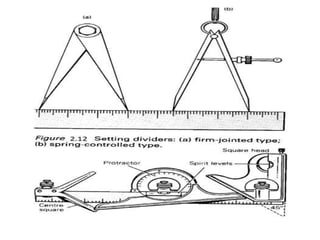
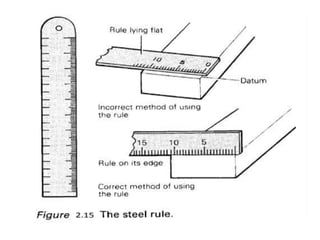
• The following tools are used in laying-out.
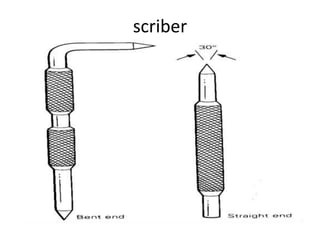
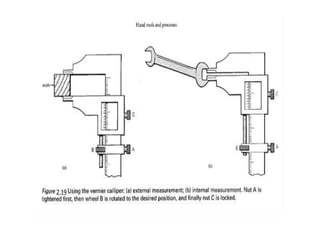
scriber
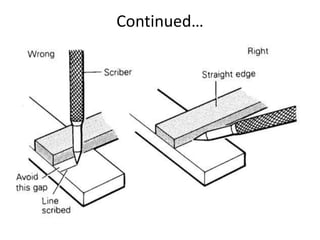
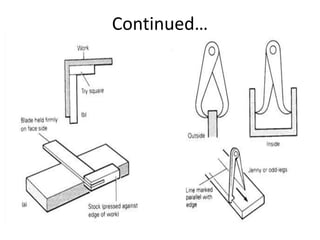
Continued…
Continued…
Dot punch…
a. making out punches, b. making out dots , c. filling of removing metal, d. chamfering
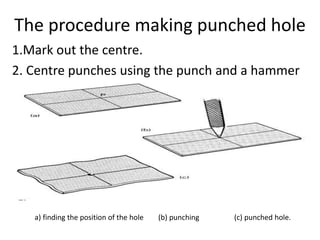
The procedure making punched hole
1.Mark out the centre.
2. Centre punches using the punch and a hammer
a) finding the position of the hole (b) punching (c) punched hole.
3. Bench work operations
3.1 Cutting: In the metalwork shop, materials
(especially metals) are cut to shape before filing. The
numerous types of cutting operations.
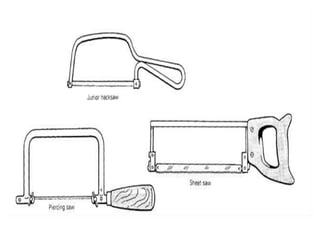
Cutting using Saws(mishar) :Saws used for cutting
purposes in the school workshop
The different type of saw are:
• Hacksaw
• The junior hacksaw
• The sheet saw
• The piercing saw
types of saw
• Hacksaw
Points to watch when using the hacksaw
1. Hold the work securely in the vice.
2. Grip the hacksaw firmly, using both hands
3. Use the same stance as for filing.
4. Use the full length of the blade.
Other saws…
• The junior hacksaw: has a spring tension frame,
which takes a blade about 150 mm long and 6
mm wide. It is useful tool for small work.
• The sheet saw: is used for cutting large sheets
of metal or other materials, and fitted with the
standard hacksaw blade (32 teeth per 25mm).
• The piercing saw: is used for fine work, either
for decorative patterns or for cutting circles in
beaten metal work. To fix the blade, loosen one
end and passing through a hole drilled in the
work, then re-fix it in the frame.
KNIVES(mindi)
• Most knives have cutting edges and are used to
cut, pare, notch, and trim wood, leather,
rubber, and other materials.
Fig. Pocket Knife
Saddler knife
Rubber cutting knife
Putty knife
PIPE CUTTING
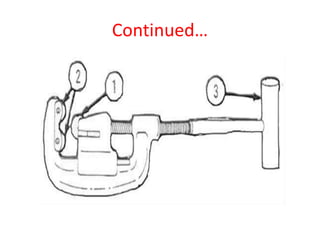
• There are two sizes of pipe cutters.
• One size can cut from 1/8 to 2 inches
• while the other can cut from 2 to 4 inches. The
pipe cutter has
1. a cutting blade
2. two pressure rollers which are adjusted and
tightened by turning the handle
• Pipe cutters are used to cut steel, brass, copper,
wrought iron, and lead pipe.
Continued…
Procedures to cut pipe
• Measure from end of pipe and make a mark
where you want to cut
Continued…
• Fasten pipe securely in a pipe vice (2). Be sure
mark is clear so that it can be cut. Pipe must be
supported on both ends to keep it from
bending.
Continued…
• Open the jaws of the pipe cutter enough to
allow the pipe cutter to be placed around the
pipe. Adjust so that the cutting blade (3) is on
the line.
Continued…
4. Tighten the handle (4) until cutting blade
makes contact with pipe.
5. Then turn the handle (4) 1/4 of a turn more
clockwise.
6. Now turn the whole cutter one turn around the
pipe (counter clockwise).
3.2 Chipping
Chipping metal (chiselling)
• You can chip the metal to produce grooves or to
reduce the width or thickness.
• Nowadays the grinder, shaper and miller are widely
used for this purpose, but if these machines are not
available, chipping is still an economical process.
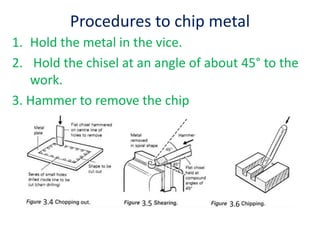
Procedures to chip metal
1. Hold the metal in the vice.
2. Hold the chisel at an angle of about 45° to the
work.
3. Hammer to remove the chip
Chisels
• It is used to cut cold metals and made of cast steel
or alloy steel.
• The common types of chisels are
flat chisel: it used for general-purpose
chiselling
cross-cut chisel: used for cutting grooves such
as keyways, and for chipping;
half-round round-nosed chisel: used for cutting
grooves (which are either curved or half-round).
diamond-pointed chisel: used for working into
corners and cutting small grooves
Continued…
• Chiselling is one of the methods of
cutting material.
• Working in Chisel is inaccurate, but still
widely used in mechanical workshop.
• When it becomes difficult to use shears
or a saw, you can use the chisel in
cutting metal plate or sheet, the process
is called chopping out.
3.3. Filling
• Filing is a method of removing metal,
and the file which is the most widely
used hand tool in the school workshop,
is used for this cutting operation. It is
made of carbon tool steel containing
about 1.3 per cent carbon.
• Filing is a skill that is difficult to learn.
It is not easy to explain how to use a
file.
principles of cross-filing
1. Hold the work firmly in the vice.
2. Allow a small part of the work to project
from the vice and avoid vibration.
3. The work should normally be level with
your elbow 4. Apply pressure in the forward
stroke only.
5. Observe the correct methods for handling
files, for
3.4. Drilling, boring, counter boring,
spot-facing
• Drilling in engineering refers to cutting a
circular hole in a material.
• before reaming, holes should be drilled.
• Drilling and reaming are therefore not the
same process.
• Boring, on the other hand, is making an
existing hole larger.
Types of drilling machine include
Continued…
• hand drill is used to hold drill bits up to 5 mm for
light hand operations.
• electric hand drill is used in the same way as the
hand drill, but it is electrically powered and
controlled.
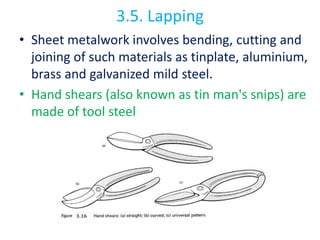
3.5. Lapping
• Sheet metalwork involves bending, cutting and
joining of such materials as tinplate, aluminium,
brass and galvanized mild steel.
• Hand shears (also known as tin man's snips) are
made of tool steel
Stakes
• Stakes may be referred to as small anvils, as
you use them for similar operations.
• The hatchet stake is usually used to turn
edges more than 90°.
• The brick iron is used for cylindrical and
conical work.
• The half-moon is used for turning edges of
circular or curved work.
Continued…
• The funnel stake is used for forming
conical and cylindrical work.
• The round-bottom stake is used for
shaping the circular or curved bottoms of
circular work.
• The tin man's anvil is used to true flat
work.
• The creasing iron is used for preparing
beaded and wired edges.
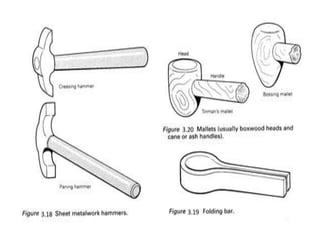
Mallets and Folding bars
• Mallets are used for flattening and bending sheet
metalwork
• The heads are usually made of wood, hide or
plastic. Common types include the tin man's mallet
and the bossing mallet
• Folding bars come in lengths of 250-300 mm, and
are used for bending sheet metal at right angles.
• Groove Punch also known as a seaming tool, has
semi-circular or rectangular grooves. It is used for
fixing wired and folded seams in position.
Soldering bit…
• It is made of copper. The two main shapes are
hatchet and straight. The bits are used in soft
soldering.
• They are heated in soldering stoves before
melting the solder. There are also electric
soldering bits.
• The soldering iron is heated in the tin man's
stove (gas soldering stove).
• Heat the bit until the green flame shows: this is
an indication that the correct temperature has
been reached.
Joints
• Types of Joints
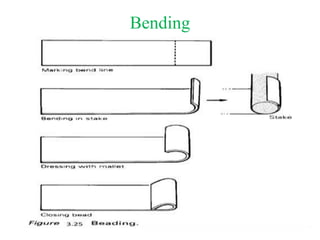
Bending
Reaming
• Reamers are used to enlarge and true a hole
• They are also used to remove burrs from the
inside diameters of pipes and drilled holes.
(1). body the (2).shank (3). blades
SOLID TAPER-PIN REAMER
SOLID STRAIGHT-HOLE REAMER
Expansion reamer
ADJUSTABLE-BLADE REAMER
Pipe reamer
USING A SOLID STRAIGHT-HOLE REAMER
I. Secure the work in a vice so that the hole to
be reamed is perpendicular to the top of the
vice jaws.1 Secure the work in a vise so that the hole to be reamed is perpendicular to
vise jaws.
ii. Using a tap wrench (1), tighten the handle to the
square end of the reamer shank (2).
2 Using a tap wrench (1), tighten the handle to the square end of the reamer shank (2).
iii. Position the reamer (3) at the top of the hole. Turn the
wrench clockwise very slowly until the reamer is centered
in the hole. Straight-hole reamers (4) have a slight taper at
the end so they will fit into the hole easily.
iv. Turn the wrench clockwise with a steady, firm pres-
Thread cutting
• Screwing is a temporary method of
fastening parts together
• Methods for cutting screw threads
include the use of the centre lathe.
• For bench work, however, taps and
dies are used.
Taps and dies
• Tapes are the tools used for cutting internal
(female) threads. The term for cutting internal
threads by hand is tapping
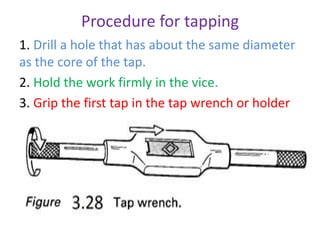
Procedure for tapping
1. Drill a hole that has about the same diameter
as the core of the tap.
2. Hold the work firmly in the vice.
3. Grip the first tap in the tap wrench or holder
Continued…
4. Insert the tap squarely in the hole and turn it
clockwise to start threading
5. Turn anti-clockwise about a quarter-turn to break
the sward.
6. Apply cutting oil through the flutes, to ease
cutting and 'wash' away the chippings.
7. Repeat operation 5 until the entire length of
thread on the tap has gone through (if it is a
through hole).
Dies
• Dies are made either of high-carbon steel or of
high speed steel. Unlike taps, dies are used for
cutting external (male) threads).
procedure for cutting external threads
• Square the end of the work and chamfer it
(using a file, grinding machine or centre lathe)
for an easy start (Figure 3.31).
Continued…
• Grip the die, held in the stock, firmly and
squarely on the work.
• Turn clockwise, about a quarter-turn, and
ease back to remove chippings.
• Apply a good supply of oil (lubricant).
• Make adjustments of the screws after
making a full cut until the depth required
is achieved
3.8.Grinding
• Grinders are mechanical devices which allow
you to reshape, form, and sharpen metal
cutting tools or other tools.
BENCH GRINDER
Bench grinder…
SHARPENING STONES
• Sharpening stones usually have one coarse
face and one fine face.
3.9. Replacing Broken tools
• Maintenance is one of the most important
jobs you will do in the Navy.
• preventive maintenance is not done
properly, or not done at all, your
equipment may be put out of commission
until it can be repaired.
• NEVER USE DAMAGED TOOLS
4. Clean up
4.1 Work area
• Keep your working area, especially the floor,
clean and free from any unnecessary items that
can cause slipping or stumbling
• Materials should be properly stored in a
material rack
• Protect the floor against spilled cutting oil.
4.2 Tools and equipment
• The tools and equipment's should be
cleaned after the required activities
are performed.
• At last they should be stored in the
recommended area based on the
specifications from the industries they
are manufactured to give the expected
services.
END OF THE MODULE
2005 E.C

Performing bench work ppt

  • 1.
    Performing Bench work Departmentof EMMT Level I (summer program) Module trainer Lemma Kiftaga(BSc in Engineering)
  • 2.
    1. Introduction toengineering metals • We will group materials of similar types together and discuss their properties • Generally Materials can be classified : – metallic and ,non metallic material • Metal:We can consider metals as substances that have a lustrous sheen when cut, are good conductors of heat, and are good conductors of electricity.eg. aluminum, copper and iron • Non metal:These can be elements, compounds of elements and mixtures of compounds. They include wood, rubber, plastics, ceramics and glass.
  • 3.
    Continued … • Somematerials are compounds of metals and non-metals. eg, naturally occurring abrasive grits, such as corundum contain between 70% and 90% of aluminium oxide (a compound of aluminium and oxygen).
  • 4.
    1.1. Importance ofmetals • Metal are the most important elements on earth that are mostly applicable in many industrial activities and construction sectors. • A repair man repairs broken parts and manufactures replacements according to samples and blueprints.
  • 5.
    1.2 Classification ofmetals • Metals can be classified as ferrous and non ferrous metals. • Ferrous metals: Ferrous metals and alloys are based on the metal iron. • Iron is a soft grey metal and is rarely found in the pure state outside a laboratory • For engineering purposes the metal iron is usually associated with the non-metal carbon.
  • 6.
    Continued… i. Plain carbonsteels:as their name implies, mainly of iron with small quantities of carbon. • There will also be traces of impurities left over from when the metallic iron was extracted for its mineral ore. • A small amount of the metal manganese is added to counteract the effects of the impurities.
  • 7.
    Plain carbon steelContains 0.1% to 1.4% carbon. Up to 1.0% manganese (not to be confused with magnesium). Up to 0.3% silicon. Up to 0.05% sulphur. Up to 0.05% phosphorus.
  • 8.
    Effect of carboncontent on the properties of plain carbon steel
  • 9.
    plain carbon steelscan be grouped in to categories i. Low carbon steels (below 0.3% carbon). ii. Medium carbon steels (0.3% to 0.8% carbon). iii. High carbon steels (between 0.8% and 1.4% carbon).
  • 10.
    i. Low carbonsteels • It is referred to as mild steels • If the carbon content is kept between 0.1% and 0.15%, the steel is often referred to as ‘ dead mild ’ steel. • This steel is very ductile and very soft, and can be pressed into complicated shapes for car body panels at room temperature without cracking
  • 11.
    Continued… • It isused for the sub-strate of tin-plate and galvanized steel. It is slightly weaker than the next group of low carbon steels to be considered • Mild steel can be forged, rolled and drawn both in the hot and in the cold condition. It is easily machined with high-speed steel cutting tools. • Because of its ease of manufacture and the very large quantities produced, mild steels are the cheapest and most plentiful of the steel products. • Hot worked mild steel is available as structural sections for fabrication engineering (e.g. I-section beams, rolled steel joists, reinforcing rods and mesh for concrete, etc.), forgings, sheet, strip, plate, rods, bars and seam- welded tubes.
  • 12.
    Cold worked mildsteel • also known as bright drawn mild steel is available as bright drawn bars  rods solid drawn tubes sheet and strip formed wire goods.
  • 13.
    Medium carbon steels •There are two groups of medium carbon steels From 0.3% to 0.5% carbon(can be heat treated to make them tough and strong) From 0.5% to 0.8% carbon can be heat treated to make them fairly hard yet remain a degree of toughness (impact resistance). • Medium carbon steels are harder, stronger and tougher than low carbon steels. • They are also more expensive. They cannot be bent or formed in the cold condition to the same extent as low carbon steels without cracking.
  • 14.
    Continued… • medium carbonsteels hot forge well, but close temperature control is required to prevent(burning and cracking)  Burning’ at high temperatures over 1150°C, as this leads to embrittlement. The metal cannot be reclaimed and the forging has to be scrapped. Cracking when forging is continued below 700°C. Cracking is due to work hardening as the steel is in the ‘cold’ condition from a forging point of view.
  • 15.
    Continued… • Medium carbonsteels with carbon content in the 0.3% to 0.5% range are used for such products as drop-hammer die blocks, laminated springs, wire ropes, screwdriver blades, spanners, hammer heads and heavy duty forgings. • Medium carbon steels with carbon content in the 0.5% to 0.8% range are used for such products as wood saws, cold chisels, forged blanks for connecting rods, crankshafts, gears and other stressed components such as high- ensile pipes and tubes.
  • 16.
    High carbon steels •These are harder, less ductile and more expensive than both mild and medium carbon steels. • They are also less tough • used for springs, cutting tools and forming dies. • High carbon steels work-harden readily and, for this reason, they are not recommended for cold working.
  • 17.
    Groups of highcarbon steels i. From 0.8% to 1.0% carbon where both toughness and hardness are required. sheet metal pressing tools where the number of components to be produced does not warrant the cost of expensive alloy steels. Also, cold chisels for fine work, some hand tools, shear blades, coil springs and high-tensile wire (piano wire).
  • 18.
    Continued… ii. From 1.0%to 1.2% carbon for sufficient hardness for most metal cutting tools for example wood- drills, screw-cutting taps and screw-cutting dies. iii. From 1.2% to 1.4% carbons where extreme hardness is required for wood-working tools and knives where a very keen cutting edge is required. For all of these applications the steel has to be heat-treated to enhance its properties
  • 19.
    Properties of material •Physical properties • Chemical properties • Thermal properties • Electrical properties • Magnetic properties • Optical properties, and • Mechanical properties
  • 20.
    Layout • Selection ofMaterials: depends on the specific task to be performed. • Layout tool: Before you can shape or form work pieces, you have to mark them to the required dimensions. • The following tools are used in laying-out.
  • 21.
  • 22.
  • 23.
  • 24.
    Dot punch… a. makingout punches, b. making out dots , c. filling of removing metal, d. chamfering
  • 25.
    The procedure makingpunched hole 1.Mark out the centre. 2. Centre punches using the punch and a hammer a) finding the position of the hole (b) punching (c) punched hole.
  • 32.
    3. Bench workoperations 3.1 Cutting: In the metalwork shop, materials (especially metals) are cut to shape before filing. The numerous types of cutting operations. Cutting using Saws(mishar) :Saws used for cutting purposes in the school workshop The different type of saw are: • Hacksaw • The junior hacksaw • The sheet saw • The piercing saw
  • 34.
  • 35.
    Points to watchwhen using the hacksaw 1. Hold the work securely in the vice. 2. Grip the hacksaw firmly, using both hands 3. Use the same stance as for filing. 4. Use the full length of the blade.
  • 36.
    Other saws… • Thejunior hacksaw: has a spring tension frame, which takes a blade about 150 mm long and 6 mm wide. It is useful tool for small work. • The sheet saw: is used for cutting large sheets of metal or other materials, and fitted with the standard hacksaw blade (32 teeth per 25mm). • The piercing saw: is used for fine work, either for decorative patterns or for cutting circles in beaten metal work. To fix the blade, loosen one end and passing through a hole drilled in the work, then re-fix it in the frame.
  • 37.
    KNIVES(mindi) • Most kniveshave cutting edges and are used to cut, pare, notch, and trim wood, leather, rubber, and other materials. Fig. Pocket Knife
  • 38.
  • 39.
  • 40.
  • 41.
    PIPE CUTTING • Thereare two sizes of pipe cutters. • One size can cut from 1/8 to 2 inches • while the other can cut from 2 to 4 inches. The pipe cutter has 1. a cutting blade 2. two pressure rollers which are adjusted and tightened by turning the handle • Pipe cutters are used to cut steel, brass, copper, wrought iron, and lead pipe.
  • 42.
  • 43.
    Procedures to cutpipe • Measure from end of pipe and make a mark where you want to cut
  • 44.
    Continued… • Fasten pipesecurely in a pipe vice (2). Be sure mark is clear so that it can be cut. Pipe must be supported on both ends to keep it from bending.
  • 45.
    Continued… • Open thejaws of the pipe cutter enough to allow the pipe cutter to be placed around the pipe. Adjust so that the cutting blade (3) is on the line.
  • 46.
    Continued… 4. Tighten thehandle (4) until cutting blade makes contact with pipe. 5. Then turn the handle (4) 1/4 of a turn more clockwise. 6. Now turn the whole cutter one turn around the pipe (counter clockwise).
  • 47.
    3.2 Chipping Chipping metal(chiselling) • You can chip the metal to produce grooves or to reduce the width or thickness. • Nowadays the grinder, shaper and miller are widely used for this purpose, but if these machines are not available, chipping is still an economical process.
  • 48.
    Procedures to chipmetal 1. Hold the metal in the vice. 2. Hold the chisel at an angle of about 45° to the work. 3. Hammer to remove the chip
  • 49.
    Chisels • It isused to cut cold metals and made of cast steel or alloy steel. • The common types of chisels are flat chisel: it used for general-purpose chiselling cross-cut chisel: used for cutting grooves such as keyways, and for chipping; half-round round-nosed chisel: used for cutting grooves (which are either curved or half-round). diamond-pointed chisel: used for working into corners and cutting small grooves
  • 50.
    Continued… • Chiselling isone of the methods of cutting material. • Working in Chisel is inaccurate, but still widely used in mechanical workshop. • When it becomes difficult to use shears or a saw, you can use the chisel in cutting metal plate or sheet, the process is called chopping out.
  • 52.
    3.3. Filling • Filingis a method of removing metal, and the file which is the most widely used hand tool in the school workshop, is used for this cutting operation. It is made of carbon tool steel containing about 1.3 per cent carbon. • Filing is a skill that is difficult to learn. It is not easy to explain how to use a file.
  • 53.
    principles of cross-filing 1.Hold the work firmly in the vice. 2. Allow a small part of the work to project from the vice and avoid vibration. 3. The work should normally be level with your elbow 4. Apply pressure in the forward stroke only. 5. Observe the correct methods for handling files, for
  • 58.
    3.4. Drilling, boring,counter boring, spot-facing • Drilling in engineering refers to cutting a circular hole in a material. • before reaming, holes should be drilled. • Drilling and reaming are therefore not the same process. • Boring, on the other hand, is making an existing hole larger.
  • 59.
    Types of drillingmachine include
  • 60.
    Continued… • hand drillis used to hold drill bits up to 5 mm for light hand operations. • electric hand drill is used in the same way as the hand drill, but it is electrically powered and controlled.
  • 62.
    3.5. Lapping • Sheetmetalwork involves bending, cutting and joining of such materials as tinplate, aluminium, brass and galvanized mild steel. • Hand shears (also known as tin man's snips) are made of tool steel
  • 63.
    Stakes • Stakes maybe referred to as small anvils, as you use them for similar operations. • The hatchet stake is usually used to turn edges more than 90°. • The brick iron is used for cylindrical and conical work. • The half-moon is used for turning edges of circular or curved work.
  • 64.
    Continued… • The funnelstake is used for forming conical and cylindrical work. • The round-bottom stake is used for shaping the circular or curved bottoms of circular work. • The tin man's anvil is used to true flat work. • The creasing iron is used for preparing beaded and wired edges.
  • 68.
    Mallets and Foldingbars • Mallets are used for flattening and bending sheet metalwork • The heads are usually made of wood, hide or plastic. Common types include the tin man's mallet and the bossing mallet • Folding bars come in lengths of 250-300 mm, and are used for bending sheet metal at right angles. • Groove Punch also known as a seaming tool, has semi-circular or rectangular grooves. It is used for fixing wired and folded seams in position.
  • 69.
    Soldering bit… • Itis made of copper. The two main shapes are hatchet and straight. The bits are used in soft soldering. • They are heated in soldering stoves before melting the solder. There are also electric soldering bits. • The soldering iron is heated in the tin man's stove (gas soldering stove). • Heat the bit until the green flame shows: this is an indication that the correct temperature has been reached.
  • 70.
  • 71.
  • 74.
    Reaming • Reamers areused to enlarge and true a hole • They are also used to remove burrs from the inside diameters of pipes and drilled holes. (1). body the (2).shank (3). blades
  • 75.
  • 76.
  • 77.
  • 78.
  • 79.
  • 80.
    USING A SOLIDSTRAIGHT-HOLE REAMER I. Secure the work in a vice so that the hole to be reamed is perpendicular to the top of the vice jaws.1 Secure the work in a vise so that the hole to be reamed is perpendicular to vise jaws.
  • 81.
    ii. Using atap wrench (1), tighten the handle to the square end of the reamer shank (2). 2 Using a tap wrench (1), tighten the handle to the square end of the reamer shank (2).
  • 82.
    iii. Position thereamer (3) at the top of the hole. Turn the wrench clockwise very slowly until the reamer is centered in the hole. Straight-hole reamers (4) have a slight taper at the end so they will fit into the hole easily. iv. Turn the wrench clockwise with a steady, firm pres-
  • 83.
    Thread cutting • Screwingis a temporary method of fastening parts together • Methods for cutting screw threads include the use of the centre lathe. • For bench work, however, taps and dies are used.
  • 84.
    Taps and dies •Tapes are the tools used for cutting internal (female) threads. The term for cutting internal threads by hand is tapping
  • 85.
    Procedure for tapping 1.Drill a hole that has about the same diameter as the core of the tap. 2. Hold the work firmly in the vice. 3. Grip the first tap in the tap wrench or holder
  • 86.
    Continued… 4. Insert thetap squarely in the hole and turn it clockwise to start threading 5. Turn anti-clockwise about a quarter-turn to break the sward. 6. Apply cutting oil through the flutes, to ease cutting and 'wash' away the chippings. 7. Repeat operation 5 until the entire length of thread on the tap has gone through (if it is a through hole).
  • 88.
    Dies • Dies aremade either of high-carbon steel or of high speed steel. Unlike taps, dies are used for cutting external (male) threads).
  • 89.
    procedure for cuttingexternal threads • Square the end of the work and chamfer it (using a file, grinding machine or centre lathe) for an easy start (Figure 3.31).
  • 90.
    Continued… • Grip thedie, held in the stock, firmly and squarely on the work. • Turn clockwise, about a quarter-turn, and ease back to remove chippings. • Apply a good supply of oil (lubricant). • Make adjustments of the screws after making a full cut until the depth required is achieved
  • 91.
    3.8.Grinding • Grinders aremechanical devices which allow you to reshape, form, and sharpen metal cutting tools or other tools. BENCH GRINDER
  • 92.
  • 93.
    SHARPENING STONES • Sharpeningstones usually have one coarse face and one fine face.
  • 94.
    3.9. Replacing Brokentools • Maintenance is one of the most important jobs you will do in the Navy. • preventive maintenance is not done properly, or not done at all, your equipment may be put out of commission until it can be repaired. • NEVER USE DAMAGED TOOLS
  • 95.
    4. Clean up 4.1Work area • Keep your working area, especially the floor, clean and free from any unnecessary items that can cause slipping or stumbling • Materials should be properly stored in a material rack • Protect the floor against spilled cutting oil.
  • 96.
    4.2 Tools andequipment • The tools and equipment's should be cleaned after the required activities are performed. • At last they should be stored in the recommended area based on the specifications from the industries they are manufactured to give the expected services.
  • 97.
    END OF THEMODULE 2005 E.C

Editor's Notes