ROLLING & SLIDING
BEARINGS
BEARING IS A MECHANICAL ELEMENT THAT
PERMITS RELATIVE MOTION BETWEEN TWO
PARTS, SUCH AS THE SHAFT AND THE HOUSING,
WITH MINIMUM FRICTION.
Functions:
• Bearing ensures free rotation of the shaft or the axle with minimum friction.
• Bearing supports the shaft or the axle and holds it in the correct position.
• Bearing takes up the forces that act on the shaft or the axle and transmits them to
the frame or the foundation.
CLASSIFICATIONS
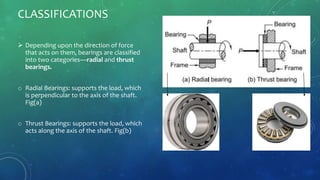
 Depending upon the direction of force
that acts on them, bearings are classified
into two categories—radial and thrust
bearings.
o Radial Bearings: supports the load, which
is perpendicular to the axis of the shaft.
Fig(a)
o Thrust Bearings: supports the load, which
acts along the axis of the shaft. Fig(b)
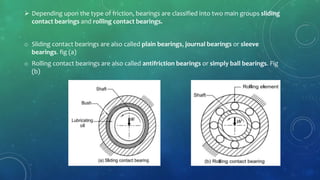
 Depending upon the type of friction, bearings are classified into two main groups sliding
contact bearings and rolling contact bearings.
o Sliding contact bearings are also called plain bearings, journal bearings or sleeve
bearings. fig (a)
o Rolling contact bearings are also called antifriction bearings or simply ball bearings. Fig
(b)
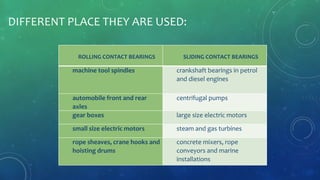
DIFFERENT PLACE THEY ARE USED:
ROLLING CONTACT BEARINGS SLIDING CONTACT BEARINGS
machine tool spindles crankshaft bearings in petrol
and diesel engines
automobile front and rear
axles
centrifugal pumps
gear boxes large size electric motors
small size electric motors steam and gas turbines
rope sheaves, crane hooks and
hoisting drums
concrete mixers, rope
conveyors and marine
installations
ROLLING CONTACT BEARINGS
A rolling contact bearing consists of four parts— inner
and outer races, a rolling element like ball, roller or needle
and a cage which holds the rolling elements together and
spaces them evenly around the periphery of the shaft.
CLASSIFICATION OF ROLLING CONTACT BEARING:
• Depending upon the type of rolling element, the bearings are classified as
ball bearing, cylindrical roller bearing, taper roller bearing and needle
bearing.
• Depending upon the direction of load, the bearings are also classified as
radial bearing and thrust bearing.
TYPES OF ROLLING CONTACT BEARINGS
o Deep Groove Ball Bearing
o Cylindrical Roller Bearing
o Angular Contact Bearing
o Self-aligning Bearings
o Taper Roller Bearing
o Thrust Ball Bearing
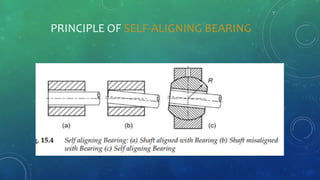
PRINCIPLE OF SELF-ALIGNING BEARING
SELECTION OF BEARING-TYPE
The selection of the type of bearing in a particular application depends upon the requirement of the
application and the characteristics of different types of bearings.
The guidelines for selecting a proper type of bearing are as follows:
o For low and medium radial loads, ball bearings are used, whereas for heavy loads and large shaft diameters, roller
bearings are selected.
o Self-aligning ball bearings and spherical roller bearings are used in applications where a misalignment between the
axes of the shaft and housing is likely to exist.
o Thrust ball bearings are used for medium thrust loads whereas for heavy thrust loads, cylindrical roller thrust bearings
are recommended. Double acting thrust bearings can carry the thrust load in either direction.
o Deep groove ball bearings, angular contact bearings and spherical roller bearings are suitable in applications where
the load acting on the bearing consists of two components— radial and thrust.
o The maximum permissible speed of the shaft depends upon the temperature rise in the bearing. For high speed
applications, deep groove ball bearings, angular contact bearings and cylindrical roller bearings are recommended.
o Rigidity controls the selection of bearings in certain applications like machine tool spindles. Double row cylindrical
roller bearings or taper roller bearings are used under these conditions. The line of contact in these bearings, as
compared with the point of contact in ball bearings, improves the rigidity of the system.
o Noise becomes the criterion of selection in applications like household appliances. For such applications, deep groove
ball bearings are recommended.
SLIDING CONTACT BEARINGS
BASIC MODES OF LUBRICATION
Lubrication is the science of reducing friction by application of a suitable
substance called lubricant, between the rubbing surfaces of bodies having
relative motion.
CLASSIFIED INTO FOLLOWING THREE GROUPS:
o Liquid lubricants like mineral or vegetable oils
o Semi-solid lubricants like grease
o Solid lubricants like graphite or molybdenum disulphide
OBJECTIVES OF LUBRICATION ARE AS FOLLOWS:
oto reduce friction
oto reduce or prevent wear
oto carry away heat generated due to friction
oto protect the journal and the bearing from corrosion
The basic modes of lubrication are thick- and thin film lubrication.
Sometimes a term ‘zero film’ bearing is used. Zero film bearing is a
bearing which operates without any lubricant, i.e., without any film
of lubricating oil.
Thick film lubrication describes a condition of lubrication, where
two surfaces of the bearing in relative motion are completely
separated by a film of fluid.
Thick film lubrication is further divided into two groups:
hydrodynamic and hydrostatic lubrication.
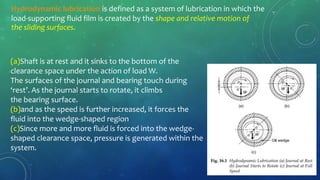
Hydrodynamic lubrication is defined as a system of lubrication in which the
load-supporting fluid film is created by the shape and relative motion of
the sliding surfaces.
(a)Shaft is at rest and it sinks to the bottom of the
clearance space under the action of load W.
The surfaces of the journal and bearing touch during
‘rest’. As the journal starts to rotate, it climbs
the bearing surface.
(b)and as the speed is further increased, it forces the
fluid into the wedge-shaped region
(c)Since more and more fluid is forced into the wedge-
shaped clearance space, pressure is generated within the
system.
Since the pressure is created within the system due to rotation of the shaft, this type
of bearing is known as self-acting bearing. The pressure generated in the clearance
space supports the external load (W).
It is not necessary to supply the lubricant
under pressure and the only requirement
is sufficient and continuous supply of the
lubricant. This mode of lubrication is seen
in bearings mounted on engines and
centrifugal pumps.
JOURNAL BEARING
• A journal bearing is a sliding contact bearing working on
hydrodynamic lubrication and which supports the load in radial
direction. The portion of the shaft inside the bearing is called
journal and hence the name ‘journal’ bearing.
• There are two types of hydrodynamic journal bearings: full
journal bearing and partial bearing.
Full Bearing:
• can take loads in any radial direction,
• angle of contact of the bushing with the journal is 360°,
• used in industrial applications.
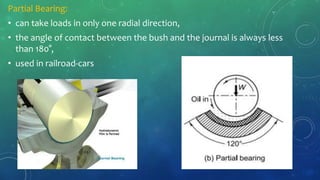
Partial Bearing:
• can take loads in only one radial direction,
• the angle of contact between the bush and the journal is always less
than 180°,
• used in railroad-cars
The advantages of partial bearings compared to full journal
bearing are as follows:
o Partial bearing is simple in construction.
o It is easy to supply lubricating oil to the partial bearing.
o The frictional loss in partial bearing is less. Therefore,
temperature rise is low.

Bearing _Rolling and sliding

  • 1.
  • 2.
    BEARING IS AMECHANICAL ELEMENT THAT PERMITS RELATIVE MOTION BETWEEN TWO PARTS, SUCH AS THE SHAFT AND THE HOUSING, WITH MINIMUM FRICTION. Functions: • Bearing ensures free rotation of the shaft or the axle with minimum friction. • Bearing supports the shaft or the axle and holds it in the correct position. • Bearing takes up the forces that act on the shaft or the axle and transmits them to the frame or the foundation.
  • 3.
    CLASSIFICATIONS  Depending uponthe direction of force that acts on them, bearings are classified into two categories—radial and thrust bearings. o Radial Bearings: supports the load, which is perpendicular to the axis of the shaft. Fig(a) o Thrust Bearings: supports the load, which acts along the axis of the shaft. Fig(b)
  • 4.
     Depending uponthe type of friction, bearings are classified into two main groups sliding contact bearings and rolling contact bearings. o Sliding contact bearings are also called plain bearings, journal bearings or sleeve bearings. fig (a) o Rolling contact bearings are also called antifriction bearings or simply ball bearings. Fig (b)
  • 5.
    DIFFERENT PLACE THEYARE USED: ROLLING CONTACT BEARINGS SLIDING CONTACT BEARINGS machine tool spindles crankshaft bearings in petrol and diesel engines automobile front and rear axles centrifugal pumps gear boxes large size electric motors small size electric motors steam and gas turbines rope sheaves, crane hooks and hoisting drums concrete mixers, rope conveyors and marine installations
  • 6.
    ROLLING CONTACT BEARINGS Arolling contact bearing consists of four parts— inner and outer races, a rolling element like ball, roller or needle and a cage which holds the rolling elements together and spaces them evenly around the periphery of the shaft.
  • 7.
    CLASSIFICATION OF ROLLINGCONTACT BEARING: • Depending upon the type of rolling element, the bearings are classified as ball bearing, cylindrical roller bearing, taper roller bearing and needle bearing. • Depending upon the direction of load, the bearings are also classified as radial bearing and thrust bearing.
  • 8.
    TYPES OF ROLLINGCONTACT BEARINGS o Deep Groove Ball Bearing o Cylindrical Roller Bearing o Angular Contact Bearing o Self-aligning Bearings o Taper Roller Bearing o Thrust Ball Bearing
  • 9.
  • 10.
    SELECTION OF BEARING-TYPE Theselection of the type of bearing in a particular application depends upon the requirement of the application and the characteristics of different types of bearings. The guidelines for selecting a proper type of bearing are as follows: o For low and medium radial loads, ball bearings are used, whereas for heavy loads and large shaft diameters, roller bearings are selected. o Self-aligning ball bearings and spherical roller bearings are used in applications where a misalignment between the axes of the shaft and housing is likely to exist. o Thrust ball bearings are used for medium thrust loads whereas for heavy thrust loads, cylindrical roller thrust bearings are recommended. Double acting thrust bearings can carry the thrust load in either direction. o Deep groove ball bearings, angular contact bearings and spherical roller bearings are suitable in applications where the load acting on the bearing consists of two components— radial and thrust. o The maximum permissible speed of the shaft depends upon the temperature rise in the bearing. For high speed applications, deep groove ball bearings, angular contact bearings and cylindrical roller bearings are recommended. o Rigidity controls the selection of bearings in certain applications like machine tool spindles. Double row cylindrical roller bearings or taper roller bearings are used under these conditions. The line of contact in these bearings, as compared with the point of contact in ball bearings, improves the rigidity of the system. o Noise becomes the criterion of selection in applications like household appliances. For such applications, deep groove ball bearings are recommended.
  • 11.
    SLIDING CONTACT BEARINGS BASICMODES OF LUBRICATION Lubrication is the science of reducing friction by application of a suitable substance called lubricant, between the rubbing surfaces of bodies having relative motion.
  • 12.
    CLASSIFIED INTO FOLLOWINGTHREE GROUPS: o Liquid lubricants like mineral or vegetable oils o Semi-solid lubricants like grease o Solid lubricants like graphite or molybdenum disulphide
  • 13.
    OBJECTIVES OF LUBRICATIONARE AS FOLLOWS: oto reduce friction oto reduce or prevent wear oto carry away heat generated due to friction oto protect the journal and the bearing from corrosion
  • 14.
    The basic modesof lubrication are thick- and thin film lubrication. Sometimes a term ‘zero film’ bearing is used. Zero film bearing is a bearing which operates without any lubricant, i.e., without any film of lubricating oil. Thick film lubrication describes a condition of lubrication, where two surfaces of the bearing in relative motion are completely separated by a film of fluid. Thick film lubrication is further divided into two groups: hydrodynamic and hydrostatic lubrication.
  • 15.
    Hydrodynamic lubrication isdefined as a system of lubrication in which the load-supporting fluid film is created by the shape and relative motion of the sliding surfaces. (a)Shaft is at rest and it sinks to the bottom of the clearance space under the action of load W. The surfaces of the journal and bearing touch during ‘rest’. As the journal starts to rotate, it climbs the bearing surface. (b)and as the speed is further increased, it forces the fluid into the wedge-shaped region (c)Since more and more fluid is forced into the wedge- shaped clearance space, pressure is generated within the system.
  • 16.
    Since the pressureis created within the system due to rotation of the shaft, this type of bearing is known as self-acting bearing. The pressure generated in the clearance space supports the external load (W). It is not necessary to supply the lubricant under pressure and the only requirement is sufficient and continuous supply of the lubricant. This mode of lubrication is seen in bearings mounted on engines and centrifugal pumps.
  • 17.
    JOURNAL BEARING • Ajournal bearing is a sliding contact bearing working on hydrodynamic lubrication and which supports the load in radial direction. The portion of the shaft inside the bearing is called journal and hence the name ‘journal’ bearing. • There are two types of hydrodynamic journal bearings: full journal bearing and partial bearing.
  • 18.
    Full Bearing: • cantake loads in any radial direction, • angle of contact of the bushing with the journal is 360°, • used in industrial applications.
  • 19.
    Partial Bearing: • cantake loads in only one radial direction, • the angle of contact between the bush and the journal is always less than 180°, • used in railroad-cars
  • 20.
    The advantages ofpartial bearings compared to full journal bearing are as follows: o Partial bearing is simple in construction. o It is easy to supply lubricating oil to the partial bearing. o The frictional loss in partial bearing is less. Therefore, temperature rise is low.