In the exam you could be asked to
explain what is meant by one thing
and contrast it with something else.
How do we explain the
difference between things?
Let us look at this example:
EXPLAIN the
difference
Question
Explain the difference between a
private and public meeting.
NOTE 1
Look at the marks allocated. If 8 marks are
given, then FOUR differences must be found; if 6
marks, then THREE differences; if 4 marks, then
TWO differences.
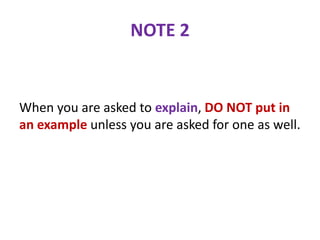
NOTE 2
When you are asked to explain, DO NOT put in
an example unless you are asked for one as well.
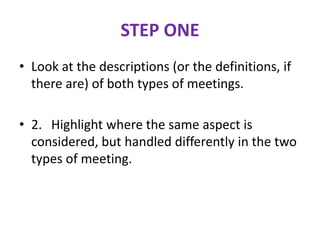
STEP ONE
• Look at the descriptions (or the definitions, if
there are) of both types of meetings.
• 2. Highlight where the same aspect is
considered, but handled differently in the two
types of meeting.
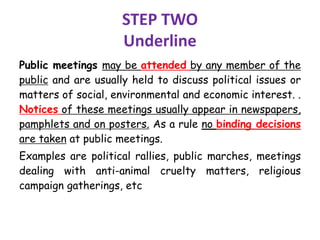
STEP TWO
Underline
Public meetings may be attended by any member of the
public and are usually held to discuss political issues or
matters of social, environmental and economic interest. .
Notices of these meetings usually appear in newspapers,
pamphlets and on posters. As a rule no binding decisions
are taken at public meetings.
Examples are political rallies, public marches, meetings
dealing with anti-animal cruelty matters, religious
campaign gatherings, etc
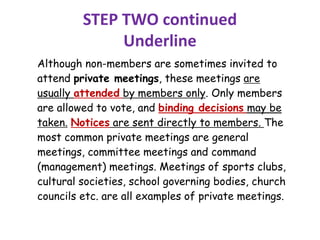
STEP TWO continued
Underline
Although non-members are sometimes invited to
attend private meetings, these meetings are
usually attended by members only. Only members
are allowed to vote, and binding decisions may be
taken. Notices are sent directly to members. The
most common private meetings are general
meetings, committee meetings and command
(management) meetings. Meetings of sports clubs,
cultural societies, school governing bodies, church
councils etc. are all examples of private meetings.
STEP THREE
Write down each underlined point for the public
meeting as a contrast to the same point under
the private meeting.
How to express the differences
Words like “but”, “however” and
“yet” indicate that a difference is
being pointed out.
ANSWER
• Public meetings may be attended
by any member of the public, but
private meetings are usually open
to members only.
[2]
ANSWER
• Notices of public meetings usually
appear in the media, but for
private meetings notices are sent
personally to members.
[2]
ANSWER
• Usually no binding decisions are
taken at public meetings.
However, at private meetings,
members may vote and binding
decisions can be taken.
[2]

N4 Communication & Management Communication - Module 6 Explain the difference

  • 1.
    In the examyou could be asked to explain what is meant by one thing and contrast it with something else. How do we explain the difference between things? Let us look at this example:
  • 2.
  • 3.
    Question Explain the differencebetween a private and public meeting.
  • 4.
    NOTE 1 Look atthe marks allocated. If 8 marks are given, then FOUR differences must be found; if 6 marks, then THREE differences; if 4 marks, then TWO differences.
  • 5.
    NOTE 2 When youare asked to explain, DO NOT put in an example unless you are asked for one as well.
  • 6.
    STEP ONE • Lookat the descriptions (or the definitions, if there are) of both types of meetings. • 2. Highlight where the same aspect is considered, but handled differently in the two types of meeting.
  • 7.
    STEP TWO Underline Public meetingsmay be attended by any member of the public and are usually held to discuss political issues or matters of social, environmental and economic interest. . Notices of these meetings usually appear in newspapers, pamphlets and on posters. As a rule no binding decisions are taken at public meetings. Examples are political rallies, public marches, meetings dealing with anti-animal cruelty matters, religious campaign gatherings, etc
  • 8.
    STEP TWO continued Underline Althoughnon-members are sometimes invited to attend private meetings, these meetings are usually attended by members only. Only members are allowed to vote, and binding decisions may be taken. Notices are sent directly to members. The most common private meetings are general meetings, committee meetings and command (management) meetings. Meetings of sports clubs, cultural societies, school governing bodies, church councils etc. are all examples of private meetings.
  • 9.
    STEP THREE Write downeach underlined point for the public meeting as a contrast to the same point under the private meeting.
  • 10.
    How to expressthe differences Words like “but”, “however” and “yet” indicate that a difference is being pointed out.
  • 11.
    ANSWER • Public meetingsmay be attended by any member of the public, but private meetings are usually open to members only. [2]
  • 12.
    ANSWER • Notices ofpublic meetings usually appear in the media, but for private meetings notices are sent personally to members. [2]
  • 13.
    ANSWER • Usually nobinding decisions are taken at public meetings. However, at private meetings, members may vote and binding decisions can be taken. [2]