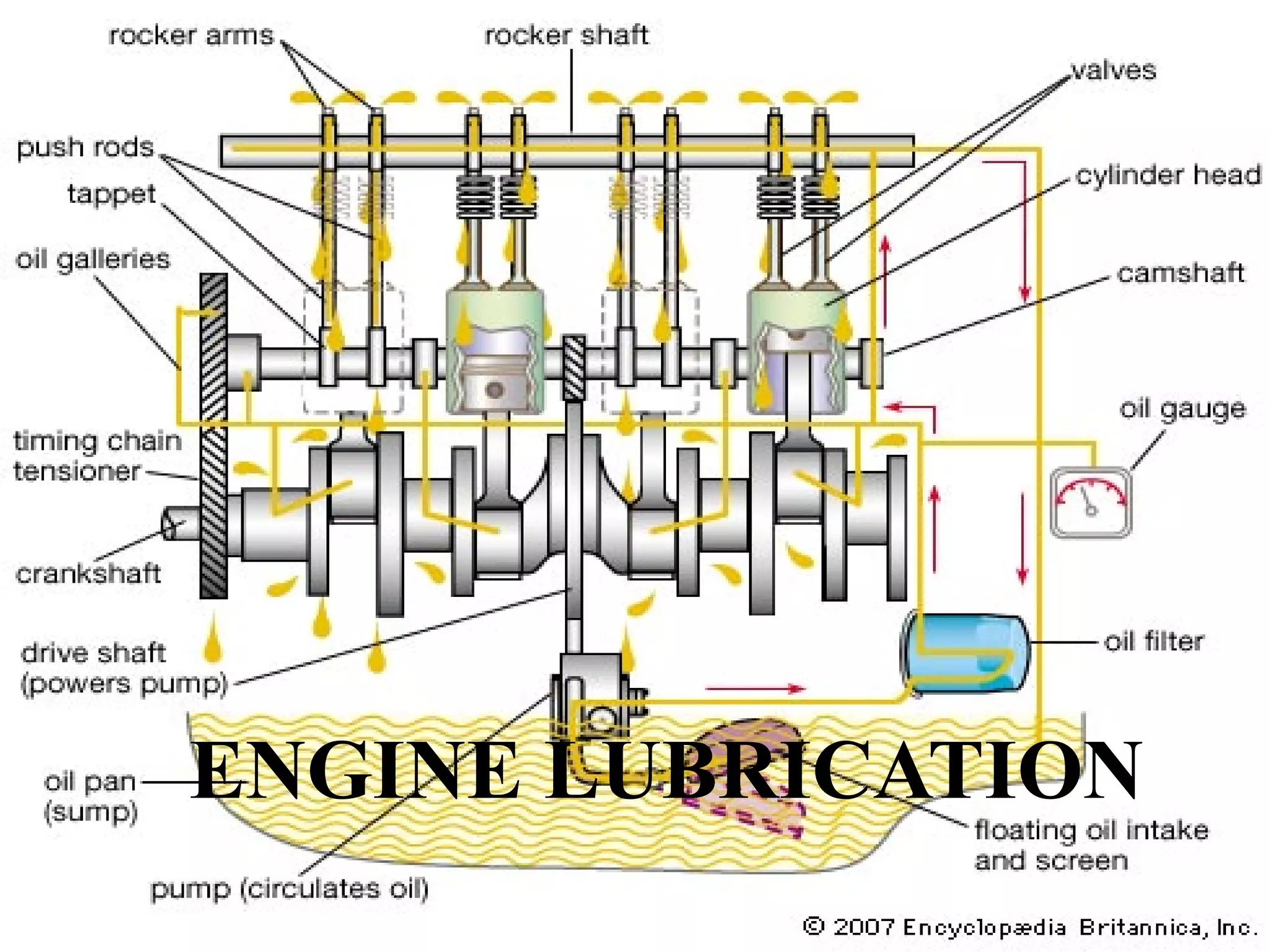
ENGINE LUBRICATION
Effects of Improper and Insufficient
               Lubrication

• Carelessness of the operator – time
• Poor construction of bearings – lack of maintenance
• Failure to provide adequate means of conducting
  lubricants to the bearings - level
       Therefore, lubrication is needed because of friction.
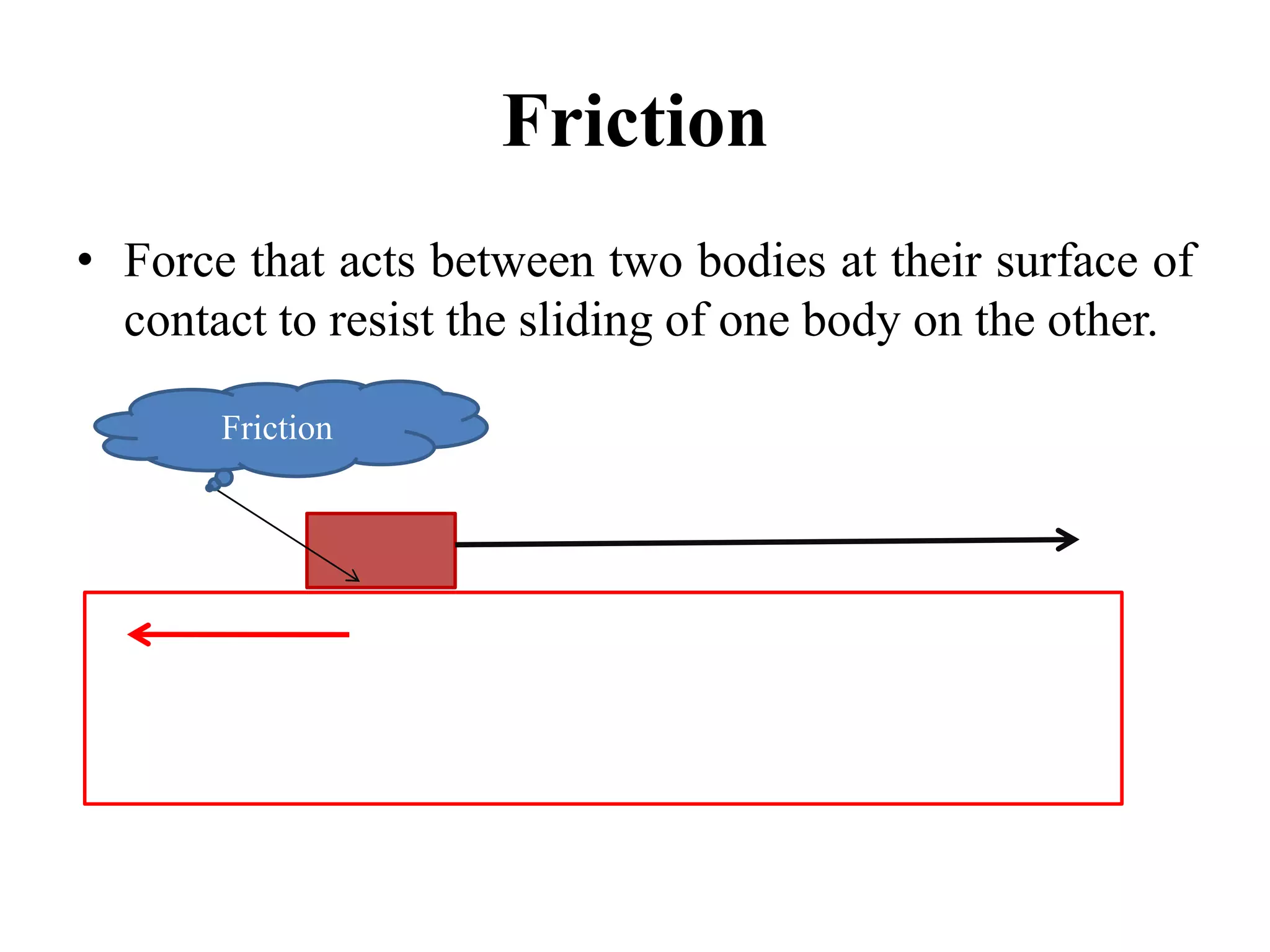
Friction
• Force that acts between two bodies at their surface of
  contact to resist the sliding of one body on the other.

       Friction
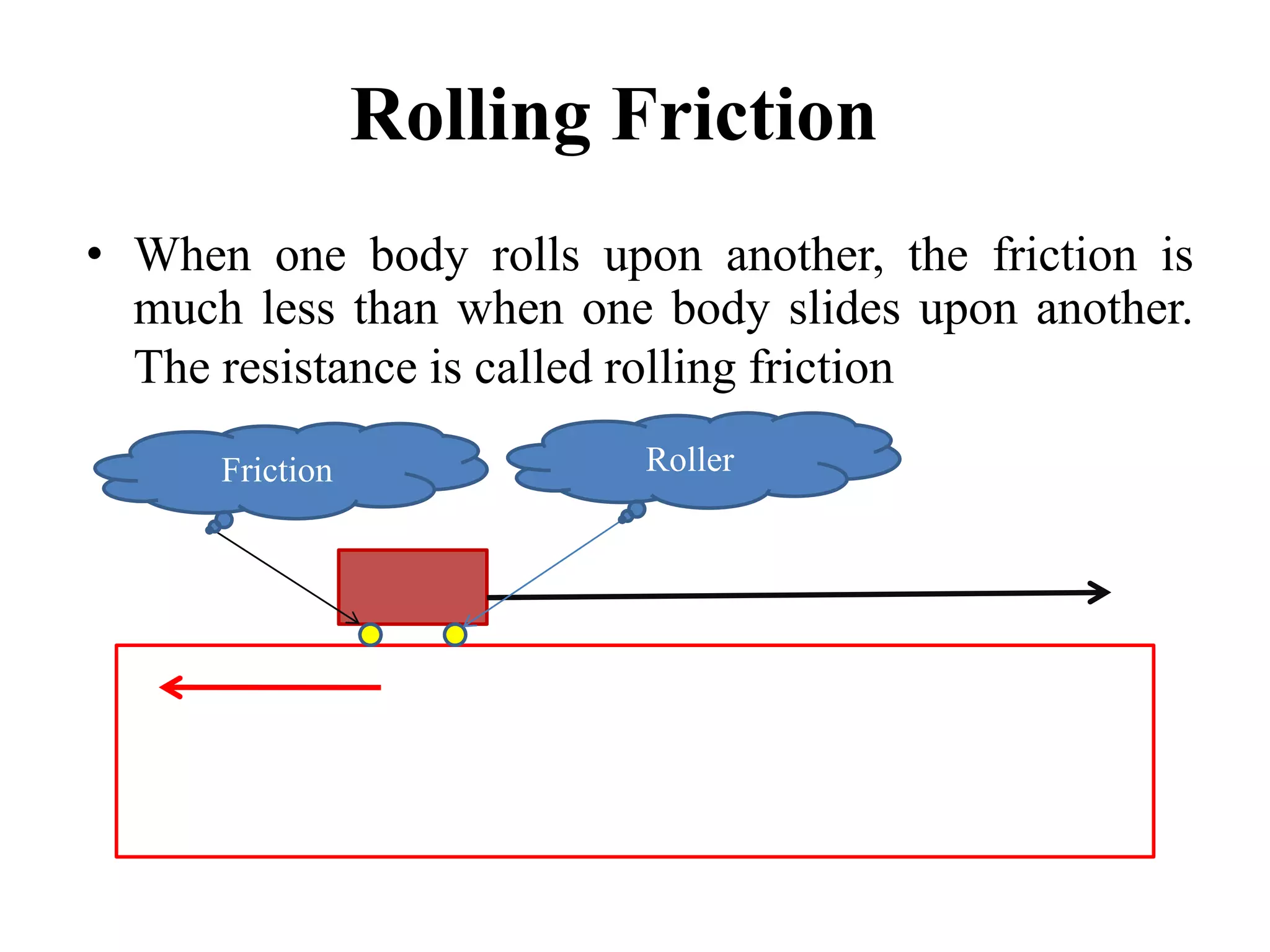
Rolling Friction
• When one body rolls upon another, the friction is
  much less than when one body slides upon another.
  The resistance is called rolling friction
      Friction           Roller
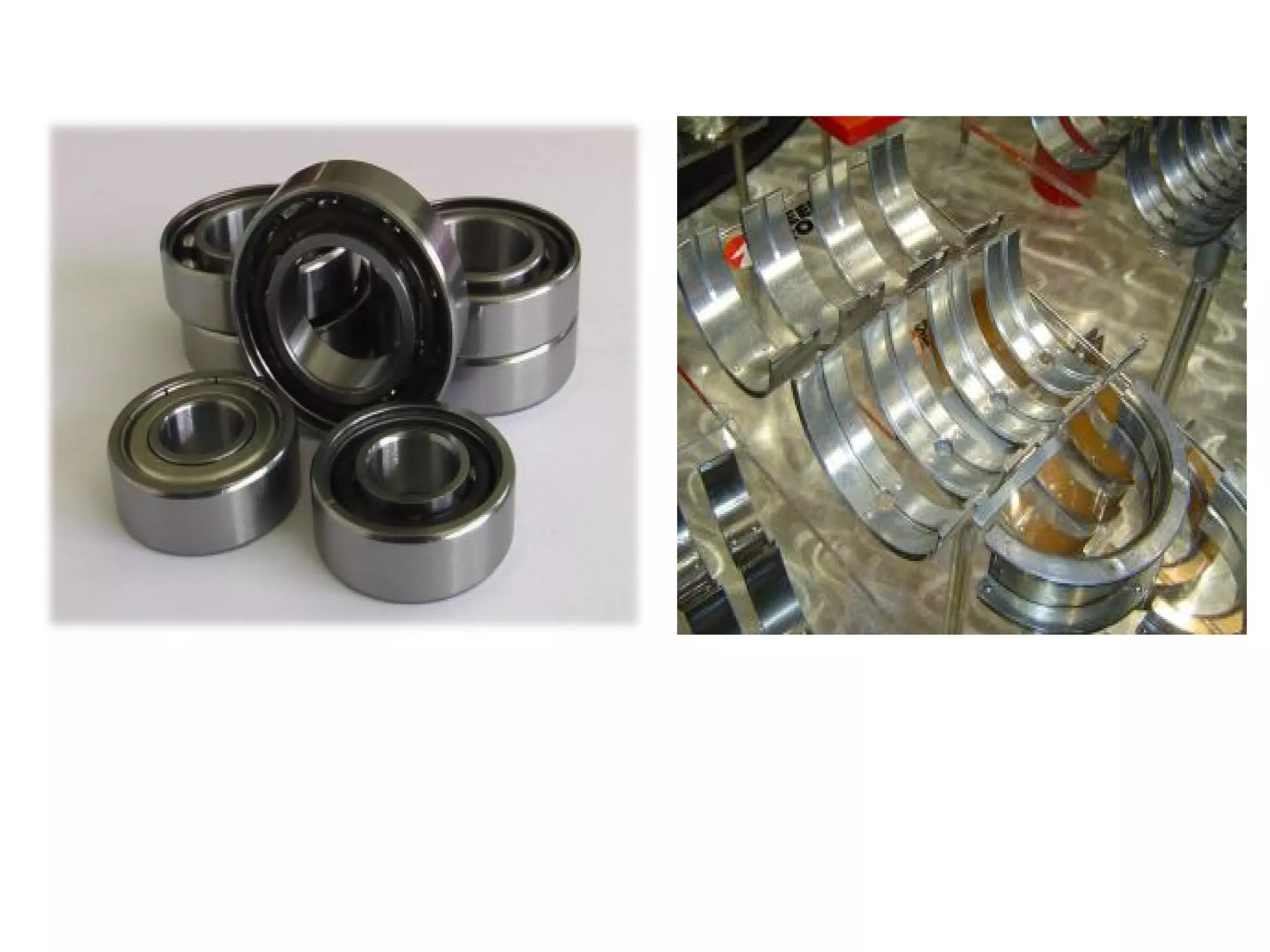
Anti friction bearing

• In the form of balls or rollers to diminish the amount
  of friction. Therefore increase the efficiency of
  machine
The Present Condition of Friction
•   Loss of horsepower – decrease 18%
•   Graduated loss of fuel economy
•   Frequent oil drains due to degradation
•   Component wear
•   Increased emissions
•   Rising maintenance cost
•   Rising labor cost
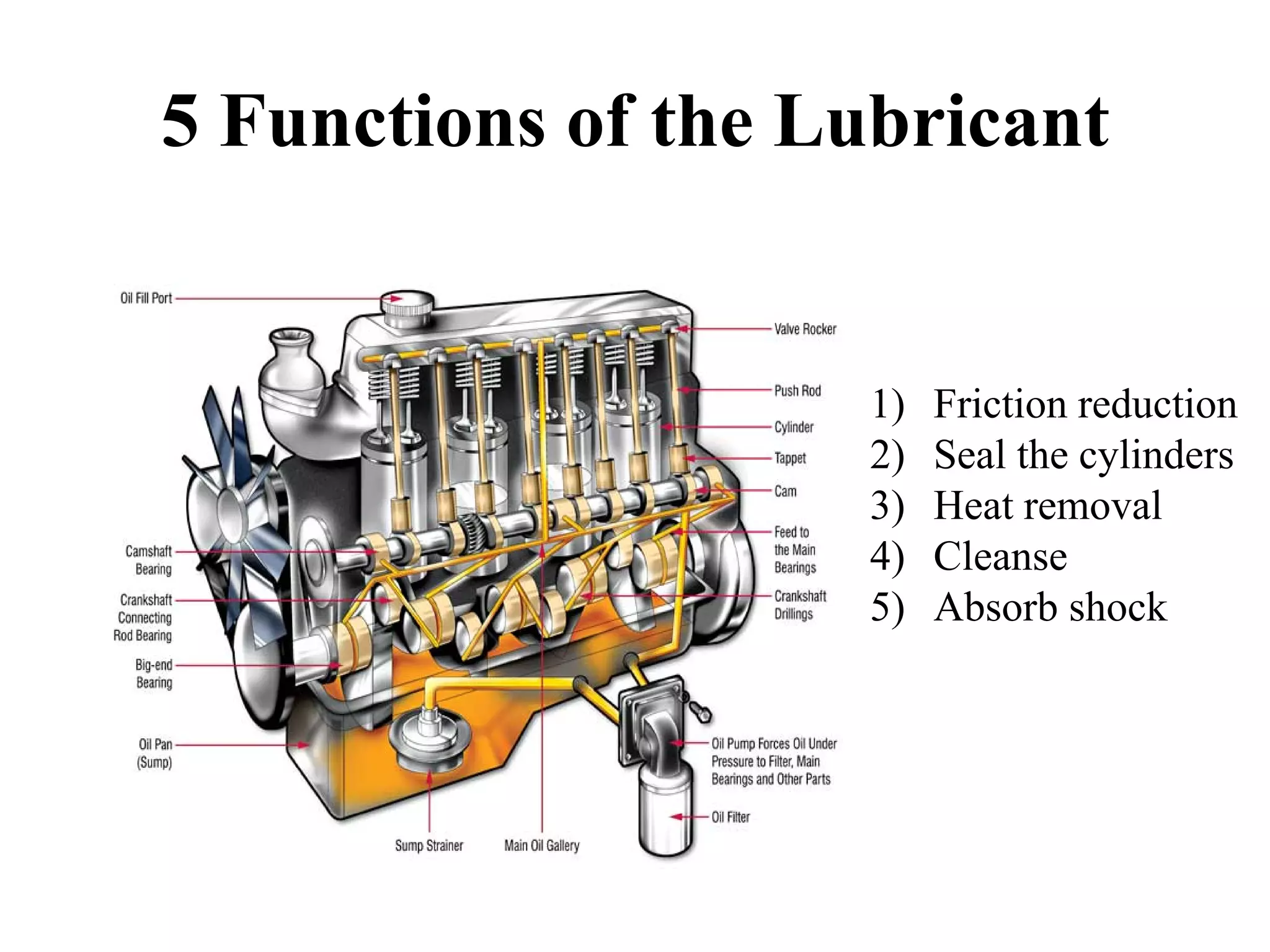
5 Functions of the Lubricant


                    1)   Friction reduction
                    2)   Seal the cylinders
                    3)   Heat removal
                    4)   Cleanse
                    5)   Absorb shock
Purpose of Lubrication
•   Helps the engine to run smoothly and last longer
•   Absorbs and dissipates heat
•   Helps in the cooling system
•   Prolongs engine life
3 basic types of engine lubricating system

a. Circulating Splash
b. Internal Force Feed and Splash
c. Full Internal Force Feed
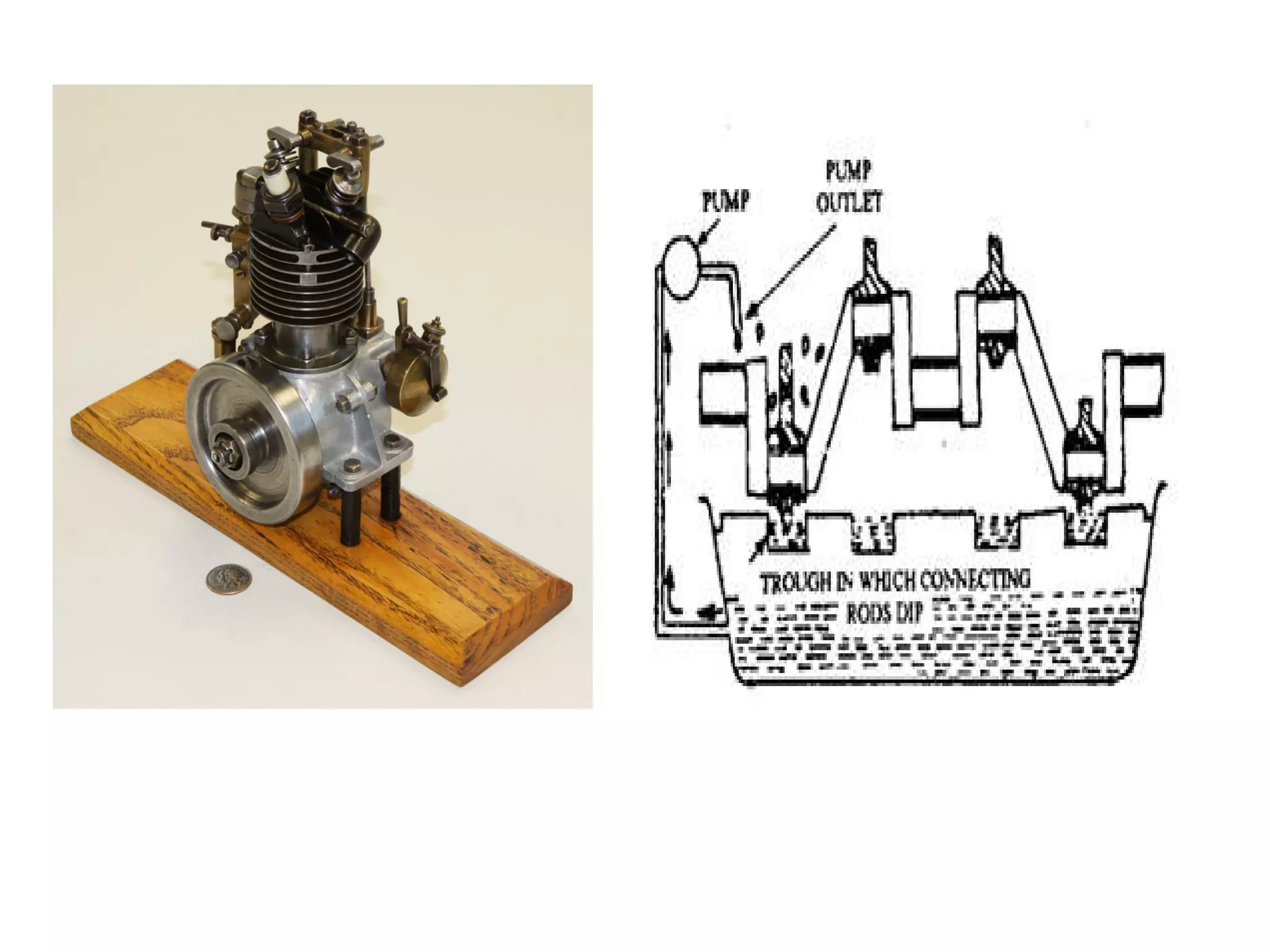
a) Circulating Splash System
Used in small single cylinder air cooled engine
  A pump supplies oil to a splash pan under the crankshaft

  As the connecting rod revolve, scoops on the end of rods
  dip into trough and oil is gravity fed through channels or
  lines

  The upper parts of cylinders, pistons and pins are lubricated
  more by oil mist taken by the oil splash. The mist is created
  by the rapid movement of the connecting rods
b) Internal Force Feed and Splash
– A pump forces oil directly to a main oil gallery in
  the engine block rather than to a splash pan

– From main oil gallery, the oil is force through
  passages to the main bearings, camshaft bearings,
  rocker arm shaft, filter and pressure sending unit

– The oil escaping from the bearings creates a mist
  that also lubricates the upper cylinder walls,
  pistons and pins
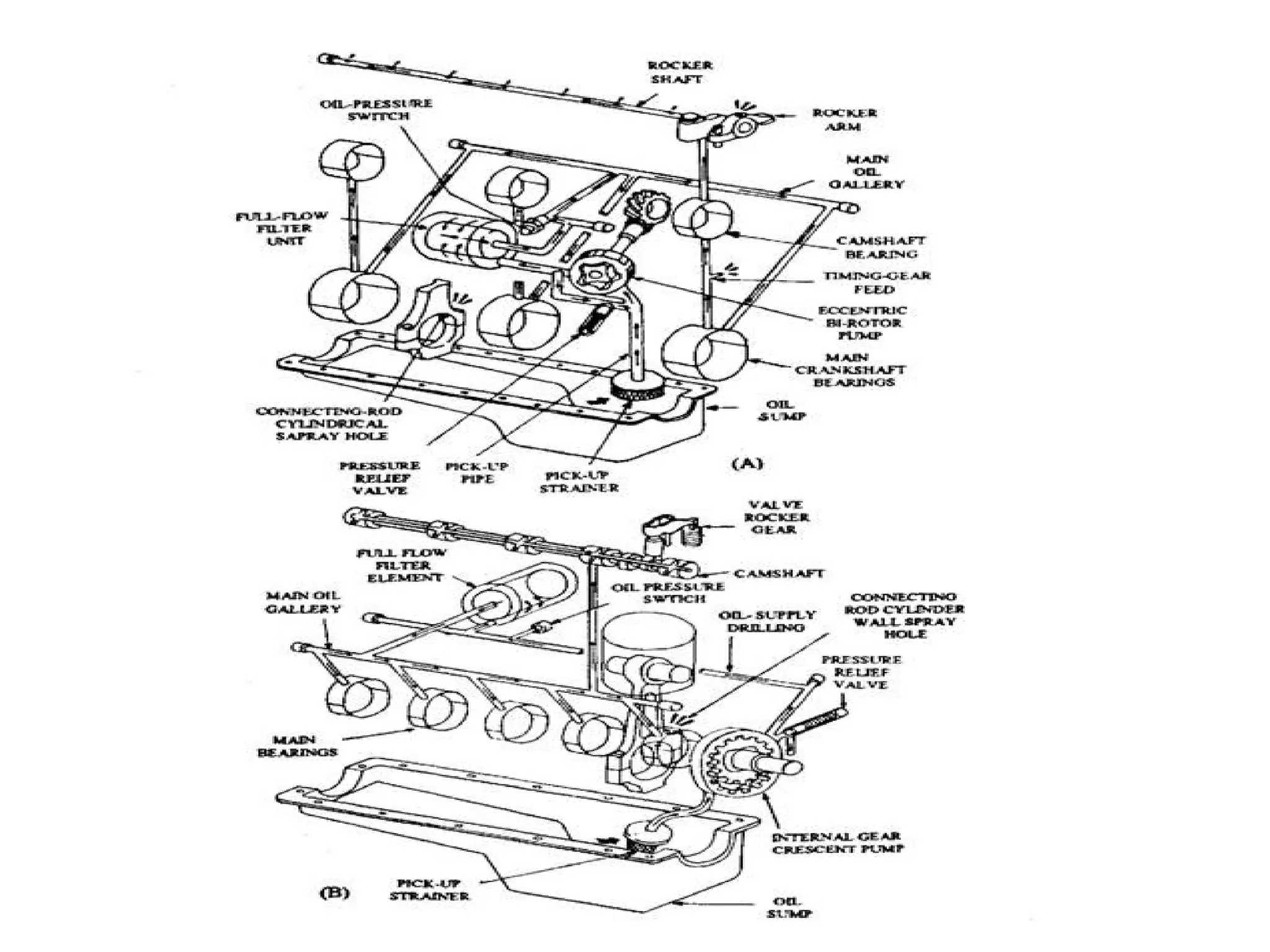
c) Full Internal Force Feed System
• Preferred in all modern diesel and petrol engines
• Pump usually in the form of gear pump
   – Oil is force not only to the crankshaft
   – bearings, rocker arm shaft, filter and pressure-sending unit,
     but also to the piston-pin bearing
   – Piston pin bearing are lubricated through drilled passages
     in the connecting rods. The cylinder walls and pistons are
     lubricated by
      i) oil escaping from piston-pin bearing
      ii) or the connecting rod bearings
      iii) or by oil sprayed by the underside of piston and cylinder wall
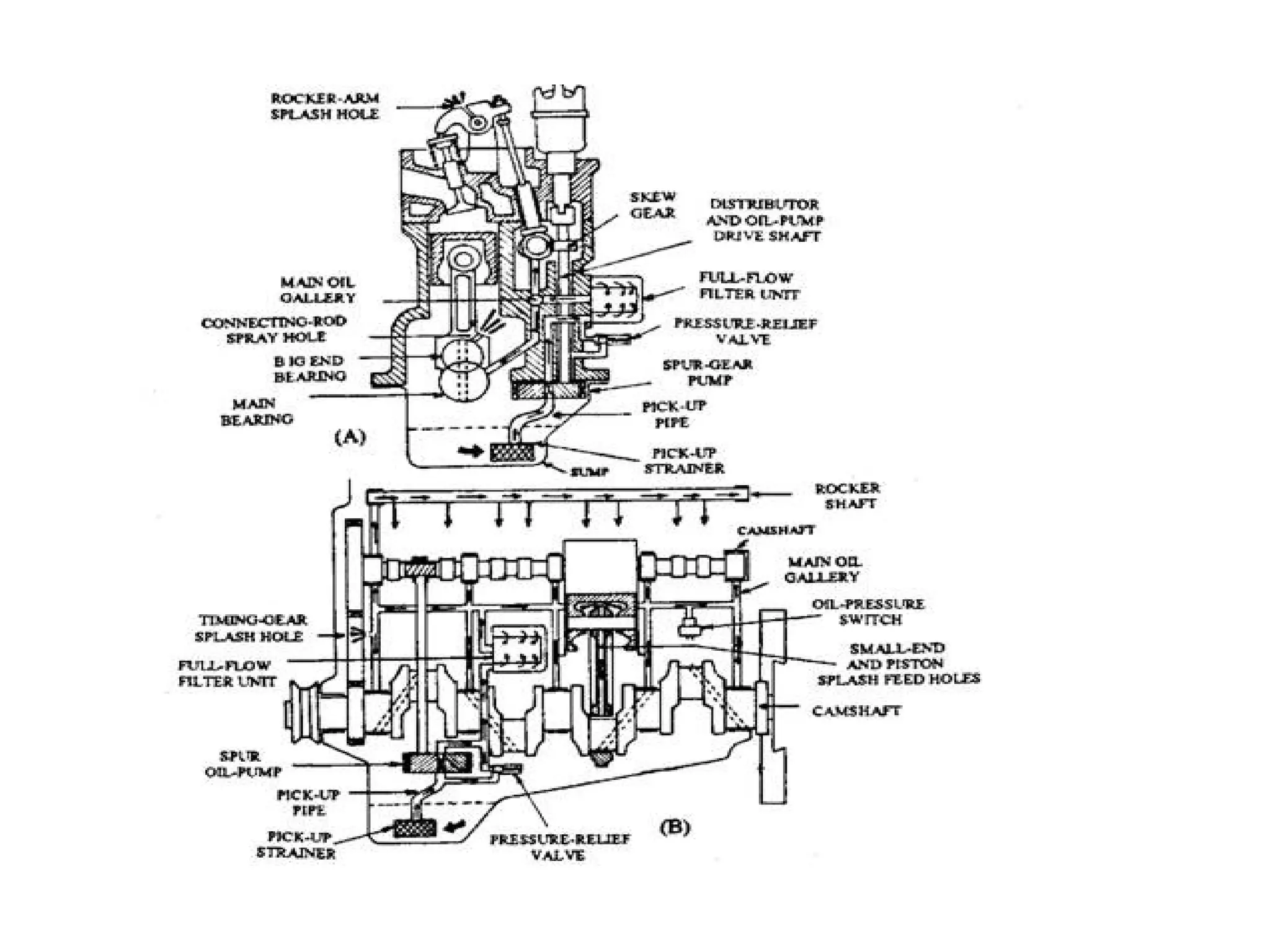
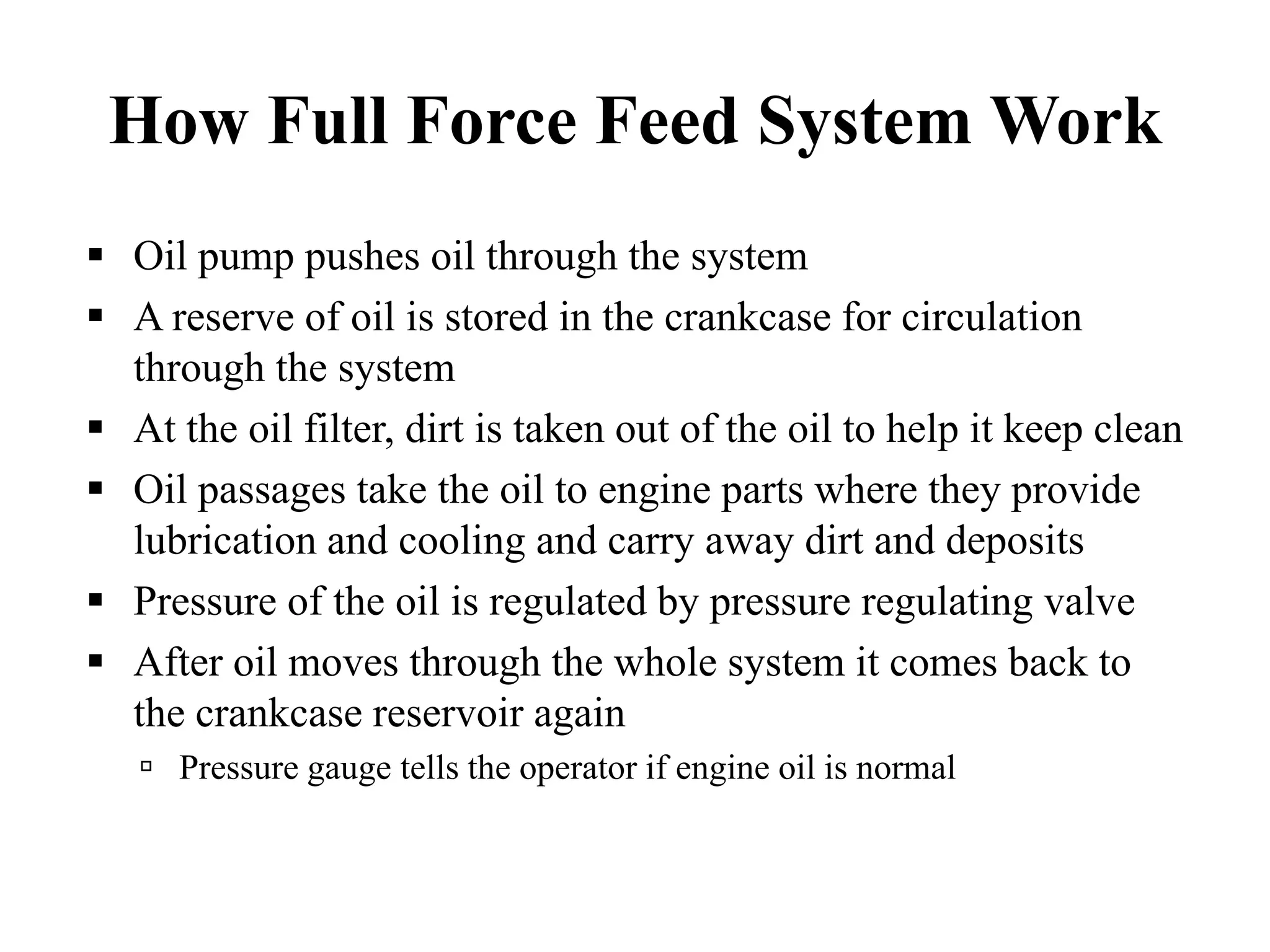
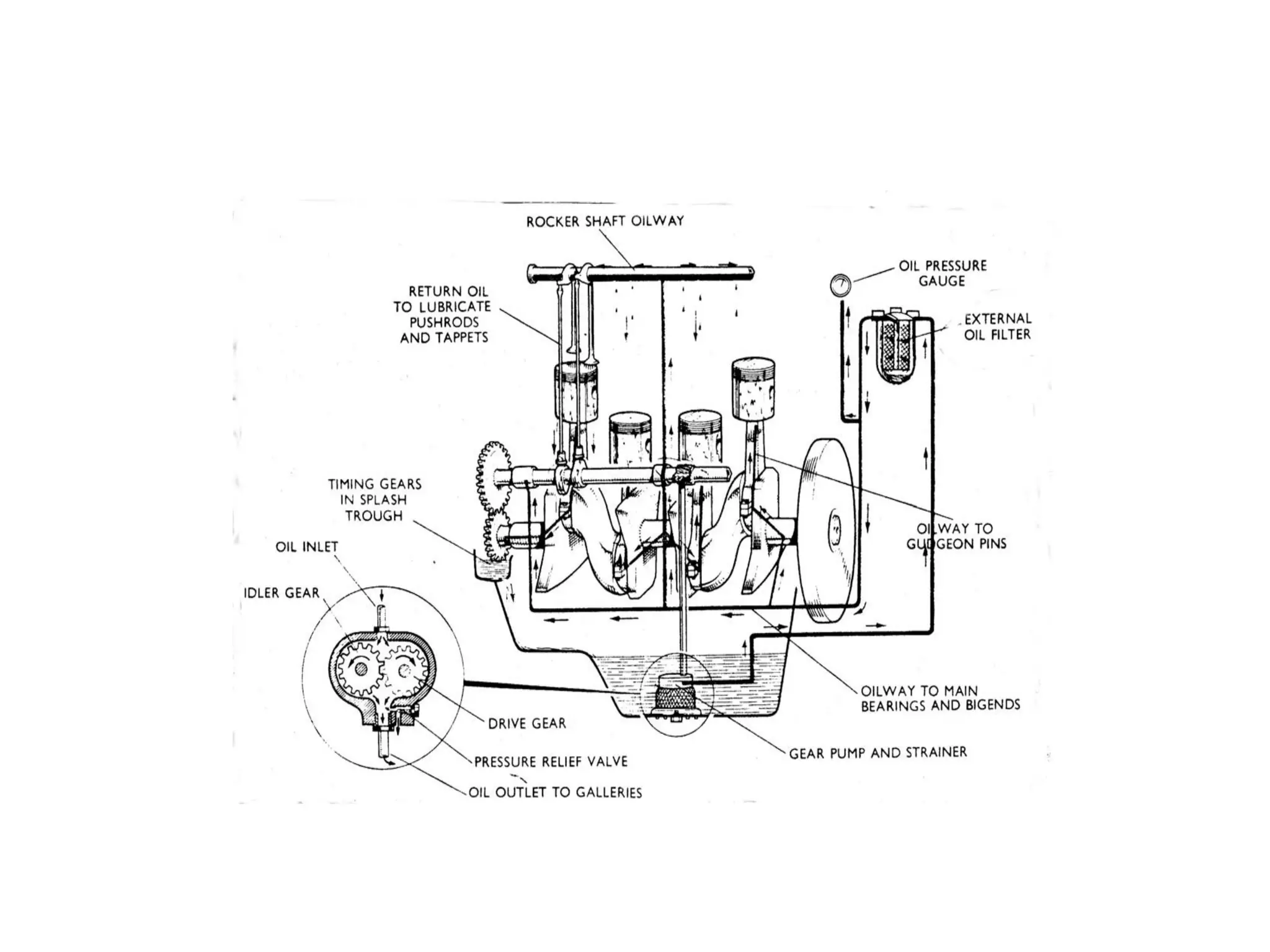
How Full Force Feed System Work
Oil pump pushes oil through the system
A reserve of oil is stored in the crankcase for circulation
through the system
At the oil filter, dirt is taken out of the oil to help it keep clean
Oil passages take the oil to engine parts where they provide
lubrication and cooling and carry away dirt and deposits
Pressure of the oil is regulated by pressure regulating valve
After oil moves through the whole system it comes back to
the crankcase reservoir again
   Pressure gauge tells the operator if engine oil is normal
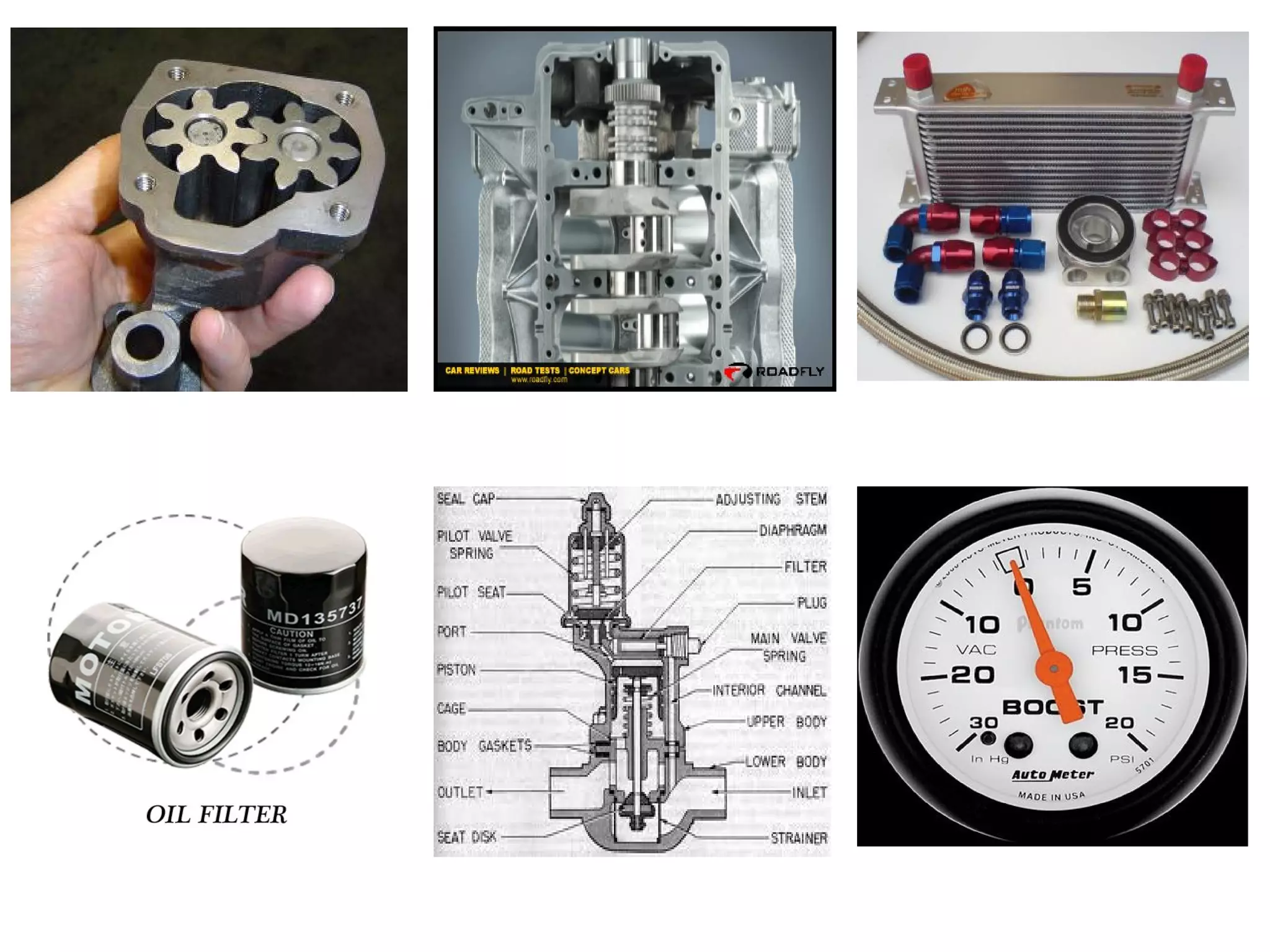
Major Parts of Lubrication System

   1.   Oil pump
   2.   Crankcase
   3.   Oil cooler (if any)
   4.   Oil filter
   5.   Pressure regulating valve
   6.   Pressure gauge
Criteria of Lubrication
1.   Keep a protective oil film on moving parts
2.   Resist high temperatures
3.   Resist corrosion and rusting
4.   Prevent ring sticking
5.   Prevent sludge formation
6.   Flow easily at low temperature
7.   Resist foaming
8.   Resist break down after prolong use
Petrol Lubrication
• Is common to small two stroke engines, consist of
  mixing a small quantity of oil with the petrol

• Ratio of oil to petrol vary from 16 parts petrol to 1
  part of oil for larger engine to 24:1 for smaller two
  stroke engines
Maintenance
1. Changing Engine Oil
    prolong using the oil will make the oil dirty and its
    additives wear out:-
     • acid formations
     • sludge
     • varnish
     • engine deposits
     • contaminated oil will make it unfit for continued use
       that will harm the vital engine parts
2. Follow the manufacturer’s recommendation on oil and filter
   changes
       e.g. 50 hours of working


3. When changing oil and filter on any engine, always warm up
   the engine first. This way the contaminants and foreign
   materials are mixed with the oil and drained out with it

4. After installing the filter and filling the engine with oil, run
   the engine and check for possible filter leaks

5. Keep a maintenance record of all oil and filter changes to be
   sure of regular engine service
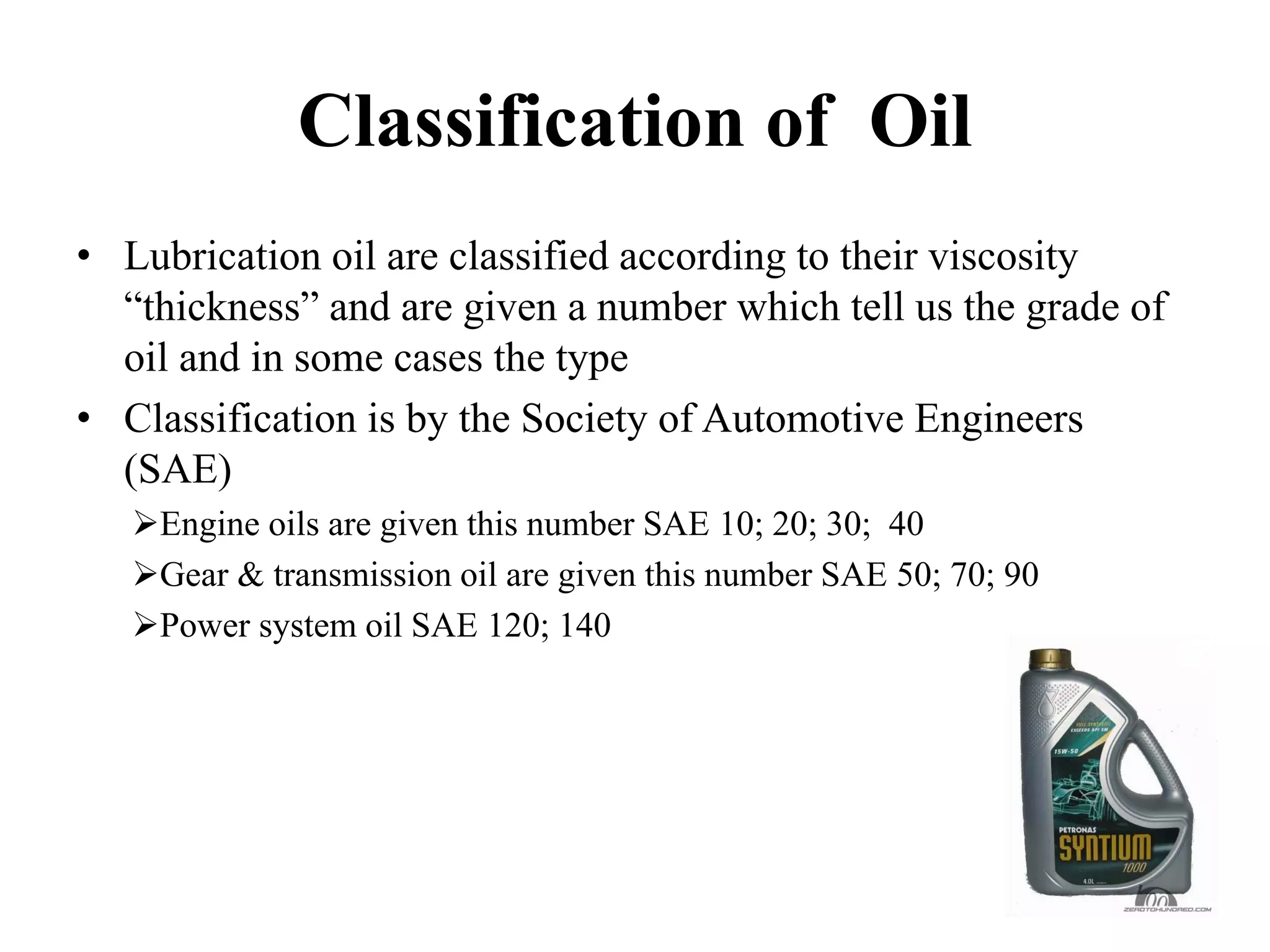
Classification of Oil
• Lubrication oil are classified according to their viscosity
  “thickness” and are given a number which tell us the grade of
  oil and in some cases the type
• Classification is by the Society of Automotive Engineers
  (SAE)
    Engine oils are given this number SAE 10; 20; 30; 40
    Gear & transmission oil are given this number SAE 50; 70; 90
    Power system oil SAE 120; 140
• The lower number indicate low viscosity oil suited to
  cold climates or engines with many stop and start
  continually, therefore never reaching proper working
  temperature.

• The higher numbers indicate high viscosity more
  suited to hot climates, or engines continually running
  in hot conditions.
Detergent Oil
• Oil that contains additives which prevent the
  formation of carbon and lacquer inside an engine.
• Used for lubrication of a diesel engine because when
  diesel fuel burns in the combustion chamber it
  produce sediments which stick to the working parts of
  the engine.
• This sediments collect on piston, piston rings and
  cylinder walls resulting in increased wear.
• The additives prevent this from happening by holding
  in suspension the sticky particles which would settle
  on the piston.
Multigrade Oil
• Oil have special additives which reverse the normal
  tendency of an oil to thicken when cold and thin out
  when hot .

• They are numbered SAE 10-30 or 20-50 and are
  called viscostatic or Universal Engine Oil more suited
  to petrol or propane engines.
Universal Oil
• These oil are produced to reduce the number of
  different types of oil needed to serve all types of
  tractor and implements, covering engines,
  transmission, hydraulic system, power steering, etc.

• These oil are of a multigrade in nature with suitable
  additives to combat engine contaminants, gearbox
  stresses, anti frothing for hydraulic system and power
  steering
THANK YOU

Agriculture Engineering-chptr 3

  • 1.
  • 2.
    Effects of Improperand Insufficient Lubrication • Carelessness of the operator – time • Poor construction of bearings – lack of maintenance • Failure to provide adequate means of conducting lubricants to the bearings - level Therefore, lubrication is needed because of friction.
  • 3.
    Friction • Force thatacts between two bodies at their surface of contact to resist the sliding of one body on the other. Friction
  • 4.
    Rolling Friction • Whenone body rolls upon another, the friction is much less than when one body slides upon another. The resistance is called rolling friction Friction Roller
  • 5.
    Anti friction bearing •In the form of balls or rollers to diminish the amount of friction. Therefore increase the efficiency of machine
  • 8.
    The Present Conditionof Friction • Loss of horsepower – decrease 18% • Graduated loss of fuel economy • Frequent oil drains due to degradation • Component wear • Increased emissions • Rising maintenance cost • Rising labor cost
  • 9.
    5 Functions ofthe Lubricant 1) Friction reduction 2) Seal the cylinders 3) Heat removal 4) Cleanse 5) Absorb shock
  • 10.
    Purpose of Lubrication • Helps the engine to run smoothly and last longer • Absorbs and dissipates heat • Helps in the cooling system • Prolongs engine life
  • 11.
    3 basic typesof engine lubricating system a. Circulating Splash b. Internal Force Feed and Splash c. Full Internal Force Feed
  • 12.
    a) Circulating SplashSystem Used in small single cylinder air cooled engine A pump supplies oil to a splash pan under the crankshaft As the connecting rod revolve, scoops on the end of rods dip into trough and oil is gravity fed through channels or lines The upper parts of cylinders, pistons and pins are lubricated more by oil mist taken by the oil splash. The mist is created by the rapid movement of the connecting rods
  • 14.
    b) Internal ForceFeed and Splash – A pump forces oil directly to a main oil gallery in the engine block rather than to a splash pan – From main oil gallery, the oil is force through passages to the main bearings, camshaft bearings, rocker arm shaft, filter and pressure sending unit – The oil escaping from the bearings creates a mist that also lubricates the upper cylinder walls, pistons and pins
  • 15.
    c) Full InternalForce Feed System • Preferred in all modern diesel and petrol engines • Pump usually in the form of gear pump – Oil is force not only to the crankshaft – bearings, rocker arm shaft, filter and pressure-sending unit, but also to the piston-pin bearing – Piston pin bearing are lubricated through drilled passages in the connecting rods. The cylinder walls and pistons are lubricated by i) oil escaping from piston-pin bearing ii) or the connecting rod bearings iii) or by oil sprayed by the underside of piston and cylinder wall
  • 18.
    How Full ForceFeed System Work Oil pump pushes oil through the system A reserve of oil is stored in the crankcase for circulation through the system At the oil filter, dirt is taken out of the oil to help it keep clean Oil passages take the oil to engine parts where they provide lubrication and cooling and carry away dirt and deposits Pressure of the oil is regulated by pressure regulating valve After oil moves through the whole system it comes back to the crankcase reservoir again Pressure gauge tells the operator if engine oil is normal
  • 20.
    Major Parts ofLubrication System 1. Oil pump 2. Crankcase 3. Oil cooler (if any) 4. Oil filter 5. Pressure regulating valve 6. Pressure gauge
  • 22.
    Criteria of Lubrication 1. Keep a protective oil film on moving parts 2. Resist high temperatures 3. Resist corrosion and rusting 4. Prevent ring sticking 5. Prevent sludge formation 6. Flow easily at low temperature 7. Resist foaming 8. Resist break down after prolong use
  • 23.
    Petrol Lubrication • Iscommon to small two stroke engines, consist of mixing a small quantity of oil with the petrol • Ratio of oil to petrol vary from 16 parts petrol to 1 part of oil for larger engine to 24:1 for smaller two stroke engines
  • 24.
    Maintenance 1. Changing EngineOil prolong using the oil will make the oil dirty and its additives wear out:- • acid formations • sludge • varnish • engine deposits • contaminated oil will make it unfit for continued use that will harm the vital engine parts
  • 25.
    2. Follow themanufacturer’s recommendation on oil and filter changes e.g. 50 hours of working 3. When changing oil and filter on any engine, always warm up the engine first. This way the contaminants and foreign materials are mixed with the oil and drained out with it 4. After installing the filter and filling the engine with oil, run the engine and check for possible filter leaks 5. Keep a maintenance record of all oil and filter changes to be sure of regular engine service
  • 26.
    Classification of Oil •Lubrication oil are classified according to their viscosity “thickness” and are given a number which tell us the grade of oil and in some cases the type • Classification is by the Society of Automotive Engineers (SAE) Engine oils are given this number SAE 10; 20; 30; 40 Gear & transmission oil are given this number SAE 50; 70; 90 Power system oil SAE 120; 140
  • 27.
    • The lowernumber indicate low viscosity oil suited to cold climates or engines with many stop and start continually, therefore never reaching proper working temperature. • The higher numbers indicate high viscosity more suited to hot climates, or engines continually running in hot conditions.
  • 28.
    Detergent Oil • Oilthat contains additives which prevent the formation of carbon and lacquer inside an engine. • Used for lubrication of a diesel engine because when diesel fuel burns in the combustion chamber it produce sediments which stick to the working parts of the engine. • This sediments collect on piston, piston rings and cylinder walls resulting in increased wear. • The additives prevent this from happening by holding in suspension the sticky particles which would settle on the piston.
  • 29.
    Multigrade Oil • Oilhave special additives which reverse the normal tendency of an oil to thicken when cold and thin out when hot . • They are numbered SAE 10-30 or 20-50 and are called viscostatic or Universal Engine Oil more suited to petrol or propane engines.
  • 30.
    Universal Oil • Theseoil are produced to reduce the number of different types of oil needed to serve all types of tractor and implements, covering engines, transmission, hydraulic system, power steering, etc. • These oil are of a multigrade in nature with suitable additives to combat engine contaminants, gearbox stresses, anti frothing for hydraulic system and power steering
  • 31.