Why changes take place

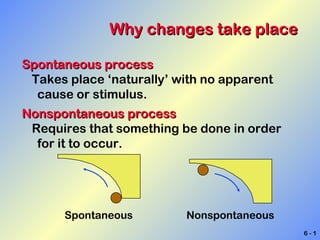
Spontaneous process
 Takes place ‘naturally’ with no apparent
  cause or stimulus.
Nonspontaneous process
 Requires that something be done in order
  for it to occur.


      Spontaneous         Nonspontaneous
                                            6-1
When will a reaction
                     be spontaneous?

Spontaneity of a reaction can be determined
 by a study of thermodynamics.

 Thermodynamics can be used to calculate
 the amount of useful work that is produced
 by some chemical reactions.

 The two factors that determine spontaneity
 are enthalpy and entropy.
                  entropy


                                              6-2
Energy

Energy - the ability to do work.

Work - when a force is applied to an object.

There are several types of energy:
• Thermal - heat
• Electrical
• Radiant - including light
• Chemical
• Mechanical - like sound
• Nuclear
                                               6-3
Energy

Energy can be classified as:

 Potential energy
 Stored energy - ability to do work.

 Kinetic energy
 Energy of motion - actually doing work.

 Energy can be transferred from one object
 to another. It can also change form.

                                                6-4
Kinetic vs. potential energy


Potential
Potential
 Energy
 Energy


                                  6-5
Converting potential
   to kinetic energy
Kinetic vs. potential energy


Kinetic
Energy


                                    6-7
Energy and
                         chemical bonds
During a chemical reaction
  • Old bonds break.
  • New bonds are formed.
  • Energy is either absorbed or released.
 Exothermic    Energy is released.
                           New bonds are
                     more stable.

 Endothermic Energy is required.
                      New bonds are less
              stable.                        6-8
Exothermic

             Reactants
Energy


                            Products


         Since excess energy is released,
         the products are more stable.
                                            6-9
Endothermic


                         Products
Energy


         Reactants


   Additional energy is required
   because the products are less stable.
                                           6 - 10
Entropy

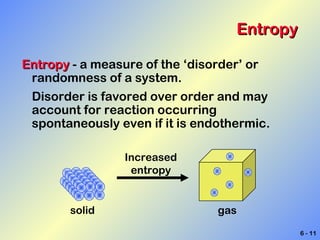
Entropy - a measure of the ‘disorder’ or
 randomness of a system.
 Disorder is favored over order and may
 account for reaction occurring
 spontaneously even if it is endothermic.

                 Increased
                  entropy


        solid                    gas

                                              6 - 11
Rate of change

Not all spontaneous changes take place in a
 useful time period.
 Some may require some initial energy to get
 them started.
                         spark
        2H2 (g) + O2 (g)       2H2O (l)
 Others can be made faster by adding a
 catalyst.
                  I-
        2H2O2 (l)      2H2O (l) + O2 (g)
Kinetics - the study of the rate of a reaction.
                                                  6 - 12
Temperature, energy and heat
Temperature. An intensive property of a
 material.

Thermal energy. Energy of motion of
 molecules, atoms or ions. All materials
 have this energy if at a temperature above
 0 K.

Heat. Thermal energy transfer that results
 from a difference in temperature. Thermal
 energy flows from warm objects to cool
 ones.
                                              6 - 13
Law of conservation of energy

“Energy cannot be created or destroyed in a
  chemical reaction.”
 During a reaction, energy can change from
 one form to another.
Example. Combustion of natural gas.
 Chemical bonds can be viewed as potential
 energy. So during the reaction:
 2CH4 (g) + 3O2 (g)   2CO2 (g) + 2H2O (l) + thermal energy + light

 some potential energy is converted to
 thermal energy and light.
                                                                     6 - 14

Ch 7 thermodynamics

  • 1.
    Why changes takeplace Spontaneous process Takes place ‘naturally’ with no apparent cause or stimulus. Nonspontaneous process Requires that something be done in order for it to occur. Spontaneous Nonspontaneous 6-1
  • 2.
    When will areaction be spontaneous? Spontaneity of a reaction can be determined by a study of thermodynamics. Thermodynamics can be used to calculate the amount of useful work that is produced by some chemical reactions. The two factors that determine spontaneity are enthalpy and entropy. entropy 6-2
  • 3.
    Energy Energy - theability to do work. Work - when a force is applied to an object. There are several types of energy: • Thermal - heat • Electrical • Radiant - including light • Chemical • Mechanical - like sound • Nuclear 6-3
  • 4.
    Energy Energy can beclassified as: Potential energy Stored energy - ability to do work. Kinetic energy Energy of motion - actually doing work. Energy can be transferred from one object to another. It can also change form. 6-4
  • 5.
    Kinetic vs. potentialenergy Potential Potential Energy Energy 6-5
  • 6.
    Converting potential to kinetic energy
  • 7.
    Kinetic vs. potentialenergy Kinetic Energy 6-7
  • 8.
    Energy and chemical bonds During a chemical reaction • Old bonds break. • New bonds are formed. • Energy is either absorbed or released. Exothermic Energy is released. New bonds are more stable. Endothermic Energy is required. New bonds are less stable. 6-8
  • 9.
    Exothermic Reactants Energy Products Since excess energy is released, the products are more stable. 6-9
  • 10.
    Endothermic Products Energy Reactants Additional energy is required because the products are less stable. 6 - 10
  • 11.
    Entropy Entropy - ameasure of the ‘disorder’ or randomness of a system. Disorder is favored over order and may account for reaction occurring spontaneously even if it is endothermic. Increased entropy solid gas 6 - 11
  • 12.
    Rate of change Notall spontaneous changes take place in a useful time period. Some may require some initial energy to get them started. spark 2H2 (g) + O2 (g) 2H2O (l) Others can be made faster by adding a catalyst. I- 2H2O2 (l) 2H2O (l) + O2 (g) Kinetics - the study of the rate of a reaction. 6 - 12
  • 13.
    Temperature, energy andheat Temperature. An intensive property of a material. Thermal energy. Energy of motion of molecules, atoms or ions. All materials have this energy if at a temperature above 0 K. Heat. Thermal energy transfer that results from a difference in temperature. Thermal energy flows from warm objects to cool ones. 6 - 13
  • 14.
    Law of conservationof energy “Energy cannot be created or destroyed in a chemical reaction.” During a reaction, energy can change from one form to another. Example. Combustion of natural gas. Chemical bonds can be viewed as potential energy. So during the reaction: 2CH4 (g) + 3O2 (g) 2CO2 (g) + 2H2O (l) + thermal energy + light some potential energy is converted to thermal energy and light. 6 - 14